patent · US4376097
Hydrogen generator for motor vehicle
8 March 1983
Page 1 — bibliographic record
United States Patent (19) 11) 4,376,097 Emelock 45) Mar. 8, 1983
54) HYDROGEN GENERATOR FOR MOTOR 56) References (Cited VEHICLE U.S. PATENT DOCUMENTS
1,363,488 12/1920 Uhlinger ............................. 423/650 76 Inventor: Melvin Emelock, 1748 N.W. 72nd 1,790,635 1/1931 Arendt ......... ... 290/17 Ave., Plantation, Fla. 33313 1,970,634 8/1934 Steinmayer .. ... 337/239 3,107,304 10/1963 Fagel ..................................... 290/17 3,313,598 4/1967 Gluckstein .......................... 423/648 (21) Appl. No.: 238,934 3,517,766 6/1970 West ............. ... 290/16 X 3,719,749 3/1973 Smith et al. ......................... 423/650 4,018, 190 4/1977 Henault .... ... 123/DIG. 12
Primary Examiner-Richard L. Chiesa
Attorney, Agent, or Firm-Joseph Zallen 51 Int. Cl. ............ ............................. B01J 19/24 57 ABSTRACT (52) U.S. Cl. ........................................ 422/189; 48/61; Oxalic acid, dispersed in glycerol is heated to form
422/193; 422/195; 422/199; 423/650; 429/17; formic acid which is then heated at a higher tempera 562/597 ture to form hydrogen. By-product carbon dioxide is 58 Field of Search ............... 422/188, 189, 191, 193, absorbed. The hydrogen is used directly with a fuel cell 422/195, 198, 199; 320/61; 48/61, 197 R, 197 to produce electricity or as fuel for an internal combus A; 423/648 R, 650; 323/371; 429/17; 123/1 A, tion engine.
276,562/597; 180/65 R, 65 B, 65 C 12 Claims, 2 Drawing Figures
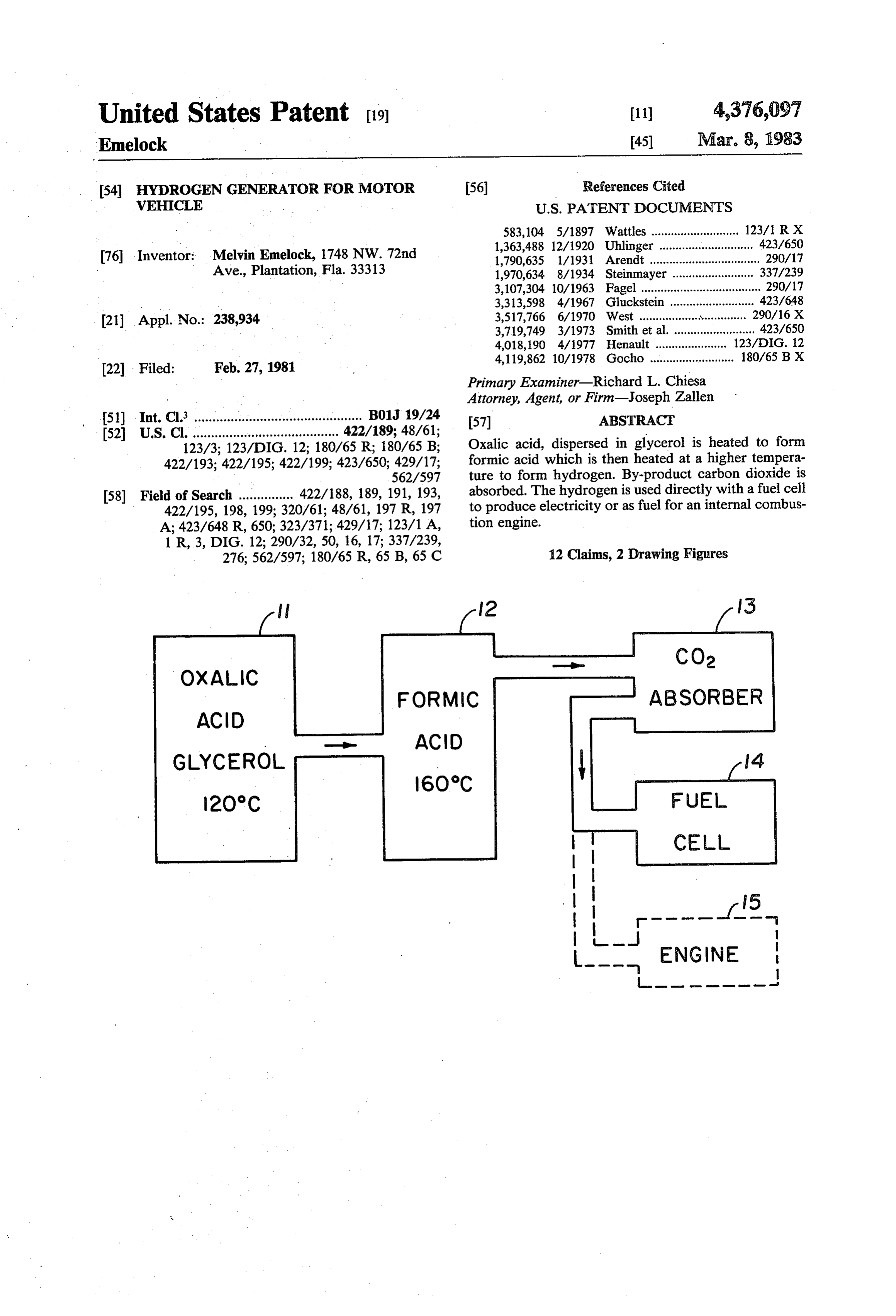
OXALIC
ACD
ACD
GLYCEROL
L.-- ENGINE
Page 2
Drawing sheet — no readable text.
Page 3
where at a temperature of 160 C, the hydrogen is
HYDROGEN GENERATOR FOR MOTOR formed. The first reaction chamber preferably has a VEHICLE heat-resistant gas permeable membrane so that the gases can escape without affecting the recirculation of the
BACKGROUND OF INVENTION 5 glycerol solution. The carbon dioxide is preferably sep This invention relates to hydrogen generators. In arated from the hydrogen by absorption as for example, particular it relates to hydrogen generators which are in a chamber of calcium hydroxide solution to form a such size and weight as to be suitable for use in motor precipate of calcium carbonate.
vehicles and the like. The fuel cell that is preferred for use with this inven As early as 1897 it was proposed to generate hydro O tion is one where the hydrogen does not have to be pure gen as a fuel for an engine by reacting zinc or iron with and where air could be used instead of pure oxygen. sulphuric acid (U.S. Pat. No. 583,104). It has also been Carbon electrodes can be used because of the durability hitherto proposed to have an electric motor vehicle and a platinum type catalyst can be used to catalyze the wherein an internal combustion engine drives a genera reaction.
tor which in turn maintains the charge on the batteries 15 Heating of the reaction chambers can be done by the for the electric motor vehicle (U.S. Pat. Nos. 1,970,634, use of thermostatically-controlled electrical heating 1,790,635, 3,517,766 and 4,119,862.) An electric vehicle units within the walls of the reaction chambers. Alter has also been described in which an internal combustion nately where an internal combustion engine is used the drives an electric generator which in turn directly heat from the exhaust of the engine can be used to ac
drives electric motors (U.S. Pat. No. 3,107,304). It has complish the chemical reactions. A vacuum pump is also been proposed to provide an internal combustion preferred to insure the removal of the gases from the engine incorporated with a hydrogen generator second reaction chamber.
wherein alcohol such as methanol is decomposed at a temperature of 200 to 400° C. in the presence of a anAelectric preferred use of the invention is in connection with catalyst such as zinc oxide-copper oxide. For a variety 25 oxalic acid vehicle fuel powered by storage batteries. The provides the energy for additional re of reasons none of the prior art hydrogen generators are charging of the batteries and thus can be operated on a commercially feasible for motor vehicles.
One object of the present invention is to provide a steady basis on a vehicle.
The construction of the device is illustrated schemati novel hydrogen generator which is feasible for use in a cally. It is well within the scope of the chemical engi
Other objects and advantages of this invention will be neering art of today to select the appropriate materials, apparent from the description and claims which follow sizes and shapes of the materials of construction, sizes, arrangement and shapes of the various chambers and taken together with the appended drawings. other components of the invention. SUMMARY OF INVENTION 35 BRIEF DESCRIPTION OF DRAWINGS
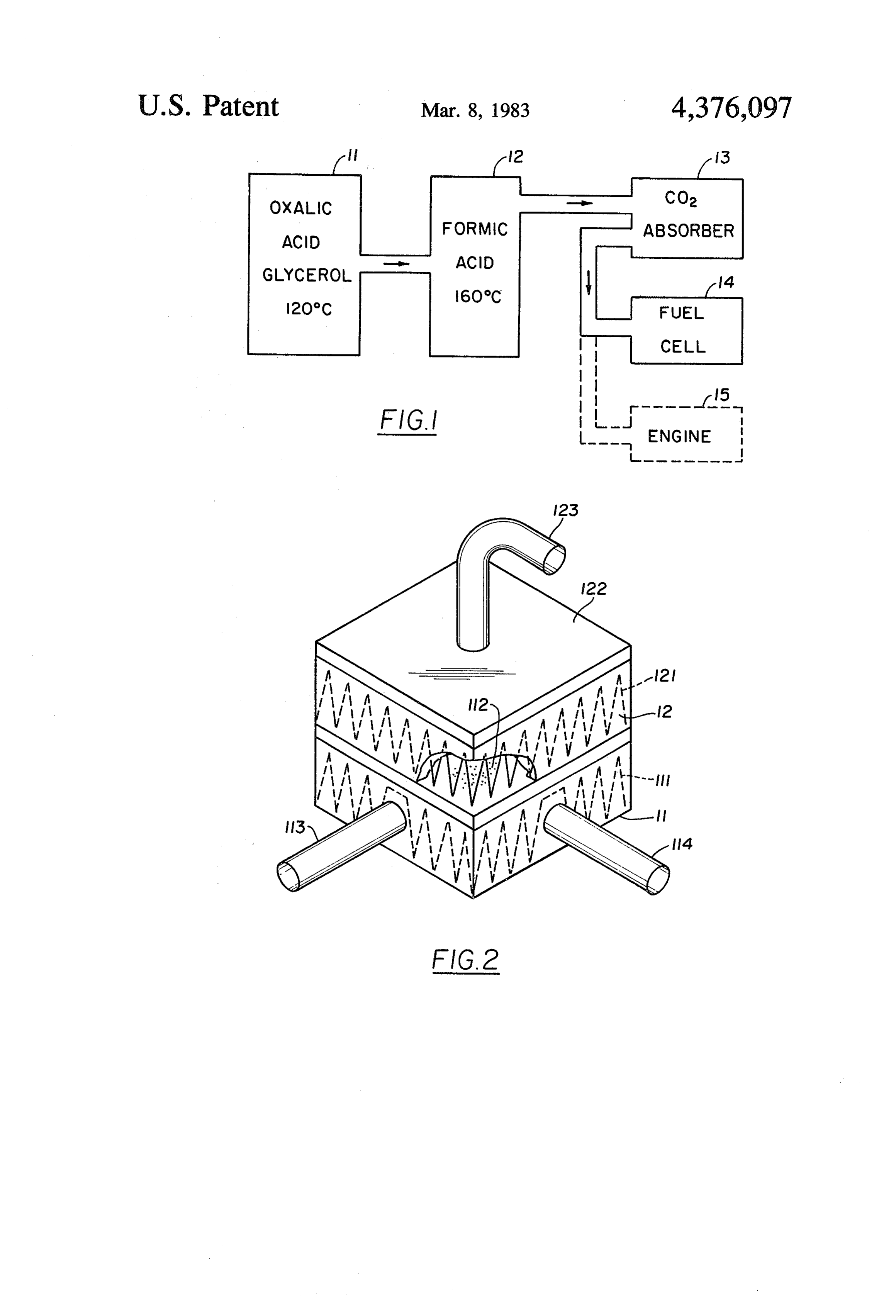
The hydrogen generator of the present invention utilizes a solid fuel, namely oxalic acid. The oxalic acid FIG. 1 is a schematic diagram of the invention. preferably in a liquid medium such as glycerol, is heated torFIG. 2 is a schematic diagram of a hydrogen genera made in accordance with this invention.
to form formic acid gas which in turn is heated to form hydrogen. SPECIFIC EXAMPLES OF INVENTION The reaction of heating oxalic acid forms carbon Referring to the drawings, the oxalic acid dispersed dioxide as a by-product and the heating of the formic acid gas also forms carbon dioxide as a by-product. in glycerol heated to 120° C. yields formic acid and Accordingly, one feature of this invention is to separate carbon dioxide. The formic acid which is gaseous in the carbon dioxide gas from the hydrogen gas as for 45 form when now heated to 160 C. forms hydrogen gas example, by absorption in an alkaline solution such as and carbon dioxide. The carbon dioxide from both calcium hydroxide. stages is absorbed and the hydrogen gas fed to either a The invention comprises broadly heating a mixture of fuel cell or an engine. . . - oxalic acid and glycerol at a temperature of approxi Oxalic acid dispersed in glycerol is placed in enclosed mately 120 C., whereby formic acid and carbon diox 50 chamber 11 which has all solid walls except for the top ide are formed, heating the formic acid to a temperature wall 112 which is a gas-permeable, inert, heat-resistant of approximately 160 C. whereby hydrogen gas and membrane, as for example, fiberglass or ceramic. The carbon dioxide are formed, and conducting the hydro walls of chamber 11 contain thermostatically controlled gen to either an internal combustion engine or a fuel electric heaters which maintain the temperature of cell. Where the hydrogen is conducted to an internal 55 chamber 11 at approximately 120 C. Conduits 113 and combustion engine it is preferred that the engine be 114 permit a continuous flow of oxalic acid and glycerol stationary and constantly running so as to operate an into chamber from a source not illustrated. electrical generator to maintain the charge in the bat As the oxalic acid decomposes into formic acid gas, tery. Where the hydrogen is conducted to a fuel cell it the gas passes through membrane wall 112 to the second is contemplated that the current produced is fed di chamber 12 where thermostatically controlled electric rectly to storage batteries, there preferably being a plu heaters in its walls maintain the temperature of chamber rality of fuel cells to obtain the required voltage. 12 at approximately 160° C. The formic acid decom In one embodiment of this invention replaceable car poses to form hydrogen gas. The hydrogen is passed tridges of oxalic acid are placed in a chamber where through carbon dioxide absorber 13 and then fed to recirculating glycerol conducts the mixture to the first 65 either a fuel cell 14 or as fuel to internal combustion reaction chamber where the temperature is about 120 engine 15.
C. The formic acid formed in the first reaction chamber The gases exit chamber 12 through exit conduit 123, is then conducted to the second reaction chamber to which a vacuum may be applied. The carbon dioxide
Page 4
absorber 13 may contain a slurry of calcium hydroxide. 6. The apparatus of claim 1 which includes an internal Although not illustrated it is contemplated that the combustion engine to which the hydrogen gas is con recirculating glycerol, will be bringing in fresh oxalic ducted.
acid in chamber 11 to replace the oxalic acid consumed, 7. The apparatus of claim 1 which includes means for so that this is a controllable reaction. The hydrogen absorbing the carbon dioxide formed during the reac produced can be fed to fuel cells of various construc tions.
tion, but preferably those that do not require high purity 8. The apparatus of claim 1 which includes means for as for example, a fuel cell utilizing aqueous sulphuric recirculating the dispersion through said first chamber acid with carbon electrodes and a platinum-type cata caS.
lyst. O 9. The apparatus of claim 1 which includes vacuum I claim: means for conducting the hydrogen gas out of said 1. A hydrogen generating apparatus comprising a apparatus.
first chamber means containing a dispersion of oxalic 10. The apparatus of claim 1 which includes storage acid in a liquid medium, first heating means associated battery means, and fuel cells to which the hydrogen is with said first chamber means for heating said disper 5 conducted, the number of fuel cells being such as to sion to a temperature whereby the oxalic acid decom supply the appropriate required voltage for the storage poses to form formic acid gas and carbon dioxide, con battery means.
ducting means to transport said formic acid gas from 11. The apparatus of claim 1 wherein said first cham said first chamber means to a second chamber means, ber means includes an inert gas-permeable wall through and a second heating means, associated with said second 20 which the formic acid gas can escape. chamber means for heating said formic acid so as to 12. A hydrogen generating apparatus comprising a form hydrogen gas and carbon dioxide. first chamber means containing oxalic acid, first heating 2. The apparatus of claim 1 wherein the medium is means associated with said first chamber means for glycerol. heating said oxalic acid to a temperature whereby the 3. The apparatus of claim 1 wherein said first heating 25 oxalic acid decomposes to form formic acid gas and means causes said first chamber means to be maintained carbon dioxide, conducting means to transport said at a temperature of about 120° C. formic acid gas from said first chamber means to a sec 4. The apparatus of claim 1 wherein said second heat ond chamber means, and a second heating means associ ing means causes said second chamber means to be ated with said second chamber means for heating said maintained at a temperature of about 160 C. 30 formic acid so as to form hydrogen gas and carbon 5. The apparatus of claim 1 which includes a fuel cell dioxide. v to which the hydrogen gas is conducted. k is
Provenance
- Collection
- Cited prior art
- Original PDF
- patentimages.storage.googleapis.com →
- Filed
- 1981-02-27
- Pages
- 4
- Method
- pdftotext (the PDF's own text layer) + pdftoppm 300dpi page scans
- Source
- Google Patents bibliographic record
- Granted
- 1983-03-08
- Inventors
- Melvin Emelock
- Transcribed from
- patentimages.storage.googleapis.com →