patent · US4287038
Purification of chlorophenolic derived compounds
1 September 1981
Page 1 — bibliographic record
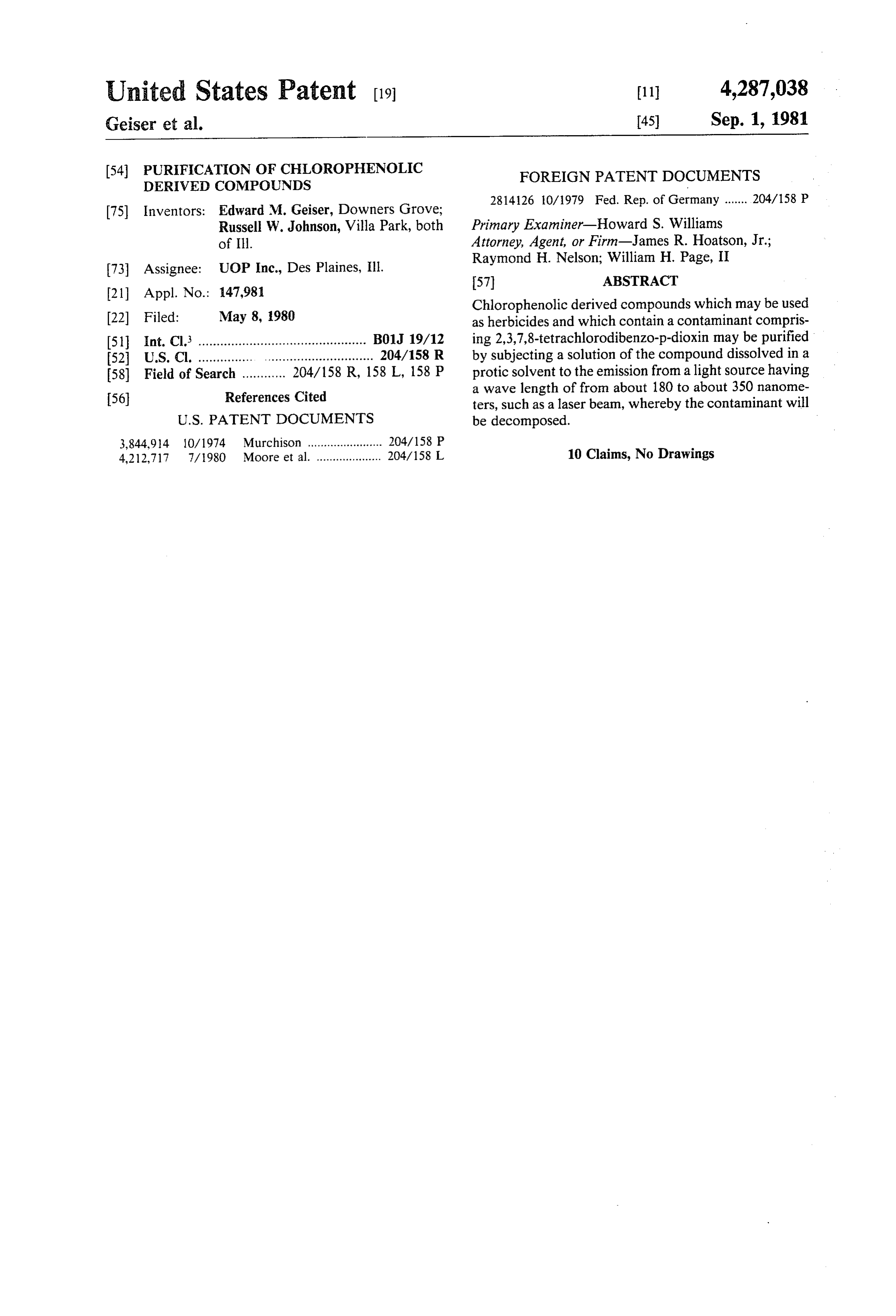
United States Patent (19) 11 4,287,038 Geiser et al. 45) Sep. 1, 1981
54 PURIFICATION OF CHLOROPHENOLC FOREIGN PATENT DOCUMENTS
DERVED COMPOUNDS
(75) Inventors: Edward M. Geiser, Downers Grove;
Russell W. Johnson, Villa Park, both Primary Examiner-Howard S. Williams of Ill. Attorney, Agent, or Firm-James R. Hoatson, Jr.;
Raymond H. Nelson; William H. Page, II (73) Assignee: UOP Inc., Des Plaines, Ill. 57 ABSTRACT 21 Appl. No.: 147,981 Chlorophenolic derived compounds which may be used 22 Filed: May 8, 1980 as herbicides and which contain a contaminant compris 51 Int. Cl. .............................................. B01J 19/12 ing 2,3,7,8-tetrachlorodibenzo-p-dioxin may be purified (52) U.S. Cl. ............... .............................. 204/158 R by subjecting a solution of the compound dissolved in a (58) Field of Search ............ 204/158 R, 158 L, 158 P protic solvent to the emission from a light source having References Cited a wave length of from about 180 to about 350 nanome 56) ters, such as a laser beam, whereby the contaminant will
3,844,914 10/1974 Murchison ....................... 204/158 P 4,212,717 7/1980 Moore et al. .................... 2O4/158 L 10 Claims, No Drawings
Page 2
from chlorophenolic derived compounds by utilizing a
PURIFICATION OF CHLOROPHENOLIC light source which possesses a relatively narrow wave
In one aspect an embodiment of this invention is
This invention relates to a process for the purification 5 found in a process for the removal of a contaminant of chlorophenolic derived compounds. More specifi comprising 2,3,7,8-tetrachlorodibenzo-p-dioxin from a cally, the invention is concerned with a process for chlorophenolic derived compound which comprises decomposing contaminants such as 2,3,7,8-tetra subjecting a solution of said compound dissolved in a chlorodibenzo-p-dioxin which are present in chloro protic solvent to the emission from a light source having phenolic derived compounds, the latter being used as 10 a wave length in the range of from about 180 to about herbicides or wood preservatives. 350 nanometers, and recovering the purified chloro Commercial herbicides which are used to control phenolic derived compound.
unwanted plants such as weeds thus increasing the A specific embodiment of this invention is found in yields of desired products are used with increasing fre the process for the removal of 2,3,7,8-tetrachlorodiben quency. Of the herbicides which are employed a partic 15 Zo-p-dioxin from 2,4,5-trichlorophenoxyacetic acid by ular group of compounds are those which have been subjecting a solution of said acid dissolved in methyl derived from chlorophenolic compounds. However, alcohol to the emission from a laser beam having a wave the chlorophenolic compounds generally contain con length in the range of from about 180 to about 350 taminants, a specific contaminant which is present in nanometers, and recovering the purified 2,4,5-trichloro these compounds comprising 2,3 7,8-tetrachlorodiben 20 phenoxyacetic acid.
zo-p-dioxin (TCDD). Although the concentration of Other objects and embodiments will be found in the TCDD is commercial herbicides is relatively low, that following further detailed description of the present is, less than about 50 ppb, the extreme toxicity which invention.
this compound possesses has raised some concern re As hereinbefore set forth the present invention is garding the use of the chlorophenolic derived herbi 25 concerned with a process for the purification of chloro cides. It has been found that TCDD is extremely toxic phenolic derived compounds containing contaminants for animals and relatively toxic for humans. The toxic such as polychlorodibenzo-p-dioxin compounds. The ity of this compound lies in the fact that it is both carci purification of the chlorophenolic derived compound is nogenic, that is, it possesses cancer forming properties, effected by subjecting a solution of said compound as well as being teratogenic, that is, it possesses proper 30 dissolved in a protic solvent to emission from a high ties which may lead to birth defects. Therefore, in order quality light source. In the preferred embodiment of the to employ these compounds as herbicides, it is neces invention, the high quality light source will possess a sary to purify the same by removing as much as possible wave length in the range of from about 180 to about 350 of the toxic compounds. nanometers (109 meters). One particularly preferred The removal of the contaminating force from the 35 light source comprises a laser beam, said term "laser' chlorophenolic compounds may be accomplished by being an abbreviation for light amplification by stimu decomposing the offending compound, said decomposi lated emission of radiation. The use of a laser beam to tion usually being effected by a dechlorination of the effect the purification by means of photodecomposition compound to the trichloro-, dichloro- or monochloro of the contaminant possesses two advantages which are substituted dibenzo-p-dioxin. The removal of one or 40 relevant to the purification, said advantages comprising more chlorine atoms from the compound will result in a spectral purity and power density. The advantage of the decrease of the toxicity of the compound, said dechlori spectral purity which is a narrow band width is neces nation being due to the fact that the chlorine to carbon sary in order to induce the photodecomposition of the bond is the weakest bond present in said compound. contaminant without an appreciable decomposition of Other forms of decomposition will include a rupture of 45 the chlorophenolic derived compound. That is, the light the oxygen to chlorine bond thus destroying the dioxin source may preferably comprise a narrow band pass so portion of the molecule. that the molecule which is being affected would be Heretofore the photodecomposition of TCDD by subjected to the intensity of radiation at the proper sunlight has been noted as well as the use of conven wave length. The advantage which lies in the power tional ultraviolet light. However, this method of de 50 density of the laser radiation is desirable inasmuch as the composing TCDD is relatively difficult to accomplish contaminant is usually present in the host compound in when it is present in a chlorophenolic derived com a relatively low concentration, that is, less than about 50 pound such as 2,4,5-trichlorophenoxyacetic acid inas and often less than about 20 ppb.
much as there is a relatively small difference in the The light source which possesses a wave length ultraviolet peak positions of the two compounds. Thus, 55 within the range hereinbefore set forth may be obtained if conventional ultraviolet light or sunlight was used to from any conventional type of laser. The laser which photodecompose TCDD, it would also tend to decom consists of a reservoir of active atoms which can be pose the host compound, namely, the 2,4,5-trichloro excited, a pump source to excite the available active phenoxyacetic acid. However, by utilizing a light atoms and a partially reflective resonant capacity to source of the type hereinafter set forth in greater detail, 60 contain and control the light which is emitted from the it is possible to decompose the undesirable contaminant excited atoms may be either solid state, gas, liquid, semi such as 2,3,7,8-tetrachlorodibenzo-p-dioxin without conductor or chemical in nature. Examples of solid state appreciably affecting the host compound. lasers which consist of a crystalline or glass host and a It is therefore an object of this invention to provide a doping additive which is the reservoir of active ions process for removing undesired contaminants from 65 will include synthetic ruby with a chromium dopant, chlorophenolic derived compounds. synthetic garnet such as yttrium-aluminum-garnet with A further object of this invention is to provide a dopants such as neodymium, erbium, holmium, etc., or process for the removal of undesirable contaminants glass with a neodymium, erbium or holmium dopant;
Page 3
gas lasers consisting of an optically transparent tube that the path length may be increased by the use of filled with a single gas or mixture of gases such as argon, external means such as reflective coatings or reflective krypton, nitrogen, carbon dioxide, helium-neon, etc.; surfaces such as mirrors. The operating parameters semi-conductor lasers such as gallium-arsenic, gallium under which this reaction is effected will include ambi aluminum-arsenic, lead-tin-tellurium, etc. It is to be 5 ent temperatures and atmospheric pressures. However, understood that the aforementioned examples of lasers it is also contemplated within the scope of this invention are only representative of the type of beams which may that subambient temperatures may be employed. These be employed and that the present invention is not neces subambient temperatures will range from ambient down sarily limited thereto. to the freezing point of the protic solvent which is em Examples of chlorophenolic derived compounds 10 ployed. For example, when methyl alcohol is used as which are currently employed as herbicides and wood the protic solvent for the chlorophenolic derived com preservatives and which will contain toxic contami pound, it is possible to operate at temperatures down to nants which must be removed prior to their use thereof, about -97 C.; when ethyl alcohol is employed as the will include 2,4,5-trichlorophenoxyacetic acid (2,4,5-T); solvent, temperatures down to about - 114 C. may be 2,4-dichlorophenoxyacetic acid (2,4-D); 4-chioro-2- employed. The use of subambient temperatures in the methylphenoxyacetic acid (MCPA); 2-(2,4-dichloro reaction may be advantageous inasmuch as the elec phenoxy)propionic acid (2,4-DP); 2-(4-chloro-2- tronic transition peaks of the contaminant such as methylphenoxy)propionic acid (MCPP); 2-(2,4,5-tri TCDD and the host compound such as 2,4,5-T may be chlorophenoxy)propionic acid (2,4,5-TP): 4-(4-chloro separated due to the lowering of the temperature and 2-methylphenoxy)butyric acid (MCPB); pentachloro 20 thus increase the efficiency of the laser beam to decom phenol, etc. As hereinbefore set forth by utilizing the pose the contaminant without a concomitant decompo emission from a light source such as a laser beam, it is sition of the host compound. The irradiation of the possible to obtain an increased efficiency in the photo solution is effected for a period of time which may decomposition of the contaminant without a concomi range from about 0.5 up to about 10 hours or more in tant photodecomposition of the host compound. 25 duration, the period of irradiation being dependent The purification of the chlorophenolic derived com upon the variables which are present including the host pound of the type hereinbefore set forth is effected by compound, the contaminant, the concentration of the subjecting a solution of the compound dissolved in a contaminant in the host compound, the concentration of protic solvent using the emission from the high quality the host compound in the solvent, the temperature, etc. light source hereinbefore discussed. Examples of protic 30 Upon completion of the irradiation period the purified solvents which may be employed will include low mo chlorophenolic derived compound may then be recov lecular weight alcohols such as methyl alcohol, ethyl ered by conventional means and separated from the alcohol, n-propyl alcohol, isopropyl alcohol, etc., or solvent, if so desired, by fractional distillation, crystalli low molecular weight carboxylic acids such as formic zation, etc.
acid, acetic acid, propionic acid, butyric acid, etc. By 35 It is also contemplated within the scope of this inven utilizing these protic solvents, it is possible to effect a tion that the purification of the chlorophenolic derived thorough dissolution of the chlorophenolic derived compound may be accomplished in a continuous man compound in the solvent and thus permit a more thor ner of operation in which the solution of the chloro ough exposure of the compound to the emission from phenolic derived compound dissolved in a protic sol the light rays. In addition, the protic solvent also pro 40 vent and which contains an undesired contaminant is vides a proton which assists in the removal of chlorine continuously charged to a quartz vessel and subjected atoms by the formation of HCl. In the preferred em to irradiation by a laser beam for a period of time suffi bodimennt of the invention the purification of the com cient to decompose the undesired contaminant, the pound is effected at ambient temperatures (20-25 C.) residence time during which the compound is subjected and atmospheric pressure although it is also contem 45 to irradiation being determined by the flow rate at plated within the scope of this invention that other which said solution is charged to the quartz vessel. reaction conditions such as elevated or reduced temper After passage through the quartz vessel for a predeter atures and pressures may be employed, although not mined period of time, said vessel being maintained at necessarily with equivalent results. predetermined operating temperatures, the purified The process for the purification of the chlorophenolic 50 solution is continuously withdrawn and subjected to derived compound is effected by placing a solution of conventional means of separation whereby the desired the compound dissolved in a protic solvent of the type compound is separated from the protic solvent and hereinbefore set forth in an appropriate apparatus. In recovered.
the preferred embodiment of the invention the appara The following examples are given for purposes of tus in which the solution is placed will comprise a 55 illustrating the process of this invention. However, it is quartz cell. The quartz is used due to the fact that it will to be understood that these examples are given merely not absorb light and is optically transparent in the re for purposes of illustration and that the present inven gion of interest. This is in contrast to other transparent tion is not necessarily limited thereto. apparatus such as Pyrex which will absorb light below EXAMPLE I about 350 nanometers. The solution is then subjected to 60 irradiation from a light source which possesses a wave In this example the use of a light source possessing a length below about 350 nanometers and preferably in a wave length other than that which may be utilized in range of from about 180 to about 350 nanometers. The the process of this invention was employed. A sample of size of the apparatus or container will be that which is 2,3,7,8-tetrachlorodibenzo-p-dioxin was diluted with a sufficient to provide a path length (the distance through 65 sufficient amount of absolute methyl alcohol to prepare which light travels in the reaction zone) in a range of a solution containing 10.1 ppm of the contaminant. This from about 1 mm to about 40 meters, and preferably Solution was then diluted with an additional amount of from about 1 cm to about 1 m. It is also contemplated methyl alcohol containing 2,4,5-trichlorophenoxyacetic
Page 4
acid until the final solution contained 10% of the acid, possessing a wave length within the range of from about 90% methyl alcohol and 0.524 ppm of TCDD. Thereaf 180 to about 350 nanometers to light sources which ter 30 ml of this solution was placed in a quartz reaction possess wave lengths outside of this range, the former cell and irradiated for a period of 7.25 hours by emission will afford a more efficient and less costly method for from an Oriel 500 watt mercury arc lamp focused onto 5 the removal of the contaminant with the concomitant an Oriel grating monochronometer equipped with a 280 obtention of a compound which may be utilized in the micron (2mm band pass) fixed slit. The output from the commercial field.
monochronometer was directed into the reactor cell The utilization of a light source such as a laser beam which was 10 cm in length equipped with a ground for treating other phenolic derived compounds such as fitting and flexible tubing which was coupled with a 10 4-chloro-2-methylphenoxyacetic acid, pentachlorophe methanol trap to avoid the possibility of contaminated nol, or 2-(2,4,5-trichlorophenoxy)propionic acid may vapors escaping into the air. In addition the cell was also show similar results.
wrapped with aliminum foil to increase the effective We claim as our invention:
path length. At the end of the 7.25 hours the sample was 1. A process for the removal of a contaminant con recovered and subjected to analysis, said analysis dis 15 prising 2,3,-7,8-tetrachlorodibenzo-p-dioxin from a closing that the irradiated sample possessed a TCDD chlorophenolic derived compound which comprises concentration of 0.39 ppm. This corresponded to a subjecting a solution of said compound dissolved in a 25.6% decomposition of contaminant which corre sponds to a quantum efficiency of about 0.52. This value aprotic wave solvent to the emission from a light source having length in the range of from about 180 to about uses the radiation absorbed by the TCDD rather than 20 350 nanometers, the total solution absorption. The efficiency of the mer phenolic derived and recovering the purified chloro compound.
cury arc lamp emission was 0.0004%. By utilizing this 2. The process as set forth in claim 1 in which the type of light source, it is estimated that the electricity removal required for the removal of the contaminant, namely, peraturesofand said contaminant is effected at ambient ten atmospheric pressures.
2,3,7,8-tetrachlorodibenzo-p-dioxin will range from 25 3. The process 47.6 to 476 kilowatt hours/kilogram of 2,4,5-trichloro light source comprises as set forth in claim 1 in which said phenoxyacetic acid and that the utility cost for the puri a laser beam. fication at a rate of 3.5¢/kilowatt hour will range from chlorophenolic derived forth 4. The process as set in claim 1 in which said compound is 2,4,5-trichloro $1.57 to $15.70/kilogram of the acid.
30 phenoxyacetic acid.
EXAMPLE I 5. The process as set forth in claim 1 in which said In constrast to this, when utilizing a light source chlorophenolic derived compound is 2,4-dichloro possessing a wave length in the range of from about 180 phenoxyacetic acid.
to about 350 nanometers such as a laser beam, the elec 6. The process as set forth in claim 1 in which said tricity required, as measured in kilowatt hours, to re 35 chlorophenolic derived compound is 4-chloro-2- move a major portion of the contaminant, namely, methylphenoxyacetic acid.
2,3,7,8-tetrachlorodibenzo-p-dioxin from 2,4,5-tri 7. The process as set forth in claim 1 in which said chlorophenoxyacetic acid will only be 0.95. Likewise, it chlorophenolic derived compound is pentachlorophe is also estimated that the utility cost for removal of this nol.
contaminant using a base of 3.5c/kilowatt hour will 8. The process as set forth in claim 1 in which said only be $0.033 or 3.3c/kilogram of acid. In addition, it chlorophenolic derived compound is 2-(2,4,5-trichloro is also estimated that the efficiency of the laser beam will phenoxy)propionic acid.
be 19%. 9. The process as set forth in claim 1 in which the It is therefore readily apparent that by comparing the protic solvent comprises methyl alcohol. efficiency, the electricity required and the utility cost to 45 10. The process as set forth in claim 1 in which the purify a phenolic derived compound such as 2,4,5-tri protic solvent comprises ethyl salcohol. chlorophenoxyacetic acid when utilizing a light source k sk e
Provenance
- Collection
- Cited prior art
- Original PDF
- patentimages.storage.googleapis.com →
- Filed
- 1980-05-08
- Pages
- 4
- Method
- pdftotext (the PDF's own text layer) + pdftoppm 300dpi page scans
- Source
- Google Patents bibliographic record
- Granted
- 1981-09-01
- Inventors
- Edward M. Geiser; Russell W. Johnson; UOP LLC
- Transcribed from
- patentimages.storage.googleapis.com →