patent · US3996029
Purification of gases containing hydrogen fluoride impurity
7 December 1976
Page 1 — bibliographic record
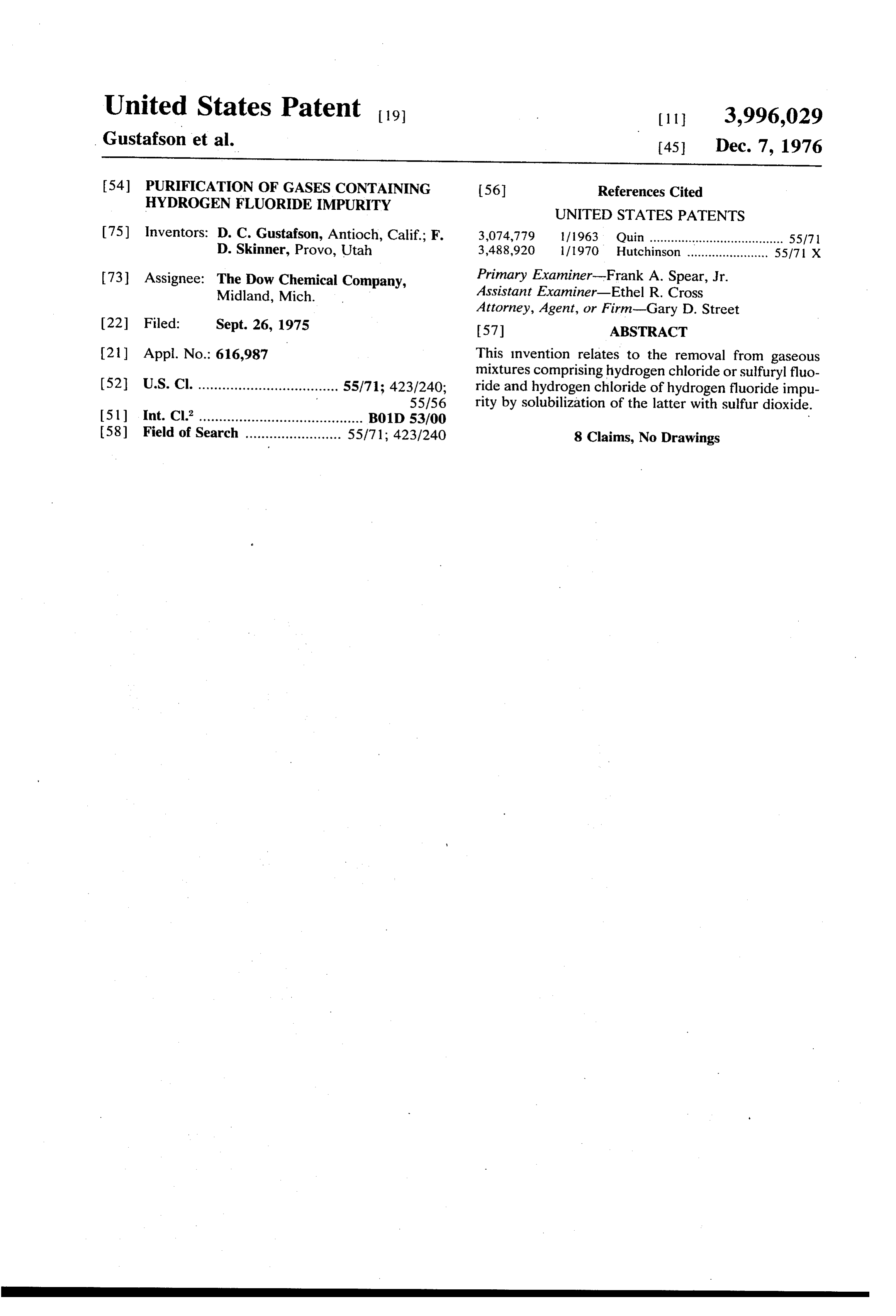
United States Patent to 11, 3,996,029 Gustafson et al. 45 Dec. 7, 1976 54) PURIFICATION OF GASES CONTAINING 56) References Cited HYDROGEN FLUORIDE IMPURITY UNITED STATES PATENTS (75) Inventors: D. C. Gustafson, Antioch, Calif.; F. 3,074,779 1/1963 Quin ...................................... 55/71 D. Skinner, Provo, Utah 3,488,920 1 / 1970 Hutchinson ......... -- - - - - - - - - 55771 X
73) Assignee: The Dow Chemical Company, Primary Examiner-Frank A. Spear, Jr. Midland, Mich. Assistant Examiner-Ethel R. Cross
Attorney, Agent, or Firm-Gary D. Street 22 Filed: Sept. 26, 1975 57 ABSTRACT (21) Appl. No.: 616,987 This invention relates to the removal from gaseous mixtures comprising hydrogen chloride or sulfuryl fluo (52) U.S. Cl. ................................... 55771; 423/240; ride and hydrogen chloride of hydrogen fluoride impu
51) Int. Cl. ......................................... B01D 53/00 rity by solubilization of the latter with sulfur dioxide.
58) Field of Search ........................ 55/71; 423/240 8 Claims, No Drawings
Page 2
contact with liquid SO2. In each embodiment, the HF is
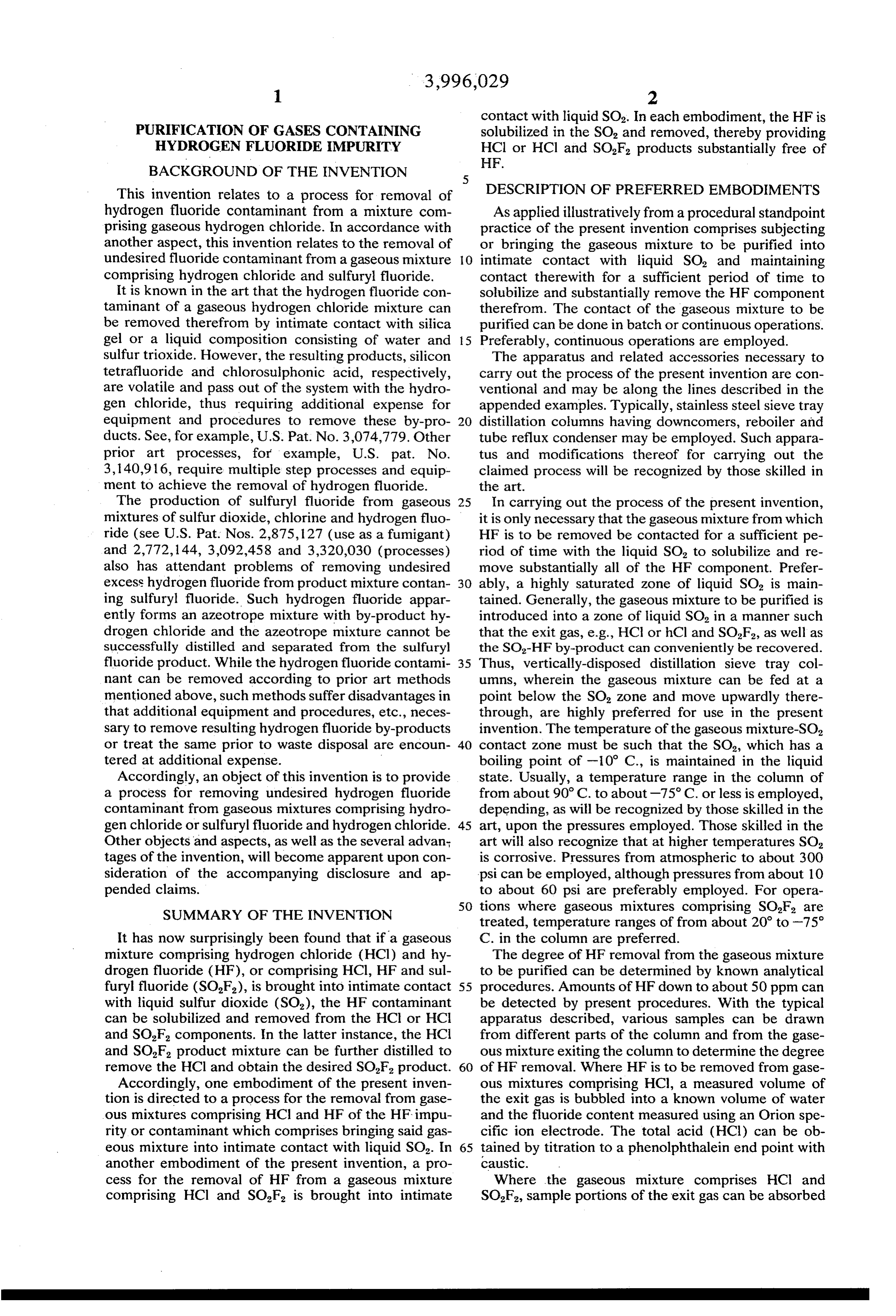
PURIFICATION OF GASES CONTAINING solubilized in the SO, and removed, thereby providing HYDROGEN FLUORIDE IMPURITY HCl or HCl and SOF products substantially free of
This invention relates to a process for removal of DESCRIPTION OF PREFERRED EMBODEMENTS hydrogen fluoride contaminant from a mixture com As applied illustratively from a procedural standpoint prising gaseous hydrogen chloride. In accordance with practice of the present invention comprises subjecting another aspect, this invention relates to the removal of or bringing the gaseous mixture to be purified into undesired fluoride contaminant from a gaseous mixture O intimate contact with liquid SO, and maintaining comprising hydrogen chloride and sulfuryl fluoride. contact therewith for a sufficient period of time to It is known in the art that the hydrogen fluoride con solubilize and substantially remove the HF component taminant of a gaseous hydrogen chloride mixture can therefrom. The contact of the gaseous mixture to be be removed therefrom by intimate contact with silica purified can be done in batch or continuous operations. gel or a liquid composition consisting of water and 15 Preferably, continuous operations are employed. sulfur trioxide. However, the resulting products, silicon The apparatus and related accessories necessary to tetrafluoride and chlorosulphonic acid, respectively, carry out the process of the present invention are con are volatile and pass out of the system with the hydro ventional and may be along the lines described in the gen chloride, thus requiring additional expense for appended examples. Typically, stainless steel sieve tray equipment and procedures to remove these by-pro 20 distillation columns having downcomers, reboiler and ducts. See, for example, U.S. Pat. No. 3,074,779. Other tube reflux condenser may be employed. Such appara prior art processes, for example, U.S. pat. No. tus and modifications thereof for carrying out the 3, 140,916, require multiple step processes and equip claimed process will be recognized by those skilled in ment to achieve the removal of hydrogen fluoride. the art.
The production of sulfuryl fluoride from gaseous 25 In carrying out the process of the present invention, mixtures of sulfur dioxide, chlorine and hydrogen fluo it is only necessary that the gaseous mixture from which ride (see U.S. Pat. Nos. 2,875,127 (use as a fumigant) HF is to be removed be contacted for a sufficient pe and 2,772,144, 3,092,458 and 3,320,030 (processes) riod of time with the liquid SO, to solubilize and re also has attendant problems of removing undesired move substantially all of the HF component. Prefer excess hydrogen fluoride from product mixture contan 30 ably, a highly saturated zone of liquid SO2 is main ing sulfuryl fluoride. Such hydrogen fluoride appar tained. Generally, the gaseous mixture to be purified is ently forms an azeotrope mixture with by-product hy introduced into a zone of liquid SO, in a manner such drogen chloride and the azeotrope mixture cannot be that the exit gas, e.g., HCl or hCl and SOF, as well as successfully distilled and separated from the sulfuryl the SO-HF by-product can conveniently be recovered. fluoride product. While the hydrogen fluoride contami 35 Thus, vertically-disposed distillation sieve tray col nant can be removed according to prior art methods umns, wherein the gaseous mixture can be fed at a mentioned above, such methods suffer disadvantages in point below the SO, zone and move upwardly there that additional equipment and procedures, etc., neces through, are highly preferred for use in the present sary to remove resulting hydrogen fluoride by-products invention. The temperature of the gaseous mixture-SO, or treat the same prior to waste disposal are encoun 40 contact zone must be such that the SO, which has a tered at additional expense. - boiling point of -10° C., is maintained in the liquid Accordingly, an object of this invention is to provide state. Usually, a temperature range in the column of a process for removing undesired hydrogen fluoride from about 90° C. to about -75 C. or less is employed, contaminant from gaseous mixtures comprising hydro depending, as will be recognized by those skilled in the gen chloride or sulfuryl fluoride and hydrogen chloride. 45 art, upon the pressures employed. Those skilled in the Other objects and aspects, as well as the several advan art will also recognize that at higher temperatures SO, tages of the invention, will become apparent upon con is corrosive. Pressures from atmospheric to about 300 sideration of the accompanying disclosure and ap psi can be employed, although pressures from about 10 pended claims. to about 60 psi are preferably employed. For opera 50 tions where gaseous mixtures comprising SOF are
SUMMARY OF THE INVENTION treated, temperature ranges of from about 20 to -75 It has now surprisingly been found that if a gaseous C. in the column are preferred. mixture comprising hydrogen chloride (HCl) and hy The degree of HF removal from the gaseous mixture drogen fluoride (HF), or comprising HCl, HF and sul to be purified can be determined by known analytical furyl fluoride (SOF), is brought into intimate contact 55 procedures. Amounts of HF down to about 50 ppm can with liquid sulfur dioxide (SO), the HF contaminant be detected by present procedures. With the typical can be solubilized and removed from the HCl or HCl apparatus described, various samples can be drawn and SOF components. In the latter instance, the HCl from different parts of the column and from the gase and SOF product mixture can be further distilled to ous mixture exiting the column to determine the degree remove the HCl and obtain the desired SOF product. 60 of HF removal. Where HF is to be removed from gase Accordingly, one embodiment of the present inven ous mixtures comprising HCl, a measured volume of tion is directed to a process for the removal from gase the exit gas is bubbled into a known volume of water ous mixtures comprising HCl and HF of the HF impu and the fluoride content measured using an Orion spe rity or contaminant which comprises bringing said gas cific ion electrode. The total acid (HCl) can be ob eous mixture into intimate contact with liquid SO2. In 65 tained by titration to a phenolphthalein end point with another embodiment of the present invention, a pro caustic.
cess for the removal of HF from a gaseous mixture Where the gaseous mixture comprises HCl and comprising HCl and SOF is brought into intimate SOF, sample portions of the exit gas can be absorbed
Page 3
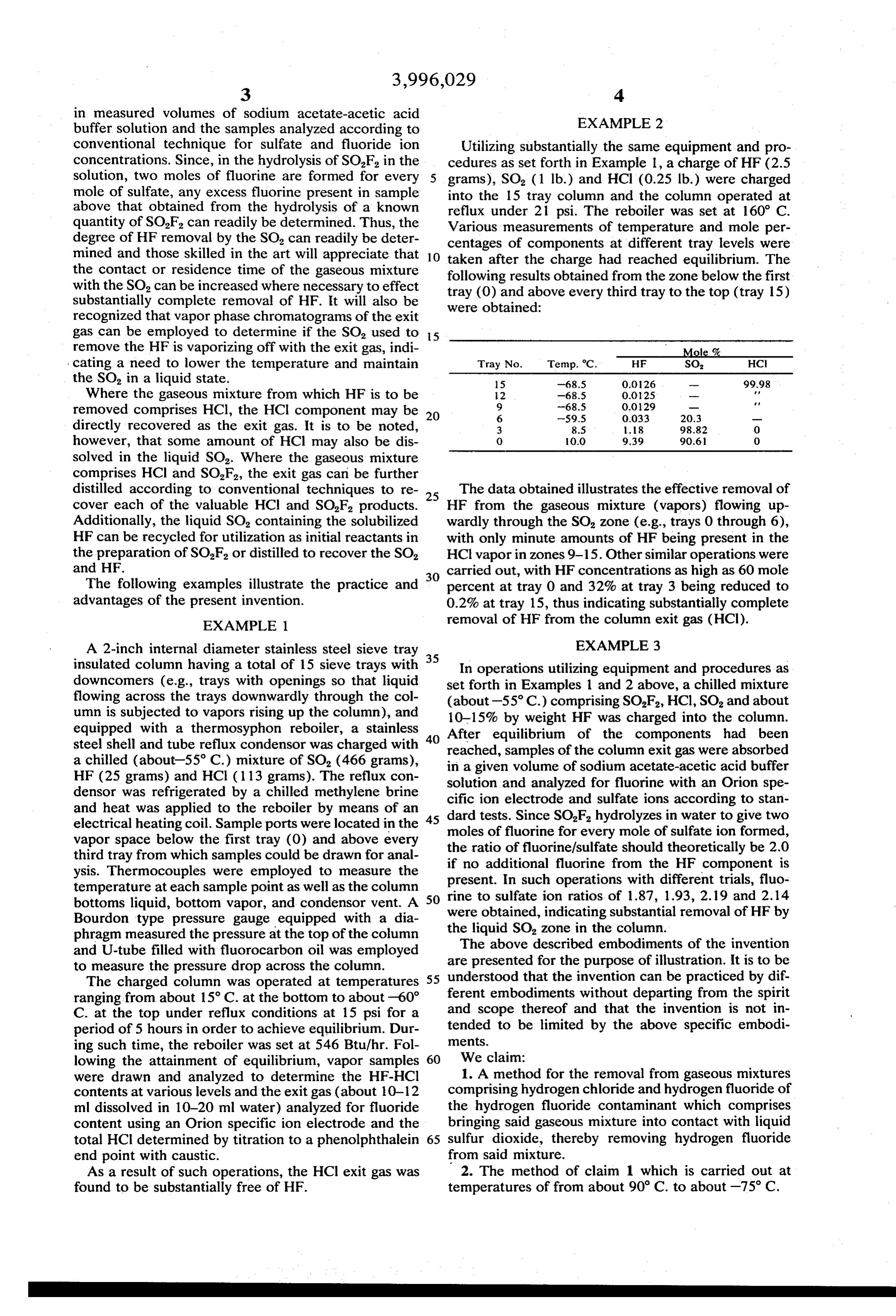
in measured volumes of sodium acetate-acetic acid buffer solution and the samples analyzed according to EXAMPLE 2 conventional technique for sulfate and fluoride ion Utilizing substantially the same equipment and pro concentrations. Since, in the hydrolysis of SOF in the cedures as set forth in Example 1, a charge of HF (2.5 solution, two moles of fluorine are formed for every grams), SO, (1 lb.) and HCl (0.25 lb.) were charged mole of sulfate, any excess fluorine present in sample into the 15 tray column and the column operated at above that obtained from the hydrolysis of a known reflux under 21 psi. The reboiler was set at 160° C. quantity of SOF, can readily be determined. Thus, the Various measurements of temperature and mole per degree of HF removal by the SO, can readily be deter centages of components at different tray levels were mined and those skilled in the art will appreciate that 10 taken after the charge had reached equilibrium. The the contact or residence time of the gaseous mixture following results obtained from the zone below the first with the SO, can be increased where necessary to effect tray (0) and above every third tray to the top (tray 15) substantially complete removal of HF. It will also be were obtained:
recognized that vapor phase chromatograms of the exit gas can be employed to determine if the SO used to 15 remove the HF is vaporizing off with the exit gas, indi Mole % cating a need to lower the temperature and maintain Tray No. Temp. C. HF SO, HC the SO, in a liquid state. 15 -68.5 0.026 ---- 99.98 Where the gaseous mixture from which HF is to be 2 -68.5 0.025 F removed comprises HCl, the HCI component may be 20 9
directly recovered as the exit gas. It is to be noted, 3 8.5 18 98.82 O however, that some amount of HCl may also be dis O 10.O 9.39 90.6 O solved in the liquid S.O. Where the gaseous mixture comprises HCl and SOF, the exit gas can be further distilled according to conventional techniques to re 25 The data obtained illustrates the effective removal of cover each of the valuable HCl and SOF products. HF from the gaseous mixture (vapors) flowing up Additionally, the liquid SO containing the solubilized wardly through the SO zone (e.g., trays 0 through 6), HF can be recycled for utilization as initial reactants in with only minute amounts of HF being present in the the preparation of SOF, or distilled to recover the SO HCl vapor in zones 9-15. Other similar operations were and HF. carried out, with HF concentrations as high as 60 mole The following examples illustrate the practice and percent at tray 0 and 32% at tray 3 being reduced to advantages of the present invention. 0.2% at tray 15, thus indicating substantially complete EXAMPLE 1. removal of HF from the column exit gas (HCl).
A 2-inch internal diameter stainless steel sieve tray EXAMPLE 3 insulated column having a total of 15 sieve trays with 35 In operations utilizing equipment and procedures as downcomers (e.g., trays with openings so that liquid flowing across the trays downwardly through the col set forth in Examples 1 and 2 above, a chilled mixture (about -55 C.) comprising SO.F., HCl, SO, and about umn is subjected to vapors rising up the column), and 10-15% by weight HF was charged into the column. equipped with a thermosyphon reboiler, a stainless 40 After equilibrium of the components had been steel shell and tube reflux condensor was charged with reached, samples of the column exit gas were absorbed a chilled (about-55° C.) mixture of SO, (466 grams), in a given volume of sodium acetate-acetic acid buffer HF (25 grams) and HCl ( 1 13 grams). The reflux con solution and analyzed for fluorine with an Orion spe densor was refrigerated by a chilled methylene brine cific and heat was applied to the reboiler by means of an 45 dard ion electrode and sulfate ions according to stan tests. Since SOF hydrolyzes in water to give two electrical heating coil. Sample ports were located in the moles of fluorine for every mole of sulfate ion formed, vapor space below the first tray (0) and above every the ratio of fluorine/sulfate should theoretically be 2.0 third tray from which samples could be drawn for anal if no additional fluorine from the HF component is ysis. Thermocouples were employed to measure the temperature at each sample point as well as the column present. In such operations with different trials, fluo
bottoms liquid, bottom vapor, and condensor vent. A 50 were obtained, indicating substantial removal of HF by Bourdon type pressure gauge equipped with a dia phragm measured the pressure at the top of the column the liquid SO, zone in the column. and U-tube filled with fluorocarbon oil was employed The above described embodiments of the invention to measure the pressure drop across the column. are presented for the purpose of illustration. It is to be The charged column was operated at temperatures 55 understood that the invention can be practiced by dif ranging from about 15° C. at the bottom to about-60 ferent embodiments without departing from the spirit C. at the top under reflux conditions at 15 psi for a and scope thereof and that the invention is not in period of 5 hours in order to achieve equilibrium. Dur tended netS.
to be limited by the above specific embodi ing such time, the reboiler was set at 546 Btu/hr. Fol lowing the attainment of equilibrium, vapor samples 60 We claim:
were drawn and analyzed to determine the HF-HCl 1. A method for the removal from gaseous mixtures contents at various levels and the exit gas (about 10-2 comprising hydrogen chloride and hydrogen fluoride of ml dissolved in 10–20 ml water) analyzed for fluoride the hydrogen fluoride contaminant which comprises content using an Orion specific ion electrode and the bringing said gaseous mixture into contact with liquid total HCl determined by titration to a phenolphthalein 65 sulfur dioxide, thereby removing hydrogen fluoride end point with caustic. from said mixture.
As a result of such operations, the HCl exit gas was 2. The method of claim 1 which is carried out at found to be substantially free of HF. temperatures of from about 90° C. to about -75 C.
Page 4
3. The method of claim 1 which is carried out at 6. The method of claim 3 which is carried out at pressures of from 0 to about 300 psi. temperatures of from about 20 to about -75 C. 4. A method for the removal from gaseous mixtures 7. The method of claim 3 wherein sulfuryl fluoride is comprising hydrogen fluoride, hydrogen chloride and recovered from the gaseous mixture following removal sulfuryl fluoride of the hydrogen fluoride contaminant of the hydrogen fluoride therefrom. which comprises bringing said gaseous mixture into 8. The method of claim 3 wherein the resulting sulfur contact with liquid sulfur dioxide, thereby removing dioxide and solubilized hydrogen fluoride mixture is hydrogen fluoride from said mixture. employed as a starting material in the preparation of 5. The method of claim 3 which is carried out under sulfuryl fluoride.
pressures of from about 10 to about 60 psi. 10 sk ck : :
Provenance
- Collection
- Cited prior art
- Original PDF
- patentimages.storage.googleapis.com →
- Filed
- 1975-09-26
- Pages
- 4
- Method
- pdftotext (the PDF's own text layer) + pdftoppm 300dpi page scans
- Source
- Google Patents bibliographic record
- Granted
- 1976-12-07
- Inventors
- D. C. Gustafson; F. D. Skinner; Dow Chemical Co
- Transcribed from
- patentimages.storage.googleapis.com →