patent · US4262112
Process for preparing polycarbonates using cyclic isourea catalysts
14 April 1981
Page 1 — bibliographic record
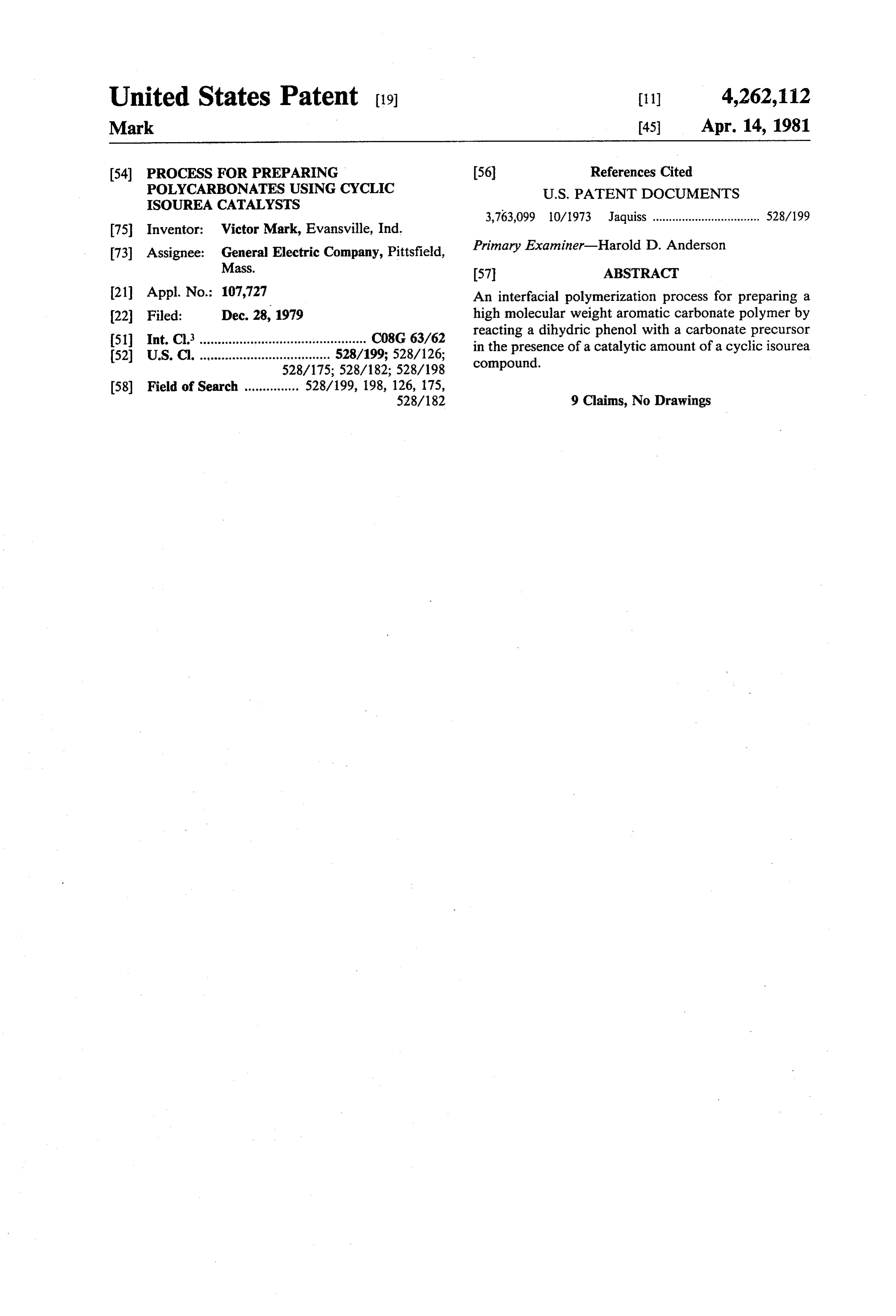
United States Patent (19) (11) 4,262,112 Mark 45) Apr. 14, 1981 (54) PROCESS FOR PREPARING 56) References Cited POLYCARBONATES USING CYCLIC U.S. PATENT DOCUMENTS
SOUREA CATALYSTS
3,763,099 10/1973 Jaquiss ................................. 528/199 75 Inventor: Victor Mark, Evansville, Ind.
73) Assignee: General Electric Company, Pittsfield, Primary Examiner-Harold D. Anderson Mass. 57 ABSTRACT 21 Appl. No.: 107,727 An interfacial polymerization process for preparing a 22 Filed: Dec. 28, 1979 high molecular weight aromatic carbonate polymer by reacting a dihydric phenol with a carbonate precursor 51 Int. Cl............................................... C08G 63/62 in the presence of a catalytic amount of a cyclic isourea (52) U.S. C. ................................... 528/199; 528/126; compound.
528/182 9 Claims, No Drawings
Page 2
DESCRIPTION OF THE INVENTION
PROCESS FOR PREPARNG POLYCARBONATES
USING CYCLIC SOUREA CATALYSTS This invention is directed to an interfacial polymeri zation process for producing high molecular weight
This invention is directed to an interfacial polymeri 5 aromatic carbonate polymers wherein a dihydric phe zation process for preparing high molecular, weight nol is reacted with a carbonate precursor in the pres aromatic polycarbonates which comprises reacting ence of an aqueous caustic solution containing an alkali under interfacial polycarbonate-forming conditions a metal or alkaline earth metal hydroxide and a catalyst dihydric phenol and a carbonate precursor in the pres 10 which is a cyclic isourea compound. ence of a catalytic amount of a cyclic isourea com The reaction of a dihydric phenol such as 2,2-bis(4- pound. hydroxyphenyl)propane with a carbonate precursor such as phosgene results in a high molecular weight
BACKGROUND OF THE INVENTION . . . aromatic polycarbonate polymer consisting of dihydric
Polycarbonates are well known thermoplastic materi 15 phenol derived units bonded to one another through als finding a wide range of uses, particularly for injec carbonate linkages. The reaction is carried out in the tion molding applications and as glazing sheet for re presence of an aqueous caustic solution containing the placement of window glass. The interfacial polymeriza alkali and alkaline earth metal hydroxide as acid accep tion technique, which is one of the methods employed tors and an inert organic solvent medium which is a in preparing a polycarbonate, involves reacting a dihy 20 solvent for the polycarbonate as it is formed. Generally, dric phenol and a carbonate precursor in the presence of a molecular weight regulator is also present to control an aqueous caustic solution containing an alkali or alka the molecular weight of the polycarbonate polymer. In line earth metal hydroxide, and an inert organic solvent the process of the present invention, an isourea is pres medium which is a solvent for the polycarbonate as it is ent and acts as an effective catalyst to speed up the formed. While the interfacial polymerization process is 25 reaction between the carbonate precursor and the dihy generally effective in producing polycarbonates, it dric phenol.
does, in general, suffer from two disadvantages. Firstly, The high molecular weight aromatic carbonate poly the rate of reaction is relatively slow. Secondly, there is mers produced in accordance with the practice of this a general difficulty in producing high molecular weight 30 invention include carbonate homopolymers of dihydric aromatic polycarbonates, i.e., those having a weight ent phenols or carbonate copolymers of two or more differ average molecular weight of about 15,000 to greater. highdihydric phenols. Additionally, the production of molecular weight thermoplastic randomly
Many techniques, such as those employing ultrasonic waves during the reaction, have been employed to rem branched polycarbonates and copolyester-polycarbon edy these two disadvantages. These techniques have 35 ates are included within the scope of this invention. The not always proved to be entirely effective and involve coreacting branched randomly
polycarbonates are prepared by polyfunctional organic compound with the the use of cumbersome and expensive equipment. It is afore-described dihydric phenol and carbonate precur advantageous economically to speed up the reaction SO.
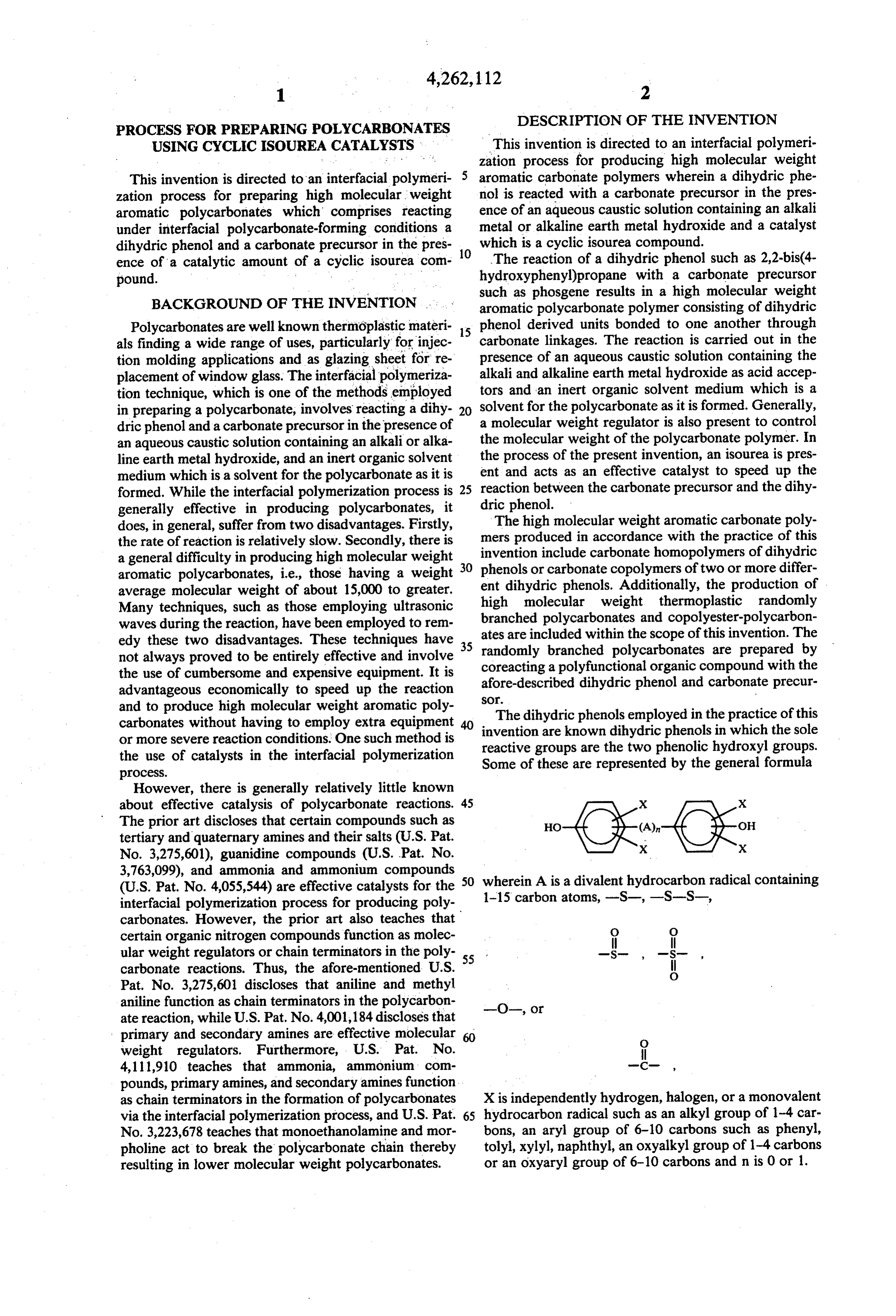
and to produce high molecular weight aromatic poly The dihydric phenols employed in the practice of this carbonates without having to employ extra equipment 40 invention are known dihydric phenols in which the sole or more severe reaction conditions. One such method is reactive groups the use of catalysts in the interfacial polymerization Some of these are are the two phenolic hydroxyl groups. process. represented by the general formula However, there is generally relatively little known about effective catalysis of polycarbonate reactions. 45 X X The prior art discloses that certain compounds such as HO (A)n OH tertiary and quaternary amines and their salts (U.S. Pat.
No. 3,275,601), guanidine compounds (U.S. Pat. No. x X 3,763,099), and ammonia and ammonium compounds 50 wherein A is a divalent hydrocarbon radical containing (U.S. Pat. No. 4,055,544) are effective catalysts for the interfacial polymerization process for producing poly 1-15 carbon atoms, -S-, -S-S-, carbonates. However, the prior art also teaches that certain organic nitrogen compounds function as molec O
ular weight regulators or chain terminators in the poly 55 -S- , -S- , carbonate reactions. Thus, the afore-mentioned U.S. O Pat. No. 3,275,601 discloses that aniline and methyl aniline function as chain terminators in the polycarbon -O-, or ate reaction, while U.S. Pat. No. 4,001,184 discloses that i primary and secondary amines are effective molecular 60 O weight regulators. Furthermore, U.S. Pat. No.
4,111,910 teaches that ammonia, ammonium com -Cpounds, primary amines, and secondary amines function as chain terminators in the formation of polycarbonates X is independently hydrogen, halogen, or a monovalent via the interfacial polymerization process, and U.S. Pat. 65 hydrocarbon radical such as an alkyl group of l-4 car No. 3,223,678 teaches that monoethanolamine and mor bons, an aryl group of 6-10 carbons such as phenyl, pholine act to break the polycarbonate chain thereby tolyi, xylyl, naphthyl, an oxyalkyl group of 1-4 carbons resulting in lower molecular weight polycarbonates. or an oxyaryl group of 6-10 carbons and n is 0 or 1.
Page 3
Typical of some of the dihydric phenols that can be 4'-methoxyphenylene)-propane, aniline and methylani employed in the practice of the present invention are line, it is possible to regulate the molecular weight of bisphenols such as bis(4-hydroxyphenyl)methane, 2,2- the polycarbonates.
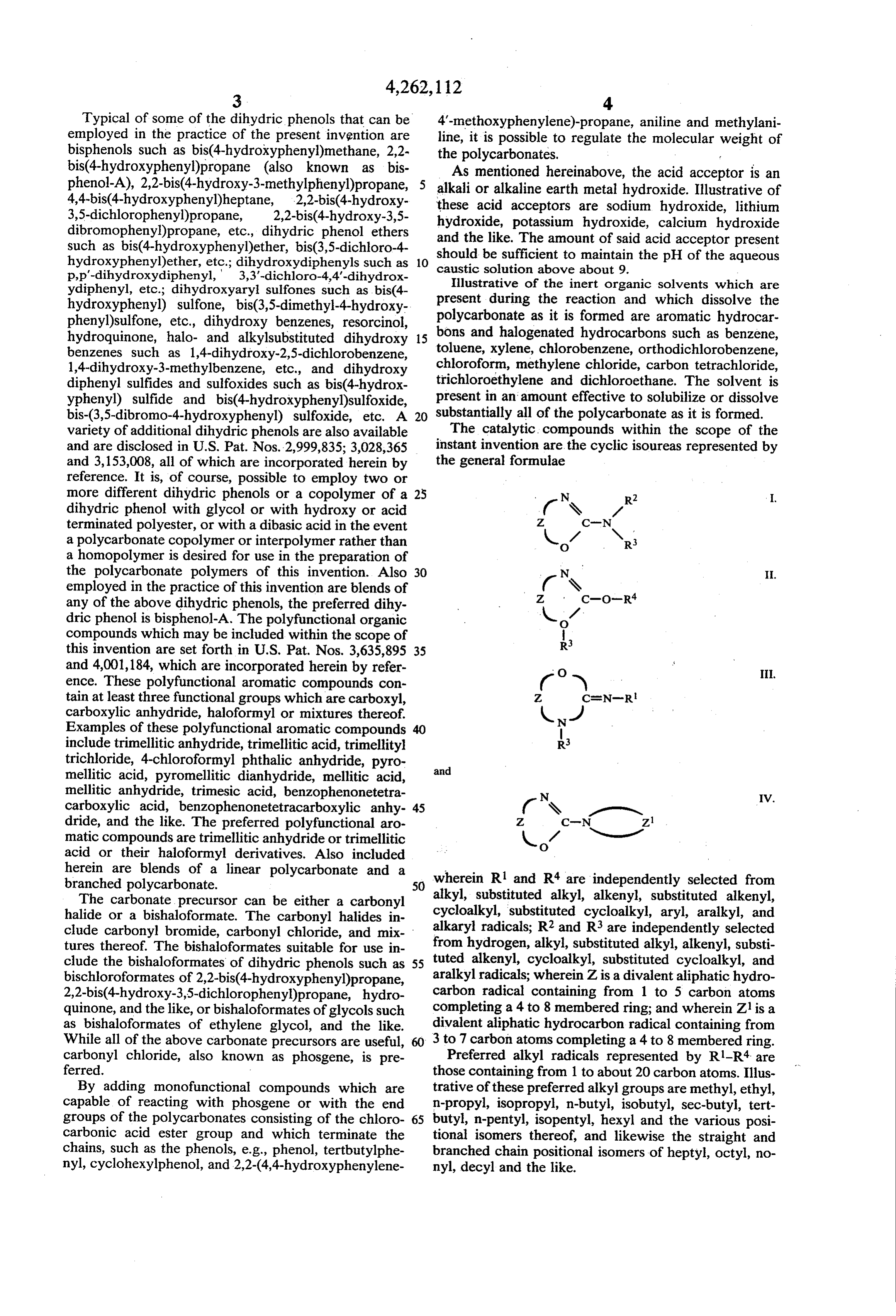
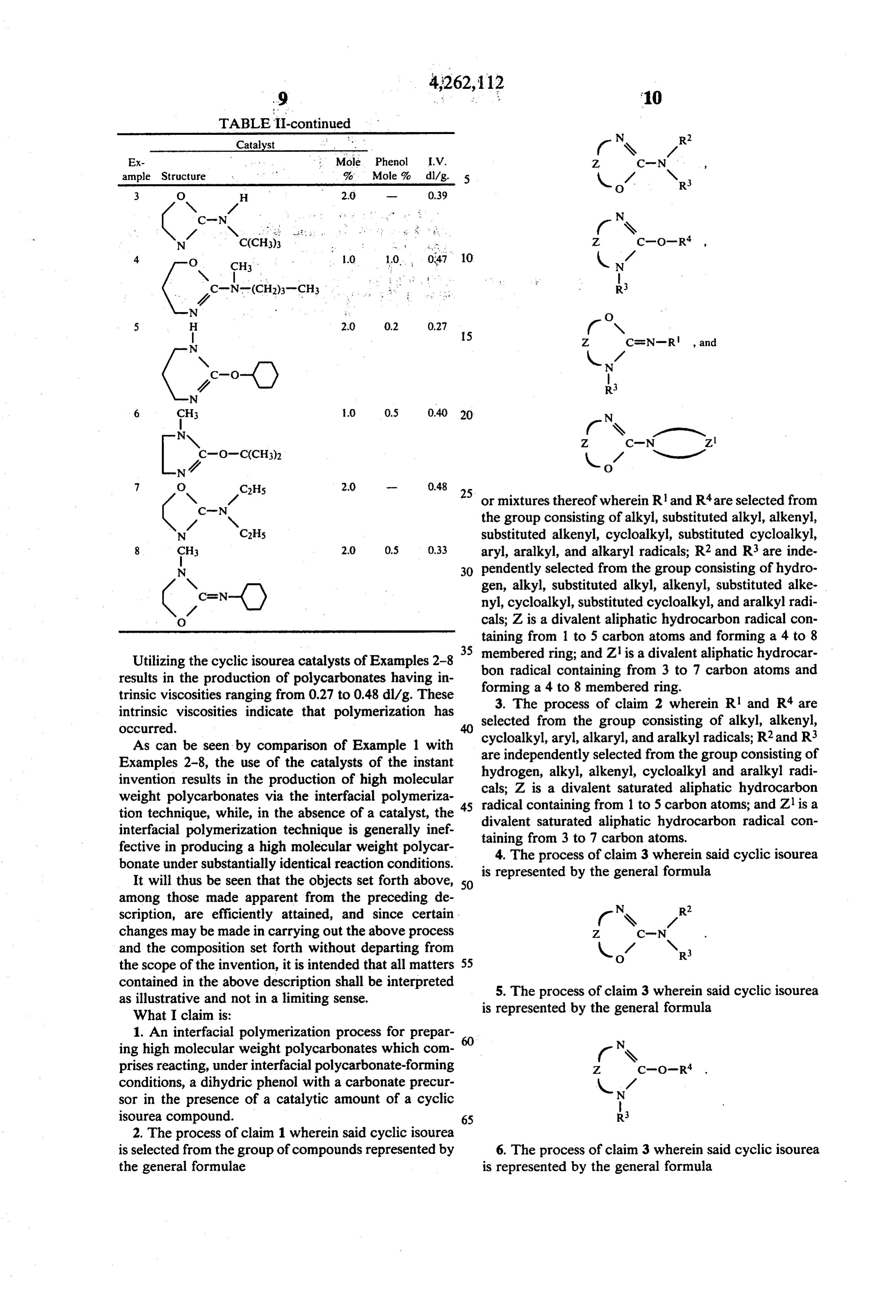
bis(4-hydroxyphenyl)propane (also known as bis As mentioned hereinabove, the acid acceptor is an phenol-A), 2,2-bis(4-hydroxy-3-methylphenyl)propane, alkali or alkaline earth metal hydroxide. Illustrative of 4,4-bis(4-hydroxyphenyl)heptane, 2,2-bis(4-hydroxy these acid acceptors are sodium hydroxide, lithium 3,5-dichlorophenyl)propane, 2,2-bis(4-hydroxy-3,5- hydroxide, potassium hydroxide, calcium hydroxide dibromophenyl)propane, etc., dihydric phenol ethers and the like. The amount of said acid acceptor present such as bis(4-hydroxyphenyl)ether, bis(3,5-dichloro-4- should be sufficient to maintain the pH of the aqueous hydroxyphenyl)ether, etc.; dihydroxydiphenyls such as 10 caustic solution above about 9. p,p'-dihydroxydiphenyl, 3,3'-dichloro-4,4'-dihydrox Illustrative of the inert organic solvents which are ydiphenyl, etc.; dihydroxyaryl sulfones such as bis(4- hydroxyphenyl) sulfone, bis(3,5-dimethyl-4-hydroxy present during the reaction and which dissolve the phenyl)sulfone, etc., dihydroxy benzenes, resorcinol, polycarbonate as it is formed are aromatic hydrocar hydroquinone, halo- and alkylsubstituted dihydroxy 15 bons and halogenated hydrocarbons such as benzene, benzenes such as 1,4-dihydroxy-2,5-dichlorobenzene, toluene, xylene, chlorobenzene, orthodichlorobenzene, 1,4-dihydroxy-3-methylbenzene, etc., and dihydroxy chloroform, methylene chloride, carbon tetrachloride, diphenyl sulfides and sulfoxides such as bis(4-hydrox trichloroethylene and dichloroethane. The solvent is yphenyl) sulfide and bis(4-hydroxyphenyl)sulfoxide, present in an amount effective to solubilize or dissolve bis-(3,5-dibromo-4-hydroxyphenyl) sulfoxide, etc. A 20 substantially all of the polycarbonate as it is formed. variety of additional dihydric phenols are also available The catalytic compounds within the scope of the and are disclosed in U.S. Pat. Nos. 2,999,835; 3,028,365 instant invention are the cyclic isoureas represented by and 3,153,008, all of which are incorporated herein by the general formulae reference. It is, of course, possible to employ two or more different dihydric phenols or a copolymer of a 25 -N dihydric phenol with glycol or with hydroxy or acid (1 nC terminated polyester, or with a dibasic acid in the event Z a polycarbonate copolymer or interpolymer rather than a homopolymer is desired for use in the preparation of N^ the polycarbonate polymers of this invention. Also 30 -N II. employed in the practice of this invention are blends of (1 ''n.
any of the above dihydric phenols, the preferred dihy Z C-O-R dric phenol is bisphenol-A. The polyfunctional organic compounds which may be included within the scope of k this invention are set forth in U.S. Pat. Nos. 3,635,895 35 and 4,001,184, which are incorporated herein by refer O III. ence. These polyfunctional aromatic compounds con NC-N-R tain at least three functional groups which are carboxyl, carboxylic anhydride, haloformyl or mixtures thereof. N-1
Examples of these polyfunctional aromatic compounds include trimellitic anhydride, trimellitic acid, trimellityl k trichloride, 4-chloroformyl phthalic anhydride, pyro mellitic acid, pyromellitic dianhydride, mellitic acid, and mellitic anhydride, trimesic acid, benzophenonetetra N carboxylic acid, benzophenonetetracarboxylic anhy 45 (1 N la-N dride, and the like. The preferred polyfunctional aro Z C-N Zl matic compounds are trimellitic anhydride or trimelitic No.1 No1 acid or their haloformyl derivatives. Also included herein are blends of a linear polycarbonate and a wherein R1 and R are independently selected from
alkyl, substituted alkyl, alkenyl, substituted alkenyl,
The carbonate precursor can be either a carbonyl cycloalkyl, halide or a bishaloformate. The carbonyl halides in substituted cycloalkyl, aryl, aralkyl, and clude carbonyl bromide, carbonyl chloride, and mix alkaryl radicals; R2 and R3 are independently selected tures thereof. The bishaloformates suitable for use in from hydrogen, alkyl, substituted alkyl, alkenyl, substi clude the bishaloformates of dihydric phenols such as 55 tuted alkenyl, cycloalkyl, substituted cycloalkyl, and bischloroformates of 2,2-bis(4-hydroxyphenyl)propane, aralkyl radicals; wherein Z is a divalent aliphatic hydro 2,2-bis(4-hydroxy-3,5-dichlorophenyl)propane, hydro carbon radical containing from 1 to 5 carbon atoms quinone, and the like, or bishaloformates of glycols such completing a 4 to 8 membered ring; and wherein Zl is a as bishaloformates of ethylene glycol, and the like. divalent aliphatic hydrocarbon radical containing from While all of the above carbonate precursors are useful, 3 to 7 carbon atoms completing a 4 to 8 membered ring. carbonyl chloride, also known as phosgene, is pre Preferred alkyl radicals represented by Rl-R4 are ferred. those containing from 1 to about 20 carbon atoms. Illus By adding monofunctional compounds which are trative of these preferred alkyl groups are methyl, ethyl, capable of reacting with phosgene or with the end n-propyl, isopropyl, n-butyl, isobutyl, sec-butyl, tert groups of the polycarbonates consisting of the chloro 65 butyl, n-pentyl, isopentyl, hexyl and the various posi carbonic acid ester group and which terminate the tional isomers thereof, and likewise the straight and chains, such as the phenols, e.g., phenol, tertbutylphe branched chain positional isomers of hepty, octyl, no nyl, cyclohexylphenol, and 2,2-(4,4-hydroxyphenylene nyl, decyl and the like.
Page 4
Preferred substituted alkyl radicals represented by from 1 to about 20 carbon atoms, alkenyl radicals con Rl-R? are those containing from 1 to about 20 carbon taining from 2 to about 20 carbon atoms, cycloalkyl atoms and from 1 to about 3 substituent groups indepen radicals containing from 3 to about 14 carbon atoms, dently selected from hydroxyl, halogen and alkoxy aryl radicals containing either 6 or 12 carbon atoms,
aralkyl
Preferred alkenyl radicals represented by Rl-R are atoms, and radicals containing from 7 to about 20 carbon those containing from 2 to about 20 carbon atoms. Illus alkaryl radicals containing from 7 to about trative of these preferred alkenyl radicals are vinyl, 20 carbon atoms; R3 is selected from hydrogen, alkyl allyl, 1-propenyl, 2-propenyl, methallyl, 3-octen-1-yl radicals containing from 1 to about 20 carbon atoms, and the like. 10 alkenyl radicals containing from 2 to about 20 carbon Preferred substituted alkenyl radicals represented by atoms, cycloalkyl radicals containing from 3 to about 14 Rl-R4 are those containing from 2 to about 20 carbon carbon atoms, and aralkyl radicals containing from 7 to atoms and from 1 to about 3 substituent groups indepen about 20 carbon atoms; and wherein Z is a divalent dently selected from hydroxyl, halogen, and alkoxyl saturated aliphatic hydrocarbon radical containing from radicals. 15
Preferred cycloalkyl radicals represented by R-R' 1 toPreferred 5 carbon atoms completing a 4 to 8 membered ring. are those containing from 3 to about 14 carbon atoms. wherein Z is acompounds divalent of formula IV are those saturated aliphatic hydrocarbon
Illustrative of these cycloalkyl radicals are cyclopropyl, cyclobutyl, cyclopentyl, cyclohexyl, cycloheptyl, cy radical containing from 1 to 5 carbon atoms completing clooctyl, cyclononyl, dimethylcyclohexyl, propylcy 20 a 4 to 8 membered ring and wherein Z1 is a divalent clohexyl, and the like. saturated aliphatic hydrocarbon radical containing from Preferred substituted cycloalkyl radicals represented 3 to 7 carbon atoms completing a 4 to 8 membered ring. by RI-R are those containing from 3 to about 14 car The cyclic isoureas represented by formulae I bon atoms and from 1 to about 3 substituent groups through IV are known compounds whose preparation is independently selected from hydroxyl, halogen, and 25 known in the art. The preparation of these compounds alkoxyl radicals. Illustrative of these substituted cyclo is described in Open-Chain Nitrogen Compounds, by P. alkyls are 3-hydroxycyclopentyl, 1,2-dimethoxycy A. S. Smith, W. A. Benjamin, Inc., 1965, pages 266-277; clohexyl, fluorocyclobutyl and the like.
Preferred aralkyl radicals represented by Rl-R are in Journal of Organic Chemistry, Vol. 34, 1969, pages those containing from 7 to about 20 carbon atoms. Illus 30 1400-1405; and in Journal of Heterocyclic Chemistry, trative of these aralkyl radicals are benzyl, 2 Vol. 11, 1974, pages 257-262.
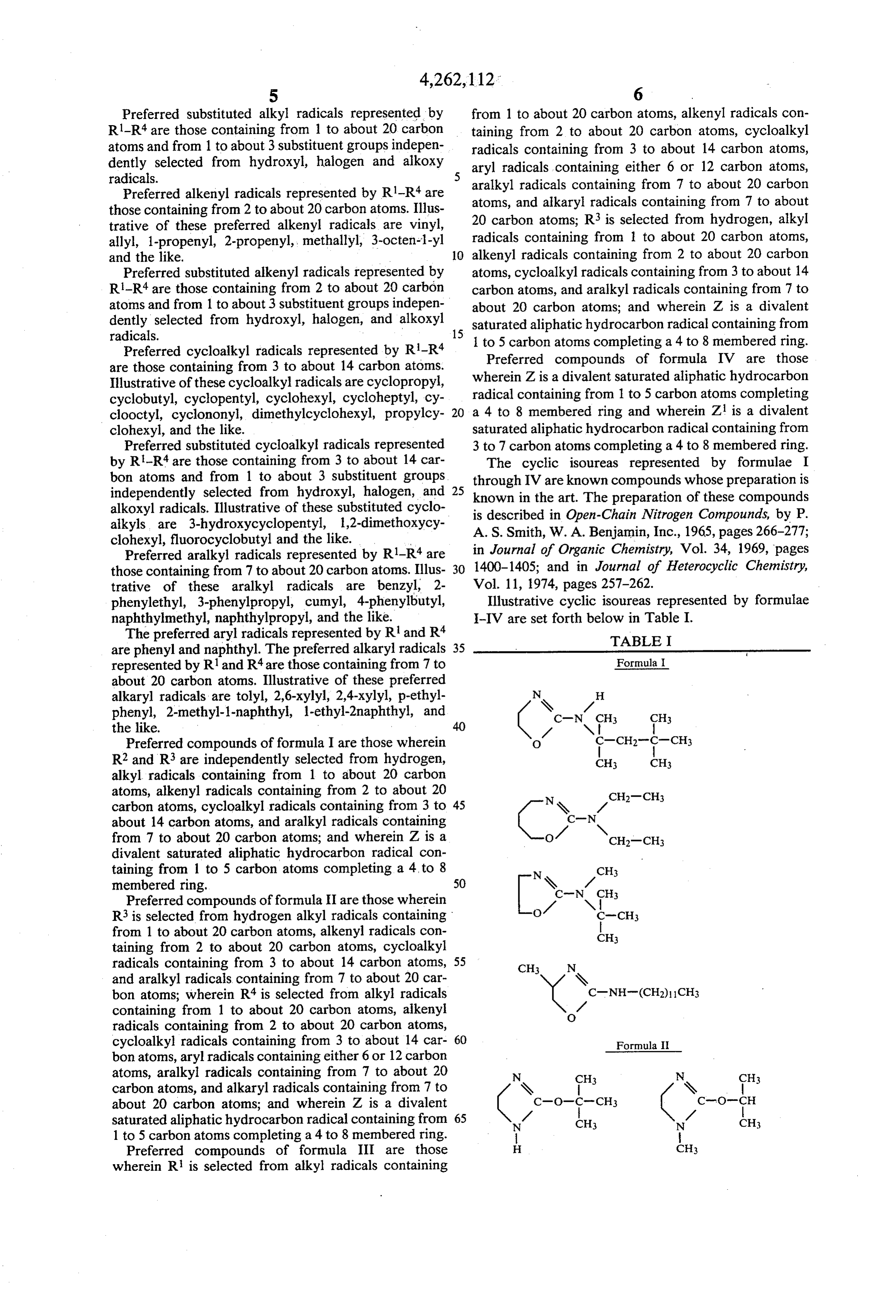
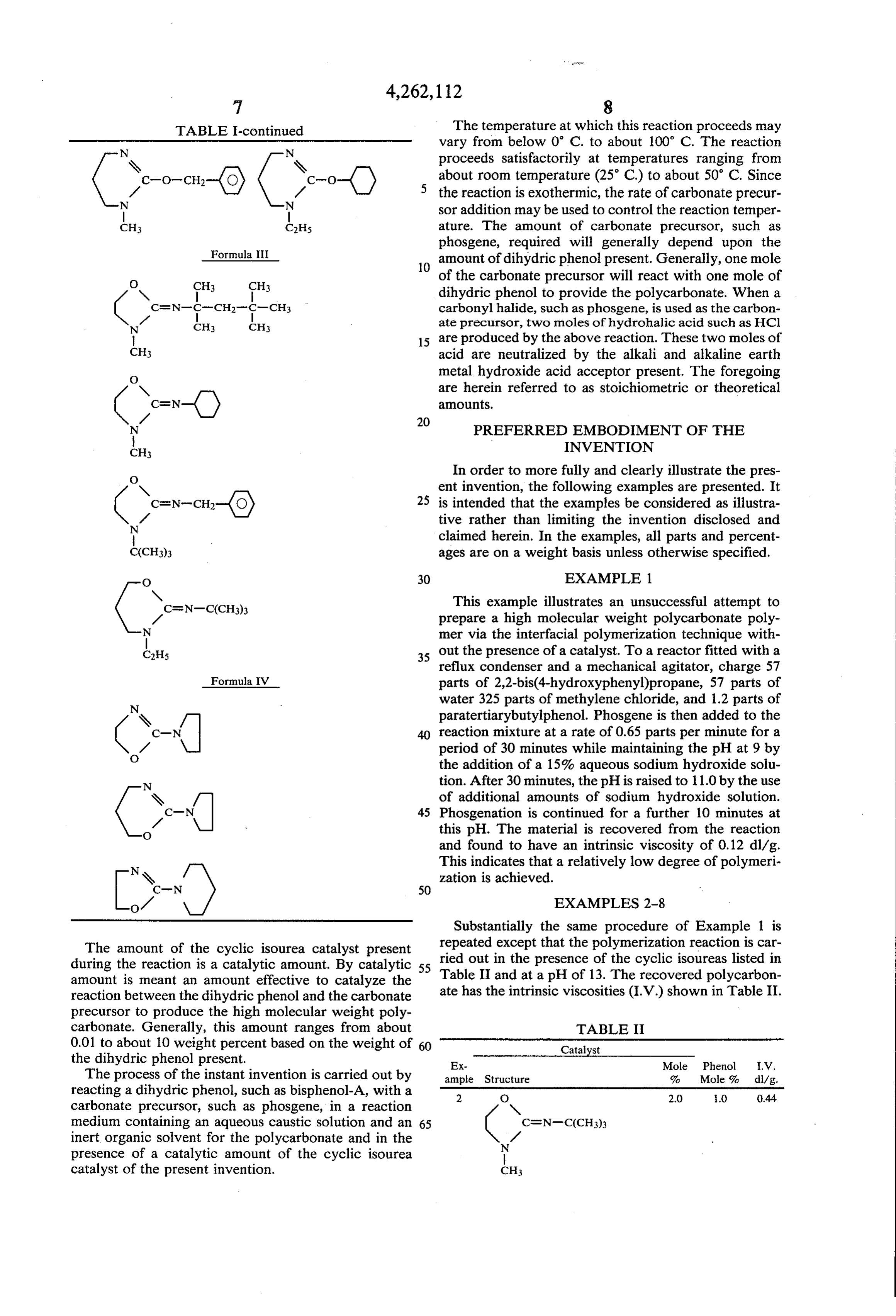
phenylethyl, 3-phenylpropyl, cumyl, 4-phenylbutyl, Illustrative cyclic isoureas represented by formulae naphthylmethyl, naphthylpropyl, and the like. I-IV are set forth below in Table I. The preferred aryl radicals represented by R1 and R' TABLE I are phenyl and naphthyl. The preferred alkaryl radicals 35 represented by R1 and R4 are those containing from 7 to Formula I about 20 carbon atoms. Illustrative of these preferred alkaryl radicals are tolyl, 2,6-xylyl, 2,4-xylyl, p-ethyl N H phenyl, 2-methyl-1-naphthyl, 1-ethyl-2naphthyl, and ( N/ C-NN/ CH3 CH3 the like.
Preferred compounds of formula I are those wherein O i-CH-i-CH R2 and R3 are independently selected from hydrogen, CH3 CH3 alkyl radicals containing from 1 to about 20 carbon atoms, alkenyl radicals containing from 2 to about 20 CH2-CH3 carbon atoms, cycloalkyl radicals containing from 3 to 45 about 14 carbon atoms, and aralkyl radicals containing from 7 to about 20 carbon atoms; and wherein Z is a CH2-CH3 divalent saturated aliphatic hydrocarbon radical con taining from 1 to 5 carbon atoms completing a 4 to 8 CH3 membered ring, 50 /
Preferred compounds of formula II are those wherein
R3 is selected from hydrogen alkyl radicals containing o/ Y-ch, from 1 to about 20 carbon atoms, alkenyl radicals con CH3 taining from 2 to about 20 carbon atoms, cycloalkyl radicals containing from 3 to about 14 carbon atoms, 55 N and aralkyl radicals containing from 7 to about 20 car bon atoms; wherein R is selected from alkyl radicals containing from 1 to about 20 carbon atoms, alkenyl radicals containing from 2 to about 20 carbon atoms,
cycloalkyl radicals containing from 3 to about 14 car 60 Formula II bon atoms, aryl radicals containing either 6 or 12 carbon atoms, aralkyl radicals containing from 7 to about 20 CH3 carbon atoms, and alkaryl radicals containing from 7 to N about 20 carbon atoms; and wherein Z is a divalent saturated aliphatic hydrocarbon radical containing from 65 1 to 5 carbon atoms completing a 4 to 8 membered ring.
Preferred compounds of formula III are those wherein R is selected from alkyl radicals containing
Page 5
TABLE I-continued The temperature at which this reaction proceeds may
vary from below O C. to about 100° C. The reaction proceeds satisfactorily at temperatures ranging from
about room temperature (25 C.) to about 50° C. Since the reaction is exothermic, the rate of carbonate precur sor addition may be used to control the reaction temper
CH3 C2H5 ature. The amount of carbonate precursor, such as phosgene, required will generally depend upon the
Formula III amount of dihydric phenol present. Generally, one mole
of the carbonate precursor will react with one mole of
N dihydric phenol to provide the polycarbonate. When a C=N-C-CH2-C-CH3 carbonylhalide, such as phosgene, is used as the carbon / ate precursor, two moles of hydrohalic acid such as HCl
15 are produced by the above reaction. These two moles of
CH3 acid are neutralized by the alkali and alkaline earth
metal hydroxide acid acceptor present. The foregoing
N are herein referred to as stoichiometric or theoretical
amounts.
N PREFERRED EMBODIMENT OF THE CH3 INVENTION
In order to more fully and clearly illustrate the pres
N ent invention, the following examples are presented. It 25 is intended that the examples be considered as illustra
Ce:N- CH-O) tive rather than limiting the invention disclosed and claimed herein. In the examples, all parts and percent
C(CH3)3 ages are on a weight basis unless otherwise specified. O 30 EXAMPLE 1.
N This example illustrates an unsuccessful attempt to
/ prepare a high molecular weight polycarbonate poly N mer via the interfacial polymerization technique with C2H5 35 out the presence of a catalyst. To a reactor fitted with a reflux condenser and a mechanical agitator, charge 57
Formula IV parts of 2,2-bis(4-hydroxyphenyl)propane, 57 parts of
water 325 parts of methylene chloride, and 1.2 parts of
N paratertiarybutylphenol. Phosgene is then added to the reaction mixture at a rate of 0.65 parts per minute for a period of 30 minutes while maintaining the pH at 9 by the addition of a 15% aqueous sodium hydroxide solu tion. After 30 minutes, the pH is raised to 11.0 by the use of additional amounts of sodium hydroxide solution.
45 Phosgenation is continued for a further 10 minutes at this pH. The material is recovered from the reaction and found to have an intrinsic viscosity of 0.12 dll/g.
This indicates that a relatively low degree of polymeri zation is achieved.
EXAMPLES 2-8
Substantially the same procedure of Example 1 is
The amount of the cyclic isourea catalyst present repeated except that the polymerization reaction is car during the reaction is a catalytic amount. By catalytic 55 ried out in the presence of the cyclic isoureas listed in amount is meant an amount effective to catalyze the Table II and at a pH of 13. The recovered polycarbon reaction between the dihydric phenol and the carbonate ate has the intrinsic viscosities (I.V.) shown in Table II. precursor to produce the high molecular weight poly carbonate. Generally, this amount ranges from about TABLE I 0.01 to about 10 weight percent based on the weight of 60 Catalyst the dihydric phenol present. Ex- Mole Phenol I.V. The process of the instant invention is carried out by ample Structure % Mole % di/g. reacting a dihydric phenol, such as bisphenol-A, with a 2 O 2.0 O 0.44 carbonate precursor, such as phosgene, in a reaction N medium containing an aqueous caustic solution and an 65 CEN-C(CH3)3 inert organic solvent for the polycarbonate and in the N
presence of a catalytic amount of the cyclic isourea catalyst of the present invention. CH3
Page 6
TABLE II-continued
Catalyst : - ra R
Ex- Mole. Phenol I.V. 2. C-N g ample Structure % Mole % d1/g. 5 N- / Yr 3 O H 2.0 - 0.39 O
( Yc-N? its. s : NN N^ YcCH) .. } - is, ? Yc-o-R' 4. O CH3 1.0 10. , 0.47 10 N N^ c-f-cho-ch, k
N O 5 H 2.0 0.2 0.27 15 (1\ N Z. C=N-R , and N N/
a c-o-C) R3 6 h3 .0 O.S 0.40 20 N
a 32 Z.No?c-NCz 7 O 20 w 0.48
N / C2H5 or mixtures thereof wherein R and R' are selected from e-N the group consisting of alkyl, substituted alkyl, alkenyl, N C2H5 substituted alkenyl, cycloalkyl, substituted cycloalkyl, 8 CH3 2.0 0.5 0.33 aryl, aralkyl, and alkaryl radicals; R2 and Rare inde 30 pendently selected from the group consisting of hydro
N gen, alkyl, substituted alkyl, alkenyl, substituted alke ( c-N-O nyl, cycloalkyl, substituted cycloalkyl, and aralkyl radi . O cals; Z is a divalent aliphatic hydrocarbon radical con taining from 1 to 5 carbon atoms and forming a 4 to 8
Utilizing the cyclic isourea catalysts of Examples 2-8 35 membered ring; and Z is a divalent aliphatic hydrocar results in the production of polycarbonates having in- bon radical containing from 3 to 7 carbon atoms and trinsic viscosities ranging from 0.27 to 0.48 dil/g. These foil a 4 to 8 membered ", R4 intrinsic viscosities indicate that polymerization has s E. "...it SEES. ord be seen by comparison of Example 1 with 40 cycloalkyl, aryl, alkaryl, and aralkyl radicals; R and R3
Examples 2-8, the use of the catalysts of the instant are independently selected from the group Eg of invention results in the production of high molecular hydrogen, alkyl, alkenyl, cycloalkyl and aralkyl radi weight polycarbonates via the interfacial polymeriza- cals; Z is a divalent saturated aliphatic y:
tion technique, while, in the absence of a catalyst, the 45 Asia As A to E. Sa interfacial polymerization technique is generally inef- Year Eyear On 21C3 CO fective in producing a high molecular weight polycar- 4. rocess of claim 3 wherein said cvclic isourea bonate under substantially identical reaction conditions. re Rd by the general formula y It will thus be seen that the objects set forth above, so 1s rep y 2 among those made apparent from the preceding de scription, are efficiently attained, and since certain 1N R changes may be made in carrying out the above process Z. CaN and the composition set forth without departing from V-4 Yr the scope of the invention, it is intended that all matters 55 O
Anot dbylist labe interpreted e 5. The process of claim 3 wherein said cyclic isourea
What I claim is: is represented by the general formula 1. An interfacial polymerization process for prepar ing high molecular weight polycarbonates which com- 60 1. N prises reacting, under interfacial polycarbonate-forming Z C-O-R conditions, a dihydric phenol with a carbonate precur- \-4 sor in the presence of a catalytic amount of a cyclic isourea compound. 65 R3 2. The process of claim 1 wherein said cyclic isourea is selected from the group of compounds represented by 6. The process of claim 3 wherein said cyclic isourea the general formulae is represented by the general formula
Page 7
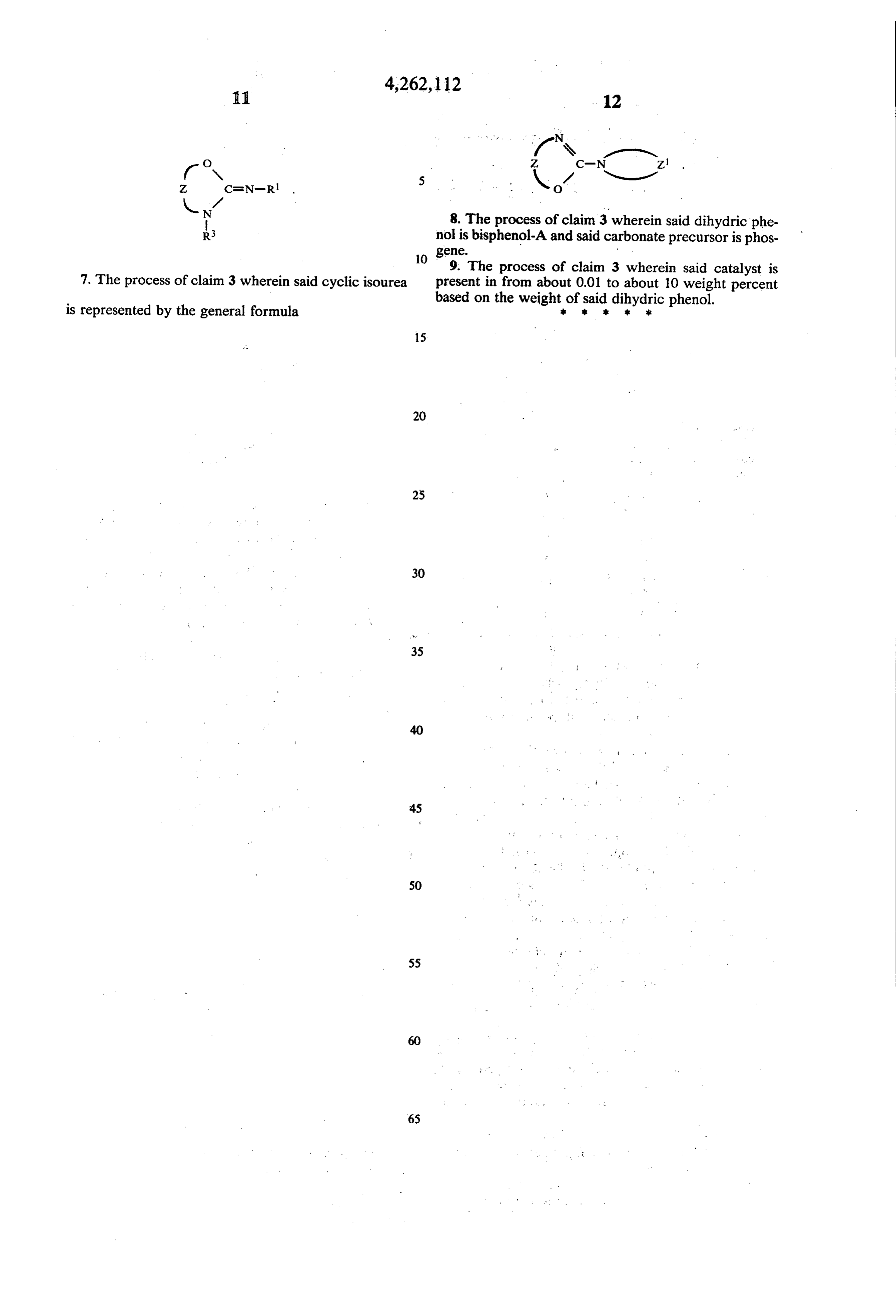
Z N =N-R . s N o^ \-/ a a N 8. The process of claim 3 wherein said dihydric phe R3 nol is bisphenol-A and said carbonate precursor is phos 10 gene.
9. The process of claim 3 wherein said catalyst is 7. The process of claim 3 wherein said cyclic isourea present in from about 0.01 to about 10 weight percent based on the weight of said dihydric phenol.
is represented by the general formula
Provenance
- Collection
- Cited prior art
- Original PDF
- patentimages.storage.googleapis.com →
- Filed
- 1979-12-28
- Pages
- 7
- Method
- pdftotext (the PDF's own text layer) + pdftoppm 300dpi page scans
- Source
- Google Patents bibliographic record
- Granted
- 1981-04-14
- Inventors
- Victor Mark; General Electric Co
- Transcribed from
- patentimages.storage.googleapis.com →