patent · US4518707
Process for preparing high surface area iron/cobalt Fischer-Tropsch slurry catalysts
21 May 1985
Page 1 — bibliographic record
United States Patent (19) 11 Patent Number: 4,518,707 Soled et al. (45) Date of Patent: May 21, 1985 54 PROCESS FOR PREPARING HIGH C.R. Acad. Sc. Paris, p. 268, (May 28, 1969), by P. SURFACE AREA IRON/COBALT Courty and B. Delmon.
FISCHER-TROPSCH SLURRY CATALYSTS "Fischer-Tropsch Synthesis with Iron-Cobalt Alloy 75 Inventors: Stuart L. Soled, Madison; Rocco A. Catalysts'-Stud. Surf Sci. Catal.., 7, Part A, pp. Fiato, Scotch Plains, both of N.J. 432-446, (1981), (English).
AIChE, 1981, Summer National Meeting, Detroit, Pre 73) Assignee: Exxon Research & Engineering print No. 408, (English).
Company, Florham Park, N.J. Journal of Materials Science, 7, (1972), pp. 1383-1390, 21 Appl. No.: 561,190 by A. C. C. Tseung and J. R. Goldstein. ACS Meeting, Division of Petroleum Chemistry, Mar.
(22 Filed: Dec. 14, 1983 1978, entitled "Catalytic Synthesis of Light Olefinic 51) Int. Cl. ......................... B01J 23/78; B01J 27/22 Hydrocarbons from CO and Hydrogen Over Some Iron 52 U.S. Cl. .................................... 502/174: 502/170; Catalysts', by C. H. Yang and A. G. Oblad. 502/177; 502/201: 502/217; 502/218: 502/224; Journal of Catalysis, 32, pp. 452-465, (1974), by J. R. Goldstein et al.
502/226; 502/.328; 502/.330, 502/524; 518/717 J. Phys. Chem. Solids 1959, vol. 9, pp. 165-175, by G. 58 Field of Search ............... 502/.330,524, 328, 177, H. Jonker.
502/170, 174, 201, 217, 218, 224, 226; 518/717 "The Fischer-Tropsch and Related Synthesis", by (56) References Cited Storch, Golombic and Anderson, (Wiley), pp. 242-243.
2,567.296 9/1951 Milligan et al...................... 502/.330 J. Murray and J. W. Linnett.
2,662,090 12A953 Scharmann et al. ..... . 260/449.6 "Numerical Data and Functional Relationships in Sci 2,686, 195 8/1954 McAdams et al. ................. 518/718 ence and Technology', Landolt-Bornstein, New Se 2,735,862 2/1956 Buchmann et al. .. ... 502A260 X 2,850,515 9/1958 Riblett .............................. 260/449.6 ries, vol. 12, part B, Magnetic and Other Properties of 4,154,751 5/1979 McVicker et al. .......... 260/449.6 R Oxides and Related Compounds: Spinels, Iron Oxides and Iron-Metal-Oxygen Compounds, editor K. H.
FOREIGN PATENT DOCUMENTS Hellwege, pp. 245-250.
2050859A 1/1981 United Kingdom. Kirk-Othmer, “Encyclopedia of Chemical Technol
OTHER PUBLICATIONS Journal of Catalysis, vol. 72, pp. 95-110, (1981), by J. A. Khan et al., "The Synthesis of Light Hydrocarbons Amelse, L. A. Schwartz and J. B. Butt. from CO and Hydrogen Mixtures over Selective Metal Hydrocarbon Processing, Nov. 1980, pp. 139-142, Catalysts", ACS 173rd Symposium, Fuel Div., New "Make Olefins from Syn Gas', by V. U. S. Rao and R. Orleans, (Mar. 1977), pp. 138-147. J. Gormley.
Stud., Surf. Catal.., 7, PT/A, p. 432, (1981). Z. Physik Chemie Neue Folge, 112,215-233, (1978), by "Mossbauer Spectroscopy of Supported Fe-Co Alloy Kitzelman et al., “In Situ Study of the Primary Reac Catalysts for Fischer-Tropsch Synthesis'-Journal of tions in the Hydrogenation of CO on Iron Catalysts'. Catalysts, vol. 72, pp. 37-50, (1981). J.C.S. Chem. Comm., pp. 428-430, (1983). "Mossbauer and Magnetic Studies of Bifunctional Primary Examiner-W. J. Shine Medium-Pore Zeolite-Iron Catalysts Used in Synthesis Attorney, Agent, or Firm-Robert J. North; Edward M. Gas Conversion'-Advances in Chemistry Series, 1981, Corcoran pp. 573-588, by Lo et al. 57 ABSTRACT "Mossbauer Effect in Iron and Dilute Iron Based Al loys'-Physics Reports (Section C of Physics Letters), Slurried high surface area Fe-Co spinels which are fully 12, No. 5, (1974), pp. 335-374. reduced/carburized provide exceptionally high activity Gmelins Handbuch der Anorganische Chemie, vol. 8, and selectivity in the conversion of CO/H2 to alpha-ole Auflage, (1959), pp. 408-413 and 1160-1161. fins. These iron-cobalt catalysts maintain good activity Hydrocarbon Processing, May 1983, pp. 88-96. and selectivity under low pressure reaction conditions.
(1977), by D. Kitzelmann et al., German. 32 Claims, No Drawings
Page 2
the process of adding an alpha-hydroxy aliphatic car
PROCESS FOR PREPARNG HIGH SURFACE boxylic acid, e.g., glycolic acid, to a basic aqueous solu AREA IRON/COBALT FISCHER-TROPSCH tion containing dissolved iron and cobalt salts and sub SLURRY CATALYSTS sequently evaporating the solution to dryness to yield an amorphous mixed metal oxide, which on calcining at
BACKGROUND OF THE INVENTION elevated temperature, exhibits a spinel crystal structure 1. Field of the Invention and possesses a high surface area. This invention relates to high surface area iron-cobalt The unsupported high surface area Fe-Co spinels Fischer-Tropsch slurry catalysts, their preparation and O prepared in this manner, possess surface areas (BET) in use in Fischer-Tropsch slurry processes for selectively the range of about 100-200 m2/g (square meters per producing high amounts of C2 to C20 alpha-olefin mate gram), which are significantly higher than correspond rials. ing Fe-Co spinels prepared by a conventional process, 2. Brief Description of the Prior Art e.g., 0.2-1.0 m2/g.
Methods for preparing low molecular weight olefins 15 After the addition of promoter agents, by surface by Fischer-Tropsch processes using coprecipitated deposition or impregnation, such as alkali carbonate, iron-based catalysts including cobalt as cocatalyst, are the high surface area spinels are then subjected to high well-known in the art, as described, for example, in U.S. temperature, e.g., 300-400 C., H2 reduction to obtain
AICHE 1981 Summer Natl Meeting Preprint No. 408, 20 aH2/CO fully reduced alloy, followed by treatment with at 300-400° C. to convert the alloy to a fully
"The Synthesis of Light Hydrocarbons from CO and carburized state.
H2 Mixtures over Selected Metal Catalysts' ACS 173rd The resulting high surface are reduced and carbu Symposium, Fuel Division, New Orleans, March 1977; rized catalysts, provide unusually high activity, selec J. Catalysis 1981, No. 72C1), pp. 37-50; Adv. Chem. tivity and activity maintenance
Sem. 1981, 194, 573-88; Physics Reports (Section C of of CO/H2 to alpha-olefins underin the direct conversion slurry reactor condi
Physics Letters) 12 No. 5 (1974) pp. 335-374; UK Pa 25 tent Application No. 2050859A; J. Catalysis 72, 95-110 tions. These catalysts are especially useful in low pres (1981); Gmelins Handbuch der Anorganische Chemie 8, sure slurry reactor systems where alpha-olefin residence Auflage (1959), pp. 88-96; and Chem. Ing. Tech. 49 times in the reaction zone can be minimized, and the (1977) No. 6, pp. 463-468. physical properties of the catalyst bed are conducive to It is further known that high levels of cobalt in copre 30 use of finely divided powdered catalysts. cipitated iron-cobalt alloy catalysts produce enhanced In accordance with this invention, there is provided, selectivity to olefinic products under certain process a composition of matter comprising an unsupported, conditions, as described in Stud, Surf Catal. 7, Pt/A, Group IA or IIA metal salt promoted iron-cobalt spinel pp. 432 (1981). or mixture thereof, said spinel exhibiting a single phase Although the above-described prior art describes 35 powder x-ray diffraction pattern substantially isostruc catalysts and processes displaying good fixed bed olefin tural with Fe3O4, and possessing a BET surface area synthesis activity, what is particularly desired are slurry greater than 5 m/g and an iron-cobalt atomic ratio of catalysts which can preferably be completely pretreated about 4 to 1 or above.
in situ in the slurry liquid to yield the reduced, carbided Further provided is a composition of matter compris active catalysts in the process displaying the combina ing an iron-cobalt metallic alloy, being isostructural tion of good C2-C20 olefin synthesis activity, low selec with metallic alpha-iron, as determined by X-ray dif tivity to methane, coupled with long-term activity fractometry, and possessing a BET surface area greater maintenance which is essential for a successful commer than 5 m2/g, said alloy being produced by contacting cial process. Particularly desired is where the catalyst the above, described Fe:Co spinel with a reducing at precursor is the metal oxide spinel of the final catalyst 45 mosphere.
composition. Also provided is a composition of matter comprising It has been found that low surface area iron-cobalt spinels having BET surface areas below 5 m2/g are not tion beingand a reduced carbided iron-cobalt alloy, said composi substantially isostructural with Chi-FesC2 readily pretreated in situ in a Fischer-Tropsch slurry (Hagg carbide), as determined liquid under mild conditions to readily yield active SO and possessing a BET surfacebyarea X-ray diffractometry, of greater than 5 catalysts for producing C2-C20 olefins.
The preparation of high surface metal oxides is de above-described iron-cobalt alloy with acontacting m/g, said composition produced by carbiding the
scribed in the French article, "C. R. Acad. Sc. Paris', mosphere. A related composition is also provided being p268 (May 28, 1969) by P. Courte and B, Delmon. The isostructural with Fe3C (cementite) and having a BET article describes a process for producing high surface 55 surface area metal oxides by evaporating to dryness aqueous greater than 5 m2/g. solutions of the corresponding glycolic acid, lactic acid, Furthermore, there is provided a process for produc malic or tartaric acid metal salts. One oxide that was ing the iron-cobalt spinel composition described above prepared by their described method was CoFe2O4. comprising the steps of: (a) evaporating a liquid solution However, the above references do not describe or 60 comprising a mixture of iron and cobalt salts of at least suggest the use of single phase Fe:Co spinels having one alpha-hydroxy aliphatic carboxylic acid, wherein iron-cobalt atomic ratios of 4:1 or above or suggest their the molar ratio of total moles of said acid to total moles applicability in conducting or carrying out slurry-type of said iron and cobalt, taken as the free metals, is about Fischer-Tropsch processes. 1:1 to above, and wherein the atomic ratio of iron:- 65 cobalt, taken as the free metals in said mixture is greater
SUMMARY OF THE INVENTION than 2 to 1; yielding an amorphous residue; and (b) It has been found that high surface area, in situ, pre calcining said residue at elevated temperature for a time treatable iron-cobalt slurry catalysts can be prepared by sufficient to yield an iron-cobalt spinel, exhibiting a
Page 3
single spinel phase, isostructural with Fe3O4, as deter area is in contrast to conventional methods of spinel mined by powder X-ray diffractometry. formation, e.g., high temperature sintering of compo In addition, there is provided a process for preparing nent oxides in an oxygen-free atmosphere. The surface the above-described iron-cobalt alloy composition of area is generally in the range of about 0.1 to 1 m2/g. The matter comprising contacting the above-described iron 5 high surface area obtained in the present process corre cobalt spinel, with a reducing atmosphere under condi sponds to about 0.01 to 0.002 microns in particle size. tions of elevated temperature, pressure, space velocity The iron to cobalt atomic ratio of the metals in the for a time sufficient to substantially reduce the metal spinel is 4:1 or above and is preferably in the range of oxides of the spinel. 7:1 to 35:1, and particularly preferred in the range of There is also provided a process for preparing the 10 19-20:1.
above-described reduced and carbided spinel compris The spinel can be represented by the formula: Fex ing the step of contacting the above-described iron cobalt metal alloy, with a carbiding atmosphere under CoyO4,other wherein x and y are decimal or integer values than zero, and wherein the sum of x plus y is 3 conditions of elevated temperature, pressure, space velocity, for a time sufficient to substantially carbide 15 and the ratio of x to y is 4:1 and preferably being about 7 to 1 to 35 to 1. Particularly preferred is where the iron said alloy.
There is further provided a process for synthesizing a to Representative cobalt atomic ratio is about 19 to 20 to 1.
hydrocarbon mixture containing C2-C20 olefins com sponding to the examples of the various spinels corre prising the step of contacting a catalyst composition, 5Co0.375O4, Fe2.97Co003O4 are
comprised of an unsupported iron cobalt spinel, or mix 20 composition utilized may compriseFe2.25Co0.75O4.
a mixture of spinels ture thereof, said spinel initially exhibiting a single spi in which at least two iron-cobalt spinels are present, nel phase being isostructural with Fe3O4, as determined by X-ray diffractometry, and possessing an initial BET being isostructural with Fe3O4, having BET surface areas greater than 5 m2/g, wherein said spinels individu surface area greater than 5 m2/g and an Fe:Coatomic ally possess different iron-cobalt atomic ratios, being 4:1 ratio of 4:1 or above, said contacting conducted with a 25 or above.
mixture of CO and hydrogen under conditions of pres Physical properties, in general, of these subject spi sure, space velocity and elevated temperature for a time sufficient to produce said C2-C20 olefins. nels are similar to those of magnetite, Fe3O4, and in clude: melting point above 1400 and brown to black in
DESCRIPTION OF THE INVENTION AND 30 color.
PREFERRED EMBODIMENTS The iron-cobalt spinels are generally used in unsup The subject high surface area iron-cobalt spinels are ported form in the slurry process.
new compositions of matter which are isostructural A promoter agent can also be used in the composition with Fe3O4, as determined by X-ray diffractometry and can be used to particularly promote olefin forma using copper K alpha radiation and exhibit a single 35 tion, for example, in the process. General classes of spinel phase. By the term "spinel' is meant a crystal suitable promoter agents include hydroxides carbon structure whose general stoichiometry corresponds to ates, bicarbonates, organic acid salts, e.g. acetates, inor AB2O4, where A and B can be the same or different ganic acid salts, e.g., nitrates, halides, sulfates, of Group cations. Included within this definition is the commonly IA and IIA metals including lithium, sodium, potas found spinel, MgAl2O4. A and B can have the following sium, rubidium, cesium, barium, calcium, strontium, cationic charge combinations: A = +2, B= --3, magnesium, and the like. These promoters can be added A = +4, B = --2, or A= --6, B= -1. Spinels contain an to the iron-cobalt spinel, if desired, simply by impreg approximately cubic close-packed arrangement of oxy nating the iron-cobalt spinel composition with an aque gen atoms with th of the available tetrahedral inter ous solution of one or more of said promoter agents and stices and of the octahedral interstices filled, and can 45 drying the resulting impregnate. exhibit hundreds of different phases. Further descrip Representative examples of specific promoter agents tion of the spinel structure can be found in "Structural are potassium carbonate, potassium sulfate, potassium Inorganic Chemistry' by A. F. Wells, Third Edition, bicarbonate, cesium chloride, rubidium nitrate, lithium Oxford Press, and the Article “Crystal Chemistry and acetate, potassium hydroxide, and the like. Preferred Some Magnetic Properties of Mixed Metal Oxides with 50 are the Group IA compounds and a particularly pre the Spinel Structure' by G. Blasse, Phillips Research ferred promoter agent is potassium carbonate. Review Supplement, Volume 3, pp 1-30, (1964). By the The promoter, if used, is generally present in about a term "isostructural' is meant crystallizing in the same 0.1 to 10 gram-atom 9% of metal ion based on the total general structure type in that the arrangement of the combined metals gram-atoms. A preferred level of pro atoms remains very similar with only minor changes in 55 moter agent is in the range of 1 to 2 gram-atom 9%. A unit cell constants, bond energies, and angles. By the particularly preferred spinel composition of the subject term "single spinel phase' is meant one structural and invention is Fe2.85Co0.15O4/1 % K as potassium carbon compositional formula, corresponding to a single spinel ate. In the empirical formulas used herein, the amount material into which all of the metal components are of the promoter agent, e.g., potassium, is expressed in incorporated, and exhibiting one characteristic X-ray 60 terms of gram atom percent based on the total gram diffraction pattern. atoms of metals used. Thus, "1 gram-atom percent of The spinel possesses a BET surface area greater than potassium' signifies the presence of 1 gram-atom of 5 m2/g as determined by the well-known BET surface potassium per 100 total gram atoms of combined gram area measurement technique as described in reference atoms of Fe and Co.
JACS Vol. 60, p. 309 (1928) by S. Brunauer, P. H. Em 65 The utility of the subject spinels is their ability, to mett, and G. Teller, and preferably the spinel has a undergo unexpectedly facile in situ reduction in the surface area greater than 50 m2/g and particularly pre slurry liquid and pretreatment to form iron-cobalt al ferred of about 100 to 300 m2/g. This obtained surface loys, which are further in situ carbided to form active
Page 4
slurry catalysts in a Fischer-Tropsch slurry process for added is sufficient to keep the pH in the range of about making C2-C20 olefins from CO/hydrogen. 5 to 7.0,
The subject spinel composition can be made by a It should be noted that the exact sequence of steps process in which a basic aqueous solution of cobalt and need not be adhered to as described above, with the iron salts of an alpha-hydroxy aliphatic carboxylic acid, proviso that the resulting aqueous solution contain dis is evaporated to dryness, leaving an amorphous residue, solved iron and cobalt salts in stoichiometric amounts as which is then heated at elevated temperature to substan iron and cobalt salts of alpha-hydroxy carboxylic acid tially form the spinel, in a single spinel phase, being in solution. If there are any insoluble materials present isostructural with Fe3O4 and possessing a surface area after addition of the base and organic acid, they should greater than 5 m/g, preferably above 50 m2/g. The O be filtered prior to the evaporation step. heating is conducted such that no significant loss in At this point, the resulting solution is evaporated, as surface area of the final spinel is incurred. for example, by air drying, or under reduced pressure, The key to the synthesis of the subject spinels is in the at elevated temperature, as practiced in a rotary evapo use of an organic, saturated, aliphatic, alpha-hydroxy rator, or in a vacuum drying oven.
carboxylic acid to form a complex salt, which is soluble 15 The resulting material from the evaporation step is an in the aforementioned aqueous medium, at a pH on the amorphous residue, generally being a powder. This acidic side, i.e. pH of 5-7. The solubility of the iron and residue is heated at elevated temperature at 100 to 600 cobalt organic salts of the alpha-hydroxy carboxylic C. for about 1 to 24 hours in generally air to result in a acid prevent crystallization from occurring, resulting in substantially single spinel phase which is isostructural a crystalline product being obtained from the solution, 20 with Fe3O4, as determined by X-ray diffractometry, as which would possess a relatively low surface area. previously described herein. Preferred temperature The subject method utilizes an alpha-hydroxy ali range is 100-400 C., and particularly preferred is phatic carboxylic acid which acts as a solubilizing agent about 350° C. for single phase spinel formation. for the iron and cobalt salts in the aqueous solution. Any A further subject of the instant invention is a compo saturated aliphatic alpha-hydroxy carboxylic acid, con 25 sition of matter being a reduced iron-cobalt metallic taining at least one alpha-hydroxy grouping, can be alloy formed from the spinel described above, said alloy used to form the soluble iron and cobalt salts in the being isostructural with alpha-iron, as determined by subject invention process in mildly basic aqueous solu X-ray diffractometry, and preferably possessing a BET tion, is deemed to be included within the scope of this surface area of about 5 to 10 m2/g and above or higher. invention. Representative examples of such acids which 30 Generally preferred is where the surface area is about can be mono-hydroxy or di-hydroxy or mono-carboxy 5-10 m2/g and particularly preferred being 6-8 m2/g. lic or di-carboxylic are glycolic, malic, glyceric, man The atomic ratio of iron to cobalt is not restricted and delic, tartaric, lactic acids and mixtures thereof. A pre can be 4:1 and above. Generally, however, for C2-C20 ferred carboxylic acid used in the process is glycolic olefin synthesis in the subject process described herein, acid. 35 the iron-cobalt atomic ratio is preferably about 4 to 1 The amount of acid used is at least the stoichiometric and above and more preferably being about 7 to 1 to 35 amount, i.e., 1 to 1 molar ratio for each metal present to 1 and a particularly preferred range is of about and preferably in about a 5-10% molar excess of the 19-20:1.
stoichiometric amount. Higher ratios can be used, if it is The iron-cobalt alloy can be produced by reducing economical to do so. Lower amounts can also be used the above-described iron-cobalt spinel in a reducing but would result in incomplete iron and cobalt acid salt atmosphere at elevated temperature generally of about formation. 240 C. and above and preferably 300 to 400° C. The The first step in the process comprises forming an reduction can be carried out with various reducing aqueous solution by dissolving iron salts and cobalt gases including hydrogen, H2/CO, and the like, and salts, in a water-soluble salt form such as their nitrates, 45 mixtures thereof. Preferably hydrogen gas alone is gen sulfates, chlorides, acetates, and the like, in water. erally used in an inert carrier medium such as helium, The concentration of the salts in the aqueous liquid is neon, argon, or nitrogen, in the absence of CO when not critical to the extent that the salts are present in less substantially pure, non-carbided alloy is desired. than a saturated solution to avoid precipitation. For The alloy can be prepared ex situ in a tube reactor or example, an 80-90% saturated solution, of combined 50 in situ in the Fischer-Tropsch slurry process. The in situ dissolved metal molarities for avoiding precipitation in preparation is conducted in the slurry apparatus when the process, can be effectively used. the above described spinel is reduced while suspended The temperature of the aqueous solution is not criti in the slurry liquid, in a reducing atmosphere being cal and may be above room temperature to aid in the preferably a hydrogen atmosphere at elevated tempera solubilizing process. However, room temperature is 55 ture being about 240 C., or above, preferably at adequate and is the temperature generally used in the 240-300 C., at a space velocity, pressure, and hydro process. The pressure also is not critical in the process gen concentration sufficient to cause substantial reduc and atmospheric pressure is generally used. tion of the spinel to the alloy. Substantial reduction is The aqueous solution can also contain a small amount complete when the X-ray diffraction pattern shows a of organic solvent such as ethanol, acetone, and the like 60 pattern substantially isostructural with alpha-iron. for aiding in the solubilizing of the iron and cobalt salts The above-described alloy is useful in forming a carb of the alpha-hydroxy carboxylic acid. ided iron-cobalt catalyst useful in the subject Fischer Following the dissolving of the iron and cobalt salts, Tropsch slurry process for making C2-C20 olefins, as the alpha-hydroxy carboxylic acid is added, together described herein.
with a sufficient quantity of base, usually being ammo 65 Also, subjects of the instant invention are composi nium hydroxide, sodium hydroxide, potassium hydrox tions of matter being reduced and carbided iron-cobalt ide, and the like, preferably ammonium hydroxide, to alloys, one being isostructural with FesC2, "Hagg car solubilize the resulting acid salts. The amount of base bide' as described in Trans, of the Iron & Steel Inst. of
Page 5
Japan, Vol. 8, p. 265 (1968) by Nagakura et al., as deter Also, a subject of the instant invention is a Fischer mined by X-ray diffractometry and possessing a BET Tropsch process for producing C2-C20 olefins by utiliz surface area of greater than 5 m2/g; and two, being ing the iron-cobalt spinel, iron-cobalt alloy and the isostructural with Fe3C "cementite', as determined by reduced, carbided, iron-cobalt spinel catalyst described X-ray diffractometry, and possessing a BET surface hereinabove.
area of greater than 5 m2/g. Although a fixed bed process can be used, a preferred Preferred is where the surface area of either material process mode for operating the Fischer-Tropsch pro is about 25-200 m2/g and particularly being preferred cess utilizing the catalysts described herein is a slurry of about 60-150 m2/g, including both the formed Fe-Co type process wherein the catalyst in fine particle size carbide and surface carbon formed during the carbiding 10 and high surface area being above 5 m2/g is suspended step. in a liquid hydrocarbon and the CO/hydrogen mixture The atomic ratio of the iron:cobalt is not restricted forced through the catalyst slurry allowing good for either composition but generally for use in the sub contact between the CO/hydrogen and the catalyst to ject process for producing C2-C20 olefins is 4:1 or above initiate and maintain the hydrocarbon synthesis process. and preferably 7:1 to 35:1 and particularly preferred in 15 Advantages of a slurry process over that of a fixed the range of about 19-20:1. bed process are that there is better control of the exo The carbided iron-cobalt alloy, having an X-ray dif thermic heat produced in the Fischer-Tropsch process fraction pattern isostructural with FesC2, can be pro during the reaction and that better control over catalyst duced by carbiding the iron-cobalt alloy, described activity maintainance by allowing continuous recycle, hereinabove, in a suitable carbiding atmosphere at ele 20 recovery, and rejuvenation procedures to be imple vated temperature of up to about 400 C. Temperatures mented. The slurry process can be operated in a batch above 500 lead to formation of Fe-Co carbides which or in a continuous cycle, and in the continuous cycle, are isostructural with Fe3C, cementite. the entire slurry can be circulated in the system allow Carbiding atmospheres which can be used to produce ing for better control of the primary products residence the subject reduced, carbided, catalyst include CO, 25 time in the reaction zone.
CO/hydrogen, aliphatic hydrocarbons, aromatic hy The subject process can use any of the above drocarbons, and the like. A preferred carbiding atmo described materials, as catalyst or catalyst precursors: sphere is CO/hydrogen. When using CO/hydrogen the iron-cobalt spinel isostructural with Fe3O4; the iron carbiding atmosphere, mixtures of CO/hydrogen can be cobalt alloy isostructural with alpha-iron; or, the re used in a 1:10 to 10:1 molar ratio. A preferred ratio used 30 duced, carbided, iron-cobalt alloy which is isostructural for carbiding purposes is a 1:1 molar ratio. with FesC2, or Fe3C. All the materials must have a The carbiding step is generally conducted at a tem BET surface area of greater than 5 m2/g, to be applica perature of about 250 C., or above and preferably at ble in the efficient claimed slurry process described 300 to 400 C. A preferred method of carbiding the herein. These materials can also be made independently alloy is in situ in the slurry liquid to be used in the Fisch 35 of the apparatus prior to use or can be made in situ in the er-Tropsch process. A particularly preferred method is apparatus during the carrying out of the process. A where the spinel is treated with a mixture of CO/hydro preferred procedure is where the spinel, in high surface gen and reduced and carbided in situ in one step prior to area form is pretreated in situ in the slurry liquid, in hydrocarbon synthesis. The pressure is generally about either distinct reduction-carbiding steps or in one re 1 atmosphere, and a space velocity of about 20-20,000 duction-carbiding step as with CO/hydrogen at ele v/v/hr is chosen in order to completely carbide the vated temperature. A full discussion of each of the ma starting iron-cobalt oxide which can be determined by terials, their properties and their preparation are given X-ray diffractometry when the material becomes isos hereinabove and need not be reiterated.
tructural with Haag carbide, FesC2. The Haag-type The slurry liquid used in the process is a liquid at the Fe-Co carbides produced in this process are of the gen 45 reaction temperature, must be chemically inert under eral formula: Fes-(5/3)Co(5/3)C2, and also include the reaction conditions and must be a relatively good surface carbon produced during the carbiding process. solvent for CO/hydrogen and possess good slurrying Carbiding temperatures above 500 C. and preferably and dispersing properties for the finely divided catalyst. 500-700 C., lead to formation of a mixed Fe-Co car Representative classes of organic liquids which can be bide of the general formula Fe3-yCoC, which is gener 50 utilized are high boiling paraffins, aromatic hydrocar ally formed under ex situ procedures which allow the bons, ethers, amines, or mixtures thereof. The high use of higher temperatures than possible in the in situ boiling paraffins include Clo-C50 linear or branched slurry process. paraffinic hydrocarbons; the aromatic hydrocarbons The resulting carbide is an active slurry catalyst for include C2-C20 single ring and multi- and fused ring producing C2-C20 olefins in the described Fischer 55 aromatic hydrocarbons; the ethers include aromatic Tropsch slurry process. ethers and substituted aromatic ethers where the ether Also, the above-described alloy and carbide, can be oxygen is sterically hindered from being hydrogenated; prepared independently of the slurry apparatus and may the amines include long chain amines which can be be pyrophoric and inconvenient to handle. In that case, primary, secondary, and tertiary amines, wherein pri the material may be passivated by contact with oxygen 60 mary amines preferably contain at least a C12 alkyl for a sufficient time to reduce or eliminate the pyro group in length, secondary amines preferably contain at phoric tendency. Generally, the oxygen used in the least two alkyl groups being C7 or greater in length, and passivating process is used in an inert gas stream carrier tertiary amines preferably contain at least three alkyl such as helium for a sufficient time to cause passivation. groups being C6 or higher in length. The slurry liquid Generally, this is conducted preferably at room temper 65 can contain N and O in the molecular structure but not ature, at a pressure and space velocity which are conve S, P, As or Sb, since these are poisons in the slurry nient and easy to control and to maximize the efficiency process. Representative examples of specific liquid of the process needed for complete passivation. slurry solvents useful are dodecane, tetradecane, hexa
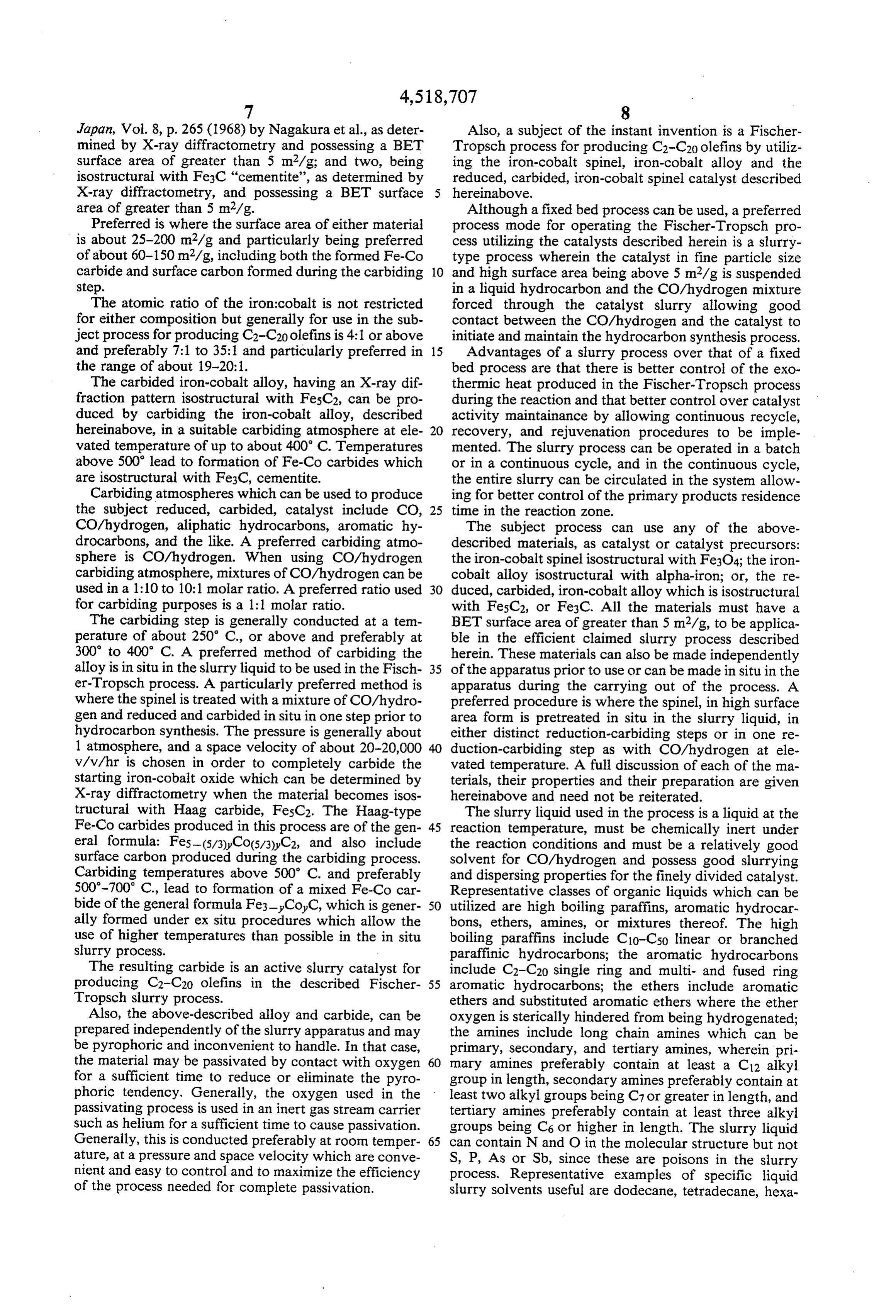
Page 6
decane, octadecane, cosane, tetracosane, octacosane, also be used but tend to lead to more paraffinic prod dotriacontane, hexatriacontane, tetracontane, tetratet uctS.
racontane, toluene, o-, m-, and p-xylene, mesitylene, Generally, after the pretreatment, the CO/hydrogen C1-C12 mono- and multi-alkyl substituted benzenes, feedstream is introduced to initiate and maintain hydro dodecylbenzene, naphthalene, anthracene, biphenyl, carbon synthesis. By the use of the above-described diphenylether, dodecylamine, dinonylamine, trioctyla catalysts in the system, the activity maintenance is very mine, and the like. Preferred liquid hydrocarbon slurry good and on a laboratory scale, e.g., 500 cc of slurry solvent is octacosane or hexadecane. containing 50 g of catalyst described herein, 30 days of The amount of catalyst used in the liquid hydrocar continuous run have been observed without significant bon slurry solvent is generally about 10 to 60 g. of dry O decline in percent CO conversion activity while main catalyst per 500 g. slurry liquid. Preferably about 30 to taining good C2-C20 olefin synthesis activity. 50 g. dry catalyst per 500 g. slurry liquid slurry is uti The percent CO conversion obtainable in the subject lized, being in about a respective 5:1 to 10:1 weight process, while providing substantial quantities of ratio. C2-C20 olefins, ranges from about 30 to 80 percent and The slurry system, comprised of the slurry liquid and 15 usually about 50 to 60 percent for sufficient C2-C20 finally divided catalyst, is generally stirred to promote olefin production.
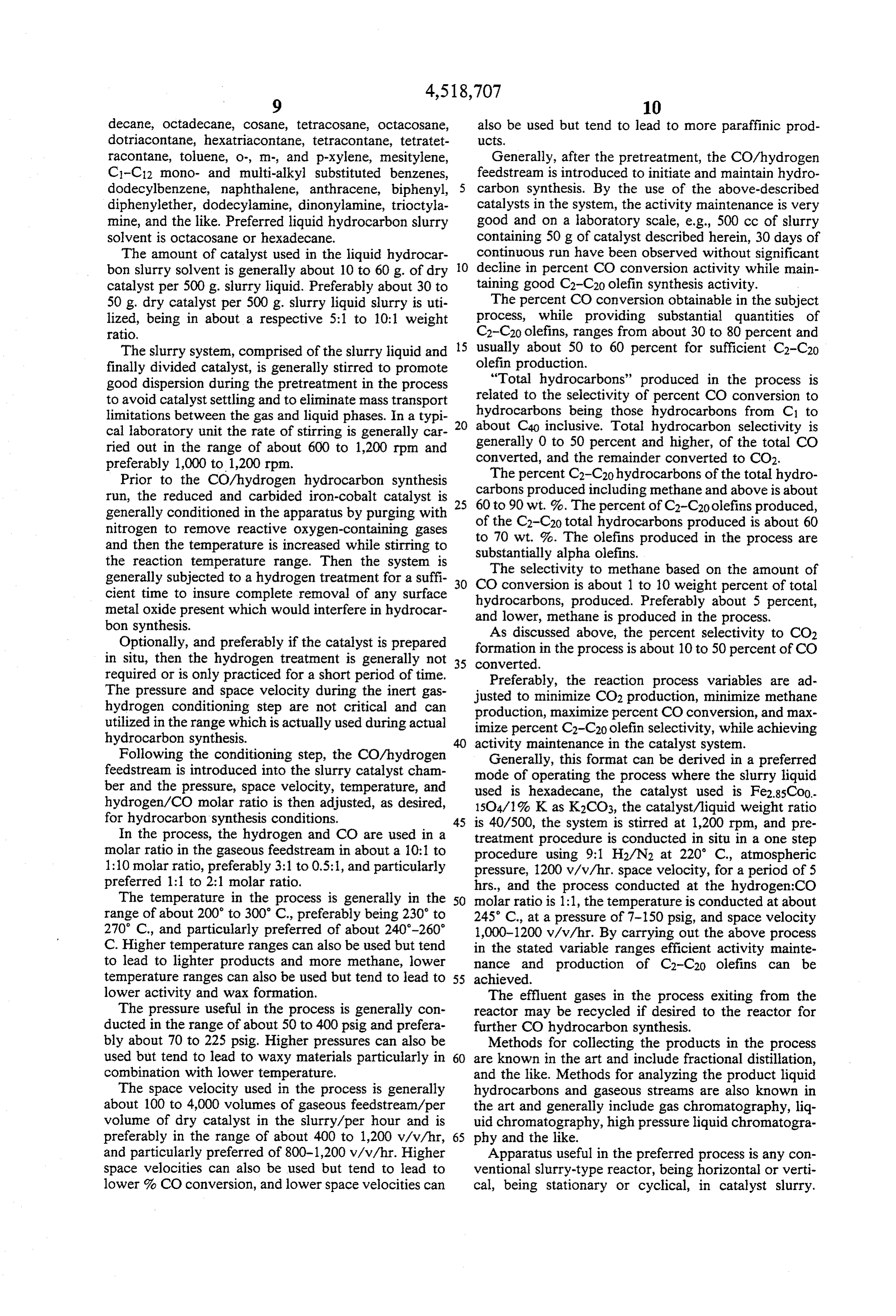
good dispersion during the pretreatment in the process "Total hydrocarbons' produced in the process is related to avoid catalyst settling and to eliminate mass transport hydrocarbons to the selectivity of percent CO conversion to limitations between the gas and liquid phases. In a typi 20 being those hydrocarbons from C1 to cal laboratory unit the rate of stirring is generally car about C40 inclusive. Total hydrocarbon selectivity is ried out in the range of about 600 to 1,200 rpm and generally converted, 0 to 50 percent and higher, of the total CO and the remainder converted to CO2.
preferably 1,000 to 1,200 rpm. The percent C2-C20 hydrocarbons of the total hydro Prior to the CO/hydrogen hydrocarbon synthesis run, the reduced and carbided iron-cobalt catalyst is 60 carbons produced including methane and above is about generally conditioned in the apparatus by purging with 25 of to 90 wt.%. The percent of C2-C20 olefins produced, nitrogen to remove reactive oxygen-containing gases the C2-C20 total hydrocarbons produced is about 60 and then the temperature is increased while stirring to to 70 wt.%. The olefins produced in the process are the reaction temperature range. Then the system is substantially The alpha olefins.
selectivity to methane based on the amount of generally subjected to a hydrogen treatment for a suffi 30 CO conversion is about cient time to insure complete removal of any surface hydrocarbons, produced.1 toPreferably 10 weight percent of total about 5 percent, metal oxide present which would interfere in hydrocar and lower, methane is produced in the process. bon synthesis. As discussed above, the percent selectivity to CO2 Optionally, and preferably if the catalyst is prepared formation in situ, then the hydrogen treatment is generally not 35 converted.in the process is about 10 to 50 percent of CO required or is only practiced for a short period of time. Preferably, the reaction process variables are ad The pressure and space velocity during the inert gas justed to minimize CO2 production, minimize methane hydrogen conditioning step are not critical and can production, utilized in the range which is actually used during actual imize percentmaximize
percent CO conversion, and max olefin selectivity, while achieving hydrocarbon synthesis. activity maintenance in the catalyst system. Following the conditioning step, the CO/hydrogen Generally, this format can be derived in a preferred feedstream is introduced into the slurry catalyst cham mode of operating the process where the slurry liquid ber and the pressure, space velocity, temperature, and used is hexadecane, the catalyst used is Fe2.85Co0 hydrogen/CO molar ratio is then adjusted, as desired, 15O4/1% K as K2CO3, the catalyst/liquid weight ratio for hydrocarbon synthesis conditions. 45 is 40/500, the system is stirred at 1,200 rpm, and pre In the process, the hydrogen and CO are used in a treatment procedure is conducted in situ in a one step molar ratio in the gaseous feedstream in about a 10:1 to procedure using 9:1 H2/N2 at 220 C., atmospheric 1:10 molar ratio, preferably 3:1 to 0.5:1, and particularly pressure, 1200 v/v/hr. space velocity, for a period of 5 preferred 1:1 to 2:1 molar ratio. hrs., and the process conducted at the hydrogen:CO The temperature in the process is generally in the 50 molar ratio is 1:1, the temperature is conducted at about range of about 200' to 300° C., preferably being 230 to 245° C., at a pressure of 7-150 psig, and space velocity 270° C., and particularly preferred of about 240-260 1,000-1200 v/v/hr. By carrying out the above process C. Higher temperature ranges can also be used but tend in the stated variable ranges efficient activity mainte to lead to lighter products and more methane, lower nance and production of C2-C20 olefins can be temperature ranges can also be used but tend to lead to 55 achieved.
lower activity and wax formation. The effluent gases in the process exiting from the The pressure useful in the process is generally con reactor may be recycled if desired to the reactor for ducted in the range of about 50 to 400 psig and prefera further CO hydrocarbon synthesis.
bly about 70 to 225 psig, Higher pressures can also be Methods for collecting the products in the process used but tend to lead to waxy materials particularly in 60 are known in the art and include fractional distillation, combination with lower temperature. and the like. Methods for analyzing the product liquid The space velocity used in the process is generally hydrocarbons and gaseous streams are also known in about 100 to 4,000 volumes of gaseous feedstream/per the art and generally include gas chromatography, liq volume of dry catalyst in the slurry/per hour and is uid chromatography, high pressure liquid chromatogra preferably in the range of about 400 to 1,200 v/v/hr, 65 phy and the like.
and particularly preferred of 800-1,200 v/v/hr. Higher Apparatus useful in the preferred process is any con space velocities can also be used but tend to lead to ventional slurry-type reactor, being horizontal or verti lower % CO conversion, and lower space velocities can cal, being stationary or cyclical, in catalyst slurry.
Page 7
Other apparatus not specifically described herein will 10% oxygen in helium was introduced for one hour to be obvious to one skilled in the art from a reading of this passivate the material. The X-ray diffraction pattern of disclosure. the resulting material was isostructural with Fesc. The EXAMPLES BET nitrogen surface area of the material was about 118 m2/g. Analysis showed that about 60-70 weight
The following Examples are illustrative of the best percent of the material was carbon and thus the material mode of carrying out the invention as contemplated by us and should not be construed as being limitations on was a composite of Fea.75Co0.25C2/1 gram-atom 76 K and surface carbon.
the scope and spirit of the instant invention.
Unless otherwise indicated, the selectivity weight 10 EXAMPLE 2 percentages of product hydrocarbons is given on a Into a slurry reactor, being a 300 cc Parr CSTR (con CO2-free basis.
It should be further noted that the data in Example 8 tinuous cosane stirred tank reactor) was charged: 50 g of octa and 5.0 of the high surface area spinel, described was obtained utilizing a large scale slurry apparatus and the data was analyzed for alcohols content as reported. 15 above in Example 1. The system was purged with nitro The previous examples did not analyze for or report an gen and then H2 while the temperature was increased alcohols content and it is reasonably believed to be from room temperature to 220 C., where the system below 15% of total products in the small scale appara was maintained under these conditions in a hydrogen tus. atmosphere with stirring for a one-hr period at 600 rpm. EXAMPLE 1. 20 The system was then placed under CO hydrogenation reaction conditions by adjusting the reaction tempera
Preparation of Fe2.85Co0.15O4 Spinel ture to 270° C., the H2/CO volume ratio to 1:1, the 198.04 grams of ferric nitrate in 144 cc of water and space velocity to 1200 V gaseous feedstream/V dry 7.5 grams of cobalt nitrate in 8 cc of water were mixed 25 catalyst/hr, the pressure to 70 psig, and the slurry stir together. To this solution was added a solution of 41.6 rer speed to 600 rpm in the octacosane solvent. The grams of 85% glycolic acid containing 45 cc of ammo effluent gas from the reactor was monitored by an HP nium hydroxide such that the resulting pH of the ammo 5840A Refinery Gas Analyzer to determine percent CO nium glycolate solution was about 6.5. The ammonium conversion and the nature of the hydrocarbon products. glycolate solution constituted 0.51 moles of glycolic The results are listed below in Table I under the high acid such that about a one to one molar ratio of total 30 surface area spinels as "oxide'. metals including iron and cobalt to glycolic acid re Further runs were made based on the spinel which sulted. The ammonium glycolate solution was added to was (1) reduced ex situ, and (2) reduced/carbided ex the aqueous solution containing iron and cobalt salts situ, prior to being charged into the slurry liquid. The and the contents stirred. The resulting solution was results are listed below in the Table as "reduced' and allowed to evaporate by air drying. Upon drying at 35 “reduced/carburized', respectively, together with the room temperature the resulting solid was shown by specific pretreatment conditions. The control, and the X-ray diffraction to be an amorphous material because low of lack of sharp discrete reflections. The solid was samesurface area spinel also run under substantially the conditions, are listed below.
heated in air at 350 C. for 2 hours. An X-ray diffraction pattern of the resulting material showed it to be a single from Alpha Chemicals andsample, The listed comparative Fe2O3, was obtained had a BET surface area of phase cobalt-iron spinel isomorphous with Fe3O4. The less than 10 m2/g.
X-ray diffraction peaks were broadened relative to a compositionally equivalent material obtained by a high The listed comparative sample Fe2.85Co0.15O4/1% K temperature procedure. This indicated that the resulting was made by sintering an intimate mixture of Fe2O3, Fe obtained material was of very small particle size. The 45 metal and Co3O4, in the appropriate molar ratio, at surface area of the resulting material was about 200 800-1,000 C. for 24 hours in an evacuated sealed tube. Square meters per gram. Carbon analysis of the material The solid was collected, crushed, pelletized and then indicated approximately 0.15% carbon percent. The the sintering procedure repeated. The obtained solid resulting material was impregnated with one gram was crushed and then impregnated with aqueous potas atomic percent of potassium using an aqueous solution 50 sium carbonate and then dried at 125 C. for several of potassium carbonate and drying of the resulting im hours in a drying oven. The surface area of the obtained pregnated sample at 125 C. The resulting solid had an solid was about 0.3 m2/g.
empirical formula of Fe2.85Co0.15O4/1% K. TABLE I Preparation of Alloy 55 Slurried F-T Catalysts with 1:1 H2:CO
The above obtained oxide was reduced at 400 C. in % CO % % % %. Oiefin a stream of 15 volume percent hydrogen/85% helium at Catalysts Conv. CO2 CH4 C2-C4 C2-C4 200 v/v/hr (SHSV) for 4 hours. One percent of oxygen Fe2O3 <4.0 -- - M- -
in helium was introduced at room temperature for one 1%. K. Fe2.85Co.15O4/ <4.0 m - m --
hour to passivate the material. The X-ray of the result 60 Spinels (100 + m2/g) ing material was isostructural with alpha iron. The re Fe2 35Co0 1504 sulting BET nitrogen surface area was 8 m2/g. Oxide 78 48 3.1 7.3 92
Preparation of Carbide Reduced/Carburized 79 48 4.5 6.0 92 The above reduced material was treated at 400° C. in 65 Conditions: 270° C., 1:1 Hz:CO, 1200 v/v/cat/hr. 70 psig, 600 rpm, octacosane a stream of 15 volume percent hydrogen/80% heli solvent. H at 350° C. for 12 hours and 400 C. for 24 hours. um/5% CO at 200 v/v/hr. for four hours. Following H/CO at 350° C. for 12 hours and 400° C. for 24 hours. this the sample was cooled to room temperature and
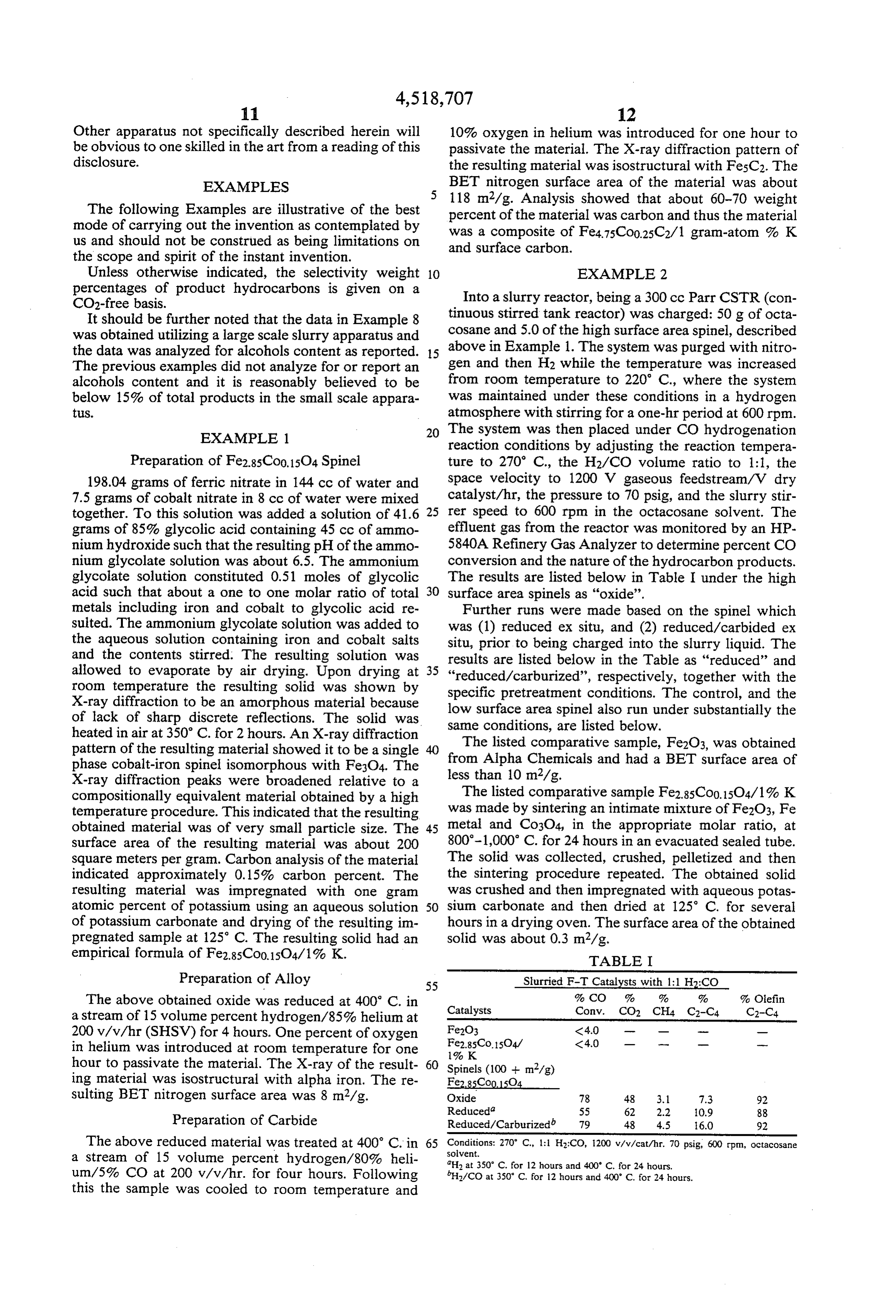
Page 8
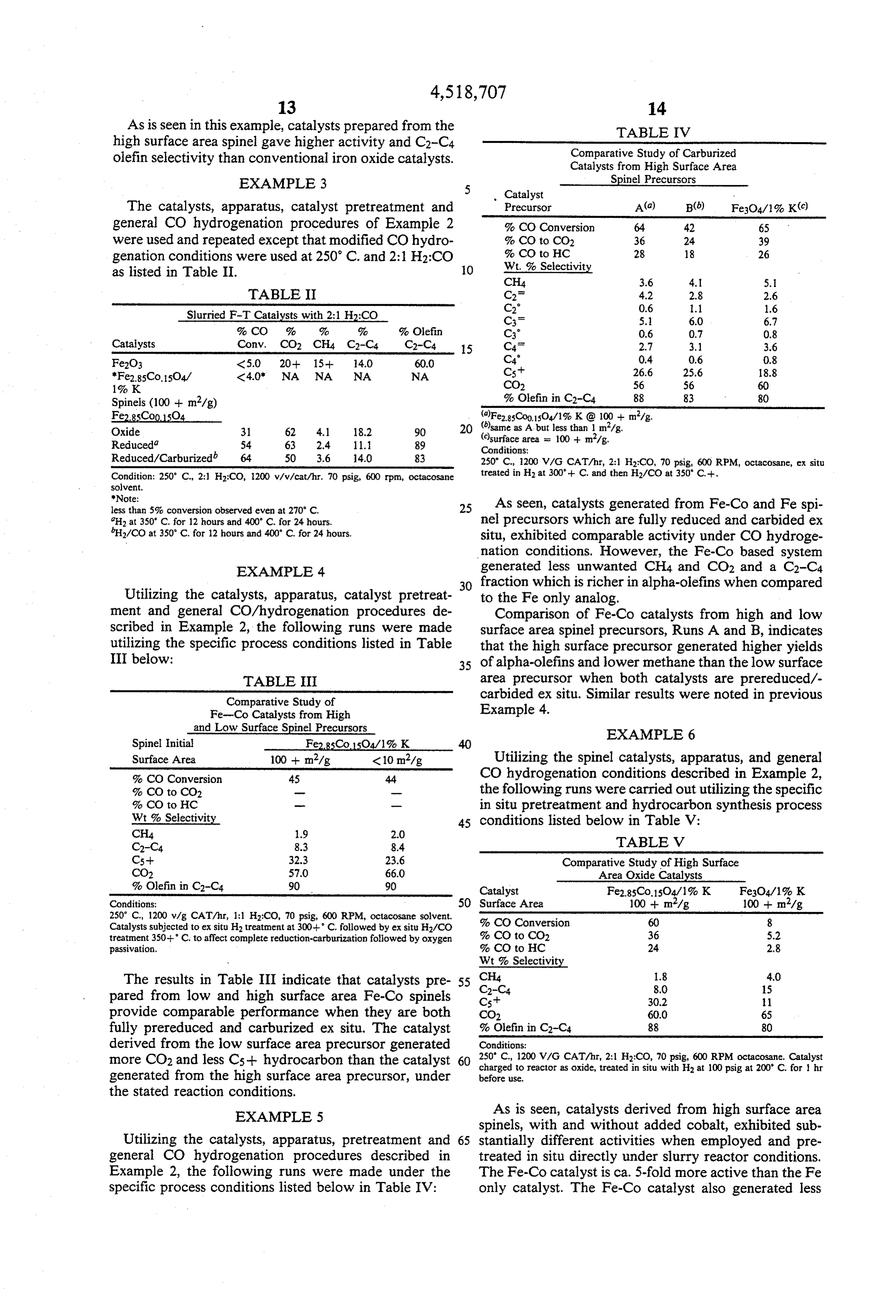
As is seen in this example, catalysts prepared from the TABLE IV high surface area spinel gave higher activity and C2-C4 Comparative Study of Carburized olefin selectivity than conventional iron oxide catalysts. Catalysts from High Surface Area EXAMPLE 3 5 Spinel Precursors
Catalyst
The catalysts, apparatus, catalyst pretreatment and Precursor A(a) B(b) Fe3O4/1% Ke) general CO hydrogenation procedures of Example 2 % CO Conversion 64 42 65 were used and repeated except that modified CO hydro % CO to CO2 36 24 39 genation conditions were used at 250 C. and 2:1 H2:CO % CO to HC 28 18 26 as listed in Table II. O Wt. % Selectivity
TABLE II c 4.2 2.8 2.6
Slurried F-T Catalysts with 2:1 H2:CO C= 5. 6.0 6.7 % CO %. 2, % %. Olefin C 0.6 0.7 0.8 Catalysts Conv. CO2 CH4 C2-C4 C2-C4 15 C4- 2.7 3.1 3.6 Fe2O3 <5.0 20- 15-- 14.0 60.0 C4 0.4 0.6 0.8 *Fe2.85Co.15O4/ <4.0" NA NA NA NA C5t 26.6 25.6 18.8 19%. K. CO2 56 56 60 Spinels (100 + m/g) % Olefin in C2-C4 88 83 80 Fe2.85Co0.1504 (Fe2.85Co01s04/1% K G 100 + m/g. Oxide 31 62. 4.1 18.2 90 20 same as A but less than 1 m/g, Reduced 54 63 2.4 11. 89 (surface area = 100 + m/g.
Conditions:
Reduced/Carburized 64 50 3.6 14.0 83 250 C., 1200 VaG CATAhr, 2:1 H2CO, 70 psig, 600 RPM, octacosane, ex situ Condition: 250 C., 2:1 H2:CO, i200 W/vacatahr. 70 psig, 600 rpm, octacosane treated in H2 at 300+ C. and then H2/CO at 350 C.--. solvent.
Note:
less than 5% conversion observed even at 270 C. 25 As seen, catalysts generated from Fe-Co and Fespi H2 at 350° C. for 12 hours and 400° C. for 24 hours. nel precursors which are fully reduced and carbided ex H/CO at 350° C. for 12 hours and 400° C. for 24 hours. situ, exhibited comparable activity under CO hydroge nation conditions. However, the Fe-Co based system
EXAMPLE 4 generated less unwanted CH4 and CO2 and a C2-C4
Utilizing the catalysts, apparatus, catalyst pretreat- 3o fraction which is richer in alpha-olefins when compared to the Fe only analog.
ment and general CO/hydrogenation procedures de Comparison of Fe-Co catalysts from high and low scribed in Example 2, the following runs were made surface area spinel precursors, Runs A and B, indicates utilizing the specific process conditions listed in Table that the high surface precursor generated higher yields III below: 35 of alpha-olefins and lower methane than the low surface TABLE III area precursor when both catalysts are prereduced/-
Comparative Study of carbided ex situ. Similar results were noted in previous Fe-Co Catalysts from High Example 4.
and Low Surface Spinel Precursors EXAMPLE 6
Spinel Initial Fe2.8sCo. 15O4/1% K 40
Surface Area 100 + m2/g <10 m/g Utilizing the spinel catalysts, apparatus, and general % CO Conversion 45 44 CO hydrogenation conditions described in Example 2, % CO to CO2 --- the following runs were carried out utilizing the specific % CO to HC -- -- in situ pretreatment and hydrocarbon synthesis process Wt % Selectivity 45 conditions listed below in Table V: CH4 1.9 2.0
C2-C4 8.3 8.4 TABLE V C5- 32.3 23.6 Comparative Study of High Surface CO2 57.0 66.0 Area Oxide Catalysts %. Olefin in C-C4 90 90 Catalyst Fe2.85Co.15O4/1% K Fe3O4/1% K Conditions; 50 Surface Area 100 + m/g 100 + m/g 250 C., 1200 vag CATAhr, i:1 H2:CO, 70 psig, 600 RPM, octacosane solvent. % CO Conversion 60 8 Catalysts subjected to ex situ H2 treatment at 300-- C. followed by ex situ H2/CO treatment 350-- C. to affect complete reduction-carburization followed by oxygen % CO to CO2 36 5.2 passivation. % CO to HC 24 2.8 Wt % Selectivity
The results in Table III indicate that catalysts pre 55 CH4 1.8 4.0 pared from low and high surface area Fe-Co spinels C2-C4 Cs+
provide comparable performance when they are both CO2 60.0 65 fully prereduced and carburized ex situ. The catalyst % Olefin in C2-C4 88 80 derived from the low surface area precursor generated Conditions:
more CO2 and less C5 -- hydrocarbon than the catalyst 60 250' C., 1200 V/G CAT/hr, 2:1 H2:CO, 70 psig, 600 RPM octacosane. Catalyst charged to reactor as oxide, treated in situ with H2 at 100 psig at 200' C. for 1 hr generated from the high surface area precursor, under before use.
the stated reaction conditions.
EXAMPLE 5 As is seen, catalysts derived from high surface area spinels, with and without added cobalt, exhibited sub
Utilizing the catalysts, apparatus, pretreatment and 65 stantially different activities when employed and pre general CO hydrogenation procedures described in treated in situ directly under slurry reactor conditions.
Example 2, the following runs were made under the The Fe-Co catalyst is ca. 5-fold more active than the Fe specific process conditions listed below in Table IV: only catalyst. The Fe-Co catalyst also generated less
Page 9
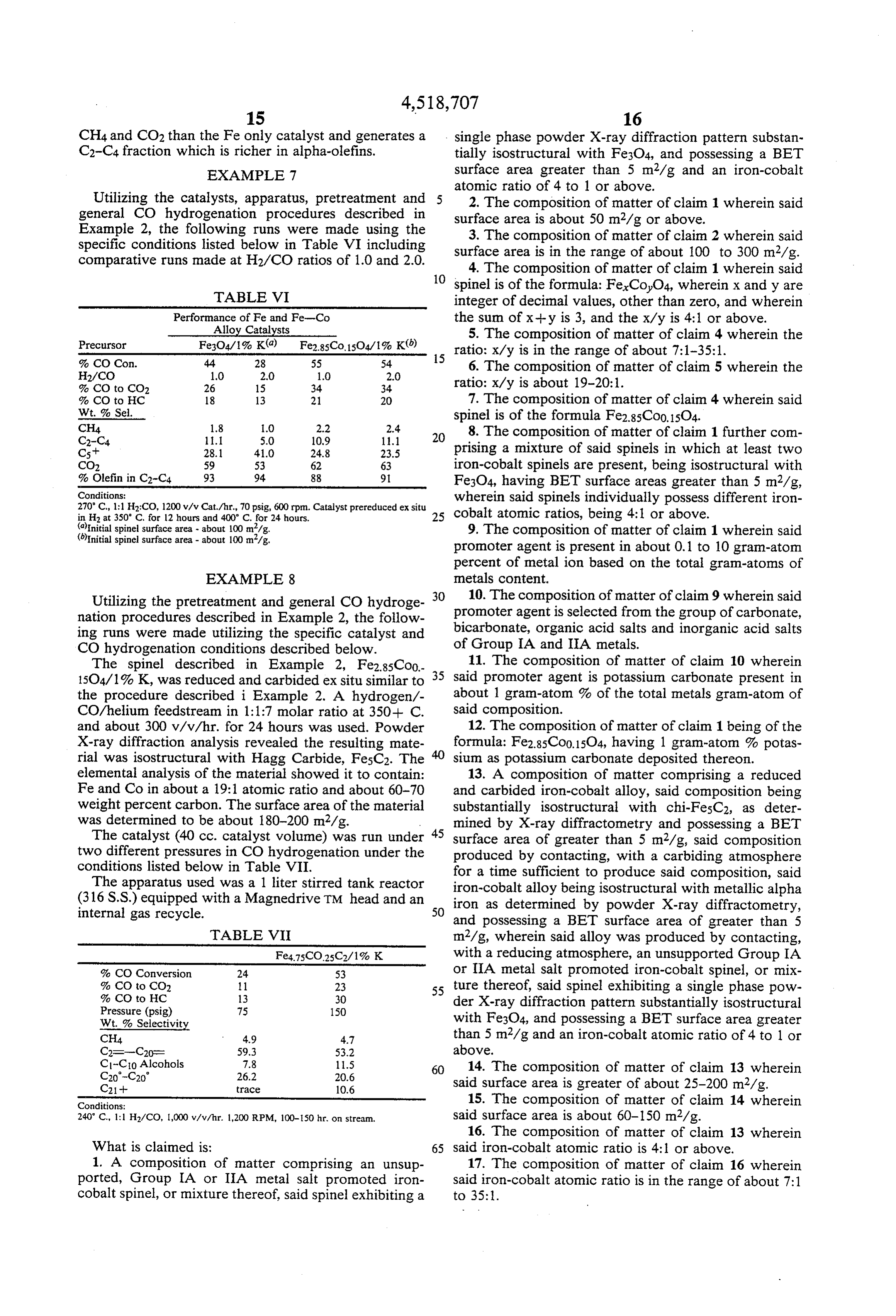
CH4 and CO2 than the Fe only catalyst and generates a single phase powder X-ray diffraction pattern substan C2-C4 fraction which is richer in alpha-olefins. tially isostructural with Fe3O4, and possessing a BET EXAMPLE 7 surface area greater than 5 m2/g and an iron-cobalt atomic ratio of 4 to 1 or above.
Utilizing the catalysts, apparatus, pretreatment and 5 2. The composition of matter of claim 1 wherein said general CO hydrogenation procedures described in surface area is about 50 m2/g or above.
Example 2, the following runs were made using the 3. The composition of matter of claim 2 wherein said specific conditions listed below in Table VI including surface area is in the range of about 100 to 300 m2/g. comparative runs made at H2/CO ratios of 1.0 and 2.0. 4. The composition of matter of claim 1 wherein said
TABLE VI
spinel is of the formula: Fe-CoO4, wherein x and y are integer of decimal values, other than zero, and wherein
Performance of Fe and Fe-Co
Alloy Catalysts the sum of x-y is 3, and the x/y is 4:1 or above.
5. The composition of matter of claim 4 wherein the ratio: x/y is in the range of about 7:1-35:1.
% CO Con. 44 28 55 54 15 6. The composition of matter of claim 5 wherein the H2/CO 1.0 2.0 1.0 2.0 % CO to CO2 26 15 34 34 ratio: x/y is about 19-20:1. % CO to HC 18 13 21 20 7. The composition of matter of claim 4 wherein said Wt. 9% Sel. spinel is of the formula Fe2.85Co0.15O4. CH4 1.8 1.0 2.2 2.4 8. The composition of matter of claim 1 further com C2-C4 11.1 5.0 10.9 11.1 20
Cs+ 28.1 41.0 24.8 23.5 prising a mixture of said spinels in which at least two CO2 59 53 62 63 iron-cobalt spinels are present, being isostructural with % Olefin in C2-C4 93 94. 88 91 Fe3O4, having BET surface areas greater than 5 m2/g, Conditions:
270° C., 1:1 H-2:CO, 1200 v/v Cat./hr., 70 psig, 600 rpm. Catalyst prereduced ex situ wherein said spinels individually possess different iron in H2 at 350° C. for 12 hours and 400° C. for 24 hours. 25 cobalt atomic ratios, being 4:1 or above. Initial spinel surface area - about 100 m/g. 9. The composition of matter of claim 1 wherein said (Initial spinel surface area - about 100 m/g. promoter agent is present in about 0.1 to 10 gram-atom percent of metal ion based on the total gram-atoms of
EXAMPLE 8 metals content.
Utilizing the pretreatment and general CO hydroge 30 10. The composition of matter of claim 9 wherein said nation procedures described in Example 2, the follow promoter agent is selected from the group of carbonate, ing runs were made utilizing the specific catalyst and bicarbonate, organic acid salts and inorganic acid salts CO hydrogenation conditions described below. of Group IA and IIA metals.
The spinel described in Example 2, Fe2.85Co0 35 11. The composition of matter of claim 10 wherein 15O4/1% K, was reduced and carbided ex situ similar to said promoter agent is potassium carbonate present in the procedure described i Example 2. A hydrogen/- about 1 gram-atom 9% of the total metals gram-atom of
CO/helium feedstream in 1:1:7 molar ratio at 350-- C. said composition.
and about 300 v/v/hr. for 24 hours was used. Powder 12. The composition of matter of claim 1 being of the X-ray diffraction analysis revealed the resulting mate formula: Fe2.85Co0.15O4, having 1 gram-atom 76 potas rial was isostructural with Hagg Carbide, Fe5C2. The sium as potassium carbonate deposited thereon.
elemental analysis of the material showed it to contain: 13. A composition of matter comprising a reduced Fe and Co in about a 19:1 atomic ratio and about 60-70 and carbided iron-cobalt alloy, said composition being weight percent carbon. The surface area of the material substantially isostructural with chi-FesC2, as deter was determined to be about 180-200 m2/g. mined by X-ray diffractometry and possessing a BET The catalyst (40 cc. catalyst volume) was run under 5 surface area of greater than 5 m2/g, said composition two different pressures in CO hydrogenation under the produced by contacting, with a carbiding atmosphere conditions listed below in Table VII. for a time sufficient to produce said composition, said The apparatus used was a 1 liter stirred tank reactor iron-cobalt alloy being isostructural with metallic alpha (316 S.S.) equipped with a Magnedrive TM head and an iron as determined by powder X-ray diffractometry,
and possessing a BET surface area of greater than 5
TABLE VII m/g, wherein said alloy was produced by contacting, Fei.75CO25C2/1% K with a reducing atmosphere, an unsupported Group IA % CO Conversion 24 53 or IIA metal salt promoted iron-cobalt spinel, or mix % CO to CO2 11 23 55 ture thereof, said spinel exhibiting a single phase pow % CO to HC 13 30 der X-ray diffraction pattern substantially isostructural Pressure (psig) 75 150
Wt. % Selectivity with Fe3O4, and possessing a BET surface area greater CH4 4.9 4.7 than 5 m2/g and an iron-cobalt atomic ratio of 4 to 1 or C2=-C20= 59.3 53.2 above.
C1-C10 Alcohols 7.8 11.5 60 14. The composition of matter of claim 13 wherein
C20-C20 26.2 20.6
C2 -- trace 10.6 said surface area is greater of about 25-200 m2/g. Conditions: 15. The composition of matter of claim 14 wherein 240 C., 1:1 H2/CO, 1,000 v/v/hr. 1,200 RPM, 100-50 hr. on stream. said surface area is about 60-150 m2/g. 16. The composition of matter of claim 13 wherein
What is claimed is: 65 said iron-cobalt atomic ratio is 4:1 or above. 1. A composition of matter comprising an unsup 17. The composition of matter of claim 16 wherein ported, Group IA or IIA metal salt promoted iron said iron-cobalt atomic ratio is in the range of about 7:1 cobalt spinel, or mixture thereof, said spinel exhibiting a to 35:1.
Page 10
18. The composition of matter of claim 17 wherein 26. A composition of matter comprising the amor said iron-cobalt atomic ratio is about 19-20:1. phous residue produced by the process in step (b) in 19. The composition of matter of claim 18 wherein claim 21.
said iron-cobalt atomic ratio is about 19:1. 27. A process for preparing an iron-cobalt alloy, 20. A composition of matter comprising a reduced being isostructural with metallic alpha iron as deter mined by powder X-ray diffractometry, and possessing a and carbided iron-cobalt alloy, said composition being BET surface area of greater than 5 m2/g, which com isostructural with Fe3C, as determined by powder prises contacting an unsupported, Group IA or Group X-ray diffractometry, and possessing a BET surface IIA metal salt promoted iron-cobalt spinel, or mixture area of greater than 5 m2/g. 10 thereof, said spinel exhibiting a single spinel phase isos 21. A process for producing the composition of mat tructural with Fe3O4, and having a BET surface area ter of claim 1 comprising the steps of (a) evaporating a greater than 5 m2/g and an iron-cobalt atomic ratio of liquid solution comprising a mixture of iron and cobalt 4:1 or above, with a reducing atmosphere under condi salts of at least one alpha-hydroxy aliphatic carboxylic 15 locity,offorelevated tions temperature, pressure, and space ve a time sufficient to substantially reduce the acid, wherein the molar ratio of total moles of said acid metal oxides of the spinel.
to total moles of said iron and cobalt, taken as free 28. The process of claim 27 wherein said reducing metals, is about 1:1, or above, and wherein the atomic atmosphere comprises hydrogen as a reducing element. ratio of iron:cobalt, taken as the free metals in said mix 29. The process of claim 27 wherein said temperature ture, is greater than 2 to 1, yielding an amorphous resi 20 is about 240 C. or greater.
due; (b) calcining said residue at elevated temperature 30. The process of claim 27 wherein said so-produced for a time sufficient to yield an iron-cobalt spinel, exhib iron-cobalt a carbiding alloy is partially or completely treated with atmosphere at elevated temperature.
iting at least one spinel phase, isostructural with Fe3O4, 31. The composition of matter of claim 10 wherein as determined by powder X-ray diffractometry; and (c) 25 said promoter agent is selected from the group of inor impregnating the composition of (b) with an aqueous ganic salts comprising nitrates, halides and sulfates. solution of a Group IA or Group IIA metal salt, foll 32. A composition of matter comprising an unsup lowed by drying the resulting impregnate. ported iron-cobalt spinel which exhibits a single phase 22. The process of claim 21 wherein said acid is se power X-ray diffraction pattern substantially isostruc lected from glycolic, malic, tartaric, or lactic acids, or 30 tural with Fe3O4 and which possesses a BET surface mixtures thereof. area greater than about 5 m2/g and an iron-cobalt 23. The process of claim 21 wherein said solution is an withatomic ratio of at least about 4 to 1, which is promoted aqueous solution. a promoter agent selected from the hydroxides of Group IA and IIA metals, and wherein said promoter 24. The process of claim 21 wherein the pH of said 35 agent is present in said composition in an amount of solution is 5 to 7.0. about 0.1 to 10 gram-atom percent of metalion based on 25. The process of claim 22 wherein said acid is gly the total gram-atoms of metals content. colic acid. sk
Page 11
UNITED STATES PATENT AND TRADEMARK OFFICE
CERTIFICATE OF CORRECTION
INVENTOR(S): Stuart L. Soled, et al. it is certified that error appears in the above-identified patent and that said Letters Patent is hereby Corrected as shown below:
In column 2, line 2, please delete therefrom the word "basic",
In column 5 line 4, please delete there from the word "basic".
eigned and escaled this
Eighth Day of October 1985
SEAL)
Attest:
DONALD.J. QUIGG
Attesting Officer Commissioner of Patents and
Provenance
- Collection
- Cited prior art
- Original PDF
- patentimages.storage.googleapis.com →
- Filed
- 1983-12-14
- Pages
- 11
- Method
- pdftotext (the PDF's own text layer) + pdftoppm 300dpi page scans
- Source
- Google Patents bibliographic record
- Granted
- 1985-05-21
- Inventors
- Stuart L. Soled; Rocco A. Fiato; Exxon Research and Engineering Co
- Transcribed from
- patentimages.storage.googleapis.com →