patent · US4210643
Phosphonate pharmaceutical composition
1 July 1980
Page 1 — bibliographic record
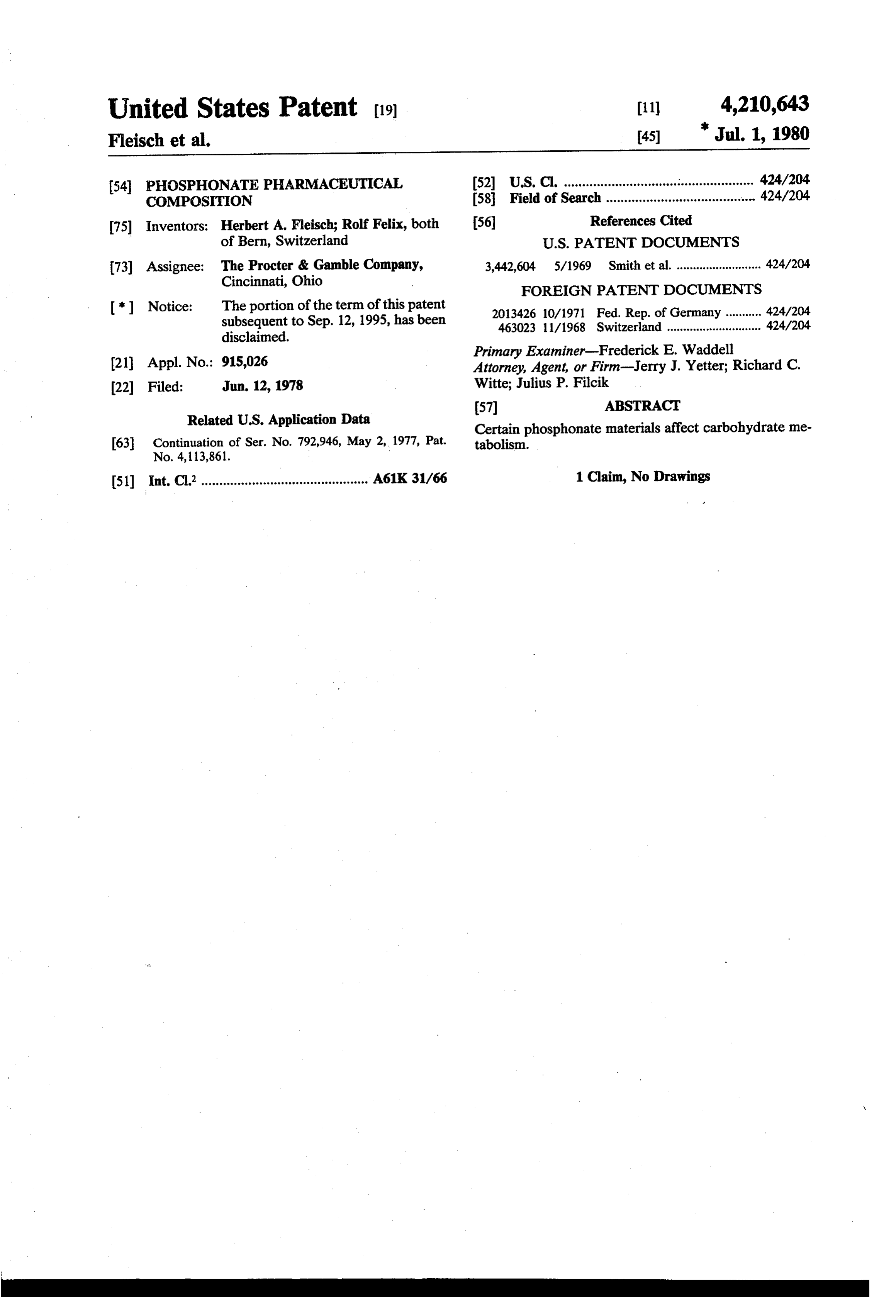
United States Patent (19) (11) 4,210,643 Fleisch et al. (45) "Jul. 1, 1980 (54 PHOSPHONATE PHARMACEUTICAL 52 U.S. C. ................................................... 424/204 COMPOSTON 58 Field of Search ........................................ 424/204 (75) Inventors: Herbert A. Fleisch; Rolf Felix, both 56) References Cited of Bern, Switzerland U.S. PATENT DOCUMENTS 73 Assignee: The Procter & Gamble Company, 3,442,604 5/1969 Smith et al. .......................... 424/204 Cincinnati, Ohio FOREIGN PATENT DOCUMENTS
Notice: The portion of the term of this patent 2013426 10/1971 Fed. Rep. of Germany ........... 424/204 subsequent to Sep. 12, 1995, has been 463023 11/1968 Switzerland ............................. 424/204 disclaimed.
Primary Examiner-Frederick E. Waddell (21) Appl. No.: 915,026 Attorney, Agent, or Firm-Jerry J. Yetter; Richard C. 22 Filed: Jun. 12, 1978 Witte; Julius P. Filcik
Related U.S. Application Data Certain phosphonate materials affect carbohydrate me 63 Continuation of Ser. No. 792,946, May 2, 1977, Pat. tabolism.
int. C.’.............................................. A61K 31/66 1 Claim, No Drawings
Page 2
The copending application of Felix and Fleisch, enti
PHOSEPHONATE PHARMACETICAL tled CARBOXY PHOSPHONATE PHARMACEU
CORPOSTON
TICAL COMPOSITION, Ser. No. 792,947, filed May 2, 1977, discloses the use of certain vicinal and geminal
This is a continuation, of application Ser. No. 5 carboxy 792,946, filed May 2, 1977, now U.S. Pat. No. 4,113,861. phosphonates to desirably affect glucose me tabolism.
BACKGROUND OF THE INVENTION
The present invention relates to compositions and DETAILED DESCRIPTION OF THE processes for affecting carbohydrate metabolism. More 10 INVENTION specifically, certain alkyl diphosphonates are adminis tered to humans and lower animals to desirably influ safeThe and treatment regimens of this invention employ a effective amount of a pharmaceutically-accept ence carbohydrate metabolism. In particular, the com able geminal diphosphonate compound. These com positions and processes herei are especially useful for affecting the metabolism of glucose and are useful in the 15 pounds are administered to treat diseases involving treatment of diabetes. carbohydrate metabolism in humans and lower animals SUMMARY OF THE INVENTION in need of such treatment. The geminal diphosphonates The present invention encompasses a method for nates.'herein are conveniently referred to as "phospho used promoting the metabolism of carbohydrates, especially 20 glucose, in humans and lower animals comprising ad By "safe and effective amount of phosphonate com ministering to a human or lower animal in need of such pound' herein is meant sufficient phosphonate com treatment a safe and effective amount of a pharmaceuti pound to desirably affect carbohydrate (especially glu cally-acceptable diphosphonate compound ("phospho cose) metabolism, at a reasonable benefit/risk ratio at nate') of the type described more fully hereinafter. 25 tendant with any medical treatment. Within the scope By the practice of this invention, disease states in volving decreased metabolism of carbohydrates, espe of sound medical judgment, the dosage of phosphonate compound will vary with the particular condition being cially glucose, are effectively treated. Accordingly, the present invention provides an effective means for the treated, the severity of the condition, the duration of the treatment of diabetes (diabetes mellitus). 30 treatment, the specific phosphonate compound em SUMMARY OF THE INVENTION ployed, and like considerations as disclosed more fully hereinafter.
The present invention encompasses a process for desirably affecting the metabolism of carbohydrates, thatBythe"pharmaceutically-acceptable' phosphonate drug compound herein is meant and other ingre especially glucose, comprising administering to a 35 human or lower animal in need of such treatment a safe dients used in the compositions employed herein are and effective amount of a pharmaceutically-acceptable suitable for use in contact with the tissues of humans geminal diphosphonate material of the type described and lower animals without undue toxicity, irritation, more fully hereinafter. allergic response, and the like, commensurate with a The present invention provides a means of treating reasonable benefit/risk ratio.
disease states involving decreased metabolism of carbo The term "administration' of the phosphonate com hydrates, especially glucose, and thus provides a means pounds and compositions herein includes systemic use, for treating diabetes mellitus which comprises adminis as by injection (especially parenterally), intravenous tering to a human suffering from diabetes mellitus a safe and effective amount of a pharmaceutically-acceptable 45 infusion suppositories and oral administration thereof. phosphonate compound. By the term "comprising' as used herein is meant that DISCUSSION OF RELATED REFERENCES various other, compatible drugs and medicaments, as Various phosphonate compounds are reported in the well the as inert ingredients, can be conjointly employed in compositions and processes of this invention, as long literature as being useful in the treatment of anomalous 50 as the critical phosphonate compounds are used in the mobilization and deposition of calcium phosphate salts (bone mineral) in humans and other animals. See espe manner disclosed. The term "comprising' thus encom cially the U.S. Pat. Nos. of M. D. Francis: 3,683,080, passes and includes the more restrictive terms "consist granted Aug. 8, 1972; 3,678,164, granted July 18, 1972; ing of and "consisting essentially of which character 3,662,066, granted May 9, 1972; 3,553,314, granted Jan. 55 ize the use of the essential phosphonate compounds in
granted June 8, 1971; 3,584, 125, granted June 8, 1971; theBypractice of this invention. "compatible' herein is meant that the components and 3,641,246, granted Feb. 8, 1972; as well as German
DT No. 2360-798 (June 26, 1975); German DT No. of the compositions which can be used in the practice of 2343-146 (Mar. 6, 1975); and Belgian BE No. 822-929 60 this invention are capable of being commingled without (Dec. 6, 1973). interacting in a manner which would substantially de In contrast with the prior art disclosures of the use of crease the efficacy of the phosphonate compositions phosphonate materials to prevent the formation of under ordinary use situations.
anomalous, calcified mineral deposits in bones, joints All percentages herein are by weight, unless other and soft tissues, the present invention is based on the 65 wise specified.
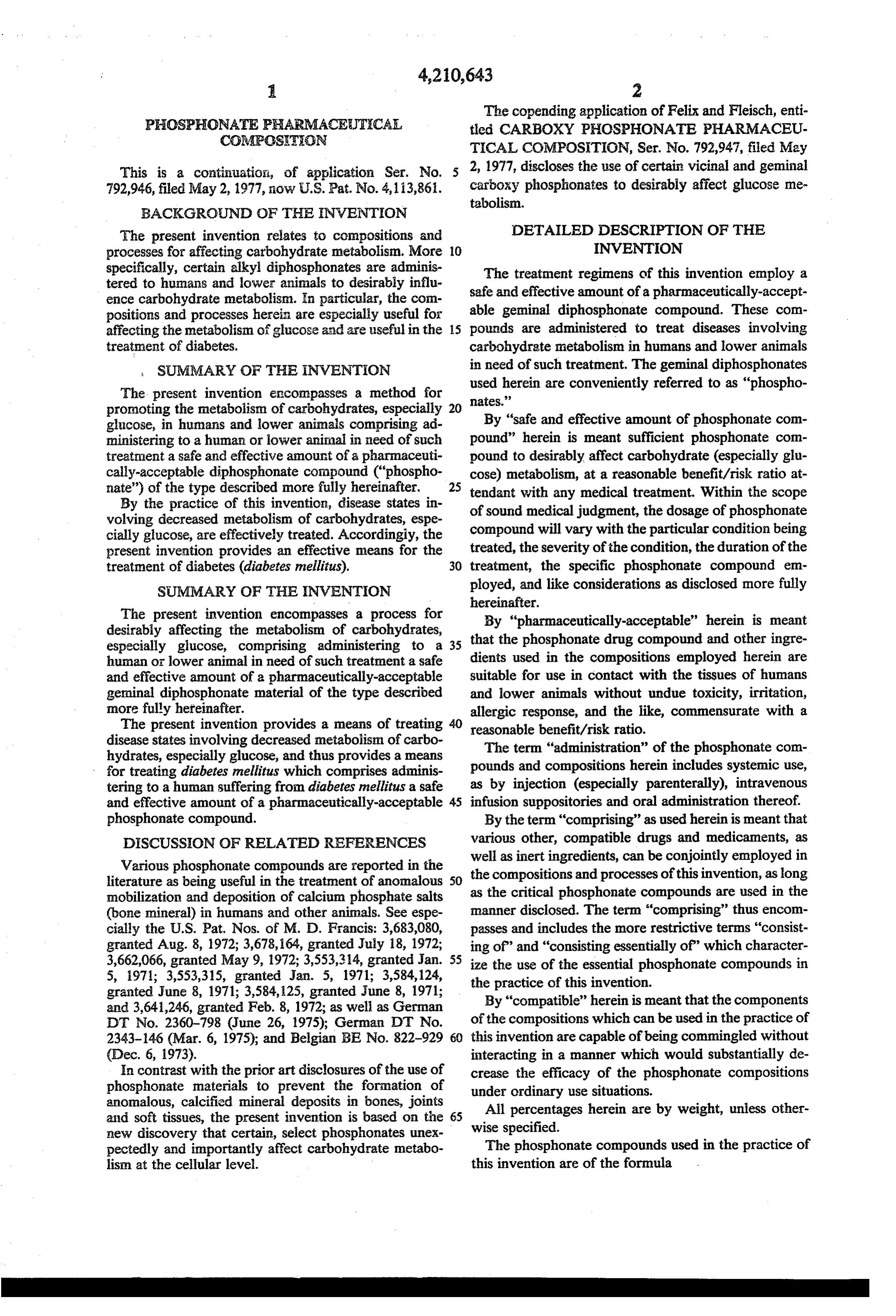
new discovery that certain, select phosphonates unex pectedly and importantly affect carbohydrate metabo The phosphonate compounds used in the practice of lism at the cellular level. this invention are of the formula
Page 3
ing 4 nil MEM with 227 mg/1 NaHCO3, 100 units/ml penicillin, 100 mcg/ml streptomycin, 0.25 mcg/ml fun gizone (=antibiotica) and 3 mg/ml collagenase (Wor thington CLS II). The free cells were then harvested and plated in costar culture dishes 3524, 16 mm diame ter (Tecnomara AG, Zurich, Switzerland) at a density
N p1 OM of 40,000 cells per dish. Each dish contained 0.5 ml
NoM MEM with 10% fetal calf serum, 2.2 g/1 NaHCO3 and
O antibiotics and was incubated at 37 C. at 5% CO2. The
O next day new medium with or without diphosphonates wherein X is H, OH or NH2; M is hydrogen, a phar was added. This medium was then replaced every third maceutically-acceptable cation, e.g., alkali metal, espe day. On day 7 new medium was added and incubated cially Na or K or an alkyl or aryl moiety, e.g., methyl, for 16 hours in order to measure the lactate production ethyl, propyl, butyl, phenyl, or the like; and Risa C2, or 5 and the glucose consumption. After the incubation the higher, hydrocarbyl group such as alkyl, cycloalkyl, or cells were released from the plate and counted. substituted C2 or higher alkyl or cycloalkyl group. The Determination of cell number term "hydrocarbyl' herein includes unsaturated and substituted alkyl, alkenyl and alkynyl and carbocyclic After the media was removed, 0.25 ml of a mixture of groups. 5 parts Hank's solution without CaCl2, and 1 part MEM The phosphonate compounds employed herein are all with 2.2 g/1 NaHCO3, containing 0.025% trypsin
known in the art and can be prepared by the general (Gibco) and 1 mg/ml collagenase (Worthington CLS procedures described in ORGANIC PHOSPHORUS II) was added to the monolayer and incubated for three COMPOUNDS Vol. 7, Kosolapoff and Maier (1976) hours at 37 C. at 5% CO2. The cells were then sus and references cited therein, as well as in the complete pended in 50 ml Hank's solution and counted on a Coul discussion of references to the preparation of such com 25 ter Counter Model industrial D, Coulter Counter Elec pounds disclosed in the U.S. Patents of Francis, cited tronic Ltd., Dunstable, Beds, England. hereinabove, the disclosures of which are incorporated herein by reference. Determination of glucose and lactate
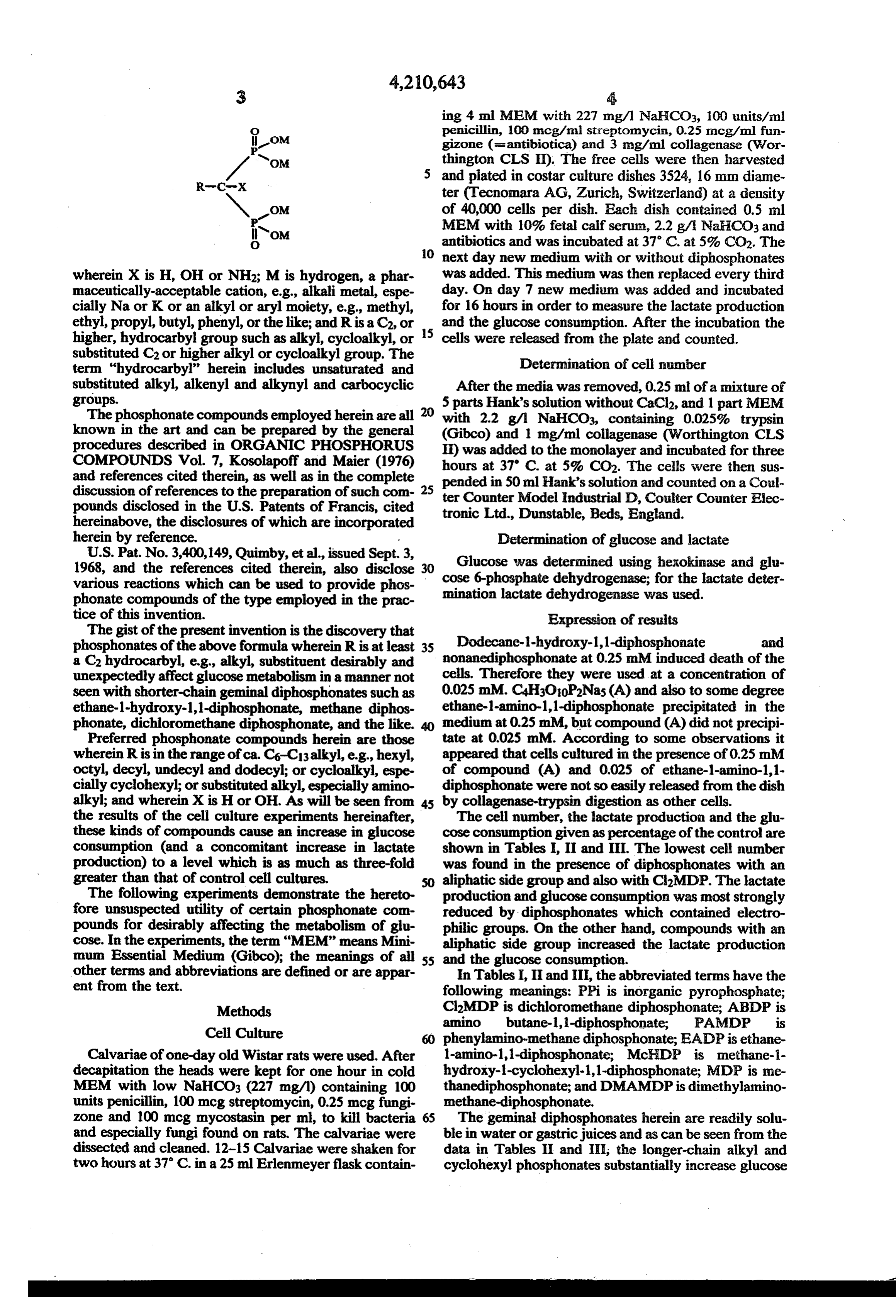
1968, and the references cited therein, also disclose 30 Glucose was determined using hexokinase and glu various reactions which can be used to provide phos cose 6-phosphate dehydrogenase; for the lactate deter phonate compounds of the type employed in the prac mination lactate dehydrogenase was used. tice of this invention. Expression of results The gist of the present invention is the discovery that Dodecane-1-hydroxy-1,1-diphosphonate and phosphonates of the above formula wherein R is at least 35 a C2 hydrocarbyl, e.g., alkyl, substituent desirably and nonanediphosphonate at 0.25 mM induced death of the unexpectedly affect glucose metabolism in a manner not cells. Therefore they were used at a concentration of seen with shorter-chain geminal diphosphonates such as 0.025 mM. CH3O10PNas (A) and also to some degree ethane-l-hydroxy-1,1-diphosphonate, methane diphos ethane-1-amino-1,1-diphosphonate precipitated in the phonate, dichloromethane diphosphonate, and the like. medium at 0.25 mM, but compound (A) did not precipi Preferred phosphonate compounds herein are those tate at 0.025 nM. According to some observations it wherein Risin the range of ca. C6-C13 alkyl, e.g., hexyl, appeared that cells cultured in the presence of 0.25 mM octyl, decyl, undecyl and dodecyl; or cycloalkyl, espe of compound (A) and 0.025 of ethane-1-amino-1,1- cially cyclohexyl; or substituted alkyl, especially amino diphosphonate were not so easily released from the dish alkyl; and wherein X is H or OH. As will be seen from 45 by collagenase-trypsin digestion as other cells. the results of the cell culture experiments hereinafter, The cell number, the lactate production and the glu these kinds of compounds cause an increase in glucose cose consumption given as percentage of the control are consumption (and a concomitant increase in lactate shown in Tables I, II and I. The lowest cell number production) to a level which is as much as three-fold was found in the presence of diphosphonates with an greater than that of control cell cultures. aliphatic side group and also with Cl2MDP. The lactate The following experiments demonstrate the hereto production and glucose consumption was most strongly fore unsuspected utility of certain phosphonate com reduced by diphosphonates which contained electro pounds for desirably affecting the metabolism of glu philic groups. On the other hand, compounds with an cose. In the experiments, the term "MEM” means Mini aliphatic side group increased the lactate production mum Essential Medium (Gibco); the meanings of all 55 and the glucose consumption.
other terms and abbreviations are defined or are appar in Tables I, II and III, the abbreviated terms have the ent from the text. following meanings: PPi is inorganic pyrophosphate; Methods Cl2MDP is dichloromethane diphosphonate; ABDP is
Cell Culture amino butane-1,1-diphosphonate; PAMDP is phenylamino-methane diphosphonate; EADP is ethane
Calvariae of one-day old Wistar rats were used. After 1-amino-1,1-diphosphonate; McHDP is methane-1- decapitation the heads were kept for one hour in cold hydroxy-l-cyclohexyl-1,1-diphosphonate; MDP is me MEM with low NaHCO3 (227 mg/1) containing 100 thanediphosphonate; and DMAMDP is dimethylamino units penicillin, 100mcg streptomycin, 0.25 mcg fungi methane-diphosphonate.
Zone and 100 mcg mycostasin per ml, to kill bacteria 65 The geminal diphosphonates herein are readily solu and especially fungi found on rats. The calvariae were ble in water orgastric juices and as can be seen from the dissected and cleaned. 12-15 Calvariae were shaken for data in Tables II and II, the longer-chain alkyl and two hours at 37 C. in a 25ml Erlenmeyer flask contain cyclohexyl phosphonates substantially increase glucose
Page 4
metabolism over the short-chain alkyl compounds. The Table III-continued
C9, C1 and C12 alkyl compounds were especially effec Glucose Consumption per 10° Cells tive in this regard, as was the cyclo-C6 compound. Of Average the compounds tested, the shorter-chain compounds Concentration Percentage had little effect, unless substituted by an amino group Compound M of Control (ABDP). However, the effect of these shorter-chain f OOS 36.3/86.4 compounds is more comparable with inorganic pyro CHOPNa2 C.2s 3.0/49.6 phosphate than with the superior undecane- and dodec C5H4O6P. 0.25 88.5/10.3 ane-1-hydroxy-1,1-diphosphonate and norane-1,i- C2H2807P2 0.025 306.2/197.6 diphosphonate compounds tested. Accordingly, pre O CH20CP2Na2
COPNa
ferred for use in the practice of this invention are those CHOPNa2 0.25 50.9/63.8 1,1-alkyldiphosphonates and 1-hydroxy-1,1-alkyldi CH3OPNa 0.025 29 phosphonates, wherein the alkyl group is longer than PE 0.25
about C6, preferably from about Cs to about C14. 15 CMDP 0.25 43.9
Table ABDP 0.25 42.9
Effect of Diphosphonates on Cell Number PAMOP 0.25 96.0/70, Average EAOP 0.25 118.9
Concentration Percentage McHDP 0.25 12.6
Compound of Control MD 0.25 91.9 20 OMAMCP 0.25 94.1/12.5
C5H2O6PF6Na2 0.25 16.2/94.2
CH4O7.PNa2 0.25 94.4/619 PREFERRED MODE C5H4O6P2 0.25 86.0/69.8
C12H26O7P 0.025 S6.4/49.0 25 Within the scope of sound medical judgment, the
dosage of the phosphonates herein will vary with the
CHOgPNa2 0.25 80.2/62.4 particular condition being treated, the severity of the C11H3OPNa 0.025 42.2 condition, the duration of treatment, and like factors PP 0.25 2.5/100.9 within the specific knowledge and expertise of the at
30 tending physician. However, single dosages can typi
cally range from 0.01 to 500 mg per kilogram of body
ABOP 0.25 78.1 weight, preferably 0.5 to 50 mg/kg (unless otherwise PAMDP 0.25 10.9/88.7 specified, the unit designated "mg/kg" as used hereinm EADP 0.25 49.0 refers to mg/kg of body weight). The higher dosages
MOP 0.25 84.5 35 within this range are usually required in the case of oral DMAMDP 0.25 107.1/89.5 administration because of somewhat limited absorption of the phosphonates through the gut. Up to four dos ages per day can be used routinely, but this can be var
Table I ied to the needs of the patient, consistent with a sound Lactate Production per 10° Cells benefit:risk ratio. Dosages greater than about 500 Average mg/kg may produce untoward symptoms and are usu
Concentration Percentage ally avoided; moreover, daily dosages greater than
Compound aM of Control about 2,000 mg/kg are not ordinarily required to pro C5H2O6PF6Na2 0.25 96.5/91.3 duce the desired benefit and may produce toxic side CH3OOPNa5 0.25 SS.0 5 effects. Again, however, patient-to-patient variations in CHOPNa
response may be expected. Dosages of about 0.01
C5H4O6P2 0.25 101.6/97.4 mg/kg are useful, especially if administered intrave C2H8OP2 0.025 3.27.1/20.5 nously.
C9H20O6PNa2 153.6 Preferably, dosages ranging from about 10 to about
67.151.6 SO 100 mg/kg are employed when the phosphonates are
CH3OPNa 0.025 312 administered orally, since absorption is not total. PEP 0.25 89.4/77.3 For parenteral administration (s.c., i.p., i.m.), phos 0. 91.7 phonate dosages are preferably from about 0.5
mg/kg/day to about 20 mg/kg/day. For long-term
ABOP 0.25 1523 55 parenteral infusion (i.v.) the most highly preferred dos PARDP 0.25 88.5/108.3 age range is from about 0.5 mg/kg/day to about 5 EAP 0.25 160.9 mg/kg/day.
McHOP 0.25 2540 For purposes of oral administration the phosphonates
DAMDP 0.25 88.2/106.6 herein can be formulated in the form of capsules, tablets or granules. For treatment of non-human animals, the phosphonates are preferably incorporated in animal
Table feed, feed supplements or feed concentrates. They can
Glucose Consumption per 106 Cells also be prepared in unit dosage form together with a Average pharmaceutical carrier, each unit dosage form contain
Concentration Percentage 65 ing from ca. 15 mg to 10 g of phosphonate. The pre
Compound mM of Control ferred concentration range of phosphonate in unit dos C5H2O6P2F5Na2 0.25 95.0/109.3 age forms intended for use by humans and smaller do C4H3OPNas 0.25 15.0 mesticated animals is from 15 mg to 1,000 mg, more
Page 5
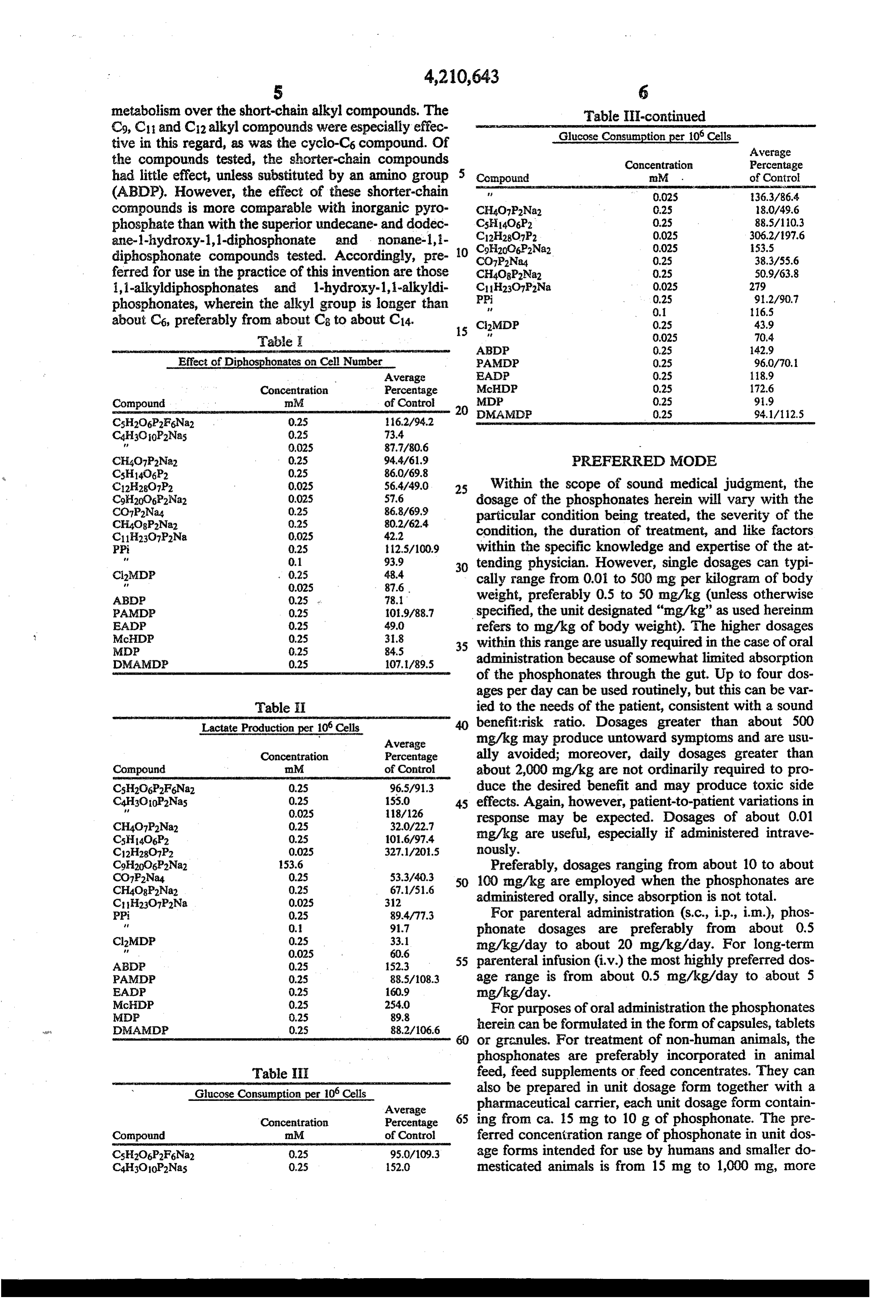
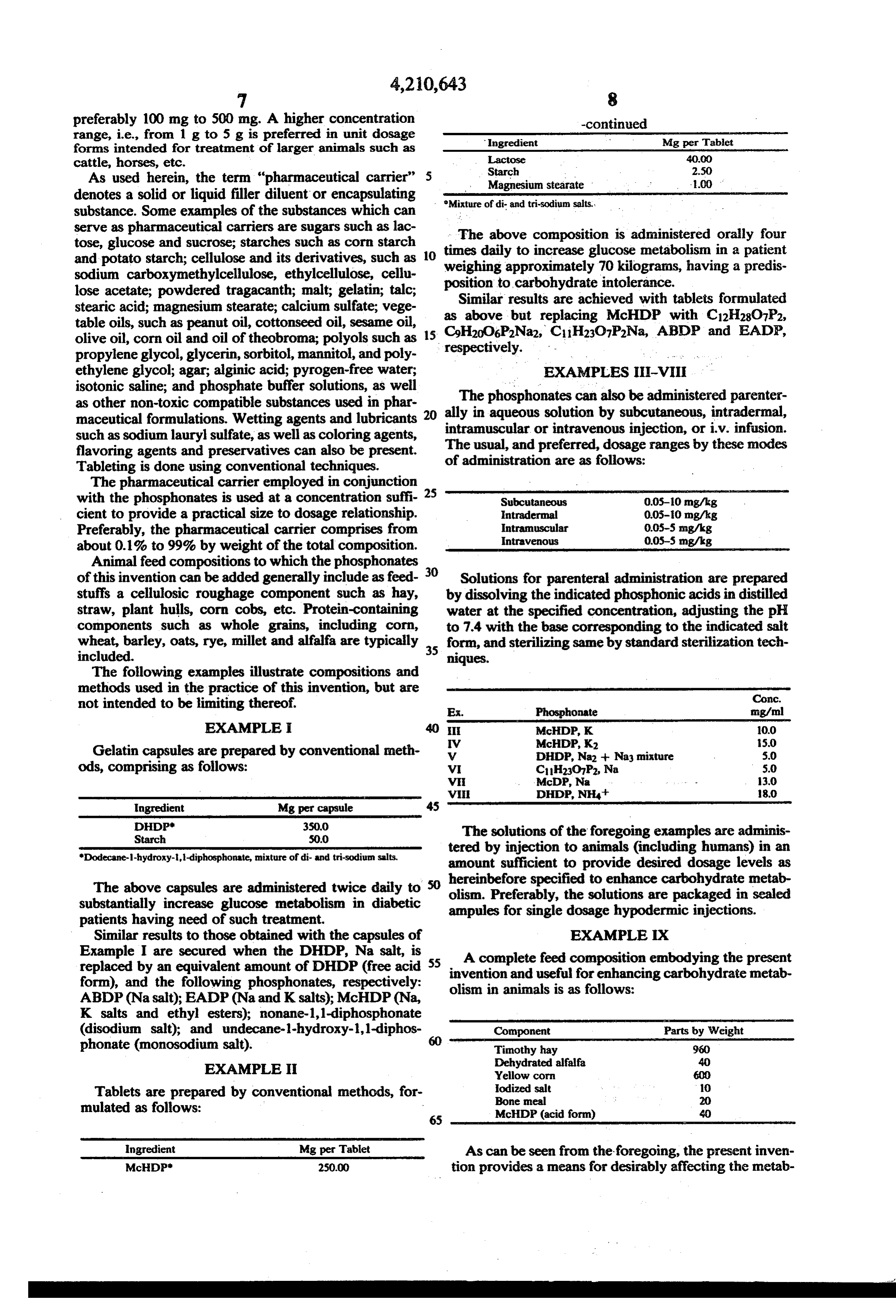
preferably 100 mg to 500 mg. A higher concentration -continued range, i.e., from 1 g to 5 g is preferred in unit dosage ngredient Mig per Tablet forms intended for treatment of larger animals such as Lactose 4000 cattle, horses, etc.
As used herein, the term "pharmaceutical carrier' 5 Starch
Magnesium stearate
denotes a solid or liquid filler diluent or encapsulating - Mixture of di- and tri-sodium salts. substance. Some examples of the substances which can serve as pharmaceutical carriers are sugars such as lac . . The above composition is administered orally four tose, glucose and sucrose; starches such as corn starch 10 times daily to increase glucose metabolism in a patient and potato starch; cellulose and its derivatives, such as weighing approximately 70 kilograms, having a predis sodium carboxymethylcellulose, ethylcellulose, cellu position to carbohydrate intolerance.
lose acetate; powdered tragacanth; malt; gelatin; talc, stearic acid; magnesium stearate; calcium sulfate; vege as Similarabove results are achieved with tablets formulated but replacing McHDP with C12H28OP2, table oils, such as peanut oil, cottonseed oil, sesame oil, 15 C9H2OO6PNa2, olive oil, corn oil and oil of theobroma; polyols such as respectively. CH2O7.PNa, ABDP and EADP, propylene glycol, glycerin, sorbitol, mannitol, and poly ethylene glycol; agar; aginic acid; pyrogen-free water; . EXAMPLES III-VIII isotonic saline; and phosphate buffer solutions, as well The phosphonates can also be administered parenter as other non-toxic compatible substances used in phar ally in aqueous solution by subcutaneous, intradermal, maceutical formulations. Wetting agents and lubricants intramuscular or intravenous injection, or i.v. infusion. such as sodium lauryl sulfate, as well as coloring agents, The usual, and preferred, dosage ranges by these modes flavoring agents and preservatives can also be present. of administration are as follows:
Tableting is done using conventional techniques.
The pharmaceutical carrier employed in conjunction 25 with the phosphonates is used at a concentration suffi Subcutaneous 0.05-10 mg/kg cient to provide a practical size to dosage relationship. Entradermal 0.05-0 mg/kg Preferably, the pharmaceutical carrier comprises from Intramuscular intravenous
about 0.1% to 99% by weight of the total composition.
Animal feed compositions to which the phosphonates of this invention can be added generally include as feed 30 Solutions for parenteral administration are prepared stuffs a cellulosic roughage component such as hay, by dissolving the indicated phosphonic acids in distilled straw, plant hulls, corn cobs, etc. Protein-containing water at the specified concentration, adjusting the pH components such as whole grains, including corn, to 7.4 with the base corresponding to the indicated salt wheat, barley, oats, rye, millet and alfalfa are typically 35 form, and sterilizing same by standard sterilization tech included. niques.
The following examples illustrate compositions and methods used in the practice of this invention, but are Conc. not intended to be limiting thereof. Ex. Phosphonate mg/ml EXAMPLE 40 McHDP, K 100
Gelatin capsules are prepared by conventional neth V DHDP, Na2 - Na3 mixture 5.0 ods, comprising as follows: V CH3OP, Na 5.0
Ingredient Mg per capsule 45
OHOP 3500 The solutions of the foregoing examples are adminis
tered by injection to animals (including humans) in an
Dodecane-1-hydroxy-,-diphosphonate, mixture of di- and tri-sodium salts.
amount sufficient to provide desired dosage levels as hereinbefore specified to enhance carbohydrate metab
The above capsules are administered twice daily to 50 olism.
substantially increase glucose metabolism in diabetic ampulesPreferably, the solutions are packaged in sealed for single dosage hypodermic injections.
patients having need of such treatment.
Similar results to those obtained with the capsules of EXAMPLE X
Example I are secured when the DHDP, Na salt, is replaced by an equivalent amount of DHDP (free acid 55 invention and useful for enhancingembodying A complete feed composition the present carbohydrate metab form), and the following phosphonates, respectively: olism in animals is as follows:
ABDP (Nasalt); EADP (Na and Ksalts); McHDP (Na,
K salts and ethyl esters); nonane-1,1-diphosphonate (disodium salt); and undecane-1-hydroxy-1,1-diphos Component Parts by Weight phonate (monosodium salt). 60 Timothy hay EXAMPLE Dehydrated alfalfa
Yellow cora
Tablets are prepared by conventional methods, for odized salt Bone meal mulated as follows: McHOP (acid form)
Ingredient Mg per Tablet As can be seen from the foregoing, the present inven McHOP 250.00 tion provides a means for desirably affecting the metab
Page 6
olism of carbohydrates, especially glucose, and thereby cyl-, tridecyl- and tetradecyl-1,1-diphosphonates, and provides a means for treating diabetes and diabetes-like the pharmaceutically-acceptable salts and esters disease states. The processes herein are preferably car thereof; and with methane-1-hydroxy-1-cyclohexyl-1,1- ried out using geminal diphosphonate compounds se diphosphonate (preferred), methanecyclohexyl-1,1- lected from the group consisting of the pharmaceutical diphosphonate, and the pharmaceutically-acceptable ly-acceptable C8-C14 alkyl- and cyclohexylmethyl-1- salts and esters thereof.
hydroxy-1,1-diphosphonates and the C8-C14 alkyl- and What is claimed is:
cyclohexylmethyl-1,1-diphosphonates. In particular, 1. A process for treating diabetes mellitus in humans the processes of this invention are preferably carried out and lower animals, comprising administering to a with the geminal diphosphonates octyl-, nonyi-, decyl-, 10 human or lower animal in need of such treatment a safe undecyl- (preferred), dodecyl- (preferred), tridecyl- and and effective amount of ethane-1-amino-1,1-diphos tetradecyl-1-hydroxy-1,1-disphosphonates, and the phonic acid, or a pharmaceutically-acceptable salt pharmaceutically-acceptable salts and esters thereof; thereof. k : with octyl-, nonyl- (preferred), decyl-, undecyl-, dode
Provenance
- Collection
- Cited prior art
- Original PDF
- patentimages.storage.googleapis.com →
- Filed
- 1978-06-12
- Pages
- 6
- Method
- pdftotext (the PDF's own text layer) + pdftoppm 300dpi page scans
- Source
- Google Patents bibliographic record
- Granted
- 1980-07-01
- Inventors
- Herbert A. Fleisch; Rolf Felix; Procter and Gamble Co
- Transcribed from
- patentimages.storage.googleapis.com →