patent · US10109812B2
Energy conversion device and method for making and using same
23 October 2018
Page 1 — bibliographic record
(12) United States Patent ( 10) Patent No.: US 10 , 109,812 B2 Britt et al. (45) Date of Patent: Oct. 23 , 2018 (54 ) ENERGY CONVERSION DEVICE AND 8 ) Field of Classification Search METHOD FOR MAKING AND USING SAME None
See application file for complete search history .
(71) Applicants:Edward J. Britt, Cupertino , CA (US );
Reay S . Dick , Mountain View , CA (56) References Cited (US ); W . Todd Wipke, Santa Cruz , CA U .S . PATENT DOCUMENTS
3 ,913 ,033 A * 10/ 1975 Tuccio HO1S 3 / 022 (72 ) Inventors: Edward J. Britt, Cupertino , CA (US ); 372/34 Reay S . Dick , Mountain View , CA 4 , 197 , 142 A * 4 / 1980 Bolton ................. B82Y 10 /00 (US ); W . Todd Wipke, Santa Cruz , CA 136 / 255 (US ) (Continued ) ( * ) Notice : Subject to any disclaimer , the term of this FOREIGN PATENT DOCUMENTS patent is extended or adjusted under 35
U .S .C . 154 (b ) by 0 days. JP 2011035353 A * 2/2011 (21) Appl. No.: 14 /855, 365 OTHER PUBLICATIONS (22 ) Filed : Sep . 15, 2015 Barros , Tiago , and Werner Kühlbrandt. “ Crystallisation , Structure and Function of Plant Light-harvesting Complex II.” Biochimica Et (65) Prior Publication Data Biophysica Acta (BBA ) Bioenergetics 1787.6 (2009 ): 753 -72.* US 2016 /0141533 A1 May 19, 2016 (Continued ) Primary Examiner — Joseph Schoenholtz
Related U .S . Application Data (57) ABSTRACT
An energy conversion device comprises an apparatus and a (63 ) Continuation - in -part of application No. method for employing energy from an electron - and , option PCT/US2014 /030670 , filed on Mar. 17 , 2014 . ally , photon - containing energy wave that is induced in one (Continued ) or more aggregated molecular ensembles . Emission is stimulated from the ensembles by a wide variety of energy (51) Int. Cl. inputs, and energy derived from this electron and / or photon HOIL 51/42 (2006 . 01) energy wave is useful for modulation of signals in circuits ; C25B 9 /08 ( 2006 .01) performing chemical reduction reactions , and performing as (Continued ) an energy conversion device , e . g ., as a photovoltaic energy (52 ) U .S . CI. converter . Although differing from a laser by virtue its CPC . ............. HOIL 51/ 42 ( 2013 .01 ): C25B 1/003 production of, inter alia , a charge transfer rather than merely ( 2013 .01); C25B 1/04 (2013 .01); C25B 9/ 04 light, the device of the invention can be employed in (2013.01 ); virtually all of the same fields in which a laser is utilized .
(Continued ) 20 Claims, 18 Drawing Sheets
Number of Electrons
m = -5 m = +5
YAKO
Ex = Eo-2 Acos ka
N = Number of atoms in the ring (20) m = Integer
Page 2
US 10 ,Page
Related U .S . Application Data Energy System for Standalone Usage .” IJCEE International Journal of Computer and Electrical Engineering (2013 ): 128 - 32 .*
Written Opinion of the Interational Searching Authority for PCT/ (60 ) Provisional application No. 61 /801,647, filed on Mar. US2014 /030670 dated Nov. 21, 2014 .* 15 , 2013 . Rooney , R . “ Triplet- Triplet Annihiliation Up Conversion in Solid Materials” , Literature Seminar at University of Illinois , Oct. 15 , (51) Int. Cl. 2015 , downloaded from URL < http ://www . chemistry .illinois. edu / C25B 9 /04 (2006 .01 ) research /materials/ seminar _ abstracts/ 2015 -2016materials/ rooney -r. C25B 1/ 00 ( 2006 .01 ) pdf> on Sep . 3 , 2016 . *
HOIL 51/ 00 ( 2006 .01) Schubert, Axel, Wichard J.d . Beenken , Holger Stiel, Bernd Voigt, Dieter Leupold , and Heiko Lokstein . “ Excitonic Coupling of
C25B 1 /04 ( 2006 .01 ) Chlorophylls in the Plant Light-Harvesting Complex LHC -II.” (52 ) U . S. CI. Biophysical Journal 82.2 (2002 ): 1030 -039 .* Fiedor, Leszek , Agnieszka Kania , Beata My?liwa -Kurdziel, ?ukasz
CPC . ... ........ C25B 9/ 08 (2013 .01 ); HOIL 51/0093 Orze?, and Gra?yna Stochel. “ Understanding Chlorophylls : Central ( 2013 .01) ; YO2E 10 / 52 (2013 .01) ; YO2E Magnesium Ion and Phytyl as Structural Determinants.” Biochimica 10 / 549 (2013 .01); YO2E 60 / 366 ( 2013 .01) ; Et Biophysica Acta (BBA ) Bioenergetics 1777 . 12 (2008 ): 1491
Burrell, Anthony K ., David L . Officer, Paul G . Plieger, and David (56 ) References Cited C . W . Reid . “ ChemInform Abstract: Synthetic Routes to Multiporphyrin
U .S . PATENT DOCUMENTS Leupold , Dieter, Klaus Teuchner, Jürgen Ehlert, Klaus- Dieter Irrgang, 5 ,149,407 A * 9 / 1992 Meyer .................... B01J 19 /087 Gernot Renger, and Heiko Lokstein . “ Two -Photon Excited Fluo 204 / 157 . 41 rescence from Higher Electronic States of Chlorophylls in Photo 6 ,630 , 128 B1 * 10 / 2003 Love ................. A61K 41/0071 synthetic Antenna Complexes: A New Approach to Detect Strong 424 /9 . 362 Excitonic Chlorophyll Alb Coupling .” Biophysical Journal 82. 3 9 ,193,727 B2 * 11/2015 Khokhlov ............ CO7D 241/46 (2002): 1580 - 585 .* 2002 /0038860 A1 * 4/ 2002 Tsuboyama ............ CO9K 19 / 54 Hoerner, L ., “ Photosynthetic Solar Cells Using Chlorophyll and the 252/ 301. 16 Applications Towards Energy Sustainability ” , Thesis University of 2003/0030873 A1* 2/ 2003 Hietala ............... H04L 1/004 South of Florida , St. Petersburg, May 2 , 2013. * 398/ 183 Krikunova, Maria , Bernd Voigt, and Heiko Lokstein . “ Direct Evi 2003/0075216 A1 * 4 / 2003 Loewe ............. B82Y 10 /00 dence for Excitonically Coupled Chlorophylls a and B in LHC II of 136 / 263 Higher Plants by Nonlinear Polarization Spectroscopy in the Fre 2003/0222203 A1* 12/ 2003 Sun ............. H01G 9 / 2059 quency Domain .” Biochimica Et Biophysica Acta (BBA ) —
2004 /0067198 A1 * 4/ 2004 Therien .............. A61K 49 /0036 Govindjee, “ Excitation Energy Transfer and Energy Migration : 424 / 9 .61 Some Basics and Background " University of Illinois , Nov . 30 , 2010 /0065110 A1 3 / 2010 Birdwell 2013 , downloaded from URL < http ://www .life. illinois.edu / govindjee/ 2010 /0193011 A1 * 8/ 2010 Mapel ......... CO3C 3 / 102 biochem494 /foerster.htm > on Sep . 2 , 2016 .* 136 / 246 Tang , C . W . and Albrecht, A . C ., “ Chlorophyll -a photovoltaic cells" 2011/0155249 A1 6 /2011 Tanabe Nature , 254 , ( Apr. 10 , 1975 ) pp . 507 -509.* 2011/0308962 A1 * 12 /2011 Eckelberry ............. C25B 1/003 Schueppel, R ., et al. “ Enhanced Photogeneration of Triplet Excitons 205 /340 in an Oligothiophene - Fullerene Blend ." ChemPhysChem , vol. 8 , 2014 /0191227 Al * 7/ 2014 Inoue .... . .. . . .. CO9B 57/ 10 No . 10 , 2007 , pp . 1497 - 1503., doi: 10 . 1002/cphc.200700306 . * 257/40 Ming Zhang et al: “ Improving Hematite ' s Solar Water Splitting 2016 / 0072070 A1 * 3/ 2016 Drees .................. HO1L 51/0043 Efficiency by Incorporating Rare -Earth Upconversion Nanomateri 136 / 263 als ” , Journal of Physical Chemistry Letters, vol. 3 , No . 21, Nov . 1 ,
OTHER PUBLICATIONS Radiy R . Islangulov et al: “ Noncoherent Low -Power Upconversion in Solid Polymer Films” , Journal of the American Chemical Society,
Simon , Yoan C ., and Christoph Weder. “ Low - power Photon Upconver vol. 129 , No. 42 , Oct. 1 , 2007 (Oct. 1, 2007 ), pp . 12652 - 12653 , US. sion through Triplet- triplet Annihilation in Polymers.” Journal of Francis K . Fong et al: “ The primary water splitting light reaction . Materials Chemistry J. Mater. Chem . 22 .39 (2012 ): 20817 .* Mass spectrometric determination of gaseous hydrogen and oxygen Organic Optoelectronics , Lecture 8 , Massachusetts Institute of evolution from water photolysis by platinized chlorophyll a dihydrate Technology,Mar. 4 , 2003 , downloaded from URL < http ://ocw .mit. polycrystals”, Journal of the American Chemical Society , vol. 100 , edu /courses/ electrical -engineering -and - computer -science /6 - 973 No . 11 , May 1 , 1978 (May 1, 1978 ), pp . 3594 -3596 , US . organic -optoelectronics -spring -2003 /lecture -notes/8 .pdf > on Sep . 1, European Supplementary Search Report, dated Dec . 10 , 2016 , in EP 2016 .* 14 76 4083 (English ).
Joneidi, A ., A . A . Shayegani, and H . Mohseni. “ A Control Meth odology of Dynamic for Photovoltaic (PV )/Fuel Cell (FC ) Hybrid * cited by examiner
Page 3
Drawing sheet — no readable text.
Page 4
Drawing sheet — no readable text.
Page 5
Drawing sheet — no readable text.
Page 6
Drawing sheet — no readable text.
Page 7
Drawing sheet — no readable text.
Page 8
Drawing sheet — no readable text.
Page 9
atent Oct. 23, 2018 Sheet 7 of 18 US 10, 109,812 B2
Lasing
Transiton forLSihfeotrimteStoGRrtoautnred
T?Rardintsoliesn 7B
FIG
Pumping SGrtoautned
UTinrasn eitdon?Photcemistry sec
SFinrglset sec
Singlet
First
sec
Stimulated
> Optical y 7A
FIG
RedLight
SHtiagthesr
BlueLight
Page 10
Drawing sheet — no readable text.
Page 11
Drawing sheet — no readable text.
Page 12
Drawing sheet — no readable text.
Page 13
U . S . Patent Oct. 23, 2018 Sheet 11 of 18 US 10 ,109 ,812 B2 EnergtiEclectron
ww - - - - - - - - - - -
FIG
Amino - --- - - - - - - - - - - - - - - - - -- - -
Energtic
Hole
Page 14
Drawing sheet — no readable text.
Page 15
Drawing sheet — no readable text.
Page 16
Drawing sheet — no readable text.
Page 17
Drawing sheet — no readable text.
Page 18
Drawing sheet — no readable text.
Page 19
Drawing sheet — no readable text.
Page 20
Drawing sheet — no readable text.
Page 21
ENERGY CONVERSION DEVICE AND which require more energy than is available in a 1. 8 eV METHOD FOR MAKING AND USING SAME photon (visible light). The EPWASER process mechanism represents , according to one embodiment of the invention , a
CROSS -REFERENCE TO RELATED practical approach to high efficiency solar-powered decom APPLICATIONS 5 position ofwater. The EPWASER effect can be produced not only in solid state , but also in vitro , and can serve as the basis
The present application is a (bypass ) continuation - in -part for a practical solar energy converter, in general. application of International Application No . PCT/US2014 / 030670 , filed Mar. 17, 2014 , which was published as SUMMARY OF THE INVENTION WO2014 - 145838 , on Sep . 18 , 2014 , and which claims the 10 right of priority based on Provisional Application No . According to one aspect of the present invention , there 61/801,647, filed Mar. 15 , 2013 . has been provided an energy conversion device , comprising: a fabricated and ordered ensemble of a material comprised
BACKGROUND OF THE INVENTION of atoms and/or molecules that can store input energy in the 15 form of electrons elevated to an increased level of excite
The present invention relates to an energy conversion ment, wherein the ordered ensemble of material exhibits , device and to a method for utilizing same and also for between adjacent atoms or molecules, a relative binding making same. More particularly the invention relates to an energy for an excited electron that is sufficient to render the apparatus and a method for employing energy from an material capable of a spin - allowed transfer of an excited electron - and, optionally , photon - containing energy wave 20 electron to an adjacent atom ormolecule in the ensemble to that is induced in one or more aggregated molecular form a meta -stable configuration in which the excited elec ensembles , wherein the emission of which is stimulated tron is spin - forbidden to lose its energy within the atom or from the ensembles. Stimulation can be accomplished by a molecule to which it has moved , and wherein the ordered wide variety of energy inputs and is preferably accom - ensemble of material is likewise capable of releasing stored plished by photon energy , in one preferred aspect of the 25 energy by means of a charge transfer between adjacent invention , by solar energy . The energy derived from this atoms or molecules from an excited electron state to a lower electron and/ or photon energy wave is useful for providing state in the adjacent atom or molecule , in a manner that sums energy that can be used for a large number of purposes , up a plurality of individual excitations in an output for the including : modulation of signals in circuits used for com - device .
munication purposes in the broadest sense ), e .g., in optical 30 The invention also provides a method for fabricating fibers, electronic conductors or radio transmission systems; energy conversion devices as defined above . performing chemical reduction reactions, by themselves , or In accordance with another aspect of the invention , there in favorably shifting or driving the energy equilibrium of is provided a method of enhancing the intensity of electro other types of chemical reactions; and performing as an magnetic energy, comprising: exposing to a source of elec energy conversion device , e . g ., as a photovoltaic energy 35 tromagnetic energy , a fabricated and ordered ensemble of a converter. Although differing from a laser by virtue its material as defined in claim 1, wherein the source of production of, inter alia , a charge transfer rather than merely electromagnetic energy is sufficient to raise electrons in the light, the device of the invention can be employed in compound to an elevated level of excitement to such a virtually all of the same fields in which a laser is utilized , degree that a population inversion occurs, wherein the such as communications, data storage , etc . 40 number ofmolecules in the excited states is greater than the Our research has led to the discovery of a novel mecha - number of molecules in the lower energy states ; and releas nism to explain the conversion of energy , including light ing stored energy by means of a charge transfer between energy . The present invention involves a mechanism or adjacent atoms or molecules from an excited electron state process denominated as Electron Polarization Wave Ampli - to a lower state in the adjacent atom or molecule , in a fied by Stimulated Emission of Radiation (EPWASER is an 45 manner that sums up a plurality of individual excitations in acronym ). The process, which results in the formation of an an output. Preferably , the ordered ensemble comprises an electron - containing energy wave in aggregated molecular ordered structure of atoms or molecules arranged close ensembles , is summarized as follows, with respect to one together so that the quantum mechanical probability of type of suitable molecule , for example , but not limited to location for excited electrons in a given unit overlaps into chlorophyll . A quantum mechanical model shows that in 50 the location of adjacent neighboring units .
certain closely associated groups ofmolecules, like chloro - According to another preferred aspect of the invention , phyll, light absorption can lead to electron transfer between the method further comprises applying the energy release to adjacent molecules . This type of inter -molecular electron a chemical reaction , more preferably a reaction comprising transfer will populate a metastable state such as the chloro - splitting water molecules into hydrogen and oxygen . In this phyll triplet state , which is normally spin - forbidden in 55 and other preferred aspects of the invention , the application isolated molecules . Successive photon induced electron of the energy release is preferably to a photochemical transfers can thus create a localized population inversion . In process, which requires energy steps greater than the energy the stimulated emission process , electrons return to the contained in one photon of light . ground state of an adjacent molecule . This occurs because According to another aspect of the invention, the method the decay of the triplet state is spin - forbidden within a given 60 uses , as the ordered ensemble ofmolecules, one comprising molecule . The EPWASER process results in the wave - like atomic or molecular ring compounds, especially those based movement of electron -hole pairs ( and optionally photons ) on ring compounds having atomic units that are a multiple which sum up or collate the energy stored in the entire of 4 and having conjugated double bonds in the ring . In molecule ensemble . preferred aspects, the ring compounds are based on a por The energy charges produced by EPWASER action can be 65 phyrin ring, especially chlorophyll . In other preferred used in an endless number applications, including the par - aspects of the invention , the ordered ensemble comprises a ticipation in chemical reactions, such as water splitting , semiconductor material arranged to form a P /N junction
Page 22
region of a semiconductor diode , whereby when low voltage or c . a wide barrier, such as 20 molecules in a row , that are electric current is driven through the junction region in a specifically designed to be high and wide enough to reflect direction at right angle to the axes of the ensemble electrons the electron back . For example , in the case of the last item , are pumped into excited states of the molecules or atomsand a set ofmolecules can be put at the end of a stack that would energy produced by this pumping action is released in the 5 only allow the electron to pass if it ' s energy was high form of coherent charge transport along axis of the enough to surmount the potential barrier. In this case the ensemble . electron 's energy would have to be at least a minimum value Preferred applications of the present device and /or in order to climb the barrier and escape. An example of using method comprise :
conversion of photovoltaic energy; applying currents 10 this effectat both to achieve a particular result would be to have caused by charge transfer for modulating signals in circuits barriers ends of the stack , with one end consisting of 20 molecules, and the other only 12 molecules. High energy employed for communication , wherein the communication electrons would only exit from the 12 molecule end, and the circuits comprise an optical fiber , an electric conductor, or a radio transmission system ; number of molecules could be tailored to achieve the utilizing the released energy stimulated from the stored 15 appropriate energy . The energy of the electron would not be energy to imprint a pattern to store information content: reduced once out, it would only be gated by the barrier . This storing the information is stored directly in the excited new type of electronic device that only allows current flow energy states of the atomic or molecular units of the when the electrons have sufficient energy, would be helpful ensemble , whereby some selected units in a chain are in a solar collector where the power conversion devices are pumped to store excited electrons , while other selected units 20 designed to operate on current with a particular voltage remain in their lower energy states in such a way that the potential. Current that was not of sufficient potential would pattern of excited vs . de -excited units becomes a form of be recycled until it was of sufficient potential . encoded information. A method of retrieving the encoded According to another preferred aspect of the invention , information from such a device comprises reading the there is provided an apparatus for carrying out a chemical variations of current that would be produced when the 25 reaction , comprising: a fabricated and ordered ensemble of information ensemble releases its stored energy by produc - a material as defined above; a source for exposing the ing a modulated transport through the chain of selectively ensemble to electromagnetic energy sufficient to raise elec pumped and de -excited units ; trons in the ring compound to an elevated level of excite transmission of electrical power using light photons; and ment to such a degree that a population inversion occurs , fabricating an accelerator on a chip , wherein the ordered 30 wherein the number of molecules in the excited states is ensemble comprises a large number of atomic and /or greater than the number of molecules in the lower energy molecular units aligned in such a way that it can build up a states; and an arrangement for contacting the fabricated very high energy in the electrons transported down the chain ensemble with at least one chemical species that is capable in order to project a beam of electrons out of the end , thereby of undergoing reaction in response to electron energy trans creating a very tiny (micro ) linear accelerator. 35 ferred from the ensemble .
In other aspects of the invention , the method and/ or Further features of the invention will become apparent device employs , as the molecular (and /or atomic ) ensemble from the detailed description of preferred embodiments that structure , a monolayer-type film of molecules deposited on follows, when considered together with the accompanying a substrate , and in certain embodiments the film is deposited figures of drawing.
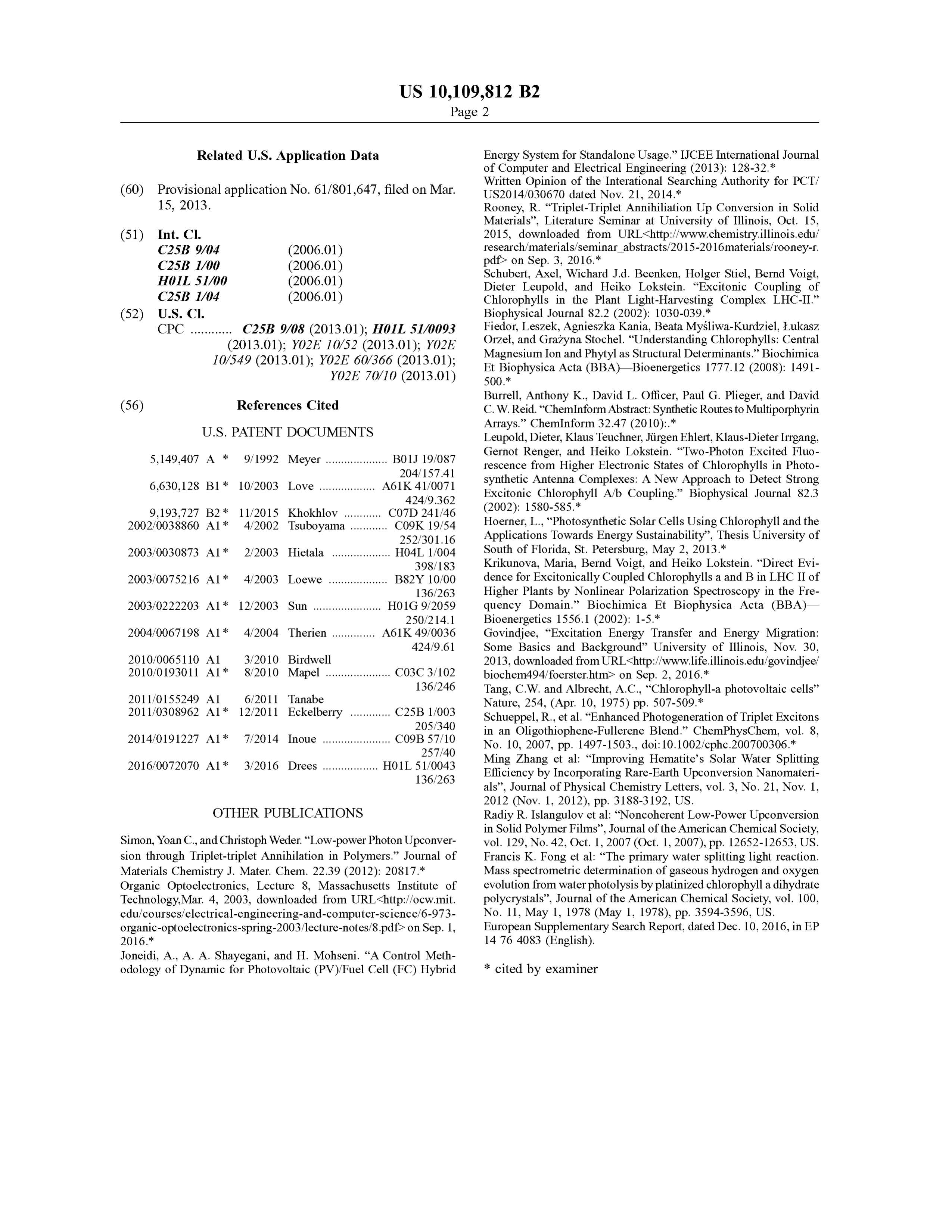
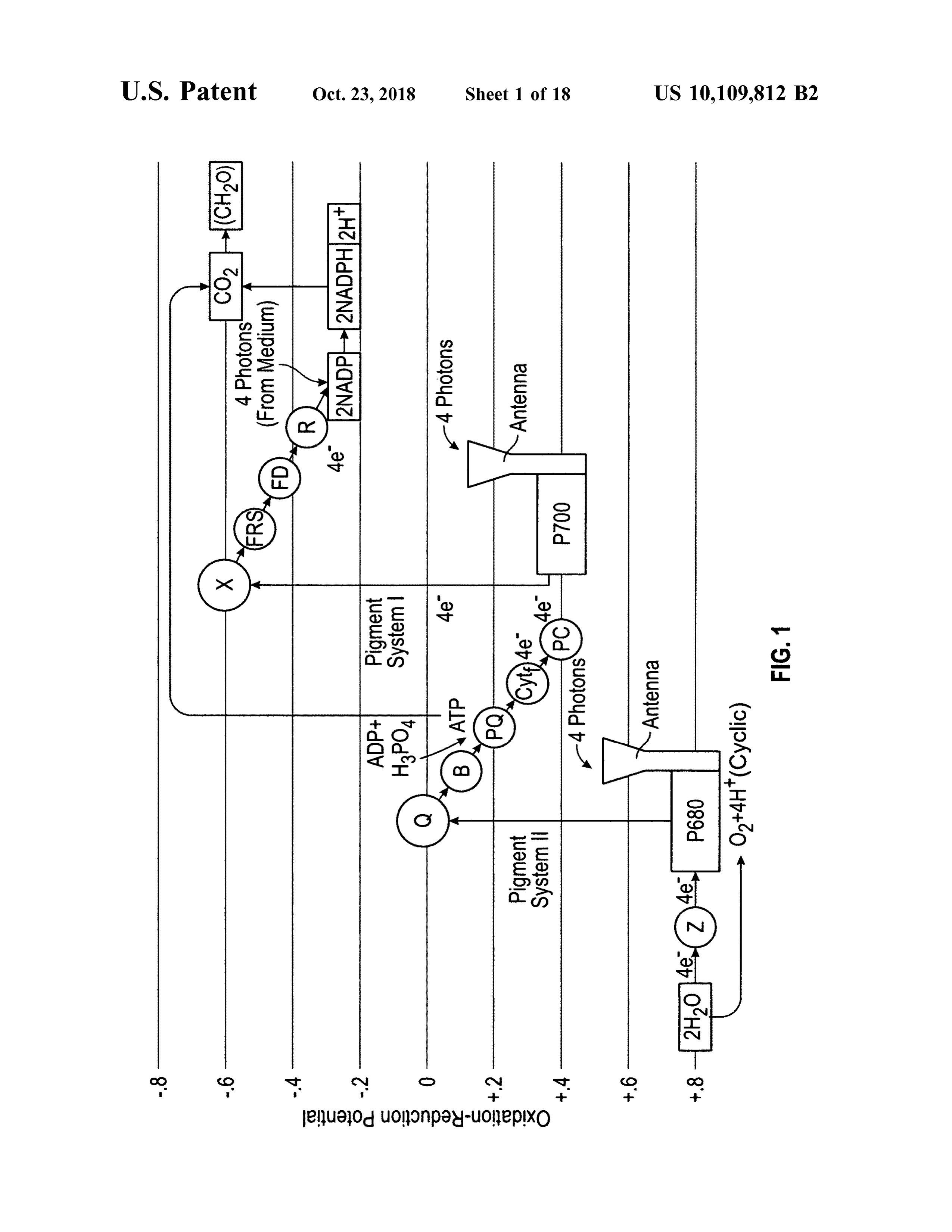
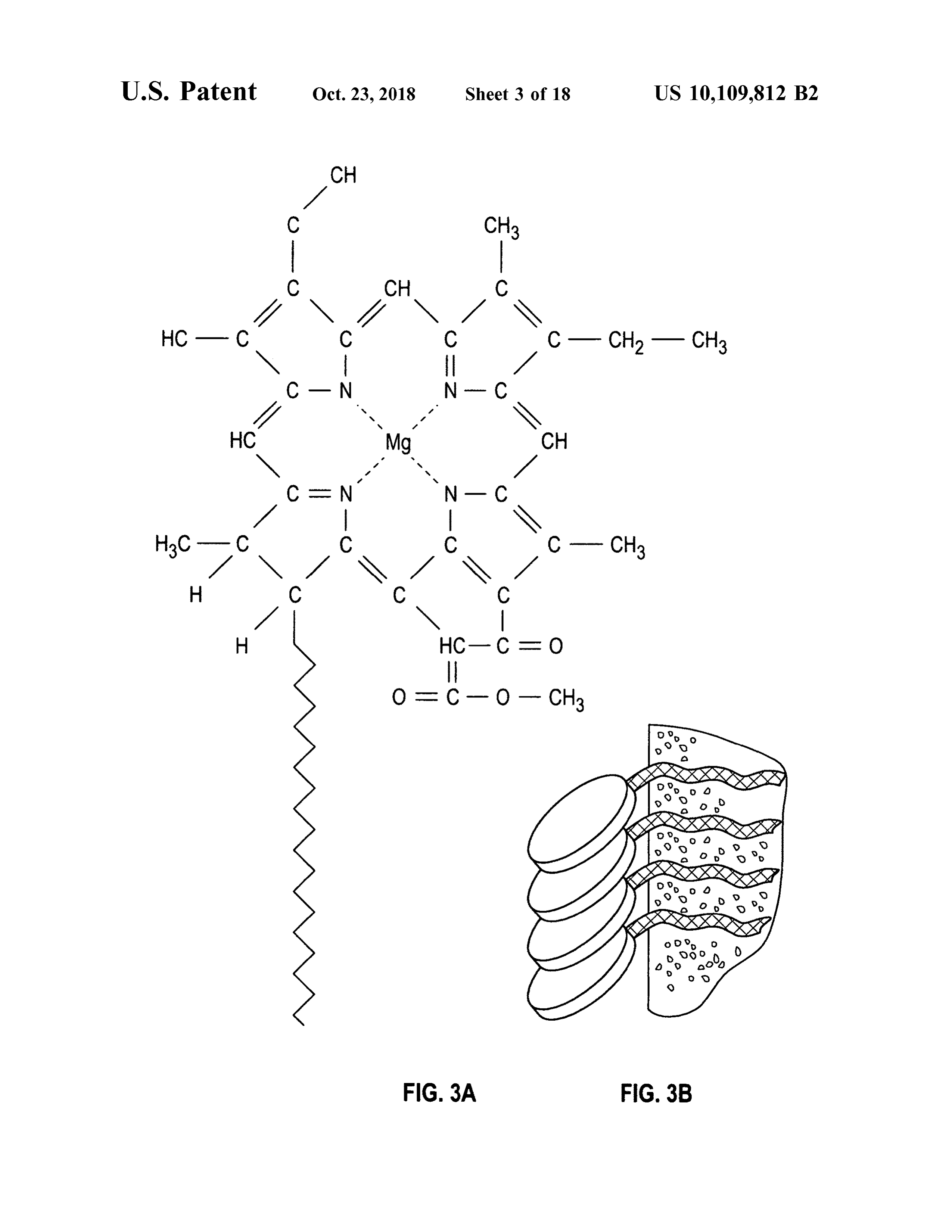
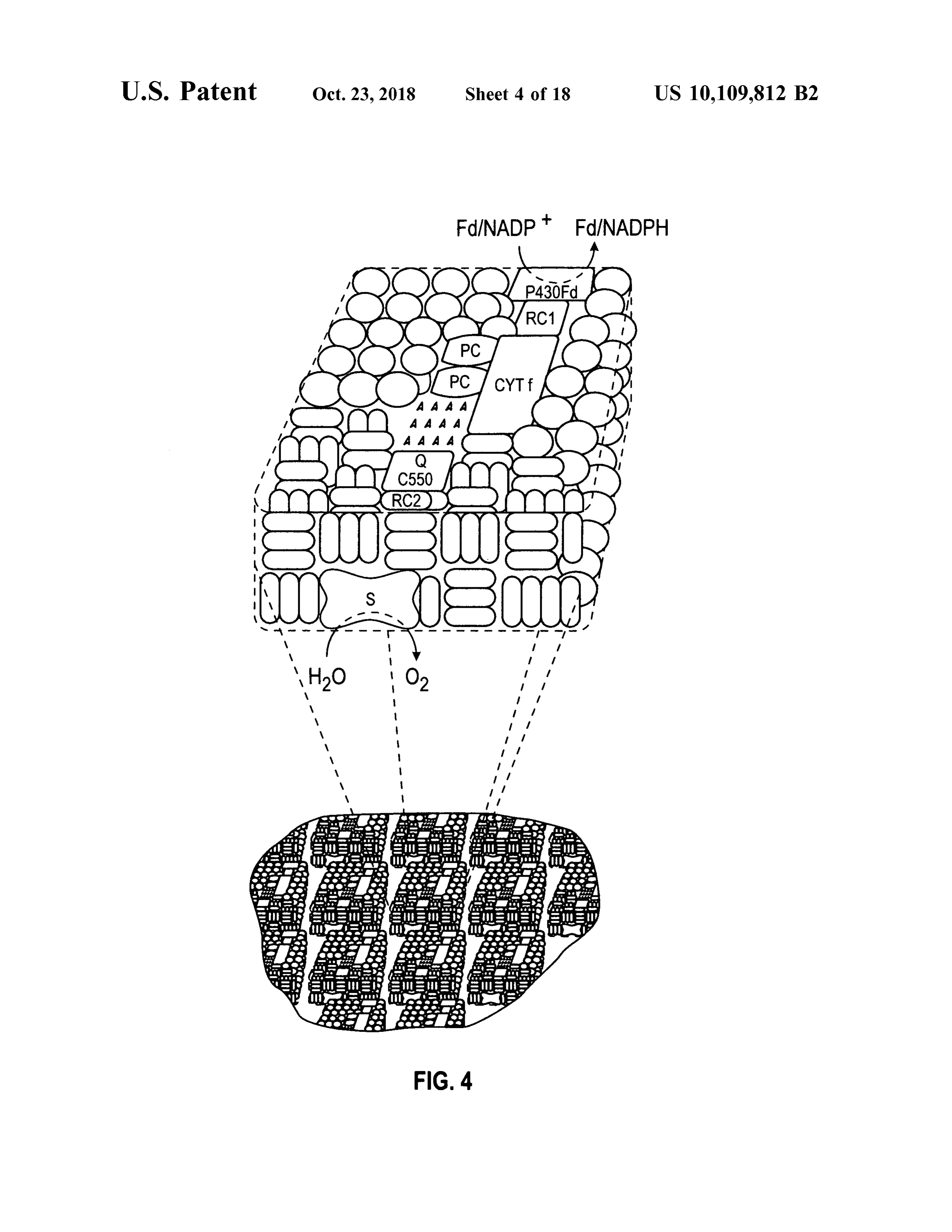
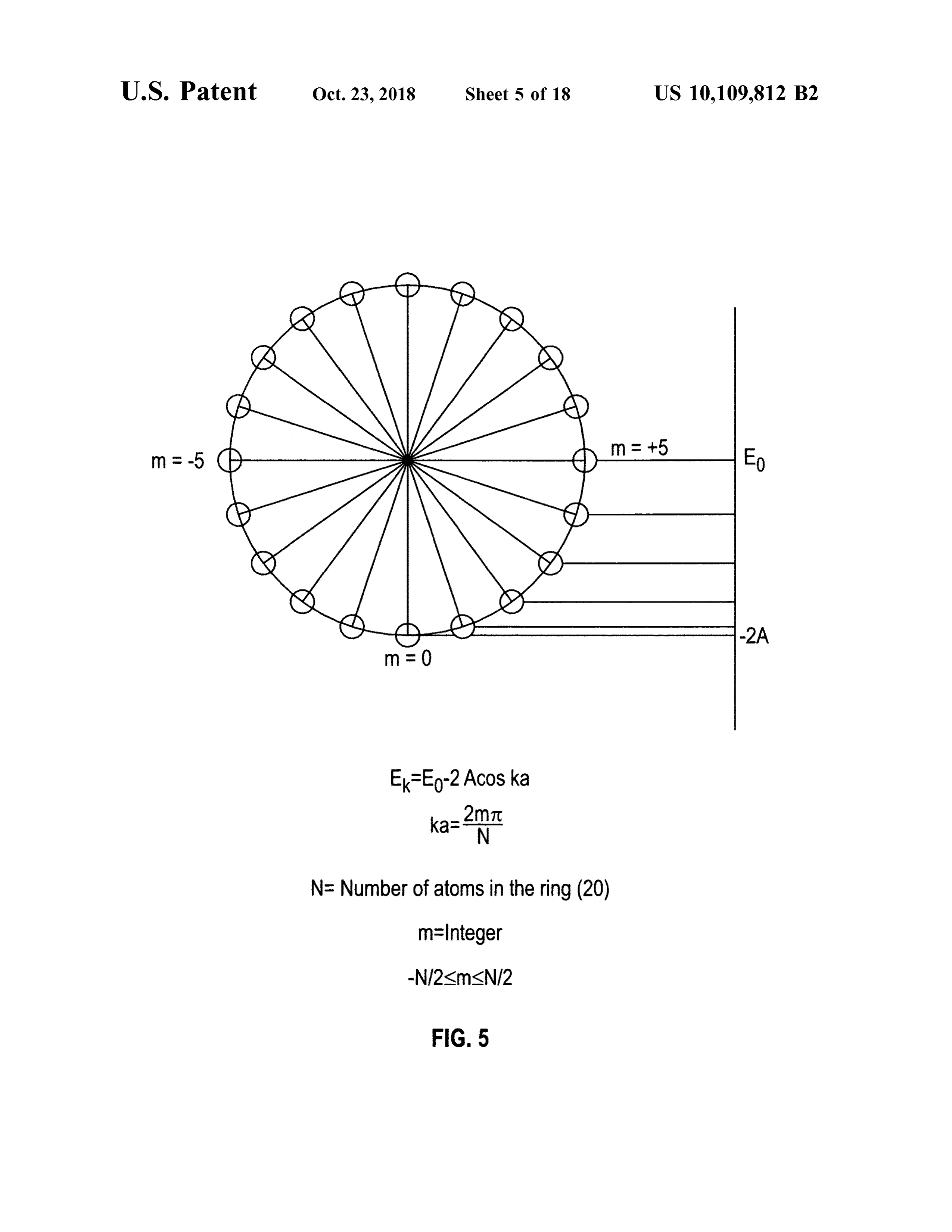
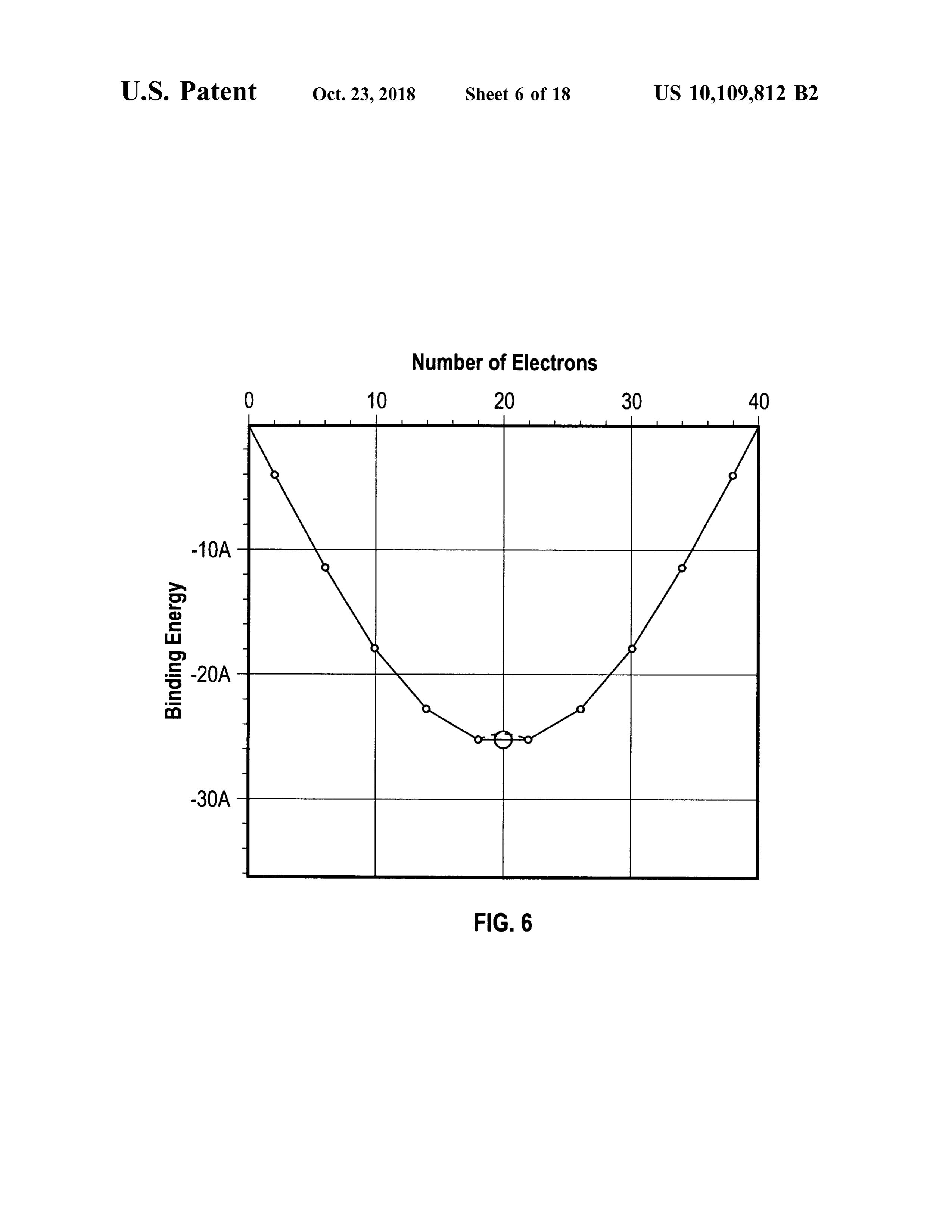
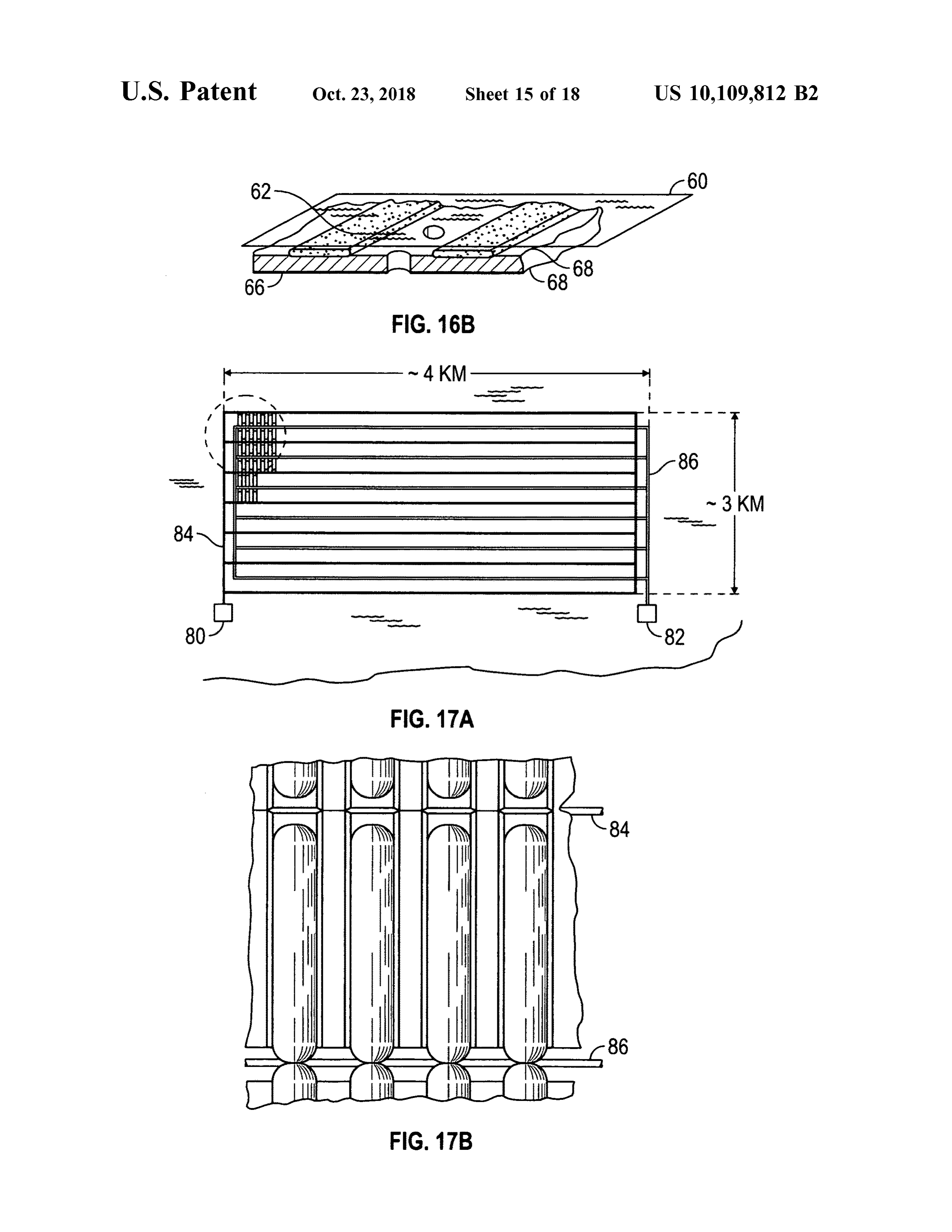
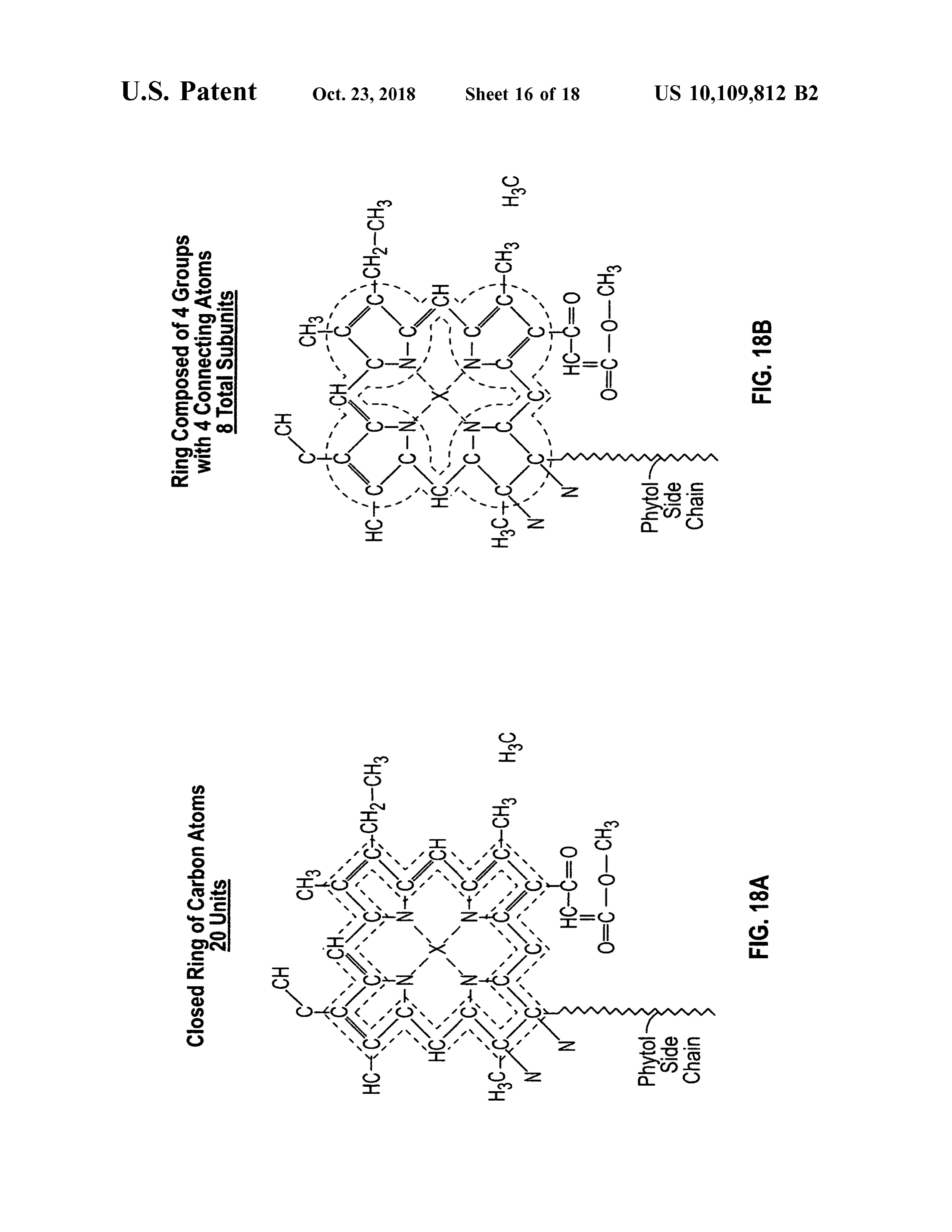
on substrate having metallic conducting strips embedded at 40 intervals to collect electric currents . In other arrangements, BRIEF DESCRIPTION OF DRAWING FIGURES the molecular ( and/ or atomic ) ensemble structure is formed in a three dimensional volume. FIG . 1 is a schematic diagram showing flow of electrons In other applications, the molecular (and/or atomic ) in the Hill -Bendall model of photosynthesis.
ensemble structure comprises a plurality of molecular or 45 FIG . 2 is a schematic representation of a photosynthetic atomic species, at least some of which function to bond to unit comprising a light- harvesting antenna and a reaction or at least interact with at least one chemical reactant. center.
According to certain preferred aspects of the invention , the FIG . 3A shows the molecular structure of chlorophyll . bonding and /or interacting species comprise at least one FIG . 3B illustrates schematically chlorophyll molecules metallic species . 50 anchored to lipid layers .
In certain preferred embodiments, the released energy FIG . 4 is a schematic view of a pebble mosaic model. from the stored energy also produces light, most preferably FIG . 5 is a diagram showing energy levels of electrons on coherent light. a closed ring of 20 atoms.
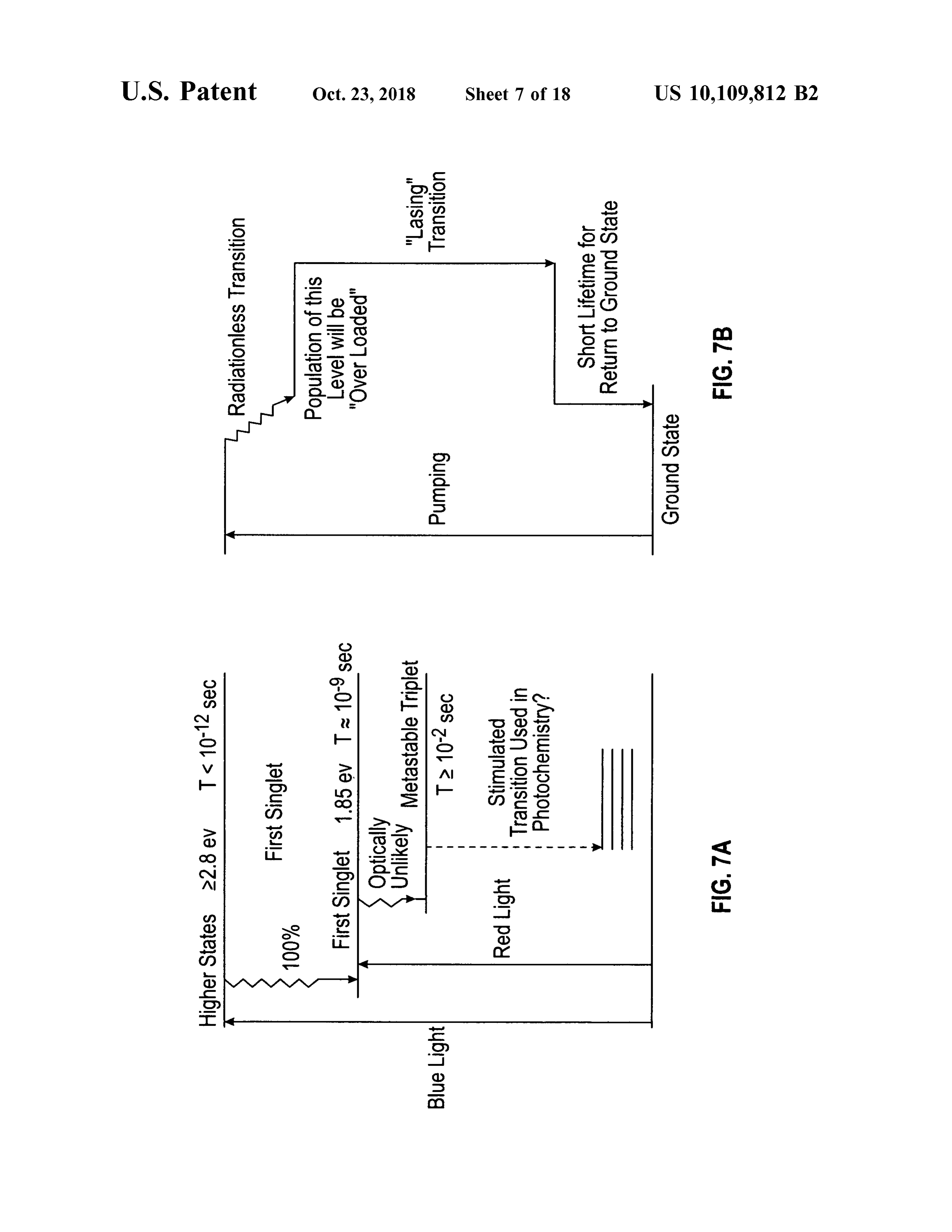
According to still other preferred aspects of the invention, FIG . 6 is a chart showing totalbinding energy of electrons the method employs a length of exposure that is sufficient to 55 on 20 atoms of the porphyrin ring in chlorophyll versus the produce multiple passes of a transferred electron thru the number of electrons on the ring. ensemble , whereby the energy in the electromagnetic charge FIG . 7A is a chart showing the energy levels in chloro motion is increased with each pass , wherein preferably the phyll.
active region of the atomic and/or molecular ensemble is FIG . 7B is a chart showing the energy levels in an ideal terminated at each end of the region with a structure suitable 60 4 -level laser system .
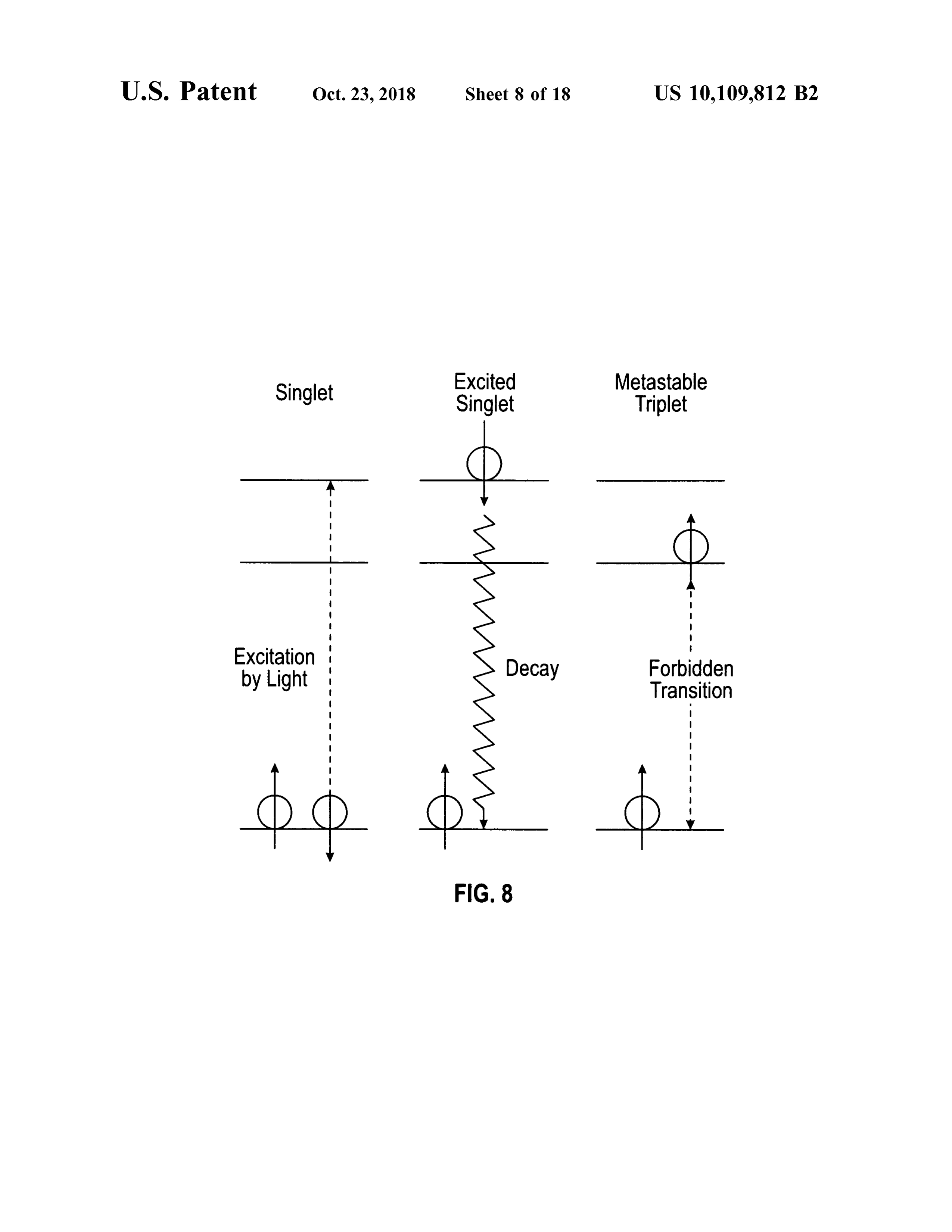
to reflect electrons (or holes ) and reverse their motion , so as FIG . 8 is a chart schematically showing three types of to cause oscillating transport of charges repeatedly passing electron transitions.
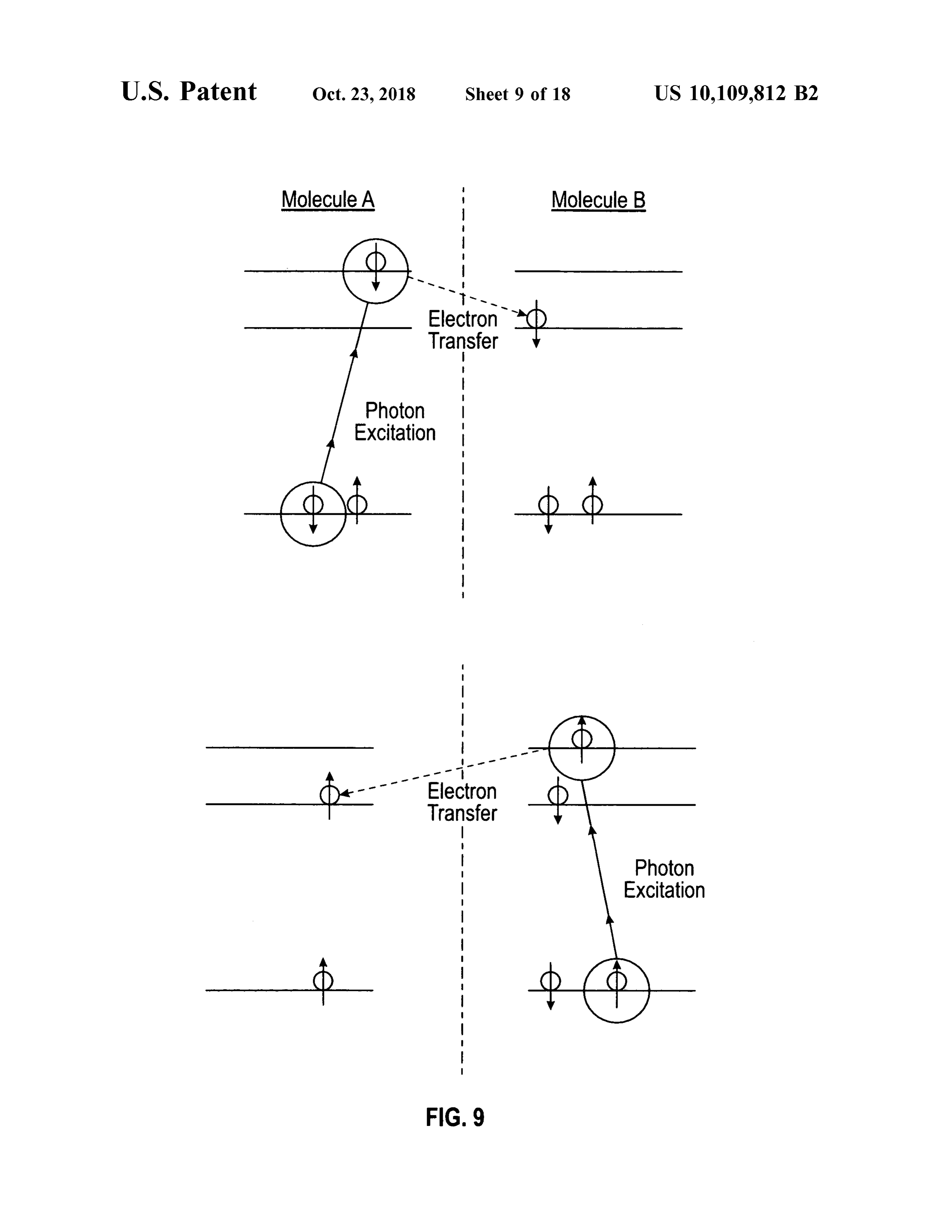
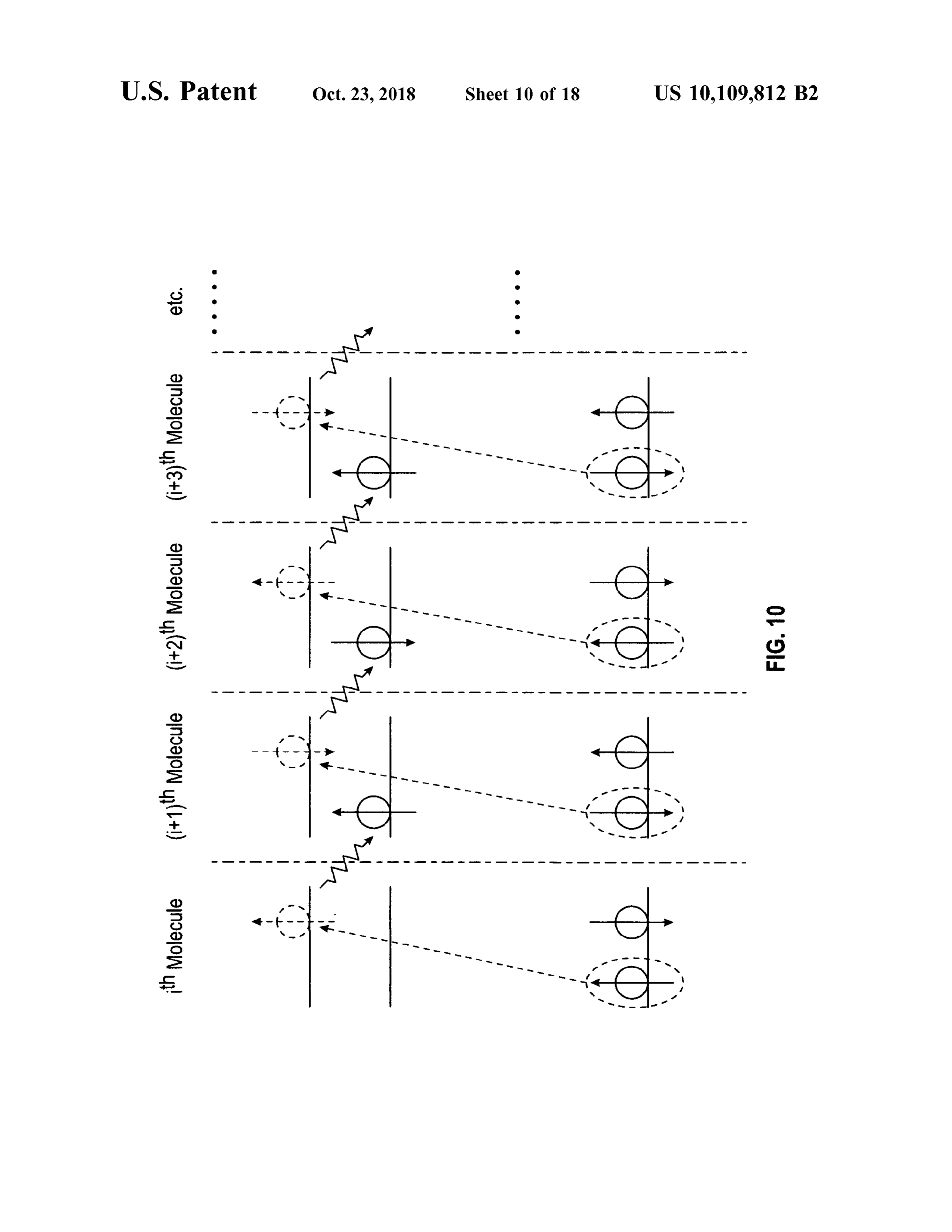
through the pumped ensemble. FIG . 9 is a chart schematically showing triplet state Some examples of an electron reflector include: (a .) formation by electron transfer in chlorophyll dimer. localized magnetic field with a strong gradient e. g ., field 65 FIG . 10 is a schematic chart showing pumping of an lines converging to focal point; (b . ) a high barrier, such as a ensemble of molecules by electron transfer from the singlet high voltage, to reflect an electron in one dimensional travel; state to the triplet state of an adjacent molecule .
Page 23
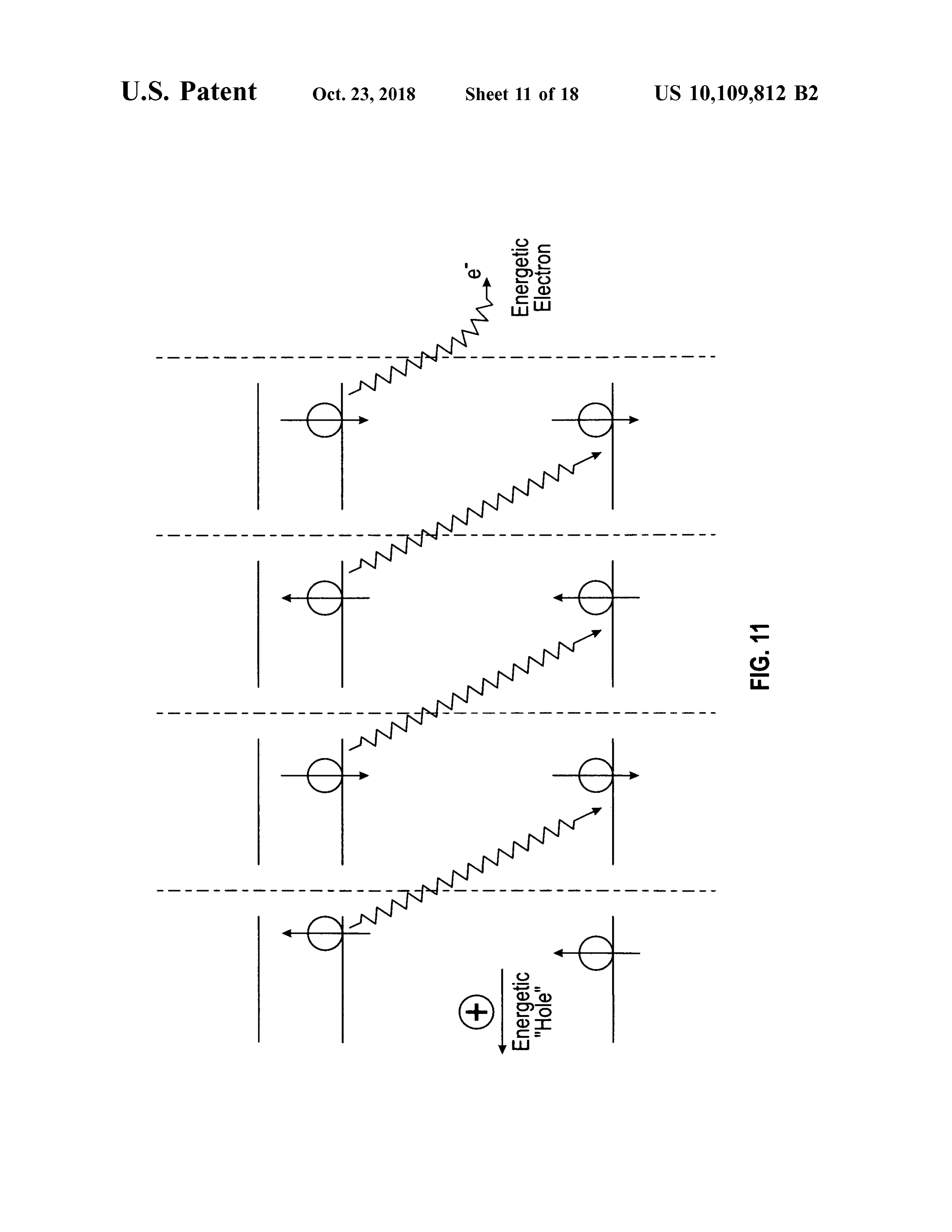
FIG . 11 is a schematic chart showing the decay of a Electron Beam :
molecular ensemble by a stimulated emission of an electron Some lasers are pumped by direct impingment of ener polarization wave . getic electron beams striking the active medium . It would be FIG . 12A is a schematic cross -section showing chloro appropriate in the present process to employ electron beams phyll molecules on the surface of a non -polar solvent. 5 striking the surface of a film .
FIG . 12B is a schematic cross -section showing chloro Gas Dynamic Process:
Gas dynamic or plasma dynamic processes can be used to phyll molecules on the surface of a polar solvent. pump gas lasers, but while this would not in most cases be FIG . 13 is a perspective illustration of semiconductor directly applicable to an ordered molecular ensemble , the device according to the present invention . present process can employ a molecular ensemble bom FIG . 14 is a schematic drawing of photovoltaic device 10 barded by gas stream , which can excite the electron levels using the EPWASER system . within the ensemble .
FIG . 15 is a schematic illustration of a photochemical Such input energy creates excited states of electrons to decomposition system for converting water into hydrogen produce a population inversion with the number of electrons and oxygen . in excited states exceeding the number of electrons in FIG . 16A is a perspective view of a floating solar con corresponding lower energy states . The excited electrons not version plant for water decomposition . only are raised to higher quantum energy level, but also FIG . 16B is a perspective view of the detail of the transfer to an adjacentmolecule ( or atom ). The stored energy in multiple molecules ( and / or atoms) can then be released photoactive surface in the system of FIG . 16A . via a process very similar to stimulated emission , in which FIG . 17A is a schematic plan view of a large scale floating 20 the excited electrons transition to a lower energy state while photochemical plant. simultaneously jumping to an adjacent unitwithin the struc FIG . 17B is an enlarged view showing the detail of the ture .
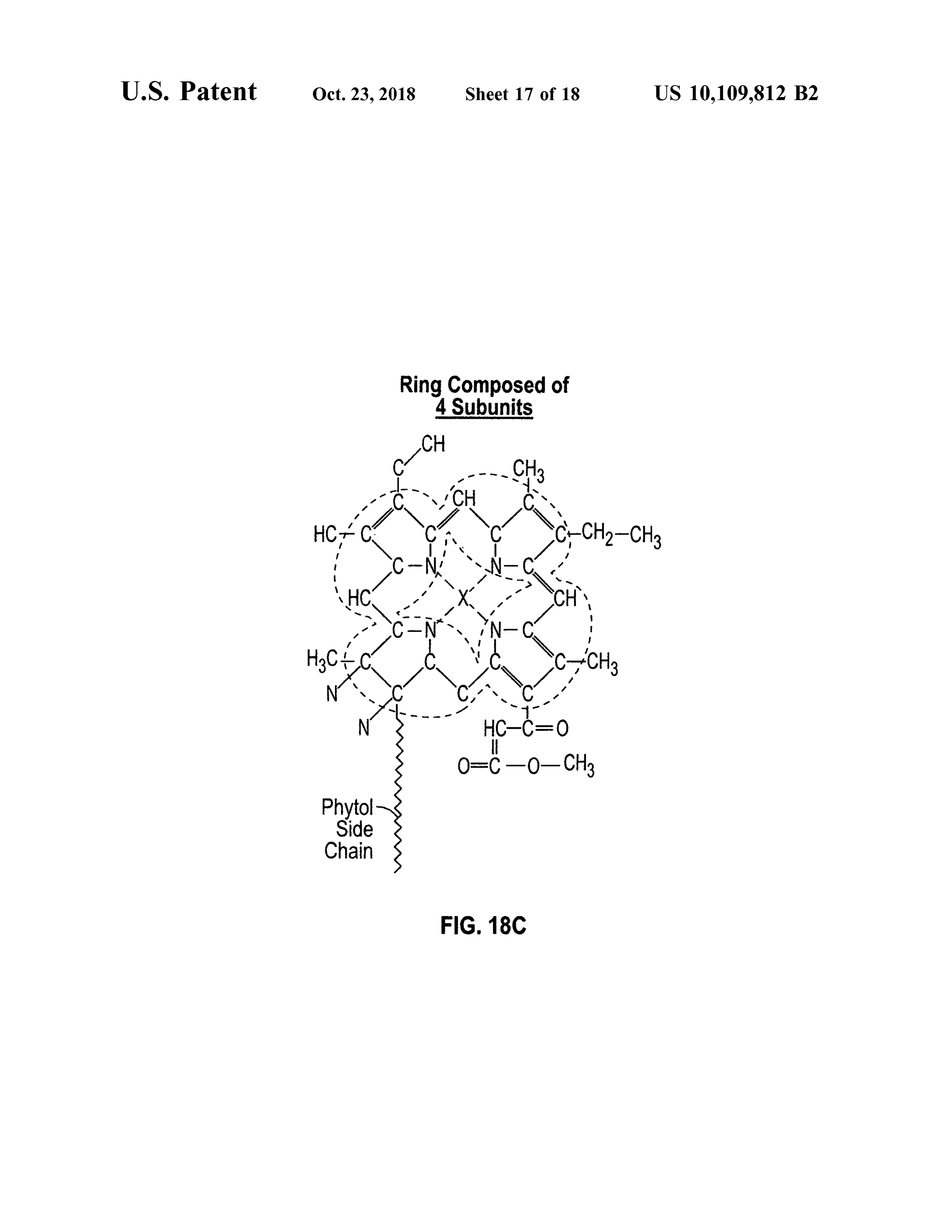
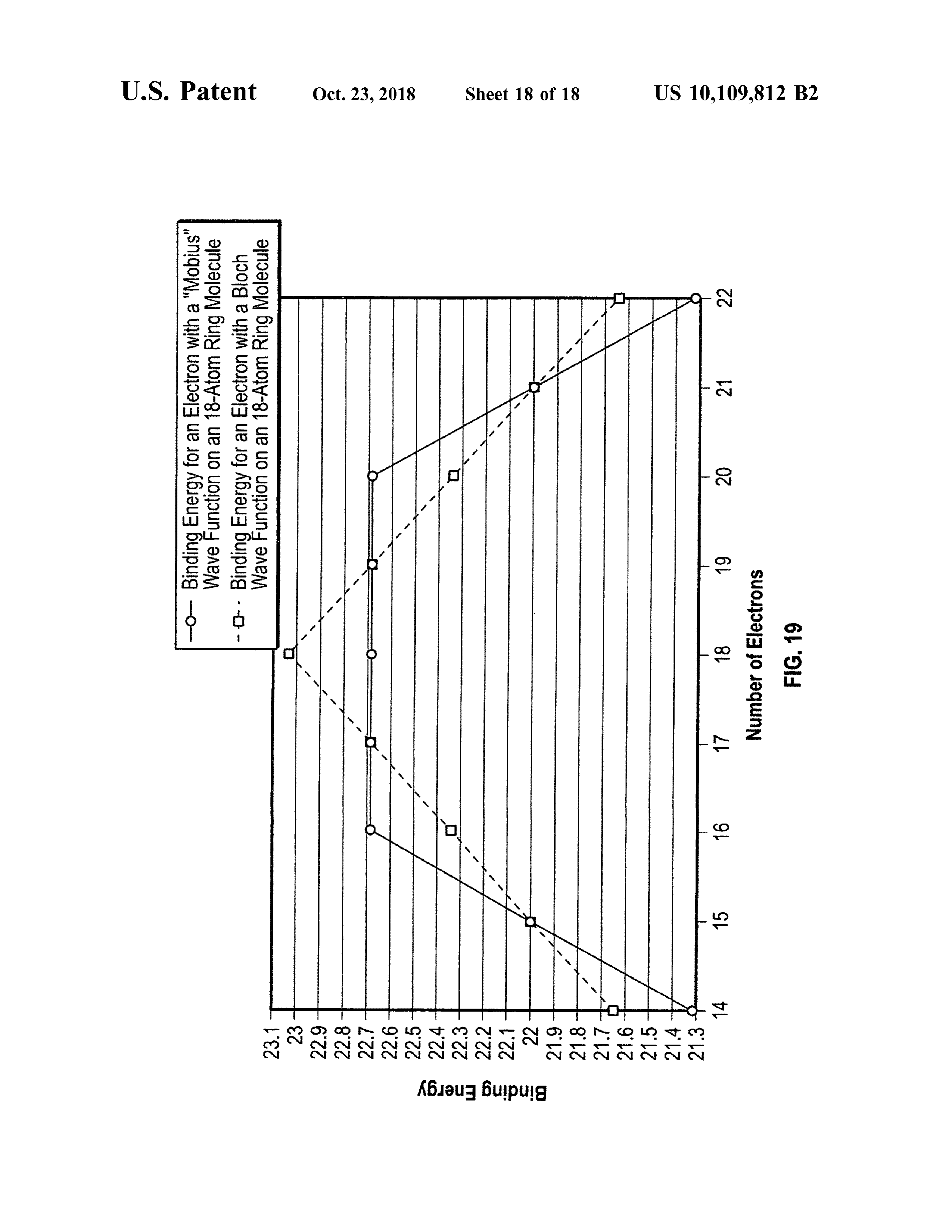
portion in the circle in FIG . 17A . This action is similar to that of lasers, because the FIGS . 18A , 18B and 18C illustrate three different ways of pumping process raises the energy states of electrons in a subunit grouping in the porphyrin molecule. number of atoms ( and / or molecules ); but, unlike lasers , the FIG . 19 is a graph of electron binding energy for an excited electrons are also transferred to a neighboring unit 18 -atom ring molecule. (atom or molecule ). Once transferred , quantum mechanical selection rules do not allow the electron to decay ( de -excite )
DETAILED DESCRIPTION OF PREFERRED back to its lower energy state within the same atom or EMBODIMENTS 30 molecule . In our process, the electron jumps to a neighbor ing unit as part of its decay transition .
The present invention is directed to methods and appa - Lasers amplify light passing through the " pumped ” ratus to produce and to exploit a new physical process , medium by a process known as stimulated emission . When which is similar to the operation of lasers, but different. a photon passes near a molecule or atom that has an excited Similar to laser operation , this process takes place in a 35 electron , the oscillating electromagnetic field of the photon special group ofmolecules ( and / or atoms), which can store " stimulates ” an excited electron to return its lower energy input energy pumping ” ) that can be in the form of light state , thereby giving up its energy and emitting another photons, or other forms of electromagnetic energy. Some of photon , which has the same wavelength and is traveling the the possible methods for pumping excitation energy include s ame direction in phase with the photon that stimulated the the following : 40 transition . Repeated events of this kind build up the intensity Light (Electromagnetic Radiation ): of the light within the laser ; in a laser the light is “ coherent.” Light ( either pulsed or continuous ) can be used as a source because all of its photons are moving in the same direction , of photons to excite electrons into excited states for the with the same frequency , and in phase . present process. The light source is not limited to the visible In our process, as an electron decays by jumping into the spectrum — it may be even be X - rays or infrared . 45 neighboring atom or molecule , it stimulates that adjacent Electrical Discharge: unit, which also contains an excited electron , to also decay Electrical discharges are sometimes used as pumping and transfer its electron to the next unit down the line. This sources for lasers. Either a diffuse discharge through the process can be continued down an arbitrarily long chain of gaseous medium , or an array of small arc discharges can be excited units , and it would thus sum up or combine the used to excite electrons in the laser medium . A similar 50 excitation energies of all the excited electrons by depositing process can be used for excitation of electrons the present that energy into the motion of the charges . The chain of units process, preferably in the form of an array of discharges does not have to be a long one; it could be as small as two impinging upon a surface of a film of the molecular individual atoms or molecules . This process causes a coher ensemble . ent electric pulse to be directed along the axis of the Chemical Reaction : 55 structured molecular ensemble . The electric pulse consists Excited electrons in compounds or radicals produced by of a high -energy electron moving in one direction , with a chemical reaction can be a source of energy input for the high - energy hole moving in the opposite direction . The present process . electron energy wave created can also be in a coherent form , Electrical Current Though Medium : and it can also include light emissions in some instances , Passing a current through the P - N junction is employed to 60 such that it therefore has the same broad spectrum of pump semiconductor lasers . Essentially most of the elec - applications as the emissions produced by a laser. trons traversing the energy step at the junction can produce Similarly to the case of the laser, the electron energy wave an output photon . A similar process can be employed for the created according to the present invention can be viewed as present process , in which a current is passed through the a stimulated emission . Stimulation can be spontaneous in molecular ensemble to excite electron states that can pro - 65 accordance with the invention ,meaning that certain of the duce energetic charge transport at right angles to the direc excited electrons often begin to spontaneously decay back to tion of the stimulating current . their normal state in a statistical manner, as in the case of a
Page 24
laser, and this is a function of the amount of energy being There is a lack of a feasible hypothesis to explain the pumped into the system . In other applications, it is appro - mechanism that occurs in plant photosynthesis . This mecha priate to apply some form of external stimulation to the nism allows a plant to collect and integrate the energy of 8 systems, in order to exercise control over the system . Any or more low energy photons and utilize this energy in a type of external stimulation can be employed , for example , 5 single photochemical reaction to split water molecules . electromagnetic energy or vibrational energy . When the Quantum mechanical considerations indicate that simulta charge level of an electron drops, it causes an oscillation neous action of several photons of incoherent light is highly which then stimulates other electrons , at the appropriate improbable. Photosynthesis must therefore involve the frequency. cooperative utilization of the energy of several photons . A The process comprises an Electron Polarization Wave 10 method that duplicates this cooperative photon action in Amplified by Stimulated Emission of Radiation (EP vitro creates the possibility of successful large - scale photo WASER ) to create energetic charge movement, which has enough energy to drive chemical reactions that normally chemical energy , for example, in accordance with one would be impossible because the energy steps are larger than embodiment of the invention , the high efficiency solar the energy in a photon of visible light. In certain embodi- 15 decomposition of ments, at the end of a series of the pumped units there is In plant photosynthesis oxygen is not evolved from CO , located a “ docking site ” interface that connects to a chemical but rather from water with hydrogen utilized for storage of reactant, e. g., a water molecule , which can be split into chemical energy by the buildup of carbohydrates. The hydrogen and oxygen . The energy required to decompose chemical balance of the carbon cycle is illustrated in FIG . 1 . water is larger than the photon energy (hv ) of visible light; 20 When the reaction shown at the top of FIG . 1 proceeds but our proposed process is capable of accomplishing this toward the right it represents the photosynthetic production feat due to the novel mechanism described above . of oxygen and 16th of a glucose molecule from water and An attractive approach to solar energy conversion is to CO2. When the reaction proceeds toward the left, glucose is directly utilize a process similar to photosynthesis which oxidized (as occurs in animal metabolism ). As indicated , occurs in plants . With respect to this field of utility , the 25 approximately 5 eV of energy are transferred by this process . benefits of utilizing a photosynthesis -like conversion of A similar amount of energy is stored by splitting 2 molecules solar energy to produce usable chemical fuels is widely of water to produce 2 molecules of free H , and one of 02. recognized . However, the search for a suitable process is The flow of electrons from water to carbon dioxide hampered by a lack of fundamentalknowledge regarding the proceeds against an electrochemical gradientof 1.2 volts and basic mechanisms of photosynthesis which allow the energy 30 requires two photochemical events. Four electrons must be of several incoherent photons to be cooperatively utilized to transferred , one at a time, to liberate a molecule of oxygen split water molecules . Our research has led to the discovery of a novel mechanism to explain this efficient conversion of and reduce a molecule of carbon dioxide to carbohydrate. The process begins with the absorption of a photon by the light energy . The process , which results in the formation of antenna of pigment system II ( PS II ) . The energy of exci an electron energy wave in aggregated molecular ensembles, 35 as discussed above , is now explained in more detail with tation is conveyed to a chlorophyll molecule in the reaction reference to one non -limiting , exemplary type ofmolecule , center of the photosynthetic unit; the molecule is designated namely , chlorophyll. A quantum mechanical model shows P680 because one of the bands in its absorption spectrum is that in closely associated groups of molecules such as those at 680 nanometers . The excited P680 transfers an electron to comprising chlorophyll, light absorption can lead to electron 40 the acceptor Q , and subsequently recovers an electron from transfer between adjacent molecules. This type of inter - the donor Z . After Z has given up four electrons it regains molecular electron transfer will populate a metastable state them by oxidizing two molecules of water. such as the chlorophyll triplet state (normally spin forbidden Experiments have shown that it is possible to make the in isolated molecules). Successive photon - or other energy first photosystem (PS II ) act to split water and evolve oxygen induced electron transfers will thus create a localized popu - 45 even though the second system (PS I) is inactive , thus the lation inversion . In the stimulated emission process , elec - possibility of utilizing the water- splitting part of the process trons return to the ground state of an adjacent molecule . This independently.
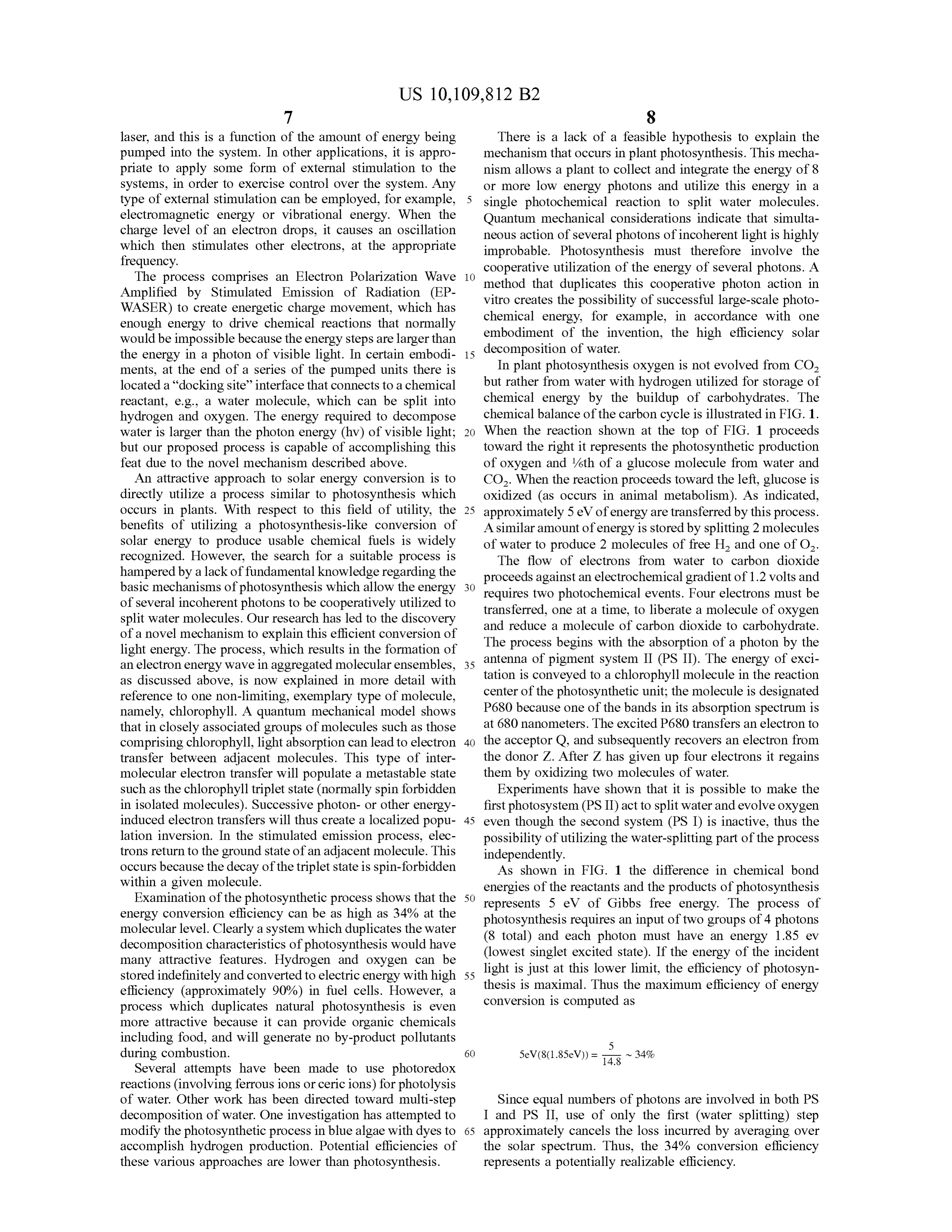
occurs because the decay of the triplet state is spin - forbidden As shown in FIG . 1 the difference in chemical bond within a given molecule . energies of the reactants and the products of photosynthesis Examination of the photosynthetic process shows that the 50 represents 5 eV of Gibbs free energy . The process of energy conversion efficiency can be as high as 34 % at the photosynthesis requires an input of two groups of 4 photons molecular level. Clearly a system which duplicates the water ( 8 total) and each photon must have an energy 1. 85 ev decomposition characteristics of photosynthesis would have (lowest singlet excited many attractive features . Hydrogen and oxygen can be light is just at this lowerstate ). If the energy of the incident limit, the efficiency of photosyn stored indefinitely and converted to electric energy with high 55 thesis is maximal . Thus the maximum efficiency of energy efficiency (approximately 90 % ) in fuel cells . However , a conversion is computed as process which duplicates natural photosynthesis is even more attractive because it can provide organic chemicals including food , and will generate no by -product pollutants
Several attempts have been made to use photoredox 60 5eV(8(1.85eV ))= - 34% during combustion .
reactions (involving ferrous ions or ceric ions) for photolysis of water. Other work has been directed toward multi -step Since equal numbers of photons are involved in both PS decomposition ofwater . One investigation has attempted to I and PS II, use of only the first (water splitting ) step modify the photosynthetic process in blue algae with dyes to 65 approximately cancels the loss incurred by averaging over accomplish hydrogen production . Potential efficiencies of the solar spectrum . Thus, the 34 % conversion efficiency these various approaches are lower than photosynthesis. represents a potentially realizable efficiency.
Page 25
Where
HC = 0 e = the electron charge
HC - OH E = permitivity of the medium r1, rz, rz =the respective distances between site of the 4th
OH - CH 5 hole, and each of the 3 previous charges.
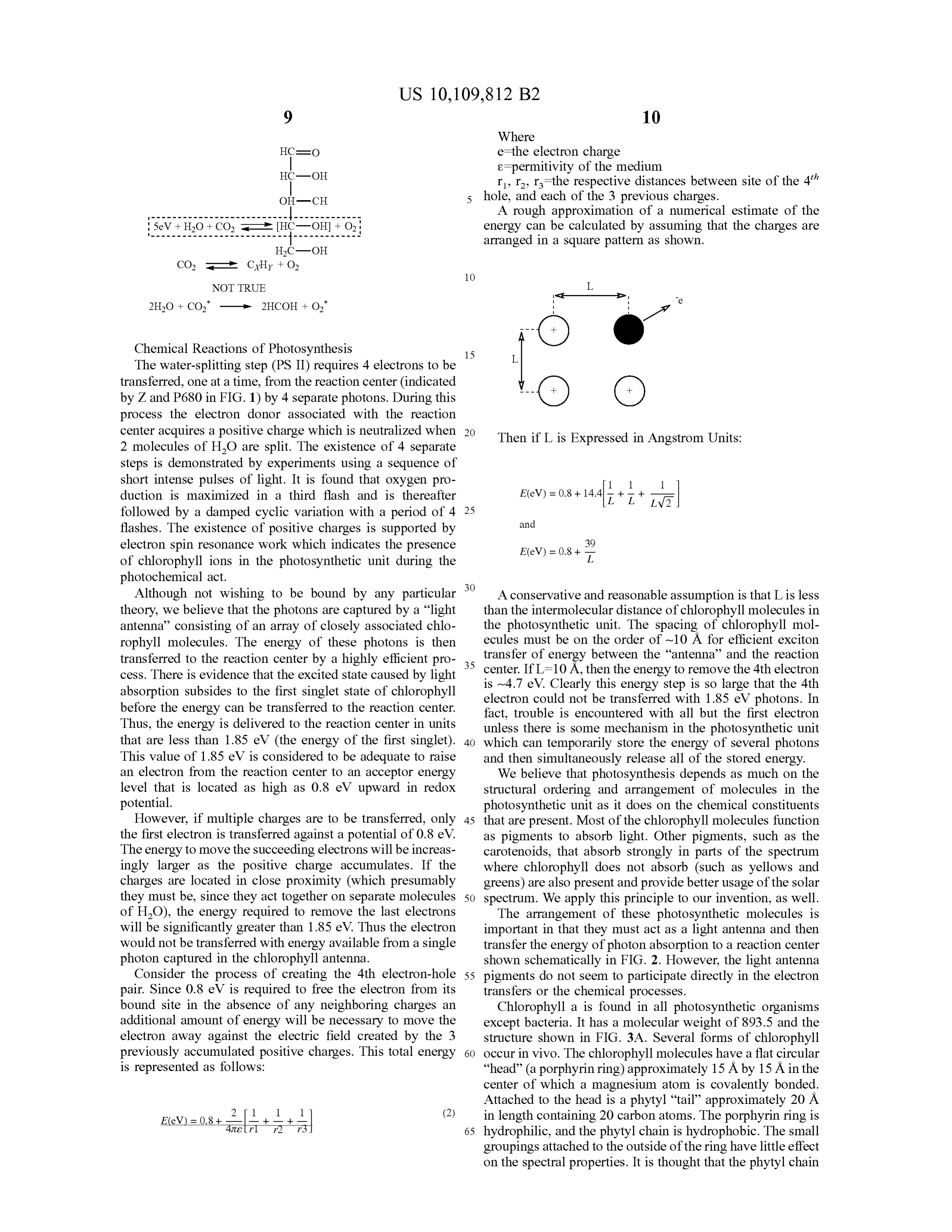
--------- A rough approximation of a numerical estimate of the 5eV + H2O + CO2 + [HC- - - -OH- ] + O2 ; energy can be calculated by assuming that the charges are arranged in a square pattern as shown.
NOT TRUE L
Chemical Reactions of Photosynthesis 15
The water -splitting step (PS II) requires 4 electrons to be transferred , one at a time, from the reaction center (indicated by Z and P680 in FIG . 1) by 4 separate photons. During this process the electron donor associated with the reaction
center acquires a positive charge which is neutralized when 20 Then if L is Expressed in Angstrom Units: 2 molecules of H2O are split. The existence of 4 separate steps is demonstrated by experiments using a sequence of short intense pulses of light. It is found that oxygen pro duction is maximized in a third flash and is thereafter followed by a damped cyclic variation with a period of 4 25 EleV)=0.8+ 14 [++++ zote ]
and
flashes . The existence of positive charges is supported by electron spin resonance work which indicates the presence EÇeV )= 0.8 + 3, of chlorophyll ions in the photosynthetic unit during the photochemical act.
Although not wishing to be bound by any particular 30s A conservative and reasonable assumption is that L is less theory , we believe that the photons are captured by a “ light than the intermolecular distance ofchlorophyllmolecules in antenna” consisting of an array of closely associated chlo the photosynthetic unit. The spacing of chlorophyll mol rophyll molecules . The energy of these photons is then ecules must be on the order of - 10 À for efficient exciton transferred to the reaction center by a highly efficient pro transfer of energy between the " antenna ” and the reaction cess. There is evidence that the excited state caused by light center. If L = 10 � , then the energy to remove the 4th electron absorption subsides to the first singlet state of chlorophyll is ~ 4 .7 eV. Clearly this energy step is so large that the 4th electron could not be transferred with 1 .85 eV photons . In before the energy can be transferred to the reaction center. fact, trouble is encountered with all but the first electron Thus, the energy is delivered to the reaction center in units unless there is somemechanism in the photosynthetic unit that are less than 1 . 85 eV (the energy of the first singlet). 40 which can temporarily store the energy of several photons This value of 1 .85 eV is considered to be adequate to raise and then simultaneously release all of the stored energy. an electron from the reaction center to an acceptor energy We believe that photosynthesis depends as much on the level that is located as high as 0 .8 eV upward in redox structural ordering and arrangement of molecules in the potential. photosynthetic unit as it does on the chemical constituents However, if multiple charges are to be transferred , only 45 that are present. Most of the chlorophyll molecules function the first electron is transferred against a potential of 0 .8 eV . as pigments to absorb light. Other pigments , such as the The energy to move the succeeding electronswill be increas carotenoids , that absorb strongly in parts of the spectrum ingly larger as the positive charge accumulates. If the where chlorophyll does not absorb ( such as yellows and charges are located in close proximity (which presumably greens) are also present and provide better usage of the solar they must be, since they act together on separate molecules 50 spectrum . We apply this principle to our invention , as well . of H2O ), the energy required to remove the last electrons The arrangement of these photosynthetic molecules is will be significantly greater than 1. 85 eV . Thus the electron important in that they must act as a light antenna and then would not be transferred with energy available from a single transfer the energy of photon absorption to a reaction center photon captured in the chlorophyll antenna . shown schematically in FIG . 2 . However, the light antenna Consider the process of creating the 4th electron -hole 55 pigments do not seem to participate directly in the electron pair. Since 0 . 8 eV is required to free the electron from its transfers or the chemical processes. bound site in the absence of any neighboring charges an Chlorophyll a is found in all photosynthetic organisms additional amount of energy will be necessary to move the except bacteria . It has a molecular weight of 893 . 5 and the electron away against the electric field created by the 3 structure shown in FIG . 3A . Several forms of chlorophyll previously accumulated positive charges. This total energy 60 occur in vivo . The chlorophyllmolecules have a flat circular is represented as follows: “ head ” (a porphyrin ring) approximately 15 �
in the center of which a magnesium atom is covalently bonded .
= 1 11 (2 ) in length containing 20 carbon atoms. The porphyrin ring is + 65 hydrophilic , and the phytyl chain is hydrophobic . The small groupings attached to the outside of the ring have little effect on the spectralproperties. It is thought that the phytyl chain
Page 26
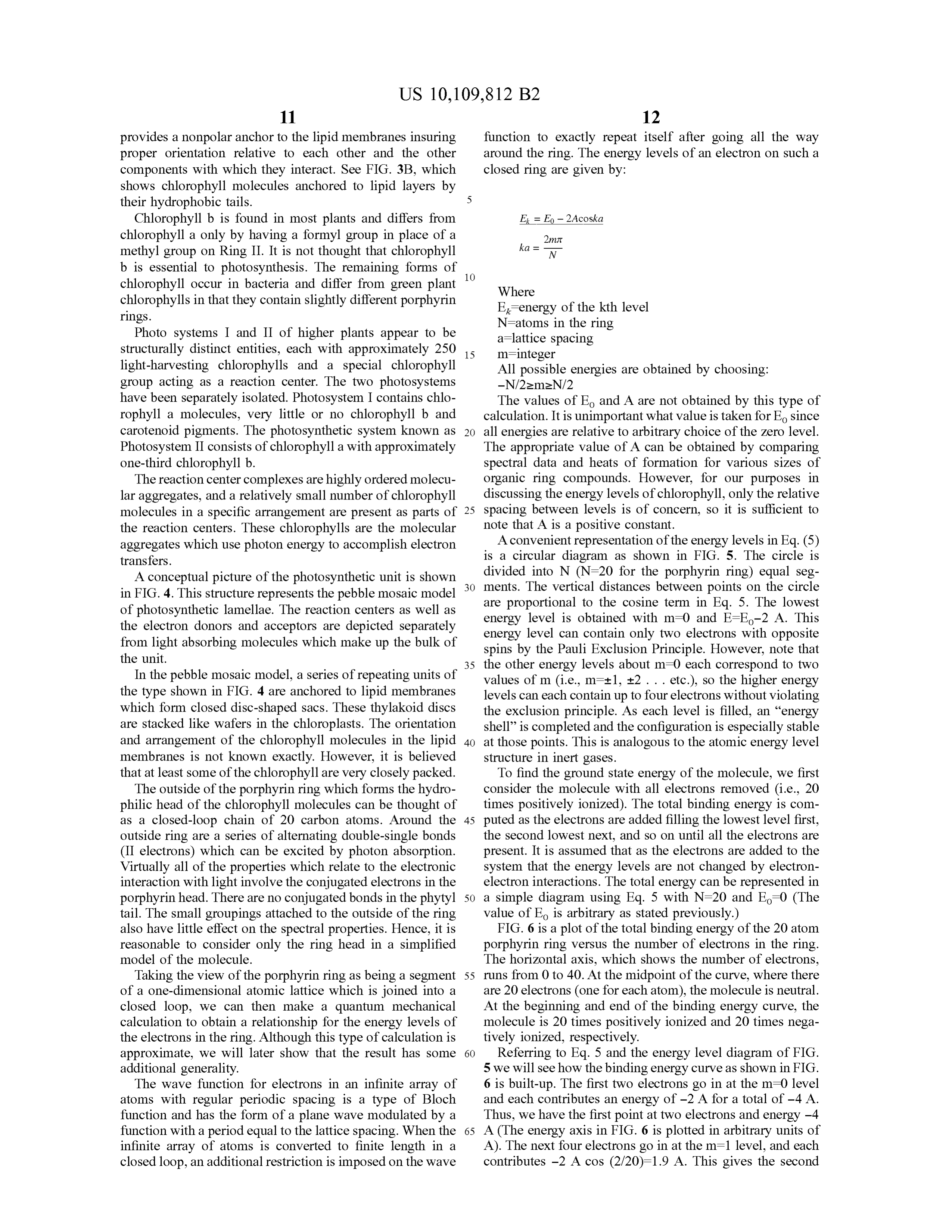
provides a nonpolar anchor to the lipid membranes insuring function to exactly repeat itself after going all the way proper orientation relative to each other and the other around the ring. The energy levels of an electron on such a components with which they interact. See FIG . 3B , which closed ring are given by :
shows chlorophyll molecules anchored to lipid layers by their hydrophobic tails.
Chlorophyll b is found in most plants and differs from Ex = Eo – 2Acoska chlorophyll a only by having a formyl group in place of a 2ma methyl group on Ring II . It is not thought that chlorophyll ka = -
b is essential to photosynthesis. The remaining forms of chlorophyll occur in bacteria and differ from green plant Where chlorophylls in that they contain slightly different porphyrin ExFenergy of the kth level rings. N = atoms in the ring
Photo systems I and II of higher plants appear to be structurally distinct entities, each with approximately 250 15 m ==lattice
integer spacing light-harvesting chlorophylls and a special chlorophyll All possible energies are obtained by choosing : group acting as a reaction center . The two photosystems - N /2 = mxN /2 have been separately isolated . Photosystem I contains chlo - The values of E , and A are not obtained by this type of rophyll a molecules, very little or no chlorophyll b and calculation . It is unimportantwhat value is taken for E , since carotenoid pigments. The photosynthetic system known as 20 all energies are relative to arbitrary choice of the zero level. Photosystem II consists of chlorophyll a with approximately The appropriate value of A can be obtained by comparing one -third chlorophyll b . spectral data and heats of formation for various sizes of The reaction center complexes are highly ordered molecu organic ring compounds. However, for our purposes in lar aggregates , and a relatively small number of chlorophyll discussing the energy levels of chlorophyll, only the relative molecules in a specific arrangement are present as parts of 25 spacing between levels is of concern , so it is sufficient to the reaction centers . These chlorophylls are the molecular note that A is a positive constant.
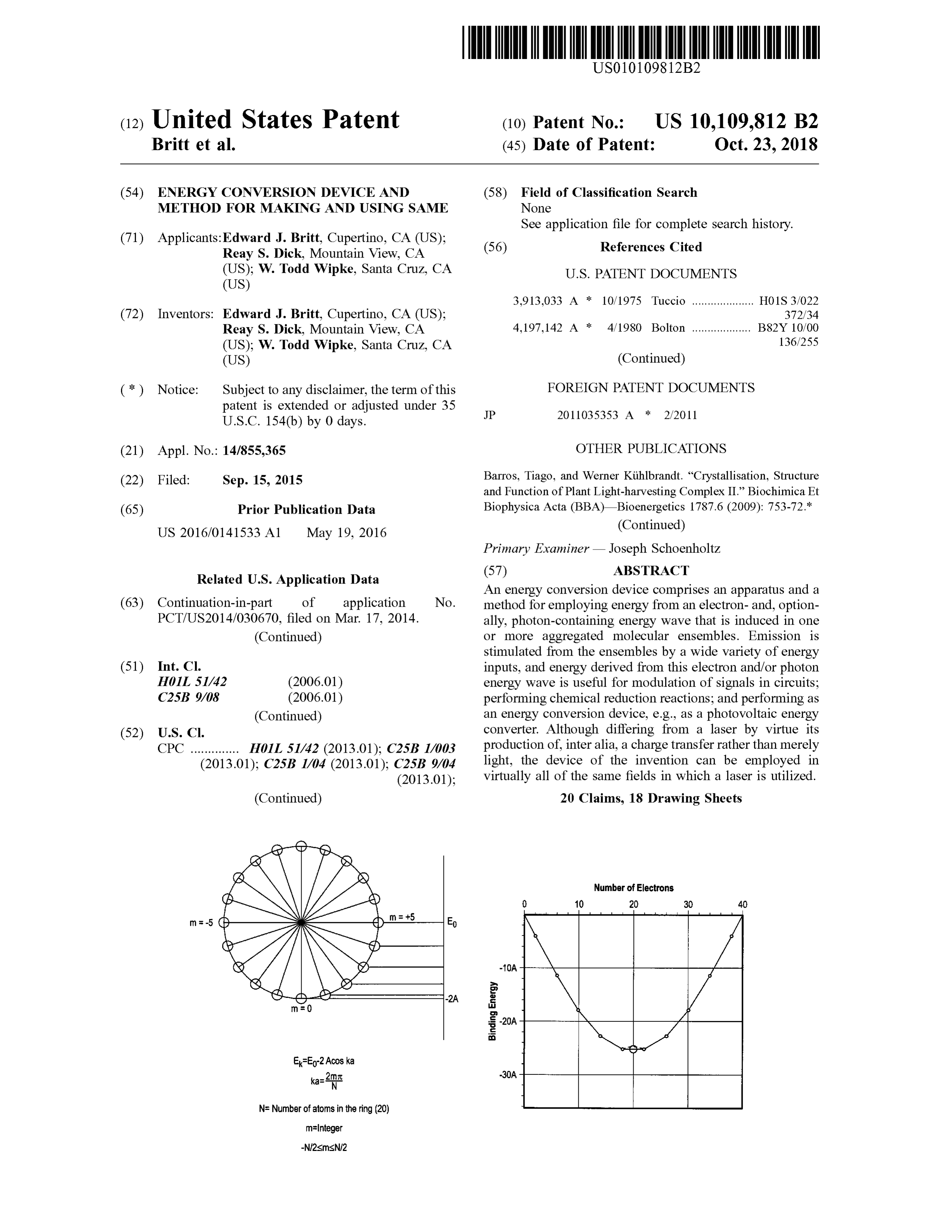
aggregates which use photon energy to accomplish electron A convenient representation of the energy levels in Eq . ( 5 ) transfers. is a circular diagram as shown in FIG . 5 . The circle is divided into N (N = 20 for the porphyrin ring ) equal seg
A conceptual picture of the photosynthetic unit is showna 30 ments in FIG . 4 . This structure represents the pebble mosaic model . The vertical distances between points on the circle of photosynthetic lamellae. The reaction centers as well as are proportional to the cosine term in Eq . 5 . The lowest energy level is obtained with m = 0 and E = E , - 2 A . This the electron donors and acceptors are depicted separately energy level can contain only two electrons with opposite from light absorbing molecules which make up the bulk of spins by the Pauli Exclusion Principle . However, note that the unit.
In the pebble mosaic model, a series of repeating units of values of m (i.e ., m = + 1,about 35 the other energy levels m = 0 each correspond to two 2 . . . etc .), so the higher energy the type shown in FIG . 4 are anchored to lipid membranes levels can each contain up to four electrons without violating which form closed disc -shaped sacs . These thylakoid discs the exclusion principle . As each level is filled , an “ energy are stacked like wafers in the chloroplasts. The orientation shell” is completed and the configuration is especially stable and arrangement of the chlorophyll molecules in the lipid 40 at those points . This is analogous to the atomic energy level membranes is not known exactly. However, it is believed structure in inert gases .
that at least some of the chlorophyll are very closely packed . To find the ground state energy of the molecule, we first The outside of the porphyrin ring which forms the hydro - consider the molecule with all electrons removed (i.e., 20 philic head of the chlorophyll molecules can be thought of times positively ionized ). The total binding energy is com as a closed -loop chain of 20 carbon atoms. Around the 45 puted as the electrons are added filling the lowest level first, outside ring are a series of alternating double -single bonds the second lowest next, and so on until all the electrons are ( II electrons) which can be excited by photon absorption . present. It is assumed that as the electrons are added to the Virtually all of the properties which relate to the electronic system that the energy levels are not changed by electron interaction with light involve the conjugated electrons in the electron interactions. The total energy can be represented in porphyrin head . There are no conjugated bonds in the phytyl 50 a simple diagram using Eq . 5 with N = 20 and E = 0 ( The tail. The small groupings attached to the outside of the ring value of E , is arbitrary as stated previously .) also have little effect on the spectral properties. Hence , it is FIG . 6 is a plot of the total binding energy of the 20 atom reasonable to consider only the ring head in a simplified porphyrin ring versus the number of electrons in the ring . model of the molecule . The horizontal axis , which shows the number of electrons, Taking the view of the porphyrin ring as being a segment 55 runs from 0 to 40 . At the midpoint of the curve , where there of a one- dimensional atomic lattice which is joined into a are 20 electrons (one for each atom ), the molecule is neutral. closed loop , we can then make a quantum mechanical At the beginning and end of the binding energy curve, the calculation to obtain a relationship for the energy levels of molecule is 20 times positively ionized and 20 times nega the electrons in the ring. Although this type of calculation is tively ionized , respectively .
approximate, we will later show that the result has some 60 Referring to Eq. 5 and the energy level diagram of FIG . additional generality . 5 we will see how the binding energy curve as shown in FIG . The wave function for electrons in an infinite array of 6 is built - up . The first two electrons go in at the m = 0 level atoms with regular periodic spacing is a type of Bloch and each contributes an energy of - 2 A for a total of -4 A . function and has the form of a plane wave modulated by a Thus , we have the first point at two electrons and energy - 4 function with a period equal to the lattice spacing . When the 65 A (The energy axis in FIG . 6 is plotted in arbitrary units of infinite array of atoms is converted to finite length in a A ). The next four electrons go in at the m = 1 level, and each closed loop , an additional restriction is imposed on the wave contributes - 2 A cos ( 2 / 20 ) = 1 .9 A . This gives the second
Page 27
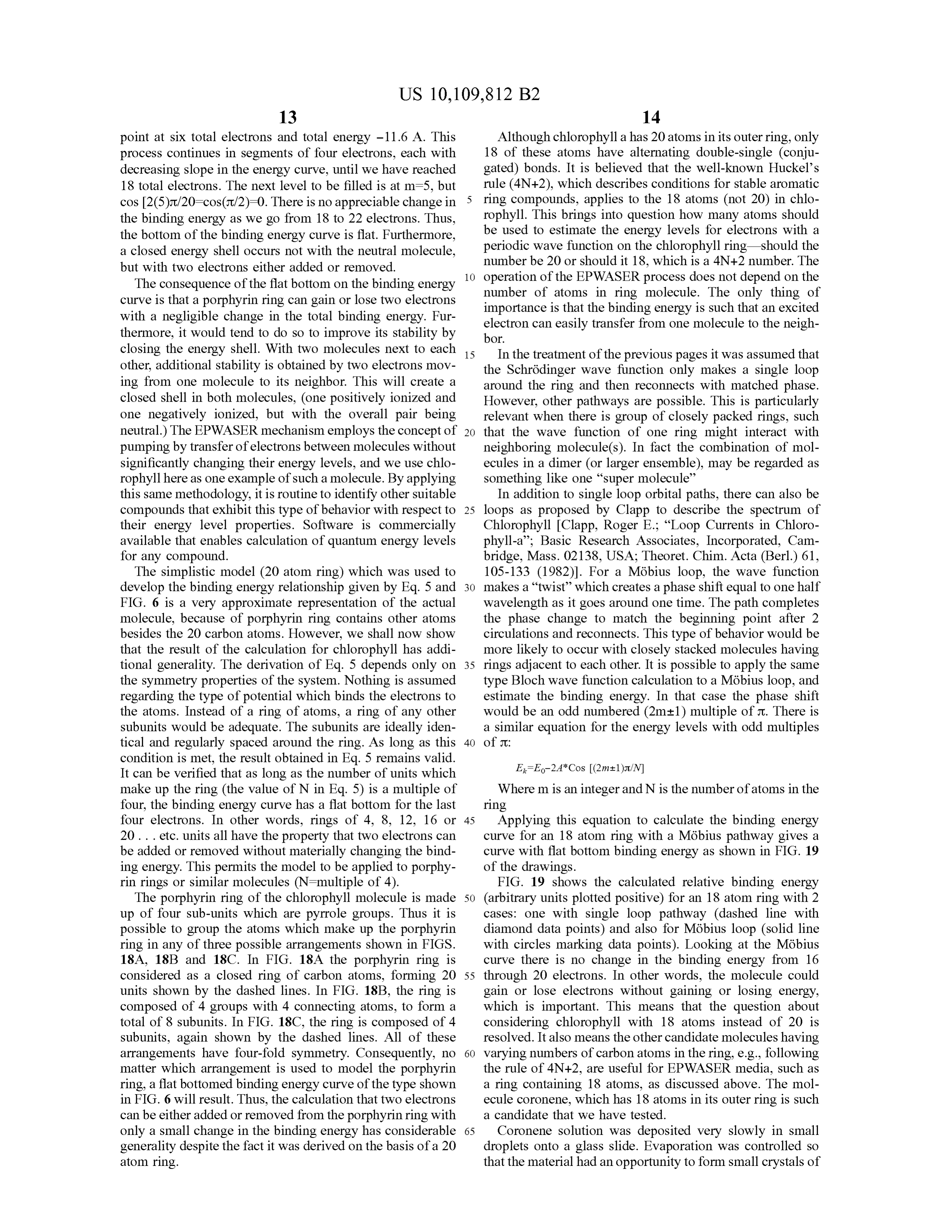
point at six total electrons and total energy - 11 .6 A . This Although chlorophyll a has 20 atoms in its outer ring, only process continues in segments of four electrons, each with 18 of these atoms have alternating double -single (conju decreasing slope in the energy curve , until we have reached gated ) bonds . It is believed that the well-known Huckel's 18 total electrons. The next level to be filled is at m = 5 , but rule (4N + 2 ), which describes conditions for stable aromatic cos [ 2 (5 ), / 20 = cos(1 /2 )= 0 . There is no appreciable change in 5 ring compounds, applies to the 18 atoms ( not 20 ) in chlo the binding energy as we go from 18 to 22 electrons. Thus, rophyll. This brings into question how many atoms should the bottom of the binding energy curve is flat. Furthermore , be used to estimate the energy levels for electrons with a periodic wave function on the chlorophyll ring — should the a closed energy shell occurs not with the neutral molecule, number be 20 or should it 18 , which is a 4N + 2 number. The but with two electrons either added or removed .
The consequence of the flat bottom on the binding energy 10 number operation of the EPWASER process does not depend on the of atoms in ring molecule . The only thing of curve is that a porphyrin ring can gain or lose two electrons importance is that the binding energy is such that an excited with a negligible change in the total binding energy . Fur electron can easily transfer from one molecule to the neigh thermore , it would tend to do so to improve its stability by bor closing the energy shell. With two molecules molecules next next toto each each 15 In the treatmentof the previous pages it was assumed that other, additional stability is obtained by two electronsmov the Schrödinger wave function only makes a single loop ing from one molecule to its neighbor. This will create a around the ring and then reconnects with matched phase . closed shell in both molecules, (one positively ionized and However , other pathways are possible . This is particularly one negatively ionized , but with the overall pair being relevant when there is group of closely packed rings, such neutral.) The EPWASER mechanism employs the concept of 20 that the wave function of one ring might interact with pumping by transfer of electrons between molecules without neighboring molecule (s ). In fact the combination ofmol significantly changing their energy levels , and we use chlo - ecules in a dimer (or larger ensemble ), may be regarded as rophyll here as one example of such a molecule . By applying something like one “ super molecule ” this same methodology, it is routine to identify other suitable In addition to single loop orbital paths, there can also be compounds that exhibit this type of behavior with respect to 25 loops as proposed by Clapp to describe the spectrum of their energy level properties . Software is commercially Chlorophyll (Clapp , Roger E .; “ Loop Currents in Chloro available that enables calculation of quantum energy levels phyll-a " ; Basic Research Associates , Incorporated , Cam for any compound. bridge, Mass . 02138 , USA ; Theoret. Chim . Acta (Berl.) 61, The simplistic model (20 atom ring) which was used to 105 - 133 (1982 ) ]. For a Möbius loop , the wave function develop the binding energy relationship given by Eq. 5 and 30 makes a “ twist” which creates a phase shift equal to one half FIG . 6 is a very approximate representation of the actual wavelength as it goes around one time. The path completes molecule , because of porphyrin ring contains other atoms the phase change to match the beginning point after 2 besides the 20 carbon atoms. However , we shall now show circulations and reconnects . This type of behavior would be that the result of the calculation for chlorophyll has addi- more likely to occur with closely stacked molecules having tional generality . The derivation of Eq. 5 depends only on 35 rings adjacent to each other. It is possible to apply the same the symmetry properties of the system . Nothing is assumed type Bloch wave function calculation to a Möbius loop , and regarding the type of potential which binds the electrons to estimate the binding energy . In that case the phase shift the atoms. Instead of a ring of atoms, a ring of any other would be an odd numbered (2m + 1 ) multiple of n . There is subunits would be adequate . The subunits are ideally iden - a similar equation for the energy levels with odd multiples tical and regularly spaced around the ring . As long as this 40 of :
condition is met, the result obtained in Eq. 5 remains valid . Ex = E . - 2A * Cos [(2m + 1) /N ] It can be verified that as long as the number of units which make up the ring ( the value of N in Eq. 5 ) is a multiple of Where m is an integer and N is the number of atoms in the four , the binding energy curve has a flat bottom for the last ring four electrons . In other words, rings of 4 , 8 , 12 , 16 or 45 Applying this equation to calculate the binding energy 20 . . . etc. units all have the property that two electrons can curve for an 18 atom ring with a Möbius pathway gives a be added or removed withoutmaterially changing the bind curve with flat bottom binding energy as shown in FIG . 19 ing energy. This permits the model to be applied to porphy- of the drawings .
rin rings or similar molecules (N =multiple of 4 ). FIG . 19 shows the calculated relative binding energy The porphyrin ring of the chlorophyll molecule is made 50 (arbitrary units plotted positive ) for an 18 atom ring with 2 up of four sub - units which are pyrrole groups . Thus it is cases : one with single loop pathway ( dashed line with possible to group the atoms which make up the porphyrin diamond data points ) and also for Möbius loop ( solid line ring in any of three possible arrangements shown in FIGS. with circles marking data points). Looking at the Möbius 18A , 18B and 18C . In FIG . 18A the porphyrin ring is curve there is no change in the binding energy from 16 considered as a closed ring of carbon atoms, forming 20 55 through 20 electrons. In other words , the molecule could units shown by the dashed lines. In FIG . 18B , the ring is gain or lose electrons without gaining or losing energy , composed of 4 groups with 4 connecting atoms, to form a which is important. This means that the question about total of 8 subunits. In FIG . 18C , the ring is composed of 4 considering chlorophyll with 18 atoms instead of 20 is subunits , again shown by the dashed lines. All of these resolved . It also means the other candidate molecules having arrangements have four - fold symmetry . Consequently , no 60 varying numbers of carbon atoms in the ring, e . g ., following matter which arrangement is used to model the porphyrin the rule of 4N + 2 , are useful for EPWASER media , such as ring, a flat bottomed binding energy curve of the type shown a ring containing 18 atoms, as discussed above. The mol in FIG . 6 will result . Thus , the calculation that two electrons ecule coronene , which has 18 atoms in its outer ring is such can be either added or removed from the porphyrin ring with a candidate that we have tested . only a small change in the binding energy has considerable 65 Coronene solution was deposited very slowly in small generality despite the fact it was derived on the basis of a 20 droplets onto a glass slide . Evaporation was controlled so atom ring . that the material had an opportunity to form small crystals of
Page 28
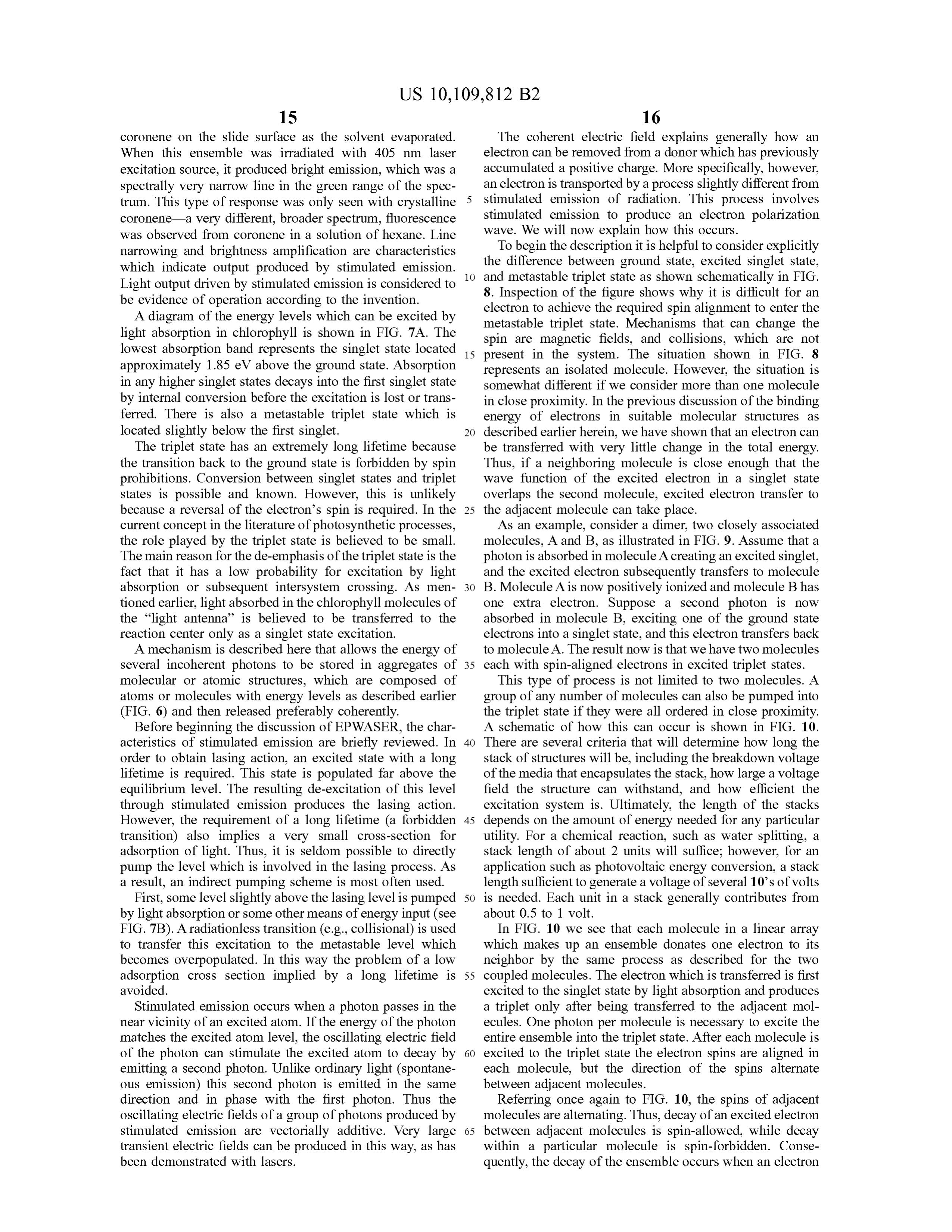
coronene on the slide surface as the solvent evaporated . The coherent electric field explains generally how an When this ensemble was irradiated with 405 nm laser electron can be removed from a donor which has previously excitation source , it produced bright emission , which was a accumulated a positive charge . More specifically, however , spectrally very narrow line in the green range of the spec an electron is transported by a process slightly different from trum . This type of response was only seen with crystalline 5 stimulated emission of radiation . This process involves stimulated emission to produce an electron polarization coronene a very different, broader spectrum , fluorescence wave was observed from coronene in a solution of hexane . Line . We will now explain how this occurs . narrowing and brightness amplification are characteristics theTodifference begin the description it is helpful to consider explicitly which indicate output produced by stimulated emission . 10 and metastablebetween ground state , excited singlet state , Light output driven by stimulated emission is considered to 8 . Inspection oftriplet state as shown schematically in FIG . the figure shows why it is difficult for an be evidence of operation according to the invention . electron to achieve the required spin alignment to enter the A diagram of the energy levels which can be excited by metastable triplet state . Mechanisms that can change the light absorption in chlorophyll is shown in FIG . 7A . The spin are magnetic fields, and collisions , which are not lowest absorption band represents the singlet state located 15 present in the system . The situation shown in FIG . 8 approximately 1. 85 eV above the ground state . Absorption represents an isolated molecule . However, the situation is in any higher singlet states decays into the first singlet state somewhat different if we consider more than one molecule by internal conversion before the excitation is lost or trans in close proximity . In the previous discussion of the binding ferred . There is also a metastable triplet state which is energy of electrons in suitable molecular structures as located slightly below the first singlet. 20 described earlier herein , we have shown that an electron can The triplet state has an extremely long lifetime because be transferred with very little change in the total energy . the transition back to the ground state is forbidden by spin Thus , if a neighboring molecule is close enough that the prohibitions. Conversion between singlet states and triplet w ave function of the excited electron in a singlet state states is possible and known . However, this is unlikely overlaps the second molecule , excited electron transfer to because a reversal of the electron ' s spin is required . In the 25 the adjacent molecule can take place . current concept in the literature of photosynthetic processes, As an example , consider a dimer, two closely associated the role played by the triplet state is believed to be small. molecules , A and B , as illustrated in FIG . 9 . Assume that a The main reason for the de -emphasis of the triplet state is the photon is absorbed in molecule A creating an excited singlet, fact that it has a low probability for excitation by light and the excited electron subsequently transfers to molecule absorption or subsequent intersystem crossing. As men - 30 B . Molecule A is now positively ionized and molecule B has tioned earlier, light absorbed in the chlorophyllmolecules of one extra electron . Suppose a second photon is now the “ light antenna” is believed to be transferred to the absorbed in molecule B , exciting one of the ground state reaction center only as a singlet state excitation . electrons into a singlet state , and this electron transfers back A mechanism is described here that allows the energy of to molecule A . The result now is that wehave two molecules several incoherent photons to be stored in aggregates of 35 each with spin - aligned electrons in excited triplet states . molecular or atomic structures, which are composed of This type of process is not limited to two molecules. A atoms or molecules with energy levels as described earlier group of any number of molecules can also be pumped into (FIG . 6 ) and then released preferably coherently. the triplet state if they were all ordered in close proximity. Before beginning the discussion of EPWASER , the char - A schematic of how this can occur is shown in FIG . 10 . acteristics of stimulated emission are briefly reviewed . In 40 There are several criteria that will determine how long the order to obtain lasing action , an excited state with a long stack of structures will be , including the breakdown voltage lifetime is required . This state is populated far above the of the media that encapsulates the stack , how large a voltage equilibrium level. The resulting de-excitation of this level field the structure can withstand, and how efficient the through stimulated emission produces the lasing action . excitation system is. Ultimately, the length of the stacks However, the requirement of a long lifetime (a forbidden 45 depends on the amount of energy needed for any particular transition ) also implies a very small cross -section for utility . For a chemical reaction , such as water splitting, a adsorption of light. Thus , it is seldom possible to directly stack length of about 2 units will suffice ; however, for an pump the level which is involved in the lasing process. As application such as photovoltaic energy conversion , a stack a result, an indirect pumping scheme is most often used . length sufficient to generate a voltage of several 10 ' s of volts First, some level slightly above the lasing level is pumped 50 is needed . Each unit in a stack generally contributes from by light absorption or some other means of energy input (see about 0 .5 to 1 volt.
FIG . 7B ). A radiationless transition (e.g ., collisional) is used In FIG . 10 we see that each molecule in a linear array to transfer this excitation to the metastable level which which makes up an ensemble donates one electron to its becomes overpopulated . In this way the problem of a low neighbor by the same process as described for the two adsorption cross section implied by a long lifetime is 55 coupled molecules . The electron which is transferred is first avoided . excited to the singlet state by light absorption and produces Stimulated emission occurs when a photon passes in the a triplet only after being transferred to the adjacent mol near vicinity of an excited atom . If the energy of the photon ecules . One photon per molecule is necessary to excite the matches the excited atom level, the oscillating electric field entire ensemble into the triplet state . After each molecule is of the photon can stimulate the excited atom to decay by 60 excited to the triplet state the electron spins are aligned in emitting a second photon . Unlike ordinary light (spontane- each molecule , but the direction of the spins alternate ous emission ) this second photon is emitted in the same between adjacent molecules .
direction and in phase with the first photon . Thus the Referring once again to FIG . 10 , the spins of adjacent oscillating electric fields of a group of photons produced by molecules are alternating . Thus, decay of an excited electron stimulated emission are vectorially additive . Very large 65 between adjacent molecules is spin - allowed , while decay transient electric fields can be produced in this way, as has within a particular molecule is spin - forbidden . Conse been demonstrated with lasers . quently , the decay of the ensemble occurs when an electron
Page 29
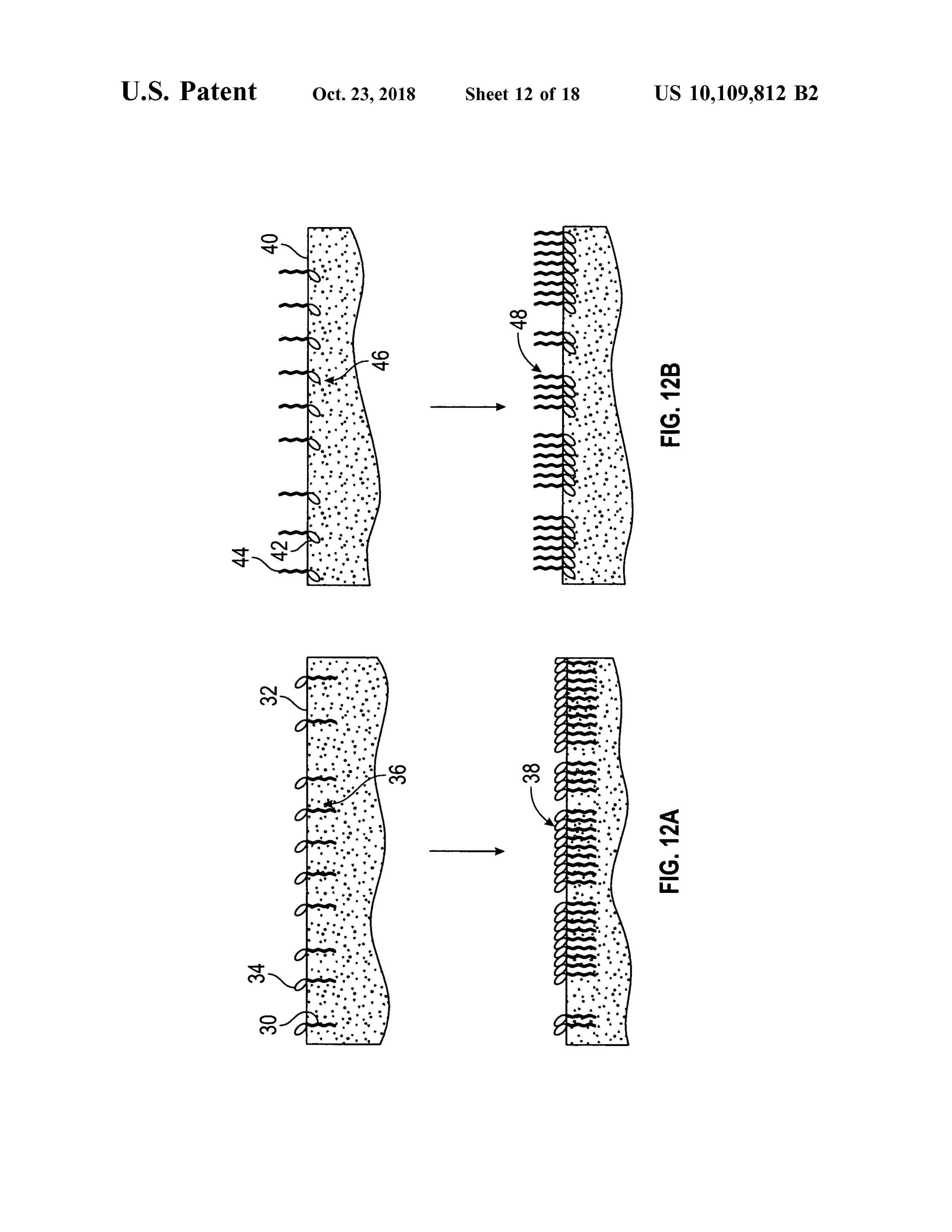
goes from the excited triplet state of a given molecule to the this is given in FIG . 12A . The hydrophobic tails 30 will be ground state of an adjacent molecule . This produces an attracted to the polar liquid 32 and hydrophilic porphyrin oscillating electric field which in turn stimulates the next heads 34 of the molecules will remain on the surface, with molecule within the line to decay in a similar fashion . hydrophilic heads pointing upward and the tails pointing An illustration ofhow this can occur is shown in FIG . 11. 5 downward . The upper image shows the dissociated chloro The following sequence of events occurs. Somewhere phyll molecules 36 on the surface of the polar solvent.
within the group, perhaps starting at one end of the stack , an If this surface monolayer is now cooled (and compressed electron in the excited triplet state goes to the ground state if necessary ) the chlorophyll molecules will tend to form by crossing over to the adjacentmolecule . At the same time 10 associated aggregates undergoing a process similar to con it generates an oscillating electric field with the proper densation in two dimensions. The formation of these mol frequency to stimulate that molecule to also decay . Since ecule aggregates will cause the porphyrin heads of the there are now three electrons in the molecule it has a very chlorophyll molecules to link to closely associated linear high probability for decay into an adjacent molecule causing stacks in the chloroplast structure . The number ofmolecules the next down the line to do likewise , and so on . The result 15 in each aggregate will be variable and will depend on the is that ofonesequential series electron issteps transferred . At each down the energy step the entire stack storedin ina degree of nucleation of the two dimensional crystals.
the triplet state is given up and added to the oscillation which By dipping a microscope slide into the solution it is moves down the line . The particle which travels here is not possible to remove the molecular film intact from the a photon but rather an electron polarization wave. surface . Depending upon whether the microscope slides are The quantum mechanical description of the moving par coated with a polar or non - polar material, it is possible to ticle is more like a polaron than a photon . The distinguishing cover the slide with many layers of the molecular film by feature between the two types of particles is that the polaron successive dippings or to have only one covering regardless contains a charge as well as an oscillating field . Unlike of the number of dippings.
stimulated emission of photons, the EPWASER decay pro - 25 Another method of preparing the chlorophyll molecular cess takes place along the axis of the molecular stack in film is to use a polar liquid 40 such as water which orients film order for the quantum efficiency in the process to be high . the hydrophilic heads 42 down and the tails 44 up . An This decay process may also be thought of as generating a example of this is drawn schematically in FIG . 12B . This positively charged hole which moves in the opposite direc type of film with dissociated molecules 46 could also be tion down the stack .
The initiation and termination of the stimulated emission 30 ciated condensed into molecular aggregates in which closely asso chlorophyll molecules 48 are produced , as shown in process should now be considered . The initiation of the decay in a molecular ensemble can start at any point where the lower image.
an asymmetry occurs. This can involve either end of the Each of these methods has its own advantages . The first stack . 35 method has some advantages in getting porphyrin heads Another event which can trigger the release of energy more closely associated than the tails . On the other hand , the stored in the stack is the donation or acceptance of an second method seems to more clearly simulate the natural electron , e.g ., to remove one electron from , or add one evolutionary process which may have taken place to form electron to , the molecule on the end of the stack . The the primitive ancestors of early plants. Both methods of resulting charge imbalance can be sufficient to initiate a 40 preparation , as well as various dipping procedures, are decay process. This type of decay implies that the decay possible . For general guidance on carrying out the genera begins along the end of the stack . The ends of the molecular tion of these types of films, we incorporate by reference, stacks are typically terminated in electron donors or accep each in its entirety, the following: I. a . S . V . Langmuir , J. tors; however, the donors /receptors need not be located at the ends, but rather can be interspersed throughout the 45 Amer. Chem . Soc., vol. 59 , p. 2075 , 1937.
stacks. In some cases , the presence of impurities can per Other methods of fabricating the ordered ensembles form the same function as the donor/receptor, i.e ., prompting according to the invention can be employed to produce discharge . ensembles from varied types of materials and in various The termination of the EPWASER decay process typically forms. For example , it is possible to fabricate a device also occurs at one end of the molecular stack which makes 50 according to the invention by employing solid state fabri up the ensemble . A final result of the release of stored energy cation techniques . An embodiment of this type is described by the stimulated emission mechanism is to produce either more fully below . In addition , it is also possible to employ an energetic electron or a positively charged hole . The nano -fabrication techniques in order to construct an ordered energetic electron can be one which is moved from a ensemble according to the invention . positively charged donor requiring a large energy step as 55 The special features of electronic binding energy levels discussed earlier. An alternative is that the energy is utilized which have been described herein have been ascribed to the by the positively charged hole to interact in a separate porphyrin ring rather than to chlorophyll itself. Thus, other chemical process, such as the removal of an electron from a compounds with similar porphyrin ring structures or other water molecule . The energy accumulated by the hole during costructures that satisfy the relationships described above are the decay process can be applied to overcome the energy also capable of EPWASER action . There are likely many barrier to remove an electron from water. systems of conjugated bonds in molecules, preferably planar The first step in synthesizing an EPWASER device is a ring systems but not necessarily planar nor necessarily ring method of creating an ordered array of the selected mol compounds, which possess the unique set of properties ecules, for example , chlorophyll . One method of accom - 65 described above.
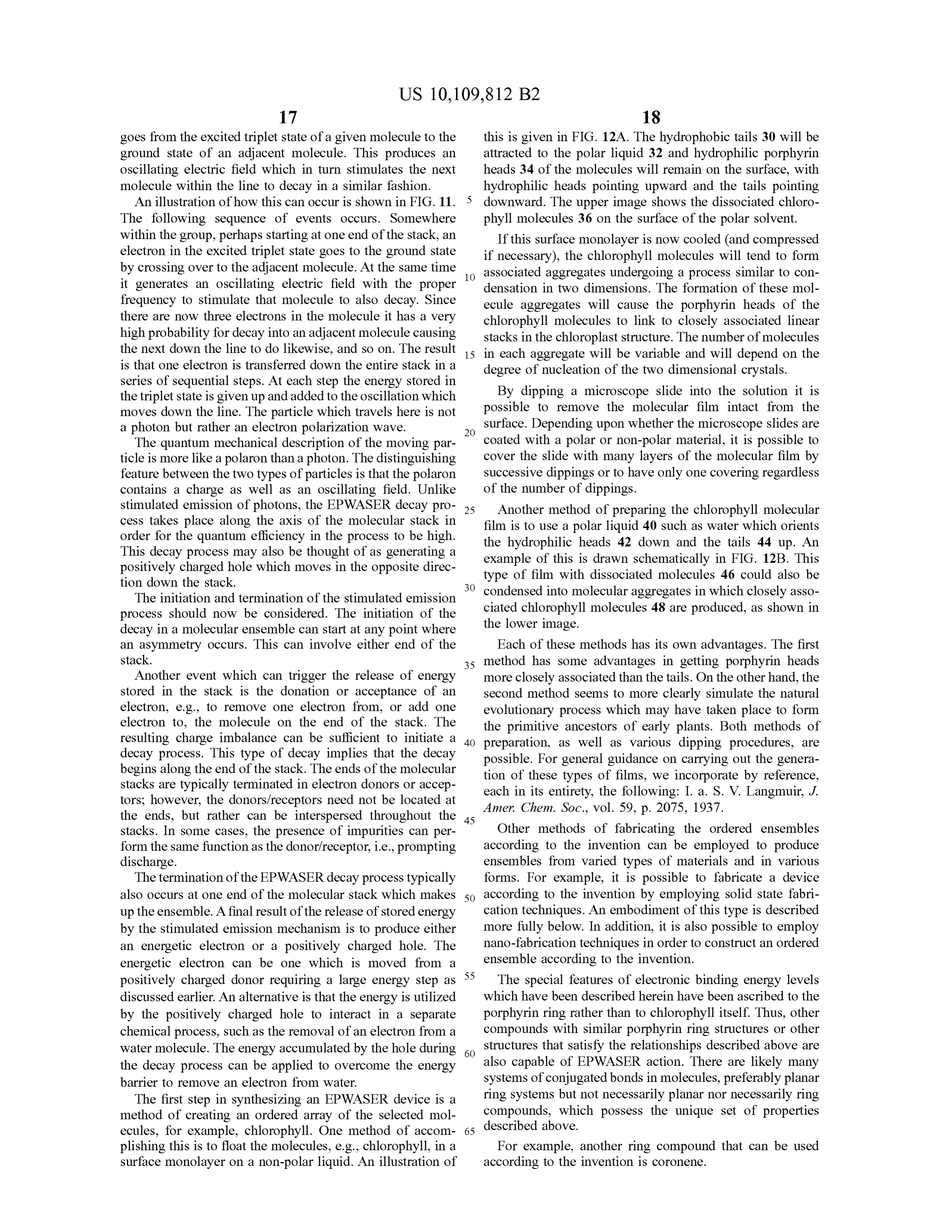
plishing this is to float the molecules , e . g ., chlorophyll, in a For example , another ring compound that can be used surface monolayer on a non -polar liquid . An illustration of according to the invention is coronene.
Page 30
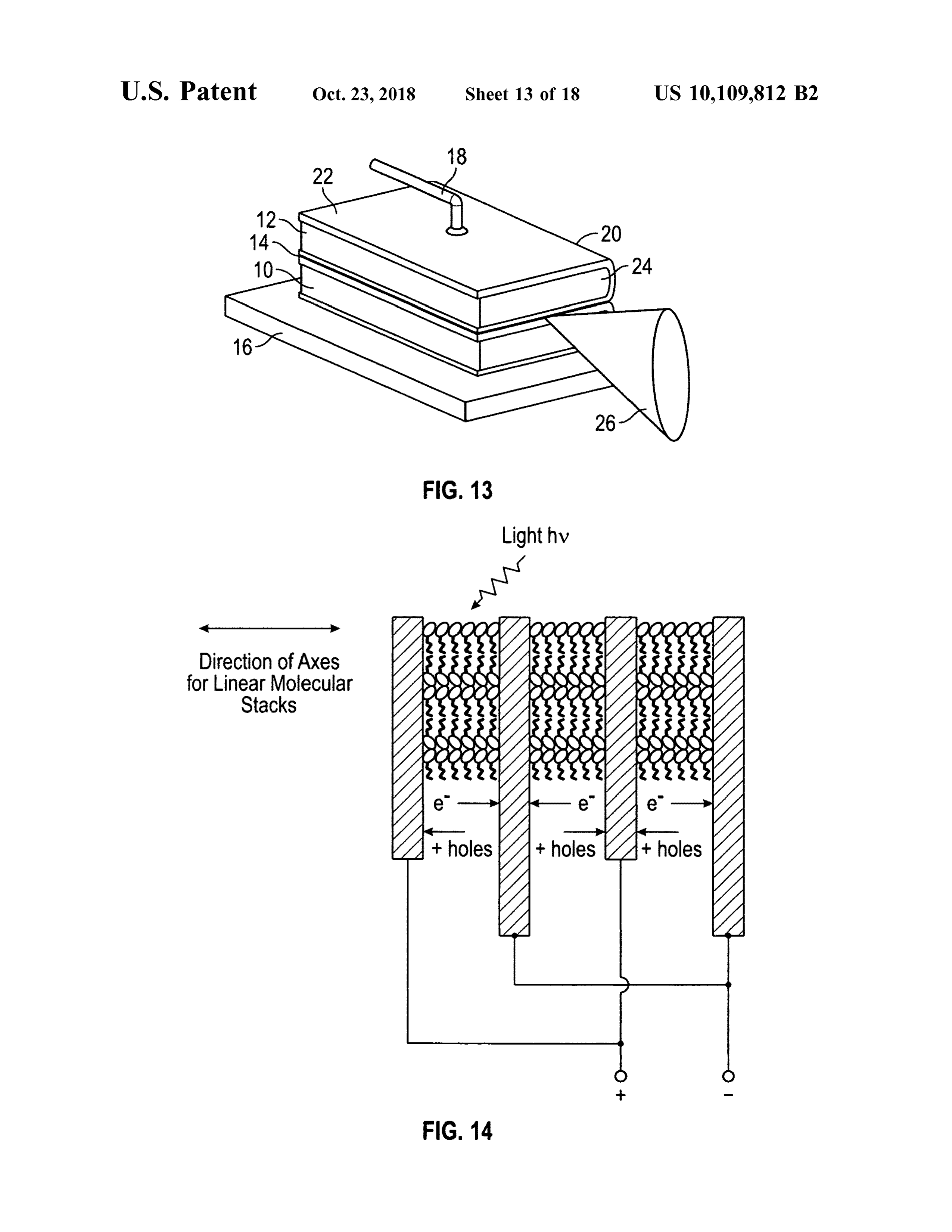
produced . A low voltage electric current passes through the semiconductor junction region ( vertical direction in the illustration ), where electrons from the N - region recombine with holes from the P -region . The energy of recombination pumps the ordered ensemble of material to create a popu lation inversion . The pumped energy is released by stimu lated transitions producing energetic charge motion along the axes of the molecular ensemble in a direction at right angle to the pumping current (horizontal in the figure ). This 10 energetic charge motion is output from the end face of the device . A device of this type can be produced either by
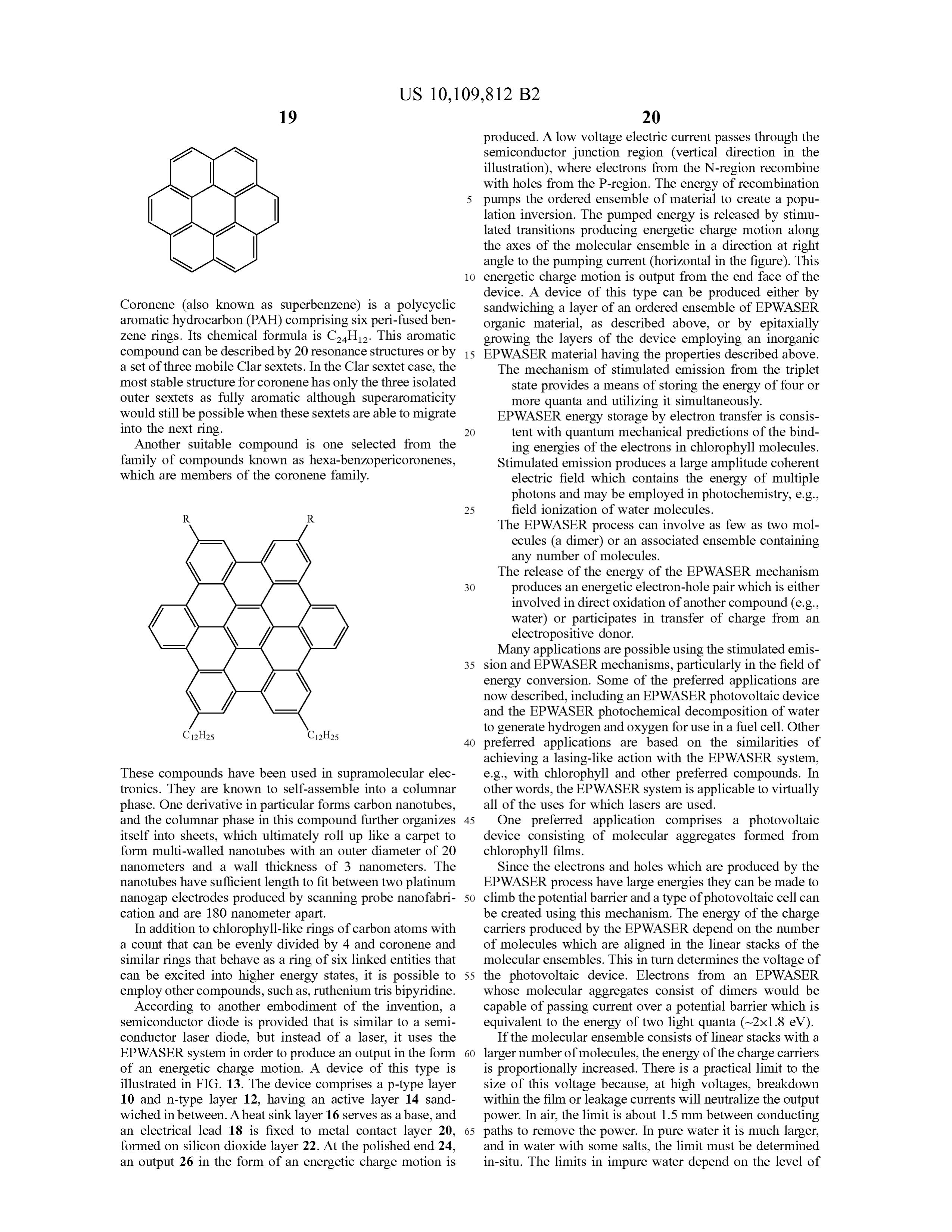
Coronene (also known as superbenzene) is a polycyclic sandwiching a layer of an ordered ensemble of EPWASER aromatic hydrocarbon (PAH ) comprising six peri- fused ben organic material, as described above , or by epitaxially zene rings . Its chemical formula is C24H , 7 . This aromatic growing the layers of the device employing an inorganic compound can be described by 20 resonance structures or by 15 EPWASER material having the properties described above. a set of three mobile Clar sextets . In the Clar sextet case , the The mechanism of stimulated emission from the triplet most stable structure for coronene has only the three isolated state provides a means of storing the energy of four or outer sextets as fully aromatic although superaromaticity more quanta and utilizing it simultaneously . would still be possible when these sextets are able to migrate EPWASER energy storage by electron transfer is consis into the next ring . 20 tent with quantum mechanical predictions of the bind Another suitable compound is one selected from the ing energies of the electrons in chlorophyll molecules . family of compounds known as hexa -benzopericoronenes, Stimulated emission produces a large amplitude coherent which are members of the coronene family. electric field which contains the energy of multiple photons and may be employed in photochemistry, e .g ., 25 field ionization of water molecules .
The EPWASER process can involve as few as two mol ecules ( a dimer ) or an associated ensemble containing any number ofmolecules .
The release of the energy of the EPWASER mechanism 30 produces an energetic electron -hole pair which is either involved in direct oxidation of another compound (e.g ., water) or participates in transfer of charge from an electropositive donor.
Many applications are possible using the stimulated emis 35 sion and EPWASER mechanisms, particularly in the field of energy conversion . Some of the preferred applications are now described , including an EPWASER photovoltaic device and the EPWASER photochemical decomposition of water
C12H25 C12H25 to generate hydrogen and oxygen for use in a fuel cell . Other 40 preferred applications are based on the similarities of achieving a lasing -like action with the EPWASER system ,
These compounds have been used in supramolecular elec - e .g ., with chlorophyll and other preferred compounds . In tronics . They are known to self-assemble into a columnar other words , the EPWASER system is applicable to virtually phase. One derivative in particular forms carbon nanotubes, all of the uses for which lasers are used . and the columnar phase in this compound further organizes 45 One preferred application comprises a photovoltaic itself into sheets, which ultimately roll up like a carpet to device consisting of molecular aggregates formed from form multi -walled nanotubes with an outer diameter of 20 chlorophyll films.
nanometers and a wall thickness of 3 nanometers . The Since the electrons and holes which are produced by the nanotubes have sufficient length to fit between two platinum EPWASER process have large energies they can be made to nanogap electrodes produced by scanning probe nanofabri- 50 climb the potential barrier and a type of photovoltaic cell can cation and are 180 nanometer apart . be created using this mechanism . The energy of the charge In addition to chlorophyll - like rings of carbon atoms with carriers produced by the EPWASER depend on the number a count that can be evenly divided by 4 and coronene and of molecules which are aligned in the linear stacks of the similar rings that behave as a ring of six linked entities that molecular ensembles. This in turn determines the voltage of can be excited into higher energy states, it is possible to 55 the photovoltaic device . Electrons from an EPWASER employ other compounds , such as, ruthenium tris bipyridine . whose molecular aggregates consist of dimers would be According to another embodiment of the invention , a capable of passing current over a potential barrier which is semiconductor diode is provided that is similar to a semi equivalent to the energy of two light quanta (~ 2x1.8 eV ). conductor laser diode , but instead of a laser, it uses the If the molecular ensemble consists of linear stacks with a EPWASER system in order to produce an output in the form 60 larger number ofmolecules, the energy of the charge carriers of an energetic charge motion . A device of this type is is proportionally increased . There is a practical limit to the illustrated in FIG . 13 . The device comprises a p - type layer size of this voltage because , at high voltages, breakdown 10 and n - type layer 12 , having an active layer 14 sand within the film or leakage currents will neutralize the output wiched in between . A heat sink layer 16 serves as a base , and power. In air , the limit is about 1 . 5 mm between conducting an electrical lead 18 is fixed to metal contact layer 20 , 65 paths to remove the power. In pure water it is much larger, formed on silicon dioxide layer 22 . At the polished end 24 , and in water with some salts , the limit must be determined an output 26 in the form of an energetic charge motion is in -situ . The limits in impure water depend on the level of
Page 31
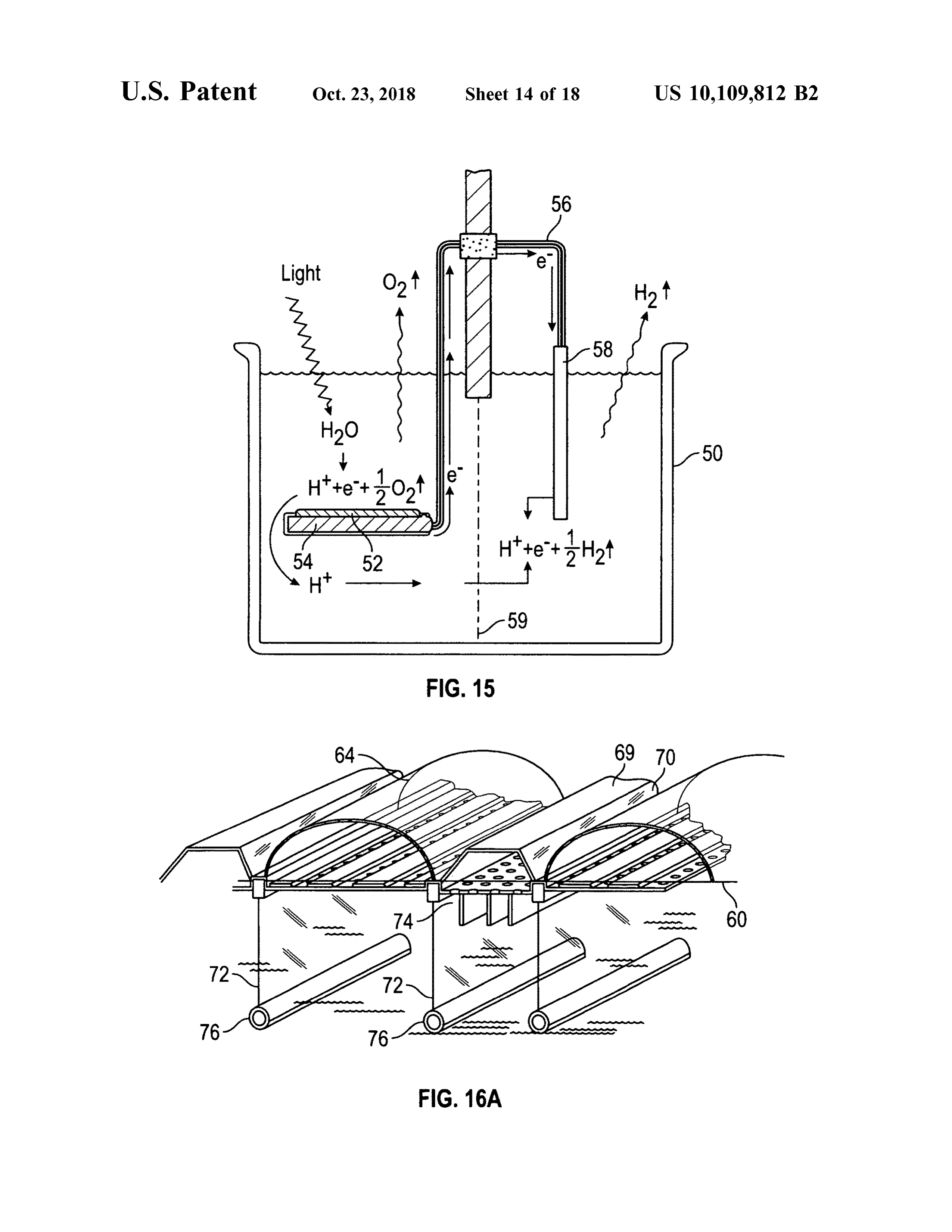
salinity in the water. In a controlled non- aqueous environ - hydrogen collector compartments 69 are preferably opaque ment, e . g ., a vacuum , voltage breakdown limits go up to to light. A drawing of this type of apparatus is shown in approximately 104 or 10 volts/ cm . FIGS. 16A and 16B .
To construct such a device there are first created the Electrons are separated from water by the EPWASER associated molecular ensembles and then they are arranged 5 process in the photoactive layers of chlorophyll aggregates. a conducting substrate which contacts the terminations of Oxygen is liberated at these surfaces and collected under the the linear stacks of the molecular arrays . A schematic of this flexible transparent covering 64. The electrons are collected arrangement is shown in FIG . 14 . by the substrate under the photoactive surface and conducted Successful achievement of EPWASER action is part of to exposed hydrogen electrodes in the adjacent compart the process to accomplish water - splitting for production of 10 ments. Protons from decomposed H2O flow through the fuel from sunlight. Operation of stimulated emission in permeable membranes 72 which separate the compartments molecular aggregates provides the ability to collect and to combine with electrons at the hydrogen electrodes 74 . apply the light energy to move electric charges. This produces hydrogen gas which is collected in a com In order to dissociate the water, H , O molecules must be partment 69 with an opaque covering. The sloping sides 70 in contact with one end of the molecular stack and an 15 of the cover of the hydrogen compartment 69 are preferably electron transfer mechanism must be at the other end. In a “mirrored ” to provide better light utilization . preferred arrangement, a chemical structure containing a The structure is articulated at each joint between com transition metal, preferably ,manganese is utilized to provide partments. The proper water level is maintained by control a contact with H , O , i.e ., an intermediary between the stack ling the amount of ballast in tubes 76 which are at bottoms and the chemical reactant( s ). Most preferably , the transition 20 of the permeable membranes 72 . The oxygen collecting metal is in the form of a manganese ions that also serve to volumes are covered by the transparent films which are complex with the water and to stabilize the reactive inter - closed at one end and connected to piping manifolds at the mediates s the water is split . However, the preferred man - opposite end. A similar type of manifolding arrangement ganese complex is generally not necessary since a molecular gathers the hydrogen which is produced . aggregate of chlorophyll can directly remove electrons from 25 Multiple units of this type can be spread over the surface water. The use of a transitionalmetal in the contact site is of the water to convert solar energy on a large scale . A layout entirely optional, as natural contact sites typically exist in of a large scale photochemical plant is shown in FIGS. 17A the ensemble structures themselves. and 17B , which is a detailed view of the portion circled in Providing electron transport from the other end of a linear FIG . 17A . The plant is shown with separate hydrogen stack which makes up the molecular aggregate can be 30 storage vessel 80 and oxygen storage vessel 82 , as well as accomplished in one embodiment by connection to an separate hydrogen pipes 84 and oxygen pipes 86 . electrical circuit in a " galvanic cell” 50 as depicted in FIG . A relatively large area must be covered to provide power 15 . The process occurs as follows. Light acts on a layer of for a significant size installation . An estimate of the required associated chlorophyll aggregates 52 to produce the stimu - area can be obtained as follows. A typical size electric power lated emission process. This layer of molecular ensembles is 35 plant ( 1000 MWe) requires an input of 3000 MWe at - 30 % the EPWASER medium which transfers electrons from the efficiency. This in turn requires a photoactive area of 3x10° water to the conducting substrate 54 . The outside of the m? exposed to solar flux. Furthermore , this is adequate only metal substrate must be insulated so that electron flow from at peak solar flux . For base load operation , averaging the the substrate is conducted up a wire 56 which is also insolation over day and night and the seasons approximately insulated . The other end of the wire is connected to an 40 increases the amount of required area by a factor of 4 to insulated electrode 58 on the other side of the galvanic cell 12x100 m² (e . g ., a 3 kmx4 km rectangle ). which is in the dark . This large area requirement gives strong motivation to The two halves of the cell are separated by a membrane consider systems which are floating over a large body of 59 which is permeable to H + ions. The H + ions produced on water such as the ocean . Such an off - shore plant is more the light side drift through the membrane and combine with 45 practical than consuming usable land area on the earth ' s electrons on the other side to produce hydrogen gas . In this surface. Since the products of a photochemical plant are way oxygen is evolved on one side of the cell and hydrogen hydrogen and oxygen which are both storable and shippable , on the other side . the advantages of a land - based system seem to be rather Large scale photochemical conversion of solar energy can small. In fact, a photochemical plant located at sea has be accomplished in one embodiment as follows, with ref - 50 attractive features which would not be available with an erence to FIGS. 16A and 16B . Flexible structures are off- shore electric plant, because the electric plant requires a fabricated which are photochemical converters , as described costly transmission line back to the shore . above, and these membranes are then floated over the In addition to the production of hydrogen and oxygen , surface of a body of water 60 . The photoactive part of the stimulated emission photochemistry has many other appli structure 62 would cover a large area in order to intercept a 55 cations. Any endergonic chemical reaction which is difficult large amount of solar energy and is mounted on a conducting to accomplish because it requires a large energy step is a substrate 66 , which is otherwise covered by insulating layers candidate - for the stimulated emission process . The 68. The covering 64 of the photoactive surface must also be EPWASER mechanism allows an aggregate of any number transparent to light or have areas which are open for light of molecules to add photon quanta and build up very passage . One side of the photoactive surface must be in 60 energetic charge carriers. Thus, chemical reactions which contact with the water. require redox potentials of many volts are possible . These It is also necessary to have some means to collect the chemical reactions can be used for the production of special hydrogen and oxygen which are produced . The oxygen is materials requiring large redox potentials at low temperature evolved as a gas above the photoactive surface and is for formation . Other possible uses are information storage , collected in a flexible transparent cover 64 which inflates as 65 imaging, or new types of photography . the gas builds up . The gas collection system has at least two As mentioned before , many other organic ring com compartments to separate the hydrogen and the oxygen . The pounds, with conjugated double bonds in the ring (any ring
Page 32
of 4 , 8 , 12 , 16 , 20 , etc . atomic sites ) can be used as an wherein energy is pumped in an amount that is sufficient to EPWASER medium . The complete list of applications for a raise a plurality of electrons in the closely spaced molecules successful EPWASER process is expected to be as large as to the one or more higher energy states ; have been developed for lasers . (B ) releasing stored energy in the longer - lived excited Preferred applications of the present device and /or pro - 5 state , by a transition process that includes a charge cess comprise : transfer jumping from the longer -lived excited state in applying the energy release to a chemical reaction , more one molecule to the lower state in the one of the preferably a reaction comprising splitting water molecules adjacent closely spaced molecule , to thereby produce into hydrogen and oxygen . In this and other preferred an electromagnetic oscillation ; and aspects of the invention , the application ofthe energy release 10 (C ) stimulating an output emission from the bounded is preferably to a photochemical process, which requires volume of excitable medium by employing the elec energy steps greater than the energy contained in one photon tromagnetic oscillation to stimulate at least one addi of light; tional successive transition of a second excited electron conversion of photovoltaic energy; to release its energy of excitation by jumping to a applying currents caused by charge transfer for modulat- 15 neighboring molecule , thereby amplifying the electro ing signals in circuits employed for communication , wherein magnetic oscillation with energy output, to thereby sum the communication circuits comprise an optical fiber, an up a plurality of individual excitations adding to an electric conductor, or a radio transmission system ; amplitude of the electromagnetic oscillation , to create utilizing the released energy stimulated from the stored an output emission comprising an electron polarization energy to imprint a pattern to store information content; 20 wave that includes an energetically driven charge storing the information is stored directly in the excited motion of electrons and/or holes . energy states of the atomic or molecular units of the 2 . A method as claimed in claim 1 , wherein the pumping ensemble , whereby some selected units in a chain are energy is directed onto the excitable medium in an amount pumped to store excited electrons, while other selected units sufficient to produce a localized population inversion , remain in their lower energy states in such a way that the 25 wherein the number of molecules in the one or more higher pattern of excited vs. de -excited units becomes a form of energy states is greater than the number ofmolecules in the encoded information . A method of retrieving the encoded lower energy state .
information from such a device comprises reading the 3. A method as claimed in claim 1, wherein at least a variations of current that would be produced when the portion of the output is generated within the device by information ensemble releases its stored energy by produc - 30 amplifying the wave with energy output that adds coherently ing a modulated transport through the chain of selectively to the amplitude of the electromagnetic oscillation and adds pumped and de-excited units ; energy to the moving electrons and /or holes . transmission of electrical power using light photons ; and 4 . A method as claimed in claim 1 , wherein the ordered to make an accelerator on a chip , wherein the ordered ensemble of molecules consists essentially of coronene. ensemble comprises a large number of atomic or molecular 35 5 . A method as claimed in claim 1 , wherein the method units are aligned in such a way that it can build up a very comprises conversion of photovoltaic energy by transform high energy in the electrons transported down the chain in ing light into electric power . order to project a beam of electrons out of the end , thereby 6 . A method as claimed in claim 1 , wherein the ring creating a very tiny linear accelerator. compound comprising a member of the coronene family What is claimed is: 40 comprises coronene in crystalline form . 1. A method of enhancing the intensity of electromagnetic 7 . A method as claimed in claim 1, wherein the bounded energy, comprising : volume comprises a layer having a thickness dimension and ( A ) pumping energy onto a bounded volume of excitable a longitudinal axis running transverse to the thickness medium containing a fabricated and ordered ensemble dimension , and wherein the electron polarization wave of a material comprised of closely spaced molecules, 45 moves in the direction of the longitudinal axis . wherein the closely spaced molecules are comprised of a 8 . A method of enhancing the intensity of electromagnetic ring compound comprising a member of the coronene energy , comprising:
family , and ( A ) pumping energy onto a bounded volume of excitable wherein the ordered ensemble has (a ) well defined energy medium containing a fabricated and ordered ensemble states including a lower state , and one or more higher 50 of a material comprised of closely spaced molecules , states above the lower state , and (b ) a curve of electron wherein the closely spaced molecules are comprised of a binding energy levels versus a number of electrons ring compound ;
added to one of the closely spaced molecules that is flat wherein the ordered ensemble has (a ) well defined energy enough to enable an electron to be added to or sub states including a lower state , and one or more higher tracted from the molecule with a negligible change in 55 states above the lower state , and (b ) a curve of electron total binding energy in the molecule; and (c ) wherein binding energy levels versus a number of electrons the closely spaced molecules of the ring compound are added to one of the closely spaced molecules that is flat arranged sufficiently close together to enable transfer of enough to enable an electron to be added to or sub excited electrons between adjacent closely spaced mol tracted from the molecule with a negligible change in ecules due to the property of the closely spaced mol - 60 total binding energy in the molecule ; and ( c ) wherein ecules recited in ( b ), whereby an excited electron can the closely spaced molecules of the ring compound are be transferred between adjacent closely spaced mol arranged sufficiently close together to enable transfer of ecules with a negligible change in binding energy, to excited electrons between adjacent closely spaced mol form a longer -lived excited state because the excited ecules due to the property of the closely spaced mol electron is spin - forbidden to decay back to the lower 65 ecules recited in (b ), whereby an excited electron can state within the one of the closely spaced molecule to be transferred between adjacent closely spaced mol which it has moved , ecules with a negligible change in binding energy, to
Page 33
form a longer- lived excited state because the excited and electron is spin - forbidden to decay back to the lower wherein the ordered ensemble has (a ) well defined energy state within the one of the closely spaced molecules to states including a lower state, and one or more higher which it has moved , states above the lower state , and (b ) a curve of electron wherein energy is pumped in an amount that is sufficient 5 binding energy levels versus a number of electrons added to one of the closely spaced molecules of the ring to raise a plurality of electrons in the closely spaced compound that is flat enough to enable an electron to be molecules to the one or more higher energy states ; added or subtracted with a negligible change in total (B ) releasing stored energy in the longer-lived excited binding energy in the molecule ; and (c ) wherein the state , by a transition process that includes a charge closely spaced molecules of the ring compound are transfer jumping from the longer -lived excited state in arranged sufficiently close together to enable transfer of one molecule to the lower state in the one of the excited electrons between adjacent closely spaced mol adjacent closely spaced molecule , to thereby produce ecules due to the property of the molecules recited in an electromagnetic oscillation ; (b ), whereby an excited electron can be transferred (C ) stimulating an output emission from the bounded 15 between adjacent closely spaced molecules with a volume of excitable medium by employing the elec negligible change in binding energy , to form a longer tromagnetic oscillation to stimulate at least one addi lived excited state because the excited electron is tional successive transition of a second excited electron spin - forbidden to decay back to the lower state within to release its energy of excitation by jumping to a the one of the closely spaced molecules to which it has moved ; and , neighboring molecule, thereby amplifying the electro - 20O wherein energy is pumped in an amount that is sufficient to magnetic oscillation with energy output, to thereby sum raise a plurality up a plurality of individual excitations adding to an to the one or more of electrons in the closely spaced molecules amplitude of the stimulating electromagnetic oscilla higher energy states ; tion , to create an output emission comprising an elec ( B ) releasing stored energy in the longer-lived excited tron polarization wave that includes an energetically 25 state , by a transition process that includes a charge driven charge motion of electrons and /or holes, transfer jumping from the longer -lived excited state in wherein at least a portion of the output emission is one molecule to the lower state in the one of the generated within the device by amplifying the wave adjacent closely spaced molecule , to thereby produce with energy output that adds coherently to the ampli an electromagnetic oscillation ; and tude of the stimulating electromagnetic oscillation and 30 ( C ) stimulating an output emission from the bounded adds energy to the moving electrons and /or holes; and volume of excitable medium by employing the elec ( D ) further comprising applying to a chemical reaction the tromagnetic oscillation to stimulate at least one addi energy released as an output emission . tional successive transition of a second excited electron 9 . A method as claimed in claim 8 , wherein the chemical to release its energy of excitation by jumping to a reaction comprises splitting water molecules into hydrogen 35 neighboring molecule , thereby amplifying the electro and oxygen . magnetic oscillation with energy output, to thereby sum 10 . A method as claimed in claim 8 ,wherein the pumping up a plurality of individual excitations adding to an energy is directed onto the excitable medium in an amount amplitude of the electromagnetic oscillation , to create sufficient to produce a localized population inversion , an output emission comprising an electron polarization wherein the number ofmolecules in the one or more highero wave that includes an energetically driven charge energy states is greater than the number of molecules in the motion of electrons and / or holes, wherein at least a lower energy state . portion of the output emission is generated within the 11. A method as claimed in claim 8 , wherein the ordered device by amplifying the wave with energy output that ensemble of atoms/molecules consists essentially of a single adds coherently to the amplitude of the electromagnetic species of molecule . 45 oscillation and adds energy to the moving electrons 12 . A method as claimed in claim 8 , wherein the ring and /or holes.
compound comprises chlorophyll-like rings of carbon 16 . A method as claimed in claim 15 , wherein the ring atoms, coronene and similar rings that behave as a ring of six compound comprises chlorophyll-like rings of carbon linked entities that can be excited into higher energy states, atoms , coronene and similar rings that behave as a ring of six linked entities that can be excited into higher energy states, and ruthenium tris bipyridine .
13 . A method as claimed in claim 8 , wherein the ordered 50 and17ruthenium tris bipyridine .
. A method as claimed in claim 15 , wherein the ordered ensemble includes a layer having a thickness dimension and ensemble includes a layer having a thickness dimension and a longitudinal axis running transverse to the thickness a longitudinal axis running transverse to the thickness dimension , and wherein the electron polarization wave dimension , and wherein the electron polarization wave moves in the direction of the longitudinal axis . moves in the direction of the longitudinal axis. 14 . A method as claimed in claim 1, further comprising 18. A method as claimed in claim 17, wherein the layer applying to a chemical reaction the energy released as an comprises a linear stack of molecules of the ring compound output emission .
15 . A method of enhancing the intensity of electromag in the direction of the longitudinal axis of the layer. 19 . A method as claimed in claim 15 , wherein the ring netic energy, comprising :
( A ) pumping energy onto a bounded volume of excitablele 60 compound
comprises conjugated rings in planar molecules.
method as claimed in claim 15 , wherein the ordered medium containing a fabricated and ordered ensemble ensemble of a material comprised of closely spaced molecules, pound. comprises at least one dimer of the ring com wherein the closely spaced molecules are comprised of a ring compound ;
Provenance
- Collection
- Patents citing this work
- Pages
- 33
- Method
- pdftotext (the PDF's own text layer) + pdftoppm 300dpi page scans
- Patent office record
- patents.google.com →
- Source
- Google Patents citing-documents table
- Assignee
- Edward J. Britt
- Inventors
- Edward J. Britt; Reay S. Dick; W. Todd Wipke
- Published
- 2018-10-23
- Transcribed from
- patentimages.storage.googleapis.com →