patent · US4180445
Oxygen selective anode
25 December 1979
Page 1 — bibliographic record
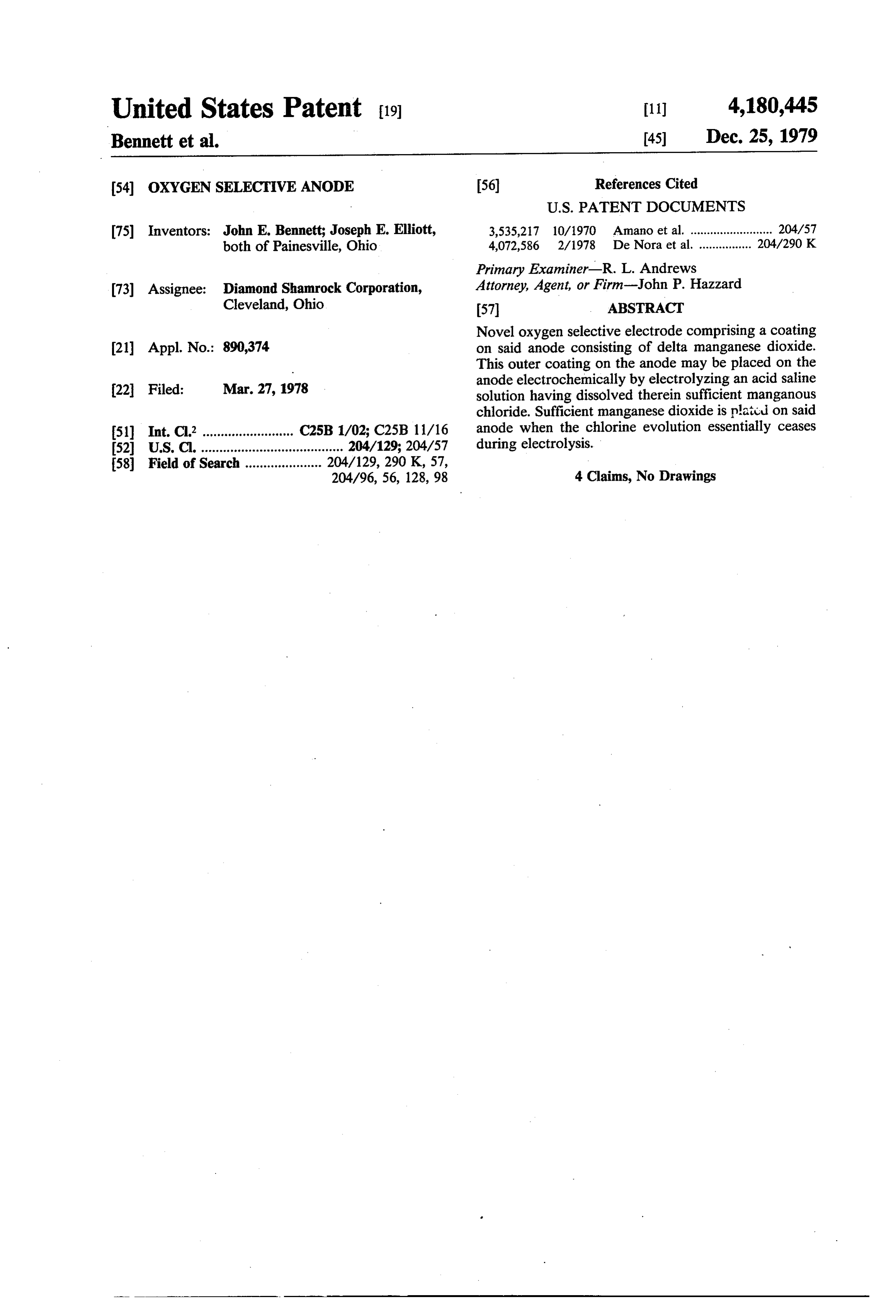
United States Patent (19) 11)
Bennett et al.
(54) OXYGEN SELECTIVE ANODE 56) References Cited
(75) Inventors: John E. Bennett; Joseph E. Elliott, 3,535,217 10/1970 Amano et al. ......................... 204/57 both of Painesville, Ohio 4,072,586 2/1978 De Nora et al. ................ 204/290 K Primary Examiner-R. L. Andrews (73) Assignee: Diamond Shamrock Corporation, Attorney, Agent, or Firm-John P. Hazzard Cleveland, Ohio 57 ABSTRACT
Novel oxygen selective electrode comprising a coating 21 Appl. No.: 890,374 on said anode consisting of delta manganese dioxide. This outer coating on the anode may be placed on the anode electrochemically by electrolyzing an acid saline 22 Filed: Mar. 27, 1978 solution having dissolved therein sufficient manganous chloride. Sufficient manganese dioxide is platti on said (51) Int. Cl’......................... C25B 1/02; C25B 11/16 anode when the chlorine evolution essentially ceases (52) 204/129; 204/57 during electrolysis.
(58) Field of search. 204/129, 290 K, 57, 4 Claims, No Drawings
Page 2
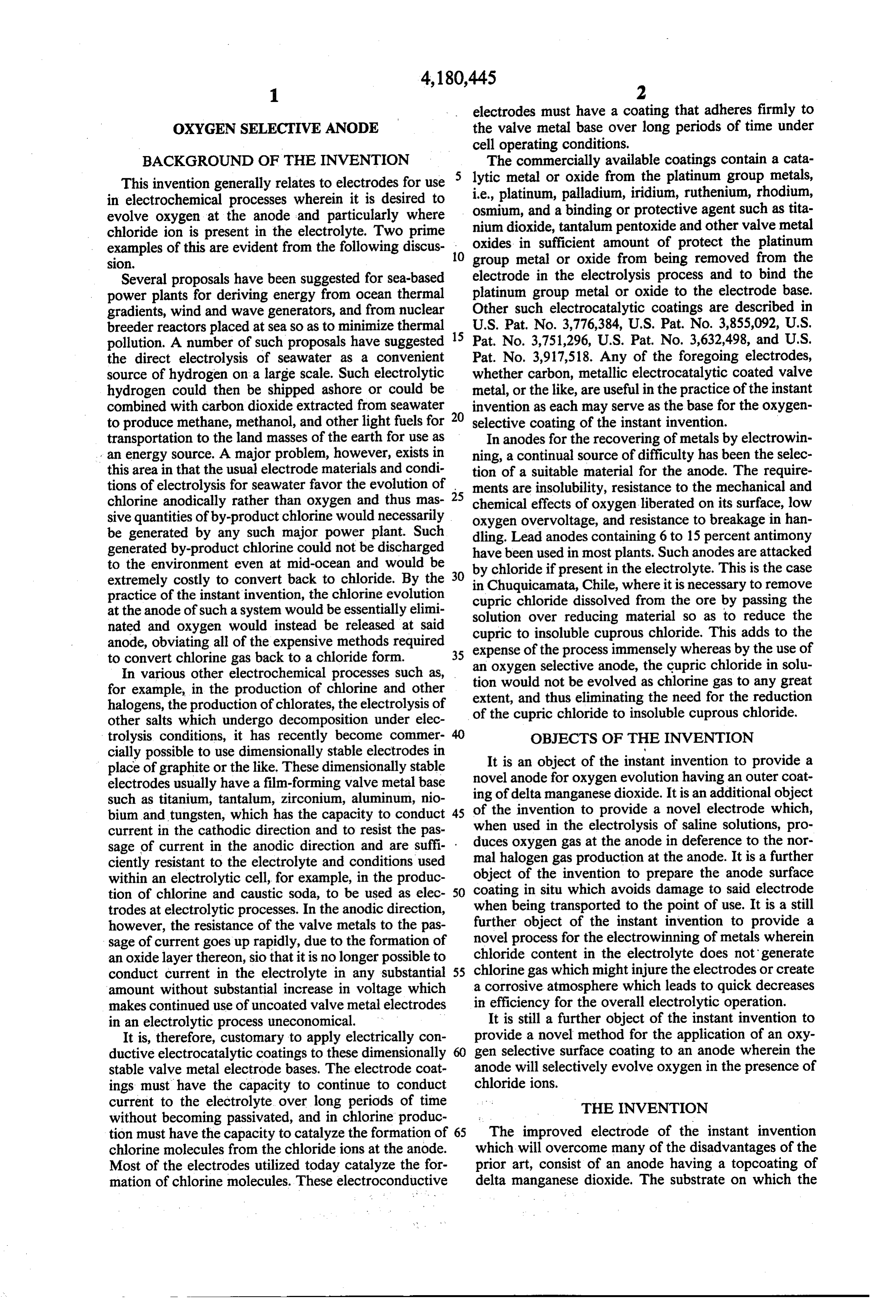
electrodes must have a coating that adheres firmly to
OXYGEN SELECTIVE ANODE the valve metal base over long periods of time under cell operating conditions.
BACKGROUND OF THE INVENTION The commercially available coatings contain a cata 5 lytic metal or oxide from the platinum group metals,
This invention generally relates to electrodes for use in electrochemical processes wherein it is desired to i.e., platinum, palladium, iridium, ruthenium, rhodium, evolve oxygen at the anode and particularly where osmium, and a binding or protective agent such as tita chloride ion is present in the electrolyte. Two prime nium dioxide, tantalum pentoxide and other valve metal examples of this are evident from the following discus O oxides in sufficient amount of protect the platinum SO. group metal or oxide from being removed from the Several proposals have been suggested for sea-based electrode in the electrolysis process and to bind the power plants for deriving energy from ocean thermal platinum group metal or oxide to the electrode base. gradients, wind and wave generators, and from nuclear Other such electrocatalytic coatings are described in breeder reactors placed at sea so as to minimize thermal U.S. Pat. No. 3,776,384, U.S. Pat. No. 3,855,092, U.S. pollution. A number of such proposals have suggested 15 Pat. No. 3,751,296, U.S. Pat. No. 3,632,498, and U.S. the direct electrolysis of seawater as a convenient Pat. No. 3,917,518. Any of the foregoing electrodes, source of hydrogen on a large scale. Such electrolytic whether carbon, metallic electrocatalytic coated valve hydrogen could then be shipped ashore or could be metal, or the like, are useful in the practice of the instant combined with carbon dioxide extracted from seawater invention as each may serve as the base for the oxygen to produce methane, methanol, and other light fuels for 20 selective coating of the instant invention. transportation to the land masses of the earth for use as In anodes for the recovering of metals by electrowin an energy source. A major problem, however, exists in ning, a continual source of difficulty has been the selec this area in that the usual electrode materials and condi tion of a suitable material for the anode. The require tions of electrolysis for seawater favor the evolution of 25 ments are insolubility, resistance to the mechanical and chlorine anodically rather than oxygen and thus mas chemical effects of oxygen liberated on its surface, low sive quantities of by-product chlorine would necessarily oxygen overvoltage, and resistance to breakage in han be generated by any such major power plant. Such dling. Lead anodes containing 6 to 15 percent antimony generated by-product chlorine could not be discharged have been used in most plants. Such anodes are attacked to the environment even at mid-ocean and would be by chloride if present in the electrolyte. This is the case extremely costly to convert back to chloride. By the 30 in Chuquicamata, Chile, where it is necessary to remove practice of the instant invention, the chlorine evolution cupric chloride dissolved from the ore by passing the at the anode of such a system would be essentially elimi solution over reducing material so as to reduce the nated and oxygen would instead be released at said anode, obviating all of the expensive methods required cupric expense to insoluble cuprous chloride. This adds to the of the process immensely whereas by the use of to convert chlorine gas back to a chloride form. 35
In various other electrochemical processes such as, tion would selective an oxygen anode, the cupric chloride in solu for example, in the production of chlorine and other extent, and thus eliminatingasthe not be evolved chlorine gas to any great need for the reduction halogens, the production of chlorates, the electrolysis of of the cupric chloride to insoluble cuprous chloride. other salts which undergo decomposition under elec trolysis conditions, it has recently become commer 40 OBJECTS OF THE INVENTION cially possible to use dimensionally stable electrodes in place of graphite or the like. These dimensionally stable novel It is an object of the instant invention to provide a electrodes usually have a film-forming valve metal base ing anode for oxygen evolution having an outer coat such as titanium, tantalum, zirconium, aluminum, nio of delta manganese dioxide. It is an additional object bium and tungsten, which has the capacity to conduct 45 of the invention to provide a novel electrode which, current in the cathodic direction and to resist the pas duces when used in the electrolysis of saline solutions, pro sage of current in the anodic direction and are suffi mal halogen oxygen gas at the anode in deference to the nor ciently resistant to the electrolyte and conditions used gas production at the anode. It is a further within an electrolytic cell, for example, in the produc object of the invention to prepare the anode surface tion of chlorine and caustic soda, to be used as elec 50 coating in situ which avoids damage to said electrode trodes at electrolytic processes. In the anodic direction, when being transported to the point of use. It is a still however, the resistance of the valve metals to the pas novel further object of the instant invention to provide a sage of current goes up rapidly, due to the formation of process for the electrowinning of metals wherein an oxide layer thereon, sio that it is no longer possible to chloride content in the electrolyte does not generate conduct current in the electrolyte in any substantial 55 chlorine gas which might injure the electrodes or create amount without substantial increase in voltage which a corrosive atmosphere which leads to quick decreases makes continued use of uncoated valve metal electrodes in efficiency for the overall electrolytic operation. in an electrolytic process uneconomical. It is still a further object of the instant invention to It is, therefore, customary to apply electrically con provide a novel method for the application of an oxy ductive electrocatalytic coatings to these dimensionally gen selective surface coating to an anode wherein the stable valve metal electrode bases. The electrode coat anode will selectively evolve oxygen in the presence of ings must have the capacity to continue to conduct chloride ions.
current to the electrolyte over long periods of time THE INVENTION without becoming passivated, and in chlorine produc tion must have the capacity to catalyze the formation of 65 The improved electrode of the instant invention chlorine molecules from the chloride ions at the anode. which will overcome many of the disadvantages of the Most of the electrodes utilized today catalyze the for prior art, consist of an anode having a topcoating of mation of chlorine molecules. These electroconductive delta manganese dioxide. The substrate on which the
Page 3
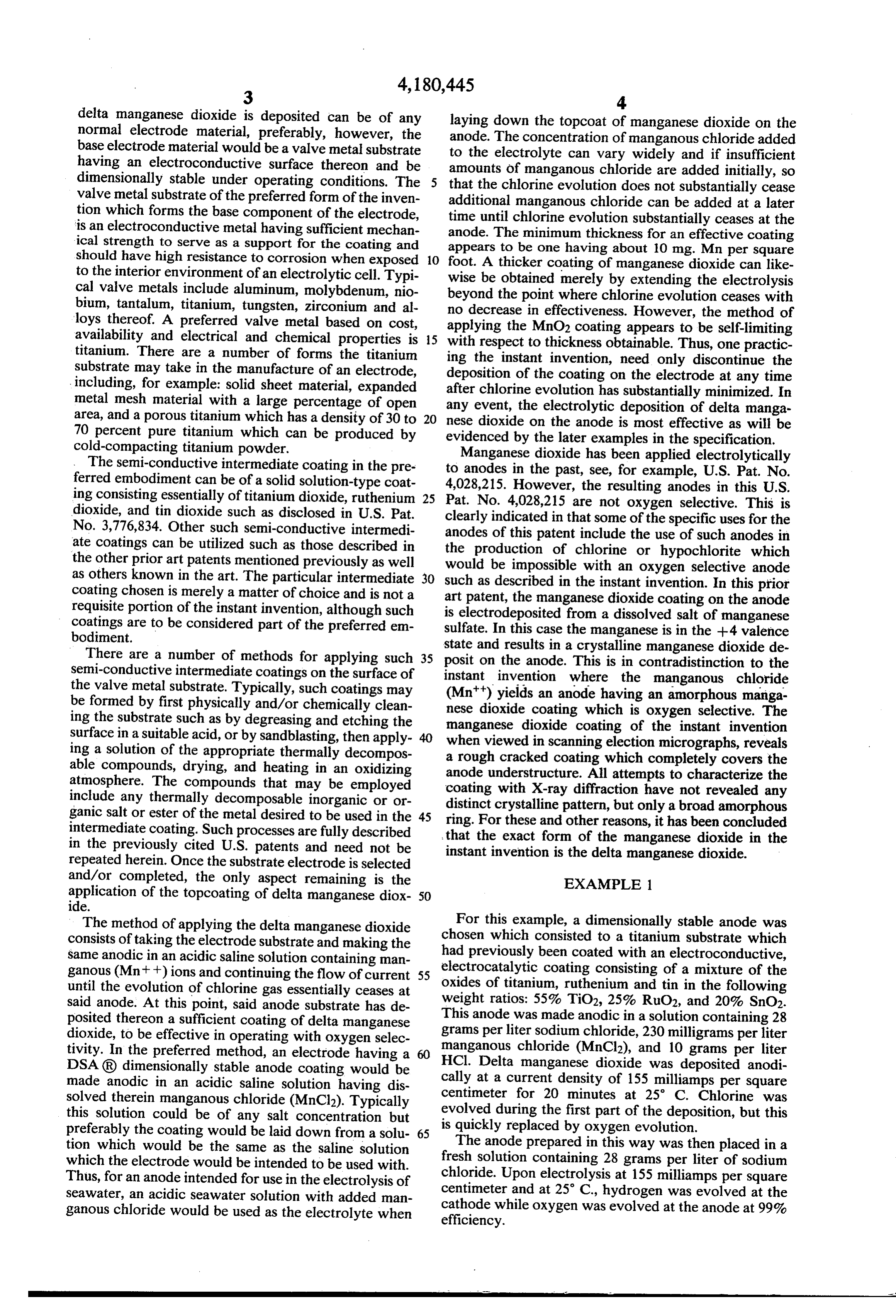
delta manganese dioxide is deposited can be of any laying down the topcoat of manganese dioxide on the normal electrode material, preferably, however, the anode. The concentration of manganous chloride added base electrode material would be a valve metal substrate to the electrolyte can vary widely and if insufficient having an electroconductive surface thereon and be amounts of manganous chloride are added initially, so dimensionally stable under operating conditions. The 5 that the chlorine evolution does not substantially cease valve metal substrate of the preferred form of the inven additional manganous chloride can be added at a later tion which forms the base component of the electrode, time until chlorine evolution substantially ceases at the is an electroconductive metal having sufficient mechan anode. The minimum thickness for an effective coating ical strength to serve as a support for the coating and should have high resistance to corrosion when exposed 10 appears to be one having about 10 mg. Mn per square to the interior environment of an electrolytic cell. Typi wise be obtainedcoating foot. A thicker of manganese dioxide can like merely by extending the electrolysis cal valve metals include aluminum, molybdenum, nio beyond the point where chlorine evolution ceases with bium, tantalum, titanium, tungsten, zirconium and al no decrease in effectiveness. However, the method of loys thereof. A preferred valve metal based on cost, applying the MnO2 coating appears to be self-limiting availability and electrical and chemical properties is 15 with respect to thickness obtainable. Thus, one practic titanium. There are a number of forms the titanium substrate may take in the manufacture of an electrode, ing the instant invention, need only discontinue the deposition of the coating on the electrode at any time including, for example: solid sheet material, expanded after chlorine evolution has substantially minimized. In metal mesh material with a large percentage of open any event, area, and a porous titanium which has a density of 30 to 20 nese dioxidetheonelectrolytic deposition of delta manga the anode is most effective as will be 70 percent pure titanium which can be produced by evidenced by the later examples in the specification. cold-compacting titanium powder. Manganese dioxide has been applied electrolytically The semi-conductive intermediate coating in the pre to anodes in the past, see, for example, U.S. Pat. No. ferred embodiment can be of a solid solution-type coat 4,028,215. However, the resulting anodes in this U.S. ing consisting essentially of titanium dioxide, ruthenium 25 Pat. No. 4,028,215 are not oxygen selective. This is dioxide, and tin dioxide such as disclosed in U.S. Pat. clearly
No. 3,776,834. Other such semi-conductive intermedi anodes indicated of this in that some of the specific uses for the patent include the use of such anodes in ate coatings can be utilized such as those described in the production of chlorine the other prior art patents mentioned previously as well would be impossible with an or hypochlorite which oxygen selective anode as others known in the art. The particular intermediate 30 such as described in the instant invention. coating chosen is merely a matter of choice and is not a art patent, the manganese dioxide coating onIn the this prior anode requisite portion of the instant invention, although such is electrodeposited from a dissolved salt of manganese coatings are to be considered part of the preferred em sulfate. In this case the manganese is in the +4 valence bodiment. state and results in a crystalline manganese dioxide de There are a number of methods for applying such 35 posit on the anode. This is in contradistinction to the semi-conductive intermediate coatings on the surface of the valve metal substrate. Typically, such coatings may instant(Mn") invention where the manganous chloride yields an anode having an amorphous manga be formed by first physically and/or chemically clean nese dioxide coating which is oxygen selective. The ing the substrate such as by degreasing and etching the manganese dioxide coating of the instant invention surface in a suitable acid, or by sandblasting, then apply- 40 when viewed in scanning election micrographs, reveals ing a solution of the appropriate thermally decompos a rough cracked coating which completely covers the able compounds, drying, and heating in an oxidizing anode understructure. All attempts to characterize the atmosphere. The compounds that may be employed coating with X-ray diffraction have not revealed any include any thermally decomposable inorganic or or ganic salt or ester of the metal desired to be used in the 45 distinct ring. For crystalline pattern, but only a broad amorphous these and other reasons, it has been concluded intermediate coating. Such processes are fully described that the exact form of the manganese dioxide in the in the previously cited U.S. patents and need not be instant invention is the delta manganese dioxide. repeated herein. Once the substrate electrode is selected and/or completed, the only aspect remaining is the EXAMPLE 1. application of the topcoating of delta manganese diox- 50 ide.
The method of applying the delta manganese dioxide For this example, a dimensionally stable anode was consists of taking the electrode substrate and making the chosen which consisted to a titanium substrate which same anodic in an acidic saline solution containing man had previously been coated with an electroconductive, ganous (Mn) ions and continuing the flow of current 55 electrocatalytic coating consisting of a mixture of the until the evolution of chlorine gas essentially ceases at oxides of titanium, ruthenium and tin in the following said anode. At this point, said anode substrate has de weight ratios: 55%. TiO2, 25% RuO2, and 20% SnO2. posited thereon a sufficient coating of delta manganese This anode was made anodic in a solution containing 28 dioxide, to be effective in operating with oxygen selec grams per liter sodium chloride, 230 milligrams per liter tivity. In the preferred method, an electrode having a 60 manganous chloride (MnCl2), and 10 grams per liter DSA (R) dimensionally stable anode coating would be HCl. Delta manganese dioxide was deposited anodi made anodic in an acidic saline solution having dis cally at a current density of 155 milliamps per square solved therein manganous chloride (MnCl2). Typically centimeter for 20 minutes at 25 C. Chlorine was this solution could be of any salt concentration but evolved during the first part of the deposition, but this preferably the coating would be laid down from a solu- 65 is quickly replaced by oxygen evolution. tion which would be the same as the saline solution The anode prepared in this way was then placed in a which the electrode would be intended to be used with. fresh solution containing 28 grams per liter of sodium Thus, for an anode intended for use in the electrolysis of chloride. Upon electrolysis at 155 milliamps per square seawater, an acidic seawater solution with added man centimeter and at 25 C., hydrogen was evolved at the cathode while oxygen was evolved at the anode at 99% ganous chloride would be used as the electrolyte when efficiency.
Page 4
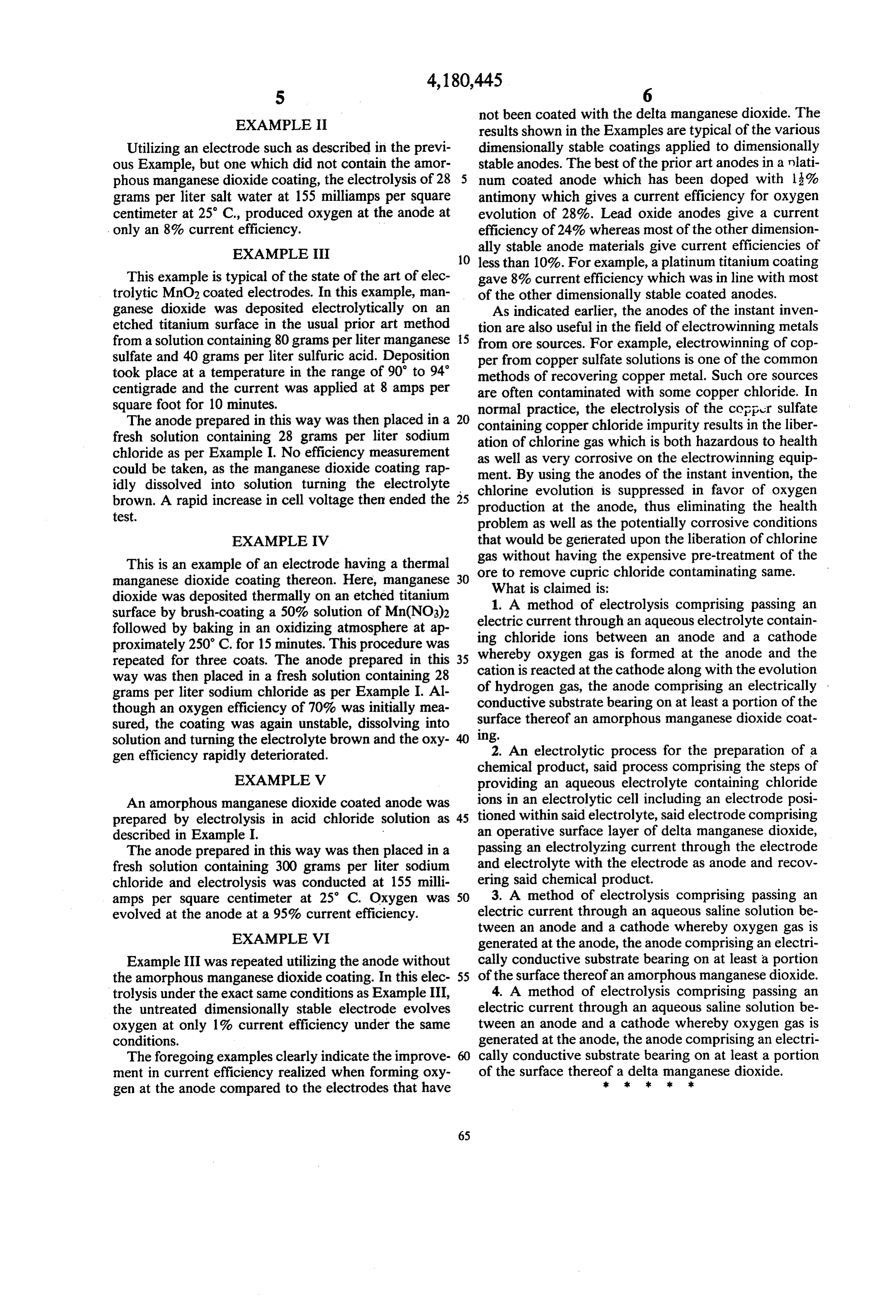
EXAMPLE II
not been coated with the delta manganese dioxide. The results shown in the Examples are typical of the various
Utilizing an electrode such as described in the previ dimensionally stable coatings applied to dimensionally ous Example, but one which did not contain the amor stable anodes. The best of the prior art anodes in a nilati phous manganese dioxide coating, the electrolysis of 28 5 num coated anode which has been doped with 13% grams per liter salt water at 155 milliamps per square antimony which gives a current efficiency for oxygen centimeter at 25 C., produced oxygen at the anode at evolution of 28%. Lead oxide anodes give a current only an 8% current efficiency. efficiency of 24% whereas most of the other dimension EXAMPLE III ally stable anode materials give current efficiencies of 10 less than 10%. For example, a platinum titanium coating
This example is typical of the state of the art of elec gave 8% current efficiency which was in line with most trolytic MnO2 coated electrodes. In this example, man of the other dimensionally stable coated anodes. ganese dioxide was deposited electrolytically on an As indicated earlier, the anodes of the instant inven etched titanium surface in the usual prior art method tion are also useful in the field of electrowinning metals from a solution containing 80 grams per liter manganese from ore sources. For example, electrowinning of cop sulfate and 40 grams per liter sulfuric acid. Deposition per from copper sulfate solutions is one of the common took place at a temperature in the range of 90° to 94 methods of recovering copper metal. Such ore sources centigrade and the current was applied at 8 amps per are often contaminated with some copper chloride. In square foot for 10 minutes. normal practice, the electrolysis of the copper sulfate The anode prepared in this way was then placed in a 20 containing copper chloride impurity results in the liber fresh solution containing 28 grams per liter sodium chloride as per Example I. No efficiency measurement ation of chlorine gas which is both hazardous to health could be taken, as the manganese dioxide coating rap ment. Byas using as well very corrosive on the electrowinning equip the anodes of the instant invention, the idly dissolved into solution turning the electrolyte chlorine evolution is suppressed in favor of oxygen brown. A rapid increase in cell voltage then ended the 25 production at the anode, thus eliminating the health test.
problem as well as the potentially corrosive conditions
EXAMPLE IV that would be generated upon the liberation of chlorine This is an example of an electrode having a thermal ore togas without having the expensive pre-treatment of the manganese dioxide coating thereon. Here, manganese 30 remove cupric chloride contaminating same. What is claimed is:
dioxide was deposited thermally on an etched titanium 1. A method of electrolysis comprising passing an surface by brush-coating a 50% solution of Mn(NO3)2 electric current through an aqueous electrolyte contain followed by baking in an oxidizing atmosphere at ap ing chloride ions between an anode and a cathode proximately 250° C. for 15 minutes. This procedure was whereby oxygen gas is formed at the anode and the repeated for three coats. The anode prepared in this 35 cation is reacted at the cathode along with the evolution way was then placed in a fresh solution containing 28 of hydrogen gas, the anode comprising an electrically grams per liter sodium chloride as per Example I. Al though an oxygen efficiency of 70% was initially mea conductive substrate bearing on at least a portion of the sured, the coating was again unstable, dissolving into surface thereof an amorphous manganese dioxide coat solution and turning the electrolyte brown and the oxy 1ng.
gen efficiency rapidly deteriorated. 2. An electrolytic process for the preparation of a chemical product, said process comprising the steps of
EXAMPLE V providing an aqueous electrolyte containing chloride An amorphous manganese dioxide coated anode was ions in an electrolytic cell including an electrode posi prepared by electrolysis in acid chloride solution as 45 tioned within said electrolyte, said electrode comprising described in Example I. an operative surface layer of delta manganese dioxide, The anode prepared in this way was then placed in a passing an electrolyzing current through the electrode fresh solution containing 300 grams per liter sodium and electrolyte with the electrode as anode and recov chloride and electrolysis was conducted at 155 milli ering said chemical product.
amps per square centimeter at 25 C. Oxygen was 50 3. A method of electrolysis comprising passing an evolved at the anode at a 95% current efficiency. electric current through an aqueous saline solution be
EXAMPLE VI
tween an anode and a cathode whereby oxygen gas is generated at the anode, the anode comprising an electri
Example III was repeated utilizing the anode without cally conductive substrate bearing on at least a portion the amorphous manganese dioxide coating. In this elec 55 of the surface thereof an amorphous manganese dioxide. trolysis under the exact same conditions as Example III, 4. A method of electrolysis comprising passing an the untreated dimensionally stable electrode evolves electric current through an aqueous saline solution be oxygen at only 1% current efficiency under the same tween an anode and a cathode whereby oxygen gas is conditions. generated at the anode, the anode comprising an electri The foregoing examples clearly indicate the improve cally conductive substrate bearing on at least a portion ment in current efficiency realized when forming oxy of the surface thereofk a isdeltak manganese
dioxide.
gen at the anode compared to the electrodes that have
Provenance
- Collection
- Cited prior art
- Original PDF
- patentimages.storage.googleapis.com →
- Filed
- 1978-03-27
- Pages
- 4
- Method
- pdftotext (the PDF's own text layer) + pdftoppm 300dpi page scans
- Source
- Google Patents bibliographic record
- Granted
- 1979-12-25
- Inventors
- John E. Bennett; Joseph E. Elliott; Diamond Shamrock Corp
- Transcribed from
- patentimages.storage.googleapis.com →