patent · US4146449
Purification of silane via laser-induced chemistry
27 March 1979
Page 1 — bibliographic record
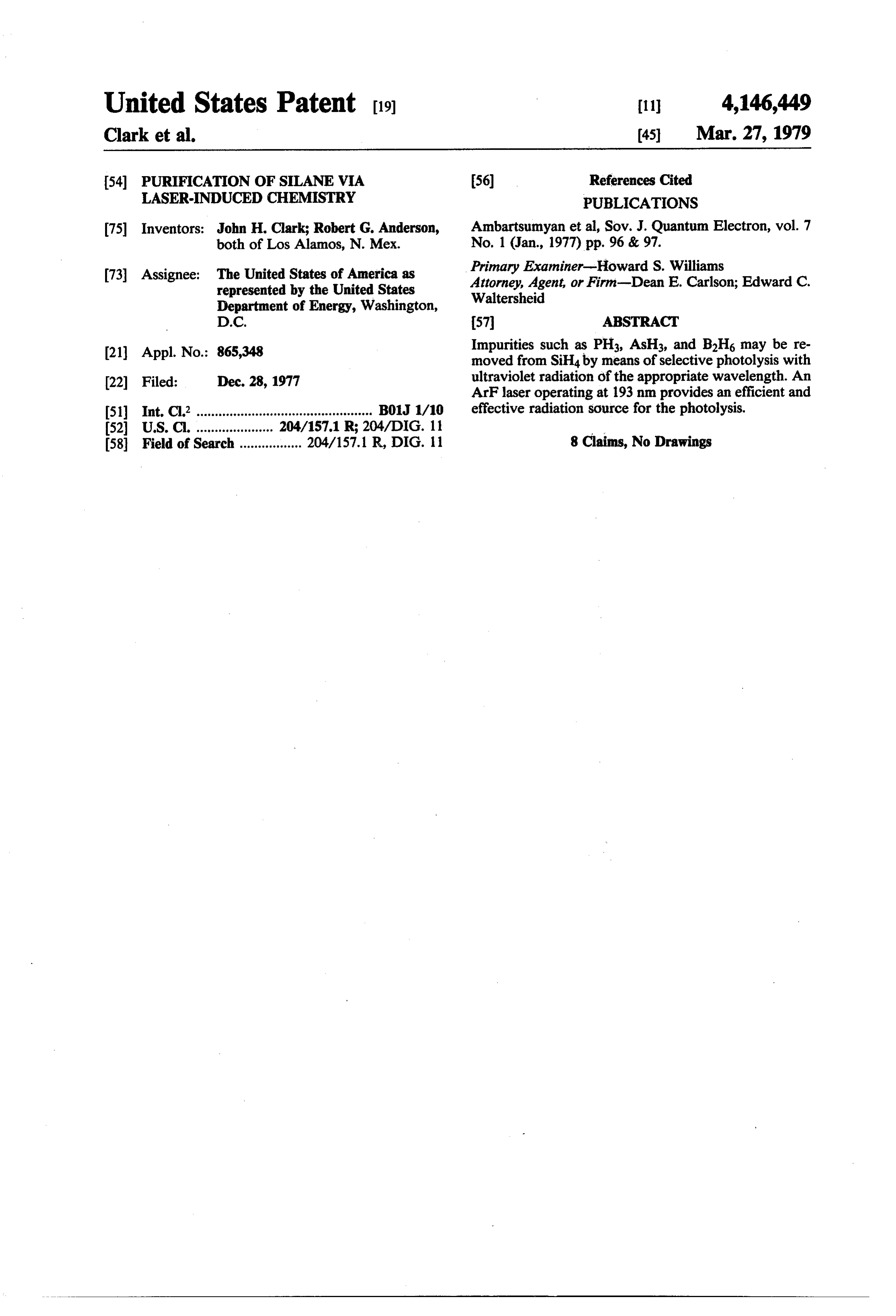
United States Patent (19) 11 4,146,449 Clark et al. (45) Mar. 27, 1979 (54) PURIFICATION OF SILANE WA (56) References Cited LASER-INDUCED CHEMISTRY PUBLICATIONS 75 Inventors: John H. Clark; Robert G. Anderson, Ambartsumyan et al, Sov. J. Quantum Electron, vol. 7 both of Los Alamos, N. Mex. No. 1 (Jan., 1977) pp. 96 & 97.
(73) Assignee: The United States of America as Primary Examiner-Howard S. Williams represented by the United States Attorney, Agent, or Firm-Dean E. Carlson; Edward C. Department of Energy, Washington, Waltersheid
D.C. 57 ABSTRACT (21) Appl. No.: 865,348 Impurities such as PH3, AsH3, and B2H6 may be re moved from SiH4 by means of selective photolysis with (22) Filed: Dec. 28, 1977 ultraviolet radiation of the appropriate wavelength. An ArFlaser operating at 193 nm provides an efficient and 51 Int. C.’................................................ B01 1/10 effective radiation source for the photolysis.
(58 Field of Search ................. 204/157.1 R, DIG. 11 8 Claims, No Drawings
Page 2
utilizes the differences in molecular properties to
PURFICATION OFSLANE WA achieve separation selectivities which can be quite high.
LASER-INDUCED CHEMISTRY
DESCRIPTION OF THE PREFERRED
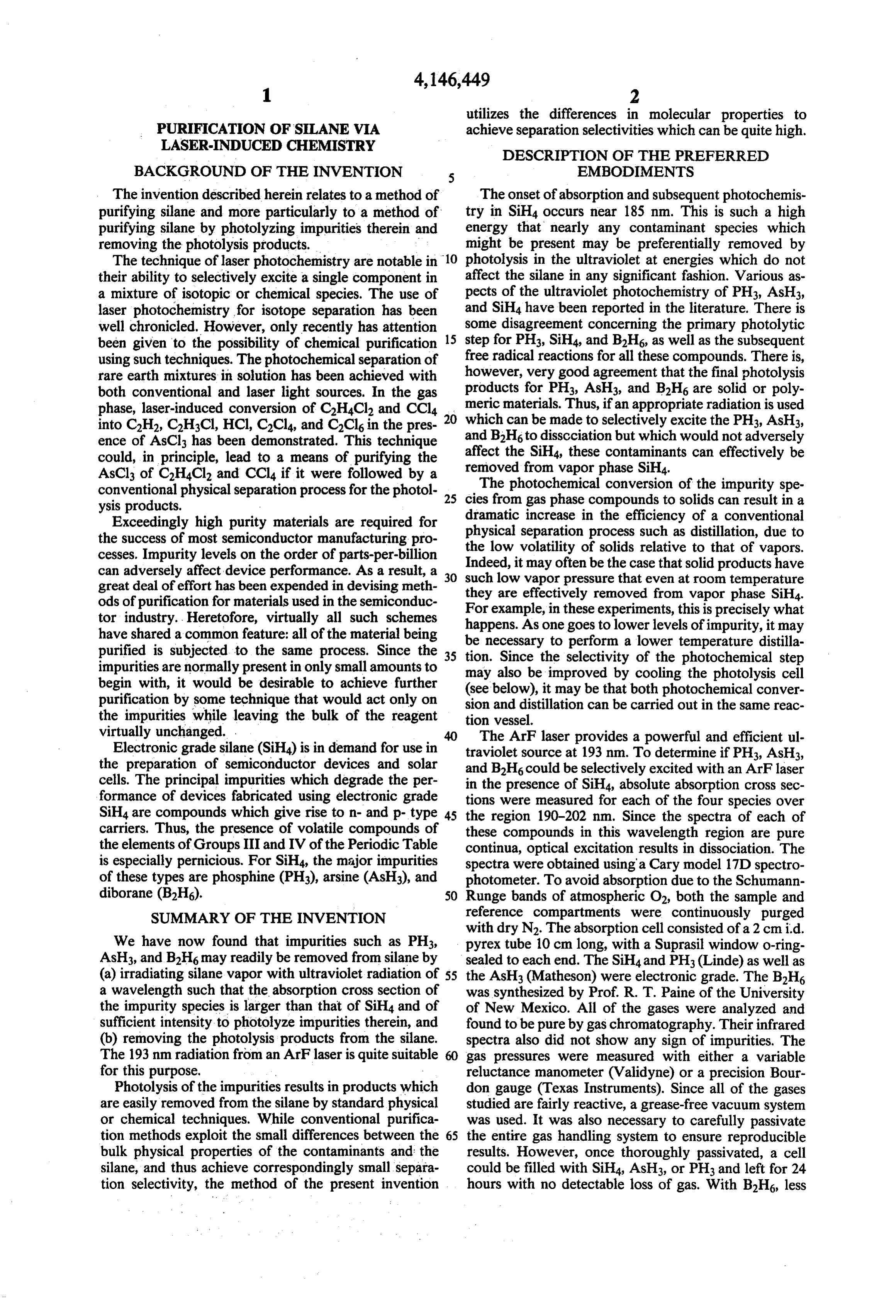
BACKGROUND OF THE INVENTION 5 EMBODIMENTS
The invention described herein relates to a method of The onset of absorption and subsequent photochemis purifying silane and more particularly to a method of try in SiH4 occurs near 185 nm. This is such a high purifying silane by photolyzing impurities therein and energy that nearly any contaminant species which removing the photolysis products. might be present may be preferentially removed by The technique of laser photochemistry are notable in 10 photolysis in the ultraviolet at energies which do not their ability to selectively excite a single component in affect the silane in any significant fashion. Various as a mixture of isotopic or chemical species. The use of pects of the ultraviolet photochemistry of PH3, Ash, laser photochemistry for isotope separation has been and SiH4 have been reported in the literature. There is well chronicled. However, only recently has attention some disagreement concerning the primary photolytic been given to the possibility of chemical purification 15 step for PH3, SiH4, and B2H6, as well as the subsequent using such techniques. The photochemical separation of free radical reactions for all these compounds. There is, rare earth mixtures in solution has been achieved with however, very good agreement that the final photolysis both conventional and laser light sources. In the gas products for PH3, Ash, and B2H6 are solid or poly phase, laser-induced conversion of C2H4Cl2 and CCl4 20 meric which materials. Thus, if an appropriate radiation is used can be made to selectively excite the PH3, AsH3, into CH2, C2H3Cl, HCl, C2Cl4, and C2Cl6 in the pres ence of AsCl has been demonstrated. This technique and B2H6 to disscoiation but which would not adversely could, in principle, lead to a means of purifying the affect the SiH4, these contaminants can effectively be AsCl of CHCl2 and CC14 if it were followed by a removed The from vapor phase SiH4.
photochemical conversion of the impurity spe conventional physical separation process for the photol 25 cies from gas phase compounds to solids can result in a ysis products.
Exceedingly high purity materials are required for dramatic increase in the efficiency of a conventional the success of most semiconductor manufacturing pro physical separation process such as distillation, due to cesses. Impurity levels on the order of parts-per-billion the low volatility of solids relative to that of vapors. Indeed, it may often be the case that solid products have can adversely affect device performance. As a result, a 30 such great deal of effort has been expended in devising meth they low vapor pressure that even at room temperature ods of purification for materials used in the semiconduc For example, in theseremoved are effectively from vapor phase SiH4.
tor industry. Heretofore, virtually all such schemes happens. As one goes to lower levelsthisofisimpurity, experiments, precisely what it may have shared a common feature: all of the material being be necessary to perform a lower temperature distilla purified is subjected to the same process. Since the 35 tion. Since the selectivity of the photochemical step impurities are normally present in only small amounts to may also be improved by cooling the photolysis cell begin with, it would be desirable to achieve further (see below), it may be that both photochemical conver purification by some technique that would act only on sion and distillation can be carried out in the same reac the impurities while leaving the bulk of the reagent tion vessel.
virtually unchanged. . The Arf laser provides a powerful and efficient ul Electronic grade silane (SiH4) is in demand for use in the preparation of semiconductor devices and solar traviolet source at 193 nm. To determine if PH3, Ash, and B2H6 could be selectively excited with an Arf laser cells. The principal impurities which degrade the per in the presence of SiH4, absolute absorption cross sec formance of devices fabricated using electronic grade tions were measured for each of the four species over SiH4 are compounds which give rise to n- and p-type 45 the region 190-202 nm. Since the spectra of each of carriers. Thus, the presence of volatile compounds of these compounds in this wavelength region are pure the elements of Groups III and IV of the Periodic Table continua, optical excitation results in dissociation. The is especially pernicious. For SiH4, the major impurities spectra were obtained using a Cary model 17D spectro of these types are phosphine (PH3), arsine (AsH3), and photometer. To avoid absorption due to the Schumann diborane (B2H6). 50 Runge bands of atmospheric O2, both the sample and SUMMARY OF THE INVENTION reference compartments were continuously purged with dry N2. The absorption cell consisted of a 2 cm i.d.
We have now found that impurities such as PH3, pyrex tube 10 cm long, with a Suprasil window o-ring AsH3, and B2H6 may readily be removed from silane by sealed to each end. The SiH4 and PH3 (Linde) as well as (a) irradiating silane vapor with ultraviolet radiation of 55 the Ash (Matheson) were electronic grade. The B2H6 a wavelength such that the absorption cross section of was synthesized by Prof. R. T. Paine of the University the impurity species is larger than that of SiH4 and of of New Mexico. All of the gases were analyzed and sufficient intensity to photolyze impurities therein, and found to be pure by gas chromatography. Their infrared (b) removing the photolysis products from the silane. spectra also did not show any sign of impurities. The The 193 nm radiation from an Arf laser is quite suitable 60 gas pressures were measured with either a variable for this purpose. reluctance manometer (Validyne) or a precision Bour Photolysis of the impurities results in products which don gauge (Texas Instruments). Since all of the gases are easily removed from the silane by standard physical studied are fairly reactive, a grease-free vacuum system or chemical techniques. While conventional purifica was used. It was also necessary to carefully passivate tion methods exploit the small differences between the 65 the entire gas handling system to ensure reproducible bulk physical properties of the contaminants and the results. However, once thoroughly passivated, a cell silane, and thus achieve correspondingly small separa could be filled with SiH4, Ash, or PH3 and left for 24 tion selectivity, the method of the present invention hours with no detectable loss of gas. With B2H6, less
Page 3
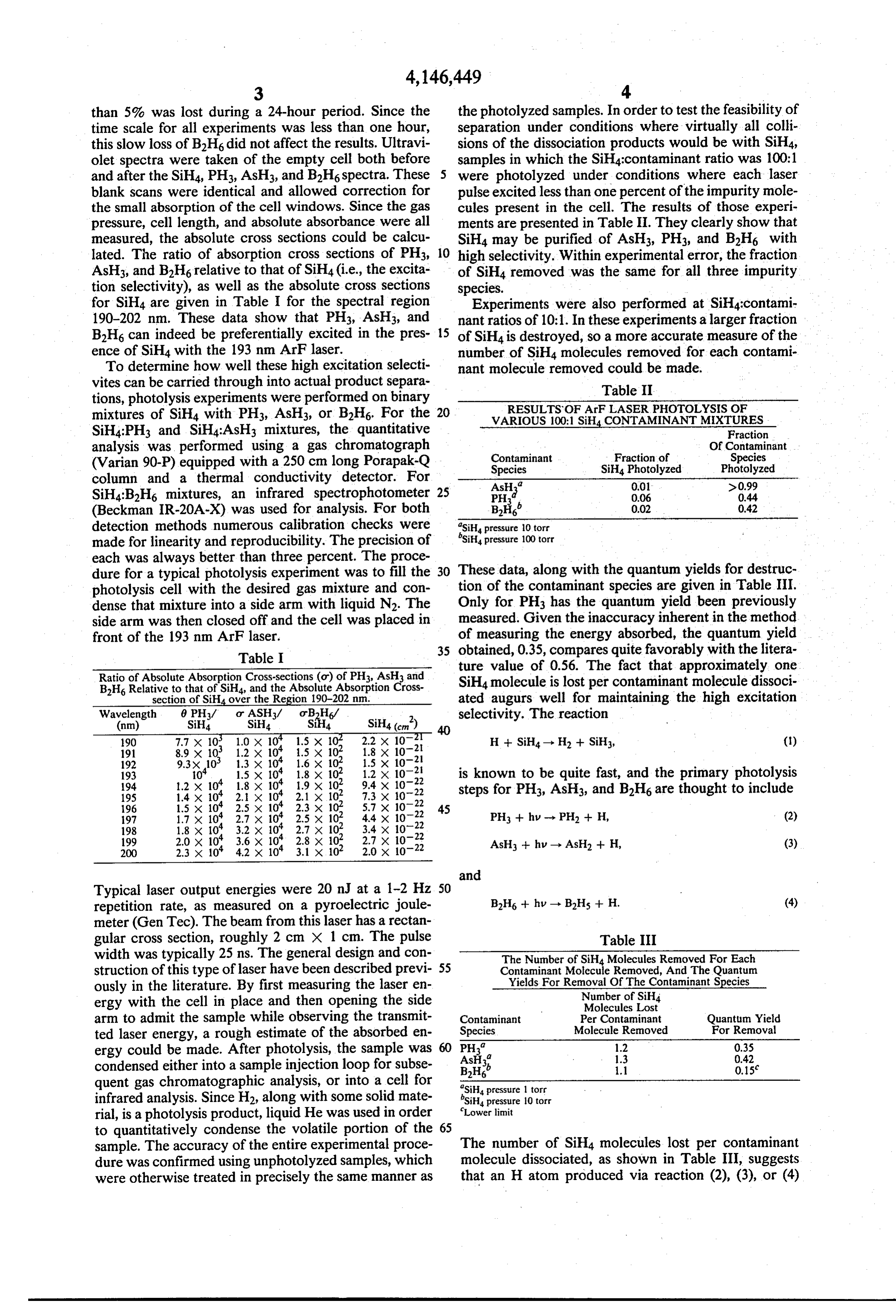
than 5% was lost during a 24-hour period. Since the the photolyzed samples. In order to test the feasibility of time scale for all experiments was less than one hour, separation under conditions where virtually all colli this slow loss of B2H6 did not affect the results. Ultravi sions of the dissociation products would be with SiH4, olet spectra were taken of the empty cell both before samples in which the SiH4:contaminant ratio was 100:1 and after the SiH4, PH3, Ash, and B2H6 spectra. These 5 were photolyzed under conditions where each laser blank scans were identical and allowed correction for pulse excited less than one percent of the impurity mole the small absorption of the cell windows. Since the gas cules present in the cell. The results of those experi pressure, cell length, and absolute absorbance were all ments are presented in Table II. They clearly show that measured, the absolute cross sections could be calcu SiH4 may be purified of AsH3, PH, and B2H6 with lated. The ratio of absorption cross sections of PH3, O high selectivity. Within experimental error, the fraction AsH3, and B2H6 relative to that of SiH4 (i.e., the excita of SiH4 removed was the same for all three impurity tion selectivity), as well as the absolute cross sections species.
for SiH4 are given in Table I for the spectral region Experiments were also performed at SiH4:contami 190-202 nm. These data show that PH, Ash, and nant ratios of 10:1. In these experiments a larger fraction B2H6 can indeed be preferentially excited in the pres 15 of SiH4 is destroyed, so a more accurate measure of the ence of SiH4 with the 193 nm Arf laser. number of SiH4 molecules removed for each contami To determine how well these high excitation selecti nant molecule removed could be made.
vites can be carried through into actual product separa Table II tions, photolysis experiments were performed on binary RESULTS OF AirF LASERPHOTOLYSIS OF mixtures of SiH4 with PH, Ash, or BH6. For the 20
VARIOUS 100:1 SiH4 CONTAMINANT MIXTURES
SiH4:PH3 and SiH4:AsH3 mixtures, the quantitative Fraction analysis was performed using a gas chromatograph Of Contaminant (Varian 90-P) equipped with a 250 cm long Porapak-Q Contaminant Fraction of Species Species SiH4 Photolyzed Photolyzed column and a thermal conductivity detector. For AH" 0.01 >0.99 SiH4:B2H6 mixtures, an infrared spectrophotometer 25 PH B 0.06 0.44 (Beckman IR-20A-X) was used for analysis. For both BH6 0.02 0.42 detection methods numerous calibration checks were SiH4 pressure 10 torr made for linearity and reproducibility. The precision of sih pressure 100 torr each was always better than three percent. The proce dure for a typical photolysis experiment was to fill the 30 These data, along with the quantum yields for destruc photolysis cell with the desired gas mixture and con tion of the contaminant species are given in Table III. dense that mixture into a side arm with liquid N2. The Only for PH3 has the quantum yield been previously side arm was then closed off and the cell was placed in measured. Given the inaccuracy inherent in the method front of the 193 nm Arf laser. of measuring the energy absorbed, the quantum yield 35 obtained, 0.35, compares quite favorably with the litera
Table I
Ratio of Absolute Absorption Cross-sections (o) of PH3, Ash and ture value of 0.56. The fact that approximately one
B2H6 Relative to that of SiH4, and the Absolute Absorption Cross SiH4 molecule is lost per contaminant molecule dissoci section of SiH4 over the Region 190-202 nm. ated augurs well for maintaining the high excitation Wavelength 0 PH/ or ASH/ or B2H6/ selectivity. The reaction (nm) SiH4 SiH4 SiH4 SiH4 (cm) 40 90 7.7 x 10³ 1.0 x 10 1.5 x 10² 22 x 10-2 H + SiH4 - H2 + SiH, (1)
193 104 1.5 x 10 i.8 x 102 1.2 x 10² is known to be quite fast, and the primary photolysis 194 1.2 x 10 1.8 x 10 1.9 x 10² 9.4 X 10²² steps for PH3, Ash, and B2H6 are thought to include
196 15 x 10' 2.5 x 10 2.3 x 10² 5.7 x 10⁻²² 45 197 1.7 x 10 2.7 X 10 2.5 x 10² 44 x 1022 PH -- hv - PH2 + H, (2)
199 2.0 x 10' 3.6 X 10 2.8 x 10² 2.7 x 10²² AsH3 -- hv -> AsH2 + H, (3)
and
Typical laser output energies were 20 nJ at a 1-2 Hz 50 repetition rate, as measured on a pyroelectric joule B2H6 -- hv - BH5 + H. (4) meter (GenTec). The beam from this laser has a rectan gular cross section, roughly 2 cm x 1 cm. The pulse Table III width was typically 25 ns. The general design and con The Number of SiH4 Molecules Removed For Each struction of this type of laser have been described previ 55 Contaminant Molecule Removed, And The Quantum ously in the literature. By first measuring the laser en Yields For Removal Of The Contaminant Species ergy with the cell in place and then opening the side Number of SiH,
Molecules Lost arm to admit the sample while observing the transmit Contaminant Per Contaminant Quantum Yield ted laser energy, a rough estimate of the absorbed en Species Molecule Removed For Removal ergy could be made. After photolysis, the sample was Asis PH" 1.2
condensed either into a sample injection loop for subse B2H6 1.1 0.15 quent gas chromatographic analysis, or into a cell for SiH4 pressure 1 torr infrared analysis. Since H2, along with some solid mate SiH4 pressure 10 torr rial, is a photolysis product, liquid He was used in order “Lower limit to quantitatively condense the volatile portion of the 65 sample. The accuracy of the entire experimental proce The number of SiH4 molecules lost per contaminant dure was confirmed using unphotolyzed samples, which molecule dissociated, as shown in Table III, suggests were otherwise treated in precisely the same manner as that an H atom produced via reaction (2), (3), or (4)
Page 4
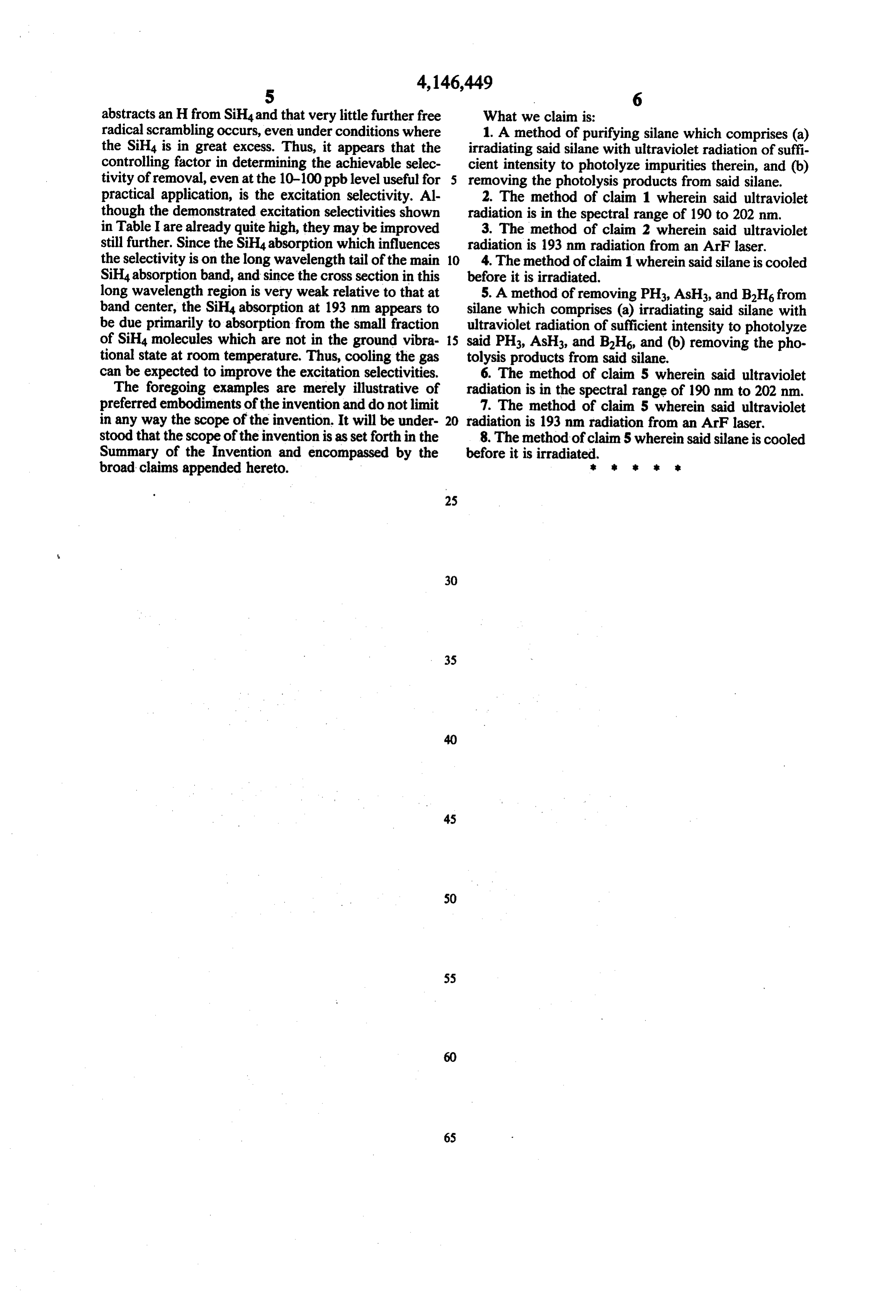
abstracts an H from SiH4 and that very little further free What we claim is:
radical scrambling occurs, even under conditions where 1. A method of purifying silane which comprises (a) the SiH4 is in great excess. Thus, it appears that the irradiating said silane with ultraviolet radiation of suffi controlling factor in determining the achievable selec cient intensity to photolyze impurities therein, and (b) tivity of removal, even at the 10-100 ppb level useful for 5 removing the photolysis products from said silane. practical application, is the excitation selectivity. Al 2. The method of claim 1 wherein said ultraviolet though the demonstrated excitation selectivities shown radiation is in the spectral range of 190 to 202 nm. in Table I are already quite high, they may be improved 3. The method of claim 2 wherein said ultraviolet still further. Since the SiH4 absorption which influences radiation is 193 nm radiation from an Arf laser. the selectivity is on the long wavelength tail of the main 10 4. The method of claim 1 wherein said silane is cooled SiH4 absorption band, and since the cross section in this before it is irradiated.
long wavelength region is very weak relative to that at 5. A method of removing PH3, Ash, and B2H6 from band center, the SiH4 absorption at 193 nm appears to silane which comprises (a) irradiating said silane with be due primarily to absorption from the small fraction ultraviolet radiation of sufficient intensity to photolyze of SiH4 molecules which are not in the ground vibra 15 said PH3, Ash, and B2H6, and (b) removing the pho tional state at room temperature. Thus, cooling the gas tolysis products from said silane. can be expected to improve the excitation selectivities. 6. The method of claim 5 wherein said ultraviolet The foregoing examples are merely illustrative of radiation is in the spectral range of 190 nm to 202 nm. preferred embodiments of the invention and do not limit 7. The method of claim 5 wherein said ultraviolet in any way the scope of the invention. It will be under 20 radiation is 193 nm radiation from an Arf laser. stood that the scope of the invention is as set forth in the 8. The method of claim 5 wherein said silane is cooled Summary of the Invention and encompassed by the before it is irradiated.
broad claims appended hereto.
Provenance
- Collection
- Cited prior art
- Original PDF
- patentimages.storage.googleapis.com →
- Filed
- 1977-12-28
- Pages
- 4
- Method
- pdftotext (the PDF's own text layer) + pdftoppm 300dpi page scans
- Source
- Google Patents bibliographic record
- Granted
- 1979-03-27
- Inventors
- John H. Clark; Robert G. Anderson; US Department of Energy
- Transcribed from
- patentimages.storage.googleapis.com →