patent · US3966879
Removal of sulfur oxides and particulate matter from waste gas streams
29 June 1976
Page 1 — bibliographic record
United States Patent (19) 11, 3,966,879 Groenendaal et al. (45) June 29, 1976 54 REMOVAL OF SULFUR OXIDES AND 3,501,897 3/1970 Van Helden et al................ 423/244 PARTICULATE MATTER FROM WASTE 3,755,535 8/1973 Naber................................. 423/244 GAS STREAMS OTHER PUBLICATIONS 75 Inventors: Willem Groenendaal; Friedrich C. Perry, Chemical Engineers Handbook, 4th Ed., 1963 Taubert, both of The Hague; Jaap 20-67, 68,74, 75,95.
E. Naber; Gijsbertus A. Bekker, both of Amsterdam, all of Primary Examiner-Oscar R. Vertiz
Netherlands Assistant Examiner-Gregory A. Heller 73 Assignee: Shell Oil Company, Houston, Tex.
22 Filed: May 6, 1974 57 ABSTRACT A process for the removal of particulate matter and 21 Appl. No.: 467,530 suifur oxides from waste gases is disclosed which com prises cross-current contacting of the waste gas stream (30) Foreign Application Priority Data with a moving bed of supported, copper-containing May 8, 1973 United Kingdom............... 21848/73 acceptor in a first zone, thereby accepting the sulfur oxides and filtering out the particulate matter, remov 52 U.S. Cl...................................... 423/244; 55/73 ing in subsequent separate zones the particulate mat (5) Int. Cl.'....................... B01J 8/00; COB 17/00 ter and the sulfur oxides from the acceptor and, op 58 Field of Search............................ 423/242-244; tionally, reactivating the acceptor in a subsequent 55773 zone before introducing it back into the first zone for further removal of sulfur oxides and particulate mat (56) References Cited ter. An apparatus suitable for carrying out the process is also described.
UNITED STATES PATENTs 3,405,508 10/1968 Peters et al......................... 423/244 10 Claims, 5 Drawing Figures
Page 2
Drawing sheet — no readable text.
Page 3
Drawing sheet — no readable text.
Page 4
Drawing sheet — no readable text.
Page 5
temperature of from about 300° to 500°C cross
REMOVAL OF SULFUR OXDES AND currently through a moving bed of the solid accep PARTICULATE MATTER FROM WASTE GAS tor, thereby accepting the sulfur oxide on said ac . . . . STREAMS ceptor filtering out the particulate matter to afford BACKGROUND OF THE INVENTION an acceptor loaded with sulfur oxides and particu late matter and a waste gas stream substantially
This invention relates to a process for the removal of free of both sulfur oxides and particulate matter; particulate matter and sulfur oxides from waste gases B. removing the particulate matter from the loaded Such as flue gas. The invention also relates to an appa 10 acceptor in a first separation zone wherein the ratus for carrying out such a process. acceptor loaded with both sulfur oxides and partic Because of increasingly stringent requirements on ulate matter is stripped of particulate matter by the abatement of air pollution, the removal of sulfur transporting the loaded acceptor through a stream oxides from gas mixtures, in particular from hot waste of an inert stripping gas, gases containing relatively small amounts of sulfur ox C. separating the sulfur oxides from the acceptor ides, such as flue gases and gases originating from 15 product of the first separation zone by contacting roasting processes, has in the past few years become of the acceptor with a reducing gas at a temperature great concern and technical importance. between 300-500°C in a second separation zone In many cases these waste gases also contain particu whereby the sulfur oxides bound to the acceptor late matter, in particular when they emerge from roast are released as SO, gas and ing processes or from electrical power plants (coal 20 D. returning the acceptor product of the second sep fired and sometimes oil-fired ones), which must also be aration zone into cross-current contact with said removed from the waste gases. It is possible to remove waste gases under oxidative conditions in the sulfur the particulate matter, which, generally, consists of oxide and particulate matter removal Zone. In an small particles and is called “fly ash', from the waste alternative aspect of the process of the invention, gases before or after the removal of the sulfur oxides, 25 the acceptor product of the second separation Zone e.g., buy filtration, with cyclones or by electrostatical from which sulfur oxides have at least partly, and in precipitation. Such measures, however, require large most cases substantially completely been removed, capital investment in addition to the capitol cost of the is reactivated by contacting it with an oxidizing separate facilities for sulfur oxide removal. Further, agent, preferably an oxygen-containing gas, in an even with this very large capitol investment there is no 30 activation zone before its introduction into the assurance of complete success since the state of the art sulfur oxide and particulate matter removal Zone. on particulate matter removal is not sufficiently ad DESCRIPTION OF THE PREFERRED vanced to assure trouble-free operation in all instances. EMBODIMENTS Accordingly, it would be very desirable if a process could be developed for the removal of both particulate 35 In the first zone the supported, copper-containing matter and sulfur oxides from waste gases, in which acceptor is to be brought into intimate contact with the there is no need for costly separate installations for the waste gas to be treated, by passing the waste gas cross removal of particulate matter. currently through a moving bed of acceptor particles. By the employment of this contacting technique it has
SUMMARY OF THE INVENTION 40 been found that essentially complete trapping of the It has now been found that supported, copper-con particulate matter can be accomplished such that little taining acceptors for sulfur oxides will function very or no particulate matter passes the moving acceptor effectively to remove both sulfur oxides and particulate bed while at the same time maintaining the effective matter from waste gases in the same processing zone 45 ness of the acceptor to contact and absorb the sulfur under reaction conditions required for sulfur oxide oxides present in the waste gas. This finding is surpris acceptance provided such acceptors are employed in ing since previously it has been considered impossible particulate form in a moving bed which contacts the under pratical conditions to even employ a moving or waste gas stream in cross-current fashion. Further, it fluidized bed of acceptor particles to remove SO, from has also been found that copper-containing acceptors gas streams containing particulate matter because of which are loaded with sulfur oxides and particulate 50 the clogging off of sulfur oxide acceptance sites by matter by this cross-current contacting procedure can trapped particulate matter. However, the use of the be readily processed into a reuseable from by passing cross-current contacting technique of the instant inven the loaded acceptor through separate zones for re tion apparently limits the rate of fly ash and/or other moval of the particulate matter and the sulfur oxides, particulate material deposition on the acceptor such with final activation of the sulfur oxide acceptance sites 55 that the acceptor is able to contact and accept substan being carried out in situ in the sulfur oxide and particu tially all of the sulfur oxides present in the waste gas late matter removal Zone or, optionally, in an addi prior to its becoming clogged off with particulate mat tional separate zone positioned subsequent to the re ter. Thus, the employment of the cross-current contact moval zones. Accordingly, the instant invention pro ing prodecure of the invention places an inherent limi vides a process for the removal of sulfur oxides and 60 tation on the intimacy of contact between the waste gas particulate matter from waste gases containing same and the moving acceptor bed which allows substantially which comprises complete acceptance of sulfur oxides and trapping of A. contacting the waste gas stream under oxidative particulate matter to occur in the same processing conditions in a sulfur oxide and particulate matter operation. Of course, the extent of cross-current removal zone with a solid acceptor comprising 65 contact between the waste gas and the moving acceptor copper or copper compound or mixtures thereof bed will vary widely depending on the type of waste gas supported on a particulate carrier, said contact which is being treated since the concentrations of both being established by passing the waste gas at a the sulfur oxides and the particulate matter relative to
Page 6
the total gas make-up and to each other will bear on the After impregnation the carriers loaded with the de degree of cross-current contacting required to effect sired metal compounds are dried and, if desired, heated the desired removal. One skilled in the art will recog to a temperature below 600°C, e.g., of from nize that the proper degree of cross-current contacting 350-550°C. The acceptor preferably contains copper can be readily ascertained in any given case by merely oxide as the copper compound. In cases where the analyzing the product of the cross-current contacting calcination just mentioned does not lead to the forma procedure for sulfur oxides and particulate matter and tion of copper oxide (e.g., when the impregnation has varying process conditions, i.e., waste gas flow rate, been carried out with sulfates), it is of advantage to moving bed velocity, density and thickness, etc., until convert the copper compounds into the corresponding the desired removal or sulfur oxides and particulate O oxide by carrying out a procedure similar to that for the matter is achieved. For typical sulfur oxides and partic regeneration of the loaded acceptor as described be ulate matter-containing waste gases such as flue gas low.
which generally contain relatively low concentrations, The amount of copper present in the acceptor very i.e., 0.1-5% V, of sulfur oxides and small quantities of 15 suitably ranges from 1-10% by weight of the acceptor, particulate matter, i.e., 1-20 g per nm of waste gas, it preferably from 2-7% by weight.
is preferred for practical reasons that the layer of the The temperature during contact between the waste acceptor material to be passed by the waste gas be gas and the acceptor in the first zone very suitably is in tween about 25 and 100 cm thick. Under these condi the range of from 300 to 500°C, with temperatures as tions removal of sulfur oxides and particulate matter 20 high as 430°C and as low as 325°C being preferred. can be effected by passing the waste gas stream at a During contact oxidative conditions must prevail. This velocity of between about 1 m/sec and 7 m/sec into is generally accomplished by the presence of oxygen, cross-current contact with the moving acceptor bed which in most cases is present in the waste gases to be flowing at a rate of about 0.4 mm/sec to about 2.5 treated or otherwise may be provided by the addition mm/sec; the specific velocities chosen being dependent 25 of, e.g., air.
on the thickness of acceptor layer employed. The waste gases which have been freed from particu The acceptor is very suitably used in the form of late matter and sulfur oxides may be carried off granules, spheres, pellets or the like, with diameters in through a stack.
the 1-5 mm range. The particulate matter in the waste The acceptor which is loaded after contact with the gas, the particles of which generally have a diameter 30 waste gas in the first zone with particulate matter and below 0.2 mm, or even below 0.5 mm, is readily filtered with sulfur oxides is removed from that zone. Accord by the acceptor during the contact with the waste gas. ing to the invention it has been found very desirable to If desired, part of the particulate matter (in particular remove particulate material and the sulfur oxides from the bigger particles) may be removed from the waste the loaded acceptor in separate zones. Although it is gas with a simple apparatus (e.g., a cyclone) prior to possible to remove the sulfur oxides before the particu the contact of the waste gas with the acceptor in the 35 late matter, it is preferred to free the acceptor of partic first zone. ulate matter first. According to the invention the re The acceptor should have a high mechanical strength moval of particulate matter can very effectively be in order to avoid the formation of a significant amount accomplished by stripping the acceptor in a second of small particles (fines) thereof by attrition during zone with an inert gas, in particular steam. The particu transport of the acceptor through the zones. It is pre 40 late matter, which has smaller dimensions that the ac ferred that the acceptor has a bulk crushing strength ceptor particles, is separated from the acceptor and is above 10 kg/cm. For this reason carrier materials transported by the inert gas. To take maximum advan based on reinforced refractory oxides are very suitable. tage of this size differentiation and to thereby achieve Such a refractory oxide may comprise alumina, silica, 45 optimum separation of the acceptor particles from the zirconia and thoria and/or mixtures of two or more of particulate matter it is advantageous to interpose a these oxides. Silica-alumina, gamma-alumina and al barrier substantially impenetrable to the acceptor par pha-alumina are the most preferred carrier materials. ticles (because of their size) in the particulate matter The copper or copper compound to be present on the removal zone through which the particulate matter carrier material is very suitably applied on the carrier 50 carried by the inert gas can pass after initial separation material by impregnation with a solution comprising a is effected. To achieve this result under practical condi copper compound. Aguedus solutions, in particular tions, this stripping is very suitably carry out by trans those containing copper sulphate and/or copper ni portion the loaded acceptor in relatively thin layers trate, are preferred. In order to increase the capacity of over perforated plates, and passing the inert gas the acceptors for the acceptance of sulfur oxides it is of 55 through the acceptor layers via the perforations of the advantage to impregnate the carrier prior to or simulta said plates. The perforated plates may be positioned neously with the solution of a copper compound with a under a slope such that the acceptor moves over the solution of a compound of one or more of the metals said plates by means of gravitational force. zirconium, titanium, magnesium and in particular alu The particulate matter can ultimately wholly or minum. This capacity for acceptance of sulfur oxides is 60 partly be separated from the inert gas (or after conden still further enhanced by impregnation of the carrier sation from water in cases where steam is employed) by material with a solution of an alkali metal compound, conventional means, e.g., with the aid of filters or with in particular a sodium salt, simultaneously with or after one or more cyclones and or hydrocyclones. impregnation with the afore-mentioned solution of a The sulfur oxides still bound to the acceptor after the compound or one or more of the metals zirconium, 65 removal of the particulate matter are removed from the titanium, magnesium and aluminum. Very suitably the acceptor material in a next zone. This regeneration step carrier is impregnated with a single aqueous solution is carried out by contacting the acceptor with a suitable containing salts of copper, aluminum and sodium, e.g., reducing gas such as hydrogen or hydrogen/carbon as a nitrate or sulfate. monoxide mixtures, and hydrocarbon or mixtures of
Page 7
S 6 hydrocarbons. Preferably, the reducing gas comprising After removal of the sulfur oxides it is desirable to hydrogen is diluted with one or more inert gases chosen free the acceptor from any residual reducing gas before from the group consisting of steam, nitrogen and car it is reintroduced into the sulfur oxide and particulate bon dioxide. Very suitable diluted reducing gases are matter removal zone or before it is reactivated with an gases produced by the reaction of steam and methane, oxidizing agent according to the procedure described or gases obtained by the partial oxidation of hydrocar below. This can be readily accomplished by stripping bons, or off-gases emanating from a catalytic reformer. the acceptor with inert gas. To this end the acceptor is It is preferred that the molar ratio of the inert gas and very suitably transported in relatively thin layers over combustible compounds in the reducing gas (in general perforated plates and stripped with an inert gas which is hydrogen and/or carbon monoxide and/or hydrocar O passed through the acceptor layers via the perforations bons) is from 3 to 10, preferably from 4 to 5. A pre in the plates. Preferably, the perforated plates are posi ferred inert diluent is steam. tioned at a slope from horizontal, with the acceptor The acceptor may be transported through the regen being moved over the sloped plates by means of gravi eration zone by any suitable means, such as with the aid 15 tational force. Steam is preferred as inert stripping gas. of bucket elevators, screw conveyors or vibrating con The acceptor from which the sulfur oxides have at veyors. Since the reaction between the sulfur oxides least partly, an in most cases substantially completely loaded acceptor and the reducing gas to release free been removed, may be recycled to the sulfur oxides and sulfur dioxide is very rapid, in many cases all sulfur particulate matter removal (first) zone without reacti oxide is removed from the acceptor after a few seconds 20 vation. In an active acceptor the copper is, preferably, of contact with the reducing gas. It is, therefore, pre present as its oxide. After treatment with the reducing ferred that the third zone comprises a riser tube de gas the acceptor contains the copper at least partly in bouching into a cyclone through which zone the accep the metallic form. When the acceptor in this form is tor is transported by means of the reducing gas. In this used in the first zone the metallic copper is converted case the vertical riser tube functions both as a means into copper oxide by the oxidizing gas present in the for transporting the acceptor and as the Zone for the 25 said first zone. However, since heat is liberated during removal of sulfur oxides from the acceptor. In cases the oxidation of copper to its oxide, an undesired rise in there the removal of sulfur oxides from the acceptor in temperature may take place in the first Zone. the said riser or other means of transport is not suffi For this reason it is preferred to reactivate the accep cient, a moving bed reactor may be inserted for the 30 tor in a separate zone before its introduction into the removal of the sulfur oxides from the loaded acceptor first zone. In this separate zone for activation the ac with the aid of a reducing gas. ceptor is suitably contacted with an oxidizing agent, After the removal of the sulfur oxides, the reducing e.g., an oxygen-containing gas, such as air. In order to gas and the acceptor, are separated from each other by achieve reactivation the acceptor may be transported conventional gas-solids physical separation techniques. through this separate zone via any conventional tech Preferably, this separation occurs in the cyclone. In the 35 nique for moving solid particles, e.g., bucket elevators, cyclone the acceptor is kept in contact with the reduc screw conveyors vibrating conveyors. It is preferred to ing gas, to ensure complete removal of sulfur oxides reactivate the acceptor by contacting it with an oxygen from the acceptor. containing gas in a zone comprising a riser tube de During the removal of the sulfur oxides from the 40 bouching into a cyclone. In this preferred procedure acceptor with a reducing gas, the temperature is very the acceptor is transported through the activation zone suitably in the range of from 300-500°C and prefer by means of the oxygen-containing gas used for its ably between 325° 475°C. The sulfur compounds reactivation. During transport through the vertical riser emerging from the acceptor are virtually completely in tube oxidation of the metals present on the carrier the form of sulfur dioxide. material takes place. The temperature during transport The reducing gas which has been in contact with the 45 should, preferably, be kept within the temperature acceptor now contains the sulfur originally present in range of the subsequent cross-current contacting step the waste gases in the form of sulfur dioxide, and may in the first zone but during oxidation of the metallic have lost its reducing properties. This gas is removed copper it may locally rise to a temperature beyond this from the regeneration zone, and the sulfur dioxide 50 range.
present therein can be recovered by conventional In the preferred embodiment of the invention relat means. It may be further processed by known methods ing to the reactivation zone the acceptor is separated to products, such as elemental sulfur, sulfuric acid or from the oxidizing agent by the cyclone and recycled to gypsum. the first zone by any suitable means, e.g., under the As the process of the invention is non-cyclic one, the influence of gravitational force or by means of a con gas emanating from the regeneration zone will always 55 veyor. The remnant of the oxidizing agent (e.g., air) have substantially the same concentration of sulfur may be discharged to the stack, or be used for any dioxide. Therefore, this gas may conveniently be di other purpose, e.g., as part of the inlet air to the fur rectly used for a process in which sulfur dioxide is nace from which the waste gases emerge. converted into other products (e.g., into elemental The invention also relates to an apparatus particu sulfur in a Claus plant). This is an important advantage 60 larly suited for carrying out the process according to of the present process over known cyclic processes the invention. The apparatus comprises a vessel for wherein the concentration of sulfur dioxide in the re cross-current contacting of the waste gas with a moving generation off-gas, in general, varies in time. Costly bed of acceptor for sulfur oxides, and separate process installations, such as absorbers and strippers, are 65 ing chambers for removal of the particulate matter needed in these latter processes to compensate for the from the loaded acceptor, for the removal of sulfur fluctuations in the SO-concentration in order to bring oxides for the loaded acceptor, and for reactivating the the sulfur dioxide from such a regeneration off-gas in a acceptor.
form suited for further processing. In a preferred embodiment the apparatus comprises:
Page 8
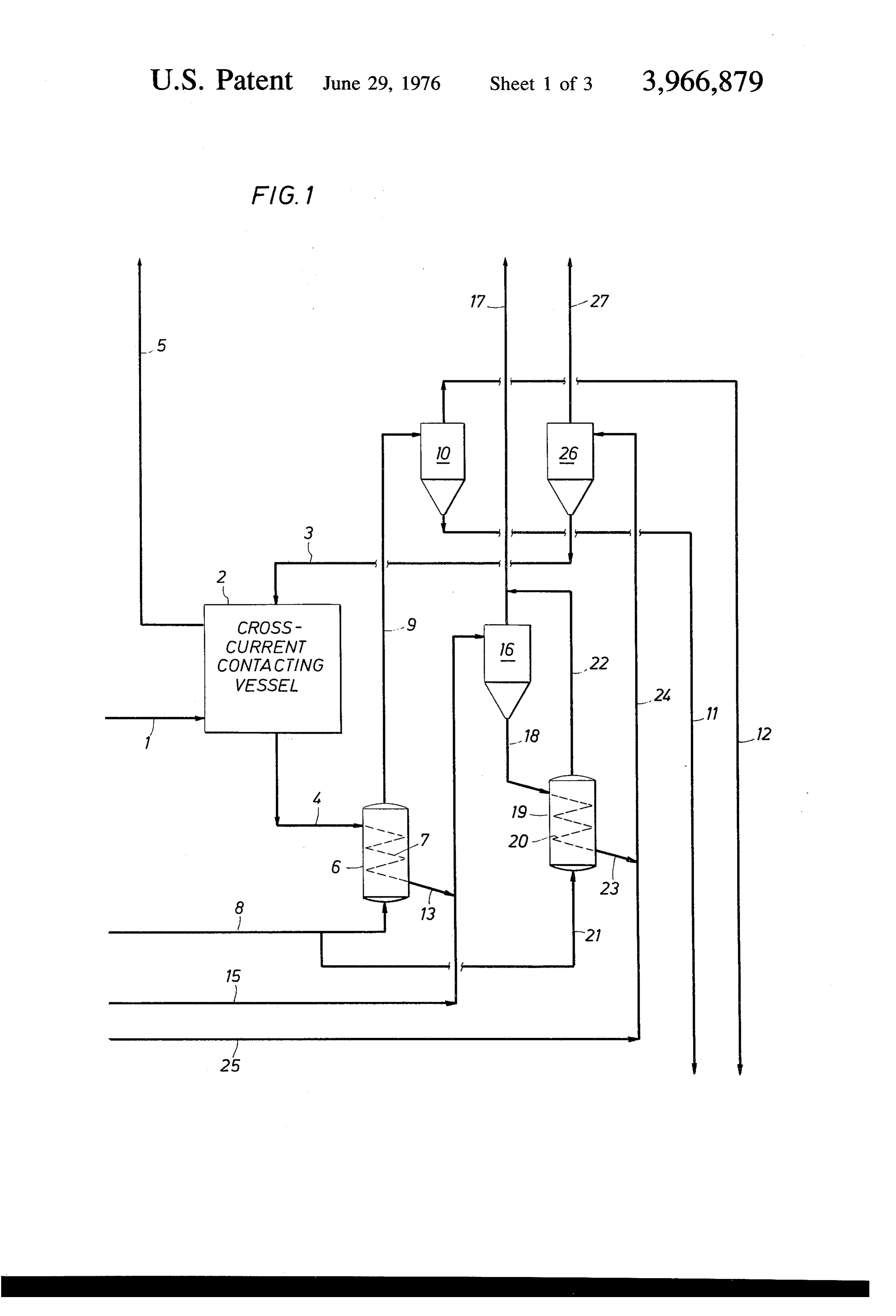
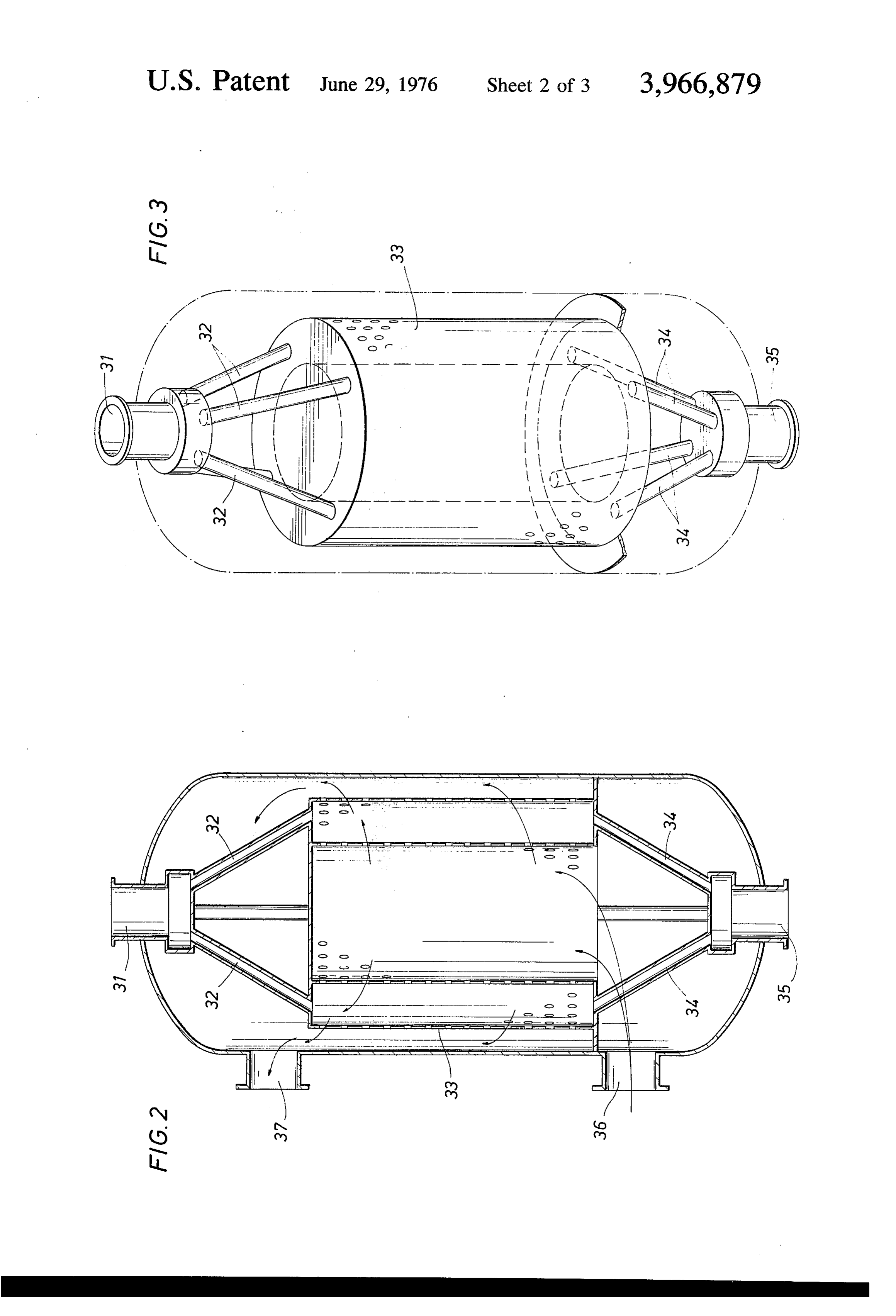
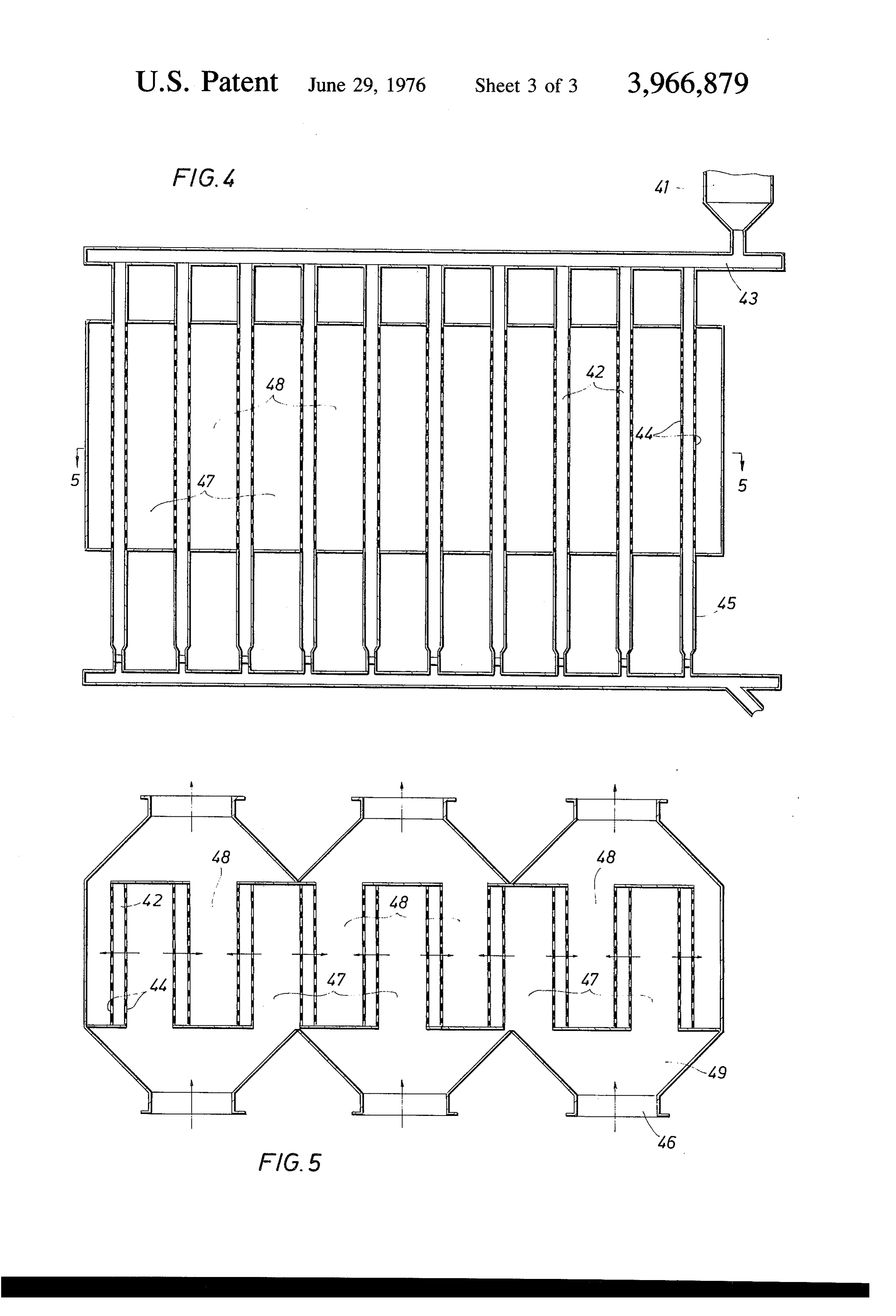
A. a contacting vessel having an inlet for waste gases passes over the plates 7 by gravitational force, and the containing sulfur oxides and particulate matter and an fly ash present thereon, is removed with the aid of steam outlet for waste gas substantially free of sulfur oxides introduced via line 8. The fly ash is transported by the and particulate matter, an internal compartment con steam via line 9 to a cyclone 10. From this cyclone dry taining a moving bed of supported, copper-containing fly ash is removed through line 11, and a slurry of fly acceptor for sulfur oxides, said internal compartment ash in water via line 12. The acceptor is removed via being defined by perforated walls disposed inside the line 13 from vessel 6 to a riser 14. Via line 15 a reduc contacting vessel, an inlet for fresh supported copper ing gas (for example, a mixture of steam and hydrogen) containing acceptor in fluid communication with said O is introduced into riser 14, and the acceptor may be internal compartment and an outlet for said acceptor transported to cyclone 16. In riser 14 the SO, is re loaded with sulfur oxides and particulate matter also in moved from the acceptor. From cyclone 16 the gas, fluid communication with said internal compartment, which now contains appreciable amounts of SO2, is and a means for directing the flow of said waste gases removed via line 17. The acceptor is removed from and said moving bed of acceptor cross-currently to one 15 cyclone 16 via line 18 to vessel 19 equipped with perfo another, said waste gas flowing through the perforated rated plates 20, which are at a slight angle with the walls of said internal compartment containing said horizontal. Steam is introduced into vessel 19 via line moving bed of acceptor; 21, and this steam, after having been in contact with B. a first purge vessel for removing particulate matter the acceptor (which may pass over plates 20 by gravita from the acceptor with a bottom inlet for purge gas and 20 tional force) is removed via line 22 from vessel 19. Line a top outlet for purge gas and particulate matter, a top 22 may be connected with line 17. The acceptor leaves inlet for acceptor material loaded with sulfur oxides vessel 19 through line 23 to a riser 24. Air is introduced and particulate matter connected to a loaded acceptor into line 24 via line 25, and the acceptor is led to a outlet of said contacting vessel and a bottom outlet for cyclone 26 via line 24. In line 24 copper on the accep purged acceptor material, at least one perforated plate 25 tor is oxidized to copper oxide. disposed in the vessel at an angle with the vertical for From cyclone 26 the gas is removed via line 27. It transporting the loaded acceptor material from its inlet may be used as feed air for the furnace from which the to the outlet and a means for passing said purge gas waste gas emerges, or it is passed to stack. The accep through said perforated plate thereby stripping said tor is recycled from cyclone 26 to reactor 2 via line 3. particulate matter from said loaded acceptor during its 30 The vessel in which the waste gas is to be contacted transport on said perforated plate; with the acceptor (vessel 2 in FIG. 1) may be con C. a first vertical riser tube debouching into a cyclone structed in several ways. The acceptor is to be trans for removing sulfur oxides from the acceptor, having a ported through the vessel as a moving bed while being bottom inlet for purged acceptor material connected to contacted cross-currently with the waste gas. the bottom outlet of the above purge vessel and a bot 35 Two vessel or reactor types, which are very suitable tom inlet for reducing gas, a cyclone top outlet for for this purpose are shown schematically in FIGS. 2, 3 sulfur oxide-containing gas and a cyclone bottom outlet and 4, 5, respectively. FIG. 2 shows a longitudinal sec for reduced acceptor material; tion and FIG. 3 a perspective fuel of a so-called cylin D. a second purge vessel with a bottom inlet and a drical radial flow reactor.
top outlet for purge gas, a top inlet for reduced accep Acceptor material enters the reactor via the top noz tor material connected to the above cyclone bottom 40 zle 31 and is distributed via conduits 32 into a cylindri outlet and a bottom outlet for purged acceptor mate cal compartment 33 with perforated walls. On its flow real and at least one perforated plate disposed in the downwards the acceptor is exposed to the flue gas. At vessel at an angle with the vertical for transporting the bottom of the cylindrical compartment the accep acceptor material from its inlet to the outlet, and tor is removed via conduit 34 and removed from the E. a second vertical riser tube debouching into a 45 reactor via bottom nozzle 35. The flue gas is passed cyclone for reactivating the acceptor having a bottom from the reactor inlet 36 and via spaces between the inlet for purged acceptor material connected to the conduits 34 into the central cone. From there is radially bottom outlet of the second purge vessel and a bottom passes the acceptor layer present in the cylindrical inlet for an oxygen-containing gas, a cyclone top outlet 50 compartment 33, thereby establishing the desired for the oxygen-containing gas and a cyclone bottom cross-current contact between moving acceptor parti outlet for reactivated acceptor material connected to the cles and the waste gas. The flue gas stream at the top of the acceptor inlet of the above contacting vessel. reactor via outlet 37.
A schematical drawing of such an apparatus is given It will be understood that several other embodiments in FIG. 1. For the sake of simplicity auxiliary equip of a cylindrical radial flow reactor are possible. I may, ment, such as bolts, nuts, valves, heating and cooling 55 e.g., contain several concentrically arranged cylindrical equipment is not shown. compartments with perforated walls through which the Flue gas is introduced via line 1 into cross-current acceptor material is transported. In all cases the flue contacting vessel 2. The acceptor is fed to vessel 2 gases are introduced in such a way that they must at through line 3. The acceptor is passed through the 60 least pass through one layer of acceptor material pre vessel and removed therefrom via line 4. The waste gas, sent in a cylindrical compartment before leaving the which was in cross-current contact with the acceptor in reactor.
vessel 2 is removed therefrom via line 5, and may be led In FIGS. 4 and 5, a so-called parallel plate reactor is to the stack. In general, it may be partly cooled by heat shown. FIG. 4 is a side view and FIG. 5 is a top view. transfer to air to be used for combustion in the furnace The acceptor material is fed to the top of the reactor from which the off-gas emerges. The acceptor removed 65 by a hopper 41 and distributed at the top over a num from the cross-current contacting vessel via line 4 is led ber of compartments 42 arranged in parallel (e.g., by to a vessel 6, which is provided with perforated plates 7 means of a closed channel-type conveyor 43). The at a slight angle with the horizontal. The acceptor acceptor flows downwards through the compartments.
Page 9
The number of compartments and their size depend on reactivated acceptor is recycled to the top of the bi the amount of flue gas to be treated, its width and on cylindrical radial flow reactor.
the allowable pressure drop. The side walls 44 of the What is claimed is:
compartments are perforated to allow for passage of 5 1. A process for removing sulfur oxides and particu the flue gas. Both top and bottom parts of the compart late matter from, waste gas streams containing sulfur ments are, preferably, triangular in cross-section to get oxides and particulate matter which comprises: . an equal distribution of acceptor across the square A. contacting the waste gas stream under oxidative cross area. Each compartment is equipped with a vane conditions in a sulfur oxide and particulate matter feeder 45 at the bottom for withdrawal of loaded ac removal zone with a solid acceptor comprising ceptor. At the bottom the acceptor is collected using 10 copper or a copper compound or mixtures thereof the same equipment as for the distribution at the top. supported on a particulate carrier, said contact The flue gas enters the reactor horizontally via inlets 46 being established by passing the waste gas at a and is fed into flue gas inlet chambers 47. From here it temperature of from about 300° to 500°C. cross passes the acceptor layer and leaves the reactor via the 15 currently through a moving bed of the solid accep flue gas outlet chambers 48. Inlet and outlet chambers tor, thereby accepting the sulfur oxide on said ac are arranged alternatively. Both side walls of each ceptor and filtering out the particulate matter to chamber (excluding the first and the last one) are per afford an acceptor loaded with sulfur oxides and forated. The distribution of the flue gas across the reac particulate matter and a waste gas stream substan tor section is obtained by one or more pyramidical inlet 20 tially free of both sulfur oxides and particulate and outlet devices 49. The outlet system is identical to matter, the inlet device. B. removing the particulate matter from the loaded
EXAMPLE
acceptor in a first separation zone wherein the acceptor loaded with both sulfur oxides and partic
Flue gas of 250 MW boiler amounting to 783,000 ulate matter is stripped of particulate matter by Nm/h gas containing 0.16% vol. SO, and 8.7 g Nm fly 25 transporting the loaded acceptor through a stream ash, is introduced at the bottom of a bi-cylindrical of an inert stripping gas; radial flow reactor, as described above, with a diameter C. separating the sulfur oxides from the acceptor of 12 meters at a temperature of 400°C and about product of the first separation zone by contacting atmospheric pressure. The layer thickness of the accep 30 the acceptor with a reducing gas at a temperature tor in each cylindrical compartment is 50 cm and the between 300-500°C in a second separation zone acceptor moves through the compartment by gravita whereby the sulfur oxides bound to the acceptor tional force at a rate of about 1 mm/sec. The acceptor are released as SO gas and consists of reinforced alumina comprising 5%wt of D. returning the acceptor product of the second sep copper. Its bulk density is 1100 kg/m and its size 3-5 35 aration zone into cross-current contact with said mm. After passage through the two cylindrical com waste gases under oxidative conditions in the sulfur partments cross-currently to the moving acceptor, the oxide and particulate matter removal zone. purified flue gas leaves the reactor at its top. The flue 2. The process according to claim 1, wherein the gas particulate matter is reduced to 0.09 g/Nm and its removal of particulate matter from the loaded acceptor SO, content is 160 ppm vol. After leaving the bi-cylin in the first separation zone is effected by transporting drical radial flow reactor the acceptor is freed from 40 the acceptor in relatively thin layers over the perfo particulate matter by stripping with low pressure steam rated plates and by passing the inert gas through the in a purge vessel comprising three inclined perforated acceptor layers via the perforations of the said plates. trays. The temperature during stripping is 390°C and 3. The process according to claim 2 wherein the the pressure is slightly above atmospheric pressure. 45 perforated plates are positioned under a slope from The acceptor is introduced at the top of the purge horizontal and the acceptor moves over the plate by vessel and leaves it at the bottom. A gas stream of means of gravitational forces. : steam and particulate matter leaves the purge vessel at 4. The process according to claim 1 wherein the its top. The acceptor now free from contaminating acceptor product of the second separation zone is reac particulate matter is then introduced in a riser tube tivated by contacting it with an oxidizing agent in an with an inside diameter of 1.0 meter in which it is con 50 activation zone prior to introducing said acceptor into tacted with a reducing gas comprising 15%vol. He and the sulfur oxide and particulate matter removal zone. introduced in the said riser rube at a rate of 15,000 5. The process according to claim 4 wherein the kg/h. The riser debouches into a cyclone with a diame oxidizing agent employed is an oxygen-containing gas. ter of 2.5 m wherein acceptor and reducing gas are 55 6. The process according to claim 1 wherein the separated. The acceptor leaves the cyclone at its bot thickness of the moving bed of acceptor particles in tom and is introduced into a second purge vessel which cross-current contact with the waste gas stream in the is similar to the one described above. The conditions sulfur oxide and particulate matter removal zone is during stripping with steam are almost identical, i.e., between about 25 and l00 cm taken in the direction of 380°C and a pressure of about 1.0 kg/cm abs. The waste gas flow.
acceptor is subsequently introduced in a second riser 60 7. The process according to claim 6 wherein the (diameter: 0.65 m) in which it is treated with air in velocities of the waste gas stream and the moving bed order to oxidize its metallic copper to copper oxide. Air in cross-current contact are between about 1 and 7 m/sec and from about 0.4 to about 2.5 mm/sec, respec is introduced at a temperature of 30°C and at a rate of tively.
13,500 kg/h. During the oxidation step the acceptor 65 temperature rises to 410°C. Air and oxidized acceptor 8. The process according to claim 1 wherein the are separated from each other in a cyclone into which acceptor product of the second separation zone is the second riser debouches. The diameter of this cy stripped with an inert gas prior to being returned into clone is 2.0 m. From the latter cyclone regenerated and cross-current contact with the waste gases under oxida
Page 10
tive conditions in the sulfur oxide and particulate mat- via the perforations of the said plates. ter romoval zone. 10. The process according to claim 9 wherein the 9. The process according to claim 8 wherein the inert gas of the stor product of the second perforated plates are positioned under a slope from separation zone is carried out by transporting the ac- 5 horizontal and the acceptor moves over the plate by ceptor in relatively thin layers over perforated plates means of gravitational force. and by passing the inert gas through the acceptor layers ck k sk xk sk
Provenance
- Collection
- Cited prior art
- Original PDF
- patentimages.storage.googleapis.com →
- Filed
- 1974-05-06
- Pages
- 10
- Method
- pdftotext (the PDF's own text layer) + pdftoppm 300dpi page scans
- Source
- Google Patents bibliographic record
- Granted
- 1976-06-29
- Inventors
- Willem Groenendaal; Friedrich C. Taubert; Jaap E. Naber; Gijsbertus A. Bekker; Shell Oil Co
- Transcribed from
- patentimages.storage.googleapis.com →