patent · US4061555
Water photolysis apparatus
6 December 1977
Page 1 — bibliographic record
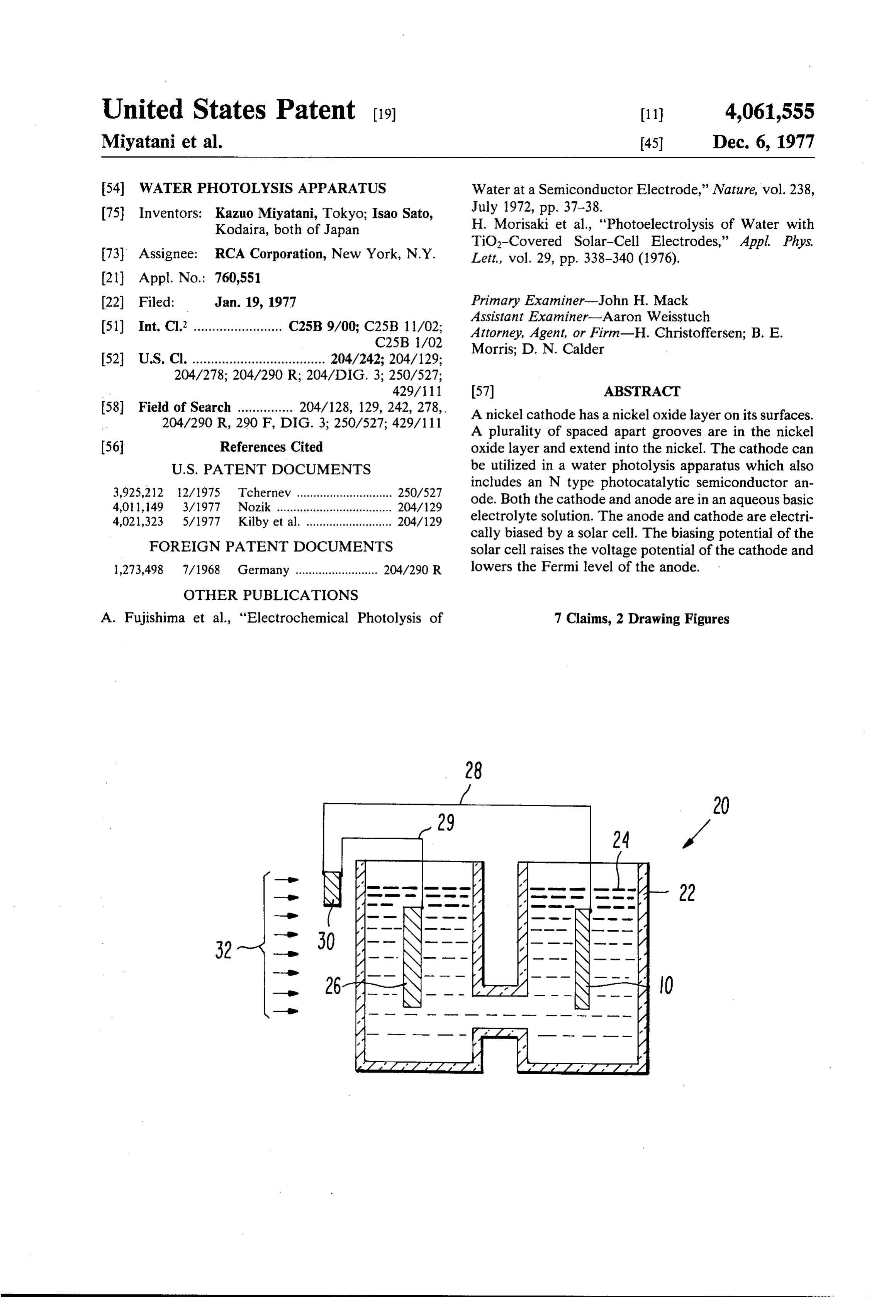
United States Patent (19) 11 4,061,555 Miyatani et al. 45 Dec. 6, 1977 54) WATER PHOTOLYSIS APPARATUS Water at a Semiconductor Electrode,' Nature, vol. 238, 75 Inventors: Kazuo Miyatani, Tokyo; Isao Sato, July 1972, pp. 37-38.
Kodaira, both of Japan H. Morisaki et al., “Photoelectrolysis of Water with TiO-Covered Solar-Cell Electrodes,' Appl. Phys.
73) Assignee: RCA Corporation, New York, N.Y. Lett, vol. 29, pp. 338-340 (1976).
22 Filed: Jan. 19, 1977 Primary Examiner-John H. Mack Assistant Examiner-Aaron Weisstuch 51) Int. Cl. ........................ C25B 9/00; C25B 11/02; Attorney, Agent, or Firm-H. Christoffersen; B. E.
52 U.S. Cl. .................................... 204/242; 204/129;
(58) Field of Search. 204/128, 129, 242, 278, A nickel cathode has a nickel oxide layer on its surfaces. 204/290 R, 290 F, DIG. 3; 250/527; 429/111 A plurality of spaced apart grooves are in the nickel (56) References Cited oxide layer and extend into the nickel. The cathode can
3,925,212 12/1975 Tchernev ............................. 250/527 includes an N type photocatalytic semiconductor an 40 1,149 3/1977 Nozik ............ ... 204/129 Ode. Both the cathode and anode are in an aqueous basic 4,021,323 5/1977 Kilby et al........................... 204/129 electrolyte solution. The anode and cathode are electri cally biased by a solar cell. The biasing potential of the
FOREIGN PATENT DOCUMENTS solar cell raises the voltage potential of the cathode and 1,273,498 7/1968 Germany ......................... 204/290 R lowers the Fermi level of the anode.
OTHER PUBLICATIONS
A. Fujishima et al., "Electrochemical Photolysis of 7 Claims, 2 Drawing Figures
Page 2
Drawing sheet — no readable text.
Page 3
scribed. The grooves 16 may be substantially parallel to
WATER PHOTOLYSSAPPARATUS each other.
BACKGROUND OF THE INVENTION In the fabrication of the cathode 10, a nickel foil, which is the substrate 12, is placed in a conventional
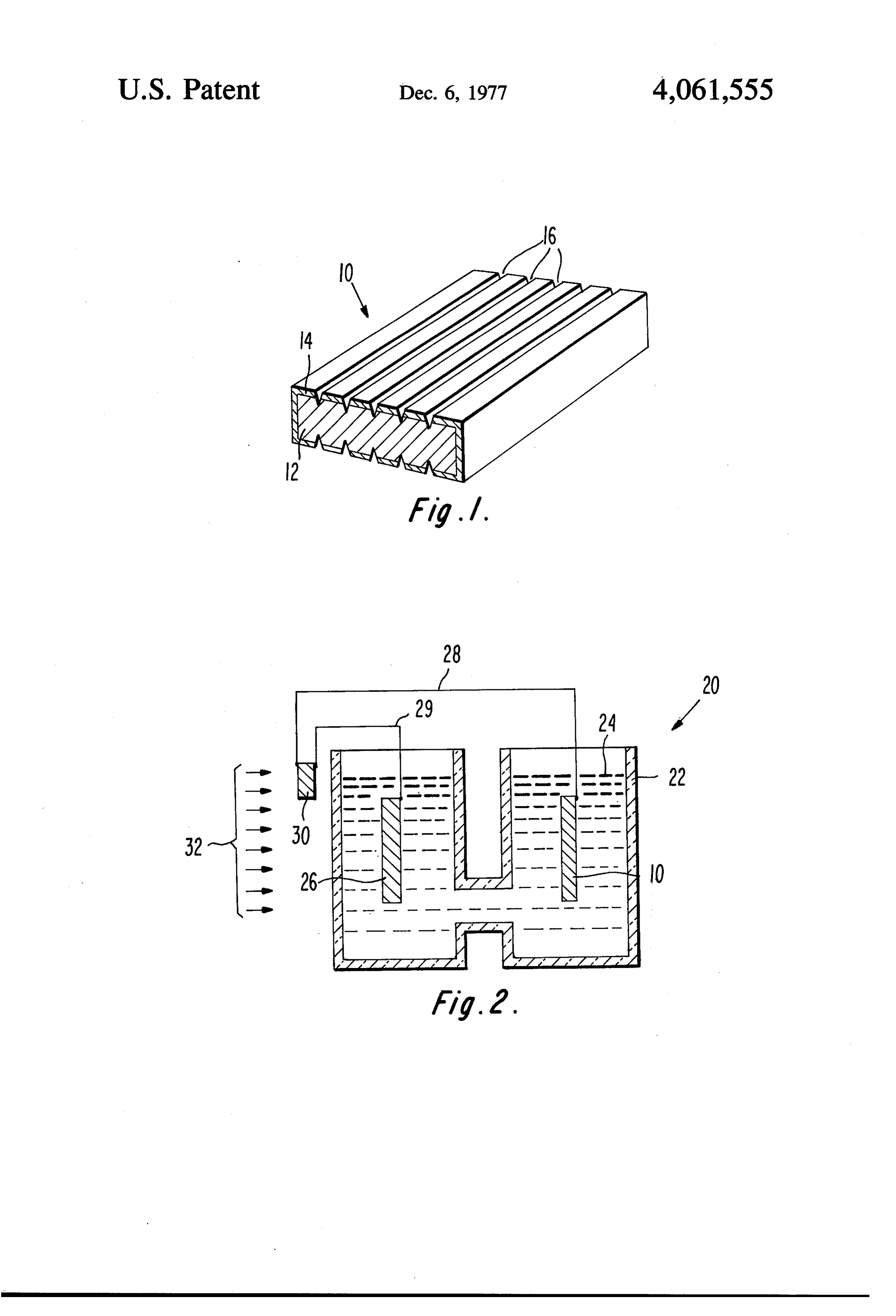
The present invention relates to a cathode which is furnace and heated in an oxygen atmosphere to a tem useful in a water photolysis apparatus and, more specifi perature of about 1000° C. for about 24 hours, forming cally, to a cathode which improves the efficiency of the the nickel oxide layer 14 on the substrate 12 surfaces. water photolysis apparatus. The grooves 16 are then formed in the nickel oxide The evolution of hydrogen and oxygen from a water layer 14 and the substrate 12 by mechanically scribing, photolysis apparatus is known. Water photolysis pro 10 for example, with a tungsten carbide edge, or by con duces a dissociation of water into hydrogen and oxygen ventional photolithographic and etching techniques. by the influence of light on at least one of a pair of The grooves 16 account for a very small portion of the semiconductor electrodes. The generated hydrogen can total cathode 10 surface area. The fabrication of the be burned as fuel. With the increasing concern for 15 cathode 10 is completed by etching a small portion of sources of energy, the water photolysis apparatus has the nickel oxide layer 14 and exposing the substrate 12 become of increased interest to those in the energy for the purpose of making electrical contact to the cath generation field. ode 10.
A typical prior art water photolysis apparatus in Referring to FIG. 2, the cathode 10 of the present invention is utilized in a water photolysis apparatus cludes a titanium dioxide (TiO2) anode and a platinum 20 designated cathode. This conventional water photolysis apparatus as 20. The water photolysis apparatus 20 has a maximum quantum yield of oxygen evolution in includes a housing 22 which contains therein an aqueous the range of 80 - 85%, but only about a 20% quantum basic electrolyte solution 24, i.e., water and a basic yield for hydrogen evolution using an applied bias volt electrolyte. It is well known to those in the chemical art age of about 0.9 volt. It has been determined that for that an electrolyte is a chemical compound which when molten or dissolved in certain solvents, usually water, proper operation the platinum cathode surface must be 25 will conduct an electric current. It is assumed for the between 5 to 50 times the area of the anode surface. The expense of a large platinum cathode and the low hydro purpose of describing the present invention that the gen yield in the conventional water photolysis appara droxide (NaOH)dissolved base electrolyte in the water is sodium hy tus contribute to its non-competitiveness as a source of 30 about 0.1 to 5.0 Normal, but other baseinelectrolytes at a concentration the range of hydrogen. Therefore, it would be most desirable to be employed, such as potassium hydroxide, as wellcan increase the cathode efficiency to make the water pho base salts, such as calcium carbonate. Also contained as in tolysis process more competitive as a means of generat the housing 22 and in contact with the solution 24 is the ing hydrogen fuel. cathode 10 of the present invention and an N type pho SUMMARY OF THE INVENTION 35 tocatalytic semiconductor anode 26. The anode 26 and A photolysis apparatus includes a housing containing 22. cathode 10 are spaced from one another in the housing an aqueous basic electrolyte solution. An anode and suchThe as anode is typically of a semiconductor material titanium dioxide (TiO2), also known as rutile.
cathode are situated in the housing and contact the A first wire 28 is in electrical contact with the cath solution. The cathode includes a nickel substrate and a ode 10, and a second wire 29 is in electrical contact with nickel oxide layer on said substrate surface. A plurality the anode 26. Both first and second wires 28 and 29 are of spaced apart grooves extend through said nickel in electrical contact with electrical biasing means 30, oxide layer and into said nickel substrate, thereby exwhich is thus in series with the cathode 10 and anode 26. posing limited areas of the nickel to said solution. For the purpose of describing the water photolysis BRIEF DESCRIPTION OF THE DRAWINGS 45 apparatus 20, the electrical biasing means 30 is a solar FIG. 1 is a cross-sectional perspective view of the cell. The solar cell 30 is a conventional solar cell, typi cally of silicon.
cathode of the present invention. When the anode 26 comes into electrical contact with FIG. 2 is a cross-sectional view of a water photolysis the cathode 10, through the first and second wires 28 apparatus utilizing the cathode of FIG. 1. 50 and 29, the resulting contact potential lowers the Fermi DETAILED DESCRIPTION OF THE level of the anode 26 to the level of the cathode 10 and INVENTION forms a Schottky barrier at the anode 26/solution 24 interface. The Schottky barrier at the anode 26/solution
Referring to FIG. 1, the cathode of the present inven 24 interface exists with or without the influence of elec tion, which is capable of being utilized in a water pho 55 tromagnetic radiation, i.e., light striking the anode 26. tolysis apparatus is designated as 10. The operation of In the operation of the water photolysis apparatus 20, the cathode 10 in a water photolysis apparatus will be radiation 32 is incident onto the anode 26, consequently discussed subsequently. at least a portion of the housing 22 is transparent to The cathode 10 includes a substrate 12 of nickel with radiation. Some of the photon energy of the incident a nickel oxide layer 14 on the surfaces of the substrateradiation 32 is absorbed by the photocatalytic semicon 12. The nickel oxide layer 14 is typically about 100 ductor anode 26 resulting in the generation of electron micrometers in thickness, and is nickel monoxide. A hole pairs. Another portion of the radiation 32 is inci plurality of spaced apart grooves 16 are in the oxide dent on the solar cell 30 resulting in the generation of a layer 14 and extend into the nickel substrate 12. These photovoltaic potential from the solar cell 30. With the grooves remove a small portion of the nickel oxide 65 generation of electron-hole pairs in the anode 26, an layer 14 exposing a portion of the substrate 12 so that electrochemical reaction occurs at the anode 26/solu the cathode 10 can be electrically contacted to other tion 24 interface resulting in the transfer of charge elements of the photolysis apparatus, subsequently de across the interface. More specifically, the generated
Page 4
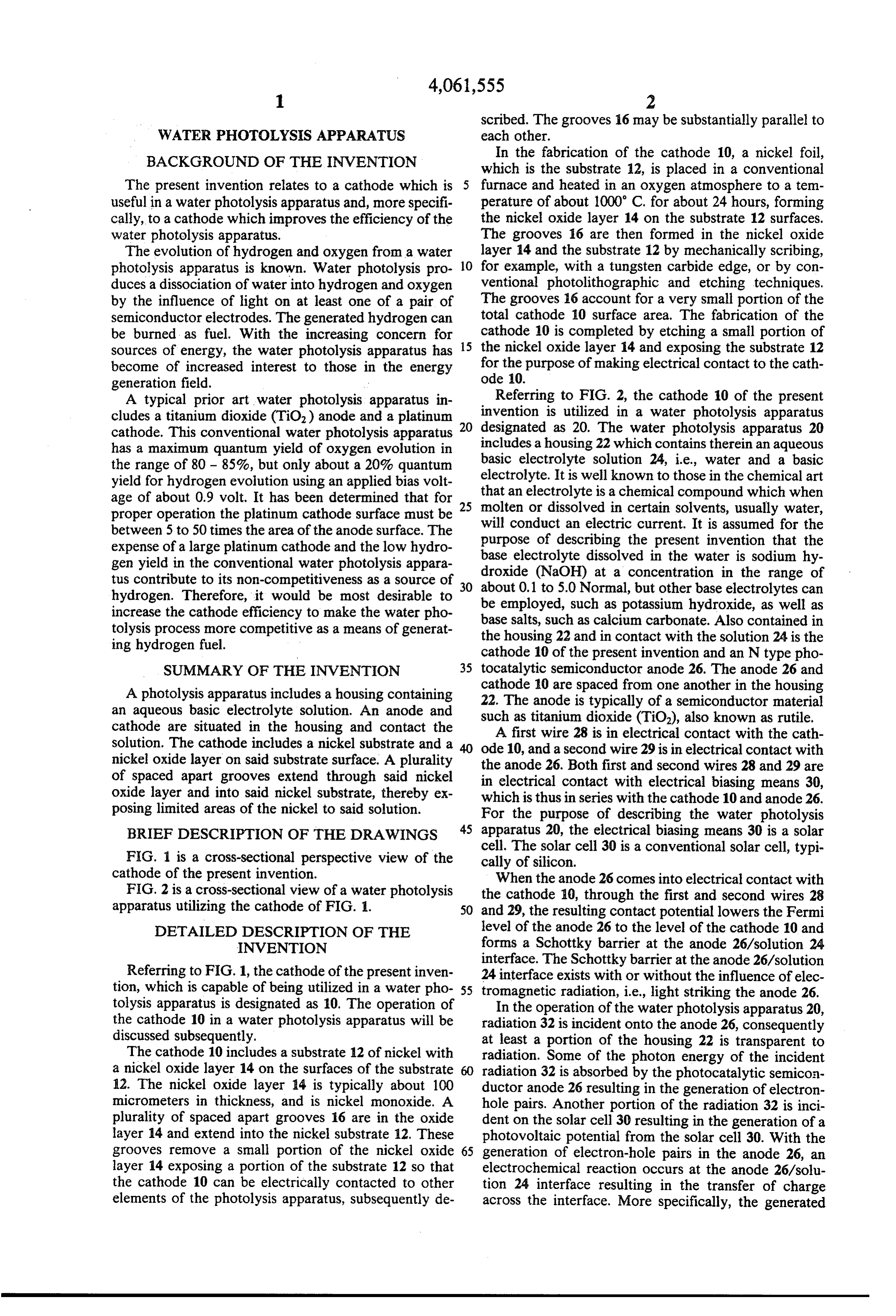
holes are attracted to the Schottky barrier at the anode current conversion into hydrogen gas. Furthermore, 26/solution 24 interface; resulting in the holes going with the cathode 10 biased to a voltage in the range of into the solution 24. These holes, being of a positive about 0.5 to 1 volt, the Fermi level of cathode 10 is charge, react with hydroxyl ions in the solution 24, about 0 to 0.15 volt above the potential needed for forming oxygen and water. This reaction is evidenced hydrogen gas evolution, which operates to increase by the following equation: hydrogen gas evolution. In the conventional photolysis 40H -- 4pt-O-2HO apparatus the cathode Fermi level is always less or about equal to the potential needed for hydrogen gas where "p +" is a hole. The generated electrons from the 10 of evolution even when the cathode is biased in the range anode 26 flow to the cathode 10 through the first and tional 0 to 10 volts, the probable reason being that conven second wires 28 and 29, requiring an increased voltage lower photolysis the anode apparatus apply a bias voltage only to potential and not to raise the cathode potential as the current passes through the solar cell 30. potential.
The electrons, which have travelled to the cathode 10, are then attracted to the solution 24 and leave the cath 15 It has been found that only about five grooves 16 are ode 10 at the cathode 10/solution 24 interface and react required on the surface of a nickel cathode 10, which is with water, forming hydrogen and hydroxyl ions, as of 1 cm2 in size, in order to drive an anode 26, 1 cm2 in size, evidenced by the following formula: titanium dioxide. In the conventional photolysis ap paratus the cathode has to be 5 to 50 times the size of the 4H2O -- 4e-2H2 + 4 OH anode. Furthermore, it has been observed that hydro 20 gen gas evolution occurs most efficiently from the where "e-' is an electron. Thus, hydrogen forming at grooves 16 when the grooves 16 are vertical, i.e., per the cathode 10 and oxygen forming at the anode 26 are pendicular to the surface of the solution 24, so that the the by-products of the electrochemical reactions taking hydrogen gas can depart freely toward the solution 24 place at the anode 26/solution 24 interface and cathode 25 surface where it is collected.
10/solution 24 interface. From the description of the Therefore, the cathode 10 of the present invention operation of apparatus 30, it is evident that a current provides hydrogen gas evolution in water photolysis flow through the anode 26, cathode 10 and solution 24 apparatus at a much higher efficiency than demon is initiated by the radiation 32 impinging on the anode strated by prior art cathodes.
26. The current through the anode 26, cathode 10 and 30 We claim:
first and second wires 28 and 29 is the result of electron 1. A cathode capable of being utilized in a photolysis flow, while the current is carried through the solution apparatus comprising:
24 back to the anode 26 by ion flow. a nickel substrate; and
The voltage bias potential of the solar cell 30 serves a nickel monoxide layer on said nickel substrate with the purpose of raising the cathode 10 voltage potential 35 a plurality of spaced apart grooves, said grooves and also of lowering the Fermi level of the anode 26. extending through said nickel oxide layer and into Specifically, the solar cell 30 raises the potential of the said nickel substrate.
cathode 10 to an operating range of about 0.5 to 1.0 2. The cathode in accordance with claim 1 wherein volt, which is about 0.15 to 0.3 volt above the potential said nickel monoxide layer is about 100 micrometers in of the cathode 10 if it were unbiased. This increase in thickness.
cathode 10 potential is hereinafter referred to as an 3. A photolysis apparatus comprising: over-voltage. The over-voltage applied to cathode 10 a housing;
raises the potential of the cathode 10 to a higher poten an aqueous basic electrolyte solution in said housing; tial level than needed for the evolution of hydrogen gas. a photocatalytic semiconductor anode in said housing As was previously stated, prior art water photolysis and contacting said solution; apparatus have a maximum quantum yield for hydrogen 45 a cathode in said housing and contacting said solu evolution at the cathode of about 20%. The advantage tion, wherein said cathode is comprised of a nickel of the cathode 10 of the present invention is that it substrate and a nickel monoxide layer on said shows a higher efficiency in hydrogen evolution, which nickel substrate surfaces, and further having a plu is a consequence of an increase in the utilization of 50 rality of spaced apart grooves, said grooves extend circuit electrons in the cathode 10 for the generation of ing through said nickel oxide layer and exposing hydrogen. Measurements from the cathode 10 have said nickel substrate; and shown approximately 100% current conversion effi an electrical biasing means in series with said anode ciency in hydrogen generation with an applied solar cell and cathode.
30 bias potential from 0.5 to 1.0 volt. It is believed that 55 4. The photolysis apparatus in accordance with claim the increase in hydrogen evolution is due to the nature 3 wherein said solution is of water and sodium hydrox of the cathode 10 and also is a result of the over-voltage ide, with said sodium hydroxide at a concentration in applied to the cathode 10. Apparently, the nickel oxide the range of about 0.1 to 5 Normal.
layer 14 of the cathode 10 is very tough and strongly 5. The photolysis apparatus in accordance with claim adheres to the substrate 12, thereby insulating the sub 3 wherein at least a portion of said housing is transpar strate 12 from the electrolyte in the solution 24. Thus, ent to radiation.
the flow of electrons leaving the cathode 10 and going 6. The photolysis apparatus in accordance with claim into the solution 24 is restricted to that portion of sub 3 wherein said biasing means is a solar cell. strate 12 exposed by grooves 16 to the solution 24. The 7. The photolysis apparatus in accordance with claim exposed portions of substrate 12 operate as high density 65 6 wherein said solar cell is capable of biasing said cath catalytic active centers for hydrogen evolution. The ode in the range of about se
restrictions in electron flow results in a more efficient
Provenance
- Collection
- Cited prior art
- Original PDF
- patentimages.storage.googleapis.com →
- Filed
- 1977-01-19
- Pages
- 4
- Method
- pdftotext (the PDF's own text layer) + pdftoppm 300dpi page scans
- Source
- Google Patents bibliographic record
- Granted
- 1977-12-06
- Inventors
- Kazuo Miyatani; Isao Sato; RCA Corp
- Transcribed from
- patentimages.storage.googleapis.com →