patent · US3977952
Process for decomposing carbon-containing compounds
31 August 1976
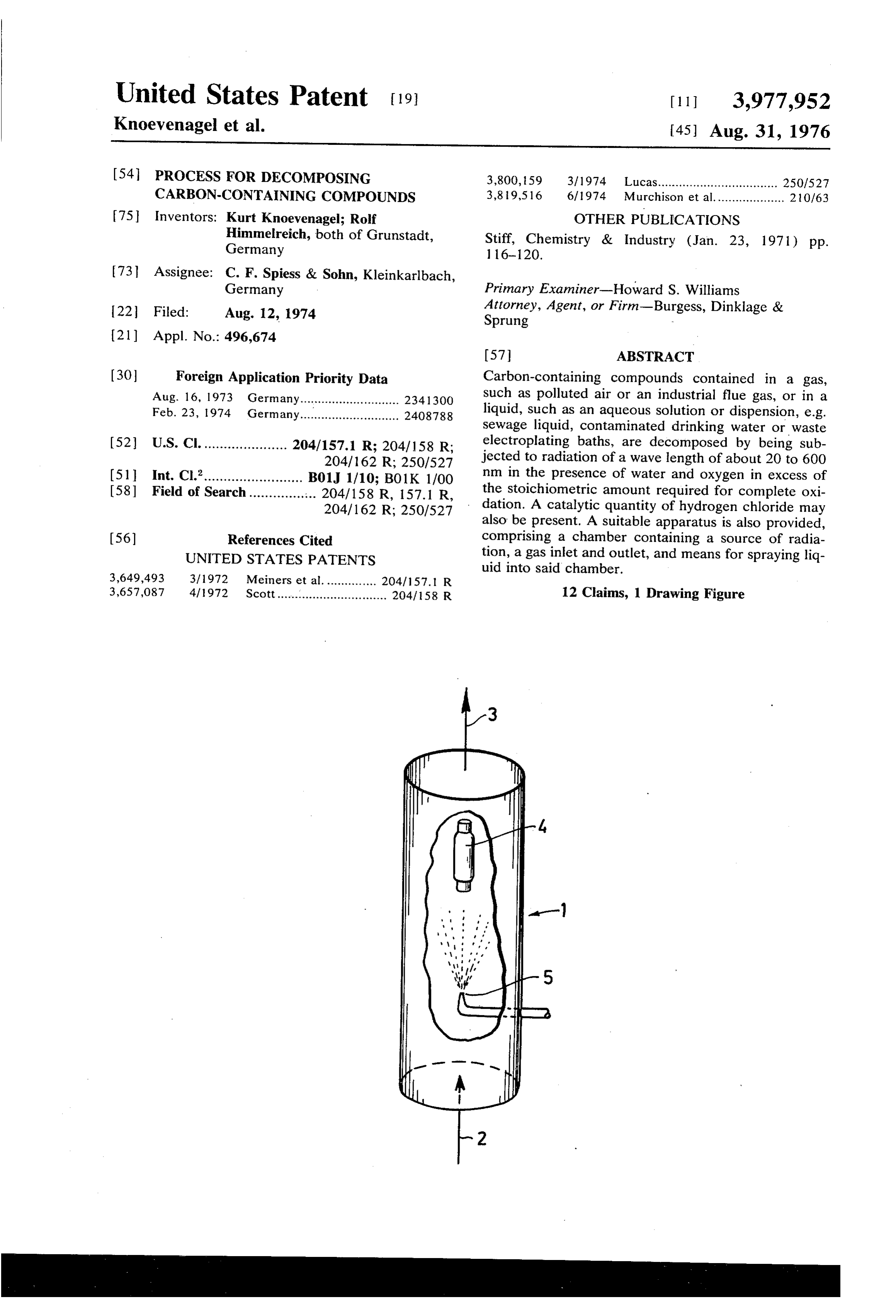
Page 1 — bibliographic record
United States Patent (19) 11, 3,977,952 Knoevenagel et al. (45) Aug. 31, 1976 54 PROCESS FOR DECOMPOSING 3,800, 159 3/1974 Lucas.................................. 250/527 CARBON-CONTAINING COMPOUNDS 3,89,516 6/1974 Murchison et al.................... 21 Of 63 75 Inventors: Kurt Knoevenagel; Rolf OTHER PUBLICATIONS Himmelreich, both of Grunstadt, Stiff, Chemistry & Industry (Jan. 23, 1971) pp. Germany 1 16-120.
73 Assignee: C. F. Spiess & Sohn, Kleinkarlbach,
Germany Primary Examiner-Howard S. Williams 22 Filed: Aug. 12, 1974 Attorney, Agent, or Firm-Burgess, Dinklage & Sprung
(30) Foreign Application Priority Data Carbon-containing compounds contained in a gas, Aug. 16, 1973 Germany............................ 234 13 OO such as polluted air or an industrial flue gas, or in a Feb. 23, 1974 Germany............................ 2408788 liquid, such as an aqueous solution or dispension, e.g. sewage liquid, contaminated drinking water or waste (52) U.S. Cl...................... 204/157.1 R; 204/158 R; electroplating baths, are decomposed by being sub 204/162 R; 250/527 jected to radiation of a wave length of about 20 to 600 (51 Int. Cl.'......................... B01J 1/10; B01K 1/OO nm in the presence of water and oxygen in excess of 58 Field of Search.............. ... 204/158 R, 157. 1 R, the stoichiometric amount required for complete oxi 204/162 R; 250/527 dation. A catalytic quantity of hydrogen chloride may also be present. A suitable apparatus is also provided, (56) References Cited comprising a chamber containing a source of radia UNITED STATES PATENTS tion, a gas inlet and outlet, and means for spraying liq uid into said chamber.
3,649,493 3/1972 Meiners et al............... 2041157. R 3,657,087 4/1972 Scott............................... 204/158 R 12 Claims, 1 Drawing Figure
Page 2
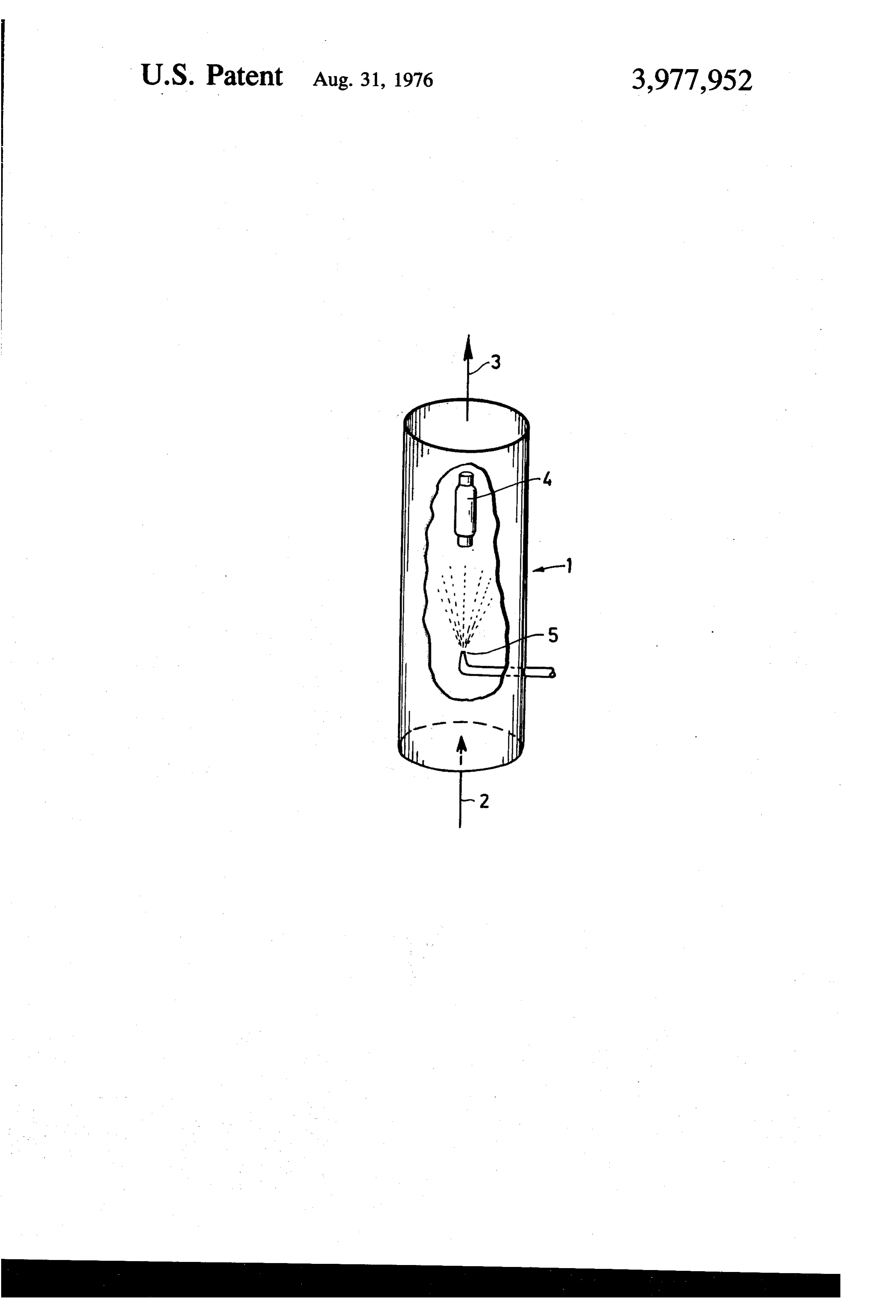
Drawing sheet — no readable text.
Page 3
chemistry is not necessary since all organic compounds
PROCESS FOR DECOMPOSING can be decomposed according to the process of the CARBON-CONTAINING COMPOUNDS invention. Thus, while not fully identifiable, there can reliably and quickly be decomposed in accordance with
The present invention relates to a process and appa the invention the decomposition products of albumi ratus for decomposing unwanted carbon-containing nous substances, which lead to strong objectionable compounds such as those present as contaminants in odors upon storage, e.g. raw materials for and residues gases and liquids. of tanneries, hide- and carcass-treating plants. In accordance with the invention there is provided a The same applies to air which still contains small process for the decomposition of one or more carbon O quantities of foul-smelling, especially unsaturated, al containing compounds comprising exposing to radia dehydes, e.g.
tion of a wave length of about 20 to 600 nm a mixture nols. Especiallyacrolein, mercaptans, isonitriles or phe advantageously, according to the pro of said compounds with water and oxygen in excess.
The process according to the invention is capable of cess of the invention, the stale air of a closed room can the broadest application. Quite generally, it is suitable like, and of 15 be freed cigarette smoke, small dust particles and the sterilized by pumping the air through a humid for the decomposition of materials usually designated ifier under irradiation. In the same manner, one can as organic, but also for the decomposition of other also purify presumable fresh air which for some reason carbon-containing compounds such as, for example, still contains organic substances or germs, before it is cyanides, cyanates, thiocyanates, and their complexes.
The carbon-containing compounds to be decomposed 20 of supplied to its final destination. In such processes it is special advantage that not only are germs killed, but according to the invention can be dispersed or homoge their organic substance is decomposed so that the latter neously distributed in gaseous or liquid phase.
The process according to the invention is especially can nowhich longer serve as a culture medium for those suitable for the removal of the carbon-containing com germs were not destroyed. pounds if they are present in only small quantities in the 25 In the simplest case, a commercially available humid medium to be cleaned, but are especially annoying ifier can be used to conduct the process according to there because of their toxicity, their unpleasant odor or the invention, to which a strong light source is attached for irradiation of the humidified air.
their color.
In the gaseous phase, the carbon-containing com Also air conditioning plants, in which the air is nor pounds to be decomposed can be distributed homoge 30 mally filtered and brought to predetermined tempera nously as gases, carbon dioxide, air or hydrogen. In ture and relative humidity, can be used for conducting water vapor, air or hydrogen, the gas or gas mixture to the process according to the invention if they are addi be cleaned already contains one reactant necessary for tionally equipped with a source of radiation so that the the decomposition. moistened air in the air conditioner is additionally irra The carbon-containing compounds to be decom 35 diated with light of a suitable wave length. posed can also be present in the gas as a dispersed Also industrial waste or flue gases which still contain liquid or solid phase; for example fogs or smokes can be environment-polluting carbon-containing compounds treated, e.g. carbon black. Also fogs or aerosols in can be purified according to the process of the inven which the impurities to be decomposed and the water tion, especially since, as a rule, they already contain the necessary for the reaction are already present as dis 40 reactants, oxygen and water vapor. The temperature in persed liquids or as gases, or smoke with inert inorganic the gas phase is not critical and can amount to several ingredients, can be successfully treated according to hundred degrees Centigrade, especially since elevated the invention. Insofar as the gases, fogs or smokes to be temperatures also increase the speed of the decomposi treated do not already contain oxygen and water in the tion.
form of water vapor or fine droplets, these reaction 45 Liquid phase processing is also feasible, whether in components must be added before the irradiation. the form of aqueous solutions, emulsions or suspen It is necessary, that water vapor and hydrogen are sions. Here, also, the process according to the inven present in excess in order to obtain a satisfactory rate tion is especially effective even if polluting impurities of decomposition. For oxygen "excess' means an are present only in very small quantity, but are espe amount in excess of the stoichiometric quantity re 50 cially annoying because of their toxicity or their taste, quired for the complete oxidation of the carbon-con as is the case with cyanide- or oil-containing ground taining substances. The water vapor must be present at water. The process according to the invention also is of least in catalytic quantities; preferably, the treatment great importance for the additional purification of liq takes place in damp or aqueous systems. uid waste, especially such as has already been exten Water vapor and oxygen do not have to be present 55 sively prepurified by the usual means. Waste is em originally in a contaminated gas to be purified. Oxygen ployed herein in its broadest sense. For example it can be added in pure form or desirably as atmospheric includes spent impregnating emulsions in the textile oxygen, i.e. air, before the treatment according to the industry, oil-containing waters such as spent cutting invention. Water vapor can be added to the gas through oils and drilling oils, acid sludges, sewage from purifica spraying or atomizing of water or as such. In certain 60 tion-, synthetic fiber, cotton, glue-, soap-, starch-, rub cases, sufficient moistening is achieved if the gases are ber- and sugar-making plants, from dye works, wool sucked or pumped through a damp filter. Preferably, laundries, galvanizing plants, tanneries, slaughter the gas mixture to be treated is saturated with water houses, tallow melting plants, and also sewage sludges vapor. which contain impurities in higher concentrations. Just The process according to the invention is especially 65 as when decomposing the carbon-containing com suitable for the purification of foul-smelling gases or pounds in the gaseous phase, when decomposing them gases containing small quantities of gaseous organic in the liquid phase their chemical nature is not impor environmental pollutants. an exact knowledge of their tant, since all the organic substances are decomposed.
Page 4
Examples of organic compounds decomposable ac For the radiation by light of a wave length of about cording to the invention are: polyamides such as wool, 20 to 600 nm there can be used a radiating tube such as casein, natural silk, nylon-6, nylon-66, phenol resins a mercury lamp, or in the simplest case even sunlight, such as phenol-formaldehyde synthetic resins in the whose intensity can be increased for the reaction to be form of resol, resitol, resit and novolak. Silicone such 5 conducted, through concave mirrors or other reflec as methyl silicone (silicone oil), methyl phenyl silicone tors. Additionally, it has been found that the decompo (silicone resin), as well as methyl polysiloxanes and sition reaction according to the process of the inven boron-siloxane-elastomers (silicone rubber), polyethy tion is improved if catalytic quantities of a chlorine lene, polypropylene, polyvinylchloride, polytetrafluo compound, especially hydrogen chloride, are added to roethylene, polymethacrylic acid ester such as poly 10 the mixture to be treated. For the treatment in aqueous methacrylic acid methyl ester, -ethyl ester, -propyl phase, this function is also fulfilled by chlorine ions. ester, etc. This catalytic effect can be detected especially clearly Monomeric organic compounds which can be de in the decomposition of carbon-containing compounds composed successfully are, for example: esters such as which are rich in hydrogen. For these reasons it is desir ethyl acetate and ethyl levulinate, alcohols such as 15 able to add a small amount of hydrochloric acid to the methanol and ethanol, aromatic compounds such as reaction mixture from the outset, if hydrochloric acid is benzene, toluene, nitrobenzene and fluorenes, insecti not formed during the reaction itself as it is in the de cides such as DDT and hexacholorocyclohexane, alde composition of chlorinated hydrocarbons. It is desir hydes such as formaldehyde, nitriles such as acetonit able to keep the concentration of the hydrochloric acid rile, and isonitries such as methyl isocyanide. 20 at a predetermined level during the reaction through A special advantage of the process according to the known techniques. The desired pH-value is dependent invention resides in the fact that normally stable cyano on the characteristic of the substance and must be complexes can also be destroyed and rendered harm determined empirically in individual cases. If, accord less while at the same time the metal contained as the 25 ing to the process of the invention, the carbon-contain center atom in the complex is precipitated, in elemen ing compounds are exposed to the effect of oxygen or tary form if it is a noble metal and as oxide or hydroxide oxygen-containing gases by radiation with ultraviolet if it is a base metal. Such complexes include, for exam light, the compounds dispersed therein are subjected to ple the hexacyanoferrate complex of Berlin blue. This photo-oxidation. The carbon content is converted into can be utilized to substantial advantage in cyanide carbon dioxide which escapes after saturation of the leaching plants for the recovery of gold and silver. Gold 30 aqueous medium. The nitrogen is set free as ammonia and silver separate out in flaky elementary form and or nitrate nitrogen, depending on its initial combined can be filtered out. form. For example, the nitrogen of the so-called pseu The applicability of the process according to the do-halogens is converted into ammonia. Sulfur-con invention is substantially independent of the physical taining organic compounds such as foul-smelling mer state of the substances to be decomposed, i.e. they can 35 captains and thioethers, as a rule, evolve sulfur dioxide. be present in solution, emulsified or suspended. The The general applicability of the process according to degree of dispersion can be of importance for the speed the invention for the decomposition of all organic sub of the decomposing reaction; for finer dispersion of the stances in water and sewage is proven by the fact that waste material the use of one of the usual detergents is elementary carbon is also completely converted into recommended, such as, for example, a wetting agent or 40 carbon dioxide. This reaction occurs as well with pow an emulsifier. However, it must be borne in mind that dered charcoal as with diamond dust. the detergent, insofar as it is of an organic nature, is The invention will be further described with refer also subject to the decomposition reaction and must ence to the drawing wherein the FIGURE shows a therefore be replaced in subsequent cycles. To obtain a suitable device for conducting the process. good dispersion, inert inorganic substances can also be 45 Referring now more particularly to the drawing, used such as, for example, pulverized talc, silicic acid, there is shown a hollow cylindrical reaction chamber 1 attaclay, and the like, which remain after the decompo which can be coated with a reflecting layer. A gaseous sition of the waste materials and thus can be used again. mixture which already contains oxygen and water The liquid phase decomposition according to the vapor is introduced through the feed line 2, passes the invention can also be carried out over a very broad 50 light source 4 and leaves the reaction chamber 1 temperature range; since it proceeds more rapidly at through the outlet 3. If the gas mixtures to be reacted to higher temperatures, however, it is preferred to work at not contain enough water, water can be sprayed in as a elevated temperature. A temperature range between fine jet at 5. With the same apparatus aqueous media about 20° and 100°C, preferably between about 40 55 can also be reacted according to the process of the and 90°C, has proven favorable. In individual cases, the invention. The residual water or aqueous medium can reaction can also be carried out under pressure with the be collected below the inlet 2 and optionally can be use of water vapor, so that still higher temperatures are recycled to the spray device 5. possible. The process according to the invention will be ex In order fully to utilize the intensity of the irradiation, 60 plained in further detail with the help of the following it is recommended to expose the aqueous media to be examples. It is unimportant whether the atmospheric. treated in the form of thin layers or fine droplets. For oxygen, as in the examples, is led through the reaction the removal of environmental pollutants from contami mixture or whether the reaction mixture is brought into nated ground- and drinking water, in many cases the close contact with the atmospheric oxygen over a oxygen dissolved in water is already sufficient for the 65 larger surface. In practice, it is not necessary that the decomposition according to the process of the inven oxygen used is free of carbon dioxide. However, in the tion during the irradiation. Otherwise, the required examples a carbon dioxide-free air current was used in oxygen can be added in pure form or preferably as order to prove the decomposition qualitatively and atmospheric oxygen, i.e. air. quantitatively. Since several different reactions take
Page 5
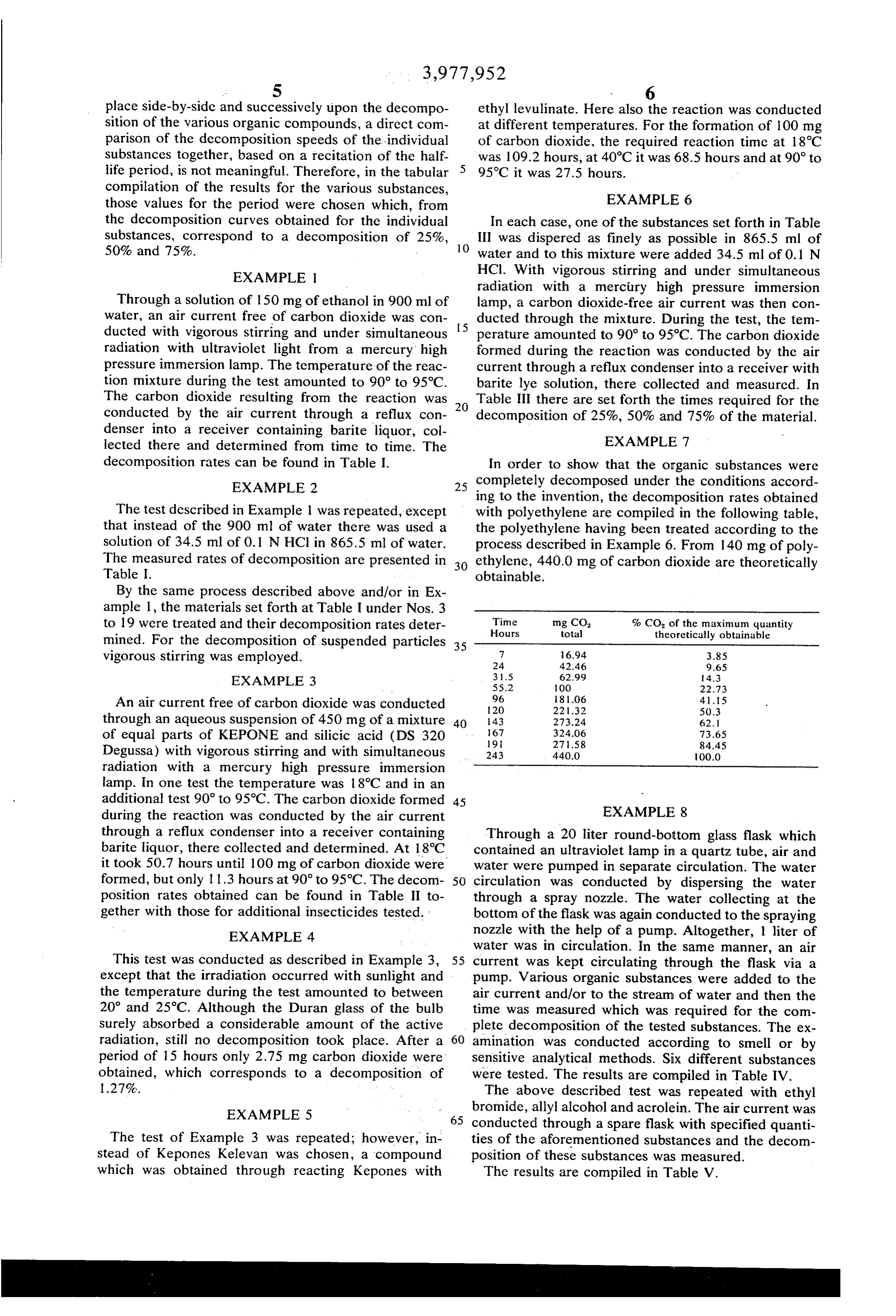
place side-by-side and successively upon the decompo ethyl levulinate. Here also the reaction was conducted sition of the various organic compounds, a direct com at different temperatures. For the formation of 100 mg parison of the decomposition speeds of the individual of carbon dioxide, the required reaction time at 18°C substances together, based on a recitation of the half was 109.2 hours, at 40°C it was 68.5 hours and at 90 to life period, is not meaningful. Therefore, in the tabular 5 95°C it was 27.5 hours.
compilation of the results for the various substances, those values for the period were chosen which, from EXAMPLE 6 the decomposition curves obtained for the individual In each case, one of the substances set forth in Table substances, correspond to a decomposition of 25%, 10 III was dispered as finely as possible in 865.5 ml of 50% and 75%. - water and to this mixture were added 34.5 ml of 0.1 N EXAMPLE 1 HCl. With vigorous stirring and under simultaneous radiation with a mercury high pressure immersion
Through a solution of 150 mg of ethanol in 900 ml of lamp, a carbon dioxide-free air current was then con water, an air current free of carbon dioxide was con ducted through the mixture. During the test, the tem ducted with vigorous stirring and under simultaneous 5 perature amounted to 90° to 95°C. The carbon dioxide radiation with ultraviolet light from a mercury high formed during the reaction was conducted by the air pressure immersion lamp. The temperature of the reac current through a reflux condenser into a receiver with tion mixture during the test amounted to 90° to 95°C. barite lye solution, there collected and measured. In The carbon dioxide resulting from the reaction was 20 Table III there are set forth the times required for the conducted by the air current through a reflux con decomposition of 25%, 50% and 75% of the material. denser into a receiver containing barite liquor, col EXAMPLE 7 lected there and determined from time to time. The decomposition rates can be found in Table I. In order to show that the organic substances were EXAMPLE 2 25 completely decomposed under the conditions accord ing to the invention, the decomposition rates obtained
The test described in Example 1 was repeated, except with polyethylene are compiled in the following table, that instead of the 900 ml of water there was used a the polyethylene having been treated according to the solution of 34.5 ml of O. 1 NHCl in 865.5 ml of water. process described in Example 6. From 140 mg of poly The measured rates of decomposition are presented in 30 ethylene, 440.0 mg of carbon dioxide are theoretically Table I. obtainable.
By the same process described above and/or in Ex ample 1, the materials set forth at Table I under Nos. 3 to 19 were treated and their decomposition rates deter Time
Hours
total % CO, of the maximum quantity theoretically obtainable mined. For the decomposition of suspended particles 35 vigorous stirring was employed. 7
EXAMPLE 3 31.5 62.99 4.3
An air current free of carbon dioxide was conducted 96 81.06 41.5
through an aqueous suspension of 450 mg of a mixture 40 143 273.24. 62. of equal parts of KEPONE and silicic acid (DS 320 167
Degussa) with vigorous stirring and with simultaneous 243 4400 100.0 radiation with a mercury high pressure immersion lamp. In one test the temperature was 18°C and in an additional test 90° to 95°C. The carbon dioxide formed 45 during the reaction was conducted by the air current EXAMPLE 8 through a reflux condenser into a receiver containing Through a 20 liter round-bottom glass flask which barite liquor, there collected and determined. At 18°C contained an ultraviolet lamp in a quartz tube, air and it took 50.7 hours until 100 mg of carbon dioxide were water were pumped in separate circulation. The water formed, but only 1 1.3 hours at 90° to 95°C. The decom 50 circulation was conducted by dispersing the water position rates obtained can be found in Table II to through a spray nozzle. The water collecting at the gether with those for additional insecticides tested. bottom of the flask was again conducted to the spraying EXAMPLE 4 nozzle with the help of a pump. Altogether, 1 liter of water was in circulation. In the same manner, an air
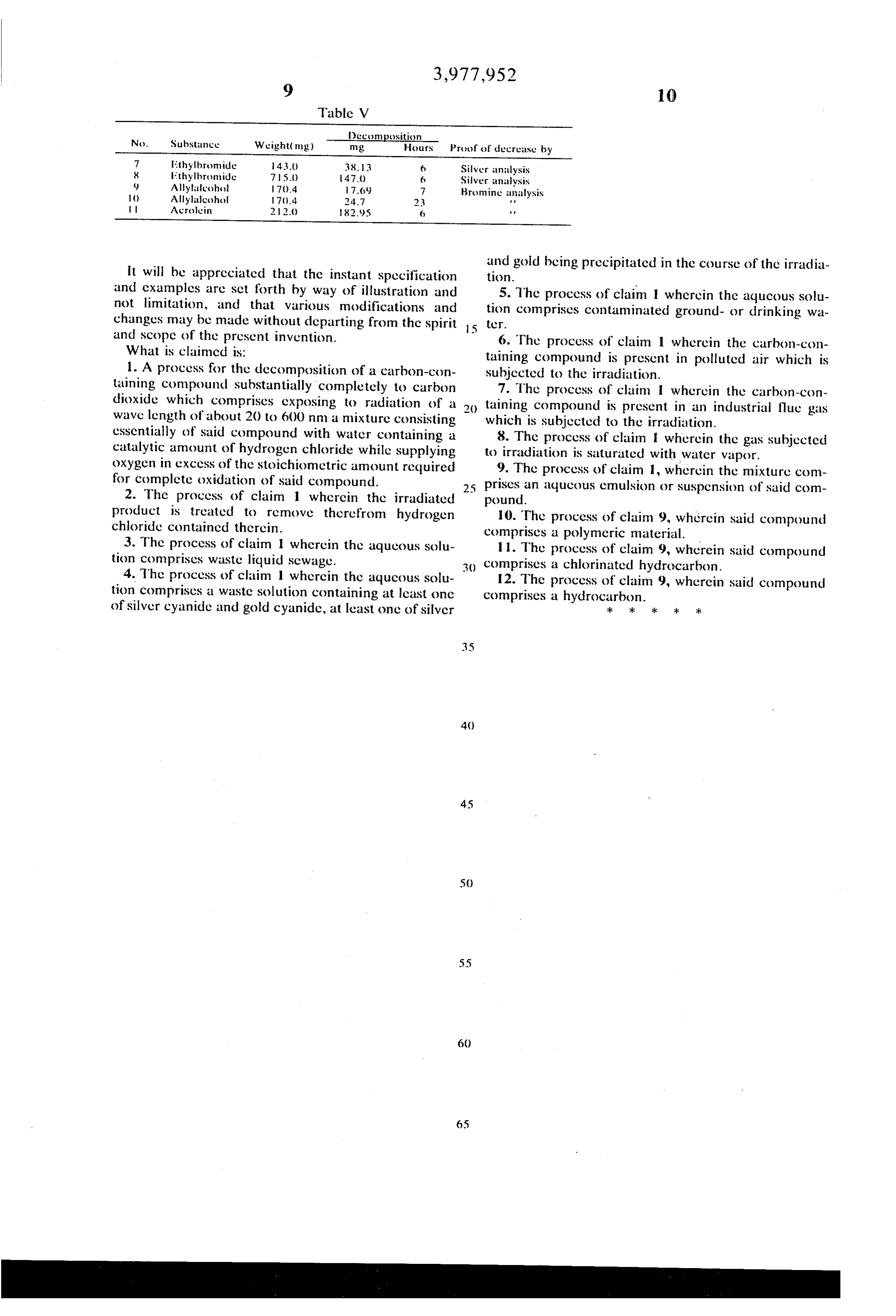
This test was conducted as described in Example 3, 55 current was kept circulating through the flask via a except that the irradiation occurred with sunlight and pump. Various organic substances were added to the the temperature during the test amounted to between air current and/or to the stream of water and then the 20 and 25°C. Although the Duran glass of the bulb time was measured which was required for the com surely absorbed a considerable amount of the active plete decomposition of the tested substances. The ex radiation, still no decomposition took place. After a 60 amination was conducted according to smell or by period of 15 hours only 2.75 mg carbon dioxide were sensitive analytical methods. Six different substances obtained, which corresponds to a decomposition of were tested. The results are compiled in Table IV. 1.27%. The above described test was repeated with ethyl
bromide, alcohol and acrolein. The air current was through a spare flask with specified quanti
The test of Example 3 was repeated; however, in ties of the aforementioned substances and the decom stead of Kepones Kelevan was chosen, a compound position of these substances was measured. which was obtained through reacting Kepones with The results are compiled in Table V.
Page 6
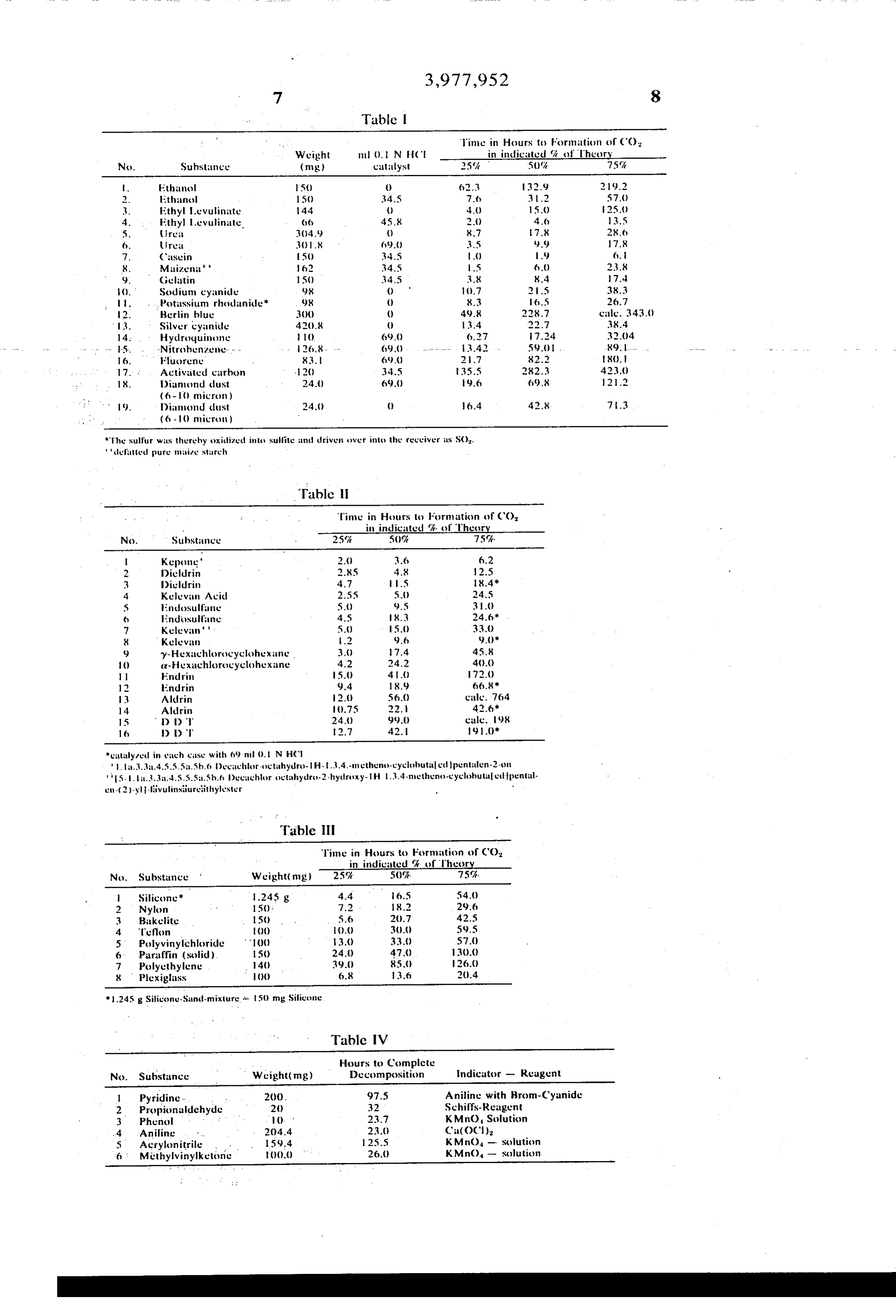
Table I line in Hours to Formation of CO
Weight (). N (' in indicated 9 of Theory
No. Subst:unce (mg) catalyst 25% 50% 75% Ethanol 15) () (2.3 32.9 29.2 2 Ethan 5() 34.5 7. 3.2 57.() 3. Ethyl Levulinate 44 () 4.() 15.) 25.() 4. Ethyl levulinate. - 45.8 2.() 46 3.5 5. rea 34.9 () 8.7 7.8 28. 6. rea 3().8 fy9.) 3.5 9.9 7.8 7. Casein 5() 34.5 t() . 6. 8. Maizena' ' f 34.5 5 f) 23.8 9. Gclatin 15) 34.5 38 8.4 7.4 (). Sodium cyanice 98 () ' ().7 2.5 38.3 1 , . Potassium rhodanide" 98 () 8.3 . 26.7 2. Berlin blue 3)() () 49.8 228.7 calc. 343.0 3. Silver cyanicle 42(),8 () 134 22.7 38.4 14. Hydroquinone () 69.() 6.27 7.24 32.04 - 15, , -Nitrobenzeic-a- - 26.8. -- (9) ... ...- . 13.42 59) 89. . . . - 16. Fluorene 83. 6. 2.7 82. 8(). 17. . . Activated carbon .2) 34.5 35.5 282.3 423.() 18. i)iamond dust 24.() 69.) 9.6 (9.8 21.2
s diond cust 24.() () 6.4 42.8 7.3
the sulfur was thereby oxidized inti sulfite and driven over into the receiver as S().
"" (luted pure maize starch
Table II in in Hours to Formation of CO, in indicated 7 of Theory
Ny. Suhstance 25% 50% 75%, Kepone' 2. 3. 6.2 2 Dieldrin 2.85 48 2.5 3 Diuridrin 4.7 5 8.4% 4 Kelevan Acid 2.55 5.) 245 5 In closulfane 5.) 9.5 3 () End sulfine 4S 83 24.f* 7 Kulevan'' 5.) 5.() 33.) 8 Kelevan 2 9.6 9.()* 9 y-Hexachlorocyclohexane 3.) 74 45.8 () cr-hexachlorocyclohexane 4.2 24.2 4().) 11 Hindrin 5.() 4.() 72.() 12 Endrin 9.4 18.9 66.8 3. Aldrin 2.() 56.() cil. 764 4 Altrin ().75 22. 42.6* 15 D ) ' 24.) 99.) calc. 98 lf DE) 2.7 42. 9.0 *citaly reti in each case with 69 m (). Nic" '1. a.3.3.4.5.5.5:1.5h.6 becauhtorictahydro-1 h. t.3.4.-Inc then-cyclohu tact pentalen-2-on - 5h.f. ibecachlor setahydro-2-hydroxy-1H I.i.4-nic then-cyclohu tact pental en-(2) yi-Iivulinsiureithylester -
Table III
Time in hours to Formation of CO.
in indicated % of Theory
N(). Substance ' Weight(mg) 25% 50%. 75%. Silican 1.245 g 4.4 6.5 54.() 2 Nylon 15): 7.2 82 29.6 3 Bakelite 15() 5.6 2).7 42.5 4 Teflon t()) ().() 3).() 59.5 5 Polyvinylchloride ()() 3.0 33.() 57.() 6 Paraffin (solid). 5() 24.) 47.() 3().() 7 Polyethylene 14() 39.) 85.) 26.() 8 Plexiglass ()() 6.8 3.6 2().4 * 1.245 g Silicon-Santi-mixture. - 50 mg Silicone
Table IV
Hours to Complcte
No. Substance Weight(mg) Dccomposition indicator - Ragent 1 Pyridine. : 200. 97.5 Aniline with Brom-Cyanide 2 Propionaldehyde 2) 32 Schiffs-Reagent 3 Phenol . . . . .. (). ' 23.7 KMnO Solution 4 Aniline 2044 23.) Ca(OCl), 5 Acrylonitriie . . . 159.4 1255 KMnO - solution 6 Methylvinylketone ()().() 2.() KMn() - solution
Page 7
Table V
Dccomposition
No. Suhstance: Weight(ing) mg Hours Proof of decrease by 7 Ethylbrmide 43.() 38.3 6 Silver analysis 8 Ethylhronide 75.() 47.() f Silver analysis t Allylalcohol IT)4 7.6) 7 Bromine analysis
It will be appreciated that the instant specification and gold being precipitated in the course of the irradia tion.
and examples are set forth by way of illustration and 5. The process of claim 1 wherein the aqucous solu not limitation, and that various modifications and tion comprises contaminated ground- or drinking wa changes may be made without departing from the spirit ter.
and scope of the present invention. 6. The process of claim 1 wherein the carbon-con What is claimcd is: taining compound is present in polluted air which is 1. A process for the decomposition of a carbon-con subjected to the irradiation. taining compound substantially completely to carbon 7. The process of claim 1 wherein the carbon-con dioxide which comprises exposing to radiation of a taining compound is present in an industrial flue gas wave length of about 20 to 600 nm a mixture consisting which is subjected to the irradiation. essentially of said compound with water containing a 8. The process of claim 1 wherein the gas subjected catalytic amount of hydrogen chloride while supplying to irradiation is saturated with water vapor. oxygen in excess of the stoichiometric amount required 9. The process of claim 1, wherein the mixture com for complete oxidation of said compound. prises an aqueous emulsion or suspension of said com 2. The process of claim 1 wherein the irradiated pound.
product is treated to remove therefrom hydrogen 10. The process of claim 9, wherein said compound chloride contained therein. comprises a polymeric material. 3. The process of claim 1 wherein the aqueous solu 11. The process of claim 9, wherein said compound tion comprises waste liquid sewage. comprises a chlorinated hydrocarbon. 4. The process of claim 1 wherein the aqueous solu 12. The process of claim 9, wherein said compound tion comprises a waste solution containing at least one comprises a hydrocarbon.
of silver cyanide and gold cyanide, at least one of silver k ck ck ck ck
Provenance
- Collection
- Cited prior art
- Original PDF
- patentimages.storage.googleapis.com →
- Filed
- 1974-08-12
- Pages
- 7
- Method
- pdftotext (the PDF's own text layer) + pdftoppm 300dpi page scans
- Source
- Google Patents bibliographic record
- Granted
- 1976-08-31
- Inventors
- Kurt Knoevenagel; Rolf Himmelreich; CF Spiess and Sohn GmbH and Co
- Transcribed from
- patentimages.storage.googleapis.com →