patent · US4011148
Method of electrolysis
8 March 1977
Page 1 — bibliographic record
United States Patent to 11 4,011,148 Goudal 45
54 METHOD OF ELECTROLYSIS 58 Field of Search .................................... 204/129 (75) Inventor: Philippe Goudal, Bures sur Yvette, 56) References Cited 73) Assignee: Electricite de France (Service FOREIGN PATENTS OR APPLICATIONS National), Paris, France 119,885 12/1918 United Kingdom ............... 2041129 22 Filed: Jan. 14, 1976 Primary Examiner-R. L. Andrew 21 Appl. No.: 648,959 Attorney, Agent, or Firm-Michael Klotz Related U.S. Application Data 57 ABSTRACT 63 Continuation-in-part of Ser. No. 569,773, April 21 A method of electrolysis is described in which the elec 1975, abandoned. s trolysis is powered by electricity generated from the 8 8 A energy released by the reaction between at least one of 30 Foreign Application Priority Data the elements liberated by the electrolysis and a reactive Mar. 11, 1975 United Kingdom ............. 10184175 body. A preferred aspect of the invention provides an Apr. 3, 1975 Belgium .............................. 155045 aqueous electrolytic vat in which the hydrogen liber Mar. 21, 1975 Germany .......................... 2512575 ated at the cathode is reacted with liquid sodium giving June 6, 1975 Italy ................................. 49945.175 sodium hydride and the oxygen liberated at the anode Mar. 25, 1975 Spain .................................. 436000 is reacted with barium oxide, either as a liquid or a Apr. 24, 1975 Switzerland ....................... 5246/75 fluidized solid, to give barium peroxide. 52) U.S. Cl. ............................................... 204/129 (5ll Int. Cl” ........................................... C25B 1/02 2 Claims, 4 Drawing Figures
distribution
Page 2
Drawing sheet — no readable text.
Page 3
Drawing sheet — no readable text.
Page 4
reactive bodies brought into contact with these porous
METHOD OF ELECTROLYSIS electrodes. ". . . .. . .
It is possible to imagine an arrangement other than
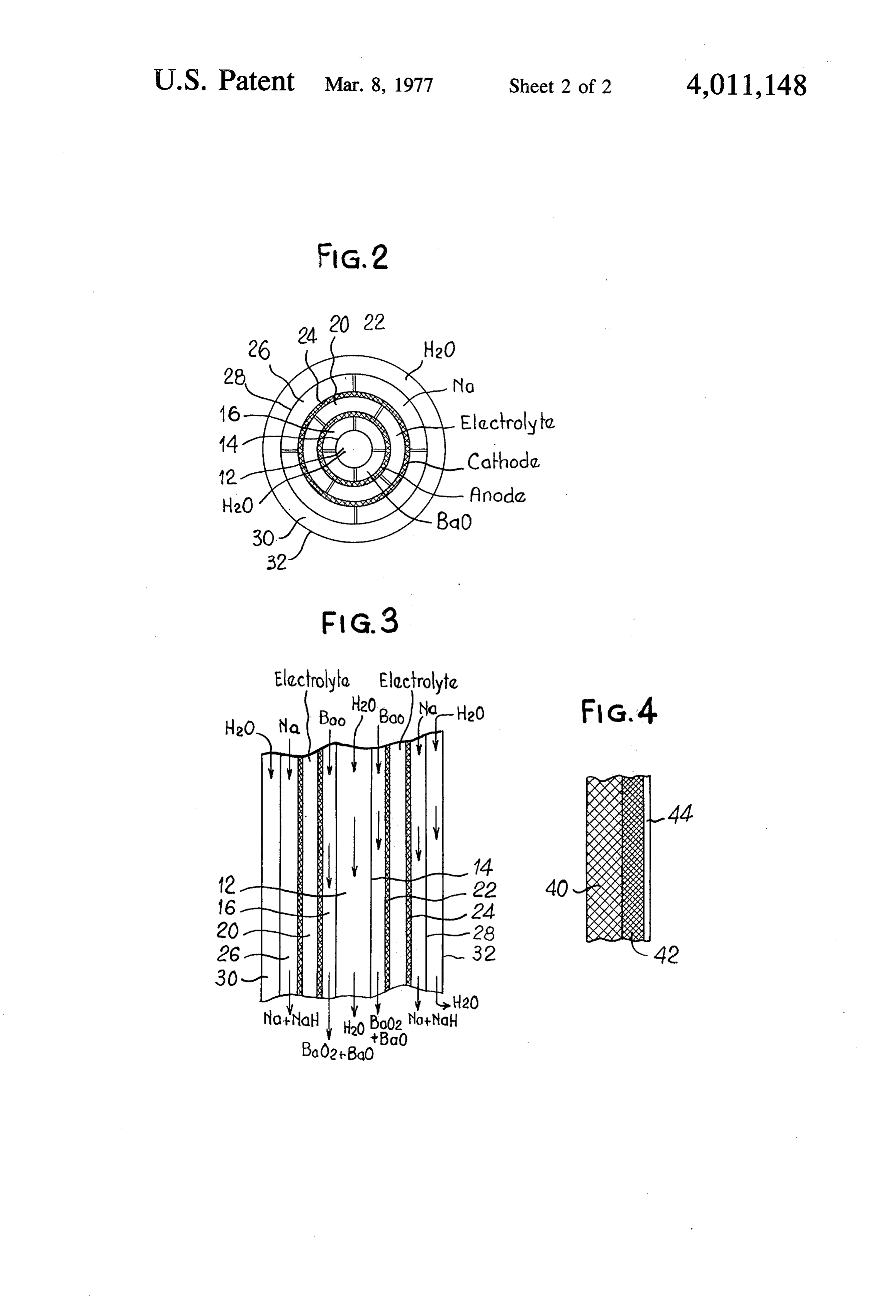
This is a continuation-in-part of U.S. Ser. No. that of a vat with porous electrodes, but the advantage 569,773, filed Apr. 21, 1975, now abandoned. 5 of the latter is that they result in a more compact ar The present invention concerns a method of electrol rangement. . . .. . &. ysis in which the electric energy necessary for the elec In the present case the electrolyte is an aqueous solu trolytic decomposition is at least partially drawn from tion of KOH (35% KOH, 65%. HO by weight, for ex the calorific energy released by chemical reactions ample) and the water is continuously supplied to the using the elements resulting from this decomposition. 10 vat through a pipe 4. ... .
In the existing state of the art, the electric supply to A stream of molten sodium is caused to circulate at electrolytic vats has been achieved by means of a com the exterior of the porous cathode 2, the sodium consti pletely separate source of electric energy. The present tuting the reactive body referred to above and combin invention aims at providing an electrolytic vat installa ing immediately, at the cathode with the hydrogen re tion, in which exothermic chemical reactions occur at 15 leased by electrolysis to provide sodium hydride, NaH. the electrodes and the released energy is recuperated The sodium hydride is liquid and therefore enables the and converted into low-voltage continuous electric hydrogen to be recovered in compact form, with lower energy. W . ing of the partial hydrogen pressure in the vat due to Consequently, in accordance with the present inven the immediate elimination of the gazeous form of hy tion, the new method of electrolysis is characterized in 20 drogen, so that the voltage necessary for supplying the that at least one of the elements resulting from the vat is reduced according to the formula electrolytic decomposition is combined with a reactive body such that heat is released when the combination takes place, the released heat is recovered and then 25 RT log p H p O, converted into electric energy which is used for supply E-Eo + -it-- to ing the continuous low-voltage electric energy neces sary for electrolysis. ". . . pH pO, pHO are the partial pressures of hydrogen, The conversion of calorific energy into electric en oxygen and water respectively; T is the temperature, F ergy is carried out in a thermodynamic cycle compris is Faraday constant and R the universal constant of gaz. ing a cold source and a hot source, the hot source being Eois a constant
constituted by the electrolytic vat which releases calo . . It can be seen and that
E. is the potential of electrodes.
reducing pH, and pC), by trans rific energy during the exothermic reaction of one of forming H, into NaH and O, into Ba O, leads to a re the gases resulting from electrolysis and the reactive duced voltage supply required for a given current. body. Since the yield from the process of electrolysis is In order to effectively reduce the partial pressures of increased if the temperature of the electrolytic bath hydrogen and oxygen, these two
gases are made to rises, the invention provides for the use, as the cold combine rapidly with reactive bodies. source, of one of the constituents of the electrolytic Consequently there are two reasons why sodium is bath before it has been introduced into the vat, so as to utilized to react with hydrogen as soon as possible after increase its temperature. . . .. hydrogen has appeared at the cathode: firstly the reac The invention is particularly useful when applied to 40 tion, is exothermic and the heat can be retrieved to the electrolysis of water, in which the electrolytic bath produce energy, secondly the reaction leads to a reduc is conventionally constituted by a dilute aqueous solu tion of the partial pressure of hydrogen, and therefore tion of a salt, a base or an acid. The water that has to be to a reduction of the electrical energy necessary to the continuously supplied to the vat at the same rate as that 45. electrolysis.
at which is decomposes into hydrogen and oxygen will For the same reasons, the oxygen released at the be the liquid used as the cold source in said thermody anode is made to combine rapidly with barium oxide
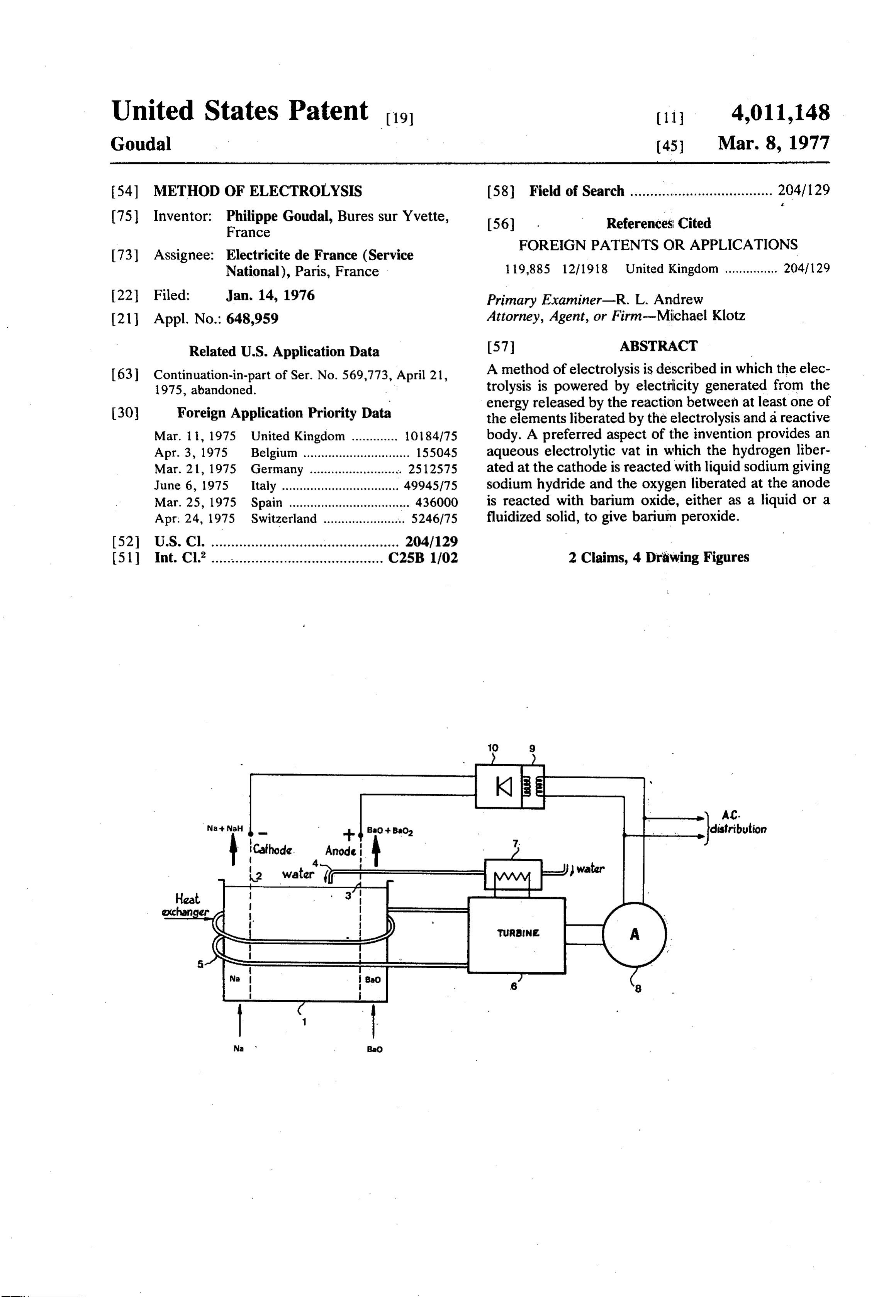
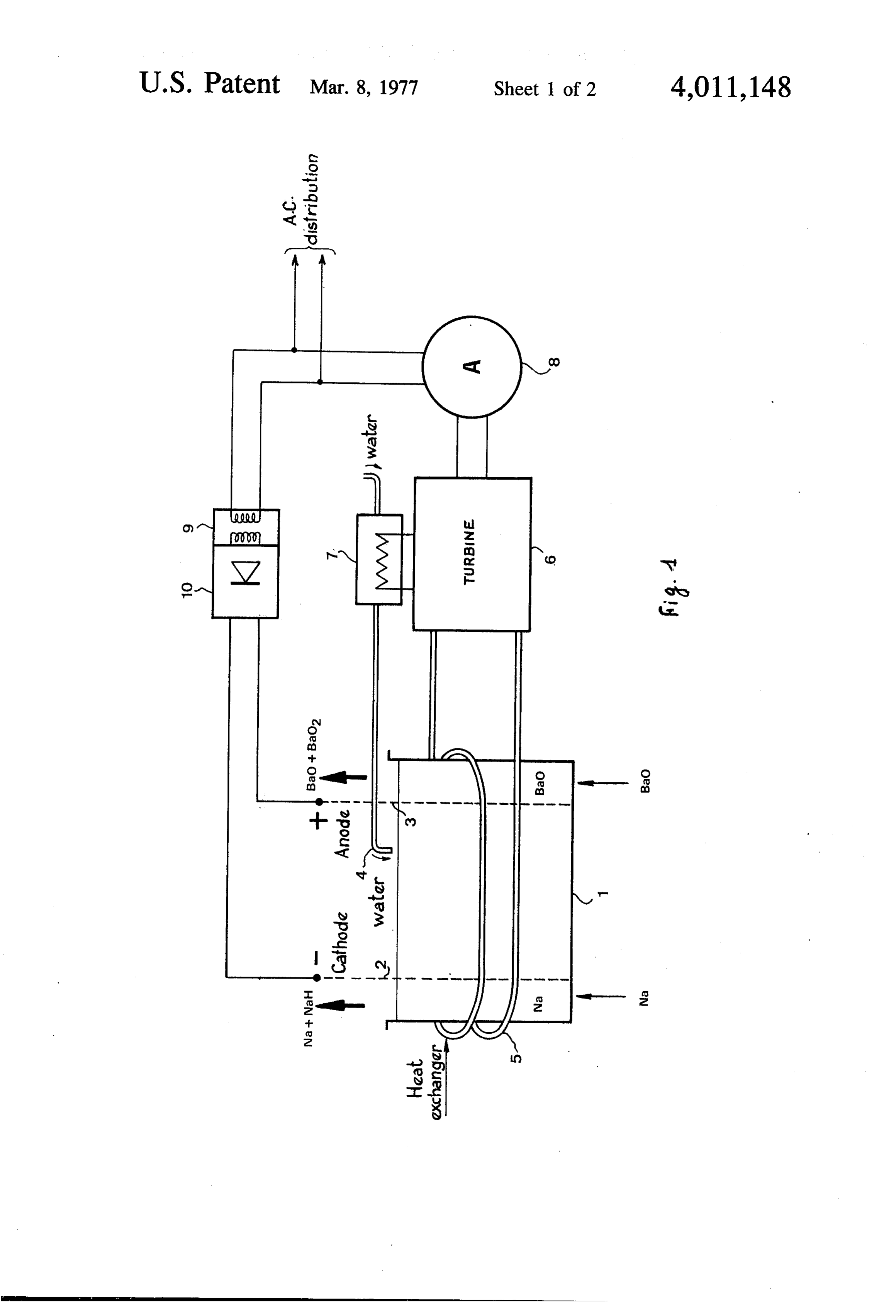
In the attached drawings, BaO to produce exothermically barium peroxide BaO, FIG. 1 illustrates diagrammatically the method of which is solid and therefore leads also to a diminution electrolysis in accordance with the invention, applied 50 of the partial pressure of oxygen. in the case of the electrolysis of water involving the A stream of barium oxide BaO in liquid form or in the release of hydrogen and oxygen, the hydrogen being form of a fluidized bed is caused to circulate at the combined with liquid sodium, and the oxygen with exterior of the porous anode 3.
In the invention, use is made of the fact that the
FIG. 2 shows a transverse cross-section of a preferred 55 reactions of combinations of, on the other hand, hydro embodiment the invention.
of vat for use in the method
according to gen with sodium and, on the other hand, of barium oxide with oxygen are exothermic at the operating
FIG. 3 shows a longitudinal cross-section of the vat of temperatures of the electrolytic vat, which tempera FIG. 2. ; tures are in the range of 200° C to 400° C. A heat FIG. 3 shows an enlarged partial cross-section of an 60 exchanger 5 recovers the released heat and passes it to electrode used in the vat of FIGS. 2 and 3. a fluid which is supplied to a turbine 6 to cause it to Referring to FIG. 1, an electrolysis vat 1, shown dia rotate. The fluid may be water-vapour. To ensure that grammatically, comprises a porous cathode 2 and a the turbine 6 operates efficiently, there is provided a porous anode 3, and the part of the vat disposed be cold source constituted by water circulated in a heat tween these two electrodes constitutes the electrolytic 65 exchanger 7. While the turbine is operating, the tem bath whereas the part situated on the other side of the perature of the water circulating in the heat-exchanger porous electrodes is used for releasing the gases of the ; 7 rises, and this water is passed to the electrolysis wat electrolytic decomposition and for reacting them with through the pipe. 4. The rise in the temperature of the
Page 5
Vat, resulting from water being passed into the thermo H - NaH in chamber 26. This chamber is limited by dynamic cycle of the turbine 6, is a factor leading to an an external wall 32, preferably made of aluminium. improvement in the yield of the electrolysis operation. The chambers are individually divided into compart The turbine 6 drives an alternator 8 which supplies ments by radial spacing walls, which maintain the vari electric energy that can be used for providing the elec ous annular walls and electrodes concentric to each trolytic vat with continuous voltage after transforma other.
tion in a voltage reducer 9 and a rectifying means 10. The dimensions have been chosen for a typical inten The aim of the electrolysis is to obtain hydrogen and sity of electrolysis current of about 1 Ampfcm of elec oxygen. Thus, to recover hydrogen from the sodium O trode. This makes approximately 0.2 cm/s of hydrogen hydride, and oxygen from the bariumperoxide, decom (evaluated at normal conditions of 0°C and 1 bar) and position by heating can be carried out later, for exam therefore 0.3 mm/s of NaH per cm of electrode. ple, by means of a high-temperature nuclear reactor. cathode 24 andinterval
An annular wall 28 of about 2 to 3 mm between has been chosen so that the
Before this decomposition, oxygen and hydrogen are produced NaH can be evacuated easily, with a current stored in compact form: BaO and NaH. 5 of liquid sodium falling by gravity at a few meters/- Numerous advantages are offered by the method in second.
accordance with the present invention, namely: Between wall 14 and anode 22, chamber 16 has an The electrolytic vat may be of compact form, partic annular width of about 5 mm to permit recuperation of ularly if electrodes are porous as described below in the solid BaO2 without jamming.
preferred embodiment. 20 The central chamber 12 has a diameter of about 15 The elements resulting from the combination of hy mm and the circulation of steam inside it is such as to drogen and of oxygen with reactive bodies, (sodium provide a temperature drop of 50° C between the ends and barium oxide) are also of compact form since they of the tube: for instance steam is circulated at a pres are either liquids (NaH) or solids (BaO2), and they can sure of 35 bars and with a speed of 5 to 6 meters per be transported from the place where they are produced 25 second (0.6 liters/sec).
to the place where they are to be used, in particular, The structure of the porous electrodes will now be sodium hydride can be used directly for certain indus described with reference to FIG. 4 which shows an trial applications. enlarged view of a portion of electrode. If sodium hydride and barium peroxide are decom They are made of three superposed porous layers posed in situ or not far from the place where they are 30 which are respectively:
produced, it is possible to recover the sodium and the a layer 40 constituted of sintered nickel having a barium oxide which then circulate continuously in the texture of relatively large grains (50 to 200 microns porous electrodes. diameter, which gives pores of about 50 to 80 microns The hydrogen and the oxygen resulting from the width). This layer 40 ensures the mechanical solidity of decomposition of NaH and BaO, are completely sepa 35 the electrode.
rated. a layer 42 constituted of sintered nickel of a closer The preferred embodiment of the electrolysis vat will texture: grains and pores about 8 to 5 times smaller now be described with reference to FIGS. 2 and 3. than in layer 40. This layer insures that no liquid from FIG. 2 shows a transverse cross-sectional view of the the electrolyte side or from the Na or BaO side can go through the electrode: the pores are made small vat which is in the form of an elongated cylinder with 40 enough concentrical electrodes, and FIG. 3 shows a longitudi so that passage by capillarity is prevented. nal cross section of the same. a layer 44 constituted of a thin nickel layer which is soldered
The cylindrical vat has a length of approximately one porous: poreson the sintered layer 42 and which is also meter, and a total diameter of a few centimeters. are mechanically drilled in this layer and 45 these pores have approximately dimensions of the
It is composed of five chambers which are succes order of 50 microns; they may be of a conical or cylin sively: drial shape. This layer 44 is in contact with the electro a chamber 12 for the circulation of steam for recu perating heat released by the reaction BaO +% O, - lyte. The dimensions of the layer are preferably 5 mm for BaO. This chamber is limited by a cylindrical wall 14 50 layer 40, 1 mm for layer 42 and 0.1 mm for layer 44. made of aluminium or an aluminium alloy. Both electrodes of the vat of FIGS. 2 and 3 can be an annular chamber 16 surrounding wall 14, for the made on this model.
circulation of BaO. This chamber is itself surrounded What I claim is:
by the porous anode 22 which is mainly made of nickel 1. A method for the electolysis of water in which the as will be explained with reference to FIG. 4. 55 electrolyte is an aqueous solution of an acid, base or an electrolyte chamber 20 between anode 22 and salt, wherein hydrogen resulting from electrolytic de cathode 24. Cathode 24 is porous and also made composition is combined with a current of sodium to mainly of nickel. form sodium hydride and the oxygen resulting from the a chamber 26 for circulation of Na, around porous electrolytic decomposition is combined with an alka cathode 224. This chamber is outwardly limited by a 60 line earth metal oxide to form an alkaline earth metal cylindrical wall 28 in a metal capable of resisting Na peroxide, or hyperoxide, and wherein the heat released and NaH at a temperature of about 400 C.: for in by these combinations is converted into electric energy stance stainless steel with high nickel and chromium which is used for supplying part of the low voltage contents, and very low carbon content, such as Incoloy electric energy necessary for the electrolysis. (46%) Fe, 32% Ni, 20% Cr). 65 2. A method as claimed in claim 1 wherein the alka a chamber 30 for circulation of steam for recupera line earth metal oxide is barium oxide. tion of heat produced by the reaction Na - 2 k sk ck ck
Provenance
- Collection
- Cited prior art
- Original PDF
- patentimages.storage.googleapis.com →
- Filed
- 1976-01-14
- Pages
- 5
- Method
- pdftotext (the PDF's own text layer) + pdftoppm 300dpi page scans
- Source
- Google Patents bibliographic record
- Granted
- 1977-03-08
- Inventors
- Philippe Goudal; Electricite de France SA
- Transcribed from
- patentimages.storage.googleapis.com →