patent · US4003426
Heat or thermal energy storage structure
18 January 1977
Page 1 — bibliographic record
United States Patent to 1 4,003,426 Best et al. 45 Jan. 18, 1977 (54) HEAT OR THERMAL ENERGY STORAGE Primary Examiner-William L. Freeh STRUCTURE Assistant Examiner-G. P. LaPointe Attorney, Agent, or Firm-Arthur J. Young 75 Inventors: John S. Best, Freeport; William J.
McMillan, Midland, both of Mich. 57 ABSTRACT 73) Assignee: The Dow Chemical Company, A heat or thermal energy storage structure comprising Midland, Mich. a crosslinked polymeric resinous matrix having a plu 22 Filed: May 8, 1975 rality of substantially unconnected small closed cavities 21 ) Appl. No.: 575,558 and a heat sink material encapsulated within the cavi ties. The structure is characterized in that the heat sink 52 U.S. Cl. ............................. 165/53; 165/104 S; material forms an essentially stable dispersion in the 252/67 uncured polymeric resinous matrix when mixed there 51 Int. Cl.' .................... F24D 5/10; F28D 13/00; with before the matrix is crosslinked. The structure can C09K 5/00 beneficially be used in conjunction with low level heat 58 Field of Search ............ 165/104 S, 53; 252/67; or thermal energy collector means and heat transfer 126/400 means to provide a space heating or cooling apparatus.
(56) References Cited The storage structure may also be effectively used to provide an additional function of a building component
UNITED STATES PATENTS in a building construction such as a wall structure. 3, 191,392 6/1965 Donnelly ............................. 252/67 3,720,198 3/1973 Laing et al. ....................... 126/400 3,785,365 ll 1974 Laing et al. ....................... 126/400 14 Claims, 1 Drawing Figure
Page 2
Drawing sheet — no readable text.
Page 3
BRIEF DESCRIPTION OF THE DRAWING
HEAT OR THERMAL ENERGY STORAGE
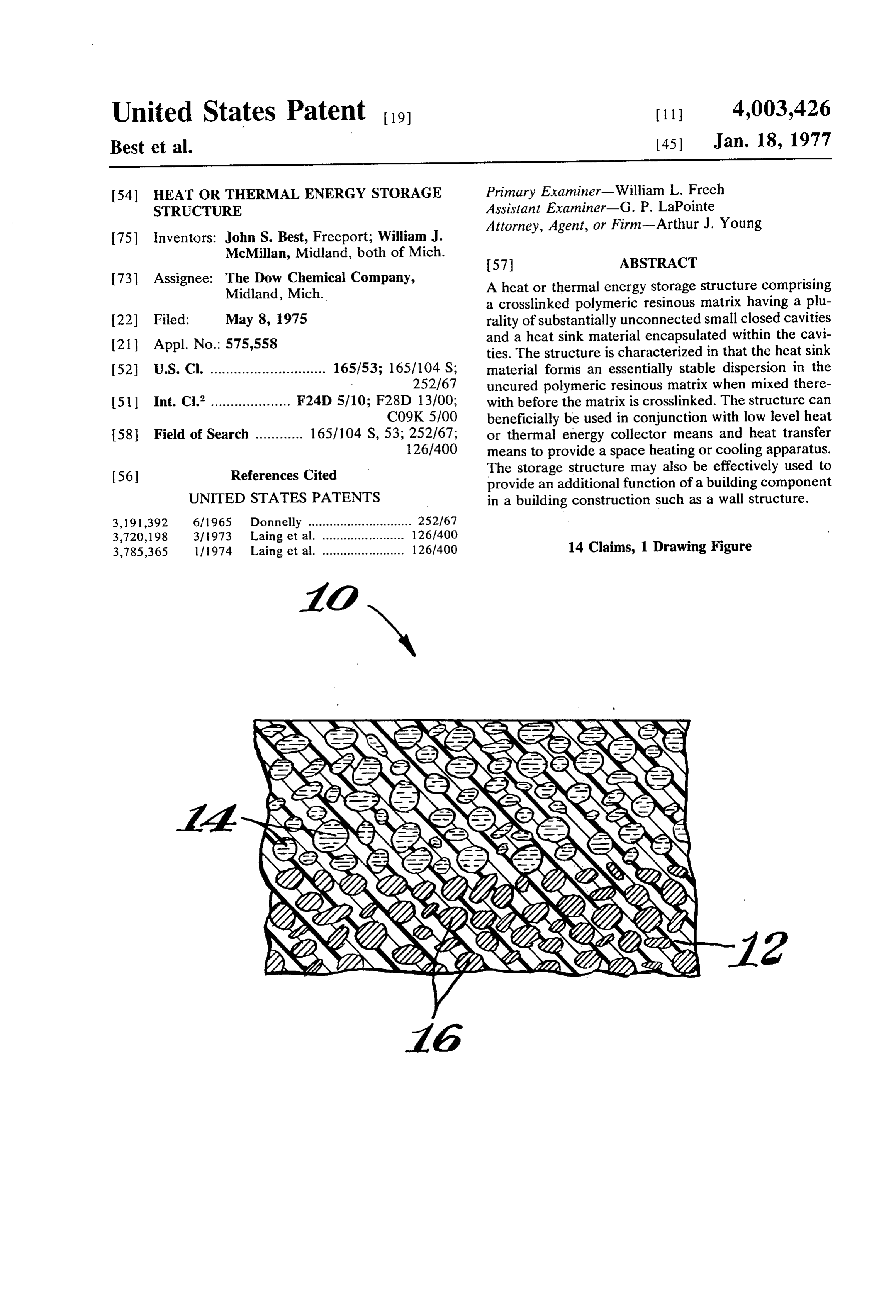
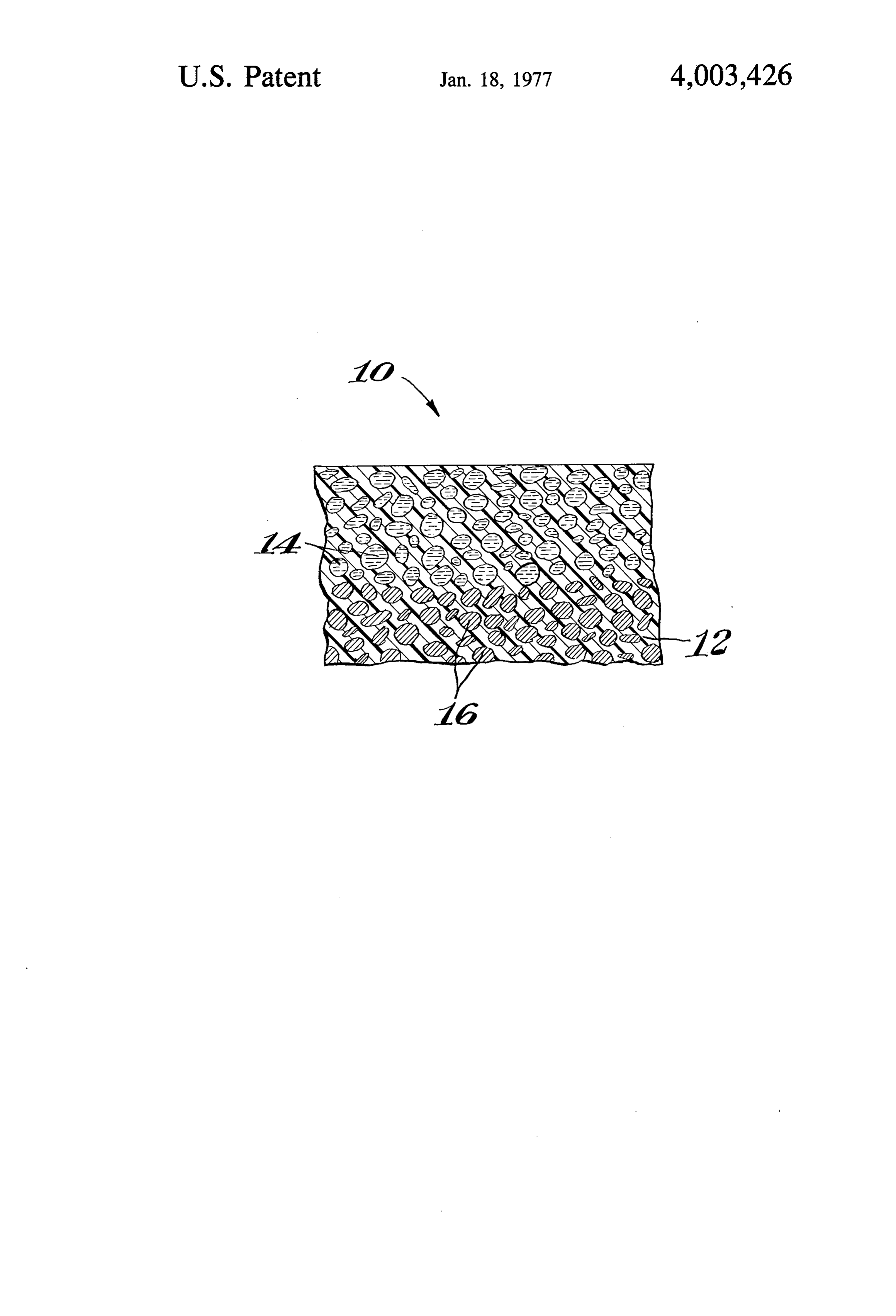
STRUCTURE Referring to the accompanying drawing, a magnified BACKGROUND OF THE INVENTION partial cross-sectional view of a crosslinked polymeric resinous matrix encapsulating a heat sink material l. Field of the Invention formed according to the principles of the present in This invention relates to heat or thermal energy stor vention is shown.
age structures of the type serving as a heat reservoir DETALED DESCRIPTION OF THE INVENTION from which heat may be drawn as needed for space heating or cooling, with particular reference to a heat 10 The following description illustrates the manner in or thermal energy storage structure formed by encap which the principles of the invention are applied but sulating a heat sink material in a cross-linked polymeric are not to be construed as limiting the scope of the resinous matrix. invention.
2. Description of the Prior Art Referring to the drawing, a heat or thermal energy In general, the use of heat or thermal energy storage 15 storage structure 10 is illustrated. The storage structure structures in space heating or cooling apparatus is well 10 comprises a crosslinked polymeric resinous matrix known. Applications which have thus far occurred 12 having a plurality of substantially unconnected small include storage of solar energy, storage of waste heat closed cavities encapsulating a heat sink material which extracted during refrigeration or from waste process may be in a liquid state, as shown by numeral 14, or in steam, and the like. 20 a solid state, as shown by numeral 16, after releasing its As commonly practiced, a heat or thermal energy heat of fusion to the adjacent environment. storage reservoir consists of a well-insulated tank con The heat or thermal energy storage structure which taining a fluid circulating coil on the interior thereof can be utilized in space heating or cooling apparatus surrounded by a heat sink storage material. In addition, can be formed with a matrix of any crosslinked or ther there are many known heat sink storage materials the 25 moset polymeric resinous material provided the heat use of which depends upon the service requirements to sink material will form an essential stable dispersion in be met. Examples of known heat storage reservoirs and the uncured polymeric resinous matrix before the ma heat sink storage materials are well illustrated in U.S. trix is crosslinked. Particularly suited cross-linked poly Pat. Nos. 2,677,664; 2,706,716 and 3,834,456 and meric resinous matrixes are selected from the group French Pat. No. 1,153,115. 30 consisting essentially of polyesters, polyvinyl esters, and epoxies. Beneficially, the crosslinked polymeric
SUMMARY resinous matrix comprises as low as about 25 weight In general, the present invention provides a heat or percent but preferably 35 weight percent or more of thermal energy storage structure comprising a cross the heat or thermal energy storage structure. linked polymeric resinous matrix having a plurality of 35 The heat sink materials useful in forming a heat or substantially unconnected small closed cavities and a thermal energy storage structure should be selected to take advantage of their relatively large latent heat ca heat sink material encapsulated within the cavities. The pacity storage structure is characterized in that the heat sink at their melting and freezing phase change which material forms an essentially stable dispersion in the supplies heat to or removes heat from the heat or ther uncured polymeric resinous matrix when mixed there 40 mal energy storage structure. The heat sink materials with before the matrix is crosslinked. Depending on the are characterized in that they should form an essen service requirements to be met, a heat sink material tially stable dispersion in the uncured polymeric resin having a specific melting point can be selected to take ous matrix when mixed therewith before the matrix is advantage of the relatively large latent heat capacity at crosslinked. Depending on the service requirements to its melting and freezing phase change for supplying 45 be met, the heat sink materials forming the heat or heat to or removing heat from the storage structure. thermal energy storage structure useful in space heat Beneficially, the structure can be used in cooperation ing or cooling apparatus should beneficially melt be with low level heat or thermal energy collector means tween about 5 C and about 100 C and should not and heat transfer means to provide a space heating or supercool more than about 5C below the melt temper cooling apparatus. When used in a space heating or 50 ature of the heat sink material. The heat sink material cooling apparatus, the storage structure can also effec can comprise up to about 75 weight percent and bene tively provide a secondary function of a building com ficially comprises up to about 65 weight percent of the ponent in a building construction such as at least one heat or thermal energy storage structure. wall of a building. A wide variety of heat sink materials may be em Accordingly, this invention has among its objects the 55 ployed in the heat or thermal energy storage structure provision of a heat or thermal energy storage structure. in accordance with the present invention. Particularly Another object of this invention is the provision of a suited as heat sink materials are inorganic hydrates heat or thermal energy storage structure which in coop such as barium hydroxide octohydrate, zinc nitrate eration with low level heat or thermal energy collector hexahydrate, strontium bromide hexahydrate, calcium means and heat transfer means can provide space heat 60 bromide hexahydrate, calcium chloride hexahydrate, ing or cooling apparatus. A further object of this inven ferric bromide hexahydrate and the like. Other inor tion is the provision of a heat or thermal energy storage ganic hydrates which have poor supercooling charac structure which can effectively provide a secondary teristics such as sodium sulfate deccahydrate and cal function as a building component of a building con cium nitrate tetrahydrate can be used as heat sink ma struction such as at least one wall in a building. Yet 65 terials provided they are nucleated as illustrated in U.S. additional objects and advantages of the present inven Pat. Nos. 2,706,716 and 2,677,664. In addition, a wide tion are even more apparent when taken in conjunction variety of aqueous organic hydrate compositions can with the accompanying specification and claims. be used as heat sink materials such as those illustrated
Page 4
in U.S. Pat. No. 3,834,456, which patent is herein fully tradename Derakane 470) and the pinacol hexahydrate incorporated by reference. More specifically, examples (melting point at 45° C) were preheated to about 52°C. of useful compositions found in the above patent are The benzoyl peroxide was then dissolved in the vinyl mixtures comprising one mole of tetrahydrofuran and ester resin with vigorous agitation. Next, the pinacol 17 moles of water, one mole of pinacol and six moles of 5 hexahydrate was slowly added while continuing agita water, i.e., (CH3)2COHCOH (CH)6 HO, and one tion to form an emulsion. Thereafter, the dimethyl mole of butane-2,3-diol and six moles of water. toluidine was added while mixing to form the final To insure against long-term loss of the heat sink ma composition which was then poured into a mold. The terial from the heat or thermal energy storage struc composition set up quickly in the mold (within about 5 ture, the structure may beneficially be enveloped in a 10 minutes) and was removed after about 2 hours in the gas or vapor barrier material. For example, after the form of a rigid structure with the pinacol hexahydrate heat or thermal energy storage structure has been dispersed therein.
formed it can be sealed in an envelope of metal foil such as aluminum foil or in a thermoplastic resinous barrier material. A wide variety of thermoplastic bar- 15 Composition EXAMPLE 2 Approximate Parts by Weight rier materials may be employed in the envelope in accordance with the present invention. Particularly Rigid polyester resin 175 (17.5%) suited as gas or vapor barrier thermoplastic resinous Flexible polyester resin
Pinacol hexahydrate
materials are combinations of vinylidene chloride poly Benzoyl peroxide 2.6 mers, vinyl chloride polymers, vinylidene fluoride poly- 20 Dimethyl toluidine 5 mers and mixtures thereof. Particularly advantageous and beneficial are compositions of vinylidene chloride polymers, wherein the polymers contain at least 70 In forming the structure of this example, the rigid and weight percent vinylidene chloride, the remainder flexible polyester resins (available from Interplastics being one or more olefinically unsaturated monomers 25 Corp. under the tradename Corezyn 158-5 and LC copolymerizerable there with. Suitable vinylidene 1062) and the pinacol hexahydrate were preheated to chloride polymers are prepared utilizing such comono about 52 C as in Example 1. The mixing steps were mers as methyl, ethyl, isobutyl, butyl, octyl and 2-ethyl accomplished in the same manner as in Example 1 with hexyl acrylates and methacrylate; phenyl methacrylate, the final result being the formation of a resilient struc cyclohexyl methacrylate, p-cyclohexylphenyl metha- 30 ture with pinacol hexahydrate dispersed therein. crylate, chlorethyl methacrylate, 2-nitro-2-methylpro pyl methacrylate, and the corresponding esters of EXAMPLE 3 acrylic acid, methyl alpha-chloro-acrylate, octyl alpha Composition Approximate Parts by Weight chloroacrylate, methyl isopropenyl ketone, acryloni
Vinyl ester trile, methacrylonitrile, methyl vinyl ketone, vinyl 35 - Anhydrous pinacol resin 750 (50%)
chloride, vinyl acetate, vinyl propionate, vinyl chloro Water 358 acetate, vinyl bromide, styrene, vinyl naphthalene, Benzoyl peroxide 5.6 ethyl vinyl ether, N-vinyl phthalimide, N-vinyl succini Dimethyl toluidine 2.25 mide, N-vinyl carbazole, isopropenyl acetate, acrylam ide, methacrylamide or monoalkyl substitution prod- 40 In forming the structure of this example, the vinyl ucts thereof, phenyl vinyl ketone, diethyl fumarate, ester resin (available from The Dow. Chemical Com diethyl maleate, methylene diethyl maleate, di pany under the tradename Derakane 411-45), the an chlorovinylidene fluoride, dimethyl itaconate, diethyl hydrous pinacol and the water were preheated to about itaconate, dibutyl itaconate, vinyl pyridine, maleic an 52 C. The anhydrous pinacol and benzoyl peroxide hydride and allyl glycidyl ether. Commercially avail- 45 were then dissolved able light stabilizers may also be incorporated in the ous agitation. The water in the vinyl ester resin with vigor was then rapidly added with vinylidene chloride material such as tertiary-butyl salol. vigorous agitation continuing
Other barrier compositions which may be used with minutes to form an emulsion offorpinacol a period of about 20 hexahydrate in benefit in accordance with the present invention are vinyl chloride polymers which contain a predominant 50 the resin. Thereafter, the dimethyl toluidine was added amount of vinyl chloride therein, and beneficially, fluo while mixing to form the final composition which was rocarbon polymers, fluoro-hydrocarbon polymers and then poured into a mold. The composition set up fluorohalohydrocarbon polymers may also be used with quickly in the mold to form a rigid structure with the benefit. pinacol hexahydrate dispersed therein. The invention is further illustrated by the following 55 As previously discussed, the heat or thermal energy examples. storage structure provided in accordance with the pre sent invention is useful in forming an apparatus for space heating and cooling when combined with a low
Composition
EXAMPLE
Approximate Parts by Weight 60 level heat or thermal energy collector means and heat or thermal energy transfer means. For example, when
Vinyl ester resin
Pinacol hexahydrate
the utilization of solar energy for heating purposes is
Benzoyl peroxide 0.88 desired, the heat collector means comprises a radiant Dimethyl toluidine 0.72 energy heat transfer device having at least one radiant energy transferring face adapted to absorb incident 65 solar energy in the form of heat. In addition, the heat or
In forming the heat or thermal energy storage struc thermal energy storage structure described herein is ture of the present example, the vinyl ester resin (avail cast around a heat exchange circulating coil in any able from The Dow Chemical Company under the desired form such as a wall structure for a building and
Page 5
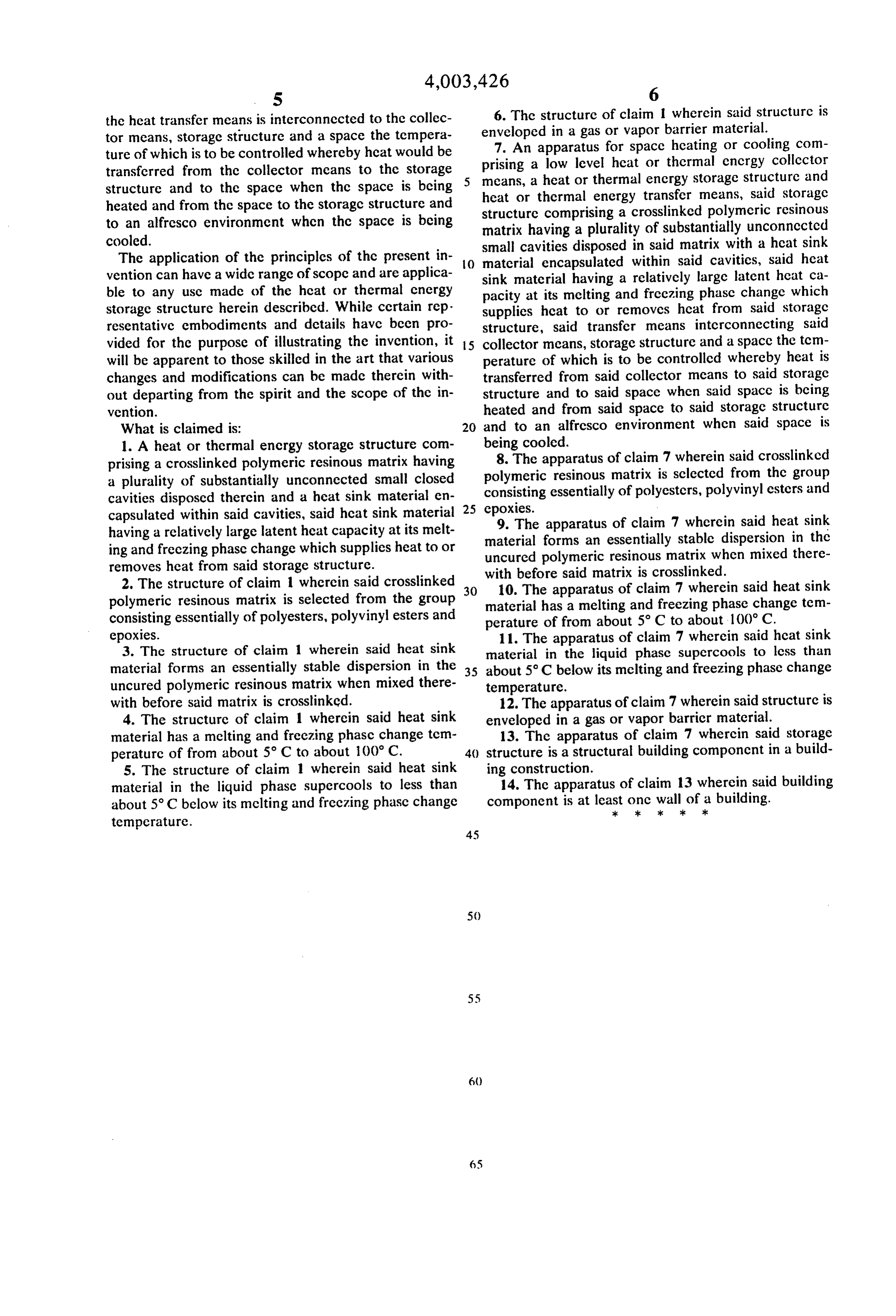
the heat transfer means is interconnected to the collec 6. The structure of claim 1 wherein said structure is tor means, storage structure and a space the tempera enveloped in a gas or vapor barrier material. ture of which is to be controlled whereby hcat would be prising a low levelfor 7. An apparatus space heating or cooling com transferred from the collector means to the storage means, a heat or thermal or heat thermal encrgy collector structure and to the space when the space is being heat or thermal energy transfer storage encrgy means, structure and said storage heated and from the space to the storage structure and structure comprising a crosslinked polymeric resinous to an alfresco environment when thc space is being matrix having a plurality of substantially unconnected cooled. small cavities disposed in said matrix with a heat sink The application of the principles of thc present in 10 material encapsulated within said cavities, said heat vention can have a widc range of scope and are applica sink material having a relatively large latent heat ca ble to any use made of the heat or thermal energy pacity at its melting and freezing phase change which storage structure herein described. While certain rep. supplies heat to or removes heat from said storage resentative embodiments and details have been pro structure, said transfer means interconnecting said vided for the purpose of illustrating the invention, it 15 collector means, storage structure and a space the tcm will be apparent to those skilled in the art that various perature of which is to be controllcd whereby heat is changes and modifications can be made therein with transferred from said collector means to said storage out departing from the spirit and the scope of the in structure and to said space when said space is being vention. heated and from said space to said storage structure What is claimed is: 20 and to an alfresco environment when said space is 1. A heat or thermal encrgy storage structure com being cooled.
prising a crosslinked polymeric resinous matrix having 8. The apparatus of claim 7 wherein said crosslinked a plurality of substantially unconnected small closed polymeric consisting resinous matrix is sclected from the group essentially of polyesters, polyvinyl esters and cavities disposed therein and a heat sink material en 25 epoxies.
capsulated within said cavities, said hcat sink material 9. The apparatus of claim 7 wherein said heat sink having a relatively large latent heat capacity at its melt ing and freezing phase change which supplies heat to or material uncured forms an essentially stable dispersion in the polymeric resinous matrix when mixed there removes heat from said storage structure. with before said matrix is crosslinked. 2. The structure of claim 1 wherein said crosslinked 10. The apparatus of claim 7 wherein said heat sink polymeric resinous matrix is selected from the group 30 material consisting essentially of polyesters, polyvinyl esters and perature has a melting and freezing phase change tem of from about 5 C to about 100° C.
epoxies. 11. The apparatus of claim 7 wherein said hcat sink 3. The structure of claim 1 wherein said heat sink material in the liquid phasc supercools to less than material forms an essentially stable dispersion in the 35 about 5C below its melting and freezing phase change uncured polymeric resinous matrix when mixed there temperature.
with before said matrix is crosslinked. 12. The apparatus of claim 7 wherein said structure is 4. The structure of claim 1 wherein said heat sink enveloped in a gas or vapor barrier material. material has a melting and freezing phase change tem 13. The apparatus of claim 7 wherein said storage perature of from about 5°C to about 100° C. 40 structure is a structural building component in a build 5. The structure of claim 1 wherein said heat sink ing construction.
material in the liquid phase supercools to less than 14. The apparatus of claim 13 wherein said building about 5°C below its melting and freczing phase change component is at leastxk onc xk wall
of ska building.
temperature.
Provenance
- Collection
- Cited prior art
- Original PDF
- patentimages.storage.googleapis.com →
- Filed
- 1975-05-08
- Pages
- 5
- Method
- pdftotext (the PDF's own text layer) + pdftoppm 300dpi page scans
- Source
- Google Patents bibliographic record
- Granted
- 1977-01-18
- Inventors
- John S. Best; William J. McMillan; Dow Chemical Co
- Transcribed from
- patentimages.storage.googleapis.com →