patent · US4125643
Process for depositing elemental silicon semiconductor material from a gas phase
14 November 1978
Page 1 — bibliographic record
United States Patent (19) (11) 4,125,643 Reuschel et al. 45) Nov. 14, 1978 54 PROCESS FOR DEPOSITINGELEMENTAL 58) Field of Search ....................... ... 427/86, 95, 9, 10; SLICON SEMCONDUCTORMATERAL 423/350,349; 118/7, 9 FROM A GAS PHASE (56) References Cited 75 Inventors: Konrad Reuschel, Vaterstetten; U.S. PATENT DOCUMENTS Wolfgang Dietze; Ulrich Rucha, both 3,120,451 2/1964 Schmidt et al. ...................... 156/606 of Munich, all of Germany 3,853,974 12/1974 Reuschel ................................ 427/86 73 Assignee: Siemens Aktiengesellschaft, Berlin & Primary Examiner-John D. Smith Munich, Germany Attorney, Agent, or Firm-Hill, Gross, Simpson, Van Santen, Steadman, Chiara & Simpson 21) Appl. No.: 774,636 57 ABSTRACT 22 Filed: Mar. 4, 1977 A semiconductor material, such as elemental silicon, is deposited on heated rod-shaped mandrels from a reac (30) Foreign Application Priority Data tive gas stream capable of pyrolytically depositing sili Mar. 8, 1976 (DE Fed. Rep. of Germany ....... 2609S64 con wherein the gas stream is regulated in such a man ner that the silicon deposition rate remains constant per 51 Int. C.’.......................... B05D 5/12; B0J 17/28 cubic centimeter of mandrel surface throughout the 52 U.S. C. .......................................... 427/9; 427/10; deposition process.
Page 2
Drawing sheet — no readable text.
Page 3
Drawing sheet — no readable text.
Page 4
proportionality of the reactive gas flow rate to the ac
PROCESS FOR DEPOSITING ELEMENTAL
SILICONSEMICONDUCTORMATERIAL FROMA
tual diameter of the deposition surface. In another ex emplary form of this embodiment, the exhaust gas from
GAS PHASE the reaction housing is monitored, as with the aid of a BACKGROUND OF THE INVENTION mass spectrograph or a gas chromatograph and select ions from the exhaust gas are segregated from the re 1. Field of the Invention maining components of the exhaust gas so as to produce The invention relates to a process of producing semi an appropriate signal which is utilized to control the conductor materials and somewhat more particularly to supply of reactive gas being fed past the deposition a process of pyrolytically depositing semiconductor O surface so that the concentration of the select ions materials, such as silicon, from a reactive gas. within the exhaust gas remain constant throughout the 2. Prior Art deposition process.
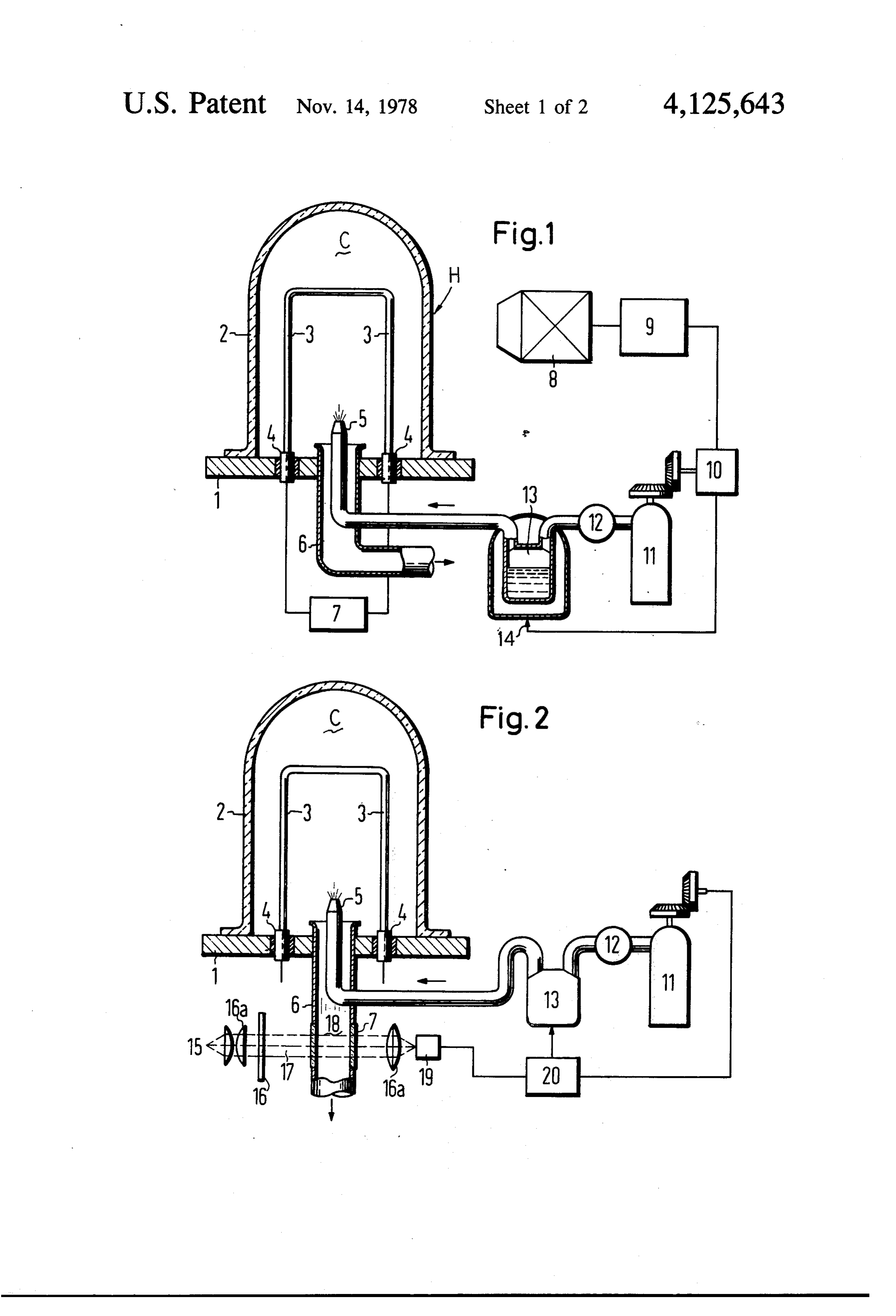
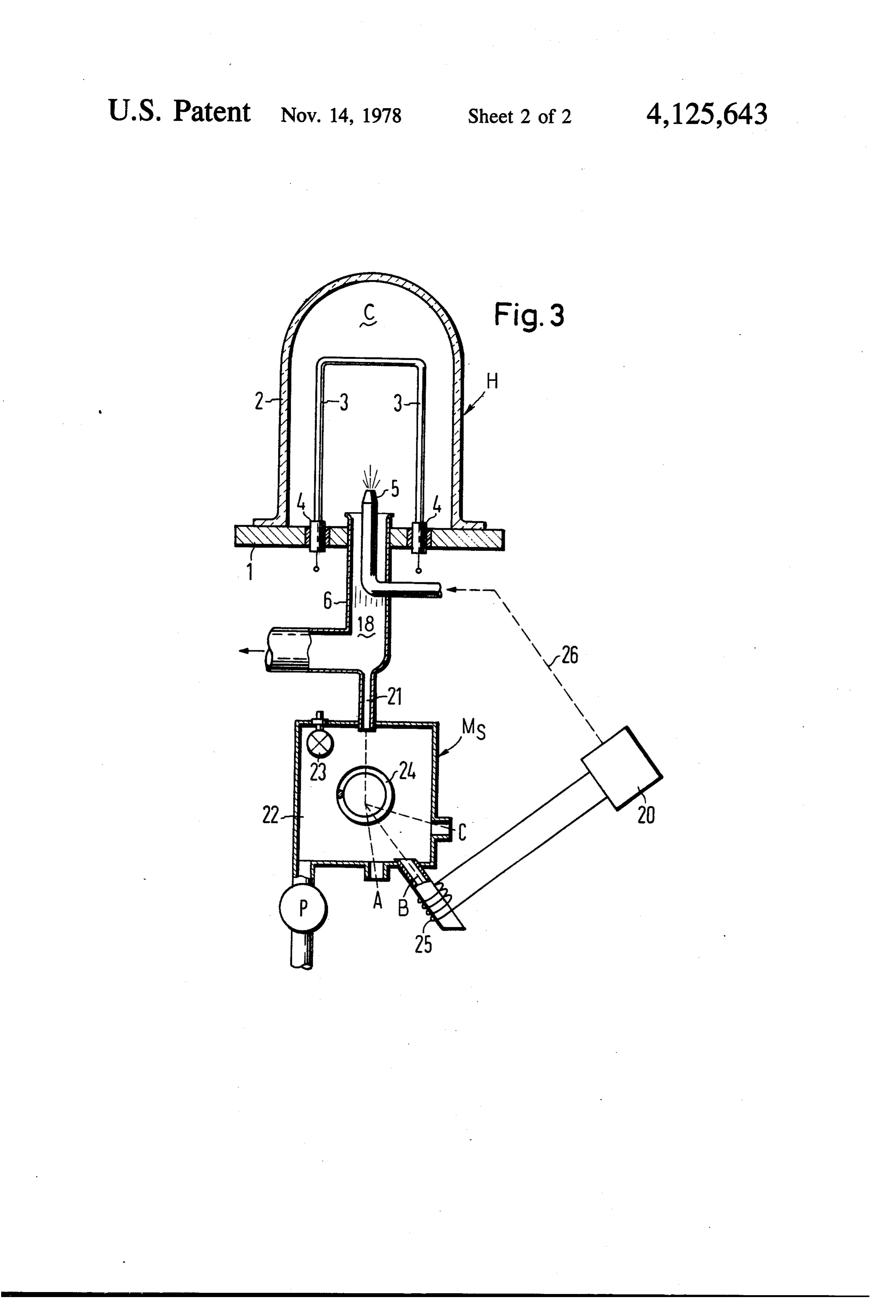
German Pat. No. 1,123,300 (which generally corre sponds to U.S. Pat. No. 3,120,451) suggests a process for BRIEF DESCRIPTION OF THE DRAWING depositing elemental silicon from a gas phase onto a 15 FIG. 1 is an elevated somewhat schematic view of an heated surface of a mandrel wherein a reactive gas apparatus useful in the practice of the invention; stream comprised of a mixture of a halogen silane and hydrogen is fed through a hollow reaction housing tusFIG. 2 is a somewhat similar view of another appara useful in the practice of the invention; and having the heated mandrel positioned therein and the FIG. 3 is an elevated somewhat schematic view of deposition rate is altered during the course of the depo yet another apparatus useful in the practice of the inven
sition process. This prior art process seeks to prevent tion.
the deposition of boron present in the reactive gas and to that end suggests that at the beginning of the deposi DESCRIPTION OF THE PREFERRED tion process, a lesser amount of the reactive gas be fed EMBODIMENTS into the reaction housing and then gradually increasing 25 The invention provides a process for depositing semi the reaction gas through-put during the course of the conductor materials, such as elemental silicon, from a deposition process. reactive gas capable of pyrolytically depositing the It has been observed that during the course of a pyro semiconductor material onto a heated mandrel or car lytic or CVD (chemical vapor deposition) process, such as described above wherein a relatively constant reac 30 rier surface wherein the semiconductor material deposi tion rate remains constant or substantially constant per tive gas flow is maintained, the deposition rate relative surface unit area of mandrel surface. to a surface unit area on the mandrel and relative to a unit of time progressively diminishes, even when the theIntemperature accordance with the principles of the invention, of the deposition surface and the mol total amount of, for example, silicon deposited on the ratio of the components mandrel during the unit of time increases proportional 35 rally or chronologicallywithin a reactive gas are tempo to the chronologically actual size of the mandrel sur rate of the reactive gas streamconstant held while the flow past the deposition sur face. Since the temperature of the mandrel surface and face is controlled in such a manner that the selected the mol ratio within the reactive gas is customarily deposition rate at the beginning of the deposition pro selected at the beginning of the deposition process so that the rate of deposition is at an optimum, typically at cess (which is selected relative to a surface unit area of a maximum, the effective deposition rate varies from the the mandrel as well as relative to a unit of time), remains optimal rate after the deposition process has run for a relatively constant throughout the deposition process. period of time because of changing conditions occa In the following description of the invention, the sioned by the deposition process per se. process will be described on the basis of producing 45 elemental silicon from a reactive gas mixture consisting
SUMMARY OF THE INVENTION of hydrogen and trichlorosilane. However, this is for The invention provides a process for depositing semi convenience only and the invention may also be prac conductor material, such as elemental silicon, from a ticed with other thermally decomposable halogen semi reactive gas wherein a substantially constant deposition conductor compounds capable of yielding a select semi rate is maintained throughout the deposition process. 50 conductor material as well as with other silicon halides, In accordance with the principles of the invention, for example, such as SiCl, SiBra, SiCl2.H2, as well as the temperature of the deposition surface (mandrel) is with other suitable thermally decomposable semicon temporally or chronologically held constant along with ductor compounds.
the composition of the reactive gas while the flow rate The term "through-put' as used herein and in the of the reactive gas past the deposition surface is regul 55 claims is defined as the amount of a reactive gas passing lated in such a manner that the deposition rate selected a heated deposition surface during a unit of time. Ac at the beginning of the deposition process (which is cordingly, the flow rate of a reactive gas stream in selected relative to a surface unit area of the mandrel as creases as a higher through-put is selected. Based on well as a unit of time) remains substantially unchanged previous observations, the deposition of silicon on a throughout the process. constant temperature deposition surface depends on the In certain embodiments of the invention, the flow through-put of a suitable reactive gas, for example, rate of a reactive gas is increased proportional to the consisting of a mixture of SiHCl3 and H2. On the other diameter of the deposition surface, which continually hand, the relation:
increases during the deposition process. In an exem plary form of this embodiment, the diameter of a deposi 65 m = 0.1 MV-0 (1) tion surface, typically a cylindrically-shaped body which may be solid or hollow, is monitored by an opto was confirmed between the deposition yield m and the electrical means which produces a signal regulating the mol ratio MV for SiHCl3/H2. Since silicon deposition is
Page 5
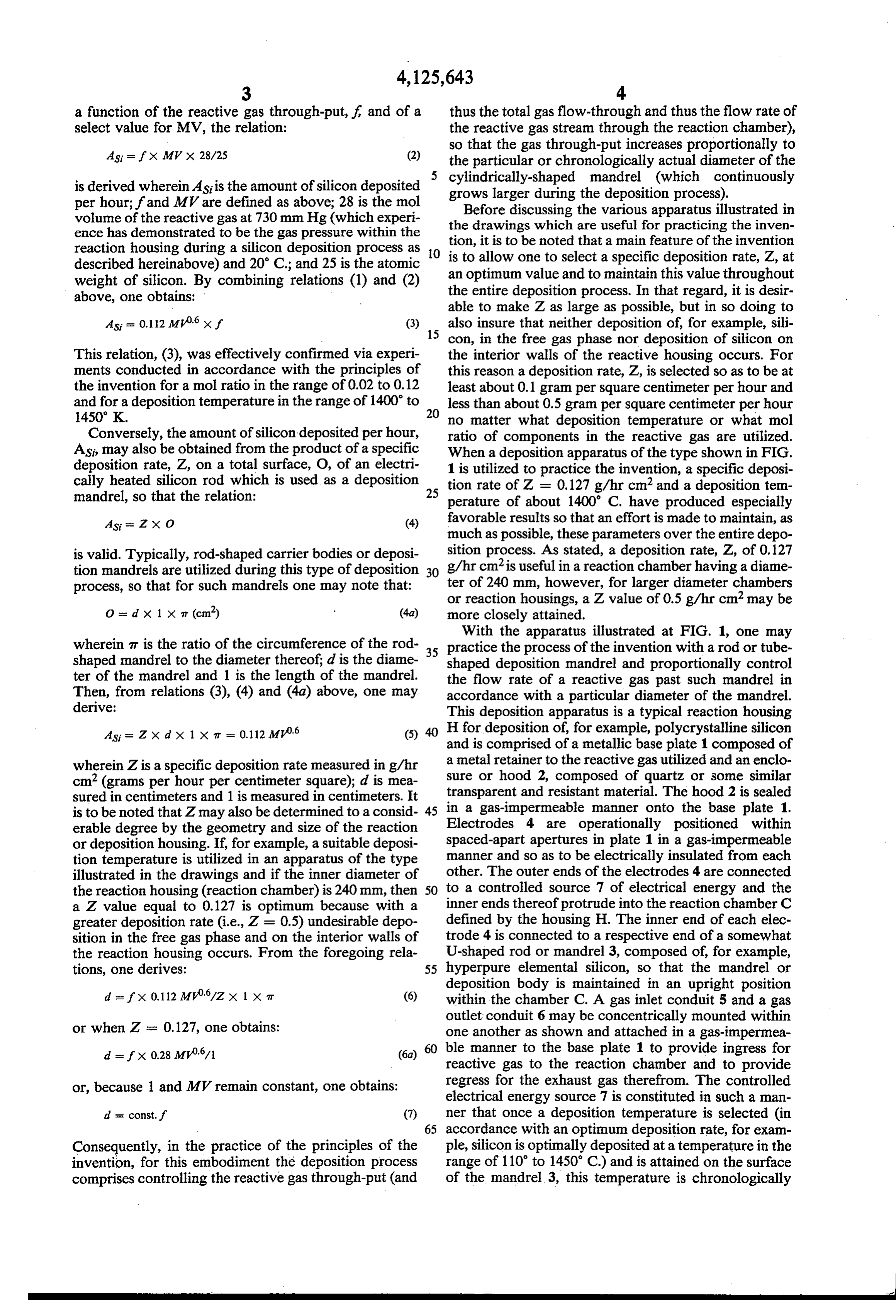
a function of the reactive gas through-put, f, and of a thus the total gas flow-through and thus the flow rate of select value for MV, the relation: the reactive gas stream through the reaction chamber), so that the gas through-put increases proportionally to
As = fx MW x 28/25 (2) the particular or chronologically actual diameter of the cylindrically-shaped mandrel (which continuously is derived wherein Asis the amount of silicon deposited 5 grows larger during the deposition process). per hour; fand MV are defined as above; 28 is the mol Before discussing the various apparatus illustrated in volume of the reactive gas at 730 mm Hg (which experi ence has demonstrated to be the gas pressure within the the drawings which are useful for practicing the inven tion, it is to be noted that a main feature of the invention reaction housing during a silicon deposition process as O is to allow one to select a specific deposition rate, Z, at described hereinabove) and 20 C.; and 25 is the atomic an optimum value and to maintain this value throughout weight of silicon. By combining relations (1) and (2) the entire deposition process. In that regard, it is desir above, one obtains:
able to make Z as large as possible, but in so doing to
As = 0.112 MW xf (3) also insure that neither deposition of, for example, sili 15 con, in the free gas phase nor deposition of silicon on
This relation, (3), was effectively confirmed via experi the interior walls of the reactive housing occurs. For ments conducted in accordance with the principles of this reason a deposition rate, Z, is selected so as to be at the invention for a mol ratio in the range of 0.02 to 0.12 least about 0.1 gram per square centimeter per hour and and for a deposition temperature in the range of 1400 to less than about 0.5 gram per square centimeter per hour 1450 K. no matter what deposition temperature or what mol Conversely, the amount of silicon deposited per hour, ratio of components in the reactive gas are utilized. As may also be obtained from the product of a specific When a deposition apparatus of the type shown in FIG. deposition rate, Z, on a total surface, O, of an electri 1 is utilized to practice the invention, a specific deposi cally heated silicon rod which is used as a deposition tion rate of Z = 0.127 g/hr cm and a deposition tem mandrel, so that the relation: 25 perature of about 1400° C. have produced especially
As = Z X O (4) favorable results so that an effort is made to maintain, as much as possible, these parameters over the entire depo is valid. Typically, rod-shaped carrier bodies or deposi sition process. As stated, a deposition rate, Z, of 0.127 tion mandrels are utilized during this type of deposition 30 g/hr cm is useful in a reaction chamber having a diame process, so that for such mandrels one may note that: ter of 240 mm, however, for larger diameter chambers or reaction housings, a Z value of 0.5 g/hr cm may be
O = d x 1 x n (cm) (4a) more closely attained.
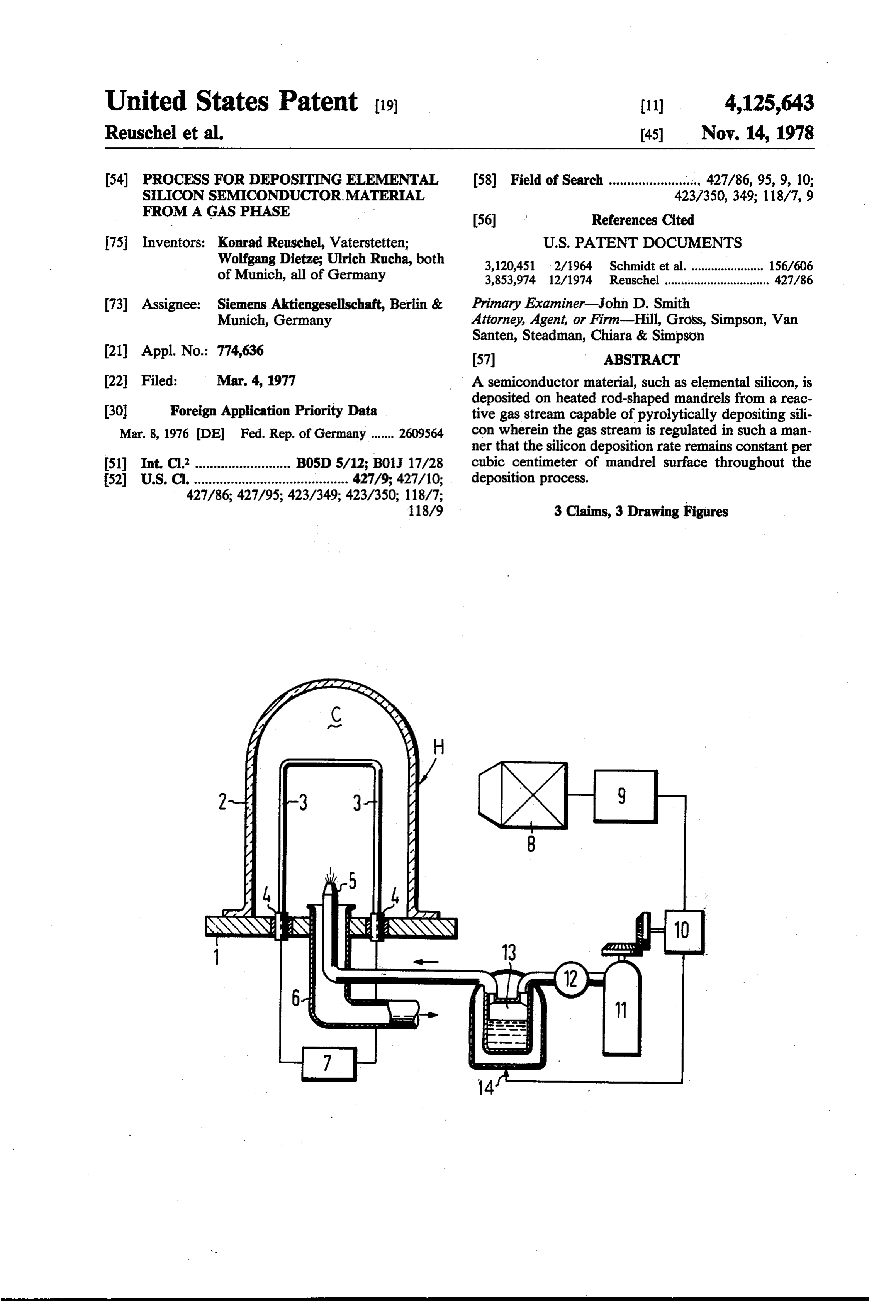
With the apparatus illustrated at FIG. 1, one may wherein T is the ratio of the circumference of the rod 35 practice the process of the invention with a rod or tube shaped mandrel to the diameter thereof; d is the diame shaped deposition mandrel and proportionally control ter of the mandrel and 1 is the length of the mandrel. the flow rate of a reactive gas past such mandrel in Then, from relations (3), (4) and (4a) above, one may accordance with a particular diameter of the mandrel. derive: This deposition apparatus is a typical reaction housing As = Z x d x 1 x n = 0.112 MV' (5) 40 H for deposition of, for example, polycrystalline silicon and is comprised of a metallic base plate 1 composed of wherein Z is a specific deposition rate measured in g/hr a metal retainer to the reactive gas utilized and an enclo cm (grams per hour per centimeter square); d is mea sure or hood 2, composed of quartz or some similar sured in centimeters and 1 is measured in centimeters. It transparent and resistant material. The hood 2 is sealed is to be noted that Z may also be determined to a consid 45 in a gas-impermeable manner onto the base plate 1. Electrodes 4 are operationally positioned within erable degree by the geometry and size of the reaction spaced-apart or deposition housing. If, for example, a suitable deposi apertures in plate 1 in a gas-impermeable tion temperature is utilized in an apparatus of the type manner and so as to be electrically insulated from each illustrated in the drawings and if the inner diameter of other. The outer ends of the electrodes 4 are connected the reaction housing (reaction chamber) is 240 mm, then 50 to a controlled source 7 of electrical energy and the a Z value equal to 0.127 is optimum because with a inner ends thereof protrude into the reaction chamber C greater deposition rate (i.e., Z = 0.5) undesirable depo defined by the housing H. The inner end of each elec sition in the free gas phase and on the interior walls of trode 4 is connected to a respective end of a somewhat the reaction housing occurs. From the foregoing rela U-shaped rod or mandrel 3, composed of, for example, tions, one derives: 55 hyperpure elemental silicon, so that the mandrel or deposition body is maintained in an upright position d = fx 0.112 MV/Z x 1 x it (6) within the chamber C. A gas inlet conduit 5 and a gas outlet conduit 6 may be concentrically mounted within or when Z = 0.127, one obtains: one another as shown and attached in a gas-impermea d = fix 0.28 MV/1 (6) 60 ble manner to the base plate 1 to provide ingress for reactive gas to the reaction chamber and to provide or, because 1 and MV remain constant, one obtains: regress for the exhaust gas therefrom. The controlled electrical energy source 7 is constituted in such a man d = const.f (7) ner that once a deposition temperature is selected (in 65 accordance with an optimum deposition rate, for exam
Consequently, in the practice of the principles of the ple, silicon is optimally deposited at a temperature in the invention, for this embodiment the deposition process range of 110 to 1450° C) and is attained on the surface comprises controlling the reactive gas through-put (and of the mandrel 3, this temperature is chronologically
Page 6
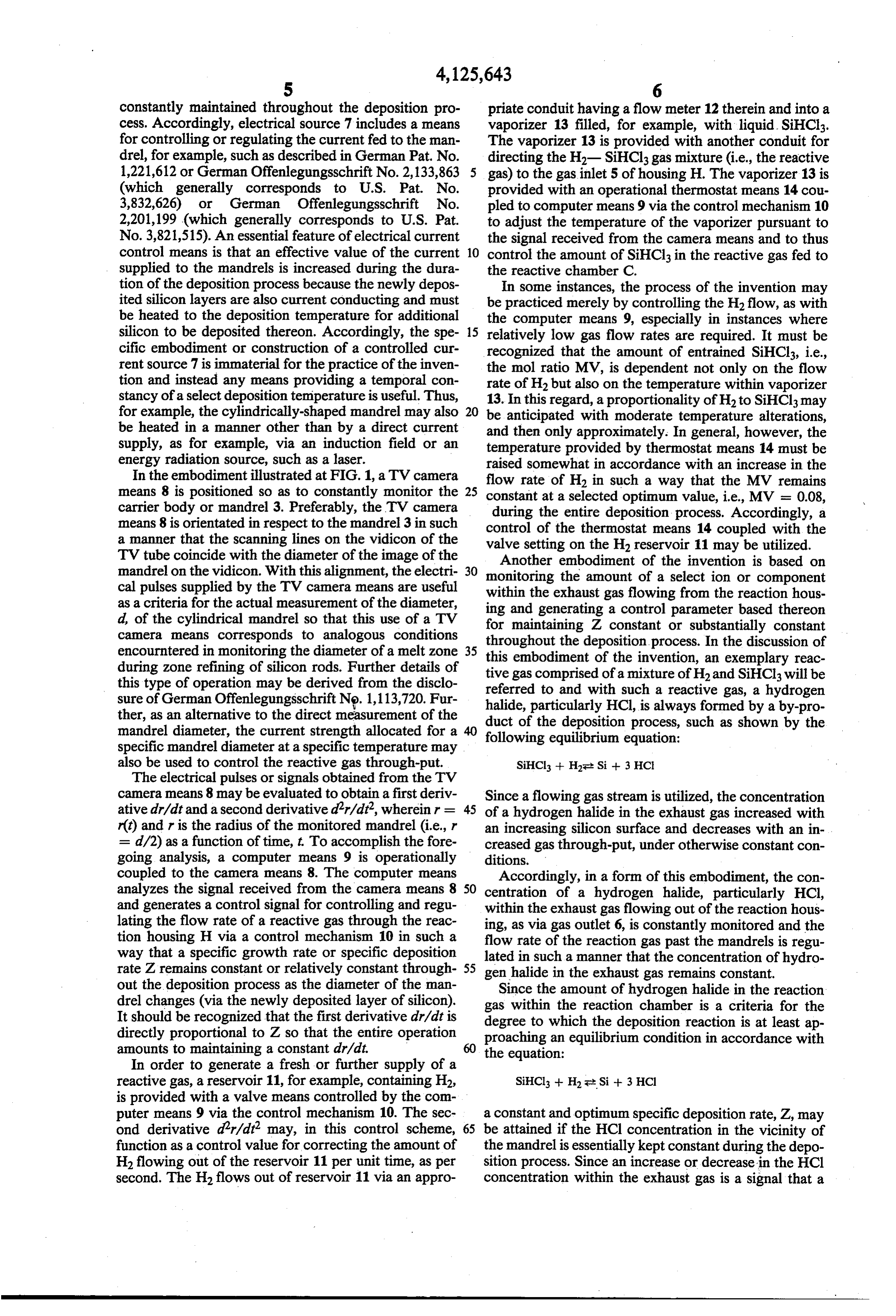
constantly maintained throughout the deposition pro priate conduit having a flow meter 12 therein and into a cess. Accordingly, electrical source 7 includes a means vaporizer 13 filled, for example, with liquid. SiHCls. for controlling or regulating the current fed to the man The vaporizer 13 is provided with another conduit for drel, for example, such as described in German Pat. No. directing the H2- SiHCl3 gas mixture (i.e., the reactive 1,221,612 or German Offenlegungsschrift No. 2,133,863 gas) to the gas inlet 5 of housing H. The vaporizer 13 is (which generally corresponds to U.S. Pat. No. provided with an operational thermostat means 14 cou 3,832,626) or German Offenlegungsschrift No. pled to computer means 9 via the control mechanism 10 2,201,199 (which generally corresponds to U.S. Pat. to adjust the temperature of the vaporizer pursuant to No. 3,821,515). An essential feature of electrical current the signal received from the camera means and to thus control means is that an effective value of the current 10 control the amount of SiHCl3 in the reactive gas fed to supplied to the mandrels is increased during the dura the reactive chamber C.
tion of the deposition process because the newly depos In some instances, the process of the invention may ited silicon layers are also current conducting and must be practiced merely by controlling the H2 flow, as with be heated to the deposition temperature for additional the computer means 9, especially in instances where silicon to be deposited thereon. Accordingly, the spe 15 relatively low gas flow rates are required. It must be cific embodiment or construction of a controlled cur recognized that the amount of entrained SiHCl, i.e., rent source 7 is immaterial for the practice of the inven the mol ratio MV, is dependent not only on the flow tion and instead any means providing a temporal con rate of H2 but also on the temperature within vaporizer stancy of a select deposition temperature is useful. Thus, 13. In this regard, a proportionality of H2 to SiHCl may for example, the cylindrically-shaped mandrel may also 20 be anticipated with moderate temperature alterations, be heated in a manner other than by a direct current and then only approximately. In general, however, the supply, as for example, via an induction field or an temperature provided by thermostat means 14 must be energy radiation source, such as a laser. raised somewhat in accordance with an increase in the In the embodiment illustrated at FIG. 1, a TV camera flow rate of H2 in such a way that the MV remains means 8 is positioned so as to constantly monitor the 25 carrier body or mandrel 3. Preferably, the TV camera constant at a selected optimum value, i.e., MV = 0.08, during the entire deposition process. Accordingly, a means 8 is orientated in respect to the mandrel 3 in such a manner that the scanning lines on the vidicon of the controlvalve of the thermostat means 14 coupled with the setting on the H2 reservoir 11 may be utilized.
TV tube coincide with the diameter of the image of the Another embodiment of the invention is based on mandrel on the vidicon. With this alignment, the electri 30 monitoring the amount of a selection or component cal pulses supplied by the TV camera means are useful within the exhaust gas flowing from the reaction hous as a criteria for the actual measurement of the diameter, d, of the cylindrical mandrel so that this use of a TV ing for and generating a control parameter based thereon maintaining Z constant or substantially constant camera means corresponds to analogous conditions throughout the deposition process. In the discussion of encourntered in monitoring the diameter of a melt zone this embodiment of the invention, an exemplary reac
during zone refining of silicon rods. Further details of tive gas comprised of a mixture of H2 and SiHCl will be this type of operation may be derived from the disclo referred to and with such a reactive gas, a hydrogen sure of German Offenlegungsschrift Ne. 1,113,720. Fur halide, ther, as an alternative to the direct measurement of the duct ofparticularly the
HCl, is always formed by a by-pro deposition process, such as shown by the mandrel diameter, the current strength allocated for a following equilibrium equation:
specific mandrel diameter at a specific temperature may also be used to control the reactive gas through-put. SiHCl -- Hae Si + 3 HCl
The electrical pulses or signals obtained from the TV camera means 8 may be evaluated to obtain a first deriv Since a flowing gas stream is utilized, the concentration ative drydt and a second derivative dr/dt, wherein r = 45 of a hydrogen halide in the exhaust gas increased with r(t) and r is the radius of the monitored mandrel (i.e., r an increasing silicon surface and decreases with an in = d/2) as a function of time, t. To accomplish the fore creased gas through-put, under otherwise constant con going analysis, a computer means 9 is operationally ditions.
coupled to the camera means 8. The computer means Accordingly, in a form of this embodiment, the con analyzes the signal received from the camera means 8 50 centration of a hydrogen halide, particularly HCl, and generates a control signal for controlling and regu within the exhaust gas flowing out of the reaction hous lating the flow rate of a reactive gas through the reac ing, as via gas outlet 6, is constantly monitored and the tion housing H via a control mechanism 10 in such a flow rate of the reaction gas past the mandrels is regu way that a specific growth rate or specific deposition lated in such a manner that the concentration of hydro rate Z remains constant or relatively constant through 55 gen halide in the exhaust gas remains constant. out the deposition process as the diameter of the man drel changes (via the newly deposited layer of silicon). gasSince the amount of hydrogen halide in the reaction within the reaction chamber is a criteria for the
It should be recognized that the first derivative drydt is degree to which the deposition reaction is at least ap directly proportional to Z so that the entire operation proaching an equilibrium condition in accordance with amounts to maintaining a constant dr/dt. 60 the equation:
In order to generate a fresh or further supply of a reactive gas, a reservoir 11, for example, containing H2, SiHCl + HateSi + 3 HC1 is provided with a valve means controlled by the com puter means 9 via the control mechanism 10. The sec a constant and optimum specific deposition rate, Z, may ond derivative drydt may, in this control scheme, 65 be attained if the HCl concentration in the vicinity of function as a control value for correcting the amount of the mandrel is essentially kept constant during the depo H2 flowing out of the reservoir 11 per unit time, as per sition process. Since an increase or decrease in the HCl second. The H2 flows out of reservoir 11 via an appro concentration within the exhaust gas is a signal that a
Page 7
deviation from the constant and optimum deposition crease of surface area on the mandrel or deposition rate. has occurred, one may also practice the invention surface and the increased HCl concentration, naturally, by keeping the specific deposition rate constant or at is noticeable in the exhaust gas. This phenomena effects least optimum by maintaining a constant or substantially the light beam 17 by an increased weakening of the constant concentration of HCl in the exhaust gas via a radiation intensity impinging on the photoelectric cell suitable control of the flow rate of the reactive gas 19. By increasing the amount of fresh reactive gas to the entering the reaction chamber. reaction chamber, and thus increasing the gas flow rate, An apparatus suitable for practicing the foregoing the increase in the HCl concentration noted above is embodiment of the invention is illustrated at FIG. 2, counteracted. Accordingly, in one form of this embodi where like reference numerals are utilized to designate 10 ment of the invention, the signal emitted by photo-elec like elements, as described in FIG. 1. As shown, a gas tric cell 19 is fed to an evaluator means 20 in such a outlet 6 is provided with a transparent section 7 which manner that means 20 maintains a sufficient supply of allows optical examination and monitoring of the ex fresh reactive gas to the reaction chamber to maintain haust gas stream 18 flowing from the reaction chamber the concentration of HCl in the exhaust gases constant C. A light source 15 generating polychromatic light is 15 or relatively constant based on an optimum Z value. positioned to generate a light beam which passes In addition to the just-described means of monitoring through suitable imaging lens 16a and a corresponding the HCl content in the exhaust gas, other monitoring filter 16 to produce a controlled monochromatic light and control means may also be utilized. However, in beam 17 having a wavelength which coincides with an any selected monitoring and control means, it must be absorption peak or band of the HCl molecule or other 20 recognized that the exhaust gas contains, as a rule, the hydrogen halide molecule which is being monitored (if addition to HCl or some other hydrogen halide being necessary, an electrical glow-discharge which takes monitored, a considerable amount of the hydrogen si place in dilute HCl may be utilized as a monochromatic lane utilized in the reactive gas, such as SiHCl3, and that light source). As the light beam 17 passes through the the chemical and physical behavior of hydrogen silane flowing exhaust gas stream 18, it is captured by an ap 25 is, in many respects, similar to that of HCl or some other propriately positioned photo-electric cell means 19. As halide specie being monitored. Thus, for example, it is must be apparent, the beam 17 is weakened in propor almost impossible to chemically separate HCl out from tion to the HCl concentration in the exhaust gas stream the exhaust gas without having new HCl generated 18 and the degree of weakening is a criteria for the then therein by the chemical conversion of the available present concentration of HCl in the exhaust gas. 30 SiHCl3 so that the parameters being measured or moni Because a preferred reaction gas is composed of H2 tored may be falsified.
and SiHCl3, or, alternatively, H2 and SiCl4, substantial One of the other monitoring means useful in the prac amounts of hydrogen silane, particularly SiHCl3 or tice of the invention may be based on mass spectros SiCl4, are, as a rule, still present in the exhaust gas copy, another may be based on the Raman effect and stream 18. Accordingly, the selection of a wavelength 35 yet another may be based on gas chromatography. For for the beam 17 must be such that the selected wave example, a portion of the exhaust gas may be fed into a length does not coincide with an absorption peak or gas chromatography means which quantitatively deter band or any silicon halide molecules within the exhaust mines the amount of HCl in the portion via heat con gas stream. It is recommended that the wavelength of ductivity measurement cell and generates a signal corre the HCl absorption spectrum, i.e., 1.76pm, be utilized as 40 sponding to the concentration of HCl in the exhaust gas the absorption wavelength for beam 17. Because this which may then be utilized to control the through-put wavelength is in the infra-red region, a suitable light of fresh reactive gases within the reaction chamber. source 15 and a suitable filter 16 as well as suitable An embodiment of the invention based on mass spec imaging lens means 16a must be used in forming beam troscopy will be explained with the aid of an apparatus 17, along with a suitable infra-red sensitive photo-elec 45 as shown at FIG. 3. The schematic shown in FIG. 3 is tric cell 19. limited, for the sake of brevity, to solely portions of the In these situations, the so-called Nernst lamp is rec reactive housing H and the means utilizing to monitor ommended, for example, as the light source 15 and a the spent or exhausted reactive gas. As shown, the gas so-called interference filter is recommended as filter outlet 6 leading exhaust gases away from the housing H means 16, along with mineral salt lenses for lens means 50 is provided with a branch line 21 which communicates 16a. A suitable photo-electric cell is, for example, a with a mass spectrograph Ms. The mass spectrograph is photodiode composed of a semiconductor material se comprised of an enclosed hollow housing 22, the inte lected from the group consisting of indium antimonide, rior of which is constantly evacuated by a suitable pump indium arsenide, gallium antimonide or mixed crystals means P and is thus constantly maintained at an ex of any of the foregoing along with AsGa. Further, 55 tremely low pressure. Positioned within the interior of suitable photo-electric cells may be composed of semi the housing 22 is a means 24 for generating a constant conductive AIBVI compounds whose composition is electrical and/or magnetic field and a means 23 for individually controlled in such a manner that the result ionizing the atmosphere within housing 21. Because the ing photo-electric cells is sensitive for a maximum respective gas molecules within the exhaust gas have wavelength of 1.76pm. 60 different masses, the exhaust gas molecules which pass The signal emitted by the photo-electric cell means into the mass spectrograph Msare converted into corre 19, is, in turn, fed to an evaluator 20 which in turn sponding molecular ions, which are then, by virtue of produces a signal for controlling the flow rate of the their differing masses, accelerated in a different manner reaction gas, similarly to the computer arrangement from other ions via the electric or magnetic field within described in FIG. 1. In this regard, it must be recog 65 the mass spectrograph. If a magnetic field is utilized, nized that as the diameter of the deposition surface then in addition to a tangential acceleration, a normal (mandrel 3) increases during the deposition process, the acceleration also takes place, i.e., a different deflection HCl concentration raises proportionately to the in from the original or normal path of travel of an ion,
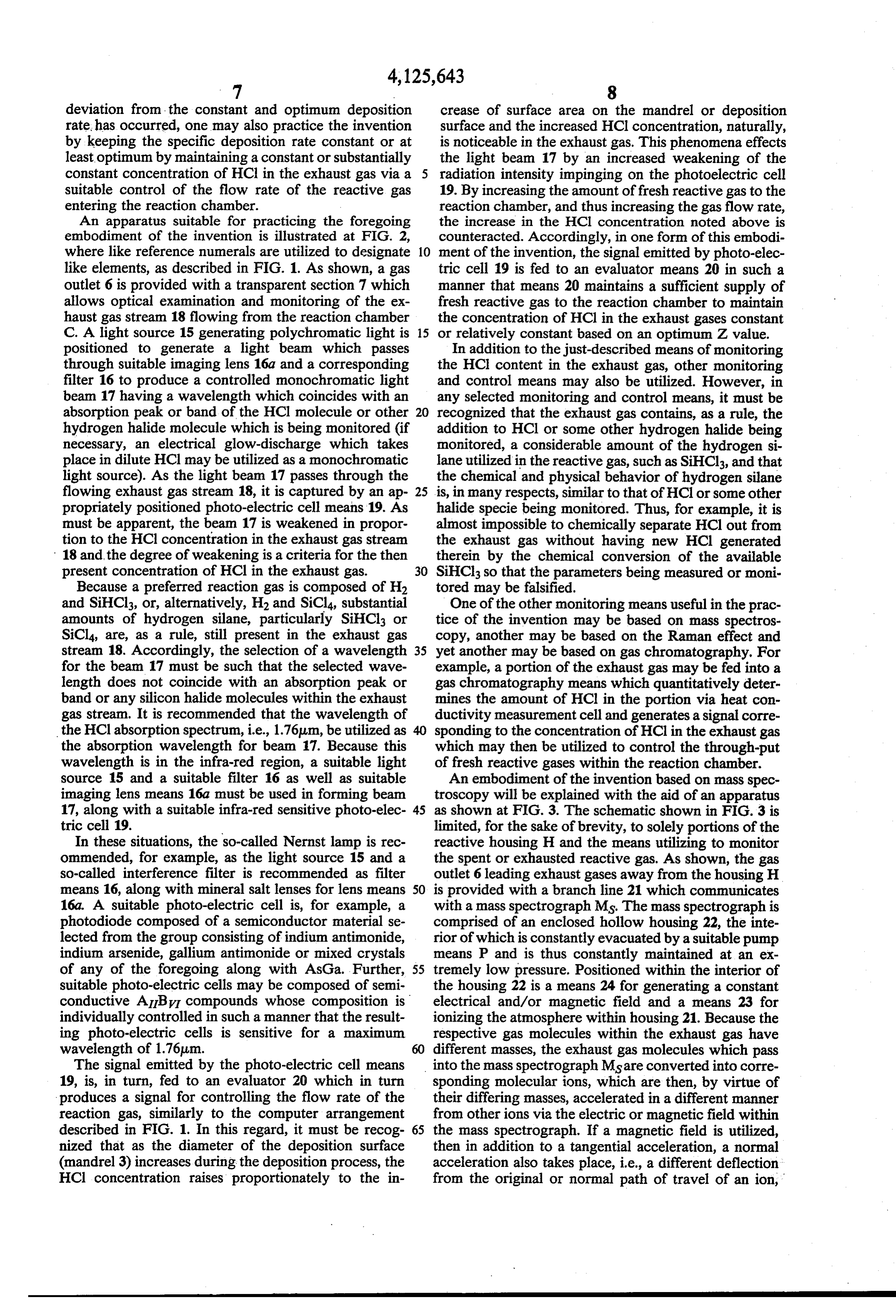
Page 8
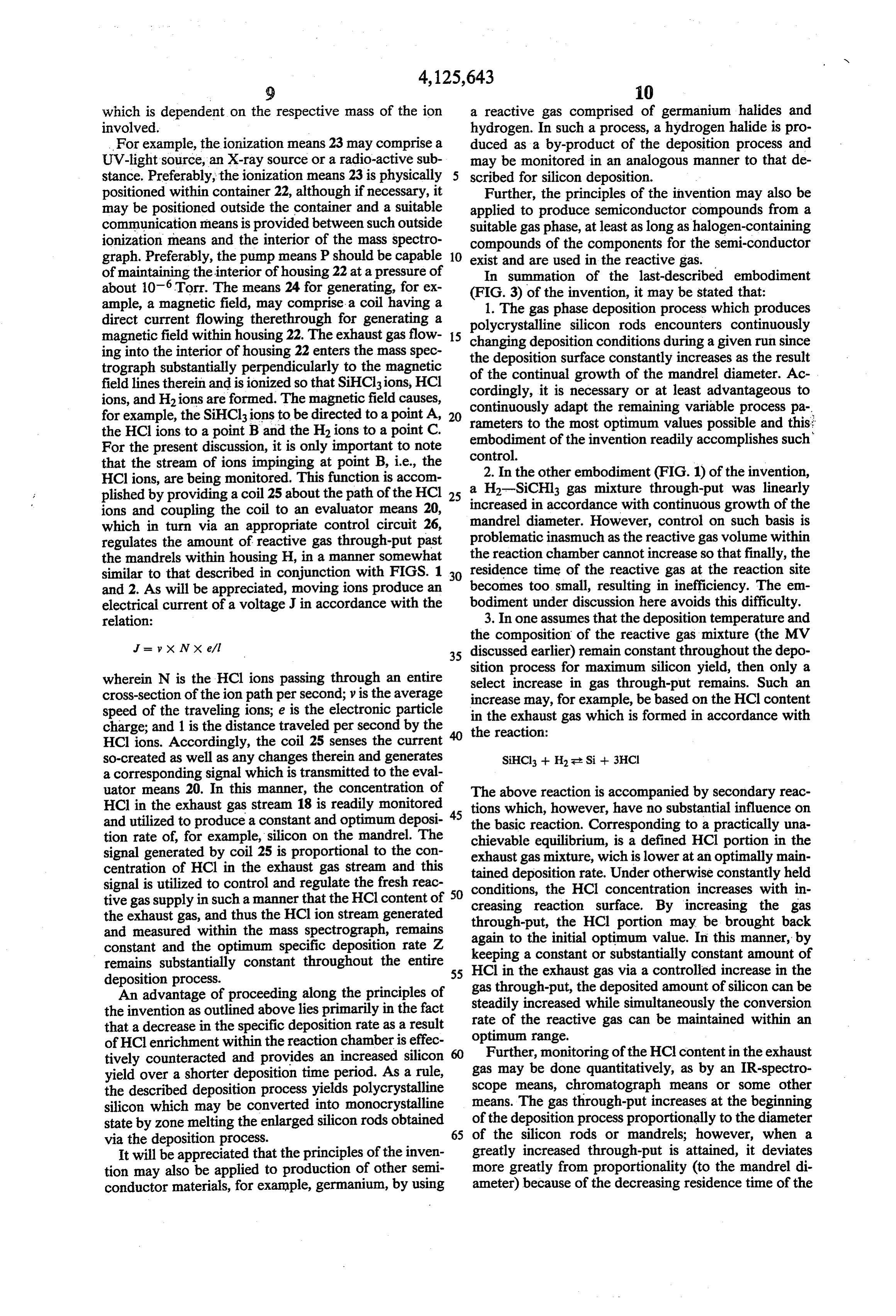
which is dependent on the respective mass of the ion a reactive gas comprised of germanium halides and involved. hydrogen. In such a process, a hydrogen halide is pro For example, the ionization means 23 may comprise a duced as a by-product of the deposition process and UV-light source, an X-ray source or a radio-active sub may be monitored in an analogous manner to that de stance. Preferably, the ionization means 23 is physically 5 scribed for silicon deposition.
positioned within container 22, although if necessary, it Further, the principles of the invention may also be may be positioned outside the container and a suitable applied to produce semiconductor compounds from a communication means is provided between such outside suitable gas phase, at least as long as halogen-containing ionization means and the interior of the mass spectro compounds of the components for the semi-conductor graph. Preferably, the pump means P should be capable 10 of maintaining the interior of housing 22 at a pressure of exist and are used in the reactive gas. about 106 Torr. The means 24 for generating, for ex (FIG. summation
3) of the of the last-described embodiment invention, it may be stated that:
ample, a magnetic field, may comprise. a coil having a 1. The gas phase deposition process which produces direct current flowing therethrough for generating a polycrystalline silicon rods encounters continuously magnetic field within housing 22. The exhaust gas flow 15 changing deposition conditions during a given run since ing into the interior of housing 22 enters the mass spec the deposition surface constantly increases as the result trograph substantially perpendicularly to the magnetic of the continual growth of the mandrel diameter. Ac field lines therein and is ionized so that SiHClsions, HCl cordingly, ions, and H2 ions are formed. The magnetic field causes, continuouslyit adapt is necessary or at least advantageous to for example, the SiHCl3 ions to be directed to a point A, 20 rameters to the mosttheoptimum remaining variable process pa values possible and this the HCl ions to a point B and the H2 ions to a point C. embodiment of the invention readily accomplishes such For the present discussion, it is only important to note that the stream of ions impinging at point B, i.e., the control.
HCl ions, are being monitored. This function is accom 2. In the other embodiment (FIG. 1) of the invention, plished by providing a coil 25 about the path of the HCl 25 a H2-SiCH13 gas mixture through-put was linearly ions and coupling the coil to an evaluator means 20, increased in accordance with continuous growth of the mandrel diameter. However, control on such basis is which in turn via an appropriate control circuit 26, problematic inasmuch as the reactive gas volume within regulates the amount of reactive gas through-put past the mandrels within housing H, in a manner somewhat the reaction chamber cannot increase so that finally, the similar to that described in conjunction with FIGS. 1 30 residence time of the reactive gas at the reaction site and 2. As will be appreciated, moving ions produce an becomes too small, resulting in inefficiency. The em electrical current of a voltage J in accordance with the bodiment under discussion here avoids this difficulty. relation: 3. In one assumes that the deposition temperature and the composition of the reactive gas mixture (the MV
W = y x NX evil 35 discussed earlier) remain constant throughout the depo sition process for maximum silicon yield, then only a wherein N is the HCl ions passing through an entire select increase in gas through-put remains. Such an cross-section of the ion path per second; y is the average increase may, for example, be based on the HCl content speed of the traveling ions; e is the electronic particle in the exhaust gas which is formed in accordance with charge; and 1 is the distance traveled per second by the the reaction:
HCl ions. Accordingly, the coil 25 senses the current so-created as well as any changes therein and generates SiHCl3 + H2 b Si + 3HCl a corresponding signal which is transmitted to the eval uator means 20. In this manner, the concentration of The above reaction is accompanied by secondary reac HCl in the exhaust gas stream 18 is readily monitored 45 tions which, however, have no substantial influence on and utilized to produce a constant and optimum deposi the basic reaction. Corresponding to a practically una tion rate of, for example, silicon on the mandrel. The chievable equilibrium, is a defined HCl portion in the signal generated by coil 25 is proportional to the con exhaust gas mixture, wich is lower at an optimally main centration of HCl in the exhaust gas stream and this tained deposition rate. Under otherwise constantly held signal is utilized to control and regulate the fresh reac tive gas supply in such a manner that the HCl content of 50 conditions, creasing the HCl concentration increases with in reaction surface. By increasing the gas the exhaust gas, and thus the HCl ion stream generated through-put, the HCl portion may be brought back and measured within the mass spectrograph, remains again to the initial optimum value. In this manner, by constant and the optimum specific deposition rate Z. keeping a constant or substantially constant amount of remains substantially constant throughout the entire HCl in the exhaust gas via a controlled increase in the deposition process. 55
An advantage of proceeding along the principles of gas through-put, the deposited amount of silicon can be steadily increased while simultaneously the conversion the invention as outlined above lies primarily in the fact rate of the reactive gas can be maintained within an that a decrease in the specific deposition rate as a result optimum of HCl enrichment within the reaction chamber is effec 60 Further,range.
tively counteracted and provides an increased silicon gas may bemonitoring of the HCl content in the exhaust yield over a shorter deposition time period. As a rule, scope means,done quantitatively, as by an IR-spectro chromatograph means or some other the described deposition process yields polycrystalline silicon which may be converted into monocrystalline means. The gas through-put increases at the beginning state by zone melting the enlarged silicon rods obtained 65 ofof the deposition process proportionally to the diameter via the deposition process. the silicon rods or mandrels; however, when a It will be appreciated that the principles of the inven greatly increased through-put is attained, it deviates tion may also be applied to production of other semi more greatly from proportionality (to the mandrel di conductor materials, for example, germanium, by using ameter) because of the decreasing residence time of the
Page 9
gas in the reaction housing so that gas through-put can sition rate of silicon onto the mandrel surface varies no longer be increased to the same degree. A similar during the course of the deposition process, the in procedure may also be followed with other reactions, provement comprising:
for example: chronologically maintaining a relatively constant temperature at the mandrel surface and maintain
SiCl4 + H2 ? Si + 4HCl, etc. ing a relatively constant composition within the The principles of the invention may also be applied reactive gas;
for deposition of other semiconductor elements, such as varying the reactive gas through-put past the man germanium, selenium, boron, etc., as well as for deposi 10 drel in such a manner that the deposition rate of silicon onto the mandrel surface remains substan tion of inorganic semiconductor compounds, such as tially constant throughout the deposition process, AIB compounds, SiC, etc., insofar as a reactive gas is said deposition rate being selected at the beginning available capable of undergoing pyrolytic decomposi of the deposition process in relation to a surface tion in an equilibrium reaction wherein the formation of unit area of the mandrel and in relation to a unit of a hydrogen halide, such as HCl, is related to or decisive 15 time, so that the deposition rate of silicon per unit on the specific deposition rate for the semiconductor area of mandrel surface and per unit time is main material being deposited. For example, this type of tained so as to be at least about 0.1 gram per square reaction occurs when methyl silicochloroform
(CHSiCl3) is converted with hydrogen to produce SiC centimeter per hour and less than about 0.5 gram on the surface of a heated mandrel. In all of the above 20 per square centimeter per hour; and instances, the optimum deposition rate is determined, increasing the reactive gas through-put past said man then the deposition parameters are adjusted at the be drel proportionately to the diameter of said man ginning of the deposition process to provide this opti drel which increases during the course of the depo mum deposition rate and the flow rate of the reactive sition process.
gas past the deposition site is adjusted in such a way that 25 2. In a process as defined in claim 1 wherein the diam the concentration of a hydrogen halide in the exhaust eter of said mandrel is opto-electrically monitored by an gas remains constant or substantially constant. By fol opto-electrical means operationally coupled with said lowing these guidelines one is guaranteed that the depo reaction housing, said opto-electrical means generating sition rate is maintained throughout the entire process. a signal corresponding to a chronological change of As is apparent from the foregoing specification, the 30 said diameter per unit time and transmitting said signal present invention is susceptible of being embodied with to a control means regulating the proportionality of the various alterations and modifications which may differ reaction gas flow rate to the chronologically actual particularly from those that have been described in the value of the diameter of said mandrel. preceding specification and description. For this reason, 3. In a process as defined in claim 2 wherein the man it is to be fully understood that all of the foregoing is 35 drel diameter is monitored by a TV camera means in intended to be merely illustrative and is not to be con such a way that said camera means generates an electri strued or interpreted as being restrictive or otherwise cal signal which is proportional to the chronologically limiting of the present invention, excepting as it is set actual value of the mandrel diameter, said electrical forth and defined in the hereto-appended claims. signal being transmitted to an evaluator means which We claim as our invention: 40 analyze such electrical signal as a function of time and 1. In a process for depositing elemental silicon from a produces a control signal regulating the reactive gas reactive gas comprised of a mixture of a halogen silane through-put so as to obtain a substantially constant and hydrogen whereby the reactive gas flows through a value of a first derivative drydt wherein r is the mandrel reaction housing containing a heated mandrel on which radius and t is time.
silicon is deposited from such gas and wherein the depo 45 e s
Provenance
- Collection
- Cited prior art
- Original PDF
- patentimages.storage.googleapis.com →
- Filed
- 1977-03-04
- Pages
- 9
- Method
- pdftotext (the PDF's own text layer) + pdftoppm 300dpi page scans
- Source
- Google Patents bibliographic record
- Granted
- 1978-11-14
- Inventors
- Konrad Reuschel; Wolfgang Dietze; Ulrich Rucha; Siemens AG
- Transcribed from
- patentimages.storage.googleapis.com →