patent · US390675
Galvanic battery
9 October 1888
Page 1
Drawing sheet — no readable text.
Page 2
UNITED STATES PATENT OFFICE.
DAVID HUMPHREYS, OF CINCINNATI, OHIO.
GAVANC BATTERY.
SPECIFICATION forming part of Letters Patent No. 390,675, dated October 9, 1888. Application filed March 8, 1888. Serial No. 266,524, (No model.)
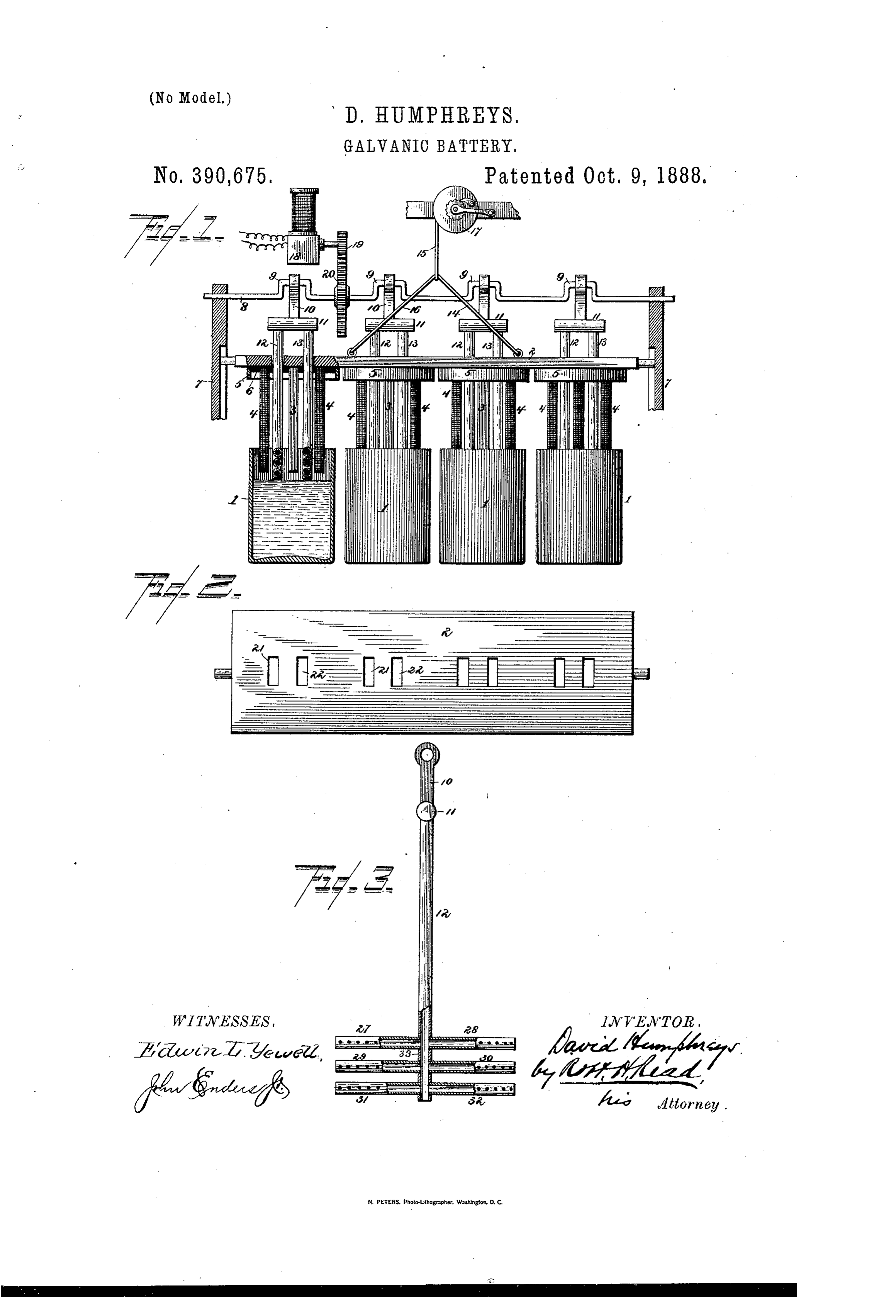
To att, whom it may concern This support carries the positive and negative 55 Be it known that I, DAVID HUMPHREYs, a elements of the batteries 34 4 34 4, &c. The citizen of the United States, residing at Cincin positive elements 333, &c., are pre?erably of nati, in the county of Hamilton and State of zinc, and the negative elements 4 4 of each Ohio, have invented certain new and useful cell are preferably of carbon and are placed Improvements in Galvanic Batteries; and I do so as to oppose the faces of the zinc. On the 6o declare the following to be a full, clear, and ex under side of the support 2 is mounted a box act description of the invention, such as will like cover, 5, for each cell, a suitable packing enable others skilled in the art to which it ap ring, 6, of soft rubber or other suitable mate IO pertains to make and use the same, reference rial, being placed within the cover, So as to being had to the accompanying drawings, and make a liquid-tight joint when the electrode. 65 to the letters and figures of reference marked support 2 is lowered upon the cells. To the thereon, which form a part of this specifica electrode-support is attached suitable sustain tion. ing-cords, 141516, which may be wound upon This invention relates to galvanic batteries or unwound from a windlass, 17, to raise or of that type in which a circulation of the ex lower the electrodes or elements into opera- 7o citing-fluid and a dislodgment of any polariz tive relation to the battery-cells. The Wind ing gases which may accumulate on the sur lass is provided with a pawl and a ratchet to face of the negative electrode are effected. hold the electrodes at any point of elevation, Heretofore it has been proposed to effect de as shown. The support 2 is provided with a polarization by rotating the negative elements, series of slots, 21 22 21 22, two such slots cor 75 SO as to cause the surface of the said elements responding to each cell of battery. Through to alternately come in contact with the at. these slots extends the depolarizing device. mosphere and with the exciting-liquid. The This is preferably made of hard rubber or 25 theory of operation of such cells is that the some other material which is not too fragile hydrogen will be dislodged by the movement and will be unaffected by the solutions used of the electrodes and will be dissipated in the in galvanic batteries. As shown in the draw open air. It has also been proposed to pro ings, it consists of a rod, 10, sleeved or hung vide the negative electrodes with superficial at the top to the crank-shaft S. To this rod points or protuberances, so that the hydrogen a cross-piece, 11, is secured, and vertical may escape from said points. rods 12 13 are connected rigidly to the CrOSS According to my invention the elements re piece. To the lower part of each of these ver main fixed when the battery is in action, and tical rods is attached a hollow frame Com an agitator is provided to cause a fresh liquid posed of tubular cross-arms 27 2829 3031. 32, 35 surface to be constantly maintained at the secured to a central tube, 33, open at the bot negative electrodes to dislodge any hydrogen tOnn. 9O which may acct inulate on said electrodes and Each cross arm is perforated with a series of cause bubbles or currents of air to be set up holes opening toward the carbon or negative near to or in contact with said electrodes, so electrode surface. One or more of these may as to neutralize and dislodge said hydrogen. be closed at the ends. These croSS-arms are My invention embodies certain features of preferably secured to the central tube at such 95 structure with these ends in view, which will distances apart that all of the arms may be al be hereinafter fully described in the specifica ternately lifted out of and depressed into the tion, and then definitely indicated in the ap exciting-liquid at each rotation of the crank 45 pended claims. shaft. The vertical rods are placed at Such a In the drawings which illustrate my system, distance apart that the openings in the perfo OO Figure 1 is an elevation of my apparatus. rated cross-arms will be brought into close re Fig. 2 is a plan view of the cover for the bat. lation to the negative surface. tery-jars. Fig. 3 is a detached, partly sec The rods 10, of which there is one for each tional, view of the agitating and depolarizing cell of the battery, are hung upon bends or device. cranks 999 of a crank-shaft, S, so that the de 1 11 1 represent a series of battery jars or polarizing device may be raised and lowered cells. A board or electrode-support, 2, is and reciprocated from side to side when said mounted so as to slide in side guides, 7 7. crank-shaft is turned. On the crank-shaft is a
Page 3
gear-wheel, 20, securely fixed to the same, and whereby the excitant is agitated and air is this gear-wheel is revolved by an electric or brought into contact with the negative sur other motor, 18, and pinion 19. face. 7) The operation of the apparatus will now be 2. A battery-depolarizer comprising a rod understood. extending into the excitant near the negative The battery-jars are supplied with an ex electrode, hollow arms carried by said rod, citant, for which a solution of bichromate of and a motor for reciprocating said arms into potash or Soda, water, and sulphuric acid may and out of the excitant, as and for the purpose 75 be adopted, although any solution which will Set forth.
O attack the positive or soluble electrode when 3. A battery-depolarizer comprising a rod the circuit is complete may be used. extending into the excitant, hollow arms car Fairly good results may be obtained by this ried by said rod, perforations in said arms, apparatus With a simple acid solution or a so and a motor for reciprocating said rod and lution of a salt of sal-ammoniac or chloride of bringing said arms into and out of the excitant, Sodium, since the polarizing-hydrogen, which as and for the purpose set forth. unfits such batteries for use where the current 4. In a galvanic battery, the combination of remains for any length of time on closed cir the positive and negative electrodes, the lat cuit, is reduced or dislodged by my apparatus ter opposing both faces of the former, an agi and the electro-motive force of the battery is tator between the opposing faces, a shaft, and maintained. The motor is set in operation connections between the shaft and agitator and the agitator and the depolarizer are recip. for bringing the agitator alternately into the rocated vertically and laterally. On each up air and the excitant.
ward movement the cross-arms 27 28 29 30 31. 5. In a galvanic battery, the combination of 32 are lifted out of the excitant and the liquid the positive and negative electrodes, the latter they contain flows out. They fill with air, opposing both faces of the former, a depolar which is carried down into the excitant on the izer comprising vertical arms extending be downward movement of the crank-shaft. This tween the opposing faces of the electrodes, air is discharged upon or in close relation to said arms provided with hollow lateral exten 95 the negative surface, and will give up its oxy sions perforated opposite the negative sur 3O gen to the nascent hydrogen on the said sur face, and a motor and crank-shaft for recipro face. Such bubbles of air as do not reach the cating said depolarizer and bringing the lat hydrogen escape upwardly and disturb the ex eral extensions alternately into and Out of the citant and contribute to the effort exerted by excitant. IOO the reciprocation of the agitator to dislodge 6. In a galvanic battery, the combination of 35 the hydrogen from said negative surface. In a cell, a slotted cover for said cell, an agitator addition to this the vertical and lateral recip extending through the slots in the cover, and rocation of these arms creates currents in the a motor for reciprocating the agitator. excitant and causes the whole body of said ex 7. In a galvanic battery, the combination of IC5 citant to be uniformly mixed, so that if any a series of cells, a cover common to all the part of Said excitant becomes weakened by the cells, an agitator for each cell extending action of the battery the fresh parts will be through slots in the cover, and a crank-shaft brought into action and the whole bulk be for reciprocating the agitator.
made to contribute its full force to the action 8. In a galvanic battery, the combination of IO of the battery. Moreover, if any salts of de a series of cells, a cover common to all the 45 Composition shouid adhere to the soluble elec cells, an agitator for each cell extending trode, these currents will remove the same and through slots in the cover, a crank-shaft for leave a clean surface for the fluid to attack, reciprocating the agitator, and means for rais and any hydrogon at the negative surface ing and lowering the cover. I I5 which may not be reduced by the depolarizing 9. The combination, with a galvanic bat liquid of the battery, if such be used, and which tery, of a depolarizer and agitator consisting may also escape the depolarizing influence of of a rod provided with air-recesses, and a the air-bubbles, will be mechanically dislodged motor for reciprocating the rod and bringing by these currents created by the agitation. It said recesses alternately into and out of the Will be seen, therefore, that my apparatus re excitant.
duces the hydrogen in three ways: first, by 10. The combination, with a galvanic bat. the chemical action of the excitant; second, tery, of a depolarizer and agitator consisting by the action of air, and, third, by agitation of a rod provided with hollow lateral perfo of the excitant produced by the joint effort of rated extensions, the perforations opposing I 25 escaping air and a mechanical agitator. the electrodes, one or more of said extensions Having thus described my invention, what I being closed at the ends, and a motor for re claim as new, and desire to secure by Letters ciprocating the extensions into and out of the
1. The combination of a galvanic battery, a In testimony whereof affix my signature in reciprocating depolarizing device in operat presence of two witnesses.
ive relation to the negative surface of said Witnesses: DAWTI) IUYPHREYS. battery, a motor for bringing said depolarizer ROBT. H. R1EAD, alternately into the air and the excitant, M. P. CALLAN.
Provenance
- Collection
- Cited prior art
- Original PDF
- patentimages.storage.googleapis.com →
- Pages
- 3
- Method
- pdftotext (the PDF's own text layer) + pdftoppm 300dpi page scans
- Source
- Google Patents bibliographic record
- Granted
- 1888-10-09
- Transcribed from
- patentimages.storage.googleapis.com →