patent · US3816401
Exhaust gas conversion process and catalyst
11 June 1974
Page 1 — bibliographic record
United States Patent Office Patented June 11, 1974
ducing conditions prevail. Notwithstanding this factor, it 3,816,401 is found that the unburned hydrocarbons are substan
EXHAUST GAS CONVERSION PROCESS tially completely oxidized, and normally at least about 50 AND CATALYST percent of the carbon monoxide is oxidized. Having Rowland C. Hansford, Yorba Linda, Calif., assigno to achieved a selective and substantially complete conversion Union Oil Company of California, Los Angeles, Calif. of nitrogen oxides to nitrogen, a substantially complete No Drawing. Filed May 25, 1972, Ser. No. 256,839 oxidation of unburned hydrocarbons, and a substantial
U.S. C. 423-213.5 2 Claims conversion of carbon monoxide, it will be apparent that the need for a second oxidation stage is materially reduced, 0 or in many cases eliminated. In cases where complete
ABSTRACT OF THE DISCLOSURE conversion of carbon monoxide is not required, the cata Process and catalyst for the catalytic conversion of lysts of this invention may be utilized in a single stage nitrogen oxides, unburned hydrocarbons and carbon converter, and if higher conversion levels are required, a monoxide in internal combustion engine exhaust gases. two-stage system may be utilized in which the second The catalyst comprises essentially a composite of copper 15 stage is materially reduced in size. oxide and iron oxides which has been precalcined at high The catalysts of this invention are also advantageous in temperatures, between about 1200 and 2400 F. The avoiding excessive heat evolution, thus eliminating the need composite catalyst is more active than either component of air pumps or expensive heat resistant materials of con alone, and more active than the same composites calcined struction. The use of air in conventional two-stage systems at lower temperatures. 20 to oxidize hydrocarbons and carbon monoxide often re sults in overheating of the second stage, depending upon air/fuel ratios to the engine and resultant hydrocarbon
BACKGROUND AND SUMMARY OF INVENTION and oxygen content of the raw exhaust gases. In my con version system, air injection is either materially reduced
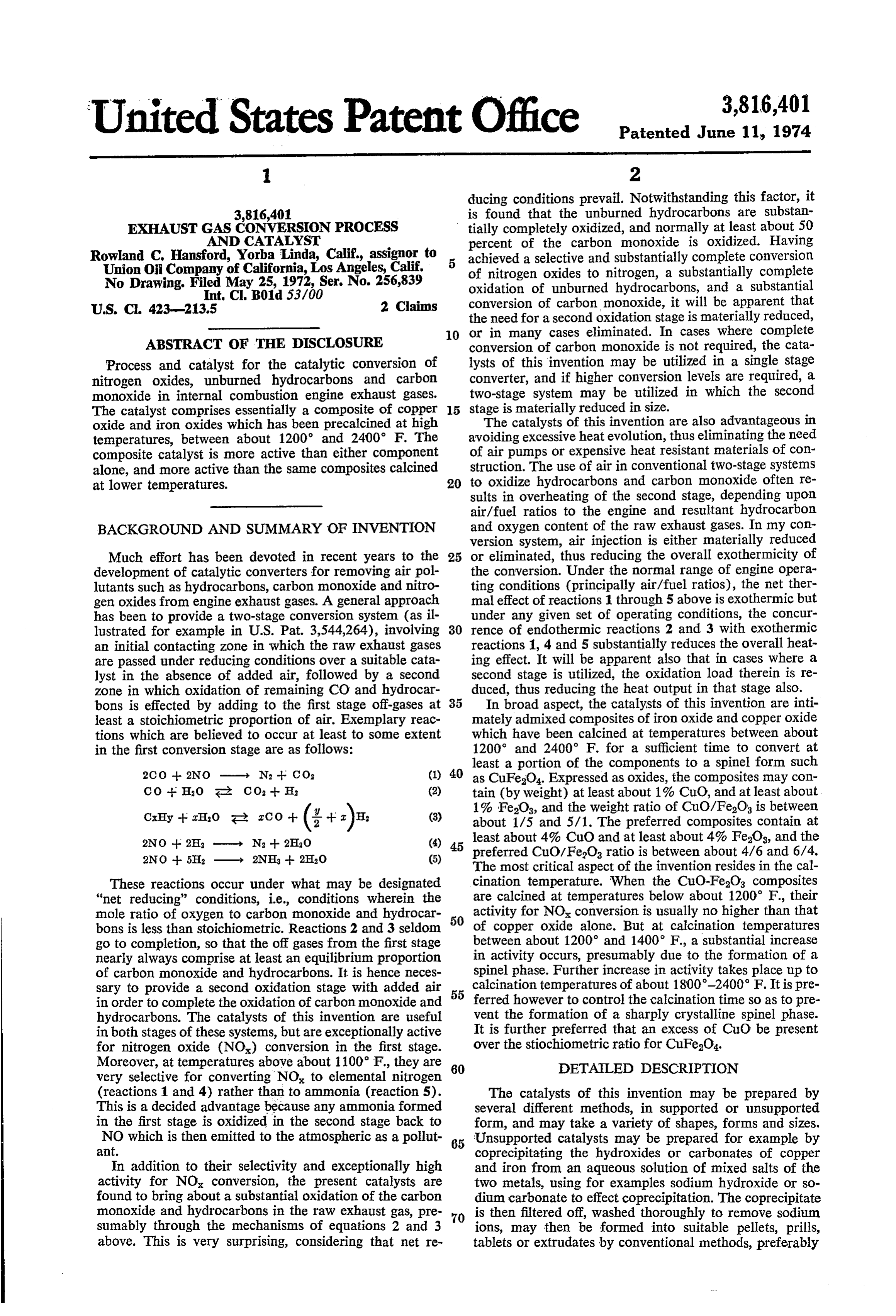
Much effort has been devoted in recent years to the 25 or eliminated, thus reducing the overall exothermicity of development of catalytic converters for removing air pol the conversion. Under the normal range of engine opera lutants such as hydrocarbons, carbon monoxide and nitro ting conditions (principally air/fuel ratios), the net ther gen oxides from engine exhaust gases. A general approach mal effect of reactions 1 through 5 above is exothermic but has been to provide a two-stage conversion system (as il under any given set of operating conditions, the concur lustrated for example in U.S. Pat. 3,544,264), involving 30 rence of endothermic reactions 2 and 3 with exothermic an initial contacting zone in which the raw exhaust gases reactions 1, 4 and 5 substantially reduces the overall heat are passed under reducing conditions over a suitable cata ing effect. It will be apparent also that in cases where a lyst in the absence of added air, followed by a second second stage is utilized, the oxidation load therein is re zone in which oxidation of remaining CO and hydrocar duced, thus reducing the heat output in that stage also. bons is effected by adding to the first stage off-gases at 35 In broad aspect, the catalysts of this invention are inti least a stoichiometric proportion of air. Exemplary reac mately admixed composites of iron oxide and copper oxide tions which are believed to occur at least to some extent which have been calcined at temperatures between about in the first conversion stage are as follows: 1200 and 2400 F. for a sufficient time to convert at least a portion of the components to a spinel form such 2CO -- 2NO - N - CO (1) 40 as CuFeO4. Expressed as oxides, the composites may con CO + H2O (-2 CO -- H, (2) tain (by weight) at least about 1% CuO, and at least about 1% Fe.O, and the weight ratio of CuO/FeO is between
CxHy -- aHO 2 a.CO -- (g - 2)H, (3) about 1/5 and 5/1. The preferred composites contain at 2NO -- 2H - N -- 2HO (4) 45 least about 4% CuO and at least about 4% FeO3, and the 2NO -- 5H2 - 2NH -- 2H2O (5) preferred CuO/FeO ratio is between about 4/6 and 6/4. The most critical aspect of the invention resides in the cal
These reactions occur under what may be designated cination temperature. When the CuO-Fe2O3 composites "net reducing' conditions, i.e., conditions wherein the are calcined at temperatures below about 1200 F., their mole ratio of oxygen to carbon monoxide and hydrocar 50 activity for NO conversion is usually no higher than that bons is less than stoichiometric. Reactions 2 and 3 seldom of copper oxide alone. But at calcination temperatures go to completion, so that the off gases from the first stage between about 1200 and 1400° F., a substantial increase nearly always comprise at least an equilibrium proportion in activity occurs, presumably due to the formation of a of carbon monoxide and hydrocarbons. It is hence neces spinel phase. Further increase in activity takes place up to sary to provide a second oxidation stage with added air 55 calcination temperatures of about 1800-2400 F. It is pre in order to complete the oxidation of carbon monoxide and ferred however to control the calcination time so as to pre hydrocarbons. The catalysts of this invention are useful vent the formation of a sharply crystalline spinel phase. in both stages of these systems, but are exceptionally active It is further preferred that an excess of CuO be present for nitrogen oxide (NO) conversion in the first stage. over the stiochiometric ratio for CuFeO. Moreover, at temperatures above about 1100 F., they are DETALED DESCRIPTION very selective for converting NO. to elemental nitrogen 60 (reactions 1 and 4) rather than to ammonia (reaction 5). The catalysts of this invention may be prepared by This is a decided advantage because any ammonia formed Several different methods, in supported or unsupported in the first stage is oxidized in the second stage back to form, and may take a variety of shapes, forms and sizes. NO which is then emitted to the atmospheric as a pollut 65 Unsupported catalysts may be prepared for example by ant. coprecipitating the hydroxides or carbonates of copper In addition to their selectivity and exceptionally high and iron from an aqueous solution of mixed salts of the activity for NO conversion, the present catalysts are two metals, using for examples sodium hydroxide or so found to bring about a substantial oxidation of the carbon dium carbonate to effect coprecipitation. The coprecipitate monoxide and hydrocarbons in the raw exhaust gas, pre 70 is then filtered off, washed thoroughly to remove sodium sumably through the mechanisms of equations 2 and 3 ions, may then be formed into suitable pellets, prills, above. This is very surprising, considering that net re tablets or extrudates by conventional methods, preferably
Page 2
with the aid of a suitable binder, e.g., 5-20 weight-percent EXAMPLES 1-3 of a gelatinous, acid-peptized alumina. Other conven tional binders such as clays and the like may also be Three unsupported catalysts of the present invention utilized. The granular composites so obtained are then were prepared by coprecipitation of Cu(OH)2 and dried and calcined as described hereinafter.
The coprecipitation technique however is not essential. Fe(OH) Fully equivalent results have been obtained by mixing the with sodium hydroxide from a solution of the nitrate salts. powdered metal oxides, mulling with peptized alumina or The coprecipitation was carried out by metering a stream other suitable binder, extruding, drying and calcining.
Other compounds, such as the metal carbonates, oxalates, IO of the salt solution and a stream of NaOH solution into the inlet of a centrifugal pump. By this means a very rapid nitrates, acetates, or similar salts whose anions can be mixing of the solutions at a constant pH of about 7.5 was readily decomposed during calcination, can also be used readily accomplished. The gelatinous precipitate was in preparing the catalyst by the co-mulling technique.
While highly active catalysts can be prepared by the filtered, dried at 220 F., and washed free of sodium above techniques, the resulting essentially undiluted com (0.01%) by a stream of deionized water flowing upward posites generally have an undesirably high density. Low through the granular solid. The washed product was dried density composites of substantially equal activity may be and pulverized through a 100-mesh screen. The powder prepared for example by grinding the comulled or copre was then thoroughly mulled with enough gelatinous acid cipitated metal compounds to micron or sub-micron size peptized alumina to give 10 percent by weight of alumina and then coextruding or copelleting the mixture with rela 20 in the final product. The mulled mix was extruded tively large amounts of alumina or other inert matrices through a 46' die, dried, and calcined for 3 hours at such as clays, silica gel, silica-alumina, and the like. 1100, 1400 and 1800° F. (separate portions). The Precalcined composites of iron oxide and copper oxide finished catalysts contained about 10% AlO3, 45% CuO may similarly be powdered and coextruded or copelleted and 45% Fe2O3 by weight.
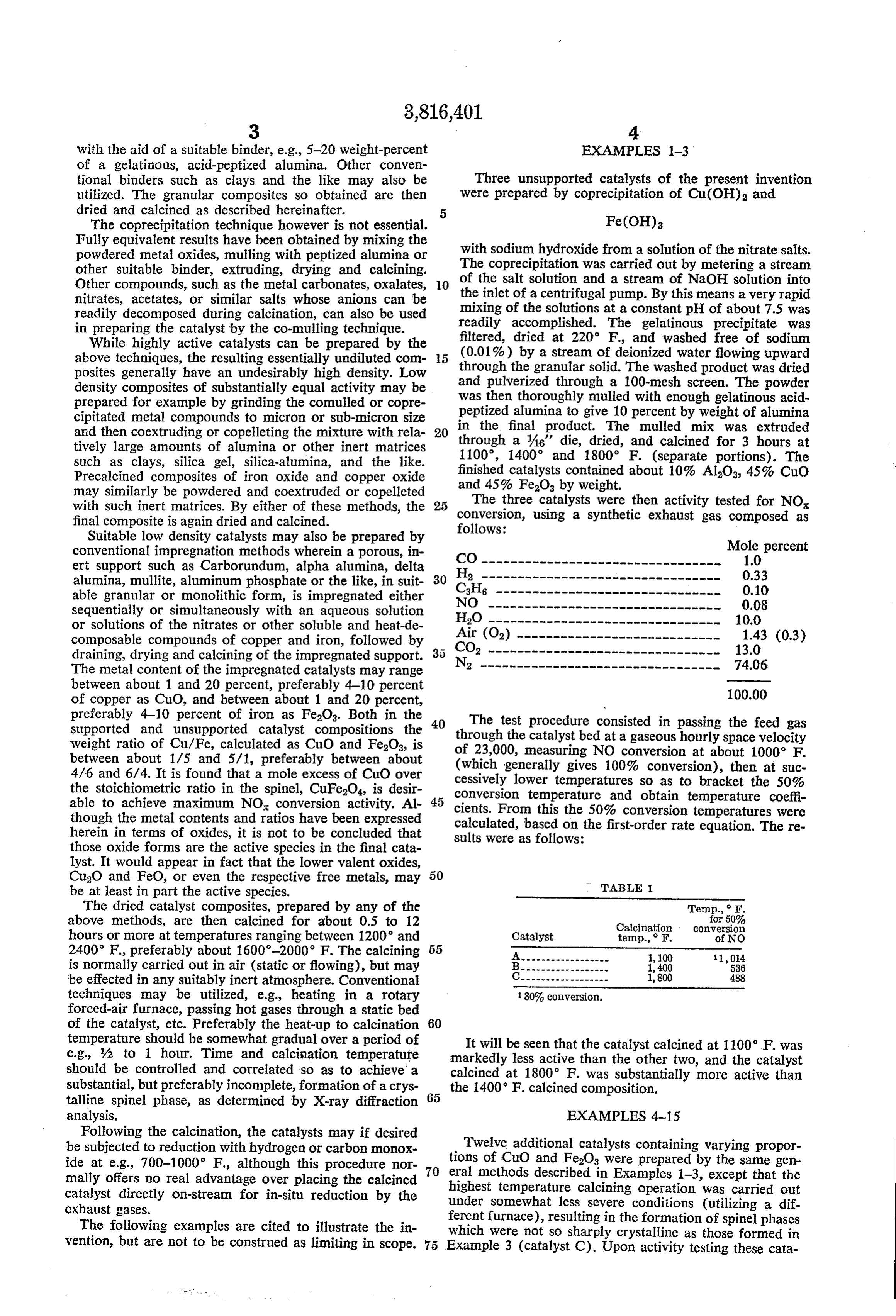
The three catalysts were then activity tested for NO with such inert matrices. By either of these methods, the 25 conversion, final composite is again dried and calcined. using a synthetic exhaust gas composed as Suitable low density catalysts may also be prepared by follows:
conventional impregnation methods wherein a porous, in Mole percent ert support such as Carborundum, alpha alumina, delta CO--------------------------------- 1.0 alumina, mullite, aluminum phosphate or the like, in suit 30 C3H6 H2 --------------------------------- 0.33 able granular or monolithic form, is impregnated either ------------------------------- 0.10 sequentially or simultaneously with an aqueous solution NO -------------------------------- 0.08 or solutions of the nitrates or other soluble and heat-de HaO -------------------------------- 10.0 composable compounds of copper and iron, followed by 8.2 (O2) ---------------------------- s (0.3) draining, drying and calcining of the impregnated support. - - - - - - - - - - - -- more m- - - - - - - - - - - - - - - 13.0
The metal content of the impregnated catalysts may range between about 1 and 20 percent, preferably 4-10 percent 100.00 of copper as CuO, and between about 1 and 20 percent, preferably 4-10 percent of iron as Fe2O3. Both in the The test procedure consisted in passing the feed gas supported and unsupported catalyst compositions the 40 through the catalyst bed at a gaseous hourly space velocity weight ratio of Cu/Fe, calculated as CuO and FeO, is of 23,000, measuring NO conversion at about 1000 F. between about 1/5 and 5/1, preferably between about (which generally gives 100% conversion), then at suc 4/6 and 6/4. It is found that a mole excess of CuO over cessively lower temperatures so as to bracket the 50% the stoichiometric ratio in the spinel, CuFeO4, is desir conversion temperature and obtain temperature coeffi able to achieve maximum NO conversion activity. Al 45 cients. From this the 50% conversion temperatures were though the metal contents and ratios have been expressed calculated, based on the first-order rate equation. The re herein in terms of oxides, it is not to be concluded that Sults were as follows:
those oxide forms are the active species in the final cata lyst. It would appear in fact that the lower valent oxides,
CuO and Fe0, or even the respective free metals, may 50 TABLE be at least in part the active species.
The dried catalyst composites, prepared by any of the Temp., F. above methods, are then calcined for about 0.5 to 12 Calcination
Conversion hours or more at temperatures ranging between 1200 and Catalyst temp., F. of NO 2400 F., preferably about 1600-2000 F. The calcining 55 A--- 1,100 11,014 is normally carried out in air (static or flowing), but may B-. 1,400 536 be effected in any suitably inert atmosphere. Conventional C--- 1,800 488 techniques may be utilized, e.g., heating in a rotary 30% conversion. forced-air furnace, passing hot gases through a static bed of the catalyst, etc. Preferably the heat-up to calcination 60 temperature should be somewhat gradual over a period of It will be seen that the catalyst calcined at 1100 F. was e.g., /2 to 1 hour. Time and calcination temperature markedly less active than the other two, and the catalyst should be controlled and correlated so as to achieve a calcined at 1800" F. was substantially more active than substantial, but preferably incomplete, formation of a crys the 1400 F. calcined composition. talline spinel phase, as determined by X-ray diffraction 65 analysis. EXAMPLES 4-15
Following the calcination, the catalysts may if desired be subjected to reduction with hydrogen or carbon monox Twelve additional catalysts containing varying propor ide at e.g., 700-1000 F., although this procedure nor 70 tions of CuO and Fe2O3 were prepared by the same gen mally offers no real advantage over placing the calcined eral methods described in Examples 1-3, except that the catalyst directly on-stream for in-situ reduction by the highest temperature calcining operation was carried out under somewhat less severe conditions (utilizing a dif exhaust gases. ferent furnace), resulting in the formation of spinel phases The following examples are cited to illustrate the in which were not so sharply crystalline as those formed in vention, but are not to be construed as limiting in scope. 75 Example 3 (catalyst C). Upon activity testing these cata
Page 3
lysts as described in Examples 1-3, the following results I claim:
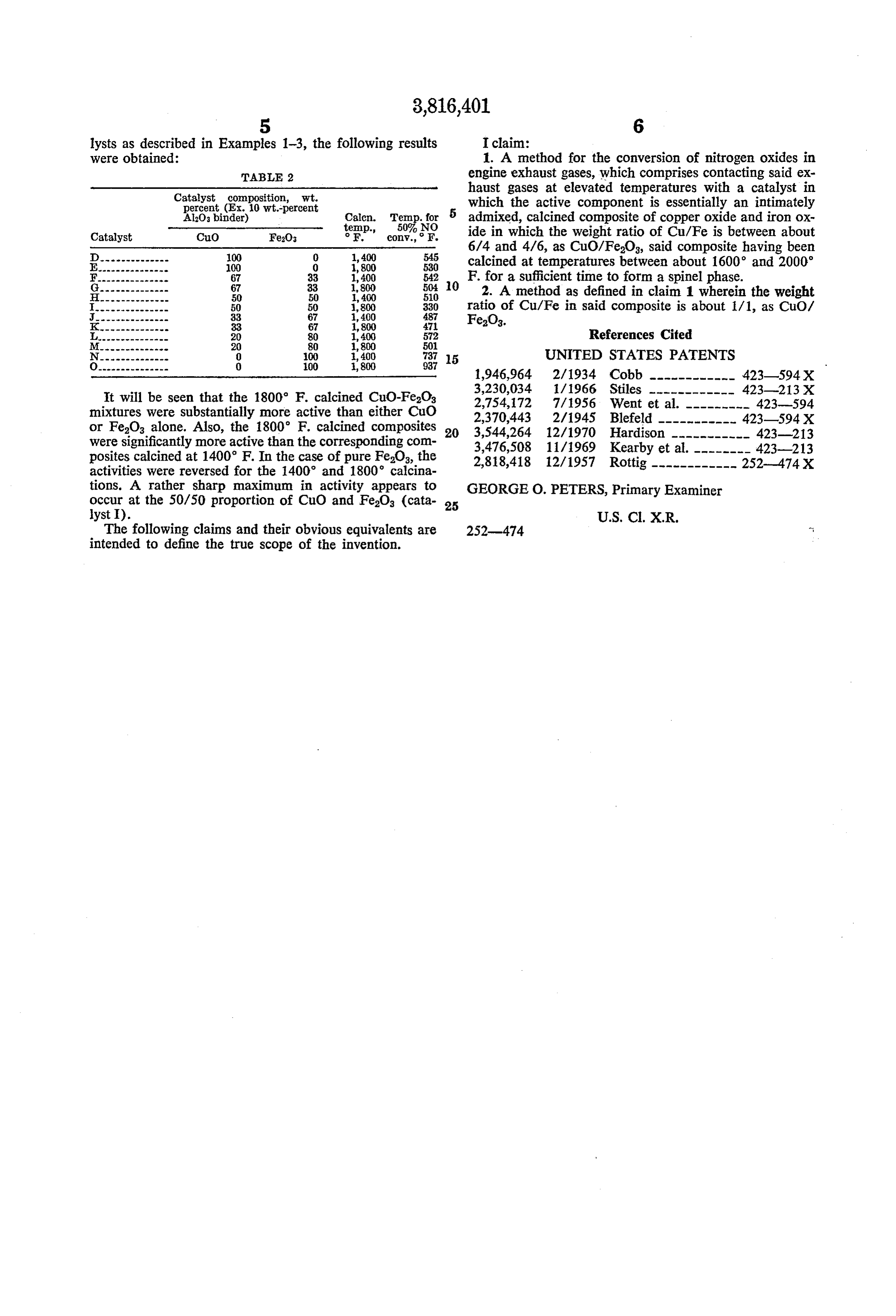
were obtained: 1. A method for the conversion of nitrogen oxides in TABLE 2 engine exhaust gases, which comprises contacting said ex VP haust gases at elevated temperatures with a catalyst in
Catalystit (Ex.
composition, 10 wt. wt. which the active component is essentially an intimately ASSE) percent St. TEp., admixed, calcined composite of copper oxide and iron ox
C&R. ide in which the weight ratio of Cu/Fe is between about - - - - 6/4 and 4/6, as CuO/Fe0, said composite having been g 8 SS 5 calcined at temperatures between about 1600 and 2000 67 33 1.66 542 F. for a sufficient time to form a spinel phase.
: E. : 2. A method as defined in claim 1 wherein the weight 50 50 1866 330 ratio of Cu/Fe in said composite is about 1/1, as CuO/
y 1,946,964. 2/1934 Cobb as a post as a ma - a - w w 423-594X
It will be seen that the 1800 F. calcined CuO-Fe2O3 3.299; 4:2: Sile et al - re- a or 121: mixtures were substantially more active than either CuO 2370443 2A1945 Blefeld ? um am m mwar as a423 594 X or FeO- alone. Also, the8 1800 F. calcined composites 20 3,544,264
were significantly more active than the corresponding com- 3,476,508 11/1969 Kearby et al. 423-213 posites calcined at 1400 F. In the case of pure Fe0, the activities were reversed for the 1400 and 1800 calcina
tions. A rather sharp maximum in activity appears to GEORGE. O. PETERS, Primary Exami occur at the 50/50 proportion of CuO and FeO (cata- 25 , Primary Examiner lyst I). 8. 4. U.S. C. X.R. The following claims and their obvious equivalents are 252-474 intended to define the true scope of the invention.
Provenance
- Collection
- Cited prior art
- Original PDF
- patentimages.storage.googleapis.com →
- Filed
- 1972-05-25
- Pages
- 3
- Method
- pdftotext (the PDF's own text layer) + pdftoppm 300dpi page scans
- Source
- Google Patents bibliographic record
- Granted
- 1974-06-11
- Inventors
- R Hansford; Union Oil Company of California
- Transcribed from
- patentimages.storage.googleapis.com →