patent · US3792690
Method and system for open cycle operation of internal combustion engines
19 February 1974
Page 1 — bibliographic record
United States Patent (19) [11] 3,792,690 Cooper (45) Feb. 19, 1974 54 METHOD AND SYSTEM FOR OPEN CYCLE chamber of the engine with a given ratio of hybrid air OPERATION OF INTERNAL COMBUSTION and fuel. The hybrid air is comprised essentially of ox ENGINES ygen from a diatomic oxygen source or in part by oxy gen and in part by an oxygen diluent from the engine's 76) Inventor: Theodore W. Cooper, 1269 products of combustion. The system provides a fuel Parkwood Dr., Novato, Calif. 94.947 limited combustion process by establishing a stoichio 22 Filed: Mar. 22, 1972 metric excess of oxygen in the hybrid air of the com bustion charge and with the oxygen diluent comprising (21) Appl. No.: 236,818 essentially gaseous carbon dioxide, or a mixture of gaseous carbon dioxide and water, with little or no ni 52 U.S. C. ............. 12313, 12311 19 A, 123/119 E, trogen. The combustion process is highly efficient and 12311 19 R produces relatively little or no unburned fuel compo 51 int. Cl............................................. F02b 51/00 nents, and relatively little or no nitrogen oxides, in the 58) Field of Search...... 123/119 E, 1 19 A; 423/218 exhaust. In one embodiment a portion of the exhaust gases is diverted to produce the diluent which is then 56) References Cited combined with diatomic oxygen to form hybrid air in UNITED STATES PATENTS a preset ratio to provide the stoichiometric excess of 3,559,402 2/1971 Stone et al...................... 12311 19 A oxygen with respect to the fuel charge, and the hybrid air is then directed to the combustion chamber on a 1,120,828 12/1914 Lowry............................. 12311 19 A 3,677,239 7/1972 Elkins............................. 12311 19 A demand basis. In another embodiment the oxygen is 3,672,341 6/1972 Smith et al...................... 12311 19 E first combined with fuel to form an oxygen/fuel mix 3,618,576 1 1/1971 Dixon ............................. 12311 19 A ture which is added to the exhaust product diluent in 2,960,834 1 1/1960 Patrick..... ... 123/119 E an intake manifold. In another embodiment an ox 3,406,014 9/1968 Guerrieri............................ 423.1218 ygen/fuel mixture is added to the exhaust product dil 3,310,381 3/1967 Guerrieri............................ 423/218 uent in the combustion chamber. In another embodi 3,121,611 2/1964 Parker................................ 423/218 ment the rate of combustion is limited by providing a 3,425,402 2/1969 Reisacher........................ 123/19 E hybrid fuel which includes a fuel diluent. In another 3,602,202 8/1971 Kobayashi. ... 12311 19 E X embodiment the oxygen source comprises a chemical 3,556,066 1/1971 Muirhead.................... 1231 19 E X process utilizing a reducing agent for combination Primary Examiner-Laurence M. Goodridge with oxygen in atmospheric air by formation of an ox Attorney, Agent, or Firm-Flehr, Hohbach, Test, Al ide, followed by an endothermic dissociation of the britton & Herbert oxide to release the oxygen for storage under pressure. In another embodiment the oxygen source comprises a 57 ABSTRACT physical process which includes liquifying air to ex A method and system for the open cycle operation of tract nitrogen therefrom by fractional distillation and returning the nitrogen to the atmosphere after trans an internal combustion engine to achieve more com ferring heat to it from the air being taken in for liquifi plete combustion and increased efficiency, and to ef cation.
fectively reduce or eliminate harmful exhaust pollut ants. A combustible charge is formed in a combustion 16 Claians, 6 Drawing Figures
aAvaag Y
COOLAA
ZAvvaaavaa cofas.us/ew OXYGaAW COO.A.A.
AAWaAWA AXA-aust
SOUAgca GASAS
awaay
CoOLaw 7
Page 2
Drawing sheet — no readable text.
Page 3
Drawing sheet — no readable text.
Page 4
Drawing sheet — no readable text.
Page 5
Drawing sheet — no readable text.
Page 6
METHOD AND SYSTEM FOR OPEN CYCLE Another object is to provide an open cycle method OPERATION OF INTERNAL COMBUSTION and system of the foregoing nature in which the induc ENGINES tion charge includes hybrid air comprising oxygen sup plied from an oxygen source which extracts diatomic
BACKGROUND OF THE INVENTION oxygen, either directly or indirectly, from atmospheric air and which exhausts directly to atmosphere.
This invention relates to a method and system for op Another object is to provide a method and system of erating an internal combustion engine on an open cy the foregoing nature in which the combustion charge cle, i.e., a cycle extracting oxygen, either directly or in comprises a fuel, diatomic oxygen and means for limit directly, from the atmosphere and exhausting directly O ing the rate of combustion such as an oxygen diluent, to atmosphere, and in particular relates to a method a fuel diluent, or the controlled injection of fuel, oxy and system of the foregoing nature which by changing gen or a mixture of oxygen and fuel. the limitation on both combustion and combustion rate Another object is to provide an open cycle method provides more complete combustion efficiency and and system of the foregoing nature in which the oxygen substantially reduces or eliminates harmful pollutants 15 diluent of the induction charge, as required for limiting in the exhaust from the engine. the combustion rate, is supplied in part or in whole There has been an increasing recognition of the from the gaseous products of combustion thereby re harmful pollution effects from the exhaust components ducing or eliminating nitrogen as the diluent. As a re of conventional internal combustion engines. Among suit nitrogen oxides are substantially reduced or elimi the primary reasons that such engines are a serious nated from the exhaust while at the same time the source of pollution are, first, that combustion of the chemical equilibrium temperature of combustion, and fuel over the engine's most useful range of power out therefore the combustion rate, is limited throgh dissoci put is limited by the amount of oxygen available in the ation of diluent and combustion products. A portion of atmosphere so that oxidation is not complete with a re 25 the energy of combustion is thereby momentarily sulting large yield of quantities of carbon monoxide and stored for later release upon reformation of the dissoci unburned hydrocarbons in the exhaust, and second, that nitrogen, comprising approximately 80 percent of ated tion materials during expansion and exhaust. Reforma is assured by virtue of the excess oxygen present atmospheric air, dissociates at high combustion tem and because peratures and forms a number of harmful nitrogen ox-o combustibles.the dissociated materials are oxygen and ides which pollute the atmosphere when released in the exhaust. The provision of a sufficient stoichiometric ex theThe foregoing and additional objects and features of cess of oxygen will cause each combustion charge to operation andaresystem invention provided by an open cycle method of for an internal combustion en become fuel-limited rather than oxygen-limited so that gine which includes a source of diatomic oxygen such oxidation during expansion and exhaust will be com 35 as provided by chemical or from plete. However, where nitrogen is used as the oxygen the atmospheric air, or by liquified the extraction from oxygen and the like.
diluent, as in conventional engines, the combustion A quantity of the diatomic oxygen is combined rate will then be sufficiently increased by the excess ox quantity of oxygen diluent, which is comprised atwith a least ygen so that the maximum combustion temperature will be increased with a concomitant increased yield of 40 in form part by products of combustion from the engine, to a charge of hybrid air having predetermined stoi harmful nitrogen oxides, and other harmful effects such chiometric excess of oxygen for combusting a charge of as increased detonation, failure of material due to high temperatures, and the like. fuel. Thus, the combustion charge of hydrid air and fuel It would be desirable in most cases to provide a sys is comprised of diatomic oxygen, in stoichiometric ex tem which, when required, either substantially replaces 45 cess, a fuel, and an oxygen diluent in sufficient quantity the nitrogen of the combustion charge for an internal to properly limit the rate of combustion where such a combustion engine with one or more components of limitation is not effected by other means, such as con the exhaust gas as the oxygen diluent, or provides a trolling fuel injection rate or by a dissociable fuel dilu suitable organic fuel diluent. Such a system would sup ent, although any order of combination of these com ply the desired stoichiometric excess of oxygen for 50 ponents of the charge lies within the invention. In one complete combustion and thus the reaction or elimina embodiment the hydrid air is formed by compressing a tion of unburned fuel, control the combustion rate and predetermined ratio of oxygen and exhaust gasses and therefore maximum combustion temperatures, and then regulating the flow of compressed hybrid air to the eliminate nitrogen oxides from the engine's exhaust. 55 engine on a demand basis. In another embodiment the oxygen is combined with fuel in proper proportion, and
OBJECTS AND SUMMARY OF THE INVENTION directed into the engine where a portion of the gasses It is a principle object of the invention to provide an from the exhaust phase of the engine comprises the ox open cycle method and system for operating internal ygen diluent for the combustion charge. In another em combustion engines which provides more complete bodiment an oxygen/fuel mixture is combined with ex fuel combustion and which substantially reduces or 60 haust product diluent in the intake manifold for induc eliminates harmful pollutants in the exhaust from the tion into the engine. In another embodiment a hydrid engine. fuel which includes a fuel diluent is provided to limit Another important object is to provide a method and the rate of combustion.
system which converts the internal combustion engine Additional objects and features of the invention will commonly regarded as being inherently dirty into an 65 become apparent from the following description in engine which may be regarded as being inherently which the preferred embodiments of the invention have clean. been set forth in detail in conjunction with the drawing.
Page 7
BRIEF DESCRIPTION OF THE DRAWING
oxygen source may be of suitable type, either chemical or physical or may comprise bottled compressed oxy
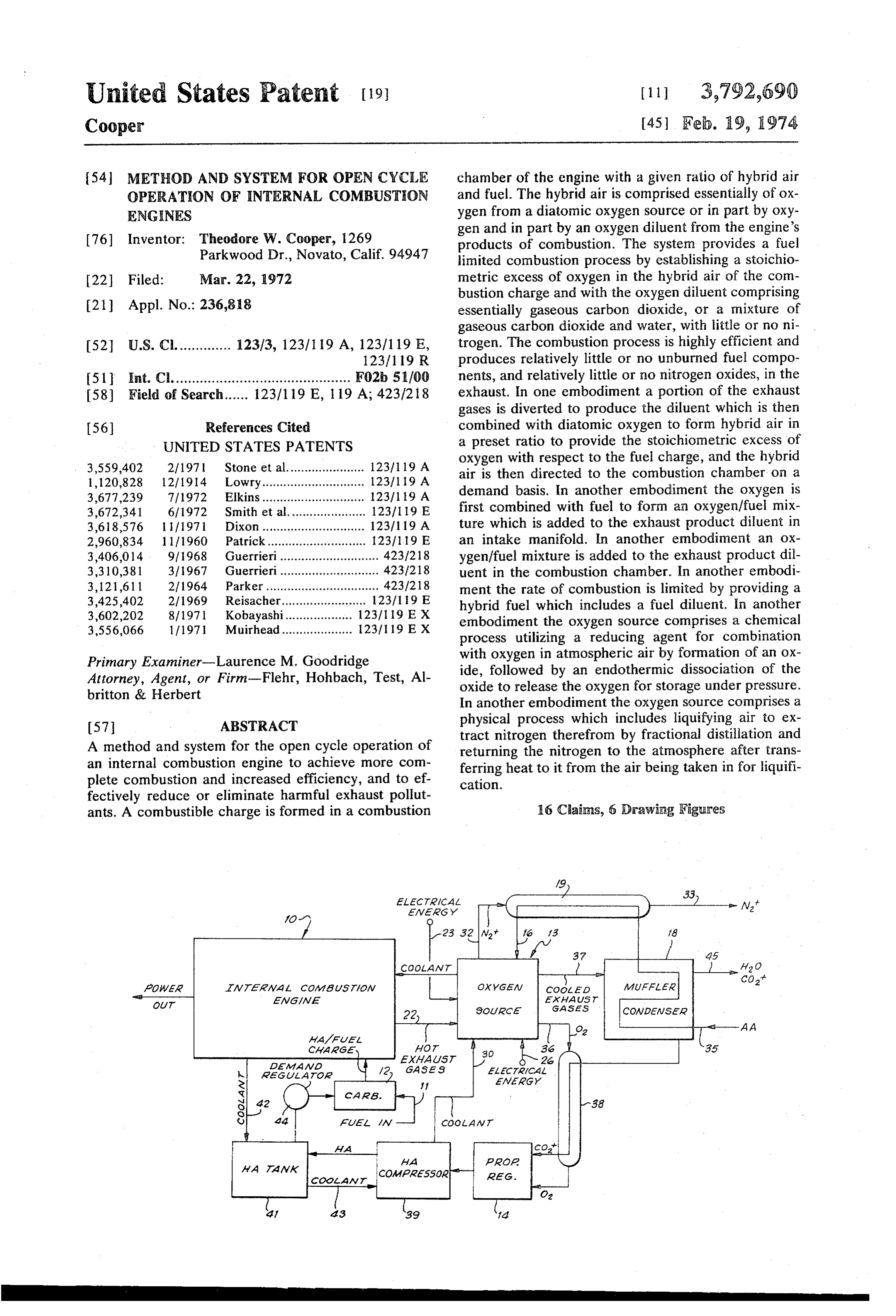
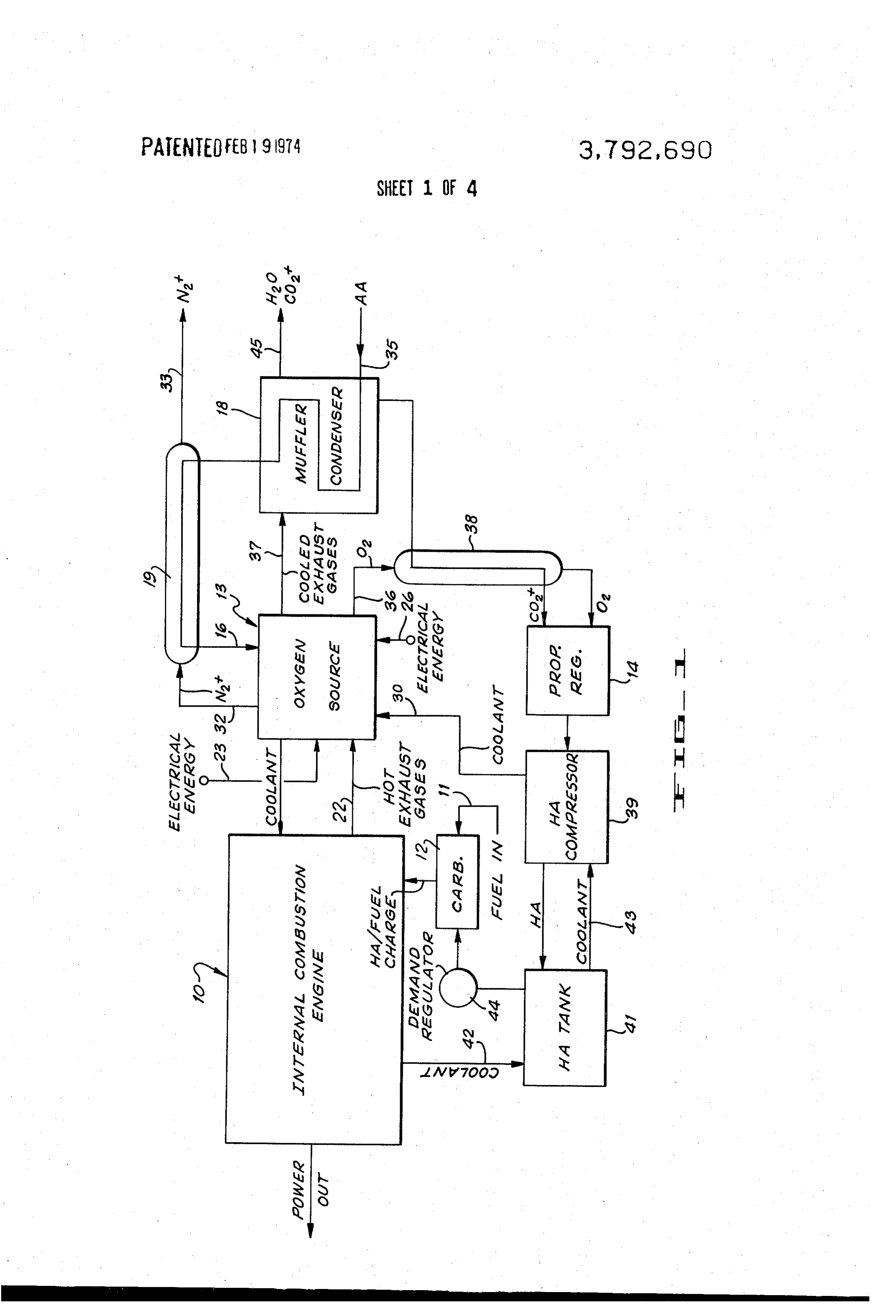
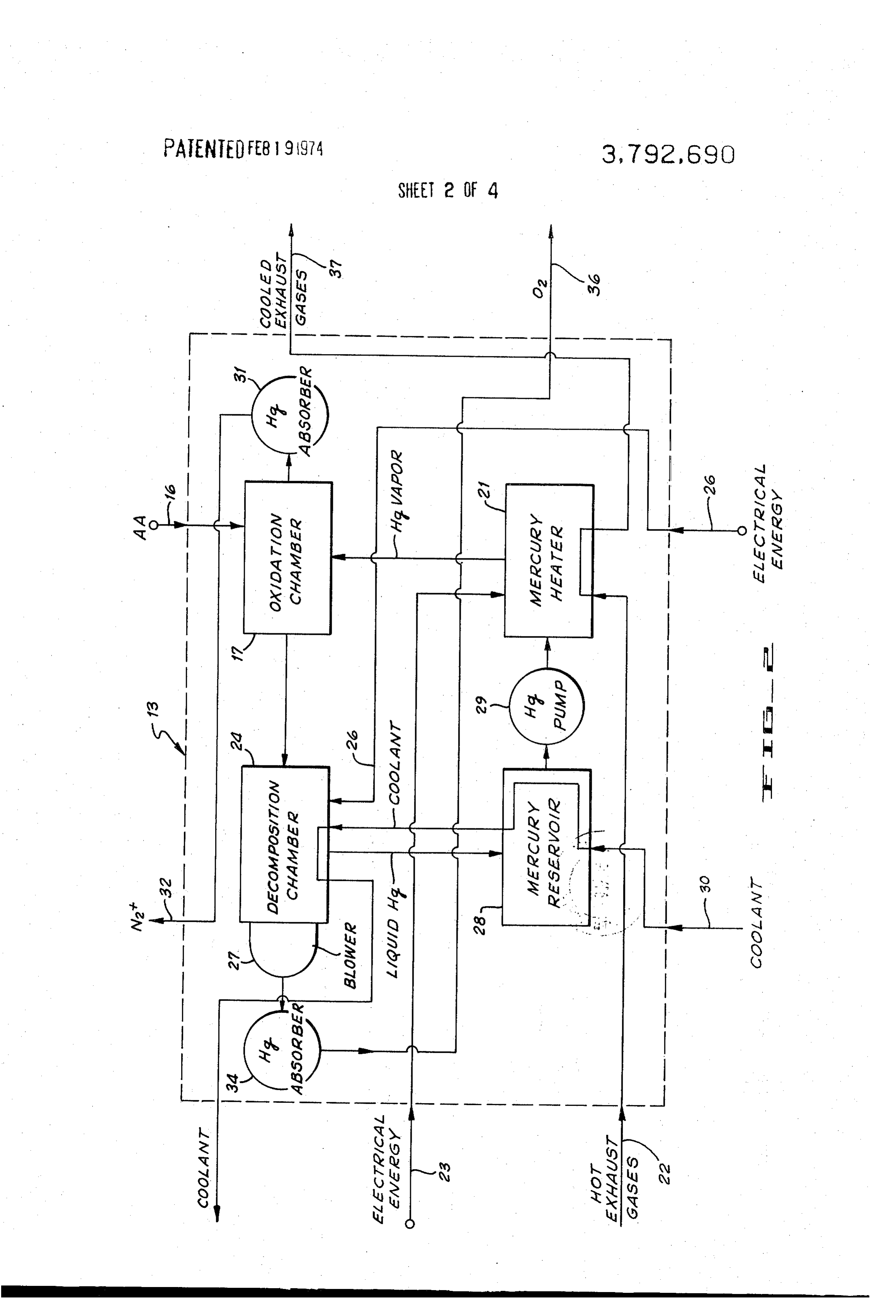
FIG. 1 is a schematic diagram of an internal combus gen or liquified oxygen.
tion engine system for carrying out the method of the A suitable chemical separator for oxygen source 13 invention; as illustrated schematically in FIG. 2 provides a process FIG. 2 is a schematic diagram of the oxygen source in which a reducing agent comprising vaporized mer for the system of FIG. 1; cury is formed into an oxide in an exothermic reaction, FIG. 3 is a schematic diagram of another embodi the oxide is removed and decomposed is an endother ment of the invention; mic reaction into mercury and oxygen constituents, FIG. 4 is a schematic diagram of another embodi 10 and the oxygen is separated for storage as the mercury ment of the invention; is returned for another cycle. Atmospheric air which is FIG. 5 is a chart illustrating a preferred valve timing cleaned and pre-heated to a temperature within the arrangement for an engine used with the embodiment range of 180° to 480° F, depending upon the particular of FIG. 4; catalysts employed (preferably Manganese Dioxide) FIG. 6 is a schematic diagram of another embodi 15 and further depending upon the mercury vapor temper ment of the invention. ature, is directed at 16 into an oxidation chamber 17 in
DESCRIPTION OF THE PREFERRED
a fast flowing stream. The incoming air preferably is
EMBODIMENTS
pre-heated by heat transfer from the exhaust gasses, in the muffler-condenser 18 of FIG. 1, and by heat trans
In the drawings FIG. 1 illustrates a preferred embodi 20 fer from heat exchanger i9 through which separated ment of the invention incorporating an internal com nitrogen exhausts from the oxygen source. A mercury bustion engine system which is suitable for substantially heater 21 is provided to generate mercury vapor at a reducing or eliminating the harmful exhaust pollutants temperature within the range of 615 to 1,800 F, and under most conditions of operation at least after an en this vapor is injected into an oxidation chamber 17 in gine's warm-up period. In the system a suitable internal 25 a direction counter to the flow of incoming air to create combustion engine 10 of either conventional Otto turbulence and enhance mixing within the oxidation cycle or Diesel cycle operation, or of reciprocating or chamber. The heat for vaporizing the mercury within rotary design, including gas turbines, is provided and the heater 21 is provided by passing the hot exhaust incorporates one or more combustion chambers and gasses from the engine through circuit 22 of FIG. , and suitable intake and exhaust manifolding. Aspiration for 30 as required, from an electric energy source 23 control fuel induction from an inlet 11 connected with a source ling suitable means such as resistance heating elements. of fuel such as liquid hydrocarbon fuel is provided by Mercury oxides are formed exothermically in oxidation a suitable carburetor 12, although the invention will chamber 17, chiefly through the formation of mercuric also find use in engine designs utilizing fuel injection 35 oxide according to the chemical equation: rather than carburetion. --
An intake charge of hybrid air, designated herein as
HA, is combined with a charge of fuel for a fuel-limited The reaction conditions of pressure, temperature and combustion process. The hybrid air comprises diatomic material concentration are established to favor forma oxygen (O) present in the range of from about 15 to 40 tion of HgO. The solid particulate mercury oxides are 100 percent by weight with the remainder of an oxygen transferred by suitable means to the low pressure de diluent comprised at least in part by products of com composition chamber 24 where the oxides float upon bustion. The oxygen diluent functions to limit the rate a pool of liquid mercury of decomposition. The oxides of combustion so that the period of combustion is are decomposed in an endothermic reaction into mer spread over a longer time span in relation to the com 45 cury and diatomic oxygen with the energy for decom bustion which would occur between fuel and pure oxy position being supplied by suitable means such as high gen alone. It is preferred for the embodiment of FIG. intensity ultra violet lights of about 2,537A and 1,849A 1 that the quantity of O, in the HA is sufficient to form wave lengths for absorption by the mercury and the ox a stoichiometric excess of oxygen in the range of 0-25 ygen, respectively, of the oxides. Energy for the ultra percent by weight for combusting a predetermined 50 voilet lights is supplied through circuit 26 from a suit charge of fuel, and to assure that the combustion is fuel able electric energy source. The oxygen of decomposi limited. tion is removed from chamber 24 by suitable gas The embodiment of FIG. 1 forms the substantially ni blower 27 while the mercury of decomposition which trogen free hybrid air by utilizing a portion of the ex is formed in the liquid pool is directed to a mercury res haust products, which initially are comprised of largely 55 ervoir 28.
carbon dioxide and water vapor, through a system in A mercury pump 29 pumps liquid mercury from res which the water vapor is removed and a portion of the ervoir 28 for recycle to mercury heater 21. A suitable carbon dioxide is combined with diatomic oxygen from coolant, preferably from the engine cooling system, is oxygen source 13 in proportioning regulator 14. The circulated through circuit 30 serially through mercury method and system of the invention is open cycle in 60 reservoir 28 and decomposition chamber 24 for cool operation in that the pollutant-free waste gasses from ing these respective composition to maintain proper the overall system are exhausted directly to atmosphere temperature levels.
while oxygen is extracted from the atmosphere either Gaseous nitrogen and other gasses remaining from directly or indirectly. In addition, in the embodiment of the atmospheric air after separation of oxygen there FIG. 1 the supply of oxygen is extracted directly from 65 from in oxidation chamber 17 are passed through a atmospheric air, designated AA, through oxygen suitable mercury vapor absorber 31 to remove all source 13 which comprises the sub-system of FIG. 2 for traces of mercury vapor. The Ng" is then directed chemically separating oxygen from air, although the through circuit 32 into heat exchanger 19 from which
Page 8
it is exhausted to atmosphere through outlet 33. Simi stant weight ratio of hybrid air to fuel can be supplied larly, the oxygen which is removed from decomposition to the engine by carburetor 12 at all levels of power chamber 24 is passed through a mercury vapor ab output so long as the hybrid air is comprised of a con sorber 34 which also removes all traces of mercury stant proportion of oxygen and diluent. Preferably reg vapor in the stream of oxygen exiting through circuit ulator 14 is of suitable design which utilizes a spring 36. loaded piston (or diaphragm) actuated responsive to Another oxygen separation process which may be oxygen pressure from source 13 to conjointly vary the utilized in the invention is that known as Brin's process flow orifice areas which meter both O and CO in a in which barium dioxide is formed when barium oxide predetermined proportion. Fine adjustment of the rela is heated in air to about 500° C. according to the fol O tive proportion of O in the mixture is accomplished lowing reaction: through adjustment of the spring force on the piston. 2BaO -- O - 2BaO, The O2 ratio in the hybrid air mixture is established from predetermined calculations based upon the par
Upon heating the barium dioxide to a higher temper ticular type of fuel employed and the HA to fuel ratio ature on the order of 800 C, or if the pressure is re 15 to be used to provide a stoichiometric excess of oxygen duced without altering the temperature, diatomic oxy between the limits of 0 - 25 percent by weight so that gen is given off and barium oxide remains as a residue complete combustion is assured. It will be assumed for according to the following reaction: the following examples that octane (CH3) is em ployed as the fuel. Octane undergoes the combustion 2BaO - 2BaO + O. 20 reaction CH-O HO + CO, and 12.5 moles of Barium oxide is thus suitable for use in the invention oxygen are required for stoichiometric combustion of as the reducing agent which reacts in an oxidation 1 mole of octane. For a first example, utilizing CO -- chamber of the type described with the oxygen of at as the diluent comprising 70 percent by volume CO, mospheric air to form a higher oxide, and this higher and product oxygen, proportioning regulator 4 is ad oxide is transferred to a decomposition chamber of the 25 justed to provide an 8 percent stoichiometric excess of type described where it is decomposed for liberating oxygen (of which 12.7 moles are supplied by the oxy diatomic oxygen with the resulting lower oxide being gen source and the remainder from product oxygen). recycled. The hybrid air constituents would be 13.5 moles of O, A number of other metals which are characterized in and 31.5 moles of CO2, per mole of fuel. For a second having higher oxides that lose oxygen upon heating to 30 example, utilizing total exhaust (CO, H2O and product give a residual lower oxide may also be utilized in the oxygen) as the diluent comprising 60 percent by vol invention. As an example, the oxides of manganese and ume of the hybrid air regulator 4 is again adjusted to lead liberate oxygen according to the following reac provide an 8 percent stoichiometric excess. In this case, tions:
12.96 moles of oxygen are supplied by the oxygen source for the hybrid air per mole of fuel since about 3MnO - MnO + O. 54 percent of the excess product oxygen (0.46 moles) 2PbO - 2PbO + O. is returned for reuse with the exhaust gasses used as dil uent.
2PbO - 6PbO + O. Proportioning regulator 14 directs the flow of hybrid The oxides of the so-called noble metals of mercury, 40 air into a suitable compressor 39, which may be pow gold and silver decompose completely upon heating ered by suitable means such as from the drive shaft of and may also be utilized in a recycling process of the the engine or an electrical energy source, and which type described to separate oxygen from atmospheric compresses the hybrid air to a pressure within the range a. of 3 - 10 atmospheres for accumulation in pressure The exhaust gasses from the engine, after giving up 45 tank 41 having a sufficient capacity to accommodate a a portion of their heat energy in the mercury heater of range of load requirements and accommodate varia oxygen source 13, are directed through circuit 37 into tions in the system between hybrid air usage and re muffler-condenser 18 where they flow in heat exchange placement. A suitable coolant, preferably the coolant relationship with the inlet 35 for the incoming atmo 50 from the engine's cooling system, is directed through spheric air. The exhaust gas mixture is thereby cooled the circuits 42 and 43 for cooling the storage tank and at a temperature below its dew point so that a substan compressor, and then through circuit 30 for use as de tial amount of the water vapor in the exhaust is con scribed in oxygen source 13.
densed and separated from the remaining exhaust Means are provided to direct a charge of the hybrid product, symbolized CO+, which comprises princi 55 air into the combustion chamber for mixture and com pally CO, and the excess oxygen remaining from the bustion with the fuel charge, and this means includes a combustion process. A portion of the CO+ is directed demand regulator 44 coupled with the preferred carbu through heat exchanger 38 in heat exchange relation retor 12. The demand regulator comprises a suitable ship with circuit 36 directing oxygen from source 13 for pressure responsive valve which maintains a down temperature equalization with, and for diluting, the 60 stream flow of hybrid air at a predetermined pressure flow of supply oxygen to yield a properly proportional level responsive to engine demand which varies in ac hybrid air mixture. cordance with engine speed and throttle opening of the From heat exchanger 38 the O, and CO2+ are di carburetor to thereby establish the required pressure rected into the proportioning regulator 14 which mixes differential in the induction manifold leading to the the two supply flows at a pre-selected ratio suitable for 65 combustion chamber. For example, the delivery pres maintaining the desired stoichiometric excess of oxy sure of regulator 44 can be preset at substantially two gen for combusting each charge of fuel introduced into atmospheres in order to provide for a rapid engine re the engine. Since the combustion is fuel limited a con sponse to changes of throttle opening whereby all in
Page 9
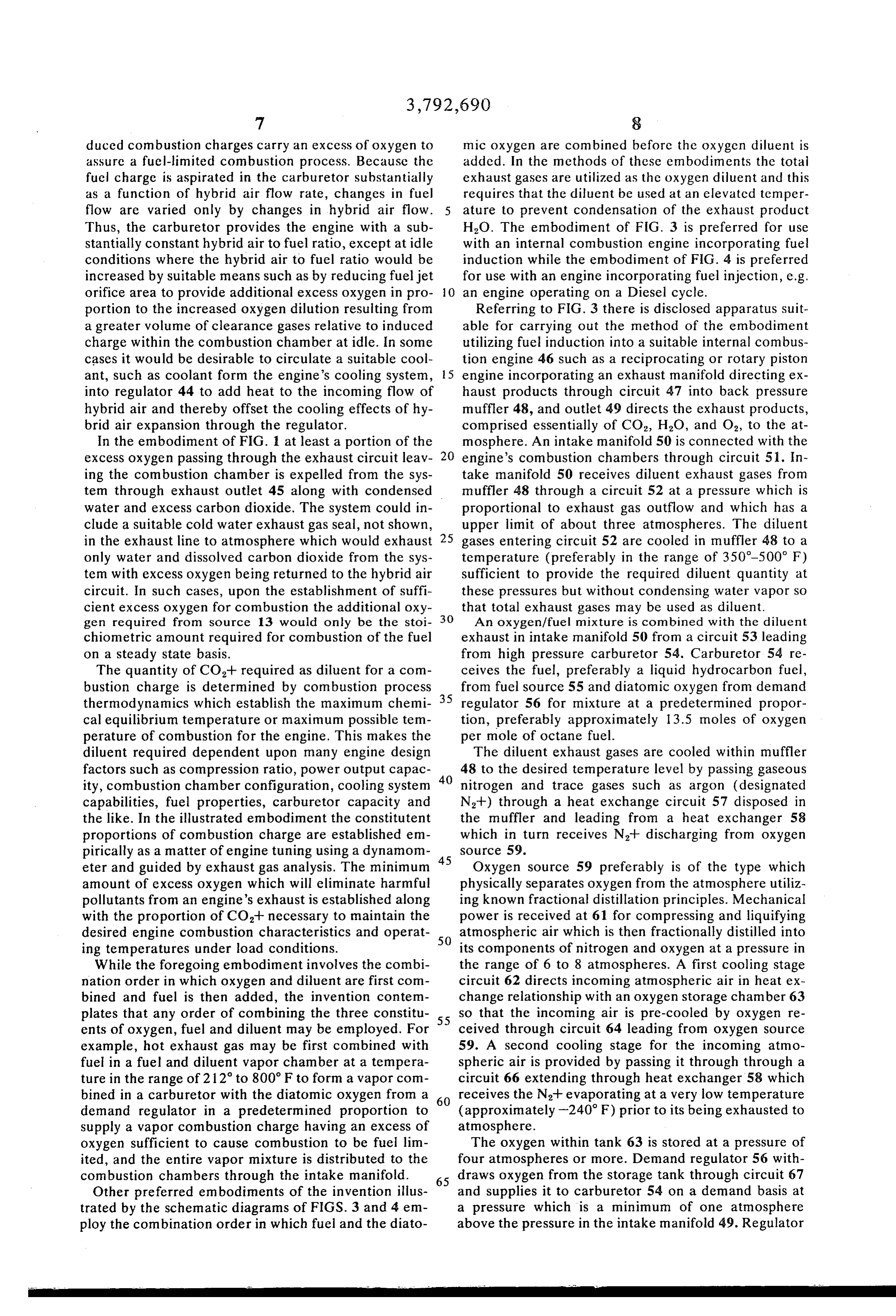
7 S duced combustion charges carry an excess of oxygen to mic oxygen are combined before the oxygen diluent is assure a fuel-limited combustion process. Because the added. In the methods of these embodiments the total fuel charge is aspirated in the carburetor substantially exhaust gases are utilized as the oxygen diluent and this as a function of hybrid air flow rate, changes in fuel requires that the diluent be used at an elevated temper flow are varied only by changes in hybrid air flow. ature to prevent condensation of the exhaust product Thus, the carburetor provides the engine with a sub HO. The embodiment of FIG. 3 is preferred for use stantially constant hybrid air to fuel ratio, except at idle with an internal combustion engine incorporating fuel conditions where the hybrid air to fuel ratio would be induction while the embodiment of FIG. 4 is preferred increased by suitable means such as by reducing fuel jet for use with an engine incorporating fuel injection, e.g. orifice area to provide additional excess oxygen in pro O an engine operating on a Diesel cycle. portion to the increased oxygen dilution resulting from Referring to FIG. 3 there is disclosed apparatus suit a greater volume of clearance gases relative to induced able for carrying out the method of the embodiment charge within the combustion chamber at idle. In some utilizing fuel induction into a suitable internal combus cases it would be desirable to circulate a suitable cool tion engine 46 such as a reciprocating or rotary piston ant, such as coolant form the engine's cooling system, 5 engine incorporating an exhaust manifold directing ex into regulator 44 to add heat to the incoming flow of haust products through circuit 47 into back pressure hybrid air and thereby offset the cooling effects of hy muffler 48, and outlet 49 directs the exhaust products, brid air expansion through the regulator. comprised essentially of CO2, H2O, and O2, to the at In the embodiment of FIG. 1 at least a portion of the mosphere. An intake manifold 50 is connected with the excess oxygen passing through the exhaust circuit leav 20 engine's combustion chambers through circuit 51. In ing the combustion chamber is expelled from the sys take manifold 50 receives diluent exhaust gases from tem through exhaust outlet 45 along with condensed muffler 48 through a circuit 52 at a pressure which is water and excess carbon dioxide. The system could in proportional to exhaust gas outflow and which has a clude a suitable cold water exhaust gas seal, not shown, upper limit of about three atmospheres. The diluent in the exhaust line to atmosphere which would exhaust 25 gases entering circuit 52 are cooled in muffler 48 to a only water and dissolved carbon dioxide from the sys temperature (preferably in the range of 350°-500 F) tem with excess oxygen being returned to the hybrid air sufficient to provide the required diluent quantity at circuit. In such cases, upon the establishment of suffi these pressures but without condensing water vapor so cient excess oxygen for combustion the additional oxy 30 that total exhaust gases may be used as diluent. gen required from source 13 would only be the stoi An oxygen/fuel mixture is combined with the diluent chiometric amount required for combustion of the fuel exhaust in intake manifold 50 from a circuit 53 leading on a steady state basis, from high pressure carburetor 54. Carburetor 54 re The quantity of CO+ required as diluent for a com ceives the fuel, preferably a liquid hydrocarbon fuel, bustion charge is determined by combustion process from fuel source 55 and diatomic oxygen from demand thermodynamics which establish the maximum chemi 35 regulator 56 for mixture at a predetermined propor cal equilibrium temperature or maximum possible tem tion, preferably approximately 13.5 moles of oxygen perature of combustion for the engine. This makes the per mole of octane fuel.
diluent required dependent upon many engine design The diluent exhaust gases are cooled within muffler factors such as compression ratio, power output capac 40 48 to the desired temperature level by passing gaseous ity, combustion chamber configuration, cooling system nitrogen and trace gases such as argon (designated capabilities, fuel properties, carburetor capacity and Na+) through a heat exchange circuit 57 disposed in the like. In the illustrated embodiment the constitutent the muffler and leading from a heat exchanger 58 proportions of combustion charge are established em which in turn receives Na+ discharging from oxygen pirically as a matter of engine tuning using a dynamom source 59.
eter and guided by exhaust gas analysis. The minimum 45 Oxygen source 59 preferably is of the type which amount of excess oxygen which will eliminate harmful physically separates oxygen from the atmosphere utiliz pollutants from an engine's exhaust is established along ing known fractional distillation principles. Mechanical with the proportion of CO+ necessary to maintain the power is received at 61 for compressing and liquifying desired engine combustion characteristics and operat atmospheric air which is then fractionally distilled into ing temperatures under load conditions. its components of nitrogen and oxygen at a pressure in While the foregoing embodiment involves the combi the range of 6 to 8 atmospheres. A first cooling stage nation order in which oxygen and diluent are first com circuit 62 directs incoming atmospheric air in heat ex bined and fuel is then added, the invention contem change relationship with an oxygen storage chamber 63 plates that any order of combining the three constitu 55 so that the incoming air is pre-cooled by oxygen re ents of oxygen, fuel and diluent may be employed. For ceived through circuit 64 leading from oxygen source example, hot exhaust gas may be first combined with 59. A second cooling stage for the incoming atmo fuel in a fuel and diluent vapor chamber at a tempera spheric air is provided by passing it through through a ture in the range of 212 to 800F to form a vapor com circuit 66 extending through heat exchanger 58 which bined in a carburetor with the diatomic oxygen from a receives the N evaporating at a very low temperature demand regulator in a predetermined proportion to (approximately -240 F) prior to its being exhausted to supply a vapor combustion charge having an excess of atmosphere.
oxygen sufficient to cause combustion to be fuel lim The oxygen within tank 63 is stored at a pressure of ited, and the entire vapor mixture is distributed to the four atmospheres or more. Demand regulator 56 with combustion chambers through the intake manifold. 65 draws oxygen from the storage tank through circuit 67 Other preferred embodiments of the invention illus and supplies it to carburetor 54 on a demand basis at trated by the schematic diagrams of FIGS. 3 and 4 em a pressure which is a minimum of one atmosphere ploy the combination order in which fuel and the diato above the pressure in the intake manifold 49. Regulator
Page 10
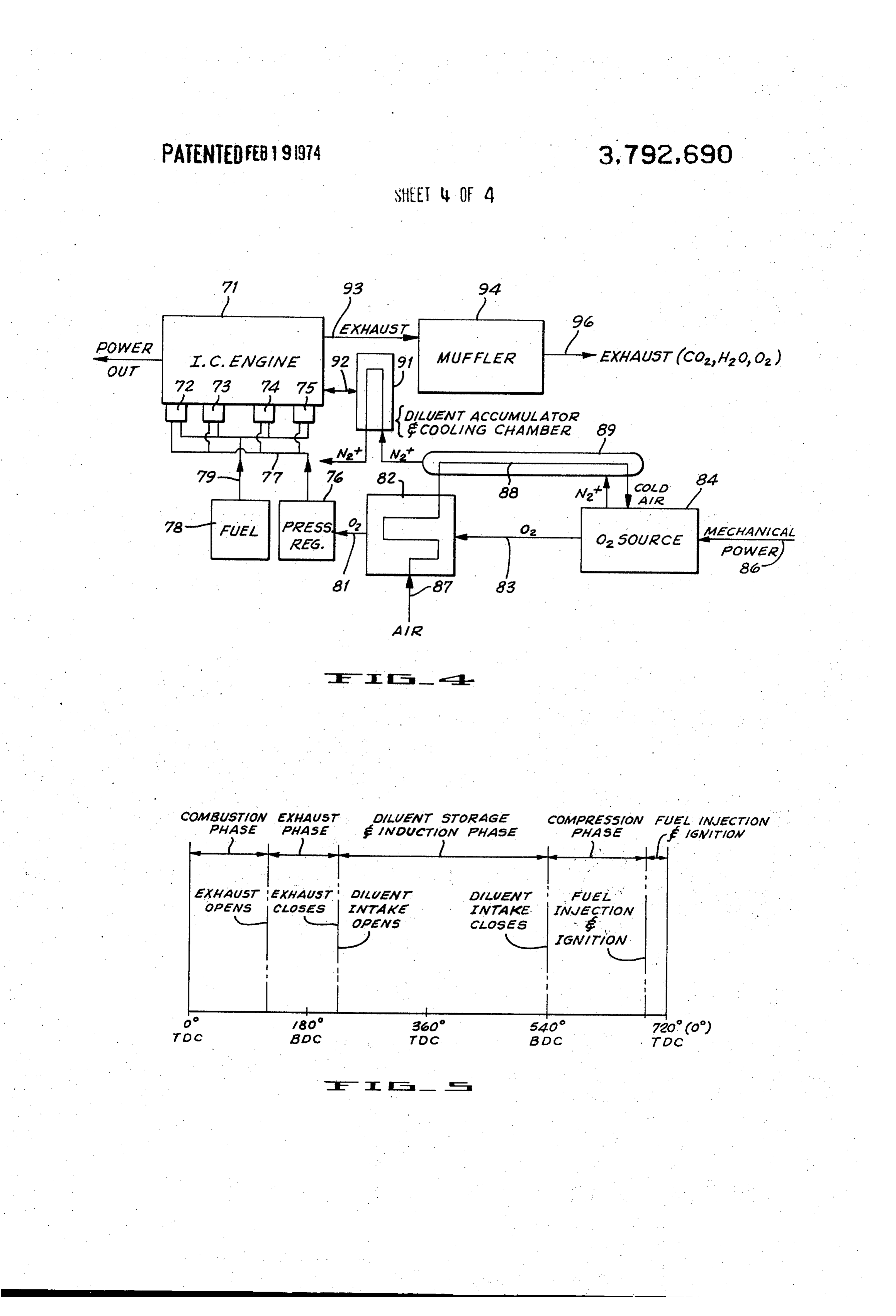
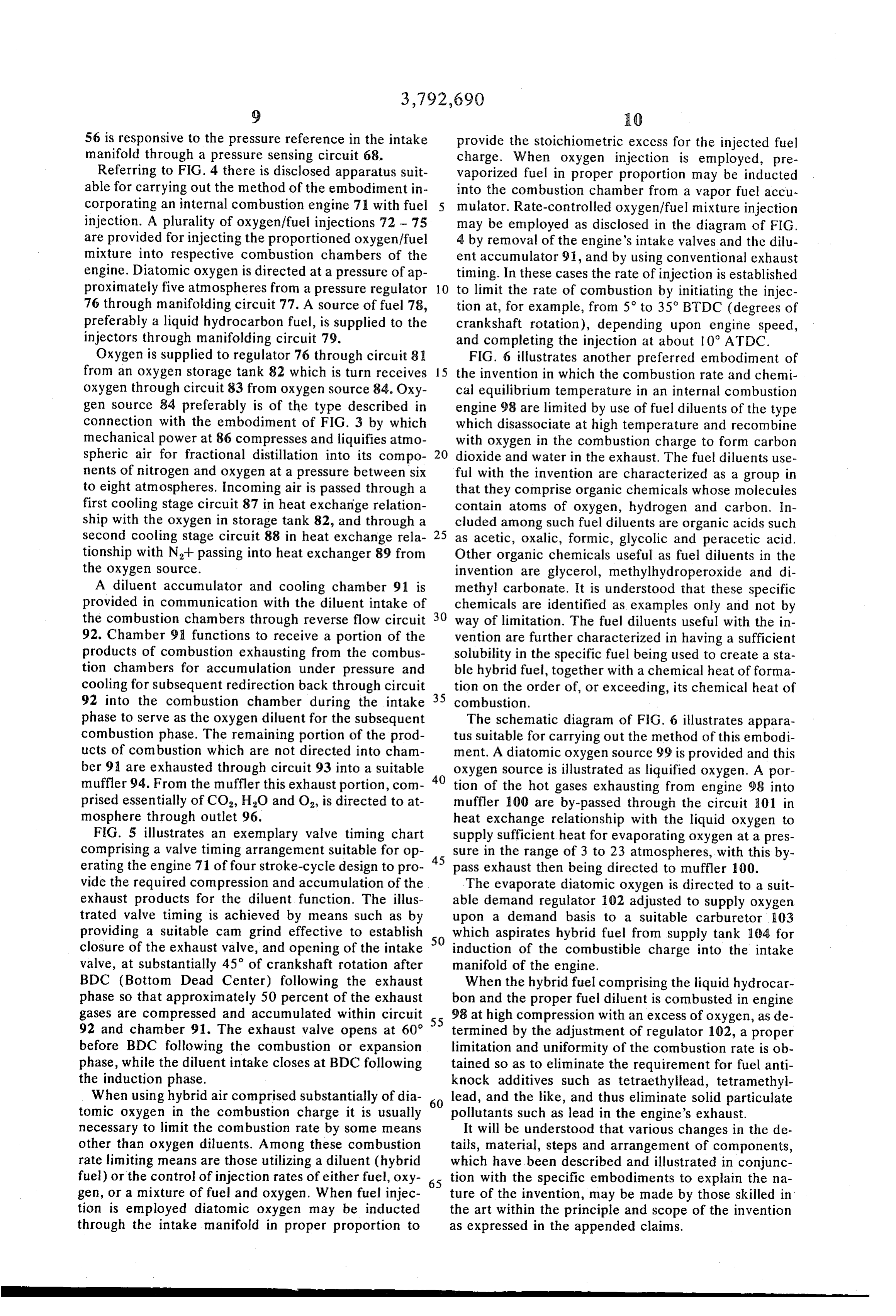
9 O 56 is responsive to the pressure reference in the intake provide the stoichiometric excess for the injected fuel manifold through a pressure sensing circuit 68. charge. When oxygen injection is employed, pre Referring to FIG. 4 there is disclosed apparatus suit vaporized fuel in proper proportion may be inducted able for carrying out the method of the embodiment in into the combustion chamber from a vapor fuel accu corporating an internal combustion engine 71 with fuel mulator. Rate-controlled oxygen/fuel mixture injection injection. A plurality of oxygen/fuel injections 72-75 may be employed as disclosed in the diagram of FIG. are provided for injecting the proportioned oxygen/fuel 4 by removal of the engine's intake valves and the dilu mixture into respective combustion chambers of the ent accumulator 91, and by using conventional exhaust engine. Diatomic oxygen is directed at a pressure of ap timing. In these cases the rate of injection is established proximately five atmospheres from a pressure regulator 10 to limit the rate of combustion by initiating the injec 76 through manifolding circuit 77. A source of fuel 78, tion at, for example, from 5 to 35 BTDC (degrees of preferably a liquid hydrocarbon fuel, is supplied to the crankshaft rotation), depending upon engine speed, injectors through manifolding circuit 79. and completing the injection at about 10 ATDC. Oxygen is supplied to regulator 76 through circuit 81 FIG. 6 illustrates another preferred embodiment of from an oxygen storage tank 82 which is turn receives 15 the invention in which the combustion rate and chemi oxygen through circuit 83 from oxygen source 84. Oxy cal equilibrium temperature in an internal combustion gen source 84 preferably is of the type described in engine 98 are limited by use of fuel diluents of the type connection with the embodiment of FIG. 3 by which which disassociate at high temperature and recombine mechanical power at 86 compresses and liquifies atmo with oxygen in the combustion charge to form carbon spheric air for fractional distillation into its compo 20 dioxide and water in the exhaust. The fuel diluents use nents of nitrogen and oxygen at a pressure between six ful with the invention are characterized as a group in to eight atmospheres. Incoming air is passed through a that they comprise organic chemicals whose molecules first cooling stage circuit 87 in heat exchange relation contain atoms of oxygen, hydrogen and carbon. In ship with the oxygen in storage tank 82, and through a cluded among such fuel diluents are organic acids such second cooling stage circuit 88 in heat exchange rela 25 as acetic, oxalic, formic, glycolic and peracetic acid. tionship with N+ passing into heat exchanger 89 from Other organic chemicals useful as fuel diluents in the the oxygen source. invention are glycerol, methylhydroperoxide and di A diluent accumulator and cooling chamber 91 is methyl carbonate. It is understood that these specific provided in communication with the diluent intake of chemicals are identified as examples only and not by the combustion chambers through reverse flow circuit 30 way of limitation. The fuel diluents useful with the in 92. Chamber 91 functions to receive a portion of the vention are further characterized in having a sufficient products of combustion exhausting from the combus solubility in the specific fuel being used to create a sta tion chambers for accumulation under pressure and ble hybrid fuel, together with a chemical heat of forma cooling for subsequent redirection back through circuit tion on the order of, or exceeding, its chemical heat of 92 into the combustion chamber during the intake 35 combustion, phase to serve as the oxygen diluent for the subsequent The schematic diagram of FIG. 6 illustrates appara combustion phase. The remaining portion of the prod tus suitable for carrying out the method of this embodi ucts of combustion which are not directed into cham ment. A diatomic oxygen source 99 is provided and this ber 91 are exhausted through circuit 93 into a suitable 40 oxygen source is illustrated as liquified oxygen. A por muffler 94. From the muffler this exhaust portion, com tion of the hot gases exhausting from engine 98 into prised essentially of CO, HO and O, is directed to at muffler 100 are by-passed through the circuit 101 in mosphere through outlet 96. heat exchange relationship with the liquid oxygen to FIG. 5 illustrates an exemplary valve timing chart supply sufficient heat for evaporating oxygen at a pres comprising a valve timing arrangement suitable for op 45 sure in the range of 3 to 23 atmospheres, with this by erating the engine 71 of four stroke-cycle design to pro pass exhaust then being directed to muffler 100. vide the required compression and accumulation of the The evaporate diatomic oxygen is directed to a suit exhaust products for the diluent function. The illus able demand regulator 102 adjusted to supply oxygen trated valve timing is achieved by means such as by upon a demand basis to a suitable carburetor 103 providing a suitable cam grind effective to establish which aspirates hybrid fuel from supply tank 104 for closure of the exhaust valve, and opening of the intake 50 induction of the combustible charge into the intake valve, at substantially 45° of crankshaft rotation after manifold of the engine.
BDC (Bottom Dead Center) following the exhaust When the hybrid fuel comprising the liquid hydrocar phase so that approximately 50 percent of the exhaust bon and the proper fuel diluent is combusted in engine gases are compressed and accumulated within circuit 98 at high compression with an excess of oxygen, as de 92 and chamber 91. The exhaust valve opens at 60 55 termined by the adjustment of regulator 102, a proper before BDC following the combustion or expansion limitation and uniformity of the combustion rate is ob phase, while the diluent intake closes at BDC following tained so as to eliminate the requirement for fuel anti the induction phase. knock additives such as tetraethyllead, tetramethyl When using hybrid air comprised substantially of dia 60 lead, and the like, and thus eliminate solid particulate tomic oxygen in the combustion charge it is usually pollutants such as lead in the engine's exhaust. necessary to limit the combustion rate by some means It will be understood that various changes in the de other than oxygen diluents. Among these combustion tails, material, steps and arrangement of components, rate limiting means are those utilizing a diluent (hybrid which have been described and illustrated in conjunc fuel) or the control of injection rates of either fuel, oxy 65 tion with the specific embodiments to explain the na gen, or a mixture of fuel and oxygen. When fuel injec ture of the invention, may be made by those skilled in tion is employed diatomic oxygen may be inducted the art within the principle and scope of the invention through the intake manifold in proper proportion to as expressed in the appended claims.
Page 11
I claim: exchange relationship with parts of said source of dia 1. An open cycle method of operating an internal tomic oxygen and thereafter at least a portion of said combustion engine system having means forming at gaseous carbon dioxide is separated from said first por least one combustion chamber, a source of liquid or tion of said products of combustion and is combined gaseous fuel and having intake, compression, combus with said diatomic oxygen to form said hybrid air. tion and exhaust phases in its cycle, including the steps 7. A method as in claim 6 in which a flow of said hy of separting oxygen from atmospheric air by chemical brid air is directed to said combustion chamber at a process using engine waste heat to provide a source of predetermined upstream pressure upon engine de gaseous diatomic oxygen, forming a quantity of hybrid mand, and said fuel charge is aspirated into said hybrid air free of nitrogen by combining said diatomic oxygen O air flow.
together with an oxygen diluent comprising carbon di 8. A method as in claim 6 in which said hybrid air is oxide taken from a first portion of the products of com compressed and stored, and said compressed hybrid air bustion from said exhaust phase, combining a given is directed to said combustion chamber upon engine charge of said fuel with a quantity of said hybrid air to demand at a predetermined pressure effective to supply form a combustion charge free of nitrogen and contain 15 the combustion requirements of said engine. ing oxygen in an amount to completely combust said 9. An open cycle method of operating an internal charge of fuel, and combusting said charge with said combustion engine system having means forming at ox quantity of oxygen whereby the rate of combustion of ygen in one combustion chamber, a source of liquid or said fuel charge and oxygen is limited by said oxygen gaseous fuel and having intake, compression, combus diluent and the products of combustion from said sys tion and exhaust phases in its cycle, including the steps tem are substantially released during engine operation. of separating oxygen from atmospheric air to provide 2. A method as in claim 1 in which said combustion a source of diatomic oxygen including chemically com rate is limited by forming and storing under pressure bining the oxygen in a quantity of preheated atmo for use upon engine demand a quantity of hybrid air, spheric air under pressure with a reducing agent utiliz said hybrid air being formed of said diatomic oxygen 25 ing the energy of engine waste heat at least in part to together at equal temperatures with said diluent carbon form an oxide of said reducing agent capable of dissoci dioxide taken at a substantially constant volume ratio ating into constituents including diatomic oxygen, sep of said diatomic oxygen to diluent carbon dioxide ef arating said oxide from said air, dissociating said oxide fective to: at a reduced pressure below said first mentioned pres a. form a stiochiometric excess of oxygen sufficient 30 sure into constituents including diatomic oxygen to completely combust the fuel in said combustion whereby the latter forms said source of oxygen, form charge, said charge being formed at a substantially ing a quantity of hybrid air by combining said diatomic constant weight ratio of said fuel to hybrid air, said oxygen together with an oxygen diluent comprising a hybrid air being supplied to said combustion cham 35 first portion of the products of combustion from said ber prior to said compression phase, and exhaust phase, combining a given charge of said fuel b. supply sufficient diluent carbon dioxide to limit the with a quantity of said hybrid air to form a combustion rate of combustion of said fuel in said combustion charge substantially by the temporary thermal dis charge containing oxygen an amount to substantially completely combust said charge of fuel, and combust sociation of said diluent during at least a portion of 40 ing said charge with said quantity of oxygen whereby said combustion phase. the rate of combustion of said fuel charge and oxygen 3. A method as in claim 2 in which said combustion is limited and the products of combustion from said sys charge is formed of said fuel charge and said hybrid air tem are substantially which is inducted into said combustion chamber, and released during engine operation. said combustion charge provides a stiochiometric ex 10. A method as in claim 9 in which said reducing cess of oxygen within the range of 0-25 percent by 45 agent comprises a mercury in vapor form and said com weight of oxygen for completely combusting said bining step includes combining said mercury vapor charge of fuel, said excess of oxygen required being a with oxygen of the atmospheric air preheated by the function of the amount of diluent used in said combus waste heat of engine exhaust products and exhaust ni tion charge. trogen to form HgO, said dissociating step includes dis 50 sociation by high intensity electromagnetic radiation at 4. A method as in claim 2 in which said first portion of the products of combustion is established at a tem oxygen, reduced pressure and temperature into mercury and perature below the dew point of the water vapor of said said dissociated mercury is recycled for subse first portion by passing the incoming atmospheric air quent combination with oxygen from atmospheric air, for subsequent oxygen separation in heat exchange re 55 and said dissociated oxygen forms said source of oxy lationship with said first portion to preheat said atmo gen. 11. A method as in claim 10 in which said atmo spheric air and to substantially remove said water vapor whereby said diluent is comprised substantially of car spheric air is preheated to a temperature within the bon dioxide gas together with excess oxygen. range of substantially 180 - 480°F, and said preheated 5. A method as in claim 2 in which said hybrid air is 60 air is combined with said mercury vapor within a tem compressed and accumulated following said exhaust perature range of substantially 615 - 1,800 F to form phase, and said compressed hybrid air is directed into a mixture at a temperature below the evaporation tem said combustion chamber with said fuel during the in perature of said mercury.
take phase to form a combustion charge. 12. A method as in claim 10 in which said high tem 6. A method as in claim 2 in which said products of 65 perature products of combustion from the combustion combustion comprising substantially CO2 and H2O in chamber are directed in heat exchange relationship gaseous form are largely removed during engine opera with said recycled mercury to provide at least a portion tion from said combustion chamber and passed in heat of the heat energy to form said mercury vapor.
Page 12
13. A method as in claim 10 in which the constituents 15. A system as in claim 14 in which said combustion of said atmospheric air remaining after separation of rate limiting means includes means to form a quantity said oxide therefrom are directed, in that order, in heat of hybrid air comprising said diatomic oxygen together exhange relationship with incoming atmospheric air to with said oxygen diluent, said diluent being comprised preheat the same prior to combiniation of the oxygen of carbon dioxide taken from a first portion of the therein with said reducing agent. products of combustion from said exhaust phase, said 14. In an open cycle internal combustion engine sys hybrid air comprising a portion of said combustion tem having intake, compression, combustion and ex charge and containing said diluent in sufficient quantity haust phases in its cycle, means forming at least one to limit the rate of combustion.
combustion chamber, a source of fuel, means separat 10 16. A system as in claim 14 which includes means to ing diatomic oxygen from atmospheric air by chemical process using engine waste heat, means to combine, compress and accumulate as nitrogen free hybrid air, prior to said combustion phase, a charge of said fuel said diluent taken from a first portion of the products with said diatomic oxygen in an amount to substantially of combustion following the exhaust phase of the en completely combust said fuel charge in said combus 5 gine together with said diatomic oxygen in an amount tion chamber, means to limit the rate of said combus sufficient to completely combust said fuel charge, and tion including means forming a combustion charge free means to direct a charge of said accumulated hybrid air of nitrogen and comprising said fuel charge and said combined with said fuel charge into said combustion oxygen together with an oxygen diluent combined prior chamber during the intake phase to form said combus to said compression phase, and means to exhaust the tion charge.
products of combustion during engine operation. ck k x: ck :
Page 13
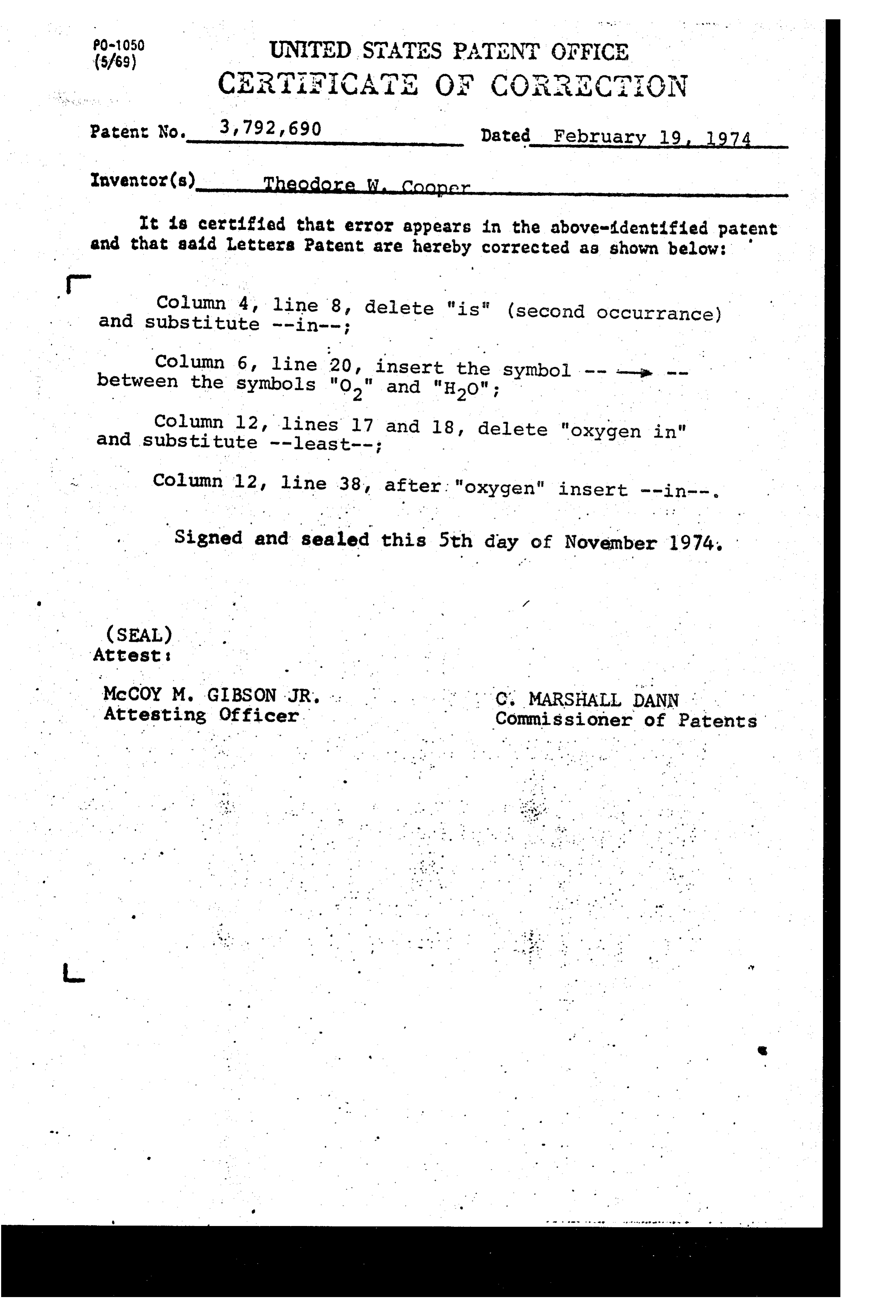
is UNITED STATES PATENT OFFICE
CERTIFICATE OR CORRECTION
Patent No. 3792,690 Dated February 19, 1974 Inventor(s) Theodore W. Cooper
It is certified that error appears in the above-?identified patent and that said Letters Patent are hereby corrected as shown below:
Column 4 --in-- and substitute line 8, delete "is" (second occurrance)
Column 6, line 20, insert the symbol - - - - - between the symbols "o" and "Ho";
Column 12, lines l7 and 18, delete "oxygen in"
column 12, line 38, after: "oxygen" insert --in--. Signed and sealed this 5th day of November 1974.
(SEAL)
McCoy M. GIBSON JR. .
Attesting Officer . . . .
C. MARSHALL BANN
of Patents
Provenance
- Collection
- Cited prior art
- Original PDF
- patentimages.storage.googleapis.com →
- Filed
- 1972-03-22
- Pages
- 13
- Method
- pdftotext (the PDF's own text layer) + pdftoppm 300dpi page scans
- Source
- Google Patents bibliographic record
- Granted
- 1974-02-19
- Inventors
- T Cooper
- Transcribed from
- patentimages.storage.googleapis.com →