patent · US3709203
Anti-pollution system for internal combustion engines
9 January 1973
Page 1 — bibliographic record
United States Patent (19) 11, 3,709,203 Cettin et al. (45) Jan. 9, 1973 (54) ANTI-POLLUTION SYSTEM FOR 2,017,481 10/1935 Von Opel......................... 123/1 19 A INTERNAL COMBUSTON ENGINES 2,187,074 1/1940 Caproni............................ 12311 19 A 2,720,856 10/1955 Hoke, Jr.... . 12311 19 AX 75 Inventors: Edward J. Cettin, Ventura; Jimmy 2,884,912 5/1959. Lewis............................... 123/1 19 A P. Pappas, Camarillo; Sam E. Lager, 3,425,402 2/1969 Reisacher......................... 12311 19-E Somis, all of Calif.
73 Assignee: Thermo-Chem Systems, Inc., Primary Examiner-Wendell E. Burns Wilmington, Del. Attorney-LeBlanc & Shur 22 Filed: July 16, 1971 57 ABSTRACT (21) Appl. No.: 163,245 A system is presented for use with any internal com bustion engine to eliminate carbon monoxide, 52) U.S. C. ................... 123/119A, 123/1 A, 123/3, hydrocarbons and nitrogen oxides from the engine ex 12311 19 E haust. The system is substantially closed, eliminating 51) int. Cl..............................................F02m 25/06 the use of ambient air for combustion of the fuel, and 58) Field of Search........ 12311 19 A, 119 E, 1 A, 2, 3 in place thereof utilizes oxygen generated by the ther mal decomposition of an alkali metal perchlorate salt 56 References Cited in the presence of a catalyst. Heat for the generation of oxygen is provided by the exhaust from the engine
UNITED STATES PATENTS manifold. The exhaust and oxygen are then mixed in proportions of 4:1, and the mixture blended with the 740,864 10/1903 Jaubert..... ... 12311 19 A fuel in the carburetor for combustion in the engine. 1,099,445 6/1914 Jaubert..... ... 12311 19 A 1,750,919 3/1930 Becker............................. 123/1 19 A 15 Claims, 2 Drawing Figures
TOBATERY
TO ATMOSPHERE
Page 2
PATENTEDJAN 9 1973 3,709,203 28 30 32 34 O FUEL MXNG FUEL+02 + CO2 ENGINE
CHAMBER
EXHAUST PRESSURE ATMOSPHERE
TOBATTERY
clo, MnO MCl2:
TO ATMOSPHERE
MXNG
CHAMBER
EDWARD J. CETTIN
FUEL JMMY "P" PAPPAS
(GASOLINE)
ATIORNEYS
Page 3
ANT-POLLUTION SYSTEM FOR INTERNAL Further research to eliminate antiknock lead addi COMBUSTON ENGINES tives from gasoline and to study the effect of fuel com This invention relates to a method and apparatus position in general on smog formation is now being adaptable for use with internal combustion engines to conducted. Although it has not been established with eliminate carbon monoxide, hydrocarbons, and certainity that lead additives are a health hazard, the nitrogen oxide pollutants normally exhausted research results are highly suggestive.
therefrom. The device in particular is a substantially It has, however, been established that lead additives closed system which eliminates the use of nitrogen-con interfere with certain exhaust control systems. For ex taining ambient air in the combustible fuel-air mixture. ample, catalytic exhaust controls which would greatly Oxygen is generated in a thermal generator heated by 10 reduce the emissions of carbon monoxide and the engine exhaust. The exhaust is also recirculated hydrocarbons are poisoned by the lead additives in from the manifold, mixed with the oxygen generated, gasoline.
and the mixture blended with hydrocarbon fuel such as Leadfree gasoline which would facilitate the use of gasoline for combustion in the engine. these catalytic exhaust control systems is not now The oxygen is generated in the preferred embodi 15 generally available, but will be in the near future. Cata ment of this invention by an alkali metal perchlorate lytic systems to eliminate exhaust pollutants, however, salt which, when heated in the presence of a catalyst are only partially successful. Effective catalytic exhaust decomposes to form a metal chloride and oxygen gas. controls for nitrogen oxide emissions have not been Within about the last 10 years...significant steps have 20 developed, as yet.
been taken to reduce the pollutants emitted from au Therefore, even with the advent of lead-free tomobiles. It has now been recognized that automobile gasoline, exhaust emission controls will not entirely exhaust is a major contributor to smog and air pollu solve the pollution problem. The remaining obstacle to tion, and that air pollution, especially in large cities, is a a "clean" automobile engine then is the elimination of public health hazard. 25 carbon monoxide and the lower unsaturated hydrocar The major pollutants emitted by internal combustion bons, aldehydes, and and nitrogen oxides from the en engines are carbon monoxide; hydrocarbons such as gine exhaust.
gasoline, evaporated from the crankcase and the fuel Complete combustion of gasoline, a hydrocarbon, tank, and ethylene, acetylene, and formaldehyde from will yield carbon dioxide and water vapor. However, incomplete combustion; and oxides of nitrogen. Addi 30 engine inefficiency promotes the formation of carbon tives, such as tetraethyllead used to boost the octane of monoxide instead of carbon dioxide. In addition, to gasoline are also emitted in the exhaust. form the combustible mixture, air is mixed with the fuel When the hydrocarbon and nitrogen oxide gases are in the carburetor. Although the active and essential exposed to sunlight, a photochemical reaction takes component for supporting combustion, oxygen, makes place. This reaction forms oxidants, ozone and other 35 up only 20 percent of ambient air, the remaining por reactive oxidizing compounds, which are not only ir tion, principally nitrogen, does not remain unreacted ritating to the eyes and lungs, but which also are toxic during the combustion process. The ignition spark in to plants and may attack rubber, fabrics, and other the cylinder forms ozone which catalyzes the formation materials. In addition, there are strong indications that of several highly toxic nitrogen oxides. These oxides nitrogen oxides and lead emissions are highly toxic to 40 may be carcinogenic and are known to be a dangerous humans. air pollutant. While engine efficiency improvement will The development of anti-pollution devices for au reduce the products of incomplete gasoline com tomobile engines has been the subject of wideranging bustion, so long as ambient air is admitted to the cylin research efforts for many years. This research has been ders as in the standard Otto cycle or Diesel engine directed toward elimination of pollutants from the air, 45 nitrogen pollutants will be formed and emitted. and the development of a "clean' automobile engine. One obvious and impractical solution to this problem The first major advance came in 1963 when the posi would be to substitute oxygen for ambient air. This tive crankcase ventilator (PCV) was first installed on solution is impractical, however, because massive all new cars. This valve system reduced a typical car's quantities of oxygen would have to be provided, and in hydrocarbon emissions to 80 percent of the former 50 addition, the standard automobile engine would have value. In 1968 exhaust controls were installed which to be redesigned to eliminate excessive peak gas tem cut hydrocarbon emissions to 37 percent of the pre peratures.
1963 levels and reduced carbon monoxide emissions to Another attempt to control nitrogen oxide formation 40 percent of the previous values. In 1970 exhaust con 55 involves lowering the peak gas temperatures, thereby trols cut hydrocarbon and carbon monoxide emissions minimizing the formation of these oxides. Control of to 30 percent of their pre-1963 levels. fuel and air flow rates, spark timing adjustments, and Devices have also been developed to cut gasoline lower air intake temperatures all have some effect. In evaporation losses from the carburetor and fuel tank to addition, recycling about 10 percent of the cooled ex reduce total hydrocarbon emissions to 15 percent of 60 haust gases also will reduce nitrogen oxide formation, those produced by a car with no controls. but this method has generally been undesirable because A workable system for virtually eliminating evapora of a reduction of engine performance and fuel econo tive losses of hydrocarbons is now scheduled for na my without elimination of pollutant emission. tionwide installation on new cars. This system uses ac Catalytic converters to reduce nitrogen oxide in the tivated carbon to soak up evaporating hydrocarbons 65 exhaust have, as noted above, not been effective. from the carburetor and fuel tank and releases them Although research in the area of catalytic converters is through special valves under controlled conditions to proceeding, a practical and inexpensive device has not be burned in the engine. been discovered.
Page 4
Therefore, while several procedures have been at it to generate oxygen by thermal decomposition in a tempted, a workable system which may be inexpensive heat exchanger.
ly adapted to standard automobile engines is not now It is a further object to provide an anti-pollution available. system for automobiles to eliminate pollutants in the It has, however, been discovered that the exhaust exhaust and to eliminate use of ambient air in the car- ... from the manifold may be recirculated and used in buretor wherein oxygen, generated by heating an alkali place of nitrogen from ambient air to eliminate the for metal perchlorate salt with recirculating exhaust gases, mation of these toxic oxides without loss in engine per is mixed in the exhaust and the mixture substituted for formance. This solution involves the provision of a O ambient air in the fuel-air mixture admitted to the thermal oxygen generator which, when heated by the cylinders for combustion.
exhaust from the manifold, provides an inexpensive These and other objects will become readily ap. and efficient source of oxygen. The recirculated ex parent with reference to the drawings and the following haust is used to heat the generator to produce oxygen description wherein:
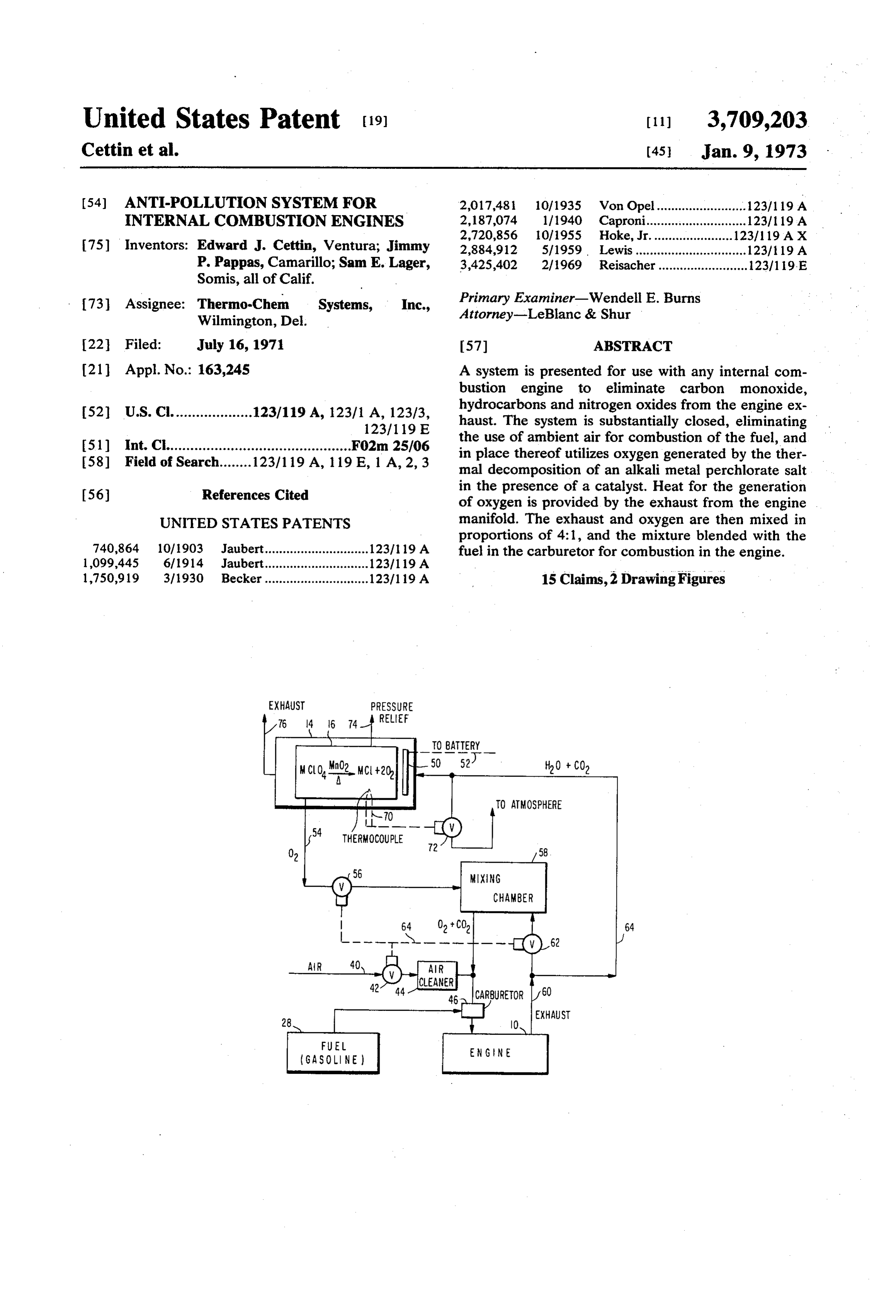
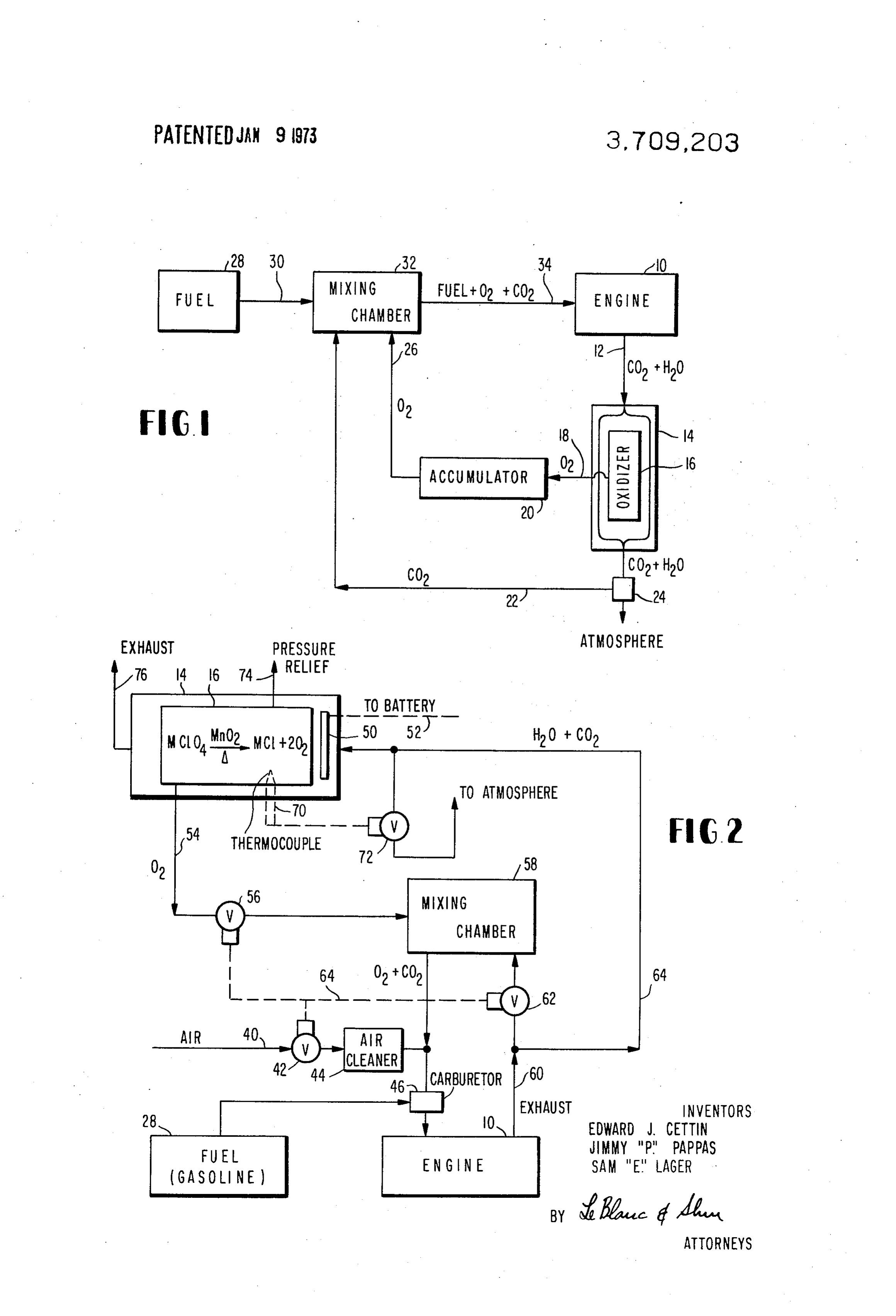
and is also substituted for nitrogen in the fuel mixture. FIG. 1 is a schematic illustrating the anti-pollution The recirculated exhaust then is essentially carbon 15 system of this invention.
dioxide and water vapor which may be safely vented to FIG. 2 is a schematic illustrating the system of FIG. 1 the atmosphere. with additional modifications according to this inven The system of this invention includes an oxidizer tion.
containing preferably an alkali metal perchlorate salt 20 With attention to the drawings, FIG. 1 illustrates the disposed within a heat exchanger. Hot exhaust gases system of this invention adapted to a conventional in pass through the exchanger, heating the perchlorate ternal combustion engine 10 which may be a Diesel cy salt and thereby generating oxygen. The oxygen is then cle, but preferably is a conventional Otto cycle au mixed with the exhaust gases in the proportion of 1:4 tomobile engine. The engine exhaust is directed from for mixing with the fuel. It should be emphasized that 25 the manifold (not shown) by line 12 to a heat when the system of this invention is at equilibrium the exchanger 14. The exhaust gases leaving the manifold recirculating exhaust will be almost entirely composed normally have a temperature at least in the range of of carbon dioxide and water vapor. 1400°-1800F. which is sufficient, as will be explained, If the water vapor is condensed and removed from for the purposes of this invention.
the exhaust before it is mixed with oxygen for admis 30 Heat exchanger 14 contains an oxidizer 16 for sion to the carburetor, the system of this invention will generating oxygen by thermal decomposition. Oxidizer in effect substitute carbon dioxide and oxygen for am 16 may be a cannister, having walls of heat-conductive bient air in a substantially closed system which emits material, containing an alkali metal perchlorate salt principally carbon dioxide and water into the at and trace quantities of manganese dioxide catalyst. If mosphere. 35 M = an alkali metal such as lithium, sodium, or potassi Because the combustion process in an automobile um, the decomposition reaction is as follows: engine is essentially adiabatic, i.e., PV = K, ther MnO modynamic work will be a function of the ratio of MCo. -). MCI - 20 f specific heats (CP/Cy py).y for air and for nitrogen is A 1.4 while y for carbon dioxide is nearly identical, 1.33. 40
Although a number of salts such as chlorates, -Therefore, substitution of carbon dioxide for nitrogen perchlorates, in an oxygen mixture in proportions similar to that of and peracetatespermanganates, perborates, peroxides could be used to produce oxygen, the ambient air will produce at least the same ther modynamic work in a given engine. majority are either unstable and explosive, or The system of this invention may be utilized with 45 uneconomical due to a low oxygen yield. Perchlorates, conventional internal combustion engines without sub however, may be handled with safety, and are cheap stantial alteration thereof and without loss in output and readily available. Lithium perchlorate is preferred therefrom to eliminate emissions of carbon monoxide, for use in the system of this invention because it may be hydrocarbons, and nitrogen oxides in the exhaust. melted safely and because it contains a high percentage Accordingly, it is an object of this invention to pro 50 of oxygen. Lithium perchlorate yields oxygen when vide an efficient and inexpensive pollution control heated to a temperature of around 250 F. in the system for internal combustion engines to eliminate presence of a manganese dioxide catalyst which speeds emission of pollutants in the engine exhaust. the reaction. The lithium analog contains 60.1 percent It is another object to provide a pollution control 55 oxygen as compared to 45.09 percent available from system which may be easily adapted to automobile en the sodium salt and 39.17 percent from the potassium gines to substitute a carbon dioxide-oxygen mixture for salt.
ambient air to form a combustible fuel-air mixture. Various metal oxides of for example mercury, man It is another object to provide a closed air system for ganese, copper, and silver may be used as a source of an internal combustion engine having a self-contained, 60 oxygen, but as stated, lithium perchlorate is preferred thermal oxygen generator heated by the manifold ex for its high yield. In addition, lithium chloride, the haust, and having a mixing device for mixing oxygen byproduct of the oxygen generation reaction may be and recirculated gases to eliminate the use of ambient regenerated to form lithium perchlorate, and therefore air in the carburetor. the process is reversible.
It is yet another object to provide a system for recir 65 As the hot exhaust gases enter the heat exchanger 14 culating the manifold exhaust from an internal com and flow around cannister 16 the lithium perchlorate bustion engine to eliminate incomplete combustion therein decomposes evolving oxygen, which is directed products therein and for cooling said exhaust by using by line 18 from the oxidizer 16 to an accumulator 20.
Page 5
The exhaust gases after passing through exchanger pressure sensor, to mixing chamber 58. Exhaust is also 14 enter line 22 for recirculation. A valve 24 may also directed from line 60 through line 64 to heat exchanger be provided to vent excess exhaust to the atmosphere. 14.Valve 42 is coupled to valve 62 and to valve 56 and is Valve 24 is preferably a one-way valve and may be a valve similar to the convention PCV valve. controlled by a conventional pressure or flow sensor. Water vapor may be removed from the exhaust gas Within a few seconds after startup valve 42 senses a before recirculation, if desired, by any conventional preselected pressure in lines 54 and 60 indicating suffi means such as by a condenser (not shown) at valve 24, cient oxygen is being generated in heat exchanger 14, or by using a desiccant, or by a drain. and valve 42 closes to shut off the flow of air through Recirculated exhaust gases from line 22, oxygen 10 line 40. It will be obvious to those skilled in the art that from accumulator 20 through line 26, and fuel from a wide variety of valves and sensors may be adapted for tank 28 through line 30 are mixed in chamber 32. use in lines 40, 54, and 60 within the scope of this in Chamber 32 may be a conventional carburetor with an vention. The essential function of valve 42 is to stop the ante-chamber wherein the oxygen and the exhaust are 15 introduction of ambient air to engine 10 when the flow mixed. The mixed gases are then blended with the fuel through lines 54 and 60 is sufficient to maintain a in the carburetor in the conventional manner. - closed system.
It must be emphasized, however, that the exhaust Oxygen and exhaust gases are admitted to mixing and oxygen are preferably mixed in a ratio of substan chamber 58 in preferred proportions of 1:4 by valves tially 4:1 so that the exhaust-oxygen mixture has sub 56 and 62. Valves 56 and 62 are adapted to be coupled stantially the same proportions as the nitrogen-oxygen 20 together in a conventional ratio and proportioning components of ambient air whereby the system is par system. Venturi sensors may be used to sense the flow ticularly adapted for use in existing internal com through lines 54 and 60 for comparison. The signal bustion engines. It will be appreciated, however, that therefrom would then open or close valves 56 and 62 to such ratio can be changed for optimum efficiency in ac 25 insure a continuous flow to chamber 58 in the desired cordance with the type of fuel utilized, i.e., gas, diesel proportions.
fuel and the like and type of engine. A conventional electric, pneumatic, or mechanical The fuel-gas mixture from chamber 32 is then coupling between valves 42, 56, and 62 for sensing and directed through line 34 to engine 10 for combustion. regulating the flow through lines 40, 54, and 60 is Any incompletely combusted components of the ex 30 shown generally at 64. It will be obvious that any type haust are then burned completely when the recircu coupling may be used within the scope of this inven lated exhaust is recombusted. If water vapor is continu tion.
ously removed from the system at valve 24 the exhaust The preferred 1:4 oxygen, exhaust mixture is then gas entering chamber 32 will be essentially carbon directed from chamber 58 by line 66 to carburetor 46 dioxide. Under normal operating conditions the system 35 and engine 10 in the conventional manner. The am will vent only carbon dioxide and water to the at bient air utilized when engine 10 is first started is mosphere. replaced by the oxygen-recirculated exhaust mixture With attention to FIG. 2, the system of this invention for normal running.
may be modified as follows to provide for only a limited use of ambient air when the engine is started. 40 In the event the temperature within cannister 16 in heat exchanger 14 exceeds a preselected optimum
When engine 10 is started ambient air is drawn level, a safety device may be used to avoid over produc through line 40, valve 42, and a conventional filter 44 tion of oxygen. In a preferred embodiment thereof a to carburetor 46. Air is mixed at carburetor 46 in the thermocouple 70 is disposed within exchanger 14 and conventional manner with fuel drawn from tank 28 through line 30. 45 coupled to a bleed valve 72 in exhaust line 64. When When engine 10 is started, a heating element 50 normally closed valve 72 senses through thermocouple disposed within heat exchanger 14 adjacent container 70, an excessive temperature within cannister 16, valve 16 is actuated to heat the oxygen containing material 72 opens to vent exhaust gases from line 64 to the at therein and to begin thermal decomposition for genera 50 mosphere.
In addition to bleed valve 72, a pressure responsive tion of oxygen. Element 50 may be an electrical re safety valve may also be utilized in relief line 74 which sistance heater adapted to be coupled to a battery (not communicates with cannister 16. The relief line 74 may shown). The electric circuit between the element 50 be adapted to other uses also. For example, line 74 may and a source of electrical energy is generally indicated open into the interior of the automobile or be con by dashed line 52. It will be obvious to those skilled in 55 nected to the vehicle airconditioning the art that any type of circuit may be employed. How oxygen to the car interior, if desired. system to furnish ever, in the preferred embodiment of this invention, the After exhaust from line 64 passes through the heat heater would be actuated by the starter switch. The heater may be turned offmanually or may be automati exhanger vented to 14 to generate oxygen in cannister 16 it is the atmosphere through line 76. A PCV valve cally disconnected after a few seconds when the oxygen 60 (not shown) may be utilized in line 72 and a portion of is being generated.
Oxygen from container 16 is directed through line 54 the exhaust from line 76 may be dried and recirculated and a proportioning valve 56, controlled by a venturior to Inlineaddition 60 in the manner described for FIG. 1, if desired.
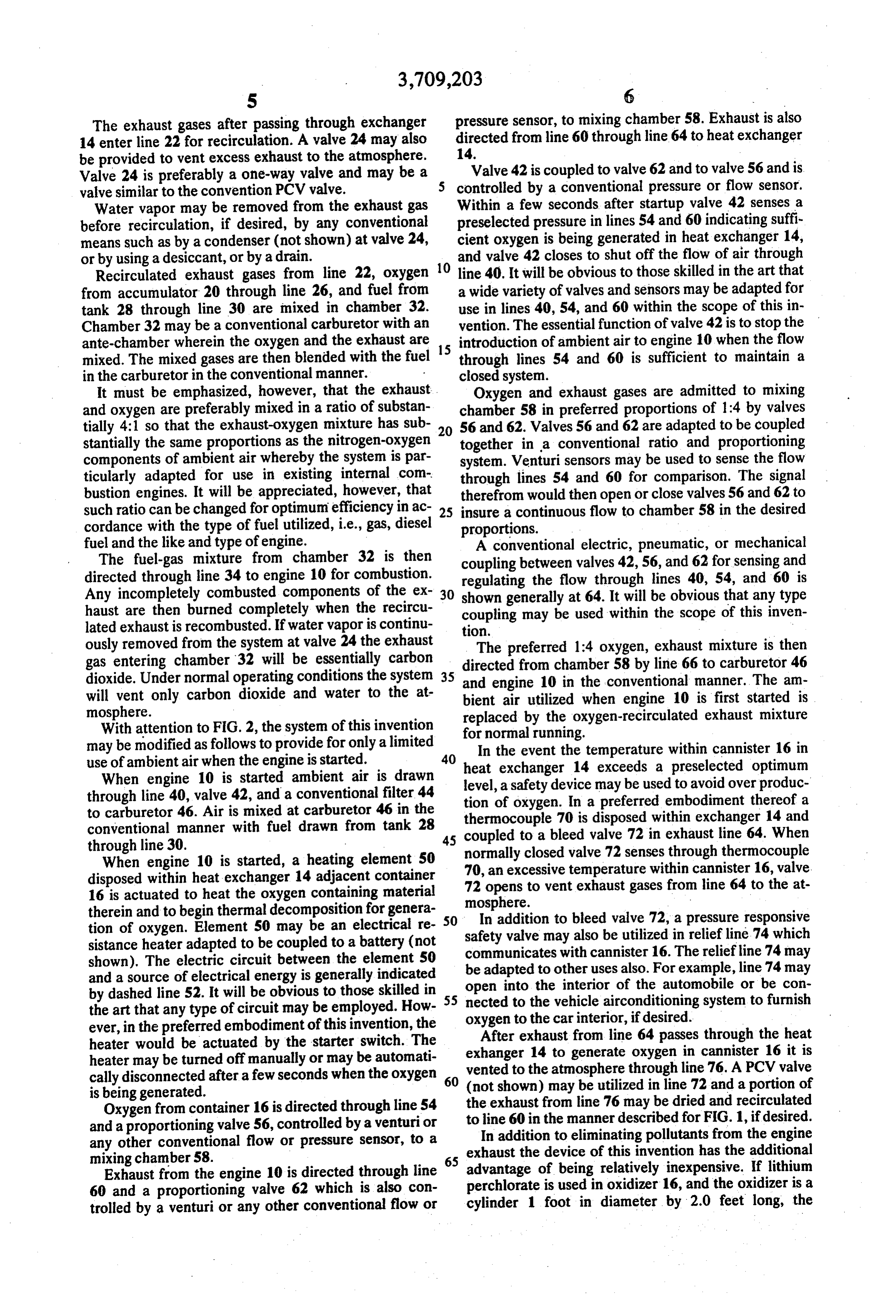
to eliminating pollutants from the engine any other conventional flow or pressure sensor, to a exhaust the device of this invention has the additional mixing chamber 58. 65 advantage of being relatively inexpensive. If lithium Exhaust from the engine 10 is directed through line 60 and a proportioning valve 62 which is also con perchlorate is used in oxidizer 16, and the oxidizer is a trolled by a venturi or any other conventional flow or cylinder 1 foot in diameter by 2.0 feet long, the
Page 6
cylinder may be packed with 238 pounds of lithium disposed in heat exchange relation with said perchlorate. If the perchlorate salt is melted first, or passage means between the inlet and the outlet packed under compression loading this quantity may thereof, said inlet adapted to be coupled to the en be doubled. Because lithium perchlorate is 60.1 per gine exhaust outlet so that exhaust from the engine cent oxygen by weight, 476 lbs. of lithium perchlorate is admitted through the inlet to the interior of said will yield 285.6 lbs. of oxygen gas. Assuming three passage means to heat the oxygen generator and pounds of oxygen is required per pound of fuel this produce oxygen:
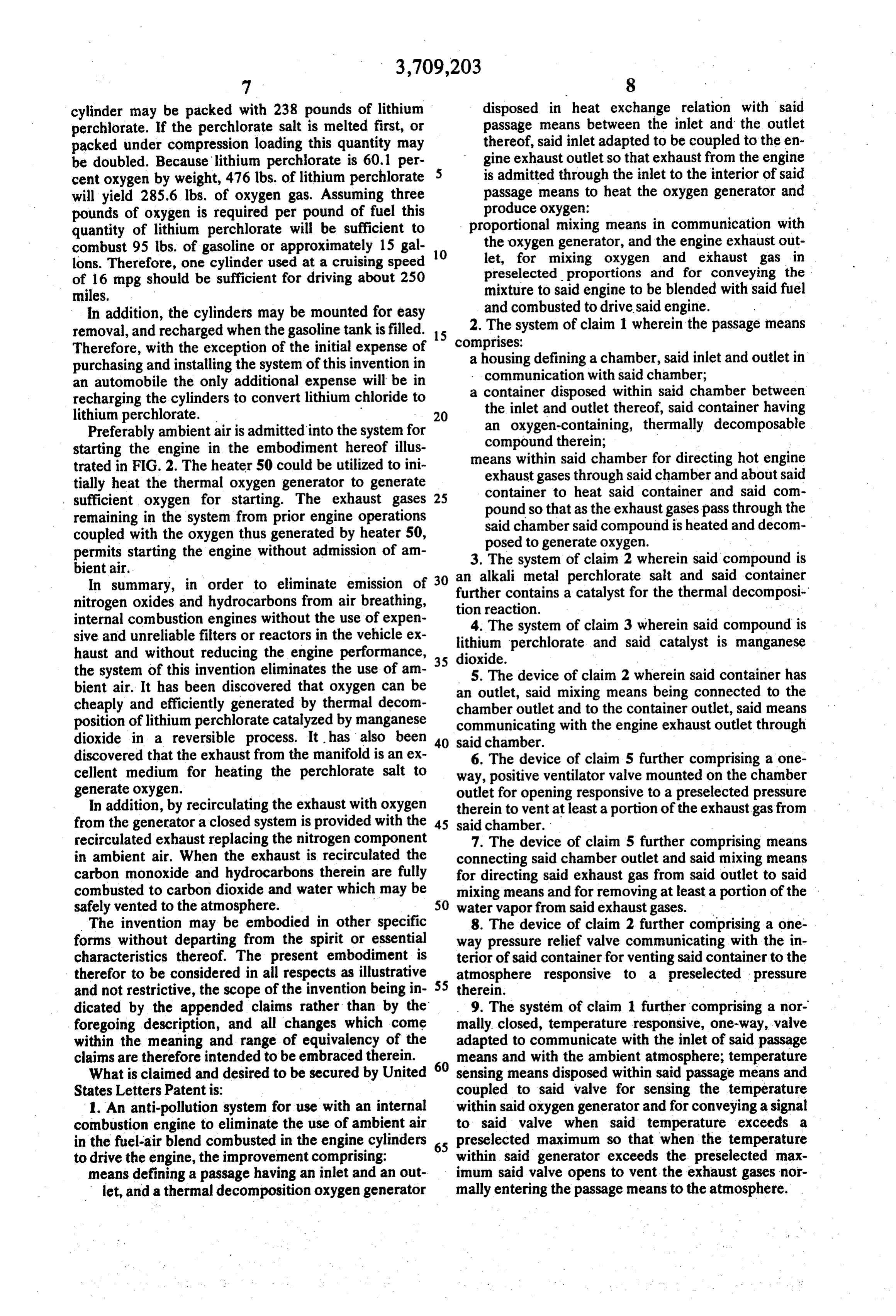
quantity of lithium perchlorate will be sufficient to proportional mixing means in communication with combust 95 lbs. of gasoline or approximately 15 gal 10 the oxygen generator, and the engine exhaust out lons. Therefore, one cylinder used at a cruising speed let, for mixing oxygen and exhaust gas in of 16 mpg should be sufficient for driving about 250 preselected proportions and for conveying the miles. mixture to said engine to be blended with said fuel In addition, the cylinders may be mounted for easy and combusted to drive said engine. 2. The system of claim 1 wherein the passage means removal, and recharged when the gasoline tank is filled. comprises:
Therefore, with the exception of the initial expense of a housing defining a chamber, said inlet and outlet in purchasing and installing the system of this invention in communication with said chamber; an automobile the only additional expense will be in a container disposed within said chamber between recharging the cylinders to convert lithium chloride to the inlet and outlet thereof, said container having
an oxygen-containing, thermally decomposable
Preferably ambient air is admitted into the system for compound therein;
starting the engine in the embodiment hereof illus means within said chamber for directing hot engine trated in FIG. 2. The heater 50 could be utilized to ini tially heat the thermal oxygen generator to generate exhaust gases through said chamber and about said container to heat said container and said com sufficient oxygen for starting. The exhaust gases 25 pound so that as the exhaust gases pass through the remaining in the system from prior engine operations said chamber said compound is heated and decom coupled with the oxygen thus generated by heater 50, posed to generate oxygen. permits starting the engine without admission of am 3. The system of claim 2 wherein said compound is bient air.
In summary, in order to eliminate emission of 30" alkali metal perchlorate salt and said container nitrogen oxides and hydrocarbons from air breathing, further contains a catalyst for the thermal decomposi tion reaction.
internal combustion engines without the use of expen 4. The system of claim 3 wherein said compound is sive and unreliable filters or reactors in the vehicle ex haust and without reducing the engine performance, 35 dioxide. perchlorate and said catalyst is manganese lithium the system of this invention eliminates the use of am 5. The device of claim 2 wherein said container has bient air. It has been discovered that oxygen can be an outlet, said mixing means being connected to the cheaply and efficiently generated by thermal decom chamber outlet and to the container outlet, said means position of lithium perchlorate catalyzed by manganese communicating with the engine exhaust outlet through dioxide in a reversible process. It has also been 40 said chamber.
discovered that the exhaust from the manifold is an ex 6. The device of claim 5 further comprising a one cellent medium for heating the perchlorate salt to way, positive ventilator valve mounted on the chamber generate oxygen. outlet for opening responsive to a preselected pressure In addition, by recirculating the exhaust with oxygen therein to vent at least a portion of the exhaust gas from from the generator a closed system is provided with the 45 said chamber.
recirculated exhaust replacing the nitrogen component 7. The device of claim 5 further comprising means in ambient air. When the exhaust is recirculated the connecting said chamber outlet and said mixing means carbon monoxide and hydrocarbons therein are fully for directing said exhaust gas from said outlet to said combusted to carbon dioxide and water which may be mixing means and for removing at least a portion of the safely vented to the atmosphere. 50 water vapor from said exhaust gases. The invention may be embodied in other specific 8. The device of claim 2 further comprising a one forms without departing from the spirit or essential way pressure relief valve communicating with the in characteristics thereof. The present embodiment is terior of said container for venting said container to the therefor to be considered in all respects as illustrative 55 atmosphere responsive to a preselected pressure and not restrictive, the scope of the invention being in therein.
dicated by the appended claims rather than by the 9. The system of claim 1 further comprising a nor foregoing description, and all changes which come mally closed, temperature responsive, one-way, valve within the meaning and range of equivalency of the adapted to communicate with the inlet of said passage claims are therefore intended to be embraced therein. means and with the ambient atmosphere; temperature What is claimed and desired to be secured by United 60 sensing means disposed within said passage means and States Letters Patent is: coupled to said valve for sensing the temperature 1. An anti-pollution system for use with an internal within said oxygen generator and for conveying a signal combustion engine to eliminate the use of ambient air to said valve when said temperature exceeds a in the fuel-air blend combusted in the engine cylinders 65 preselected maximum so that when the temperature to drive the engine, the improvement comprising: within said generator exceeds the preselected max means defining a passage having an inlet and an out imum said valve opens to vent the exhaust gases nor let, and athermaldecomposition oxygen generator mally entering the passage means to the atmosphere.
Page 7
10. An anti-pollution system for eliminating nitrogen trolling the flow of exhaust gas from the manifold oxides and for reducing carbon monoxide and to the said mixing means; hydrocarbons from the exhaust of an automobile en flow responsive valve control means coupled to said gine comprising: first and second valve means for admitting oxygen means defining a passage having an inlet in commu 5 and exhaust gases to said mixing means in a nication with the engine manifold and an outlet, preselected proportion.
said passage means adapted to receive hot exhaust meansThe 12. system of claim 11 wherein the valve control admits about four parts exhaust gas per part of gases from the engine at the inlet, and to expel the cooled gases at the outlet; W oxygen to said mixing means.
13. The system of claim 10 wherein the alkali metal a container disposed in heat exchange relation with 10 perchlorate salt is lithium perchlorate and the catalyst said passage means between the inlet and the out manganese dioxide let thereof, said container having an outlet, and is admixed therewith. 14. The system of claim 11 further comprising an having heat conducting walls so that when the hot electrical heating element, disposed within said passage gases pass through said passage means said walls 15 means adjacent said container, said element adapted to and interior of said container are heated; be selectively coupled to a source of electrical energy an alkali metal perchlorate salt material disposed when said engine is started and adapted to be uncou within said container, said salt adapted to decom pled therefrom when the exhaust gases entering the pose when heated to generate oxygen gas;
mixing means is communication with the outlet of passage means exceed a preselected maximum tem said container, with the engine manifold, and with 20 perature.
15. The system of claim 13 further comprising:
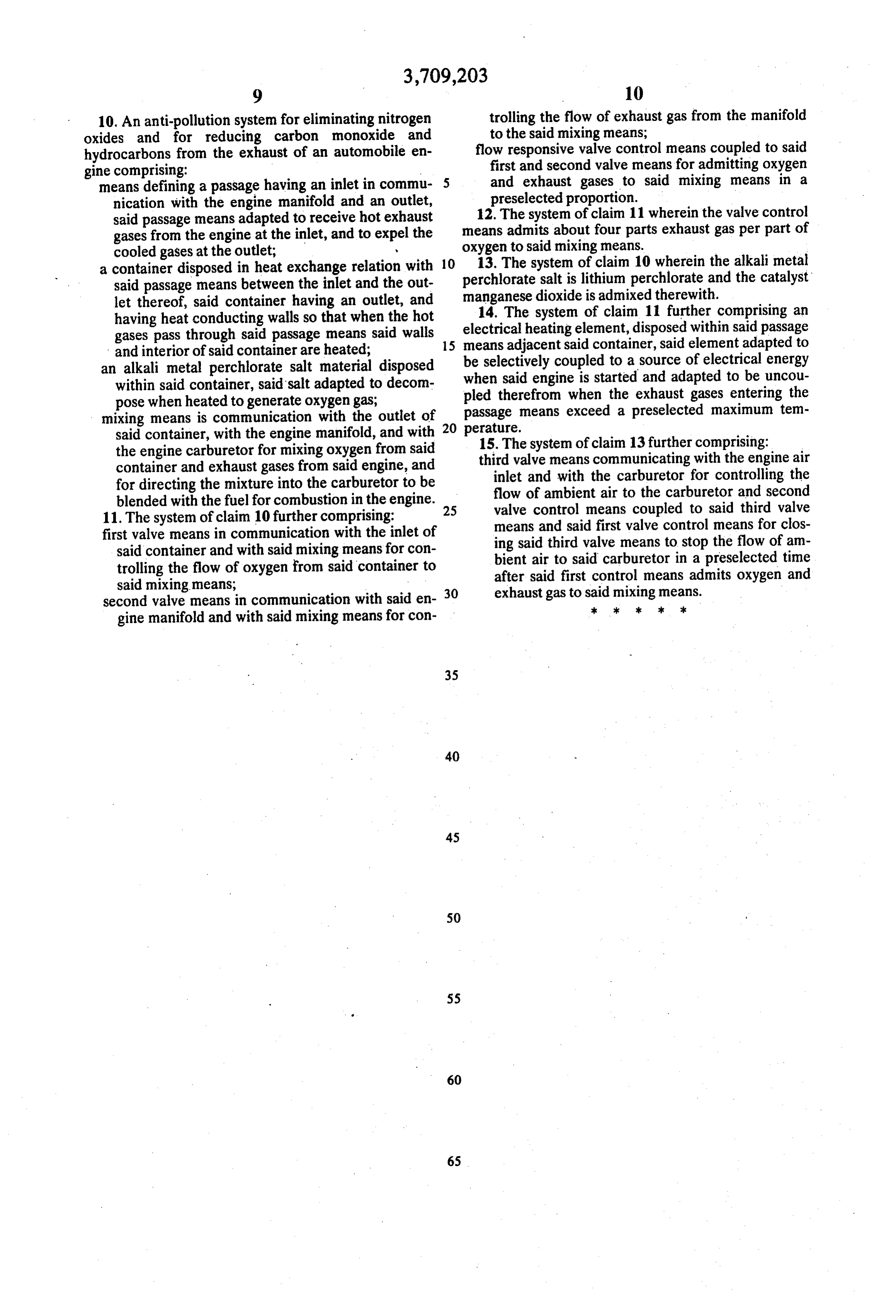
the engine carburetor for mixing oxygen from said third valve means communicating with the engine air container and exhaust gases from said engine, and inlet and with the carburetor for controlling the for directing the mixture into the carburetor to be flow of ambient air to the carburetor and second blended with the fuel for combustion in the engine. 25 valve control means coupled to said third valve 11. The system of claim 10 further comprising: means and said first valve control means for clos first valve means in communication with the inlet of said container and with said mixing means for con ing said third valve means to stop the flow of am trolling the flow of oxygen from said container to bient air to said carburetor in a preselected time said mixing means; after said first control means admits oxygen and second valve means in communication with said en 30 exhaust gas to said mixing means.
gine manifold and with said mixing means for con
Page 8
— UNITED STATES PATENT OFFICE .
CERTIFICATE OF CORRECTION
Patent No. 3,709,203 Dated January 9, 1973 Inventor(s) Edward J. Cettin, Jimmy P. Pappas, Sam E. Lager It is certified that error appears in the above-identified patent and that said Letters Patent are hereby corrected as shown below: In Column 7, 1ine 54, "therefor" should read --therefore--. In Column 9, 1ine 19, Claim 10, "is" should read --in--.
Signed and sealed this 10th day of July 1973.
(SEAL)
Attest:
EDWARD M.FLETCHER, JR.
Attesting Officer ...
Rene Tegtmeyer
Acting Commissioner of Patents
Provenance
- Collection
- Cited prior art
- Original PDF
- patentimages.storage.googleapis.com →
- Filed
- 1971-07-16
- Pages
- 8
- Method
- pdftotext (the PDF's own text layer) + pdftoppm 300dpi page scans
- Source
- Google Patents bibliographic record
- Granted
- 1973-01-09
- Inventors
- S Lager; E Cettin; J Pappas; THERMO CHEM SYST Inc
- Transcribed from
- patentimages.storage.googleapis.com →