patent · US3683622
Method of supplying a propulsion device with fuel
15 August 1972
Page 1 — bibliographic record
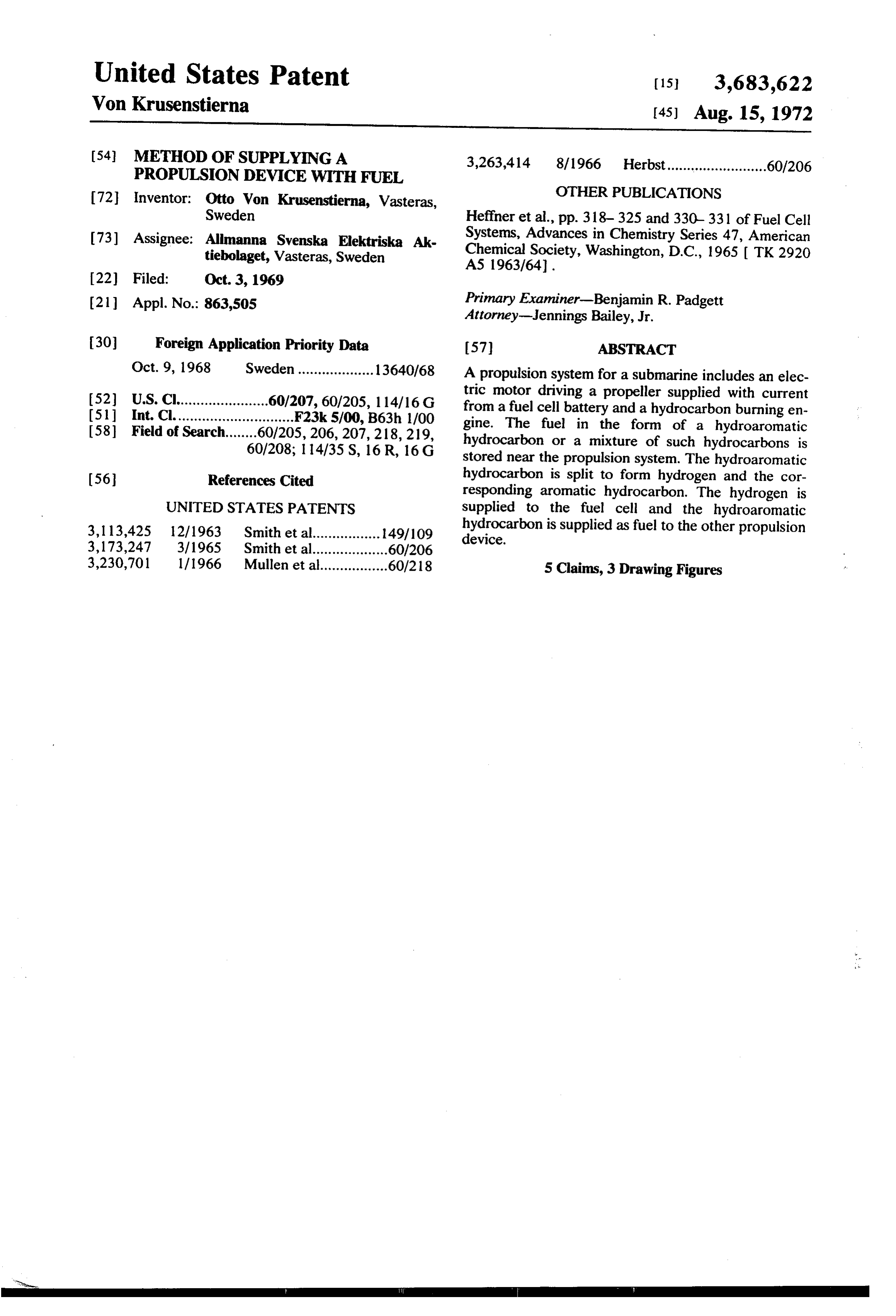
United States Patent (15) 3,683,622 Von Krusenstierna (45) Aug. 15, 1972 54 METHOD OF SUPPLYING A 3,263,414 8/1966 Herbst.........................60/206
PROPULSON DEVICE WITH FUEL
72 Inventor: Otto Von Krusenstierna, Vasteras, OTHER PUBLICATIONS Sweden Heffner et al., pp. 318-325 and 330-331 of Fuel Cell 73) Assignee: Allmanna Svenska Elektriska Ak Systems, Advances in Chemistry Series 47, American tiebolaget, Vasteras, Sweden Chemical Society, Washington, D.C., 1965 TK2920
21 Appl. No.: 863,505 Primary Examiner-Benjamin R. Padgett Attorney-Jennings Bailey, Jr.
30 Foreign Application Priority Data (57) ABSTRACT Oct. 9, 1968 Sweden................... 13640/68 A propulsion system for a submarine includes an elec
tric motor driving a propeller supplied with current (5ll Int. Cl.............................. F23kS/00, B63h 1/00 from a fuel cell battery and a hydrocarbon burning en 58) Field of Search........60/205, 206, 207,218, 219, gine. The fuel in the form of a hydroaromatic 60/208; 114/35 S, 16 R, 16 G hydrocarbon or a mixture of such hydrocarbons is stored near the propulsion system. The hydroaromatic 56 References Cited hydrocarbon is split to form hydrogen and the cor responding aromatic hydrocarbon. The hydrogen is
UNITED STATES PATENTS supplied to the fuel cell and the hydroaromatic 3,113,425 12/1963 Smith et al................. 149/109 hydrocarbon is supplied as fuel to the other propulsion device.
3,173,247 3/1965 Smith et al...................60/206 3,230,701 1/1966 Mullen et al.................60/218 5 Claims, 3 Drawing Figures
Page 2
Drawing sheet — no readable text.
Page 3
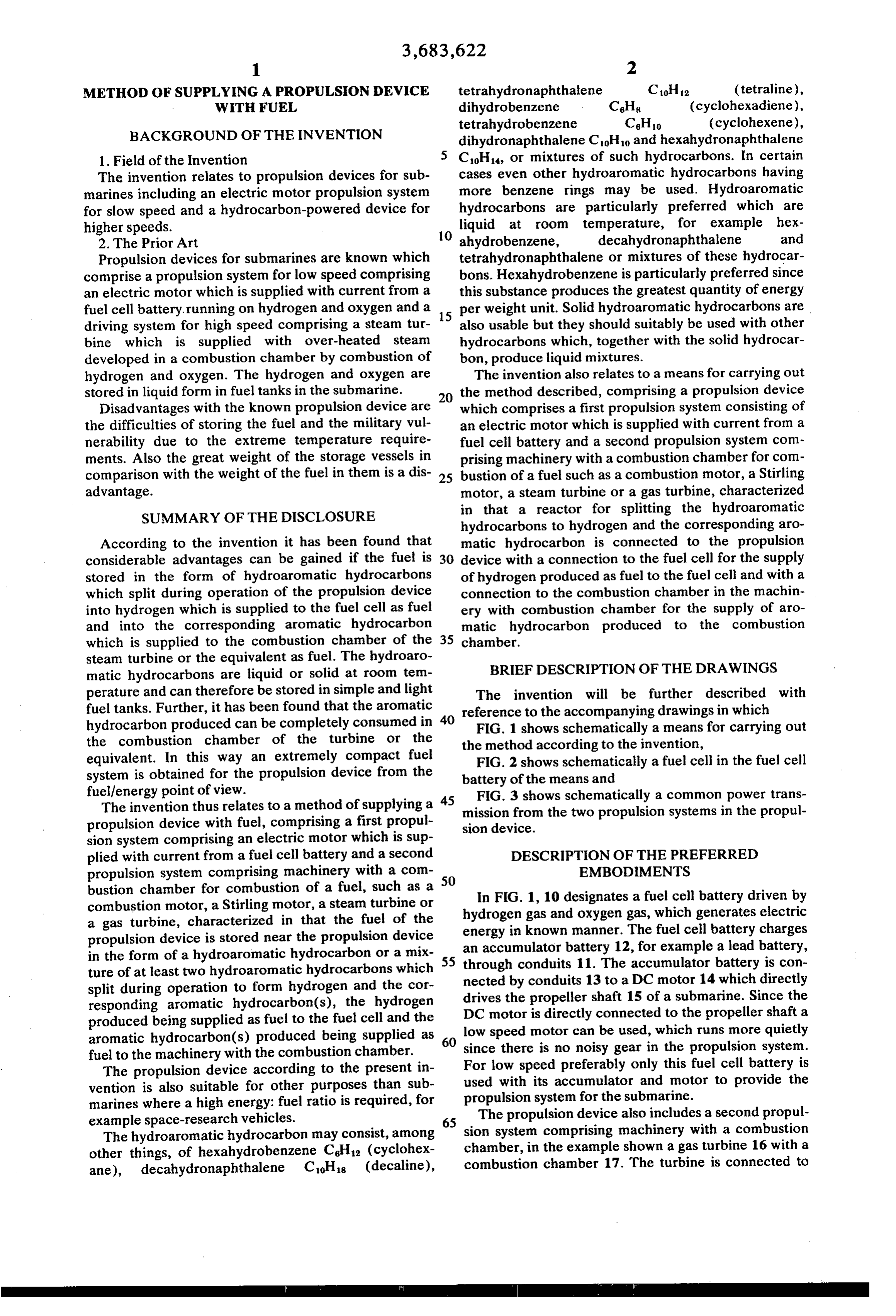
METHOD OF SUPPLYING A PROPULSON DEVICE tetrahydronaphthalene CoHtz (tetraline), WTH FUEL dihydrobenzene CH (cyclohexadiene), tetrahydrobenzene Caho (cyclohexene),
BACKGROUND OF THE INVENTION dihydronaphthalene CoHo and hexahydronaphthalene 1. Field of the Invention CoH, or mixtures of such hydrocarbons. In certain The invention relates to propulsion devices for sub cases even other hydroaromatic hydrocarbons having marines including an electric motor propulsion system more benzene rings may be used. Hydroaromatic for slow speed and a hydrocarbon-powered device for hydrocarbons are particularly preferred which are higher speeds. liquid at room temperature, for example hex 2. The Prior Art 10 ahydrobenzene, decahydronaphthalene and Propulsion devices for submarines are known which tetrahydronaphthalene or mixtures of these hydrocar comprise a propulsion system for low speed comprising bons. Hexahydrobenzene is particularly preferred since an electric motor which is supplied with current from a this substance produces the greatest quantity of energy fuel cell battery, running on hydrogen and oxygen and a 15 per weight unit. Solid hydroaromatic hydrocarbons are driving system for high speed comprising a steam tur also usable but they should suitably be used with other bine which is supplied with over-heated steam hydrocarbons which, together with the solid hydrocar developed in a combustion chamber by combustion of bon, produce liquid mixtures.
hydrogen and oxygen. The hydrogen and oxygen are The invention also relates to a means for carrying out stored in liquid form in fuel tanks in the submarine. 20 the method described, comprising a propulsion device Disadvantages with the known propulsion device are which comprises a first propulsion system consisting of the difficulties of storing the fuel and the military vul an electric motor which is supplied with current from a nerability due to the extreme temperature require fuel cell battery and a second propulsion system com ments. Also the great weight of the storage vessels in prising machinery with a combustion chamber for com comparison with the weight of the fuel in them is a dis 25 bustion of a fuel such as a combustion motor, a Stirling advantage. motor, a steam turbine or a gas turbine, characterized
SUMMARY OF THE DISCLOSURE
in that a reactor for splitting the hydroaromatic hydrocarbons to hydrogen and the corresponding aro
According to the invention it has been found that matic hydrocarbon is connected to the propulsion considerable advantages can be gained if the fuel is 30 device with a connection to the fuel cell for the supply stored in the form of hydroaromatic hydrocarbons of hydrogen produced as fuel to the fuel cell and with a which split during operation of the propulsion device connection to the combustion chamber in the machin into hydrogen which is supplied to the fuel cell as fuel ery with combustion chamber for the supply of aro and into the corresponding aromatic hydrocarbon matic hydrocarbon produced to the combustion which is supplied to the combustion chamber of the 35 chamber.
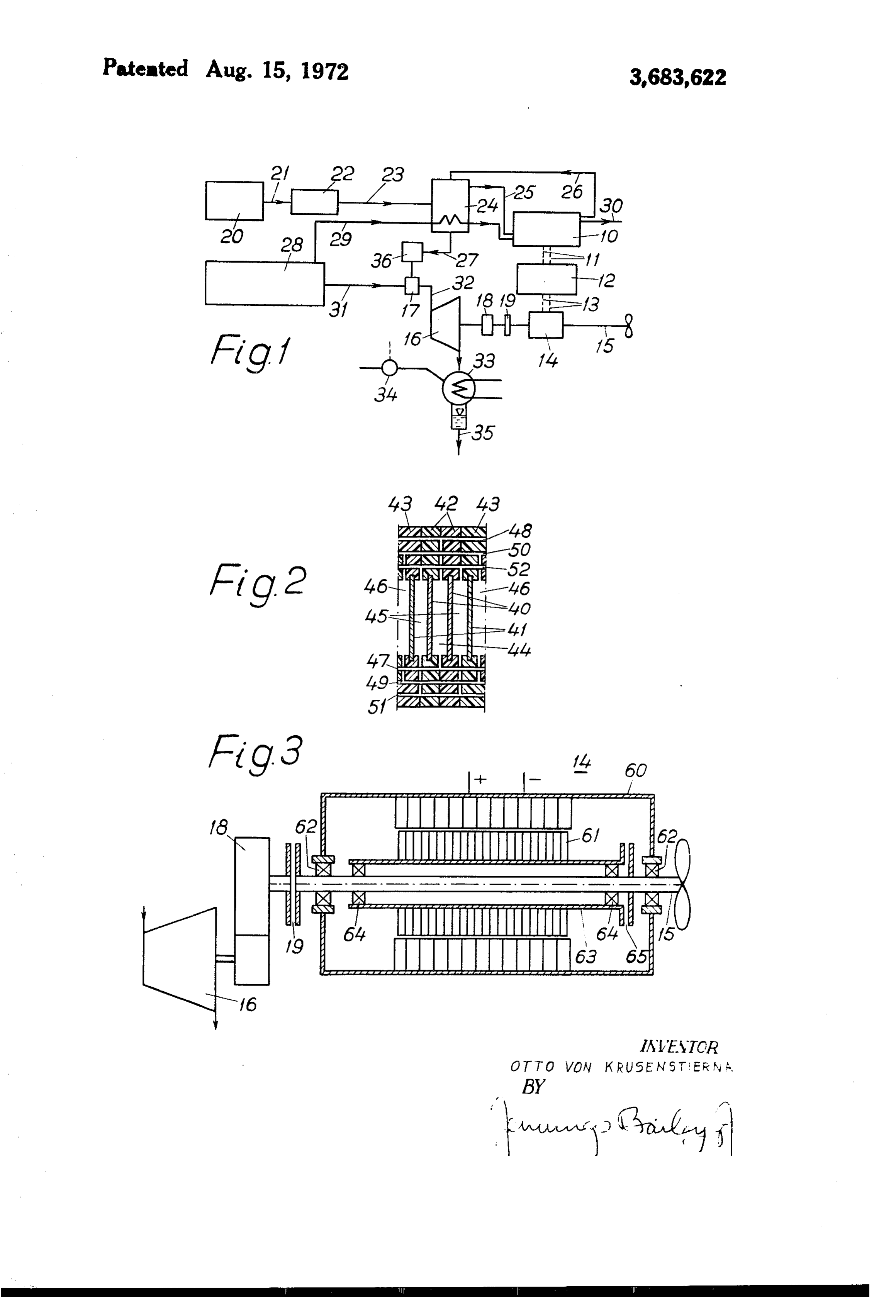
steam turbine or the equivalent as fuel. The hydroaro BRIEF DESCRIPTION OF THE DRAWINGS matic hydrocarbons are liquid or solid at room tem perature and can therefore be stored in simple and light The invention will be further described with fuel tanks. Further, it has been found that the aromatic reference to the accompanying drawings in which hydrocarbon produced can be completely consumed in 40 FIG. 1 shows schematically a means for carrying out the combustion chamber of the turbine or the equivalent. In this way an extremely compact fuel theFIG. method according to the invention, 2 shows schematically a fuel cell in the fuel cell system is obtained for the propulsion device from the battery of the means and fuel/energy point of view. FIG. 3 shows schematically a common power trans The invention thus relates to a method of supplying a 45 mission from the two propulsion systems in the propul propulsion device with fuel, comprising a first propul sion device.
sion system comprising an electric motor which is sup plied with current from a fuel cell battery and a second DESCRIPTION OF THE PREFERRED propulsion system comprising machinery with a com 50 EMBODIMENTS bustion chamber for combustion of a fuel, such as a In FIG. 1, 10 designates a fuel cell battery driven by combustion motor, a Stirling motor, a steam turbine or hydrogen gas and oxygen gas, which generates electric a gas turbine, characterized in that the fuel of the energy in known manner. The fuel cell battery charges propulsion device is stored near the propulsion device an accumulator battery 12, for example a lead battery, in the form of a hydroaromatic hydrocarbon or a mix 55 through conduits 11. The accumulator battery is con ture of at least two hydroaromatic hydrocarbons which nected by conduits 13 to a DC motor 14 which directly split during operation to form hydrogen and the cor drives the propeller shaft 15 of a submarine. Since the responding aromatic hydrocarbon(s), the hydrogen DC motor is directly connected to the propeller shaft a produced being supplied as fuel to the fuel cell and the low speed motor can be used, which runs more quietly aromatic hydrocarbon(s) produced being supplied as 60 since there is no noisy gear in the propulsion system. fuel to the machinery with the combustion chamber. For low speed preferably only this fuel cell battery is The propulsion device according to the present in vention is also suitable for other purposes than sub used with its accumulator and motor to provide the marines where a high energy: fuel ratio is required, for propulsion system for the submarine.
The propulsion device also includes a second propul
The hydroaromatic hydrocarbon may consist, among sion system comprising machinery with a combustion other things, of hexahydrobenzene CH1 (cyclohex chamber, in the example shown a gas turbine 16 with a combustion chamber 17. The turbine is connected to ane), decahydronaphthalene CoH 18 (decaline),
Page 4
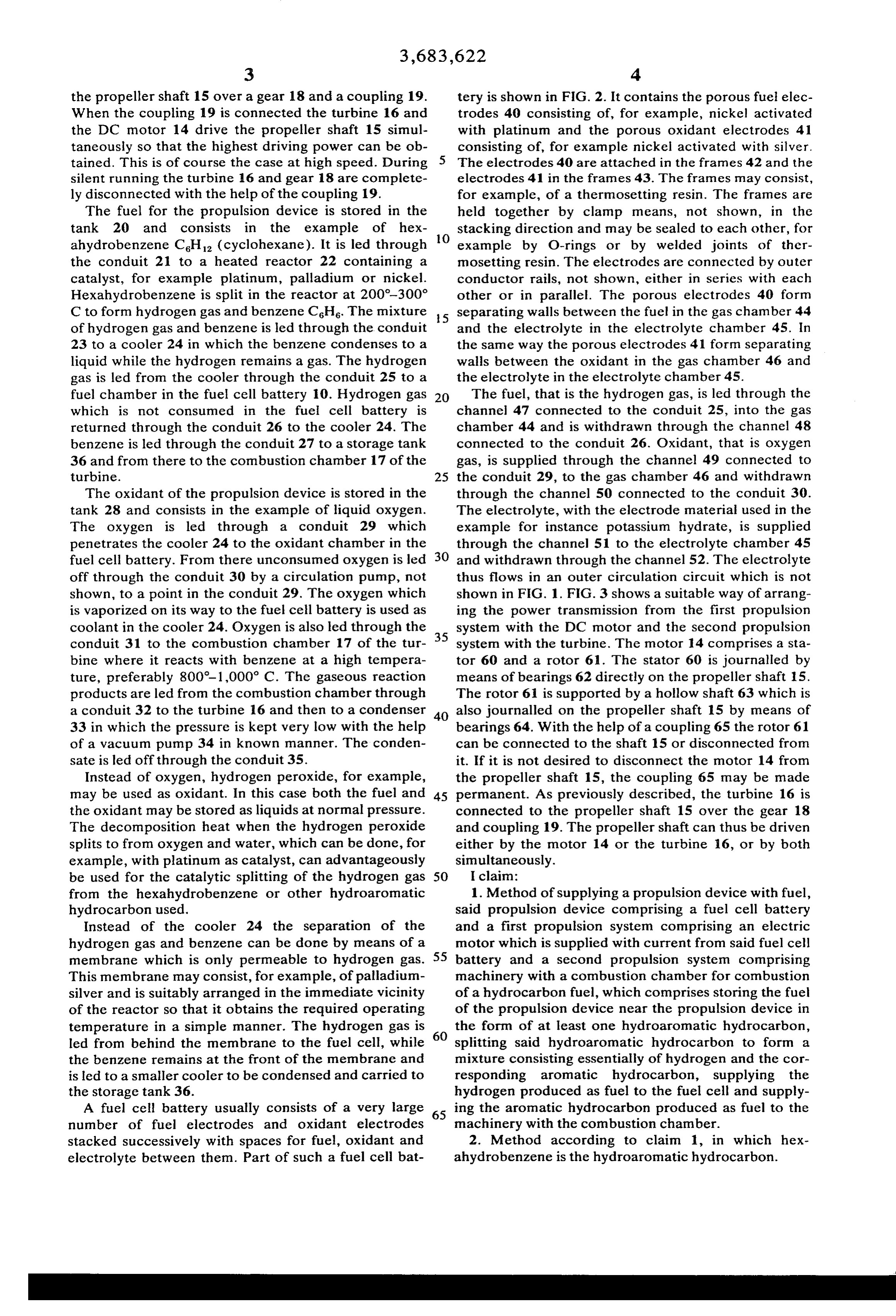
the propeller shaft 15 over a gear 18 and a coupling 19. tery is shown in FIG. 2. It contains the porous fuel elec When the coupling 19 is connected the turbine 16 and trodes 40 consisting of, for example, nickel activated the DC motor 14 drive the propeller shaft 15 simul with platinum and the porous oxidant electrodes 41 taneously so that the highest driving power can be ob consisting of, for example nickel activated with silver. tained. This is of course the case at high speed. During The electrodes 40 are attached in the frames 42 and the silent running the turbine 16 and gear 18 are complete electrodes 41 in the frames 43. The frames may consist, ly disconnected with the help of the coupling 19. for example, of a thermosetting resin. The frames are The fuel for the propulsion device is stored in the held together by clamp means, not shown, in the tank 20 and consists in the example of hex O stacking direction and may be sealed to each other, for ahydrobenzene CH (cyclohexane). It is led through example by O-rings or by welded joints of ther the conduit 21 to a heated reactor 22 containing a mosetting resin. The electrodes are connected by outer catalyst, for example platinum, palladium or nickel. conductor rails, not shown, either in series with each Hexahydrobenzene is split in the reactor at 200-300 other or in parallel. The porous electrodes 40 form C to form hydrogen gas and benzene CHs. The mixture 5 separating walls between the fuel in the gas chamber 44 of hydrogen gas and benzene is led through the conduit and the electrolyte in the electrolyte chamber 45. In 23 to a cooler 24 in which the benzene condenses to a the same way the porous electrodes 41 form separating liquid while the hydrogen remains a gas. The hydrogen walls between the oxidant in the gas chamber 46 and gas is led from the cooler through the conduit 25 to a the electrolyte in the electrolyte chamber 45. fuel chamber in the fuel cell battery 10. Hydrogen gas The fuel, that is the hydrogen gas, is led through the which is not consumed in the fuel cell battery is channel 47 connected to the conduit 25, into the gas returned through the conduit 26 to the cooler 24. The chamber 44 and is withdrawn through the channel 48 benzene is led through the conduit 27 to a storage tank connected to the conduit 26. Oxidant, that is oxygen 36 and from there to the combustion chamber 17 of the gas, is supplied through the channel 49 connected to turbine. 25 the conduit 29, to the gas chamber 46 and withdrawn The oxidant of the propulsion device is stored in the through the channel 50 connected to the conduit 30. tank 28 and consists in the example of liquid oxygen. The electrolyte, with the electrode material used in the The oxygen is led through a conduit 29 which example for instance potassium hydrate, is supplied penetrates the cooler 24 to the oxidant chamber in the through the channel 51 to the electrolyte chamber 45 fuel cell battery. From there unconsumed oxygen is led 30 and withdrawn through the channel 52. The electrolyte off through the conduit 30 by a circulation pump, not thus flows in an outer circulation circuit which is not shown, to a point in the conduit 29. The oxygen which shown in FIG. 1. FIG. 3 shows a suitable way of arrang is vaporized on its way to the fuel cell battery is used as ing the power transmission from the first propulsion coolant in the cooler 24. Oxygen is also led through the 35 system with the DC motor and the second propulsion conduit 31 to the combustion chamber 17 of the tur system with the turbine. The motor 14 comprises a sta bine where it reacts with benzene at a high tempera tor 60 and a rotor 61. The stator 60 is journalled by ture, preferably 800-1,000° C. The gaseous reaction means of bearings 62 directly on the propeller shaft 15. products are led from the combustion chamber through The rotor 61 is supported by a hollow shaft 63 which is a conduit 32 to the turbine 16 and then to a condenser 40 also journalled on the propeller shaft 15 by means of 33 in which the pressure is kept very low with the help bearings 64. With the help of a coupling 65 the rotor 61 of a vacuum pump 34 in known manner. The conden can be connected to the shaft 15 or disconnected from sate is led off through the conduit 35. it. If it is not desired to disconnect the motor 14 from Instead of oxygen, hydrogen peroxide, for example, the propeller shaft 15, the coupling 65 may be made may be used as oxidant. In this case both the fuel and 45 permanent. As previously described, the turbine 16 is the oxidant may be stored as liquids at normal pressure. connected to the propeller shaft 15 over the gear 18 The decomposition heat when the hydrogen peroxide and coupling 19. The propeller shaft can thus be driven splits to from oxygen and water, which can be done, for either by the motor 14 or the turbine 16, or by both example, with platinum as catalyst, can advantageously simultaneously.
be used for the catalytic splitting of the hydrogen gas 50 I claim:
from the hexahydrobenzene or other hydroaromatic 1. Method of supplying a propulsion device with fuel, hydrocarbon used. said propulsion device comprising a fuel cell battery Instead of the cooler 24 the separation of the and a first propulsion system comprising an electric hydrogen gas and benzene can be done by means of a motor which is supplied with current from said fuel cell membrane which is only permeable to hydrogen gas. 55 battery and a second propulsion system comprising This membrane may consist, for example, of palladium machinery with a combustion chamber for combustion silver and is suitably arranged in the immediate vicinity of a hydrocarbon fuel, which comprises storing the fuel of the reactor so that it obtains the required operating of the propulsion device near the propulsion device in temperature in a simple manner. The hydrogen gas is 60 the form of at least one hydroaromatic hydrocarbon, led from behind the membrane to the fuel cell, while splitting said hydroaromatic hydrocarbon to form a the benzene remains at the front of the membrane and mixture consisting essentially of hydrogen and the cor is led to a smaller cooler to be condensed and carried to responding aromatic hydrocarbon, supplying the the storage tank 36. hydrogen produced as fuel to the fuel cell and supply A fuel cell battery usually consists of a very large 65 ing the aromatic hydrocarbon produced as fuel to the number of fuel electrodes and oxidant electrodes machinery with the combustion chamber. stacked successively with spaces for fuel, oxidant and 2. Method according to claim 1, in which hex electrolyte between them. Part of such a fuel cell bat ahydrobenzene is the hydroaromatic hydrocarbon.
Page 5
3. Method according to claim 1, in which hydroaromatic hydrocarbon fuel consists essentially of decahydronaphthalene is the hydroaromatic hydrocar- a mixture of at least two of the substances selected bon. from the group consisting of hexahydrobenzene, 4. Method according to claim 1, in which tetr hydronaphthalene is the hydroaromatic hydrocarbon. 5 decahydronaphthalene and tetrahydronaphthalene. 5. Method according to claim 1, in which the xx xx xx xx xk
Provenance
- Collection
- Cited prior art
- Original PDF
- patentimages.storage.googleapis.com →
- Filed
- 1969-10-03
- Pages
- 5
- Method
- pdftotext (the PDF's own text layer) + pdftoppm 300dpi page scans
- Source
- Google Patents bibliographic record
- Granted
- 1972-08-15
- Inventors
- Otto Von Krusenstierna; ASEA AB
- Transcribed from
- patentimages.storage.googleapis.com →