patent · US1862952
Method of treating petroleum
14 June 1932
Page 1
June 14, 1932. W. F. BLEECKER 1862,952
METHOD OF TREATING PETROLEUM
ELECTROYTE
LqLTASAALSA LSSTL LSLAL LkLY LS TLTAkTTSLSTALTTLLLLSSSATTTA LLTTL ALLTT TATLLTTLTTTLTLTTTLLLLLTLTTTeLLTT eLeLSLSez LLTLLLLS LLLLLLT e LT SLSTTL T LLL LLTTeLeAJ
Page 2
Patented June 14, 1932 1862,952
UNITED STATES PATENT OFFICE
WARREN F. BLEECKER, OF BOULDER, COLORADo
VETHOD OF TREATING PETROLEUV
Application filed Eliay 1, 1928. Serial No. 24,215.
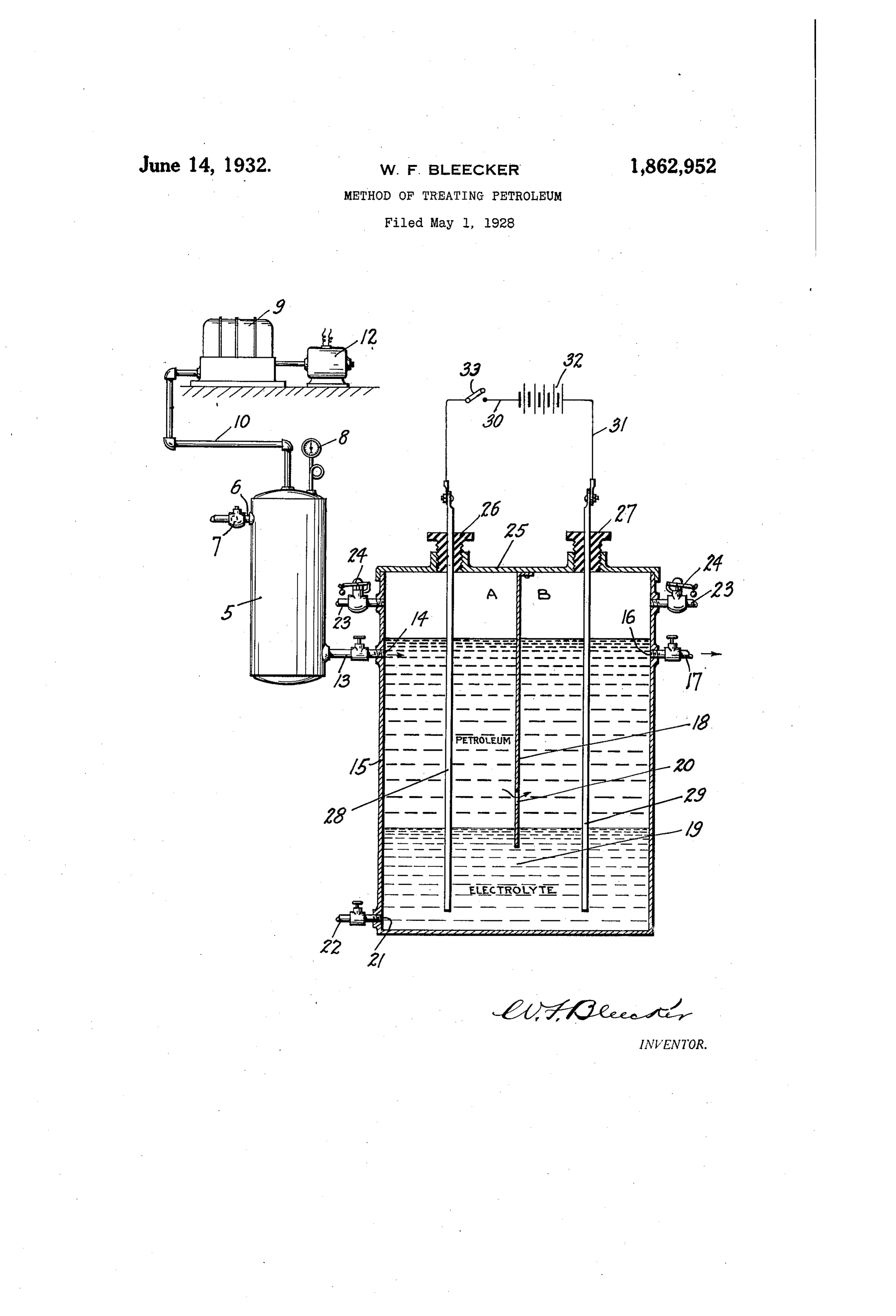
My invention relates to a method of and The treatment tank has an air-tight cap 25 apparatus for rendering corrosive sulphur that carries two insulating plugs 26 and 27 compounds in petroleum inactive. An ob apertured lengthwise, one plug being above ject of the invention is to subject petroleum each compartment. An anode 28 is inserted 5 containing such compounds to the action of through and fills the aperture in plug 26 and 55 an oxidizing gas, such as chlorine or oxide extends to within a short distance of the bot of chlorine, and then to hydrogen gas to dis tom of compartment A. A cathode 29 Oc place the oxidizing gas. cupies the same position in plug 27 and com Another object is to disperse such gases partment B. :
O through the petroleum by means of Subjecting The anode and cathode are connected by 60 same to pressure. wires 30 and 31 respectively, with a source of Other objects reside in details of construc electric energy 32, in the form of direct cur tion of the apparatus for carrying into effect rent. A switch 33 may be employed in one the foregoing objects, in novel combinations of the wires.
and arrangements of parts, and in novel steps In the operation of the present invention, 65 and arrangements of steps in the process. petroleum containing corrosive Sulphur com Reference is made to my application for pounds, such as hydrogen Sulphide and many patent Serial No. 274,213, filed May 1, 1928, others, is fed into the pressure tank 5 by the for claims on subjects matter shown and/or conduit 6. The check valve prevents the O 20 described but not claimed herein. return of liquid to the conduit from the tank The single figure in the drawing is a Sec 5 tional elevation of a system embodying the The motor 12 is started, operating the com present invention. pressor 9 and increasing the pressure in the A pressure feed tank is shown in the draw tank 5 until the oil is fed into the treatment 25 ing at 5, which is connected with a source tank 15 at the desired rate of flow. The pres (not shown) of petroleum by a conduit 6 sure in the tank 5 is shown on the gauge. having a check valve 7 to prevent the return Any suitable electrolyte is fed into the tank of petroleum to the conduit. A pressure by means of the conduit 22, preferably until gauge 8 is provided for the tank. the level of the electrolyte is above the bot 30 To raise the pressure in the tank, a com tom of the partition 18 but below the opening 80 pressor 9 is connected there with by a conduit 20. The electrolyte may be brine, a solution 10... An electric motor 12 operates the com of caustic soda, dilute sulfuric acid, or any pressor. other suitable solution that may be elec The pressure feed tank 5 has an outlet con trolyzed. The petroleum fed into the treat 35 duit 13 connected with an oil inlet 14 of a ment tank settles on top of the electrolyte and 85 treatment tank 15. The treatment tank 15 finds its level in the two compartments by has an outlet 16 emptying into a conduit 17. means of the opening 20.
Between the inlet 14 and the outlet 16 of When the dilute sulfuric acid is used, an the treatment tank is a partition 18 that di inert anode is employed, such as graphite or vides the upper part of the tank. vertically platinum. 90 into two compartments A and IB. The par If brine is used, closing the electrolytic tition is spaced from the bottom of the tank circuit by the switch 33 generates nascent 15 to provide a passage 19 and has an open chlorine at the anode and nascent hydrogen ing 20 above the passage to afford a second gas at the cathode.
connection between the compartments. An The petroleum is subjected to the oxidizing 95 electrolyte inlet 21 connected with a con effect of the gas (chlorine if brine is the elec duit 22 is provided near the bottom of the trolyte) in compartment A and to the effect tank. Gas escape conduits 23 having blow-off of the hydrogen in compartment B. Oxi valves 24 are provided above the oil inlet and dized petroleum flows from compartment. A 00
outlet to allow the escape of excess gases. into compartment B by the opening 20.
Page 3
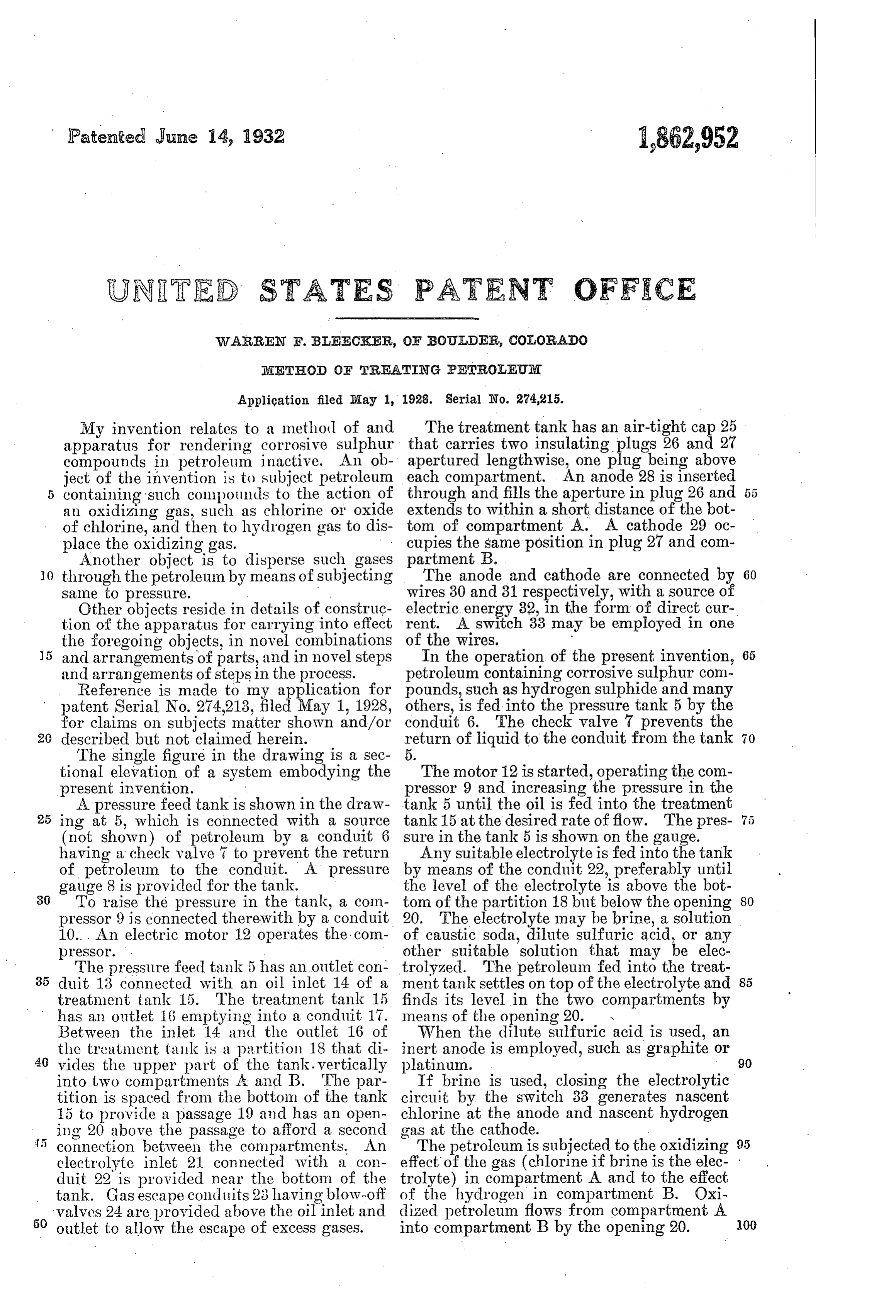
When in compartment B, oxidizing gas in pounds from petroleum containing such com the petroleum is displaced by hydrogen. pounds, comprising introducing into the The gases generated at the electrodes pass petroleum an oxidizing gas produced by elec up into the petroleum, and as soon as the trolysis of an electrolyte in the presence of pressure in the compartments is raised by ex the petroleum, and displacing the oxidizing cess gas, the gas is dispersed throughout the gas in the petroleum by hydrogen produced oil. Since the oil will absorb a sufficient by electrolysis of an electrolyte in the pres quantity of gas to completely oxidize the cor ence of the petroleum, the introduction of rosive sulfur compounds, a complete and uni said gases into the petroleum being in separate 75 form mixture is obtained, which produces and distinct steps.
complete oxidation in compartment A and 3. A process of removing sulphur com displacement of the residual oxidizing gas pounds from petroleum containing such in compartment B. The optimum tempera compounds, comprising??? floating the petro ture is ordinary atmospheric temperatures. leum on a body of an electrolyte adapted to 80 Since the process is to be operated directly. produce an oxidizing gas and hydrogen by in the oil field, this process has been worked electrolysis, electrolyzing said body and in out with a view to obtaining a process whose troducing the oxidizing gas and the hydrogen optimum temperature is that of the atmos into the petroleum in separate and distinct phere as it is usually found. steps.
The optimum pressure is five to ten 4. A process of removing sulphur com 85 pounds above atmospheric, which is consid pounds from petroleum containing such com ered enough to thoroughly disperse the gas pounds, comprising placing the petroleum through the oil. under pressure, introducing into the petro The optimum concentration of the elec leum an oxidizing gas produced by electroly 90 trolyte is that which produces the greatest sis of an electrolyte in the presence of the quantity of gas per unit of electric energy, petroleum, and displacing the oxidizing gas although any concentration of electrolyte will in the petroleum by hydrogen produced by produce gas to some degree. More specifical electrolysis of an electrolyte in the presence ly, by experiment it appears that 150 to 250 of the petroleum, the introduction of said 95 cubic centimeters of sulphuric acid of 60 gases into the petroleum being in separate Baumé per liter of water is the range of and distinct steps.
optimum concentration. 5. A process of removing sulphur com The petroleum that flows out through the pounds from petroleum containing such corn conduit 17 is “oxidized,” which merely pounds, comprising introducing into the means that the corrosive sulphur compounds petroleum a nascent oxidizing gas produced 00 have been rendered inert, neutralized, or “re by electrolysis of an electrolyte in the pres moved' as the literature of oil purification: ence of the petroleum, and displacing the terms it. The word “oxidized’ has been used oxidizing gas in the petroleum by nascent in this sense in the present specification, hydrogen produced by electrolysis of an elec 105 which seems to be the accepted meaning in trolyte in the presence of the petroleum, the the literature of this art. introduction of said gases into the petroleum “Oil' and “petroleum' are used inter being in separate and distinct steps. changeably in this specification, and wherever 6. A process of removing sulphur com either has been used, the broadest meaning pounds from petroleum containing such com 10 of either is meant. Moreover, the products pounds, comprising introducing into a stream of petroleum, such as gasoline etc. are also of the petroleum an oxidizing gas produced meant by the use of either. by electrolysis of an electrolyte in the pres Where “chlorine' is mentioned in the here ence of the petroleum, and displacing the unto appended claims, it is to be understood oxidizing gas in the petroleum by hydrogen that chlorine-containing gas, e. g., oxide of produced by electrolysis of an electrolyte in 5 chlorine, is an equivalent. the presence of the petroleum, the introduc What I claim and desire to secure by Let tion of said gases into the petroleum being in ters Patent is: 8) separate and distinct steps. 1. A process of removing corrosive sul In testimony whereof I have affixed my phur compounds from petroleum containing signature.
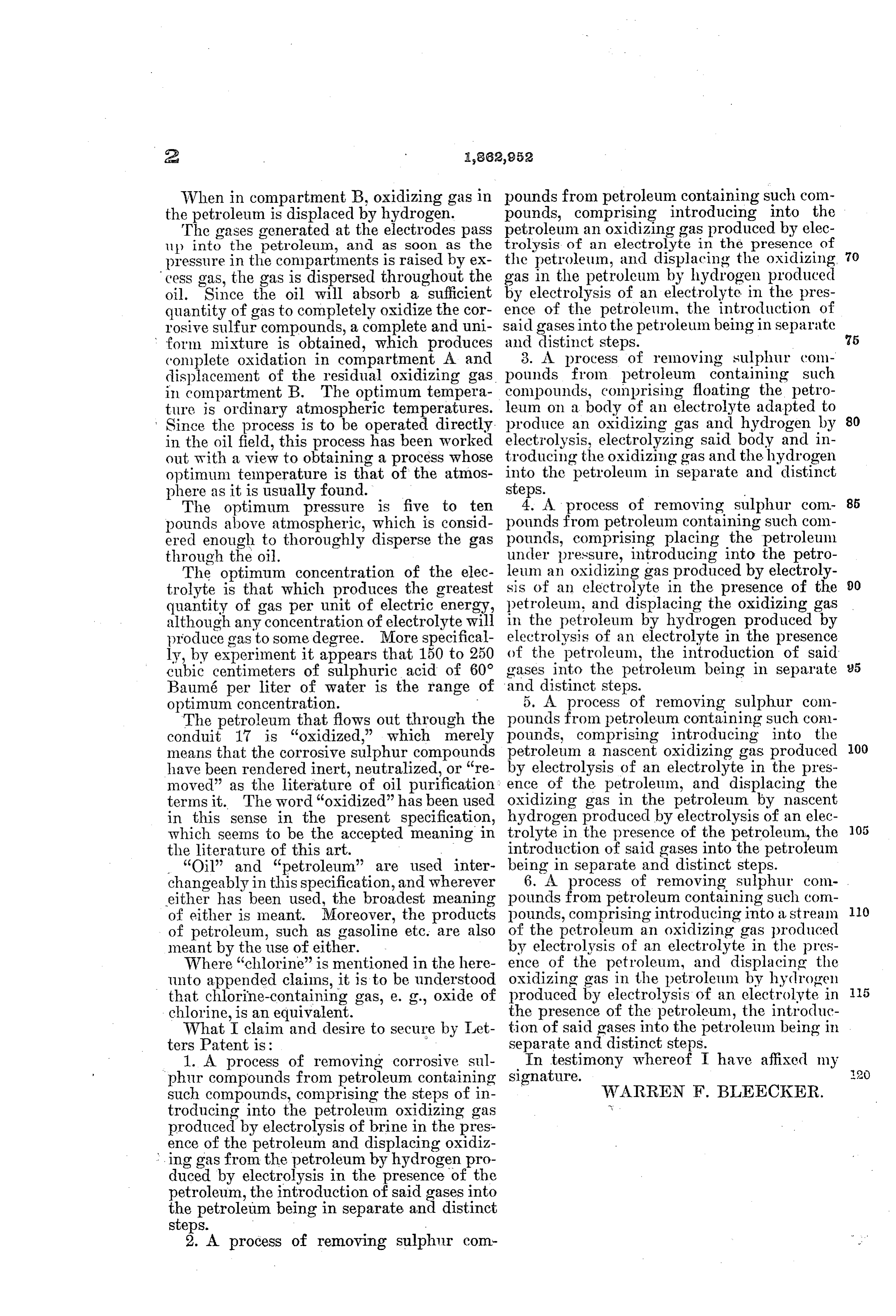
Such compounds, comprising the steps of in WARREN F. BLEECKER. troducing into the petroleum oxidizing gas produced by electrolysis of brine in the pres ence of the petroleum and displacing oxidiz ing gas from the petroleum by hydrogen pro duced by electrolysis in the presence of the petroleum, the introduction of said gases into the petroleum being in separate and distinct steps.
2. A process of removing sulphur com
Provenance
- Collection
- Cited prior art
- Original PDF
- patentimages.storage.googleapis.com →
- Filed
- 1928-05-01
- Pages
- 3
- Method
- pdftotext (the PDF's own text layer) + pdftoppm 300dpi page scans
- Source
- Google Patents bibliographic record
- Granted
- 1932-06-14
- Inventors
- Warren F Bleecker
- Transcribed from
- patentimages.storage.googleapis.com →