patent · US3574560
Device for producing gaseous reactants particularly hydrogen and oxygen for fuel cells
13 April 1971
Page 1
Drawing sheet — no readable text.
Page 2
United States Patent Office 3,574,560 Patented Apr. 13, 1971
catalysts, whereby the development of gas will be auto
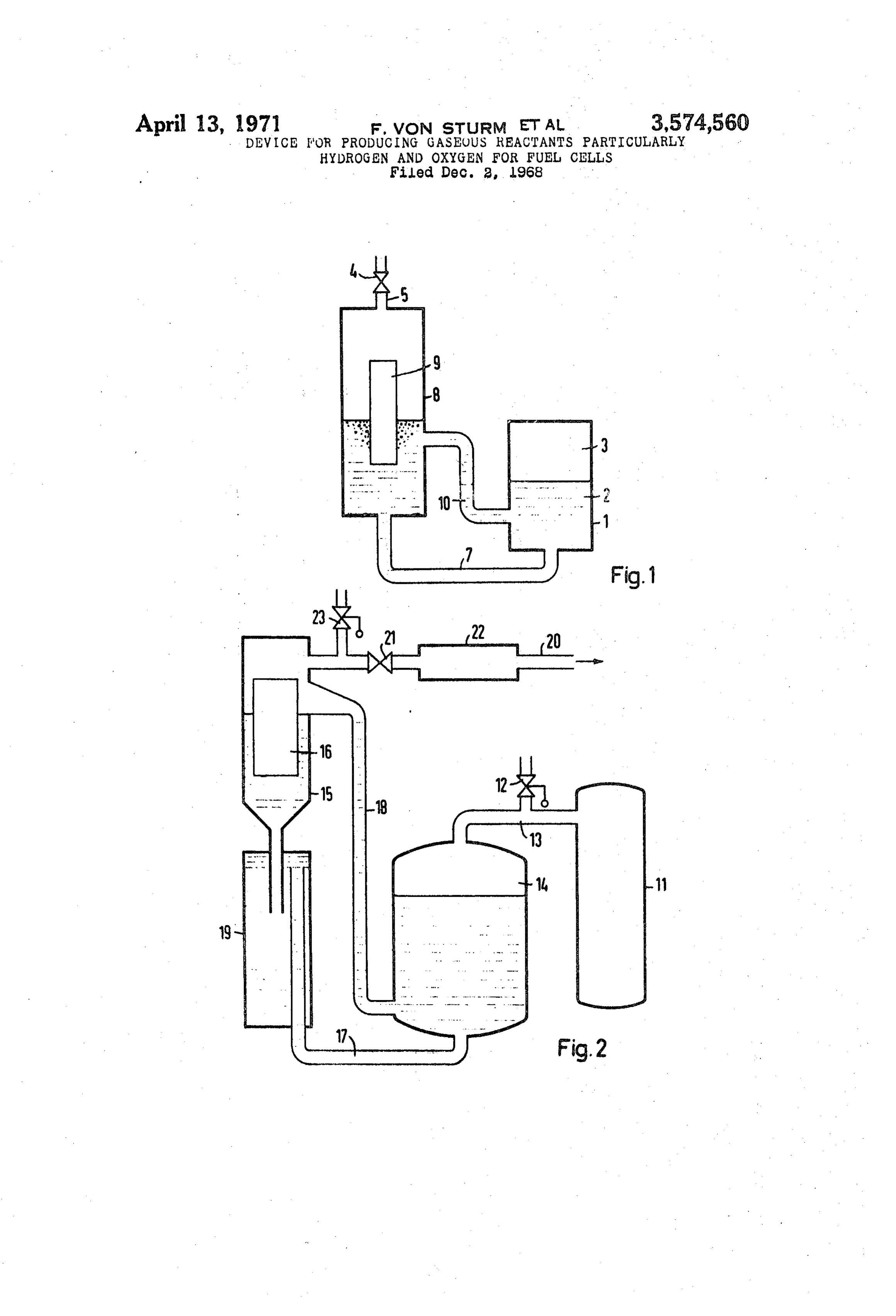
DEVICE FOR PRODUCING GASEOUS REACTANTS matically adjusted to the gas absorption of the consumer. PARTICULARLY HYDROGEN AND OXYGEN The solution to the problem lies in placing the liquid FORFUEL CELLS substance or the substance dissolved in a liquid, into a Ferdinand von Sturm and Hans Kohlmiller, Erlangen, storage container which is connected to a Sealed gas cham Germany, assignors to Siemens Aktiengesellschaft, ber and is attached, via at least one supply line, to a re Berlin, Germany action vessel which contains the solid substance or Solid Filed Dec. 2, 1968, Ser. No. 780,426 catalysts. Thus, when the pressure is reduced in the re Claims priority, application Germany, Dec. 2, 1967, action vessel, the liquid contained in the storage container P 6 67 277.8 10 is further compressed into the reaction vessel and when Int, C. B01j 7/02 the pressure in the reaction vessel rises, the liquid is trans U.S. C. 23-282 4 Claims ported, completely or partly, into the storage container. The drawing illustrates in:
ABSTRACT OF THE DISCLOSURE FIG. 1 an appropriate embodiment of the invention; 5 and
Method of producing gaseous reactants, particularly FIG. 2 a preferred embodiment.
hydrogen and oxygen, for fuel cells by reaction or cata The lower part of the storage container 1 holds the lytic dissociation of liquid or liquid-dissolved substances, liquid 2, provided for reaction or catalytic dissociation, with solid substances or solid catalysts, whereby the de for example potash lye (KOH), while the upper portion velopment of gas is automatically adjusted to the gas 20 3 of the storage container holds the pressure gas, e.g. consumed. The liquid substance or the liquid-dissolved nitrogen, which serves as an automatic regulation of the substance is placed into a storage container which is con gas production. When valve 4 is opened in the gas outlet nected with a sealed gas chamber and also connected, via tube 5, the resultant pressure drop in the reaction vessel at least one line, to a reaction tube containing the solid and pressure difference causes the liquid 2 to flow into the substance or the solid catalyst. Thus when the pressure 25 reaction vessel 8 via connecting pipe 7. The solid sub drops in the reaction tube, the liquid located in the stor stance 9 which is used as a catalyst or a reaction com age container is further compressed into the reaction tube ponent is located within reaction vessel 8. The solid sub and when the pressure in the reaction tube rises, the liquid stance may be comprised of aluminum rods which are is either completely or partially returned to the storage preferably placed into a suitable holding device, such as container. 30 a tube of stainless steel, provided with a bottom screen. Gas begins to develop when the liquid comes in contact
Most fuel cells today work with hydrogen and oxygen. with the solid substance, which balances the pressure drop occurring thereby. If the gas consumption is increased, a
These gases are usually stored in pressure bottles. A num new difference in pressure occurs and the liquid level in ber of disadvantages must be accepted thereby, such as 35 reaction vessel 8 rises. This increases the contact area of for example heavy pressure containers and difficulties in the solid substance with the liquid and, consequently, the transporting the compressed gases. amount of gas produced per time unit. If, on the other It was, therefore, proposed to produce the gaseous re hand, the gas consumption is throttled, the pressure in the actants right at the locality of their employment, from reaction vessel rises and the liquid flows from the re liquid or solid substances. Thus, according to W. Vielstich 40 action vessel back into the storage container until the (see “Brennstoffelements” (Fuel Elements), published by
Chemie GmbH, Weinheim/Bergstr., Germany, 1965, page pressure balance is reestablished. This reduces the con tact surface of the solid substance with the liquid and thus 172), hydrogen, which is needed in portable H2/O2 bat adjusts automatically to the throttled gas consumption. teries, may be developed in a connected generator, by Similarly, the new method equalizes changes in reaction dissociation of sodium borate with 35% sulphuric acid. 45 velocity which are caused by temperature fluctuations. Apparatus to produce gases from liquid and solid re Thus, an increase in temperature produces a stronger de actants have been long known. Thus, hydrogen is fre velopment of gas and results in an increased pressure in quently produced in laboratories, by reacting zinc with the reaction vessel and thus a reduction of the liquid in hydrochloric acid in the well known Kipp generator.
All such apparatus require a column of liquid for pro 50 the reaction vessel. When the temperature decreases, the liquid in the reaction vessel rises.
ducing an excess pressure of gas whereby the hydrostatic The volume ratio of reaction vessel to the pressure gas pressure of said liquid column must be in balance with chamber is determined by the difference between the mini the desired gas pressure. mum and the maximum operational pressure. It is also known that, as a rule, fuel cells have no uni form gas consumption, but rather because of different 55 n The the hydrostatic pressure difference which is produced reaction vessel by the increase or reduction in the output requirements they have a variable gas consump liquid level, must be applied as a correction only at very tion, which necessitates a control over the gas develop low gas pressures.
ment proceSS. Thus, if the minimum operating pressure amounts to As stated, the control is usually connected with the out 0.5 atmosphere gauge and the intended safety pressure put of energy. The effectiveness of batteries with smaller 60 0.6 atmosphere gauge, the volume in the pressure gas output capacities, therefore, is sharply reduced. This en chamber should be about 30 liters when the reaction tails a marked disadvantage particularly in batteries which vessel holds 5 liters. To equalize the difference in con must operate for long periods without maintenance. The centration, which occurs during the reaction process in amount of reactants to be transported becomes critical for long periods of employment and is increased beyond the 65 the reaction vessel, between the liquid in the reaction vessel and the liquid in the storage container, it is advis permissible limit, due to a decrease in the degree of able to connect the reaction vessel to the storage con efficiency. tainer, via an additional pipe which is denoted as 10 in It became necessary, therefore, to find a method and FIG. 1, namely in such a manner that during an increase a device for producing gaseous reactants, particularly hy in gas consumption and a rise in the liquid level to the drogen and oxygen, for fuel cells through reaction or 70 point where pipe 10 enters into the reaction vessel, the catalytic dissociation of liquid substances or substances liquid begins ot circulate.
dissolved in liquid, with solid substances, respectively solid The circulation of liquid which occurs continually or
Page 3
periodically during an increase in the consumption of gas, The present method is not limited to the indicated ex is caused by a gas/liquid suspension which forms in the amples and may be successfully employed also in other reaction vessel and which has a lower specific weight than reactions which deliver hydrogen and oxygen. Thus, hy the liquid in the remaining system. Simultaneously, fresh drogen can be obtained, for example, from water, with liquid enters from the storage contained into the reaction 5 the aid of alkali metals. Also, metals such as zinc may be vessel via the pipe 7, with an increased development of dissolved in acids, or hydrides such as lithiumhydride and gas. Sodium borate may be dissociated by water or acids. According to a preferred embodiment of the invention, We claim:
the gas chamber, which is provided for the regulation 1. A device for producing gases by reacting a liquid of the gas development, may be fashioned as an air cham 10 or liquid-dissolved substance with solid substances, com ber separate from the storage container. The air chamber prising a reaction vessel wherein the solid substance is so 11 in FIG. 2 is connected, via a line 13 provided with positioned that when the liquid level rises, an increasing safety valve 12, to the gas chamber of the storage con amount of the Solid substance is contacted by the liquid, tainer 14. This storage container is connected, via lines a storage container for the liquid, a sealed gas chamber 17 and 18, to the reaction vessel or chamber 15, which connected with said storage container and a connecting contains the solid substance. Preferably, a sediment sepa line between the lower portions of said storage container rator 19, which receives the undissolved reaction products, and Said reaction vessel, so that when the gas pressure is in line 17. Gas is removed via outlet 20, which is con in said reaction vessel drops, the gas pressure in said gas nected in series with the valve 21 and a gas purifying chamber transports liquid from said storage container cartridge 22. For safety reasons, safety valve 23 is inserted 20 into the reaction vessel, and when the gas pressure rises between the reaction vessel 15 and the valve 21. in the reaction vessel, the liquid is, at least partly, com The invention will be further illustrated by the fol pressed back into said storage container, and a sediment lowing examples: separator connected into said connecting line between EXAMPLE 1. said storage container and said gas chamber.
A 1 watt H/O battery, which is supposed to operate 25 vided 2. The device of claim 1, wherein a safety valve is pro at the outlet of the reaction vessel.
without maintenance for 12 months and is operated with 3. The device of claim 1 wherein a second connecting hydrogen produced from aluminum and potassium hy line is provided between the bottom part of said storage droxide, needs 0.46 liter of hydrogen per hour, at 25 C.
and an efficiency of 78%. Accordingly, 325 g. H2 are 30 containerline ending and said reaction vessel, said second connecting in the reaction vessel at the level of the solid needed within a period of 12 months. Thus, in a device substance.
according to FIG. 2, at least 2.8 kg. aluminum will be 4. The device of claim 1 wherein said sealed gas cham needed in the reaction vessel and at least 18 l. 6 M KOH ber is an air chamber connected with said storage con in the storage container, if dissolution is to occur up to aluminate. If there is a precipitation of sludge forming 35 tainer in this via a connecting line with a safety valve provided connecting line.
Al(OH), a very much diluted potash lye may be used.
EXAMPLE 2 References Cited
In a battery according to Example 1, hydrogen was UNITED STATES PATENTS obtained through catalytic dissociation of hydrazine. Thus 402,287,959 6/1942 Bailey -------------- 23-282 4.1 kg. hydrazine hydrate were needed for a 12 month 3,174,833 3/1965 Blackmer -----------. 23-282 operation of the battery. A platinum-plated nickel net 3,364,070 1/1968 Alexander ----------- 136-86 served as a dissociation catalyst in the reaction vessel. 3,453,086 7/1969 Harm -------------- 23-282 EXAMPLE 3 3,458,288 7/1969 Lafyatis et al. -------- 23-282
In a 20 w. H/O battery, oxygen was produced through 45 3,459,510 8/1969 Litz et al. ------------ 23-282 catalytic dissociation of H2O2, with a silver-plated nickel JOSEPH SCOVRONEK, Primary Examiner net. The battery efficiency was 72% and the oxygen con sumption was 5.5 liters/hour, at 25 C. To keep this U.S. C. X.R.
battery operating for 3 months without maintenance, 50 14.5 kg. O were used. To this end, 100 kg. of 30% H2O2 23-252, 260; 136-86 solution were needed in the Storage container.
Provenance
- Collection
- Cited prior art
- Original PDF
- patentimages.storage.googleapis.com →
- Filed
- 1968-12-02
- Pages
- 3
- Method
- pdftotext (the PDF's own text layer) + pdftoppm 300dpi page scans
- Source
- Google Patents bibliographic record
- Granted
- 1971-04-13
- Inventors
- Ferdinand Von Sturm; Hans Kohlmuller; Siemens Corp
- Transcribed from
- patentimages.storage.googleapis.com →