patent · US3563246
Method and apparatus for improving neural performance in human subjects by electrotherapy
16 February 1971
Page 1 — bibliographic record
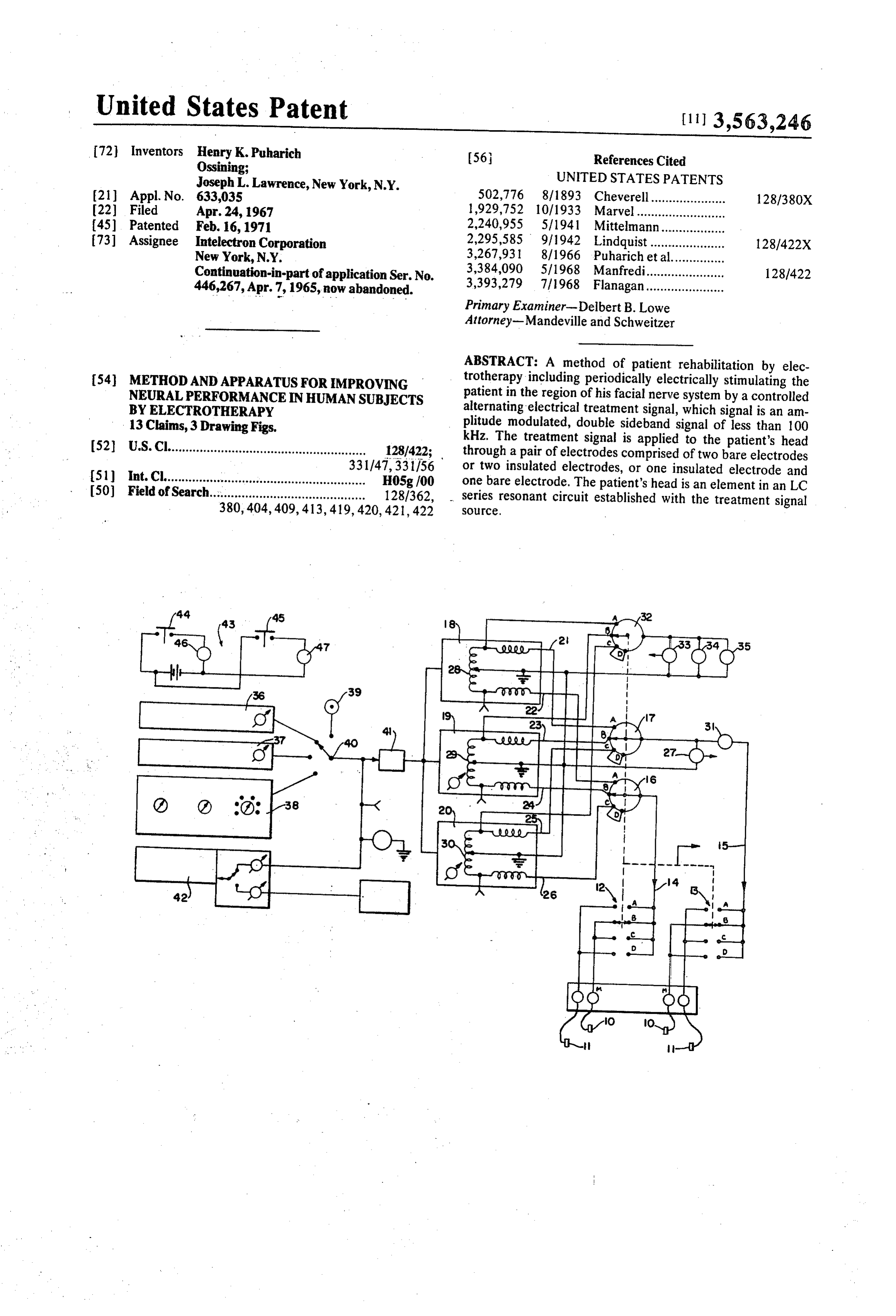
United States Patent (113,563,246 72 Inventors Henry K. Puharich 56 References Cited Ossining;
Joseph L. Lawrence, New York, N.Y. UNITED STATES PATENTS 21 ) Appl. No. 633,035 502,776 8/1893 Cheverell..................... 128/380X 22) Filed Apr. 24, 1967 1929,752 10/1933 Marvel.......... 45) Patented Feb. 16, 1971 2,240,955 5/1941 Mittelmann.
73 Assignee Intelectron Corporation 2,295,585 9/1942 Lindquist...... 128/422X New York, N.Y. 3,267,931 8/1966 Puharich et al............... Continuation-in-part of application Ser. No. 3,384,090 5/1968 Manfredi...................... 128/422 446,267, Apr. 7, 1965, now abandoned. 3,393,279 7/1968 Flanagan......................
Primary Examiner-Delbert B. Lowe
Attorney-Mandeville and Schweitzer
ABSTRACT: A method of patient rehabilitation by elec 54 METHODANDAPPARATUS FOR IMPROVING trotherapy including periodically electrically stimulating the NEURAL PERFORMANCE INHUMAN SUBJECTS patient in the region of his facial nerve system by a controlled BYELECTROTHERAPY alternating electrical treatment signal, which signal is an am 13 Claims, 3 Drawing Figs. plitude modulated, double sideband signal of less than 100 (52) U.S.C........................................................ 128/422; . kHz. The treatment signal is applied to the patient's head through a pair of electrodes comprised of two bare electrodes
(51) int. Cl......................................................... or two insulated electrodes, or one insulated electrode and H05g 100 one bare electrode. The patient's head is an element in an LC 50) Field of Search..................... 8 ww ea w 0. 128/362, series resonant circuit established with the treatment signal
Page 2
Drawing sheet — no readable text.
Page 3
Drawing sheet — no readable text.
Page 4
METHOD AND APPARATUS FOR IMPROVING NEURAL Another advantageous aspect of the invention is the PERFORMANCE INHUMAN SUBJECTSBY development of a clinical regimen, enabling specific applica ELECTROTHERAPY tion of the inventive treatment concepts to a wide variety of
RELATED PATENTS AND APPLICATIONS -
hearing loss patients. This enables standardized treatment pro 5 grams to be given in most instances, although specialized
The present invention is closely related to the subject treatment programs may be required in particularly difficult matter of our prior U.S. Pat. Nos. 2,995,633, 3,156,787, cases. The use of standardized treatment programs is particu 3,170,993, and 3,267,931, and to the subject matter of our larly desirable in the present environment, in that it renders copending U.S. application Ser. No. 446,267, filed Apr. 7, the entire treatment series susceptible of relatively automated 1965, now abandoned. With respect to certain of the subject 10 control, as by means of a prepared tape program, for example. matter hereof, the present application is a continuation in part As a secondary, but by no means insignificant, objective, of said copending application Ser. No. 446,267. the therapy program of the invention appears to have Whereas our prior patents and our prior application are therapeutic benefits with respect to a wider range of condi directed to unique methods and equipments for imparting sen 15 tions than hearing loss alone, and it is an objective of the in sations of sound to human subjects, through controlled electri vention to apply the treatment program to other areas of reha cal stimulation of the facial nerve system, the present inven bilitation as appropriate.
tion is more specifically directed to techniques of therapy, utilizing many of the principles of our prior inventions, should be better
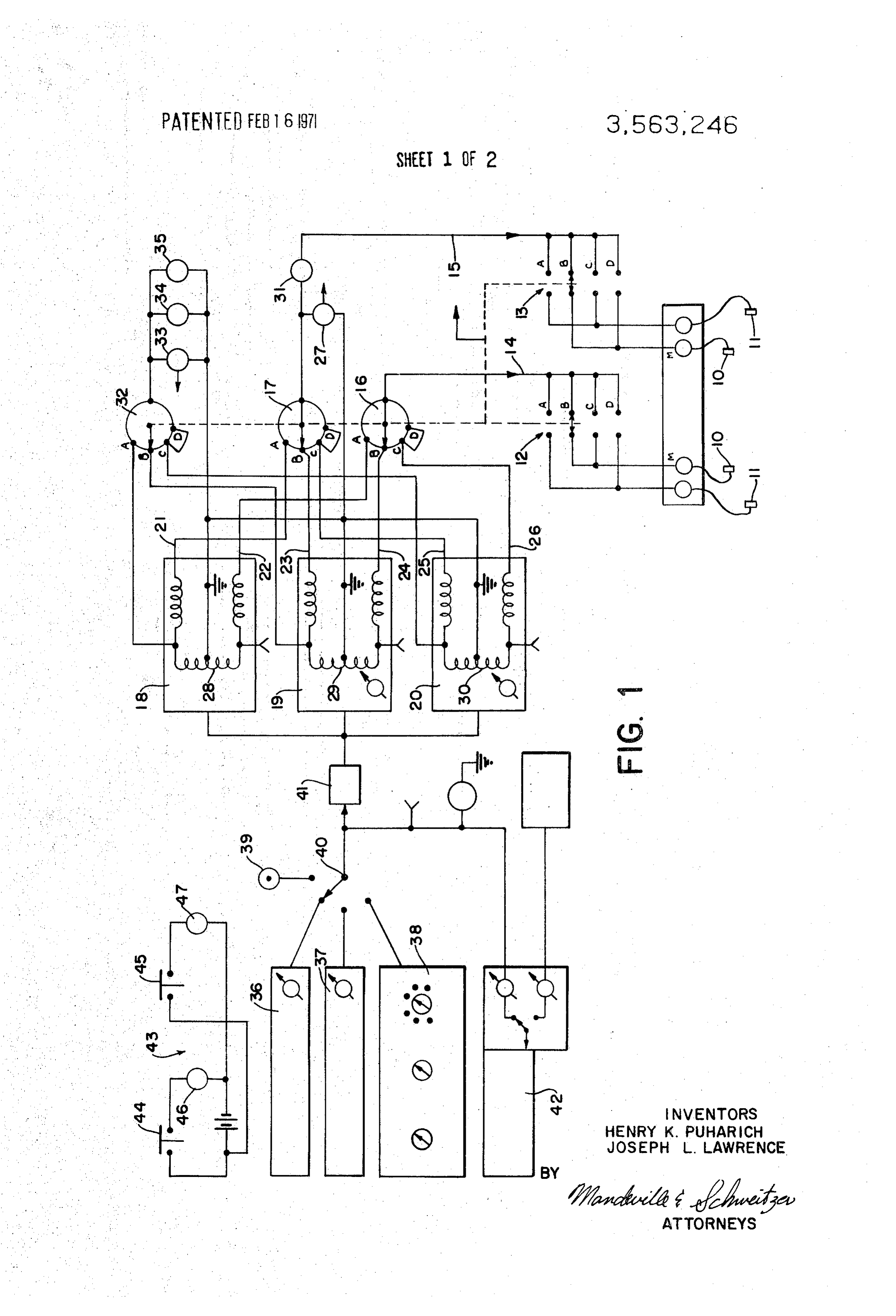
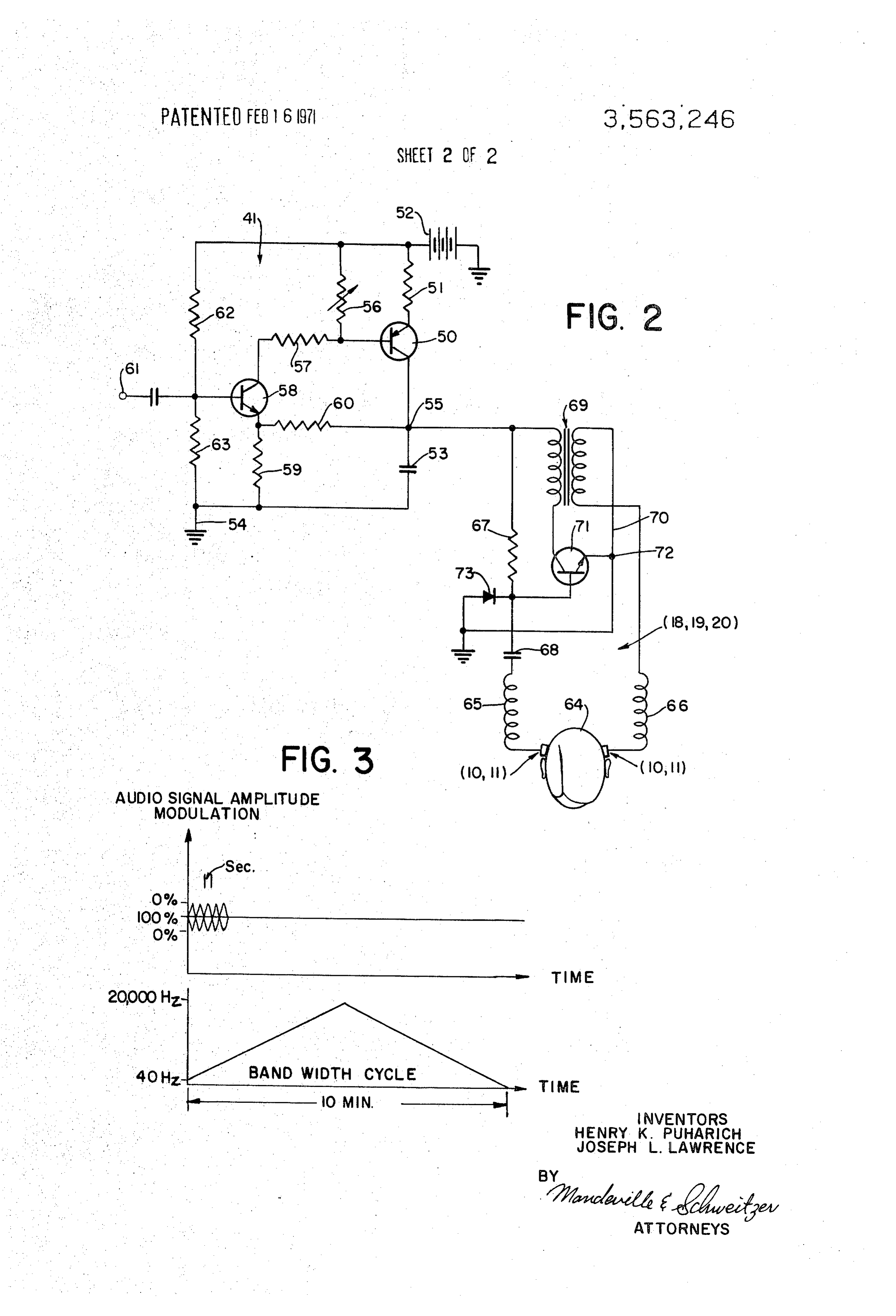
For a made understanding of the invention, reference to the following description of a preferred em whereby to effect hearing rehabilitation in many hard-of-hear 20 bodiment, and to the accompanying drawing. ing patients, as well as achieving other desirable therapeutic advantages. DESCRIPTION OF THE DRAWING BACKGROUND OF INVENTION FIG. 1 is a simplified schematic representation of a typical For many years, the medical arts have made advantageous 25 signal data generating and controlling system, with appropriate readout, which may be advantageously used in connec use of electrical energy stimulations, to achieve various tion with a clinical program utilizing the procedures of the in desired effects upon the body of a human subject. A typical well-known example is the conventional diathermy treatment, vention. FIG. 2 is a simplified schematic representation of a circuit by which heat is generated within the body tissues, through the arrangement, advantageously incorporated with the system of controlled application of radio frequency energy. Electric 30 shock treatments are used occasionally in psychiatric treat FIG. 1, for applying controlled electrical signals to a human ment. And, considerable work has been done in the art in con subject in accordance with the procedures of the invention. nection with achieving various therapeutic effects through the FIG. 3 is a simplified graphic representation illustrating a use of electrically induced sleep. Efforts also have been made program of power and frequency modulation of a carrier in the past to achieve therapeutic effects upon hearing loss pa- 35 signal applied to a subject in a typical therapeutic procedure tients through the application of extremely high frequency according to the invention.
energy; however, such efforts have not been entirely success DESCRIPTION OF THE INVENTION ful due to certain shortcomings in equipment and procedural approach, which have been obviated by the present invention. In accordance with the procedural concepts of the inven 40 tion, it has been found that significant hearing rehabilitation,
SUMMARY OF INVENTION
as well as other desirable therapeutic effects, can be realized
In accordance with one significant aspect of the invention, a by applying a course of therapy which involves a properly con basically new therapeutic procedure is provided, involving trolled electrostimulation of the subject. In accordance with specifically controlled electrostimulation of the patient, this invention, it is of significance that the subject be elec possibly accompanied by audible stimulation, whereby, over a 45 trostimulated in the region of the facial nerve system, which is period of treatments, the subnormal hearing abilities of a well-defined nerve network believed to be confined substan variety of patients, suffering from a variety of hearing loss tially to the head and neck areas of the human body. The problems, can be significantly rehabilitated. One fundamental character of the stimulation, too, is significant, and this, in ac aspect of the invention involves the discovery that the patient cordance with the present invention, is in the form of an alter should be electrically stimulated, in the region of the facial 50 nating carrier signal, of a frequency advantageously below, nerve system, using an alternating carrier signal of relatively say, 100,00 Hz. The carrier signal is applied to the subject low (compared with previous efforts) frequency, typically under conditions of circuit resonance for the carrier frequen around 60 kHz. maximum. This carrier frequency signal is im cy, and this aspect of the procedure is believed to have con parted to the subject in such a way as to constitute substan siderable significance. In addition, the carrier is a double side tially the resonant frequency for the output circuit of the 55 band signal amplitude modulated by an audio frequency system, which includes the subject. ,
In the procedure of the invention, the resonant frequenc signal, advantageously of frequencies within the audible range carrier signal is applied to the subject in accordance with a ofAs a typical subject.
explained in our prior patents and application, it is possi predetermined, controlled schedule. This schedule includes amplitude modulation of the carrier signal at modulation 60 human ble to create sensations of sound, within the brain of a typical frequencies corresponding to the audible range of hearing of a subject, by stimulating the facial nerve system of the typical human subject, for example from about 20 Hz. to subject with modulated electrical signals corresponding to the about 20,000 Hz. The subject thus is electrically stimulated by sounds sought to be generated. The teachings of our prior in an amplitude modulated, resonant frequency carrier signal of ventions thus afforded a particularly advantageous method such characteristics that it can produce sensations of sound 65 and means for aiding or augmenting the subnormal hearing within the subject, or at least within a subject having relatively capabilities of a subject by providing a source of controlled normal faculties. electrical signals which, in effect, tended to bypass certain of A particularly advantageous aspect of the invention resides the ear mechanisms of the patient.
in the provision of circuit arrangements, for application to the The present invention represents a valuable extension of subject in the region of the facial nerve system, which enable 70 our previous inventions, in that it provides not only for the substantially resonant circuit conditions to be maintained augmentation of the subject's hearing facilities, but, with without extraordinary variations in the frequency of the carri many patients, can actually effect a rehabilitation of the sub er signal, so that uncontrolled changes in circuit parameters, ject's natural hearing system, occasionally to such an extent resulting from such causes as physiological variations in the that the rehabilitated patient hears satisfactorily even without subject, can be accommodated. 75 augmentation or assistance.
Page 5
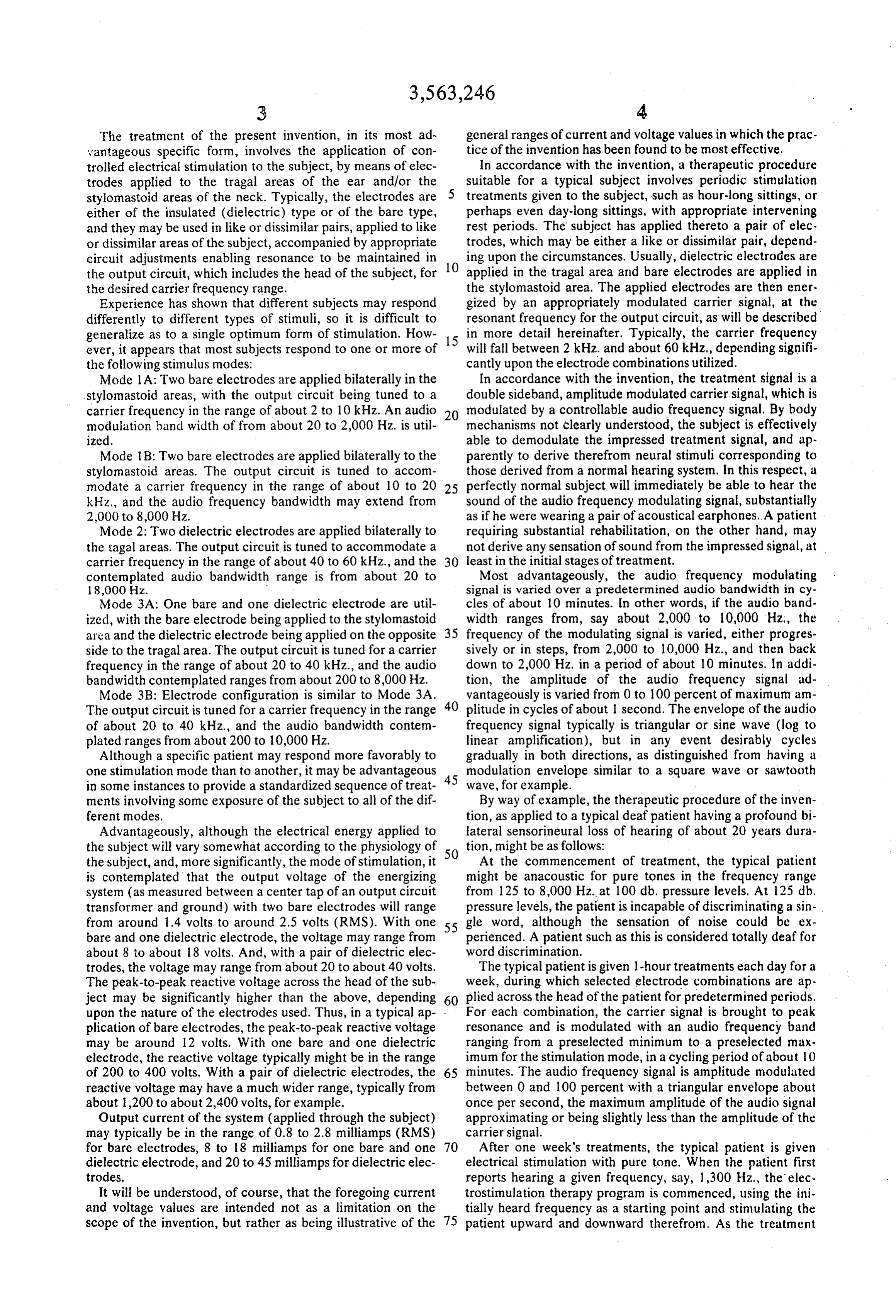
The treatment of the present invention, in its most ad general ranges of current and voltage values in which the prac vantageous specific form, involves the application of con tice of the invention has been found to be most effective, trolled electrical stimulation to the subject, by means of elec In accordance with the invention, a therapeutic procedure trodes applied to the tragal areas of the ear and/or the suitable for a typical subject involves periodic stimulation stylomastoid areas of the neck. Typically, the electrodes are treatments given to the subject, such as hour-long sittings, or either of the insulated (dielectric) type or of the bare type, perhaps even day-long sittings, with appropriate intervening and they may be used in like or dissimilar pairs, applied to like rest periods. The subject has applied thereto a pair of elec or dissimilar areas of the subject, accompanied by appropriate trodes, which may be either a like or dissimilar pair, depend circuit adjustments enabling resonance to be maintained in O ing upon the circumstances. Usually, dielectric electrodes are the output circuit, which includes the head of the subject, for applied in the tragal area and bare electrodes are applied in the desired carrier frequency range. the stylomastoid area. The applied electrodes are then ener Experience has shown that different subjects may respond gized by an appropriately modulated carrier signal, at the differently to different types of stimuli, so it is difficult to resonant frequency for the output circuit, as will be described generalize as to a single optimum form of stimulation. How 15 in more detail hereinafter. Typically, the carrier frequency ever, it appears that most subjects respond to one or more of will fall between 2 kHz. and about 60 kHz., depending signifi the following stimulus modes: cantly upon the electrode combinations utilized. Mode 1A: Two bare electrodes are applied bilaterally in the In accordance with the invention, the treatment signal is a stylomastoid areas, with the output circuit being tuned to a double sideband, amplitude modulated carrier signal, which is carrier frequency in the range of about 2 to 10 kHz. An audio 20 modulated by a controllable audio frequency signal. By body modulation band width of from about 20 to 2,000 Hz. is util mechanisms not clearly understood, the subject is effectively ized. able to demodulate the impressed treatment signal, and ap Mode 1B: Two bare electrodes are applied bilaterally to the parently to derive therefrom neural stimuli corresponding to stylomastoid areas. The output circuit is tuned to accom those derived from a normal hearing system, in this respect, a modate a carrier frequency in the range of about 10 to 20 25 perfectly normal subject will immediately be able to hear the kHz., and the audio frequency bandwidth may extend from sound of the audio frequency modulating signal, substantially 2,000 to 8,000 Hz. as if he were wearing a pair of acoustical earphones. A patient Mode 2: Two dielectric electrodes are applied bilaterally to requiring substantial rehabilitation, on the other hand, may the tagal areas. The output circuit is tuned to accommodate a not derive any sensation of sound from the impressed signal, at carrier frequency in the range of about 40 to 60 kHz., and the 30 least in the initial stages of treatment. contemplated audio bandwidth range is from about 20 to Most advantageously, the audio frequency modulating 18,000 Hz. signal is varied over a predetermined audio bandwidth in cy Mode 3A: One bare and one dielectric electrode are util cles of about 10 minutes. In other words, if the audio band ized, with the bare electrode being applied to the stylomastoid width ranges from, say about 2,000 to 10,000 Hz, the area and the dielectric electrode being applied on the opposite 35 frequency of the modulating signal is varied, either progres side to the tragal area. The output circuit is tuned for a carrier sively or in steps, from 2,000 to 10,000 Hz., and then back frequency in the range of about 20 to 40 kHz., and the audio down to 2,000 Hz, in a period of about 10 minutes. In addi bandwidth contemplated ranges from about 200 to 8,000 Hz. tion, the amplitude of the audio frequency signal ad Mode 3B: Electrode configuration is similar to Mode 3A. 40 vantageously is varied from 0 to 100 percent of maximum am The output circuit is tuned for a carrier frequency in the range plitude in cycles of about 1 second. The envelope of the audio of about 20 to 40 kHz., and the audio bandwidth conten frequency signal typically is triangular or sine wave (log to plated ranges from about 200 to 10,000 Hz. linear amplification), but in any event desirably cycles Although a specific patient may respond more favorably to gradually in both directions, as distinguished from having a one stimulation mode than to another, it may be advantageous modulation envelope similar to a square wave or sawtooth in some instances to provide a standardized sequence of treat wave, for example.
ments involving some exposure of the subject to all of the dif By way of example, the therapeutic procedure of the inven ferent modes. tion, as applied to a typical deaf patient having a profound bi Advantageously, although the electrical energy applied to lateral sensorineural loss of hearing of about 20 years dura the subject will vary somewhat according to the physiology of 50 tion, might be as follows:
the subject, and, more significantly, the mode of stimulation, it At the commencement of treatment, the typical patient is contemplated that the output voltage of the energizing might be anacoustic for pure tones in the frequency range system (as measured between a center tap of an output circuit from 125 to 8,000 Hz. at 100 db. pressure levels. At 125 db. transformer and ground) with two bare electrodes will range pressure levels, the patient is incapable of discriminating a sin from around 1.4 volts to around 2.5 volts (RMS). With one 55 gle word, although the sensation of noise could be ex bare and one dielectric electrode, the voltage may range from perienced. A patient such as this is considered totally deaf for about 8 to about 18 volts. And, with a pair of dielectric elec word discrimination.
trodes, the voltage may range from about 20 to about 40 volts. The typical patient is given l-hour treatments each day for a The peak-to-peak reactive voltage across the head of the sub week, during which selected electrode combinations are ap ject may be significantly higher than the above, depending 60 plied across the head of the patient for predetermined periods. upon the nature of the electrodes used. Thus, in a typical ap- - For each combination, the carrier signal is brought to peak plication of bare electrodes, the peak-to-peak reactive voltage resonance and is modulated with an audio frequency band may be around 12 volts. With one bare and one dielectric ranging from a preselected minimum to a preselected max electrode, the reactive voltage typically might be in the range imum for the stimulation mode, in a cycling period of about 10 of 200 to 400 volts. With a pair of dielectric electrodes, the 65 minutes. The audio frequency signal is amplitude modulated reactive voltage may have a much wider range, typically from between 0 and 100 percent with a triangular envelope about about 1,200 to about 2,400 volts, for example. once per second, the maximum amplitude of the audio signal Output current of the system (applied through the subject) approximating or being slightly less than the amplitude of the may typically be in the range of 0.8 to 2.8 milliamps (RMS) carrier signal.
for bare electrodes, 8 to 18 milliamps for one bare and one 70 After one week's treatments, the typical patient is given dielectric electrode, and 20 to 45 milliamps for dielectric elec electrical stimulation with pure tone. When the patient first trodes. reports hearing a given frequency, say, 1,300 Hz., the elec It will be understood, of course, that the foregoing current trostimulation therapy program is commenced, using the ini and voltage values are intended not as a limitation on the tially heard frequency as a starting point and stimulating the scope of the invention, but rather as being illustrative of the 75 patient upward and downward therefrom. As the treatment
Page 6
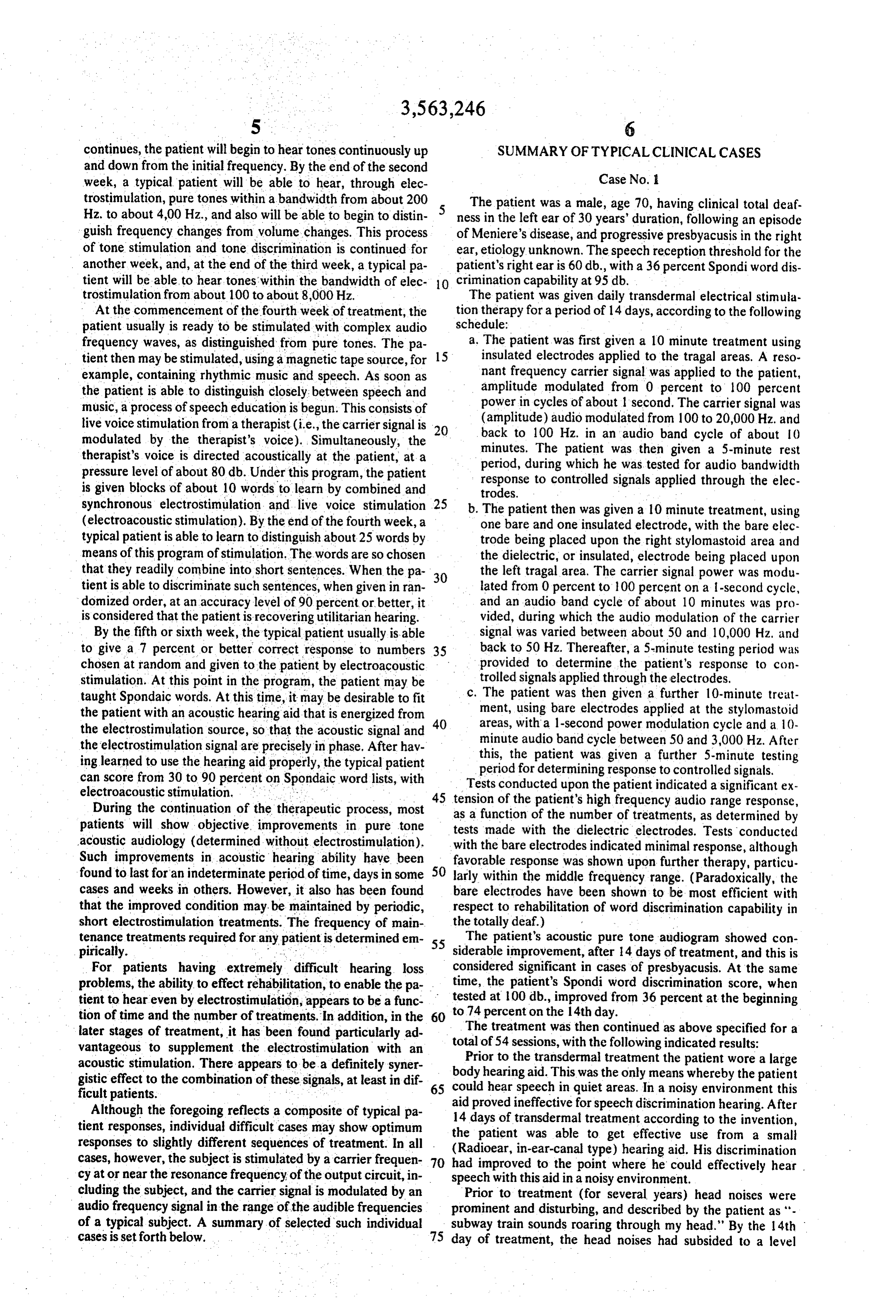
S. 6 continues, the patient will begin to hear tones continuously up SUMMARY OF TYPICAL CLINICAL CASES and down from the initial frequency. By the end of the second week, a typical patient will be able to hear, through elec Case No. trostimulation, pure tones within abandwidth from about 200 The patient was a male, age 70, having clinical total deaf Hz. to about 4,00 Hz., and also will be able to begin to distinness in the left ear of 30 years' duration, following an episode guish frequency changes from volume changes. This process of Meniere's disease, and progressive presbyacusis in the right of tone stimulation and tone discrimination is continued for ear, etiology unknown. The speech reception threshold for the another week, and, at the end of the third week, a typical pa patient's right ear is 60 db., with a 36 percent Spondiword dis tient will be able to hear tones within the bandwidth of elec O crimination capability at 95 db.
trostimulation from about 100 to about 8,000 Hz. The patient was given daily transdermal electrical stimula At the commencement of the fourth week of treatment, the tion therapy for a period of 14 days, according to the following patient usually is ready to be stimulated with complex audio schedule:
frequency waves, as distinguished from pure tones. The pa a. The patient was first given a 10 minute treatment using tient then may be stimulated, using a magnetic tape source, for 15 insulated electrodes applied to the tragal areas. A reso example, containing rhythmic music and speech. As soon as nant frequency carrier signal was applied to the patient, the patient is able to distinguish closely: between speech and amplitude modulated from 0 percent to 100 percent music, a process of speech education is begun. This consists of power in cycles of about 1 second. The carrier signal was live voice stimulation from a therapist (i.e., the carrier signal is 20 (amplitude) audio modulated from 100 to 20,000 Hz, and modulated by the therapist's voice). Simultaneously, the back to 100 Hz. in an audio band cycle of about 10 therapist's voice is directed acoustically at the patient, at a minutes. The patient was then given a 5-minute rest pressure level of about 80 db. Under this program, the patient period, during which he was tested for audio bandwidth response to controlled signals applied through the elec is given blocks of about 10 words to learn by combined and trodes.
synchronous electrostimulation and live voice stimulation 25 b. The patient then was given a 10 minute treatment, using (electroacoustic stimulation). By the end of the fourth week, a one bare and one insulated electrode, with the bare elec typical patient is able to learn to distinguish about 25 words by trode being placed upon the right stylomastoid area and means of this program of stimulation. The words are so chosen the dielectric, or insulated, electrode being placed upon that they readily combine into short sentences. When the pa 30 the left tragal area. The carrier signal power was modu tient is able to discriminate such sentences, when given in ran lated from 0 percent to 100 percent on a 1-second cycle, domized order, at an accuracy level of 90 percent or better, it and an audio band cycle of about 10 minutes was pro is considered that the patient is recovering utilitarian hearing. vided, during which the audio modulation of the carrier By the fifth or sixth week, the typical patient usually is able signal was varied between about 50 and 10,000 Hz, and to give a 7 percent or better correct response to numbers 35 back to 50 Hz. Thereafter, a 5-minute testing period was chosen at random and given to the patient by electroacoustic provided to determine the patient's response to con stimulation. At this point in the program, the patient may be trolled signals applied through the electrodes. taught Spondaic words. At this time, it may be desirable to fit c. The patient was then given a further 10-minute treat the patient with an acoustic hearing aid that is energized from 40 ment, using bare electrodes applied at the stylomastoid the electrostimulation source, so that the acoustic signal and areas, with a 1-second power modulation cycle and a 10 the electrostimulation signal are precisely in phase. After hav minute audio band cycle between 50 and 3,000 Hz. After ing learned to use the hearing aid properly, the typical patient this, the patient was given a further 5-minute testing period for determining response to controlled signals.
can score from 30 to 90 percent on Spondaic word lists, with Tests conducted upon the patient indicated a significant ex electroacoustic stimulation. . . . . 45 tension of the patient's high frequency audio range response, During the continuation of the therapeutic process, most as a function of the number of treatments, as determined by patients will show objective improvements in pure tone tests made with the dielectric electrodes. Tests conducted acoustic audiology (determined without electrostimulation). with the
Such improvements in acoustic hearing ability have been favorablebare electrodes indicated minimal response, although response was shown upon further therapy, particu found to last for an indeterminate period of time, days in some 50 larly within the middle frequency range. (Paradoxically, the cases and weeks in others. However, it also has been found bare electrodes have been shown to be most efficient with that the improved condition may be maintained by periodic, respect to rehabilitation of word discrimination capability in short electrostimulation treatments. The frequency of main the totally deaf.)
tenance treatments required for any. patient
is determined em 55 The patient's acoustic pure tone audiogram showed con siderable improvement, after 14 days of treatment, and this is
For patients having extremely difficult hearing loss considered significant in cases of presbyacusis. At the same problems, the ability to effect rehabilitation, to enable the pa time, the patient's Spondi word discrimination score, when tient to hear even by electrostimulation, appears to be a func totested at 100 db., improved from 36 percent at the beginning 74 percent on the 14th day.
tion of time and the number of treatments. In addition, in the 60 later stages of treatment, it has been found particularly ad The treatment was then continued as above specified for a vantageous to supplement the electrostimulation with an total of 54 sessions, with the following indicated results: acoustic stimulation. There appears to be a definitely syner body Prior to the transdermal treatment the patient wore a large gistic effect to the combination of these signals, at least in dif 65 couldhearing aid. This was the only means whereby the patient hear speech in quiet areas. In a noisy environment this ficult patients.
Although the foregoing reflects a composite of typical pa aid 14 proved ineffective for speech discrimination hearing. After days of transdermal treatment according to the invention, tient responses, individual difficult cases may show optimum the patient was able to get effective use from a small responses to slightly different sequences of treatment. In all (Radioear, in-ear-canal type) hearing aid. His discrimination cases, however, the subject is stimulated by a carrier frequen 70 had improved to the point where he could effectively hear cy at or near the resonance frequency of the output circuit, in speech with this aid in a noisy environment. cluding the subject, and the carrier signal is modulated by an Prior to treatment (for several years) head noises were audio frequency signal in the range of the audible frequencies prominent and disturbing, and described by the patient as "- of a typical subject. A summary of selected such individual subway train sounds roaring through my head." By the 14th cases is set forth below. 75 day of treatment, the head noises had subsided to a level
Page 7
where they were not disturbing, although still present. During applied bilaterally to the stylomastoid area. The resonant car the period from the 22nd to the 27th treatments, the head rier frequency applied was 36 kHz, with pure tone modulation noises recurred to their former loud and disturbing level. from 100 to 4,000 Hz.
However, they subsided by the 30th treatment, and were scar Next, the patient was given a 17-minute treatment with cely noticeable to the patient thereafter while under treat 5 dielectric electrodes applied bilaterally over the tragal areas, ment. substantially as in the first described sequence. During the 5 years prior to the transdermal treatment, the The patient was then given short periods of stimulation with patient was subject to attacks of vertigo at least once or twice acoustical assistance with live voice in one instance and hear a month. During the initial period of treatment (3 months) the 10 ing aids in another. , patient was free of vertiginous attacks. A 10-minute stimulation sequence was then given, using By the 22nd day of the treatment (the 18th Therapeutic bare electrodes applied to the stylomastoid areas, using a car Session) the left ear of the patient began to show significant rier frequency of about 3.1 kHz. and voice modulation. This improvement in the low frequency spectrum of the pure tone was followed by a similar sequence, in which the patient was audiogram. By the 43rd transdermal treatment the left ear had aided by a conventional hearing aid.
so improved that the patient was able to hear words for the 5 In audiomentry tests performed on the patient before and first time in thirty years. Therefore, he was fitted with after a single 70-minute treatment, remarkable improvement Sonotone M72 binaural hearing aids. As he learned to use a was shown after the treatment, as indicated in the following ta binaural aid, he was able to repeat live voice sentences cor ble.
rectly 100 percent. When tested with the right ear aid alone he 20 could repeat such sentences 90 percent. When tested with the TABLE 2 left ear aid along (masking to right ear) he could repeat sen tences with 80 percent accuracy. After the 54th transdermal Pre Treatment
Post
Treatment treatment, with the use of the Sonotone binaural aids, the pa tient was able to resume full time participation in his business. 25 Speech audiometry Right Left Right Ear Ear Ear
Left
Ear
The patient's improved abilities were found to have remained substantially at the same levels when the patient was Threshold of detectability, db---------- 35 45 30 35 Speech reception threshold, db.--------- 45 65 40 55 retested about 3 months later. However, after the patient had Threshold
of discomfort, discrimination at 30
db, Re speech
been off of therapy for 2 months, his attacks of vertigo reoc reception threshold, percent---------- 54 46 96 88 cured. Therapy was resumed, and in 2 weeks the symptoms of 30 PBreception discrimination at 40 db, Re speech
vertigo disappeared, and have not returned. Bone conduction PB speech discrimi The following is a summary of the hearing changes observed nation without masking at 65 pb audiometer output, percent.----------- 20 12 60 54 in the patient after 54 one-hour each treatments, given over a 3-month period.
The patient showed the above-indicated enhanced auditory activity for a period of 2 days following the transdermal elec
TABLE 1. trostimulation therapy. The patient was then begun on a course of therapy involving 1-hour treatments, twice a week,
Before After 40 shortly reduced to one session per week. Maintenance therapy
A. Acoustic audiometry: has now been empirically established as one treatment (1 (1) Right Ear: hour) per month to maintain the enhanced abilities indicated Pure tone average raised from, db.---------- 72------- 58 in the above table.
Speech discrimination, Spondi words, in- 36------- 82 creased from, percent.
Speech discrimination, PB words, in- 16------- 64 45 Case No. 3 creased from, percent.
(2) Left Ear: The patient is a male, age 38, with a history of hearing loss Pure tone average (unchanged), db.--------- 83------- 83
Speech discrimination, Spondi words, in- 0-------- creased from, percent.
32 at age 5, following episodes of measles, mumps, and scarlet
Speech discrimination, PB words, in- 0-------- i 12 fever. There is present bilateral symmetrical severe sen creased from, percent.
B. Patient response: 2 50 sorineural loss of hearing activity. The patient has shown (1) Right Ear: marked improvement in word discrimination acuity after 20 Speech discrimination, Spondiwords 100% treatments of 1 hour each, in accordance with the invention. Speech discrimination, PB words--- 90% (2) Left Ear: A combination of acoustic stimulation plus transdermal elec Speech discrimination, Spondiwords 54% trostimulation allows the patient to carry on normal conversa Speech discrimination, PB words--- (3) Binaural Aids Plus Electrostimulation 40% 55 tional speech and, for the first time in the patient's life, he is
Speech discrimination, Spondiwords- 100% able to use an amplified telephone to carry on a conversation.
In the following table, Part A, acoustic audiometry test
With continued TD treatment left ear PB speech discrimination is at 40% as of this date (April 3, 1967). results for the patient are indicated, before and after treat plusAfter treatment, acoustic when stimulated by transdermal electrostimulation stimulation.
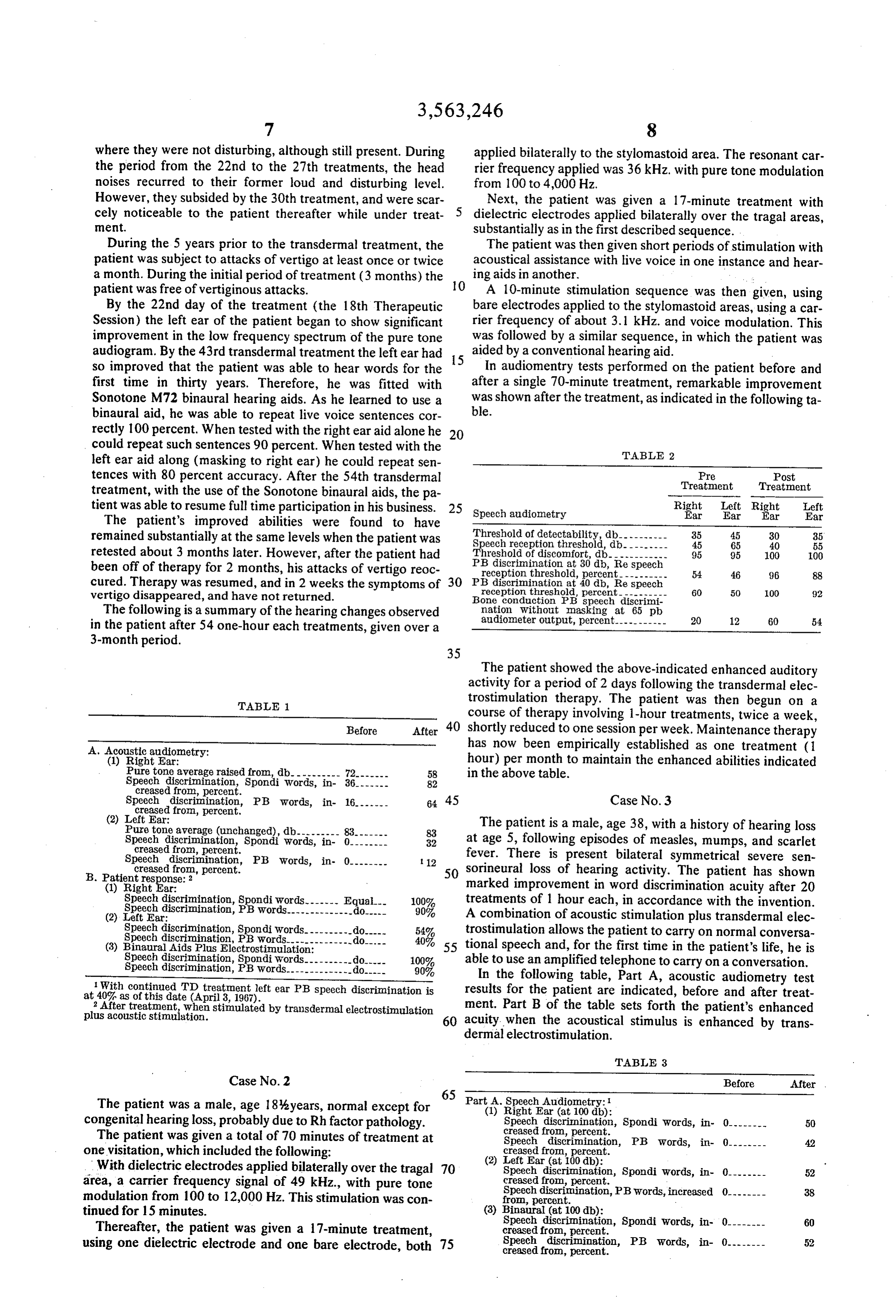
ment. Part B of the table sets forth the patient's enhanced 60 acuity, when the acoustical stimulus is enhanced by trans dermal electrostimulation.
TABLE 3
Case No. 2 Before After
Part A. Speech Audiometry:
The patient was a male, age 18%years, normal except for (1) Right Ear (at 100 db):
congenital hearing loss, probably due to Rh factor pathology. Speech discrimination, Spondi Words, in- 0-------- creased from, percent.
The patient was given a total of 70 minutes of treatment at Speech discrimination, PB Words, in- 0-------- 42 one visitation, which included the following: (2) creased from, percent.
Left Ear (at 100 db):
With dielectric electrodes applied bilaterally over the tragal 70 Speech discrimination, Spondi words, in- 0-------- 52 area, a carrier frequency signal of 49 kHz., with pure tone creased from, percent.
Speech discrimination, PB words, increased 0-------- 38 modulation from 100 to 12,000 Hz. This stimulation was con fron, percent.
tinued for 15 minutes. (3) Binaural (at 100 db): Speech discrimination, Spondi Words, in- 0-------- 60
Thereafter, the patient was given a 17-minute treatment, creased from, percent. using one dielectric electrode and one bare electrode, both 75 Speech discrimination, PB Words, in- 0-------- 52 creased from, percent.
Page 8
TABLE 3-Continued Case No. 5 Before After
Part B. Speech Audiometry: 2
The patient was a male, age 72, with total deafness in the (l) Right Ear: 3 left ear of 55 years' duration, etiology unknown. The right ear Speech discrimination, Spondiwords. ... s....... 86 showed progressive presbyacusis over the past 16 years. The Speech discrimination, PB words..............do-....
76 patient's hearing loss was complicated by senile symptoms,
Speech discrimination, Spondiwords..........do----- 90 with agitated depression occasionally, and memory confusion. Speech discrimination, PB words.............. do..... 78 The patient was given one course of treatment, of 60 minutes (3) Binaural aids at 100 db: 4
Speech discrimination, Spondiwords. . . . . . . do----- 92 each day for 24 sessions. One bare and one dielectric elec Speech discrimination, PB words.----...------ do----- 82 10 trode were applied bilaterally over the stylomastoid area, Acoustic stimulation alone. using a 36 kHz. amplitude modulated sine wave carrier, with 2 Transdermal electrostimulation plus acoustic stimulation. audio modulation from 60 to 12,000 Hz. After the treatment, Acoustic = 100 dib; electrostimulation with bare electrodes at 0.4 watt.
: Electrostimulation with bare electrodes at 0.4 watt. the patient showed significant improvement in the right ear acoustic audiometry, and a small improvement in the left ear.
15 The patient achieved significant improvement for the right ear
Case No. 4 with respect to acoustic source PB word discrimination, which
The patient was a female, age 27, having a history of was This even further improved with electroacoustic stimulation.
is reflected in the following table:
progressive sensorineural loss of hearing acuity, probably of otosclerotic origin. After 12 1-hour treatments, the patient's 20 TABLE 5 speech audiometry showed a significant increase in PB word discrimination, although this was not accompanied by any sig A.-Pre-treatment acoustic speech audiometry Right Left nificant increase in pure tone audiometry. After the 27th 1 Threshold of detectability, db.------------------------ 65 100 (Nil) hour treatment, a PB word discrimination test, with the pa Speech reception threshoid, db-...-- -- - 100 ---------- tient being electrically and acoustically stimulated, indicated 25 Threshold
discrimination at 0 db above speech reception repeated scores of 100 percent, as against a pretreatment con threshold, percent---------------------------------- 10 ---------- trol level of 42 percent for the left ear and 58 percent for the Bone conduction PB speech discrimination without masking at 65 db audiometer output, percent------- 6 ---------- right ear.
After 30 treatments, the patient, assisted by a conventional B.-Post treatment acoustic speech audiometry hearing aid, was able to carry on conversations effectively in 30 (1) Audiometer:
high noise level environments (e.g.,90 to 100 db.). Threshold of detectability, db.-------------------- Speech reception threshold, db-...- n-
In the following table, Part A sets forth the patient's speech Threshold of discomfort, db.---------------------- 100-- 100 audiometry prior to treatment; Part B sets forth the patient's PB discrimination at 0 db above speech reception threshold, percent------------------------------ 50 10 speech audiometry subsequent to the 12th 1-hour treatment; PB discrimination at 10db above speech reception threshold, percent------------------------------ 56 12 and Part C indicates the patient's hearing acuity after the 12th 35 Bone conduction PB speech discrimination with treatment, when subjected to electroacoustic stimulation. Emasking at 65 do audiometer output, per- Cent - - - - - - - - - - - - - - - - - - - - - - - - - - - - - - - - - - - - - - - - - - - -
(2) Monitored live voice at 90 db, PB discrimination, free field, percent------------------------------- 52 ----------
TABLE 4 C.-Post treatment electroacoustic speech audiometry
Part A.-Pre-treatment speech audiometry Right Left 40 (1) Transdermal. Conditions as for treatment, PB Threshold of detectability, db-. 25 30 discrimination, percent--------------------------- 60 ---------- Speech reception threshoid, db 35 80 (2) Transdermal, conditions as for treatment plus air Threshold of discomfort, db. 95 95 conduction aid to right ear at 80 db with moni PB discrimination at 40 db above speech reception tored live voice at 50 db at a distance of 3 ft. threshold, percent.------------------------------------- 44 32 behind patient, PB discrimination, percent.------- 86 16 Bone conduction PB. speech discrimination without masking at 65 db above audiometer, percent------------ 32 ------
Part B.-Post treatment speech audiometry (after 12th treatment)
A most noteworthy therapeutic effect on the patient, apart
Audiometer: from hearing improvement, was the fact that most of his Threshold of detectability, dib------------------------ 20 25
Speech reception threshold, db-...- - 35 60 behavioral symptoms of senility cleared up after 6 weeks of Threshold of discomfort, db.-------------------------- 100 100
PB discrimination at 30 db above speech reception the electrostimulation therapy. His short term memory im threshold, percent------------------------------------------ 76 proved, temporal disorientation cleared up, and irritability PB discrimination at 50 db above speech reception and emotional instability diminished markedly. Moreover, ac threshold, percent---------------------------------- 70 ------
Bone conduction PB speech discrimination without cording to the patient, Tinnitus and head noises diminished masking at 65 db above audiometer, percent-------- 40 ------ 55 markedly.
Part C.-Electroacoustic electrodes, stimulation. Transdermal, bilaterally at tragi Case No. 6
The patient was female, age 48, whose hearing was normal
Audiometer: until she was treated with Kanamycin therapy for a fulminat 60 ing Peritonitis. Typical ototoxic sensorineural hearing loss fol
Threshold of detectability (Electrostimulation, 0.4
W.), db.----------------------------------------- 15 20 lowed the administration of Kanamycin. The patient was given Speech reception threshold (Electrostimulation, 0.8
Threshold of discomfort (Electrostimulation, 0.8 W.), 20 70 26 1-hour treatments, according to the invention. She showed db-------------------------------------------------- 100- 100 steady improvement with continued therapy, and, at times, PB discrimination at 30 db abovd speech reception threshold (Electrostimulation, 0.8 W.), percent----- 100 92 65 can use an unamplified telephone to hear voice conversation.
Bone conduction PB speech discrimination without The following table indicates that the patient's acoustic au masking at 60 db above audiometer (Electrostimu
diogram improvement was positive, but small. However, the improvement in PB word discrimination was remarkable, in 1.96% speech discrimination Binaural 2 100% speech discrimination binaural.
response to acoustic source alone, as well as with elec trostimulation.
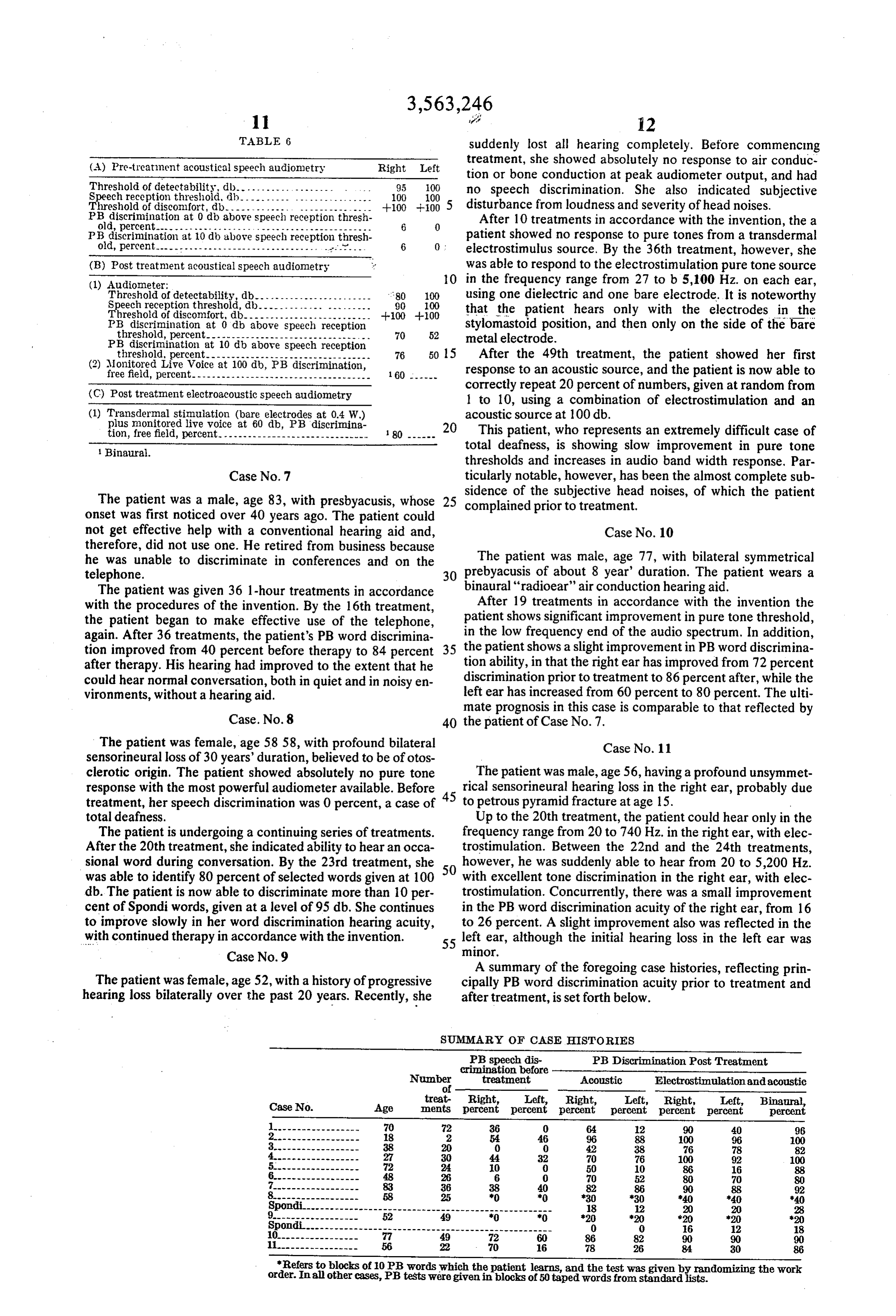
Page 9
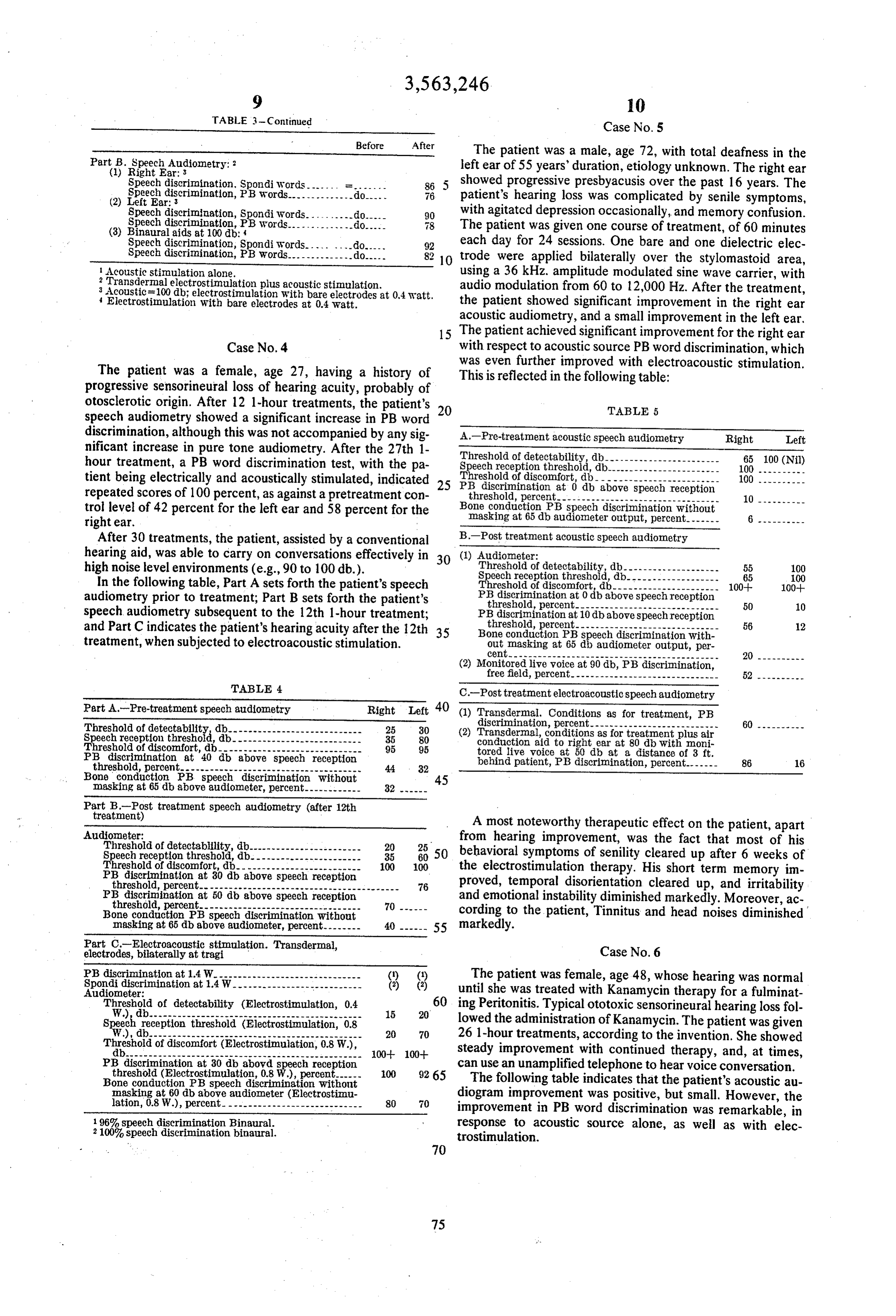
TABLE 6 suddenly lost all hearing completely. Before commencing (A) Pre-treatment acoustical speech audiometry Right Left treatment, she showed absolutely no response to air conduc Threshold of detectability, db. 95 100 tion or bone conduction at peak audiometer output, and had
Speech reception threshold, db 100 00 no speech discrimination. She also indicated subjective reshold of discomfort, db. . . . . . . . . . . . . . ... ----------...- --100 -100 5
PB discrimination at 0 db ab disturbance from loudness and severity of head noises.
old, percent---- - - - - - - - - - - - - - - - - - - - - - - - - - - - - ------------- 6 0 After 10 treatments in accordance with the invention, the a PB discrimination at 10 db above speech reception thresh patient showed no response to pure tones from a transdermal old, percent----- - - - - - - - - - - - - - - - - - - - - - - - - - - - - - - - - - - - 6 electrostimulus source. By the 36th treatment, however, she (B) Post treatment acoustical speech audiometry was able to respond to the electrostimulation pure tone source (1) Audiometer: O in the frequency range from 27 to b 5,100 Hz. on each ear,
Speech reception threshold, db.-------
using one dielectric and one bare electrode. It is noteworthy
Threshold of discomfort, db.-------------------------- --100 --100 that the patient hears only with the electrodes in the PB discrimination at 0 db above speech reception threshold, percent-------------------------------... 70 52 stylomastoid position, and then only on the side of the bare
PB discrimination at 10 db above speech reception metal electrode.
(2) Monitored Live Voice at 100 db, PB discrimination, 76 50 15 After the 49th treatment, the patient showed her first free field, percent------------------------------------- 160 ------ response to an acoustic source, and the patient is now able to (C) Post treatment electroacoustic speech audiometry correctly repeat 20 percent of numbers, given at random from l to 10, using a combination of electrostimulation and an (1) Transdermal stimulation (bare electrodes at 0.4 W.) acoustic source at 100 db. plus monitored live voice at 60 db, PB discrimina tion, free field, percent------------------------------. 80 ------ 20 This patient, who represents an extremely difficult case of 1 Binaura. total deafness, is showing slow improvement in pure tone thresholds and increases in audio band width response. Par
Case No. 7 ticularly notable, however, has been the almost complete sub
The patient was a male, age 83, with presbyacusis, whose 25 sidence complained of the subjective head noises, of which the patient prior to treatment.
onset was first noticed over 40 years ago. The patient could not get effective help with a conventional hearing aid and, Case No. 10 therefore, did not use one. He retired from business because he was unable to discriminate in conferences and on the The patient was male, age 77, with bilateral symmetrical telephone. 30 prebyacusis of about 8 year' duration. The patient wears a The patient was given 36 1-hour treatments in accordance binaural "radioear' air conduction hearing aid. After 19 treatments in accordance with the invention the with the procedures of the invention. By the 16th treatment, the patient began to make effective use of the telephone, patient shows significant improvement in pure tone threshold, again. After 36 treatments, the patient's PB word discrimina in the low frequency end of the audio spectrum. In addition, tion improved from 40 percent before therapy to 84 percent 35 the patient shows a slight improvement in PB word discrimina after therapy. His hearing had improved to the extent that he tion ability, in that the right ear has improved from 72 percent could hear normal conversation, both in quiet and in noisy en discrimination prior to treatment to 86 percent after, while the vironments, without a hearing aid. left ear has increased from 60 percent to 80 percent. The ulti mate prognosis in this case is comparable to that reflected by
Case. No. 8 40 the patient of Case No. 7.
The patient was female, age 5858, with profound bilateral Case No. 11 sensorineural loss of 30 years' duration, believed to be of otos clerotic origin. The patient showed absolutely no pure tone The patient was male, age 56, having a profound unsymmet response with the most powerful audiometer available. Before 45 rical sensorineural hearing loss in the right ear, probably due treatment, her speech discrimination was 0 percent, a case of to petrous pyramid fracture at age 15.
total deafness. Up to the 20th treatment, the patient could hear only in the The patient is undergoing a continuing series of treatments. frequency range from 20 to 740 Hz. in the right ear, with elec After the 20th treatment, she indicated ability to hear an occa trostimulation. Between the 22nd and the 24th treatments, sional word during conversation. By the 23rd treatment, she 50 however, he was suddenly able to hear from 20 to 5,200 Hz. was able to identify 80 percent of selected words given at 100 with excellent tone discrimination in the right ear, with elec db. The patient is now able to discriminate more than 10 per trostimulation. Concurrently, there was a small improvement cent of Spondi words, given at a level of 95 db. She continues in the PB word discrimination acuity of the right ear, from 16 to improve slowly in her word discrimination hearing acuity, to 26 percent. A slight improvement also was reflected in the with continued therapy in accordance with the invention. 55 left ear, although the initial hearing loss in the left ear was
A summary of the foregoing case histories, reflecting prin
The patient was female, age 52, with a history of progressive cipally PB word discrimination acuity prior to treatment and hearing loss bilaterally over the past 20 years. Recently, she after treatment, is set forth below.
SUMMARY OF CASE EISTORIES
PB speech dis- PB Discrimination Post Treatment crimination before
NumberO treatment Acoustic Electrostimulation and acoustic
treat- Right, Left, Right, Left, Right, Left, Binaural,
Case No Age ments percent percent percent percent percent percent percent
72 2. O 0 50 10 86 16 88 48 26 6 O 70 52 80 70 80
58 25 to *0 *30 *30 *40 *40 *40 - - - - - - - - - - - - - - - - - - - -- - - - - - - - - - - - - - - - - - - - - - 18 2 20 20 28 52 49 *0 *0 *20. 820 420 *20 20 - - -- --- - - - - - - - - - -- - - - ---- - - - - - - -- - - - -- - - - 0 0 6 2 18
Refers to blocks of 10 PB words which the patient learns, and the test was given by randomizing the work order. In all other cases, PB tests were given in blocks of 50 taped words from standard lists.
Page 10
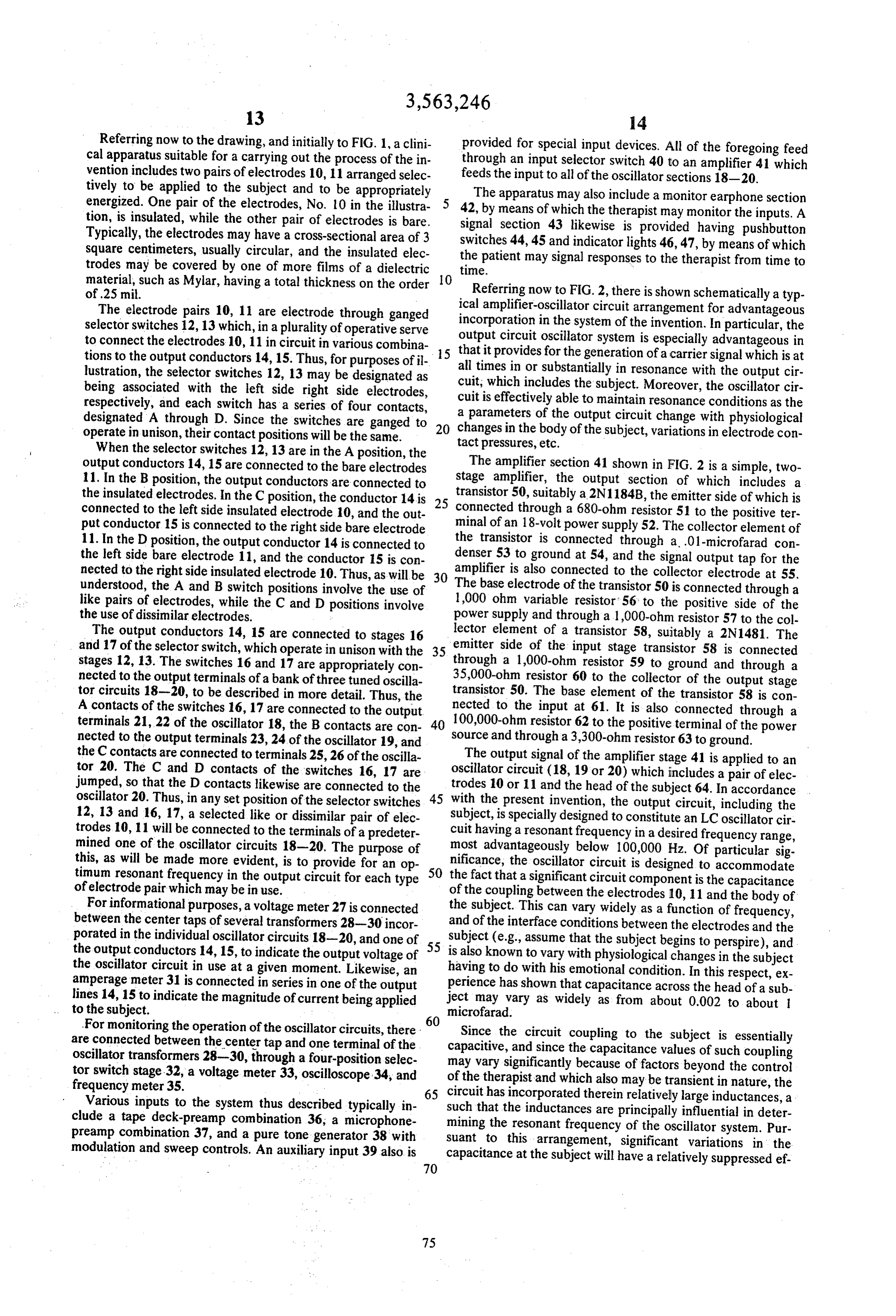
Referring now to the drawing, and initially to FIG. 1, a clini provided for special input devices. All of the foregoing feed cal apparatus suitable for a carrying out the process of the in through an input selector switch 40 to an amplifier 41 which vention includes two pairs of electrodes 10, 11 arranged selec feeds the input to all of the oscillator sections 18-20. tively to be applied to the subject and to be appropriately The apparatus may also include a monitor earphone section energized. One pair of the electrodes, No. 10 in the illustra 42, by means of which the therapist may monitor the inputs. A tion, is insulated, while the other pair of electrodes is bare. signal section 43 likewise is provided having pushbutton Typically, the electrodes may have a cross-sectional area of 3 switches 44, 45 and indicator lights 46, 47, by means of which square centimeters, usually circular, and the insulated elec the patient may signal responses to the therapist from time to trodes may be covered by one of more films of a dielectric time.
material, such as Mylar, having a total thickness on the order O Referring now to FIG. 2, there is shown schematically a typ
The electrode pairs 10, 11 are electrode through ganged ical amplifier-oscillator circuit arrangement for advantageous incorporation in the system of the invention. In particular, the selector switches 12, 13 which, in a plurality of operative serve output circuit oscillator system is especially advantageous in to connect the electrodes 10, 11 in circuit in various combina that it provides for the generation of a carrier signal which is at tions to the output conductors 14, 15. Thus, for purposes of il 5 all lustration, the selector switches 12, 13 may be designated as times in or substantially in resonance with the output cir being associated with the left side right side electrodes, cuit cuit, which includes the subject. Moreover, the oscillator cir respectively, and each switch has a series of four contacts, is effectively able to maintain resonance conditions as the designated A through D. Since the switches are ganged to 20 a parameters of the output circuit change with physiological operate in unison, their contact positions will be the same. changes in the body of the subject, variations in electrode con When the selector switches 12, 13 are in the A position, the tact pressures, etc.
output conductors 14, 15 are connected to the bare electrodes The amplifier section 41 shown in FIG. 2 is a simple, two 11. In the B position, the output conductors are connected to stage amplifier, the output section of which includes a the insulated electrodes. In the C position, the conductor 14 is transistor 50, suitably a 2N1184B, the emitter side of which is connected to the left side insulated electrode 10, and the out 25 connected through a 680-ohm resistor 51 to the positive ter put conductor 15 is connected to the right side bare electrode minal of an 18-volt power supply 52. The collector element of 11. In the D position, the output conductor 14 is connected to the transistor is connected through a .01-microfarad con the left side bare electrode 11, and the conductor 15 is con denser 53 to ground at 54, and the signal output tap for the nected to the right side insulated electrode 10. Thus, as will be 30 amplifier is also connected to the collector electrode at 55. understood, the A and B switch positions involve the use of The base electrode of the transistor 50 is connected through a like pairs of electrodes, while the C and D positions involve 1,000 ohm variable resistor 56 to the positive side of the the use of dissimilar electrodes. power supply and through a 1,000-ohm resistor 57 to the col The output conductors 14, 15 are connected to stages 16 lector element of a transistor 58, suitably a 2N1481. The and 17 of the selector switch, which operate in unison with the 35 emitter side of the input stage transistor 58 is connected stages 12, 13. The switches 16 and 17 are appropriately con through a 1,000-ohm resistor 59 to ground and through a nected to the output terminals of a bank of three tuned oscilla 35,000-ohm resistor 60 to the collector of the output stage tor circuits 18-20, to be described in more detail. Thus, the transistor 50. The base element of the transistor 58 is con A contacts of the switches 16, 17 are connected to the output nected to the input at 61. It is also connected through a terminals 21, 22 of the oscillator 18, the B contacts are con 40 100,000-ohm resistor 62 to the positive terminal of the power nected to the output terminals 23, 24 of the oscillator 19, and source and through a 3,300-ohm resistor 63 to ground. the C contacts are connected to terminals 25, 26 of the oscilla The output signal of the amplifier stage 41 is applied to an tor 20. The C and D contacts of the switches 16, 17 are oscillator circuit (18, 19 or 20) which includes a pair of elec jumped, so that the D contacts likewise are connected to the trodes 10 or 11 and the head of the subject 64. In accordance oscillator 20. Thus, in any set position of the selector switches 45 with the present invention, the output circuit, including the 12, 13 and 16, 17, a selected like or dissimilar pair of elec subject, is specially designed to constitute an LC oscillator cir trodes 10, 11 will be connected to the terminals of a predeter cuit having a resonant frequency in a desired frequency range, mined one of the oscillator circuits 18-20. The purpose of most advantageously below 100,000 Hz. Of particular sig this, as will be made more evident, is to provide for an op 50 nificance, the oscillator circuit is designed to accommodate timum resonant frequency in the output circuit for each type the fact that a significant circuit component is the capacitance of electrode pair which may be in use. of the coupling between the electrodes 10, 11 and the body of For informational purposes, a voltage meter 27 is connected the subject. This can vary widely as a function of frequency, between the center taps of several transformers 28-30 incor and of the interface conditions between the electrodes and the porated in the individual oscillator circuits 18-20, and one of 55 subject (e.g., assume that the subject begins to perspire), and the output conductors 14, 15, to indicate the output voltage of is also known to vary with physiological changes in the subject the oscillator circuit in use at a given moment. Likewise, an having to do with his emotional condition. In this respect, ex amperage meter 31 is connected in series in one of the output perience has shown that capacitance across the head of a sub lines 14, 15 to indicate the magnitude of current being applied ject may vary as widely as from about 0.002 to about 1 to the subject. microfarad.
For monitoring the operation of the oscillator circuits, there 60 Since the circuit coupling to the subject is essentially are connected between the center tap and one terminal of the oscillator transformers 28-30, through a four-position selec capacitive, may vary and since the capacitance values of such coupling significantly because of factors beyond the control tor switch stage 32, a voltage meter 33, oscilloscope 34, and of the therapist and which also may be transient in nature, the frequency meter 35. 65 circuit has incorporated therein relatively large inductances, a Various inputs to the system thus described typically in clude a tape deck-preamp combination 36, a microphone such that the inductances are principally influential in deter preamp combination 37, and a pure tone generator 38 with suant tothethis mining resonant frequency of the oscillator system. Pur arrangement, significant variations in the modulation and sweep controls. An auxiliary input 39 also is capacitance at the subject will have a relatively suppressed ef
Page 11
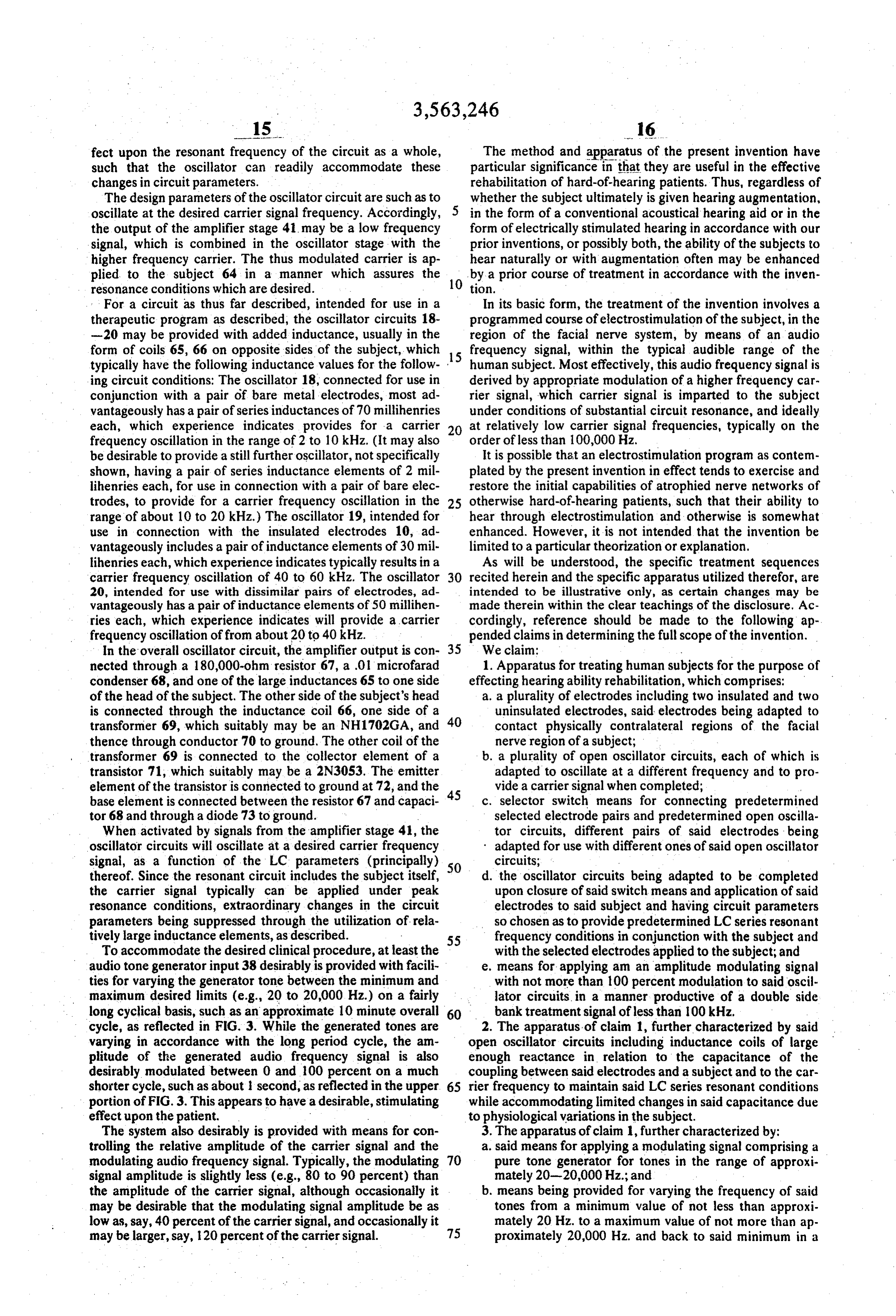
fect upon the resonant frequency of the circuit as a whole, The method and apparatus of the present invention have such that the oscillator can readily accommodate these particular significance in that they are useful in the effective changes in circuit parameters. rehabilitation of hard-of-hearing patients. Thus, regardless of The design parameters of the oscillator circuit are such as to whether the subject ultimately is given hearing augmentation, oscillate at the desired carrier signal frequency. Accordingly, in the form of a conventional acoustical hearing aid or in the the output of the amplifier stage 41 may be a low frequency form of electrically stimulated hearing in accordance with our signal, which is combined in the oscillator stage with the prior inventions, or possibly both, the ability of the subjects to higher frequency carrier. The thus modulated carrier is ap hear naturally or with augmentation often may be enhanced plied to the subject 64 in a manner which assures the 10 by a prior course of treatment in accordance with the inven resonance conditions which are desired. tion.
For a circuit as thus far described, intended for use in a In its basic form, the treatment of the invention involves a therapeutic program as described, the oscillator circuits 18 programmed course of electrostimulation of the subject, in the -20 may be provided with added inductance, usually in the region of the facial nerve system, by means of an audio form of coils 65, 66 on opposite sides of the subject, which 15 frequency signal, within the typical audible range of the typically have the following inductance values for the follow human subject. Most effectively, this audio frequency signal is ing circuit conditions: The oscillator 18, connected for use in derived by appropriate modulation of a higher frequency car conjunction with a pair of bare metal electrodes, most ad rier signal, which carrier signal is imparted to the subject vantageously has a pair of series inductances of 70 millihenries under conditions of substantial circuit resonance, and ideally each, which experience indicates provides for a carrier 20 at relatively low carrier signal frequencies, typically on the frequency oscillation in the range of 2 to 10 kHz. (It may also order of less than 100,000 Hz.
be desirable to provide a still further oscillator, not specifically It is possible that an electrostimulation program as contem shown, having a pair of series inductance elements of 2 mil plated by the present invention in effect tends to exercise and lihenries each, for use in connection with a pair of bare elec restore the initial capabilities of atrophied nerve networks of trodes, to provide for a carrier frequency oscillation in the 25 otherwise hard-of-hearing patients, such that their ability to range of about 10 to 20 kHz.) The oscillator 19, intended for hear through electrostimulation and otherwise is somewhat use in connection with the insulated electrodes 10, ad enhanced. However, it is not intended that the invention be vantageously includes a pair of inductance elements of 30 mil limited to a particular theorization or explanation. lihenries each, which experience indicates typically results in a As will be understood, the specific treatment sequences carrier frequency oscillation of 40 to 60 kHz. The oscillator 30 recited herein and the specific apparatus utilized therefor, are 20, intended for use with dissimilar pairs of electrodes, ad intended to be illustrative only, as certain changes may be vantageously has a pair of inductance elements of 50 millihen made therein within the clear teachings of the disclosure. Ac ries each, which experience indicates will provide a carrier cordingly, reference should be made to the following ap frequency oscillation of from about 20 to 40 kHz. pended claims in determining the full scope of the invention. In the overall oscillator circuit, the amplifier output is con 35 We claim:
nected through a 180,000-ohm resistor 67, a .01 microfarad 1. Apparatus for treating human subjects for the purpose of condenser 68, and one of the large inductances 65 to one side effecting hearing ability rehabilitation, which comprises: of the head of the subject. The other side of the subject's head a. a plurality of electrodes including two insulated and two is connected through the inductance coil 66, one side of a 40 uninsulated electrodes, said electrodes being adapted to transformer 69, which suitably may be an NH1702GA, and contact physically contralateral regions of the facial thence through conductor 70 to ground. The other coil of the nerve region of a subject;
transformer 69 is connected to the collector element of a b. a plurality of open oscillator circuits, each of which is transistor 71, which suitably may be a 2N3053. The emitter adapted to oscillate at a different frequency and to pro element of the transistor is connected to ground at 72, and the 45 vide a carrier signal when completed; base element is connected between the resistor 67 and capaci c. selector switch means for connecting predetermined tor 68 and through a diode 73 to ground. selected electrode pairs and predetermined open oscilla When activated by signals from the amplifier stage 41, the tor circuits, different pairs of said electrodes being oscillator circuits will oscillate at a desired carrier frequency adapted for use with different ones of said open oscillator signai, as a function of the LC parameters (principally) 50 circuits;
thereof. Since the resonant circuit includes the subject itself, d. the oscillator circuits being adapted to be completed the carrier signal typically can be applied under peak upon closure of said switch means and application of said resonance conditions, extraordinary changes in the circuit electrodes to said subject and having circuit parameters parameters being suppressed through the utilization of rela so chosen as to provide predetermined LC series resonant tively large inductance elements, as described. 55 frequency conditions in conjunction with the subject and To accommodate the desired clinical procedure, at least the with the selected electrodes applied to the subject; and audio tone generator input 38 desirably is provided with facili e. means for applying am an amplitude modulating signal ties for varying the generator tone between the minimum and with not more than 100 percent modulation to said oscil maximum desired limits (e.g., 20 to 20,000 Hz.) on a fairly lator circuits, in a manner productive of a double side long cyclical basis, such as an approximate 10 minute overall 60 bank treatment signal of less than 100 kHz, cycle, as reflected in FIG. 3. While the generated tones are 2. The apparatus of claim 1, further characterized by said varying in accordance with the long period cycle, the am open oscillator circuits including inductance coils of large plitude of the generated audio frequency signal is also enough reactance in relation to the capacitance of the desirably modulated between 0 and 100 percent on a much coupling between said electrodes and a subject and to the car shorter cycle, such as about 1 second, as reflected in the upper 65 rier frequency to maintain said LC series resonant conditions portion of FIG.3. This appears to have a desirable, stimulating while accommodating limited changes in said capacitance due effect upon the patient. to physiological variations in the subject. The system also desirably is provided with means for con 3. The apparatus of claim 1, further characterized by: trolling the relative amplitude of the carrier signal and the a. said means for applying a modulating signal comprising a modulating audio frequency signal. Typically, the modulating 70 pure tone generator for tones in the range of approxi signal amplitude is slightly less (e.g., 80 to 90 percent) than mately 20-20,000 Hz.; and the amplitude of the carrier signal, although occasionally it b. means being provided for varying the frequency of said may be desirable that the modulating signal amplitude be as tones from a minimum value of not less than approxi low as, say, 40 percent of the carrier signal, and occasionally it mately 20 Hz. to a maximum value of not more than ap may be larger, say, 120 percent of the carrier signal. 75 proximately 20,000 Hz. and back to said minimum in a
Page 12
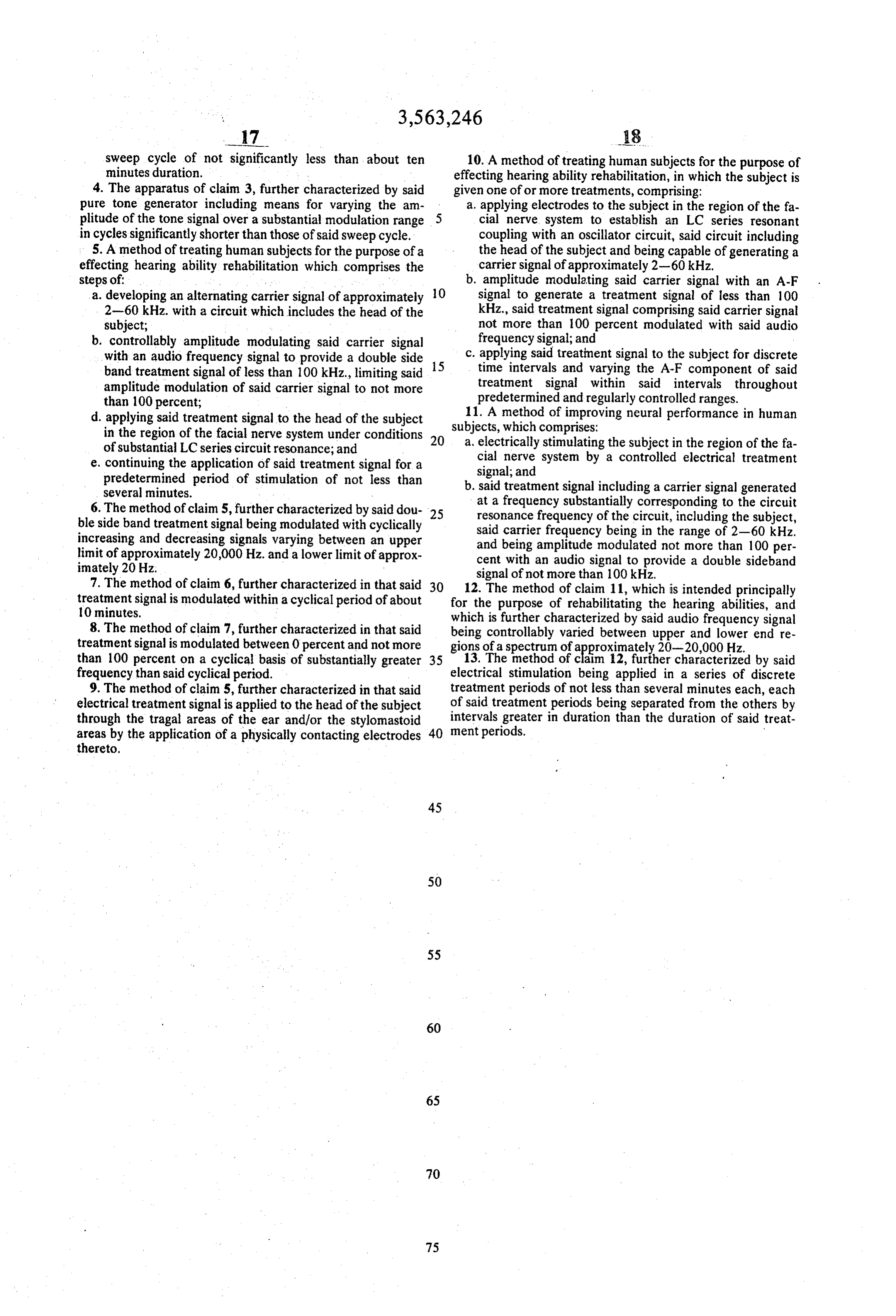
sweep cycle of not significantly less than about ten 10. A method of treating human subjects for the purpose of minutes duration. effecting hearing ability rehabilitation, in which the subject is 4. The apparatus of claim 3, further characterized by said given one of or more treatments, comprising: pure tone generator including means for varying the am a. applying electrodes to the subject in the region of the fa plitude of the tone signal over a substantial modulation range cial nerve system to establish an LC series resonant in cycles significantly shorter than those of said sweep cycle. coupling with an oscillator circuit, said circuit including 5. A method of treating human subjects for the purpose of a the head of the subject and being capable of generating a effecting hearing ability rehabilitation which comprises the carrier signal of approximately 2-60 kHz. steps of b. amplitude modulating said carrier signal with an A-F a. developing an alternating carrier signal of approximately O signal to generate a treatment signal of less than 100 2-60 kHz. with a circuit which includes the head of the kHz., said treatment signal comprising said carrier signal subject; not more than 100 percent modulated with said audio b. controllably amplitude modulating said carrier signal frequency signal; and - with an audio frequency signal to provide a double side 15 c. applying said treatment signal to the subject for discrete band treatment signal of less than 100 kHz., limiting said time intervals and varying the A-F component of said amplitude modulation of said carrier signal to not more treatment signal within said intervals throughout than 100 percent; predetermined and regularly controlled ranges. 11. A method of improving neural performance in human d. applying said treatment signal to the head of the subject subjects, which comprises:
in the region of the facial nerve system under conditions 20 a. electrically of substantial LC series circuit resonance; and stimulating the subject in the region of the fa e. continuing the application of said treatment signal for a cial nerve system by a controlled electrical treatment predetermined period of stimulation of not less than signal; and several minutes. b. said treatment signal including a carrier signal generated 6. The method of claim 5, further characterized by said dou 25 at a frequency substantially corresponding to the circuit ble side band treatment signal being modulated with cyclically resonance frequency of the circuit, including the subject, increasing and decreasing signals varying between an upper said carrier frequency being in the range of 2-60 kHz. limit of approximately 20,000 Hz. and a lower limit of approx and being amplitude modulated not more than 100 per imately 20 Hz. cent with an audio signal to provide a double sideband signal of not more than 100 kHz.
7. The method of claim 6, further characterized in that said 30 12. The method of claim 11, which is intended principally treatment signal is modulated within a cyclical period of about for the purpose of rehabilitating the hearing abilities, and 10 minutes. which is further characterized by said audio frequency signal 8. The method of claim 7, further characterized in that said being controllably varied between upper and lower end re treatment signal is modulated between 0 percent and not more gions of a spectrum of approximately 20-20,000 Hz. than 100 percent on a cyclical basis of substantially greater 35 13. The method of claim 2, further characterized by said frequency than said cyclical period. electrical stimulation being applied in a series of discrete 9. The method of claim 5, further characterized in that said treatment periods of not less than several minutes each, each electrical treatment signal is applied to the head of the subject of said treatment periods being separated from the others by through the tragal areas of the ear and/or the stylomastoid intervals greater in duration than the duration of said treat areas by the application of a physically contacting electrodes 40 ment periods.
thereto.
Provenance
- Collection
- Cited prior art
- Original PDF
- patentimages.storage.googleapis.com →
- Filed
- 1967-04-24
- Pages
- 12
- Method
- pdftotext (the PDF's own text layer) + pdftoppm 300dpi page scans
- Source
- Google Patents bibliographic record
- Granted
- 1971-02-16
- Inventors
- Henry K Puharich; Joseph L Lawrence; Intelectron Corp
- Transcribed from
- patentimages.storage.googleapis.com →