patent · US4052139
Method and apparatus for improving the energy yield of a reaction
4 October 1977
Page 1 — bibliographic record
United States Patent (19) 11) 4,052,139 Paillaud et al. (45) Oct. 4, 1977
54 METHOD AND APPARATUS FOR 3,306,338 2/1967 Wright et al... 431/2 X IMPROVING THE ENERGY YELD OF A 3,679,560 7/1972 Mezey ............. ... 204/57, 1 S
REACTION
3,749,545 7/1973 Velkoff .................................... 431/2
(76) Inventors: Maltot
Pierre Paillaud, 14930 Eterville par
(Calvados); Jöel Raymond, Primary Examiner-Edgar W. Geoghegan 177, rue de Bretagne, 14760 Attorney, Agent, or Firm--Melville, Strasser, Foster & Bretteville, sur Odon (Calvados), Hoffman both of France 57 ABSTRACT (21) Appl. No.: 631,226 Method and apparatus to improve the energy yield of a 22) Filed: Nov. 12, 1975 reaction, particularly a combustion process. When used Foreign Application Priority Data in a heating system in which fuel is burned, a burner (30) sprays fuel and combustion supporting gas, preferably Nov. 12, 1974 France ................................ 74.3732O. air, into the reaction zone inside a combustion chamber. An electromagnetic radiation of which the frequency 51 Int. C.’................................................ F23B 7/00 range is 8800 Mc/s - 10% corresponding to the maxi (52) U.S. C. ...................................... 431/2; 123/1 A; mum motion which may be imparted to the reactants of
the molecules is directed at the reactants, by an antenna (58) Field of Search ....................... 431/2, 4, 8; 137/3, whose axis intersects the axis of the burner inside the 137/5, 6; 123/1 A, 3, 119 reaction zone. A dissociable substance, preferably water 56) References Cited with a surface active agent, is used as an additive and
field is provided around the spray of fuel leaving the 1939,302 12/1933 Heaney ..................... 123/119 EUX burner by a metal ring at a potential of 300 to 25,000 V. 2,463,569 3/1949 Smith ............................... 157/1 RX 2,576,450 11/1951 De Marval .... ... 123/119 E X 17 Claims, 1 Drawing Figure
-- Fue
-- Water
and
Oscillating current
Page 2
Drawing sheet — no readable text.
Page 3
When the reaction is principally or secondarily in
METHOD AND APPARATUS FOR IMPROVING tended for the recovery of heat, for example the burn THE ENERGY YIELD OF A REACTION ing of fuel in a boiler for heating, the transmission of heat to recovery surfaces, e.g., the walls and tubes of
The present invention relates to a method of improv 5 the boiler, is greatly improved by subjecting the reac ing the energy yields of reactions, particularly combus tion zone or area to an electrostatic field at a voltage tion. ranging between 300 and 15,000 V. The effect of such a In reactions such as the combustion of hydrocarbons, field is to cause an ionic dispersion, in the reaction zone it has been known for a long time that the reaction then towards the walls, of the mixture of reactants between the combustible or fuel and the combustion O which has been highly ionized due to the simultaneous supporting gas occurs progressively with the destruc effect of the electromagnetic field and reaction. A po tion of particles or droplets of the fuel, formation of tential below 300 V is not very effective, whereas a intermediaries in chains and, normally, the production potential above 15,000 V generates premature and in of unburnt residues. If said production is eliminated by complete combustion after a spontaneous ionization. In using an excess of the combustion supporting gas (air), 15 an internal combustion engine, potentials may range up there results a loss in the energy yield. to 25,000 V.
It is also known, and it makes good sense, that a reac One of the effects of the addition of water in such a tion is more complete and faster when the reactants are case is that since the dielectric constant of the hydrocar mixed better initially. It has been proposed to improve bon fuel and combustion supporting gas is in general the mixing of the reactants by vibrations of variable 20 even less than about 1/40 that of water, a molecular frequency, and yet, here again, the complications of the focusing is brought about by the effect on the rate of equipment override in general the corresponding gain. propagation of the electromagnetic wave which is Only simple improvements relative to the shape and given by the formula:
arrangements of the tuyeres, for ameliorating the turbu lence, have really been accepted in practice. 25 y = 1/ VE
For some time it has also been known that it is possi ble to improve a combustion process by adding a sub where E is the absolute dielectric constant of the me stance in the presence of the fuel which partially disso dium and u is the magnetic permeability of the medium. ciates, at a temperature below that of the combustion From another standpoint, the specific heat of the reaction, the products of dissociation recombining in 30 combustion supporting gases is in general very much the vicinity of the flame, with themselves and the inter less than that of water and hydrogen, the presence of mediary products of combustion. The simplest such water, whether dissociated or not, improves the trans additive is water. Nevertheless the energy gain afforded mission of energy.
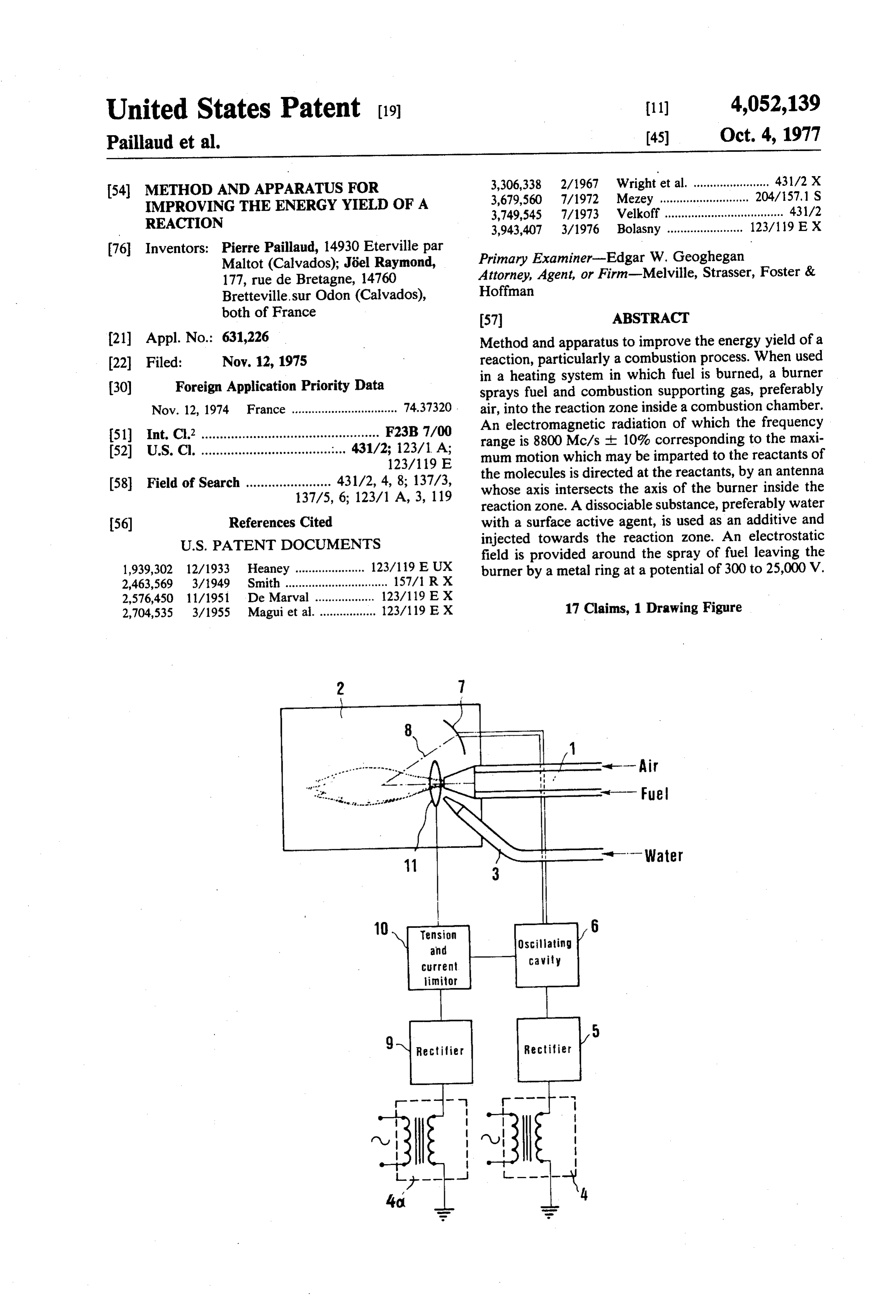
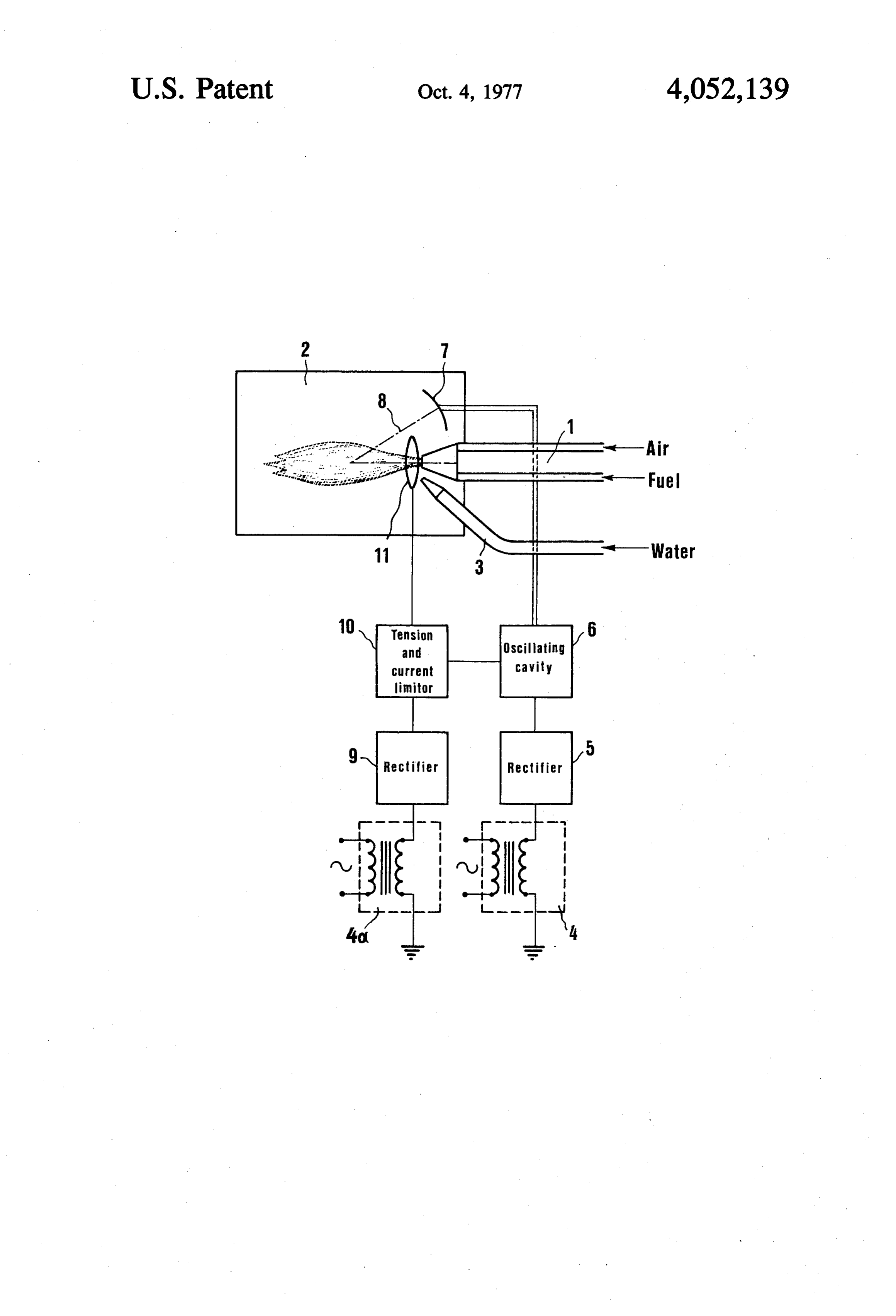
by water is very substantially less than might be hoped, According to a preferred embodiment for use in a therefore hardly compensating for the added complica 35 heating system including a boiler utilizing fuel oil com tion due to the addition of water. Accordingly, such a prising a conventional burner 1 which injects fuel and method has not achieved wide acceptance. air into the combustion chamber 2 and an injector 3 The preceding is not only true for a combustion pro which injects water, to which a surface active agent has cess but also for all other similar reactions, been added, as a pressurized spray phase. The flow rate The idea which was the starting point for the present of the sprayed water is at most 20% by weight that of invention is that additives such as water are far from as the fuel injected.
effective as they could be because the motion imparted The super high frequency generator set at a central to the molecules of the solid or liquid reactants has been frequency of 8800 Mc/s comprises an isolation voltage heretofore very small and inadequate to dislodge the transformer 4. A fixed voltage rectifier 5, an oscillating particles and droplets to the point of permitting them to 45 cavity 6 with a pulse generator and horn type wave react fully with the additive. guide antenna 7 which extends into the combustion We have surprisingly and unexpectedly discovered chamber to the vicinity of the burner so that its axis 8 that the maximum thermal or ionic motion imparted to intersects the axis of the burner in the middle of the substantially all the substances capable of reacting is flame. The consumption of the super high frequency located in the frequency band of 8800 Mc/s -- 10%. SO generator is about 215 volt-amperes for domestic use. Up until the present day it was not easy to obtain such The electrostatic generator comprises a special isola elevated frequencies, but recently apparatus have been tion voltage transformer 4a, a special voltage rectifier 9, made available enabling the production and transmis a voltage and current limiter 10, and an insulated metal sion of such super high frequencies, in the radar range, ring 11 disposed in front of the tip of the burner and economically, at suitable levels of power. 55 having a diameter 15mm larger than the maximum In the method according to the invention, before cross-sectional dimension of the conical spray of con reacting the reactants, possibly with the addition of an bustion reactants in the same plane. The output voltage additive whose products of dissociation are capable of is adjustable between 500 and 15,000 V, the current recombining at least in part with themselves or with the variable between 0.1 and 0.5 milliamps. The power reactants, the reactants are subjected to an electromag 60 consumed is 17 volt-amperes for domestic use. netic field whose frequency is selected in the band of Although the preceding example is relative to a boiler 8800 Mc/s -- 10% which corresponds to a maximum of a heating system it is to be noted that the invention is thermal or ionic motion imparted to the reactants. particularly well suited for internal combustion engines In case of the combustion of hydrocarbons, the pre where it is possible to achieve in addition to an im ferred additive is water to which a surface active agent 65 proved energy yield, an appreciable gain in the regular such as "Teepol', a trademarked product distributed by ity of combustion and nearly total elimination of un "Compagnie Francaise des Produits Chimiques', Shell, burnt residues.
Paris, France, is added. What we claim is:
Page 4
1. A method of improving the energy yield of a reac ranging between 300 and 25,000 V, and applying said tion between reactants, comprising providing electro electrostatic field to said reactants. magnetic radiation the frequency of which substantially 11. A method according to claim 2, said reaction corresponds to the maximum thermal or ionic motion of being combustion and said reactants including at least the molecules of said reactants, and directing said elec one hydrocarbon fuel and a combustion supporting gas. tromagnetic radiation towards said reactants while al 12. An apparatus for improving the energy yield of a lowing the reaction to proceed. combustion process comprising a combustion chamber, 2. A method according to claim 1, the frequency of said electromagnetic radiation being in the band of 8800 aspraying burner extending inside said combustion chamber for fuel and a combustion supporting gas into a
McMs - 10%. 10 reaction zone in said combustion chamber, means for 3. A method according to claim 2, further comprising, supplying fuel and combustion supporting gas to said before applying said electromagnetic radiation, adding burner, an at least partially dissociable additive at a temperature the bandmeans for generating a super high frequency in below the temperature of reaction of said reaction, and said super high Mc/s
frequency towards said combustion allowing the products of dissociation to recombine ZOC. 15 thereafter.
4. A method according to claim 3, further comprising 13. An apparatus according to claim 12, wherein said the products of dissociation recombining with them means for directing the super high frequency is an an selves. tenna having an axis intersecting the axis of said burner 5. A method according to claim 3, further comprising 20 inside said combustion zone.
the products of dissociation recombining with the prod 14. An apparatus according to claim 13, wherein ucts of said reaction. wave guide means carries the super high frequency 6. A method according to claim 3, further comprising from said means for generating to said antenna. the products of dissociation recombining during said 15. An apparatus according to claim 12, further com reaction. 25 prising means for injecting an additive into said combus 7. A method according to claim 3, further comprising tion zone.
the products of dissociation recombining after said reac 16. An apparatus according to claim 12, further com tion. prising means for producing and applying an electro 8. A method according to claim 3, the additive being static field in the vicinity of said reaction zone. a substance the products of dissociation of which are 30 17. An apparatus according to claim 16, wherein the oxygen and hydrogen. last mentioned means include a metal ring arranged 9. A method according to claim 3, the additive being inside said combustion chamber and extending round Water. the spray of fuel leaving said burner, and means electri 10. A method according to claim 2, further compris cally isolating said metal ring.
ing producing an electrostatic field having a potentional 35 k k k k
Provenance
- Collection
- Cited prior art
- Original PDF
- patentimages.storage.googleapis.com →
- Filed
- 1975-11-12
- Pages
- 4
- Method
- pdftotext (the PDF's own text layer) + pdftoppm 300dpi page scans
- Source
- Google Patents bibliographic record
- Granted
- 1977-10-04
- Inventors
- Pierre Paillaud; Joel Raymond
- Transcribed from
- patentimages.storage.googleapis.com →