patent · US3460893
Apparatus for analyzing a continuously moving strip by means of attenuated total reflection
12 August 1969
Page 1
350 to 6 SR - as a iiii" " ' is Eiji,
ROOM
Aug. 12, 1969 P. A. WLKS, JR 3,460,893
APPARATUS FOR ANALYZING A CONTINUOUSLY MOWING
STRIP BY MEANS OF ATTENUATED
TOTAL REFLECTION
Filed Sept. 5, 1965 2. Sheets-Sheet
RAOAN
ENERGY
RADANT
ENERGY
3460893 . ? inter--------in-la sr. . . . . OR IN 35.6/96 ------A
Page 2
Aug. 12, 1969 P. A. WLKS, JR 3,460,893
APPARATUS FOR ANALYZING A CONTINUOUSLY MOWING
STRIP BY MEANS OF ATTENUATED
TOTAL REFLECTION
Filed Sept. 15, 1965 2 Sheets-Sheet 2
S. 5 EREy
RADAN
ENERGY
RADANT
ENERGY SPECTROPHOTOMETER
FIG.9 2ez M. was, A.
Page 3
United States Patent Office 3,460,893 Patented Aug. 12, 1969
3,460,893 come the above and other difficulties of known systems.
APPARATUS FOR ANALYZING A CONTINUOUSLY Another object of the invention is to provide an in MOVING STRIP BY MEANS OF ATTENUATED ternal reflection cell capable of instantaneously producing TOTAL REFLECTION a spectrum incident to the absorption of wave lengths Paul A. Wilks, Jr., Darien, Conn., assignor to Wilks from a ray of radiant energy as a sample of web, film, rib Scientific Corporation, Norwalk, Conn., a corpora bon or the like continuously moves past a point in a tion of Connecticut plane containing the reflected rays of radiant energy. Filed Sept. 15, 1965, Ser. No. 487,515 Still another object of the invention is to provide from Int, C. G01j 3/42 a continuously moving web, film or ribbon device, the
U.S. C., 356-96 7 Claims O analysis of which is desired, an infrared spectrum of the material as the web, film or ribbon continuously moves past a point of analysis.
ABSTRACT OF THE DISCLOSURE Another object of the invention is to provide such a An apparatus having a rotatable cylindrical element System in which the infrared spectrum is unaffected by having multiple internal reflection characteristics and with the thickness of the web, film or ribbon. beveled ends wherein the strip of material to be analyzed Still another object of the invention is to provide is moved in contact with the cylinder as it rotates. A such a system in which uniform contact of the sample Source of radiant energy is passed into one of the beveled of web, film or ribbon with the reflecting face of a cell ends and a spectrophotometer receives the rays of energy is assured.
as they emerge from the other beveled end to produce a In one aspect of the invention, an internal reflection cell spectrum for continuously analyzing the material of the may be composed of a hollow, cylindrical crystal member strip such as a web, film or ribbon. having the capability of total internal reflection. The crystal may be thallium bromide, iodide and germanium traussmullamm or any other transmitting material.
This invention relates to spectroscopy, and particularly 25 In another aspect of the invention, the hollow, cylin to an improved system for continuously analyzing a mov drical crystal may have beveled edges that are opposed ing web, film or ribbon with radiant energy such as infra to each other.
red. In still another aspect of the invention, a source of Internal reflection spectroscopy is based on a portion 30 radiant energy may be located in position to direct rays of the energy in a radiation beam being totally internally thereof onto one of the beveled ends of the hollow, reflected, escaping from the reflecting medium and then cylindrical crystal at an angle greater than the critical being returned into the medium with each reflection. If angle, causing the ray to be transmitted into the trans an absorbing sample is brought into contact with the mitting crystal, less a reflection loss which is a function medium, radiation will be absorbed at wave lengths where 35 of the index of refraction of the crystal. When the radia the sample absorbs in much the same fashion as in tion beam reaches the internal surface of the hollow transmission spectroscopy. cylindrical crystal, it will strike that face at an angle The amount of absorption of energy by the sample less than the critical angle and will be totally internally depends upon the reflective indices of refraction of a reflected to the outer cylindrical face of the hollow, transmitting medium in the range, the angle of incidence 40 cylindrical crystal. Here again, the beam will be totally of the radiation beam as it strikes the reflecting surface, reflected back to the initial face, down the crystal until and the number of reflections the radiation beam makes it reaches the beveled edge opposite that at which the off the reflecting face or faces of the reflecting medium radiation beam entered the crystal, at which point it will in contact with the sample. pass out of the cylindrical crystal. It has been proposed to employ a single place for the 45 dricalIn a further aspect of the invention, the hollow, cylin transmitting medium, having opposed beveled edges and crystal may be mounted in journal bearings so that it is free to rotate.
parallel faces extending therebetween. A ray of the source is arranged to strike one of the beveled faces at an angle In a still further aspect of the invention, a web, film greater than the critical angle, causing the ray to be trans or ribbon of a material to be analyzed may be spirally mitted into the transmitting medium, less a reflection loss 50 iswrapped around the hollow, cylindrical crystal so that it payed on and off continuously.
which is a function of the index of refraction of the medium. When the radiation beam reaches one of the In a still further aspect of the invention, a spectro parallel faces, it will strike that face at less than the photometer may be located in a manner to receive the rays of radiant energy as they pass from the hollow, cylin critical angle and will be totally internally reflected to the other parallel face. Again, the beam will be totally 55 candrical crystal and wherein a spectrum is produced that eflected back to the initia face, and so forth, along the be compared with known spectra for analyzing the medium until it reaches the beveled edge opposite that at uniformity or other characteristics of the web, film or which the radiation beam entered the medium, at which ribbon.
point it will pass out of the plate medium. In another aspect of the invention, the web, film or If a sample of material is brought into contact with ex 60 ribbon may be passed tangentially over the cylindrical posed parallel faces of the plate, the beam will penetrate crystal with an idler roller that is urged into contact with the film and cylinder along an axial line that is parallel a small amount (in the order of the wave length of the to that in which the ray of energy travel through the radiation) into the sample with each reflection. The radia cylindrical tion will be absorbed at those wave lengths where the crystal, sample absorbs. Since the penetration into the sample is 65 In a further aspect of the invention, the idler roller so slight, the amount of absorption is small but may be than may have the ribbon or web spiralled around it, rather multiplied by the number of reflections, around the cylindrical crystal. While the above-discussed structure is satisfactory for In a still further aspect of the invention, the crystal may stationary films or samples to be analyzed, it is not suit be a solid cylinder having beveled edges, in which case the able for continuously moving webs, films or ribbons. O rays of radiant energy as they pass into the solid, cylin The principal object of the invention is to provide a drical crystal, are reflected from one internal surface to system of internal reflection spectroscopy that will over the other as they pass through the cylinder in the same
Page 4
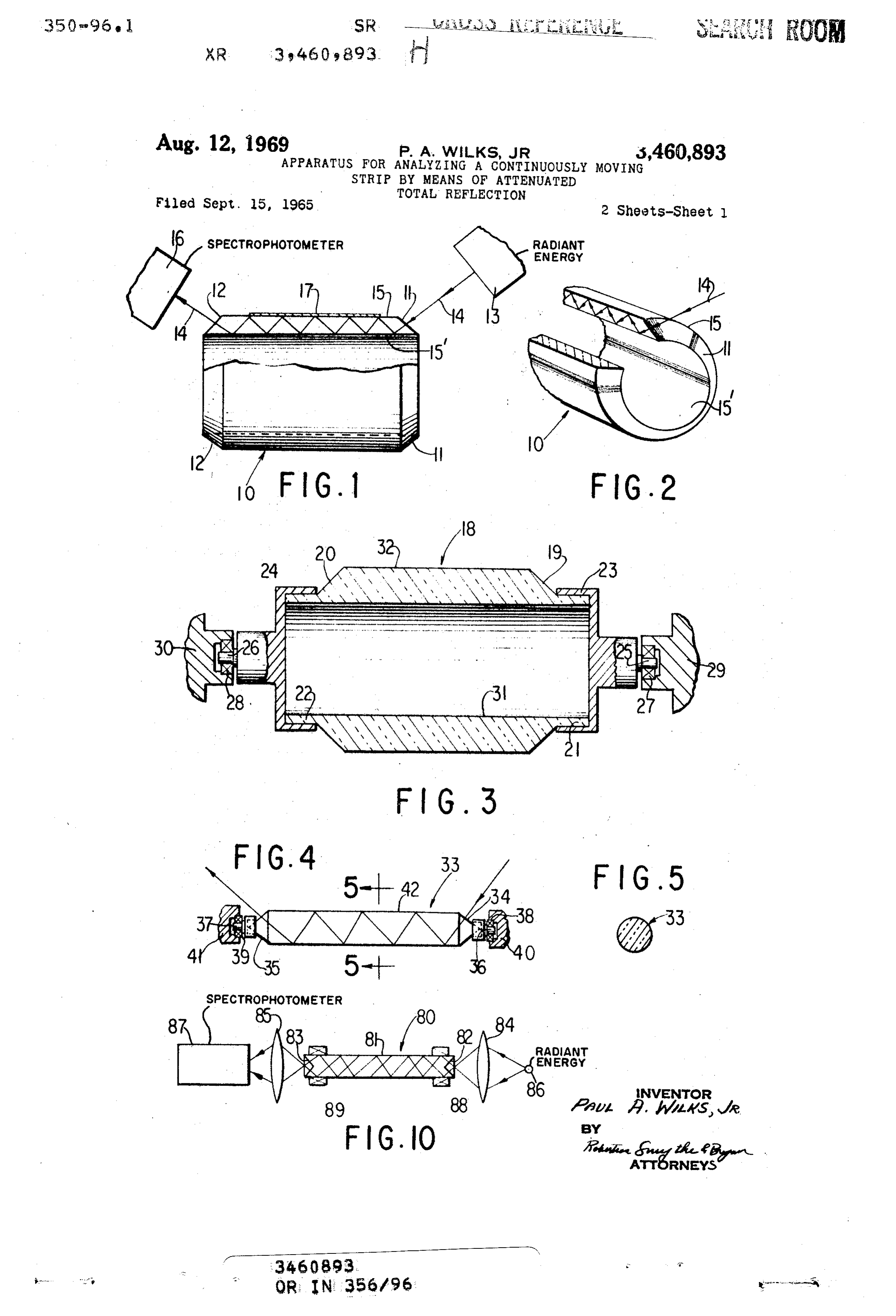
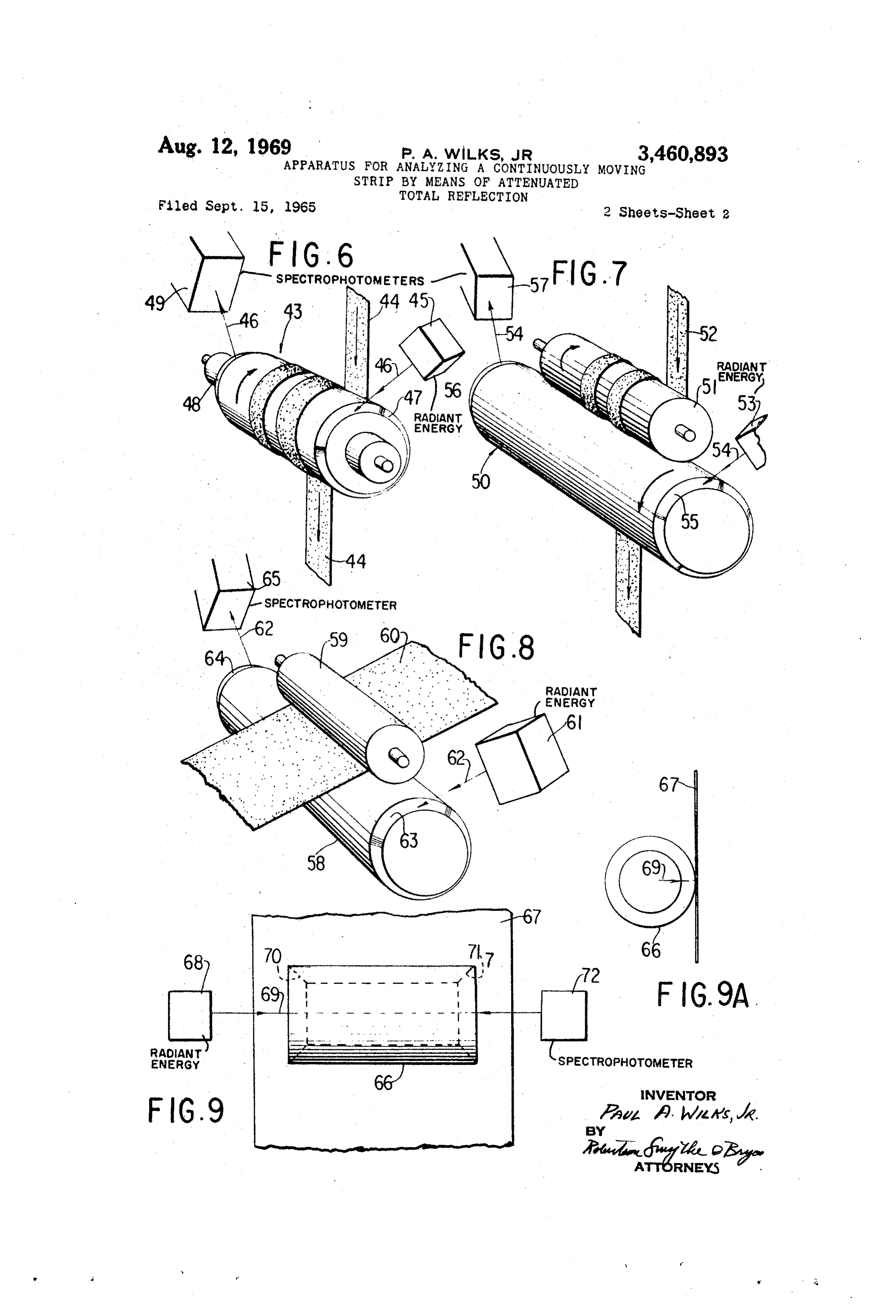
fashion that they do with respect to the hollow, cylin The crystal 18 includes internal cylindrical surface 31 drical crystal. and exterior cylindrical surface 32. The rays of radiant In a still further arrangement, the cylinder may have energy are adapted to be directed onto the beveled sur hollow conical end shapes. face 19 at an angle greater than the critical angle so The above, other objects and novel features of the 5 that the energy passes into the crystal 18, totally reflect invention will become apparent from the following speci ing from surface 31 to surface 32 and back again to sur fication and accompanying drawings which are merely face 31, and so on until it exits from the beveled surface exemplary. 20 in the same manner that the radiant energy beam 14 In the drawings: passes through the crystal 10 of FIG. 1. FIG. 1 is a hollow, cylindrical internal reflection cell () Referring to FIGS. 4 and 5, the principles of the in to which the principles of the present invention have vention are shown as applied to a solid, cylindrical crystal been applied; 33 having conical ends 34 and 35 that are rigidly fixed FIG. 2 is a perspective view of the crystal shown in to trunnions 36 and 37 journaled in antifriction bearings FIG. 1; 38, 39 mounted in rigid supports 40, 41. In the embodi FIG. 3 is a sectional elevational view of the hollow, ment shown in FIG. 4, the ray of radiant energy enters cylindrical crystal to which the principles of the inven the crystal through the conical end surface 34 at an angle tion have been applied, and in which the crystal is mount greater than the critical angle so that it passes into the ed for rotation in a journal bearing; solid, cylindrical crystal 33 and reflects back and forth FIG. 4 is a modified form of the crystal, showing it as between the cylindrical surface 42 of the member 33 a solid, cylindrical member journaled in bearings; within a plane including the ray of radiant energy enter FIG. 5 is a sectional view taken substantially along ing the conical end surface 34. As the radiant energy line 5-5 of FIG. 4; passes through the solid, cylindrical crystal 33, it exits FIG. 6 is a perspective view of a crystal embodying from the conical surface 35 still in the same plane of the the principles of the invention, and in which a web, film entering radiant energy beam, and passes into a spec or ribbon is shown spirally wound about it; 25 trophotometer such as 16 shown in FIG. 1. FIG. 7 is another manner of using the cell with the Referring to FIG. 6, a crystal 43 is shown mounted for ribbon, web or film spirally wound about an idler roll rotation about a horizontal axis. A web, film or ribbon that is maintained in axial contact with a cylindrical 44 is shown spirally wound about the crystal 43, and a crystal; light source 45 directs a beam of radiant energy 46 onto FIG. 8 is another manner of using the crystal in which 30 a beveled surface 47 of the crystal 43. The radiant energy the continuously moving ribbon, web or film is held in beam 46 totally internally reflects back and forth be tangential contact with the cell by an idler roller; tween the two cylindrical surfaces of the cell 43 and exits FIGS. 9 and 9A are views of another use to which the from a beveled surface 48, passing into spectrophotometer crystal of the present invention may be put; and 49. As the web 44 continuously moves, it rotates cell 43 FIG. 10 is another modified form of the invention. 35 while the radiant beam 46 remains in the same radial Referring to the drawings, and particularly to FIGS. plane. Thus, there is a continuous absorption within the 1 to 3, the principles of the invention are shown as ap wave length that the web 44 absorbs and produces a spec plied to a hollow, cylindrical crystal 10 having beveled trum within the spectrophotometer 49 which can be com edges 11 and 12. The crystal 10 may be made of a ma terial which has the capability of total internal reflection. 40 pared the web with known curves to determine the condition of or ribbon 44 as it passes around the cell 43.
A source of radiant energy 13 may be arranged so that The spectrophotometer may be any well known type such a ray 14 therefrom strikes the beveled edge 11 at an as the Model 21 made by Perkin-Elmer Corporation. angle greater than the critical angle so that the ray passes Referring to FIG. 7, a cell 50 similar to cell 43 has into the annulus of the crystal 10, striking the internal mounted above it an idler roller 51 about which roller surface 15 thereof at an angle less than the critical angle 51 a ribbon 52 is spiralled and which continuously moves. and hence being totally reflected to the outer surface 15 The friction between the ribbon 52 and the cell 50 causes of the crystal 10, from which it is totally reflected back the latter to rotate, thereby to eliminate any friction be to the surface 15, and so on until it emerges from the tween the cell 50 and the continuously moving ribbon 52. beveled edge 12 and is directed into a spectrophotometer A Source of radiant energy 53 directs a radiant beam 54 16 where a spectrum is produced which is affected by the onto a beveled edge 55 of the cell 50 within a plane that absorption of a material 17 to be analyzed that lies in contact tangentially with the crystal 10. The radiant includes the axis of the idler roller 51 and the cell 50. energy may, for example, be infrared. The radiant beam 54, of course, reflects back and forth As the ray 14 passes through the crystal 10, the beam throughout the cell 50 and exits from a beveled surface will penetrate a small amount (in the order of the wave 56 of cell 50 and is received by a spectrophotometer 57. length of the radiation) into the sample 17 with each re Referring to FIG. 8, a cylindrical cell 58 is mounted flection. The radiation will be absorbed at those wave for free rotation, and an idler roll 59 is mounted so that lengths where the sample absorbs. Since the penetration it rests in axial contact with the periphery of cell 58. A into the sample is very slight, the amount of absorption sheet, Web or film 60 is adapted to be drawn between is small but is multiplied by the number of reflections of idler roll 59 and the cell 58, while a source of radiant the beam. 60 energy 61 directs a ray of radiant energy 62 onto a The result of the radiant beam passing into the spectro beveled Surface 63 of the cell 58. As the radiant beam photometer 16 is to provide a well defined continuous 62 reflects back and forth within cell 58, it finally exits spectrum as the web, film or ribbon continuously passes from a beveled Surface 64 on cell 58 and is received the point on the crystal in the plane of the radiant energy by a spectrophotometer 65.
passing through the crystal. The continuous spectrum may 65 Referring to FIGS. 9 and 9A, a cell 66 is mounted for be compared with a conventional transmission curve in order to detect desirable or undesirable characteristics of rotation about a horizontal axis, and in this instance a the Web, film or ribbon as it continuously moves past the Web, film or ribbon 67 merely makes an area contact radiant energy beam. with the cell 66 which extends peripherally about the cell Referring to FIG. 3, a hollow, cylindrical crystal 18 70 for a slight distance just sufficient to effect the rotation includes opposed beveled surfaces 19 and 20 as well as of cell 66 by the movement of the web past it. A source cylindrical ends 21 and 22. Ends 21 and 22 are rigidly of radiant energy 68 directs a beam 69 onto a beveled Secured to cup-shaped elements 23 and 24 having trun. edge 70 of the cell 66, and it reflects back and forth nions 25, 26 that are journaled in antifriction bearings 27, through the cell, exiting from a beveled edge 71 and is 28 mounted in supporting means 29 and 30. 75 received by a spectrophotometer 72.
Page 5
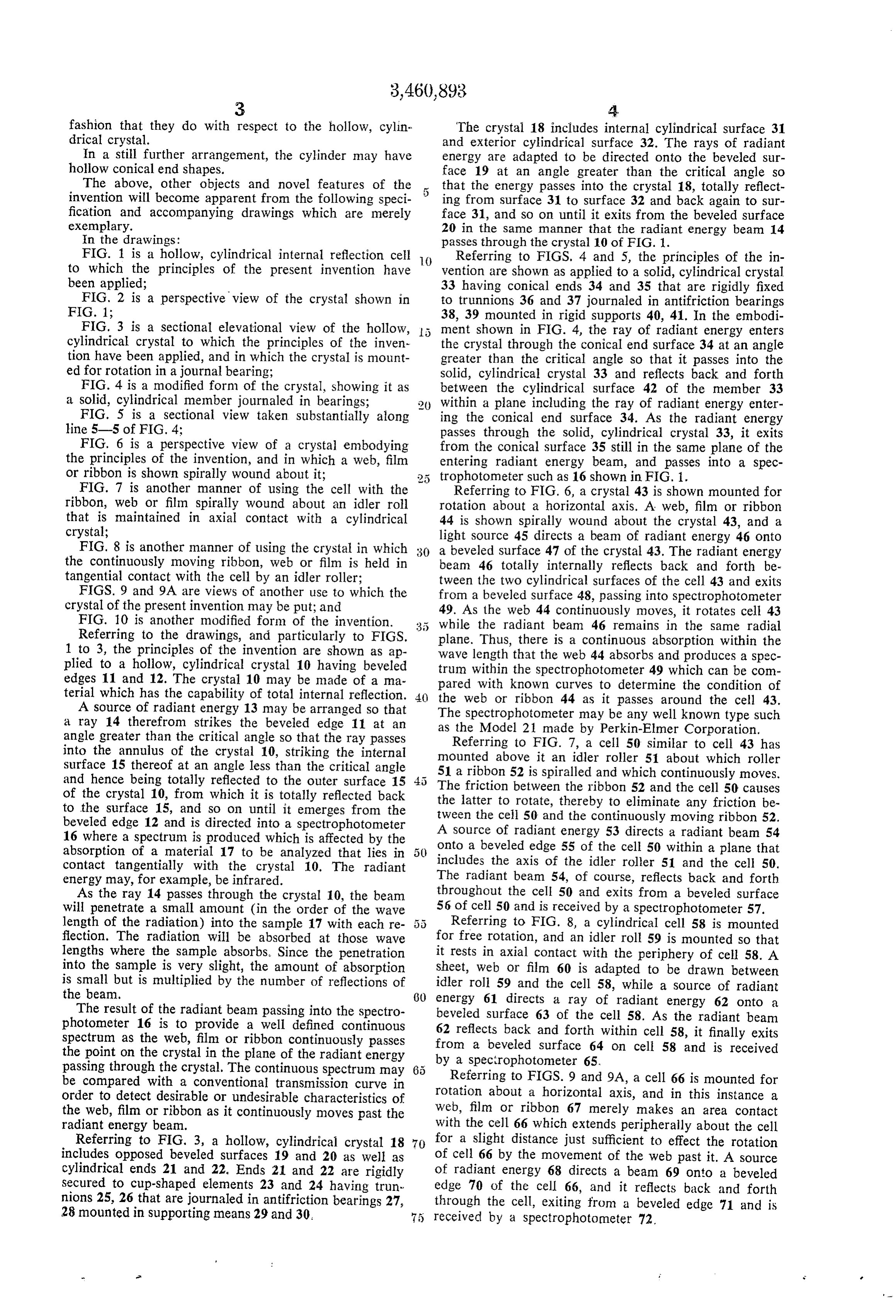
Referring to FIG. 10, the elements are similar to the from a material exhibiting total internal reflection, said previously described embodiment of FIG. 9 except that cylindrical element including opposed beveled ends; the end beveled surfaces 82, 83 are in a solid crystal as means for mounting said element for rotation; a source in FIG. 4. The arrangement is shown generally at 80 with of radiant energy arranged to direct radiant energy rays a solid rotatable cylindrical element 81 carried in journals 5 onto one of said beveled ends at an angle greater than 88, 89. Lens 84, 85 direct energy from 86 to the spec the critical angle of the material from which said element trophotometer 87. is made; a spectrophotometer arranged at the opposite What is claimed is: end of said element for receiving said rays of radiant en 1. Apparatus for producing a spectrum for the purpose ergy as they emerge from the beveled end of said element of analyzing a continuously moving strip of material, O opposite that to which the source rays are applied; and comprising in combination, a cylindrical element made a roller mounted for rotation about an axis parallel to from a material exhibiting total internal reflection, said that of said element, in contact therewith and said axes cylindrical element including opposed beveled ends; being in the same plane as the radiant energy rays, said means for mounting said element for rotation; a source roller pressing said strip against said cylindrical element of radiant energy arranged to direct radiant energy rays 5 as the strip is continuously moved. onto one of said beveled ends at an angle greater than 6. Apparatus for producing a spectrum for the purpose the critical angle of the material from which said element of analyzing a continuously moving strip of material, is made; means for continuously moving said strip in comprising in combination, a cylindrical element made contact with said cylindrical element as it rotates; and a from a material exhibiting total internal reflection, said spectrophotometer arranged at the opposite end of ele 20 cylindrical element including opposed beveled ends; means ment for receiving said rays of radiant energy as they for mounting said element for rotation; a source of radi element from the beveled end of said element opposite ant energy arranged to direct radiant energy rays onto that to which the source rays are applied. one of said beveled ends at an angle greater than the 2. Apparatus for producing a spectrum for the pur critical angle of the material from which said element is pose of analyzing a continuously moving strip of mate 25 made; a spectrophotometer arranged at the opposite end rial, comprising in combination, a hollow cylindrical ele of said element for receiving said rays of radiant energy ment made from a material exhibiting total internal re as they emerge from the beveled end of said element op flection, said cylindrical element including opposed bev posite that to which the source rays are applied; a roller eled ends; means for mounting said element for rotation; mounted for rotation about an axis parallel to that of a source of radiant energy arranged to direct radiant 30 said element, in contact therewith and said axes being in energy rays onto one of said beveled ends at an angle the same plane as the radiant energy rays; and a strip greater than the critical angle of the material from which spirally wound about said roller so that said strip may said element is made; means for continuously moving be continuously payed on and off said roller. said strip in contact with said cylindrical element as it 7. Apparatus for producing a spectrum for the purpose rotates; and a spectrophotometer arranged at the opposite 35 of analyzing a continuously moving strip of material, end of said element for receiving said rays of radiant comprising in combination, a cylindrical element made energy as they emerge from the beveled end of said ele from a mateiral exhibiting total internal reflection, said ment opposite that to which the source rays are applied. cylindrical element including opposed beveled ends; 3. Apparatus for producing a spectrum for the pur means for mounting said element for rotation; a source pose of analyzing a continuously moving strip of mate 40 of radiant energy arranged to direct radiant energy rays rial, comprising in combination, a solid cylindrical ele onto one of said beveled ends at an angle greater than the ment made from a material exhibiting total interal re critical angle of the material from which said element is flection, said cylindrical element including opposed bev made; a spectrophotometer arranged at the opposite end eled ends; means for mounting said element for rotation; of said element for receiving said rays of radiant energy a source of radiant energy arranged to direct radiant 45 as they emerge from the beveled end of said element energy rays onto one of said beveled ends at an angle opposite that to which the source rays are applied; a greater than the critical angle of the material from which roller mounted for rotation about an axis parallel to that said element is made; means for continuously moving said of said element, in contact therewith and said axes being strip in contact with said cylindrical element as it ro in the same plane as the radiant energy rays; and a strip tates; and a spectrophotometer arranged at the opposite 50 located between said element and roller so that said end of said element for receiving said rays of radiant strip may be continuously drawn past said point of con energy as they emerge from the beveled end of said tact between said roller and element. element opposite that to which the source rays are ap plied. References Cited 4. Apparatus for producing a spectrum for the pur 55 UNITED STATES PATENTS pose of analyzing a continuously moving strip of mate rial, comprising in combination, a cylindrical element 2,719,235 9/1955 Emerson --------- 88-14 X made from a material exhibiting total internal reflection, 2,947,212 8/1960 Woods.
said cylindrical element including opposed beveled ends; 3,222,615 12/1965 Holly ------------ 350-96 X means for mounting said element for rotation; a source 60 3,308,709 3/1967 Harrick ------ 350-96 X of radiant energy arranged to direct radiant energy rays 3,321,714 5/1967 Tien -------------- 331-94.5 onto one of said beveled ends at an angle greater than 3,363,107 1/1968 Martin, the critical angle of the material from which said element OTHER REFERENCES is made; a spectrophotometer arranged at the opposite end of said element for receiving said rays of radiant en 65 Harrick: "Multiple Reflection Cells for Internal Re ergy as they emerge from the beveled end of said element flection Spectrometry,” Analytical Chemistry, vol. 36, opposite that to which the source rays are applied; and No. 1, January 1964, pp. 188-191, strip means spirally wound about said element so that said strip may be continuously payed on and off said RONALD L, WIBERT, Primary Examiner element. 70 F. L. EVANS, Assistant Examiner 5. Apparatus for producing a spectrum for the purpose of analyzing a continuously moving strip of material, U.S. C. X.R. comprising in combination, a cylindrical element made 250-83: 350-96: 356-199
Provenance
- Collection
- Cited prior art
- Original PDF
- patentimages.storage.googleapis.com →
- Filed
- 1965-09-15
- Pages
- 5
- Method
- pdftotext (the PDF's own text layer) + pdftoppm 300dpi page scans
- Source
- Google Patents bibliographic record
- Granted
- 1969-08-12
- Inventors
- Paul A Wilks Jr; Wilks Scientific Corp
- Transcribed from
- patentimages.storage.googleapis.com →