patent · US3458412
Electrolytic process of preparing pure hydrogen
29 July 1969
Page 1
July 29, 1969 Mutsuaki SHINAGAWA ET AL 3,458,412
ELECTROLYTIC PROCESS OF PREPAPING PURE HYDROGEN
Filed March 5, 1967 3 Sheets-Sheet l
&era. O /WaOH. agua Son b: WHCA aqua Soln 3OOO C Wa/WOs agua sor d: P2SO4 aqua Soln
Concenfraffon (w?/O )
fCO
Page 2
July 29, 1969 MUTsUAki SHINAGAwa ET AL 3,458,412
ELECTROLYTIC PROCESS OF PREPARING PURE HYDROGEN
Filed March 15, 1967 3. Sheets-Sheet 2
a: (MWHC0+ Bales
E (V vs SCE)
AIG 4 a 40% WHAQst Bales
E (VMs SCA)
Page 3
July 29, 1969 MUTSUAKI SHINAGAWA ET All- 3,458,412
ELECTROLYTIC PROCESS OF PREPARING PURE HYDROGEN
Filed March 15, 1967 3 Sheets-Sheet 3. AIG 5
a: WaOH aqua son (2OC) b; WaOH aquo son (6OC)
C: WHa/WO3 aqua son (/OC) d: WHa/WO3 agua son (4OC)
Page 4
United States Patent Office 3,458,412 Patented July 29, 1969
solutions. Thus the sodium hydroxide solution has more 3,458,412 room for improvement.
ELECTROLYTIC PROCESS OF PREPARING It is an object of this invention to provide an improved PURE HYDROGEN electrolytic preparation of pure hydrogen.
Mutsuaki Shiraagawa, Amagasaki-shi, and Hiroyuki Nezu, It is another object of the present invention to provide Hirakata-shi, Japan, assignors to Matsushita Electric a simplified and practical process for the same. Industrial Co., Ltd., Kadoma-shi, Osaka, Japan, a cor A further object of this invention is to provide a process poration of Japan
Filed Mar. 15, 1967, Ser. No. 623,426 for producing pure hydrogen in commercial and economi Claims priority, application Japan, Mar. 30, 1966, cal manner.
41/20,482 O According to the present invention, mercury is employed int, C, CC1b. 13/04 as the cathode and an aqueous solution of ammonium U.S. C. 204-129 7 Claims salts as the electrolyte. A small amount of powdered semiconductor materials is further suspended in the
AESTRACT OF THE DISCLOSURE aqueous solution.
5 The preferred ammonium salts are ammonium chloride
Preparation of pure hydrogen by electrolyzing water and ammonium nitrate. Semiconductor material should in a cell having mercury cathode, the water being an have a forbidden band spacing of less than 0.5 ev. and aqueous solution of ammonium salts such as NH4C1 or containing chemical elements of groups V and VI of the NH4NO3 where a powdered semiconductor material Periodic Table. Examples are bismuth telluride, indium having forbidden band spacing less than 0.5 ev. is sus 20 arsenide, cadmium antimonide and tellurium as a pended. The material is BiTe Te, InAs, CdSb, Ge, catalyser.
Si, CdTe or ZnS, Generally speaking, the present invention provides a fundamentally improved combination of the electrode and
This invention is concerned with a process of preparing electrolyte in the electrolytic system. The inventors have carried out various studies of the current-electric potential pure hydrogen by electrolysis of water. More particularly, the present invention relates to a process for preparing curve upon suspending semiconductor material into the pure hydrogen by electrolyzing an aqueous solution of electrolytic system under constant-potential of constant ammonium salts with a mercury cathode, a powdered proposed voltage. From the result of the above studies it has been semiconductor material being suspended therein. to determine the range of the hydrogen over In the conventional electrolysis of water for produc 30 voltage which is effected by the forbidden band spacing in the semiconductor material to be used.
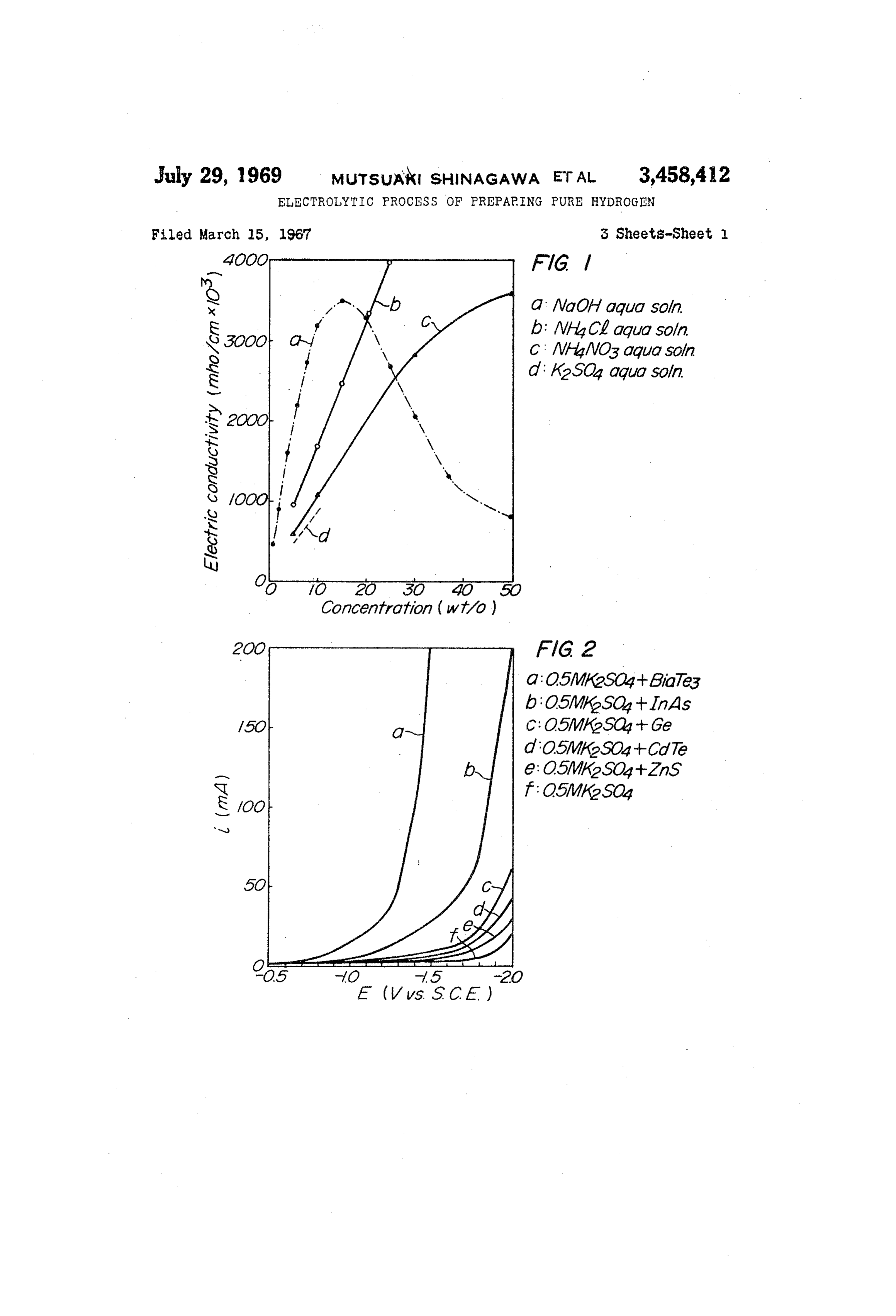
tion of hydrogen, caustic alkali is added to improve the In the accompanying drawings, FIG. 1 is a diagram electric conductivity of water, iron or nickel which has matic view of relations between the concentration and been properly treated is used as an electrode to prevent electrolytic conductivity in an aqueous solution of elec over-voltage and corrosion. The conventional method 35 is not satisfactory. Current efficiency is theoretically trolyte such as sodium hydroxide, ammonium chloride, speaking, 100 percent, because side-reaction does not ammonium FIG. 2 is nitrate and potassium sulfate, respectively.
a diagram of current-electric potential in an take place except the generation of hydrogen and oxygen.
In practice, the current efficiency was nearly 100 percent electrolytic system of mercury cathode (electrode Sur in the single electrode-type electrolytic cell and 90-95% 40 face: 10 cm.2), carbon anode (diameter: 1 cm.) and elec trolyte (60 ml.) of an aqueous solution of potassium in the double electrode-type electrolytic cell. However, sulfate (0.5 M), suspending 500 mg. of various kinds of the power consumption depends almost on the cell voltage semiconductor materials (particle size of 50-100p) under (actual decomposition voltage), because the current effi constant potential.
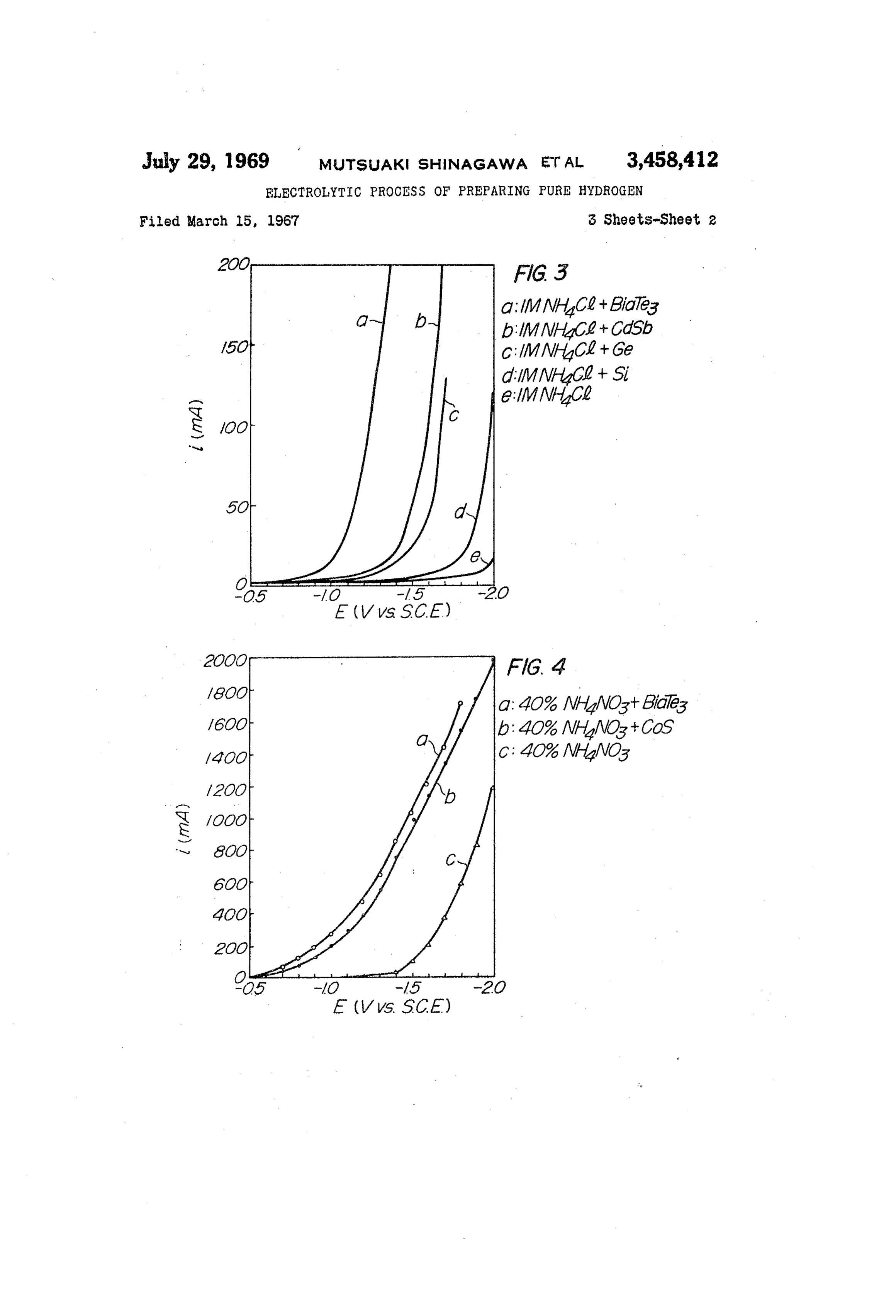
ciency is nearly 100%. The cell voltage is higher than FIG. 3 is a diagram of current-electric potential in an theoretical decomposition voltage by such a value that corresponds to the voltage due to over-voltage and con 45 electrolytic system of mercury cathode, carbon anode and an aqueous ammonium chloride solution (1 M), centration polarization as well as the voltage drop due suspending to the internal resistances based on electrolyte, mem various kinds of semiconductor materials brane, and conductor. The cell voltage is practically within under constant potential.
FIG. 4 is a diagram of current-electric potential in an the range of 1.9 to 2.6 v. (theoretical voltage for de 50 electrolytic composition of water: 1.22 v., at 30° C.). system of mercury cathode, nickel anode and To generate 1 m.8 of pure hydrogen, 4.5-6.2 kwh. is a 40% solution of ammonium nitrate (5.9M), Suspending required. The power consumption will be reduced by bismuth telluride and cobalt sulfide under constant poten controlling the composition of the electrolyte and elect tial.
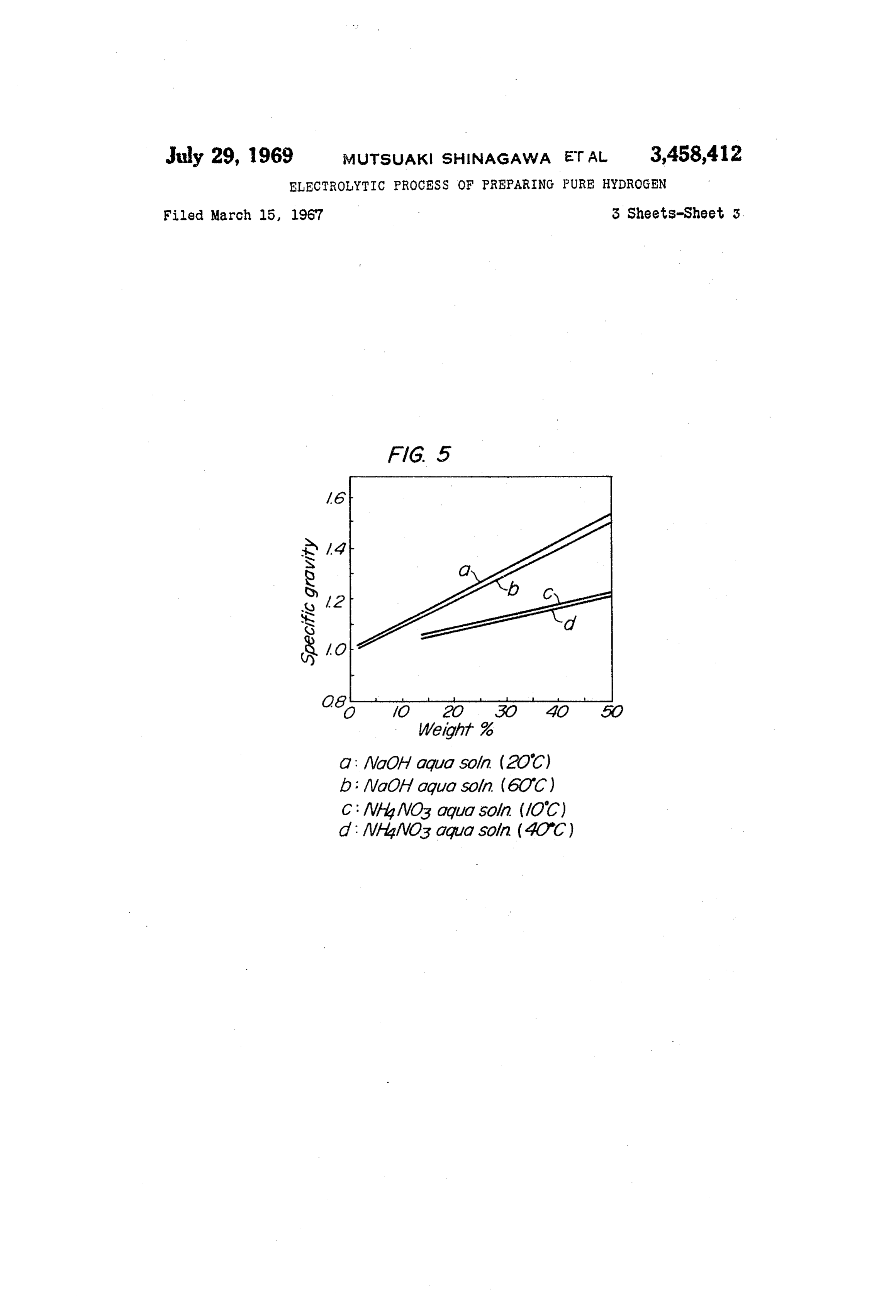
FIG. 5 is a diagram of the relation between con ing electrode materials. The relation between concentra 55 centration tion of sodium hydroxide solution used as an electrolyte tion of sodium (percent by weight) and density in the Solu and electric conductivity thereof shows that the electric hydroxide and ammonium nitrate. conductivity has a maximum point at 15%. The electric It is well known that in electrolysis, the current may conductivity of a sodium hydroxide solution is remark be regulated by the voltage applied, and the current will start to flow when the voltage reaches a certain level ably lowered, as carbon dioxide is absorbed. Carbonate 60 but formed by the absorption of carbon dioxide has a rela not at lower voltages. The voltage at this point is called the “voltage of decomposition.” FIG. 2 represents tively low solubility, so that the carbonate deposits in the cathode potentials in the various systems comprising the electrolytic cell, to increase internal resistance. Ac a saturated calomel electrode and the smaller the forbid cordingly, make-up water should be controlled to keep den the absorption of carbon dioxide gas at a minimum. On 65 lowerband spacing of the semiconductor material, the is the voltage of decomposition of water. In the the other hand, the size of bubble developed by the electrolysis depends upon the concentration and tempera electrolysis alysts such of pure water, employing electrochemical cat as semiconductor material may serve conspec ture of the solution. The ascending speed of the bubble uously to decrease the hydrogen over voltage on the depends on the viscosity and specific weight of the solu cathode and, consequently also decrease both the voltage tion. Consequently, the requirement for the sodium hy O and the consumption of power of the electrolytic cell. droxide solution as an electrolyte has not yet been FIG. 3 is the cathode potentials in the various system fully met, when it is compared with other electrolyte comprising 1 M-ammonium chloride solution as the elec
Page 5
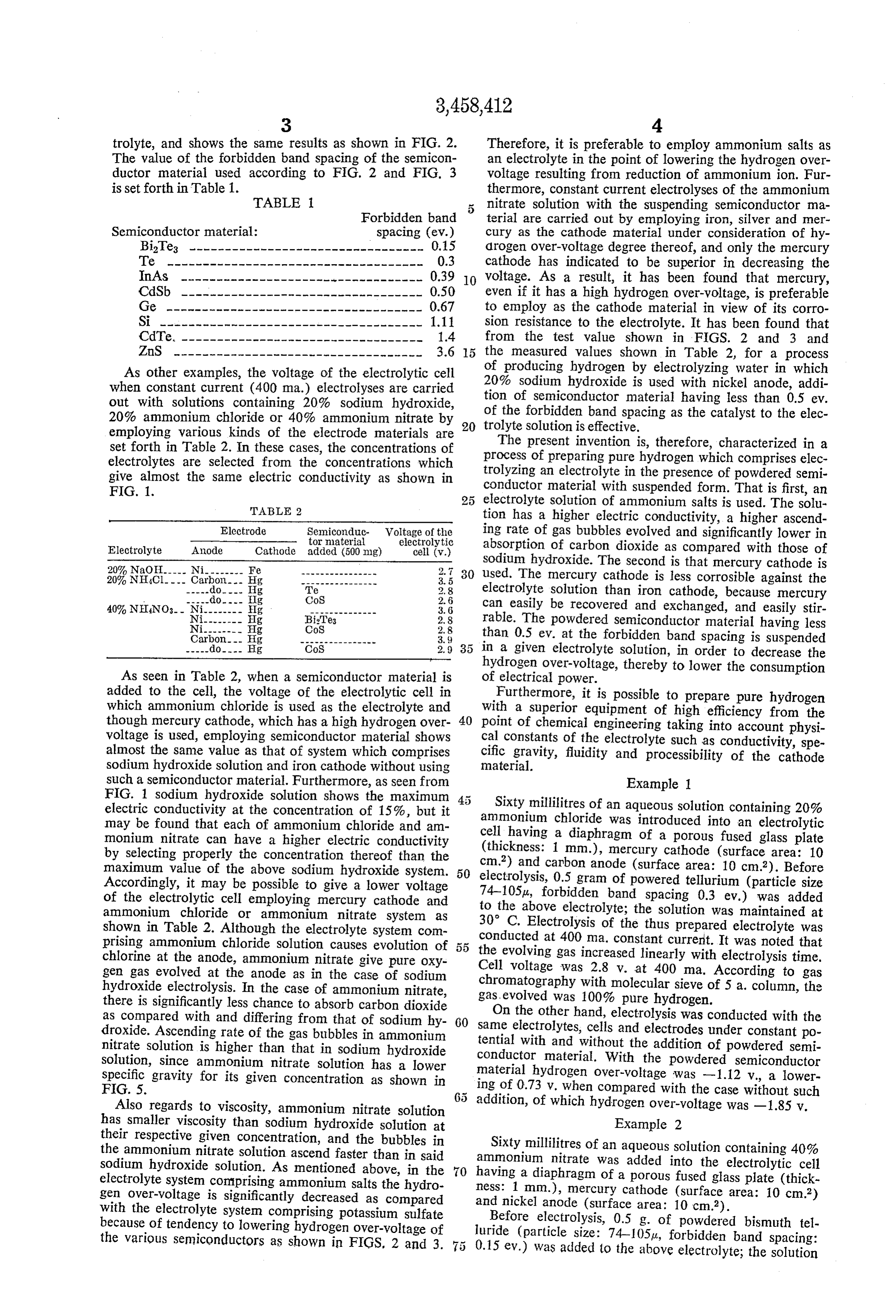
trolyte, and shows the same results as shown in FIG. 2. Therefore, it is preferable to employ ammonium salts as The value of the forbidden band spacing of the senico an electrolyte in the point of lowering the hydrogen over ductor material used according to FIG. 2 and FIG. 3 voltage resulting from reduction of ammonium ion. Fur is set forth in Table 1. thermore, constant current electrolyses of the ammonium TABLE 1. nitrate solution with the suspending Semiconductor ma"
Forbidden band terial are carried out by employing iron, silver and her
Semiconductor material: spacing (ev.) cury as the cathode material under consideration of hy BiTe --------------------------------- 0.15 drogen over-voltage degree thereof, and only the mercury Te ------------------------------- 0.3 cathode has indicated to be superior in decreasing the InAS --------------------- - - - - - r - - - - - - 0.39 10 voltage. As a result, it has been found that mercury, CdSb -------------------------------- 0.50 even if it has a high hydrogen over-voltage, is preferable Ge ------------------------------- 0.67 to employ as the cathode material in view of its corro Si ---------------------------------- 1.11 sion resistance to the electrolyte. It has been found that CdTe. -------------------------------- 1.4 from the test value shown in FIGS. 2 and 3 and ZnS ---------------------------------- 3.6 5 the measured values shown in Table 2, for a process
As other examples, the voltage of the electrolytic cell of producing hydrogen by electrolyzing water in which 20% sodium hydroxide is used with nickel anode, addi when constant current (400 ma.) electrolyses are carried tion out with solutions containing 20% sodium hydroxide, of theofforbidden semiconductor material having less than 0.5 eV. band spacing as the catalyst to the elec 20% ammonium chloride or 40% ammonium nitrate by employing various kinds of the electrode materials are 20 trolyte solution is effective. The present invention is, therefore, characterized in a set forth in Table 2. In these cases, the concentrations of process of preparing pure hydrogen which comprises elec electrolytes are selected from the concentrations which trolyzing give almost the same electric conductivity as shown in conductoranmaterial electrolyte in the presence of powdered semi with suspended form. That is first, an
TABLE 2
electrolyte solution of ammonium salts is used. The Solu tion has a higher electric conductivity, a higher ascend
Electrode Semiconduc tornmaterial
Voltage of the electrolytic ing rate of gas bubbles evolved and significantly lower in
Electrolyte Anode Cathode added (500mg) cell (v.) absorption of carbon dioxide as compared with those of 20% NaOH----- Ni-------- Fe ---------------- 2.
sodium hydroxide. The second is that mercury cathode is 55% NHC1---- Carbon--- Hg -------------- 3.5 30 used. The mercury cathode is less corrosible against the - - - - - do---- Hg Te 2.8 electrolyte solution than iron cathode, because mercury
CoS
can easily be recovered and exchanged, and easily stir
Ni-------- E. CoS 3. rable. The powdered semiconductor material having less Carbon--- Hig ---------------- than 0.5 ev. at the forbidden band spacing is suspended - - - - - do---- Hg CoS 2.9 35 in a given electrolyte solution, in order to decrease the ul-Haru- " hydrogen over-voltage, thereby to lower the consumption As seen in Table 2, when a semiconductor material is of electrical power.
added to the cell, the voltage of the electrolytic cell in Furthermore, it is possible to prepare pure hydrogen which ammonium chloride is used as the electrolyte and 40 with a superior equipment of high efficiency from the though mercury cathode, which has a high hydrogen over point of chemical engineering taking into account physi voltage is used, employing semiconductor material shows cal constants of the electrolyte such as conductivity, spe almost the same value as that of system which comprises cific gravity, fluidity and processibility of the cathode sodium hydroxide solution and iron cathode without using material.
such a semiconductor material. Furthermore, as Seen from Example 1
FIG. 1 sodium hydroxide solution shows the maximum Sixty millilitres of an aqueous solution containing 20% electric conductivity at the concentration of 15%, but it ammonium chloride was introduced into an electrolytic may be found that each of ammonium chloride and an monium nitrate can have a higher electric conductivity cell having a diaphragm of a porous fused glass plate (thickness: 1 mm.), mercury cathode (surface area: 10 by selecting properly the concentration thereof than the cm.) and carbon anode (surface area: 10 cm.). Before maximum value of the above sodium hydroxide System. 50 electrolysis, 0.5 gram of powered tellurium (particle size Accordingly, it may be possible to give a lower voltage 74-105u, forbidden of the electrolytic cell employing mercury cathode and to the above electrolyte; band spacing 0.3 ev.) was added ammonium chloride or ammonium nitrate System as the solution was maintained at shown in Table 2. Although the electrolyte system com 30° C. Electrolysis of the thus prepared electrolyte was prising ammonium chloride solution causes evolution of the evolvingat gas conducted 400 ma. constant current. It was noted that increased linearly with electrolysis time.
chlorine at the anode, ammonium nitrate give pure oxy gen gas evolved at the anode as in the case of Sodium Cell voltage was 2.8 v. at 400 ma. According to gas chromatography with molecular sieve of 5 a... column, the hydroxide electrolysis. In the case of ammonium nitrate, gas evolved was 100% pure hydrogen.
there is significantly less chance to absorb carbon dioxide On the other hand, electrolysis was conducted with the as compared with and differing from that of sodium hy 60 droxide. Ascending rate of the gas bubbles in ammonium same electrolytes, cells and electrodes under constant po tential with and without the addition of powdered semi nitrate solution is higher than that in sodium hydroxide conductor material. With the powdered semiconductor solution, since ammonium nitrate solution has a lower material specific gravity for its given concentration as shown in hydrogen over-voltage was -1.12 v., a lower FIG. 5. ing of 0.73 v. when compared with the case without such Also regards to viscosity, ammonium nitrate solution addition, of which hydrogen over-voltage was -1.85 v. has smaller viscosity than sodium hydroxide solution at Example 2 their respective given concentration, and the bubbles in Sixty millilitres of an aqueous solution containing 40% the ammonium nitrate solution ascend faster than in said ammonium nitrate was added into the electrolytic cell sodium hydroxide solution. As mentioned above, in the O having electrolyte system comprising ammonium salts the hydro a diaphragm of a porous fused glass plate (thick gen over-voltage is significantly decreased as compared ness: 1 mm.), mercury cathode (surface area: 10 cm.) with the electrolyte system comprising potassium sulfate andBeforenickel anode (surface area: 10 cm.). electrolysis, 0.5 g. of powdered bismuth tel because of tendency to lowering hydrogen over-voltage of the various semiconductors as shown in FIGS, 2 and 3. 75 luride (particle size: 74-105u, forbidden band spacing: 0.15 ev.) was added to the above electrolyte; the solution
Page 6
temperature was maintained at 30° C. Electrolysis of the The pure hydrogen produced according to the pres thus prepared electrolyte was conducted under constant ent invention can be used extensively, since pure hydro potential, which gave a hydrogen over-voltage of 0.8 v. gen is required not only for synthesis but in various fields This voltage was 0.60 v. lower than 1.4 v. given by elec of technology.
trolysis without the semiconductor material powder. We claim:
When electrolysis was conducted with the same elec 1. A process for preparing pure hydrogen which com trolyte, cell and electrodes under a constant current of prises electrolyzing water in a cell having a mercury 400 ma., the gas evolving from cathode increased as Cathode and an aqueous solution of inorganic ammo time elapses, and the graph relation of the amount of nium salts as an electrolyte, at least one powdered semi gas evolved to time was observed to be linear; the cell 10 conductor having a forbidden band spacing of 0.5 ev. or voltage was 2.8 v. at electrolysis current 400 ma. Accord less being suspended in the solution, said semiconductor ing to gas chromatograph with molecular sieve 5 a... col comprising elements of groups V and VI of the Periodic umn, gas thus evolved was 100% pure hydrogen. Table.
Example 3 2. A process according to claim 1, wherein the ammo Sixty millilitres of an aqueous solution containing ei 5 nium salt is ammonium chloride. ther 20% ammonium chloride or 40% ammonium ni 3. A process according to claim 1, wherein the ammo trate was introduced into an electrolytic cell having a nium salt is ammonium nitrate. diaphragm of a porous fused glass plate (thickness: 1 4. A process according to claim 1, wherein the pow mm.), mercury cathode (surface area: 10 cm.) and car dered semiconductor material is at least one selected bon anode (surface area: 10 cm.). Before electrolysis, 20 from the group consisting of BiTes, InAs, CdSb, Ge, Si, 0.5 gram of cobalt sulphate (particle size: 5-10u) was CdTe, and ZnS.
added to the electrolyte which was maintained at 30 C, 5. A process according to claim 2, wherein about 20% Electrolysis at 400 ma., constant current, caused gas to by weight of ammonium chloride is in an aqueous solu evolve from the cathode, of which amount increased lin tion.
early with time. In this electrolysis, with 20% ammo 25 6. A process according to claim 3, wherein about 40% nium chloride and 0.5 g. of cobalt sulphate suspended in by weight of ammonium nitrate is in an aqueous solu the electrolyte, cell voltage was 2.6 v. at electrolysis cur tion.
rent of 400 ma. With 40% ammonium nitrate and 0.5 g. 7. A process according to claim 1, wherein the pow of cobalt sulphate, the cell voltage was 2.9 v. Gas chro dered semiconductor is present in a catalytic amount. matography with molecular sieve 5 a. revealed that the 30 gas evolved was 100% pure hydrogen. References Cited
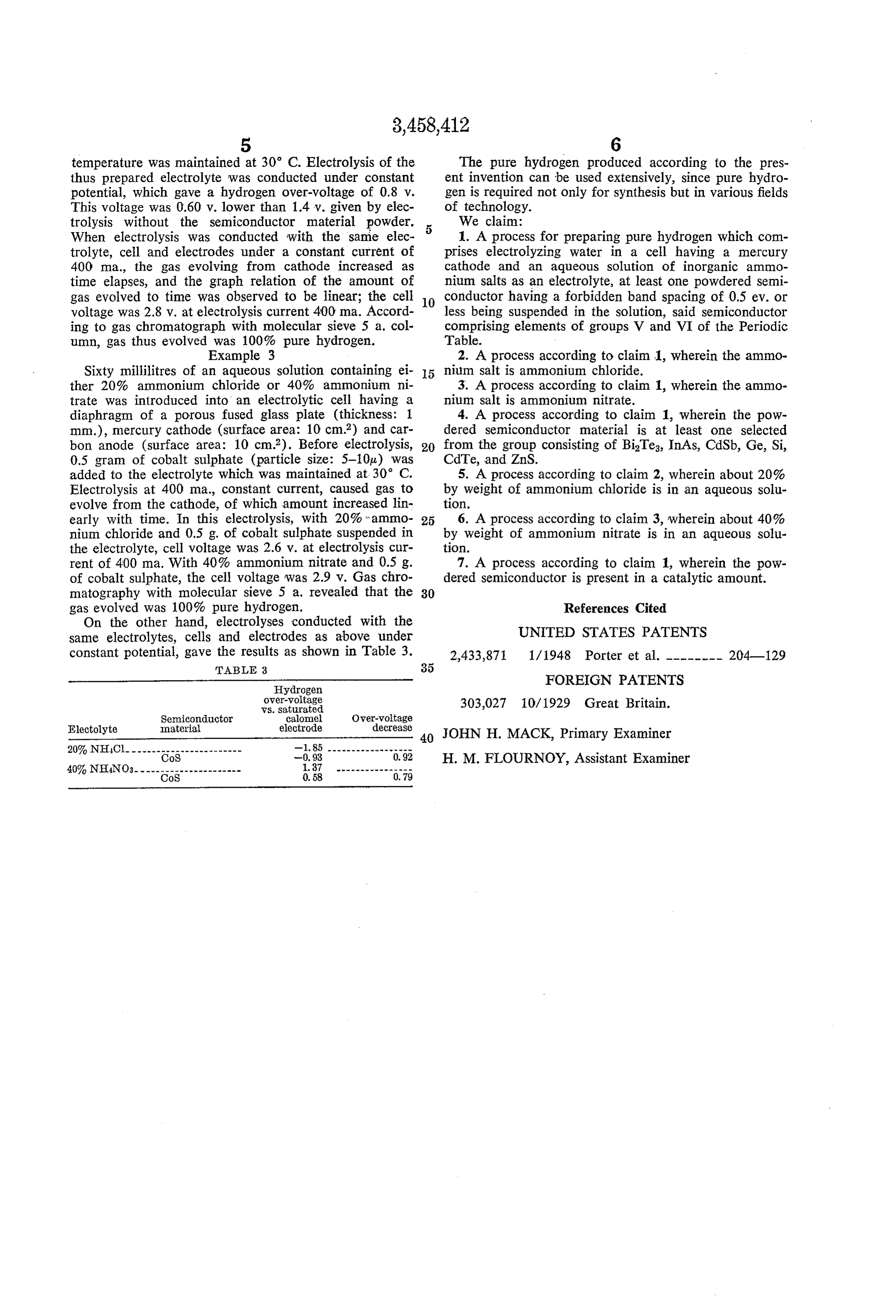
On the other hand, electrolyses conducted with the UNITED STATES PATENTS same electrolytes, cells and electrodes as above under constant potential, gave the results as shown in Table 3. 2,433,871 1/1948 Porter et al. -------- 204-129
Hydrogen
FOREIGN PATENTS
vs. saturated 303,027 10/1929 Great Britain.
Semiconductor calomel Over-voltage
Electolyte material electrode decrease 40 JOHN H. MACK, Primary Examiner 20% NH4Cl------------------------ l85 ------------------
CoS
H. M. FLOURNOY, Assistant Examiner
Provenance
- Collection
- Cited prior art
- Original PDF
- patentimages.storage.googleapis.com →
- Filed
- 1967-03-15
- Pages
- 6
- Method
- pdftotext (the PDF's own text layer) + pdftoppm 300dpi page scans
- Source
- Google Patents bibliographic record
- Granted
- 1969-07-29
- Inventors
- Mutsuaki Shinagawa; Hiroyuki Nezu; Matsushita Electric Industrial Co Ltd
- Transcribed from
- patentimages.storage.googleapis.com →