patent · US3356600
Means and method for producing a dry homogeneously mixed hydrogen and oxygen fuel gas for torches
5 December 1967
Page 1
Dec. 5, 1967 R. W. HENES 3,356,600
MEANS AND METHOD FOR PRODUCING A DRY HOMOGENEOUSLY MIXED
HYDROGEN AND OXYGEN FUEL GAS FOR TORCHES
NNNNNNNNNNNNNES
INVENTOR,
RICHARD W. HENES
Page 2
United States Patent Office Patented Dec. 5, 1967
duced since the rate of heat application is a function of
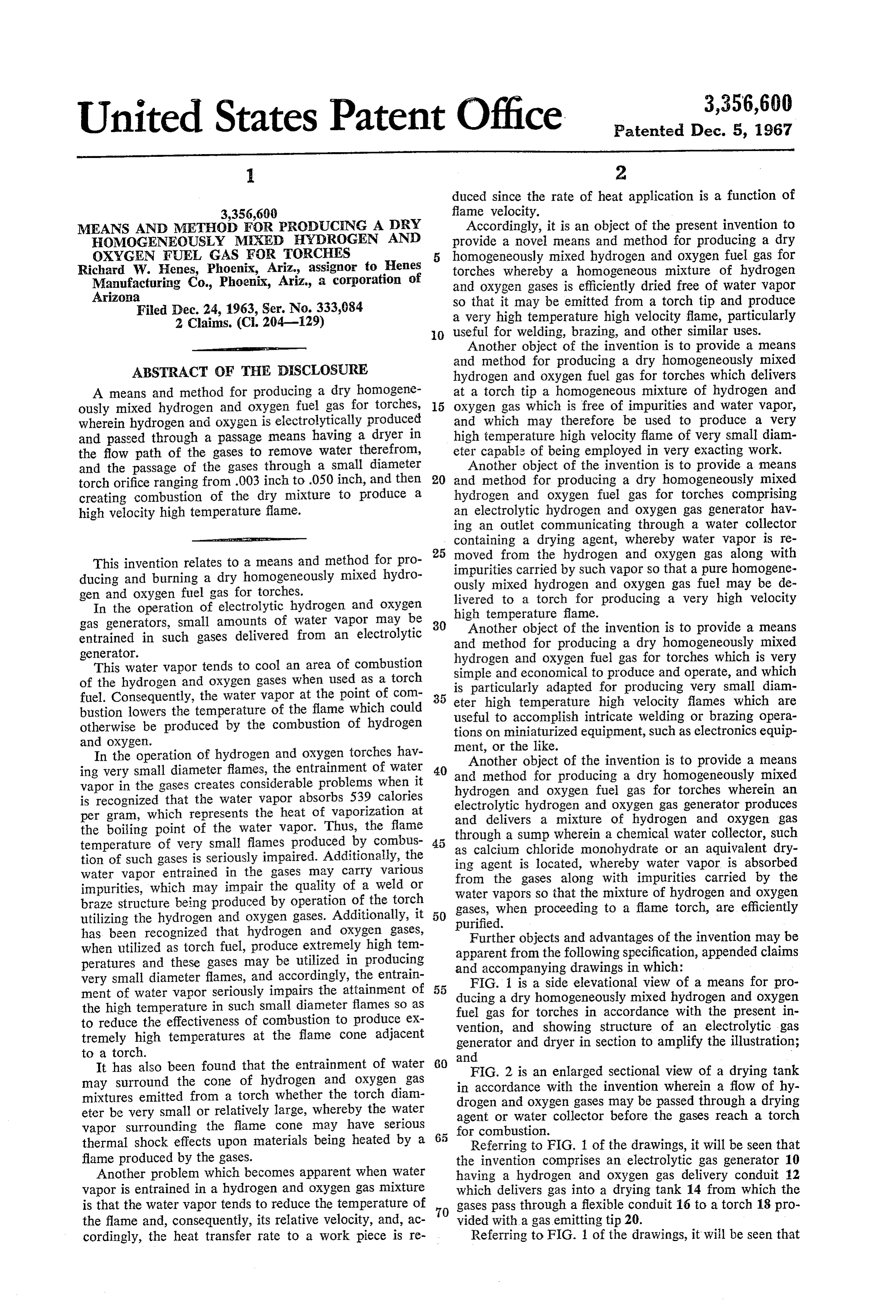
MEANS AND METHOD For PRODUCING A DRY Accordingly, it is an object of the present invention to HOMOGENEOUSLY MIXED HYDROGEN AND provide a novel means and method for producing a dry OXYGEN FUEL GAS FOR TORCHES homogeneously mixed hydrogen and oxygen fuel gas for Richard W. Henes, Phoenix, Ariz., assignor to Henes torches whereby a homogeneous mixture of hydrogen Manufacturing Co., Phoenix, Ariz, a corporation of and oxygen gases is efficiently dried free of water vapor Arizona So that it may be emitted from a torch tip and produce Filed Dec. 24, 1963, Ser. No. 333,084 a very high temperature high velocity flame, particularly
0 useful for welding, brazing, and other similar uses.
Another object of the invention is to provide a means and method for producing a dry homogeneously mixed
ABSTRACT OF THE DISCLOSURE hydrogen and oxygen fuel gas for torches which delivers A means and method for producing a dry homogene at a torch tip a homogeneous mixture of hydrogen and ously mixed hydrogen and oxygen fuel gas for torches, 5 oxygen gas which is free of impurities and water vapor, wherein hydrogen and oxygen is electrolytically produced and which may therefore be used to produce a very and passed through a passage means having a dryer in high temperature high velocity flame of very small diam the flow path of the gases to remove water therefrom, eter capable of being employed in very exacting work. and the passage of the gases through a small diameter Another object of the invention is to provide a means torch orifice ranging from .003 inch to .050 inch, and then 20 and method for producing a dry homogeneously mixed creating combustion of the dry mixture to produce a hydrogen and oxygen fuel gas for torches comprising high velocity high temperature flame. an electrolytic hydrogen and oxygen gas generator hav ing an outlet communicating through a water collector acroecease-r- containing a drying agent, whereby water vapor is re 25 moved from the hydrogen and oxygen gas along with
This invention relates to a means and method for pro ducing and burning a dry homogeneously mixed hydro impurities ously mixed carried by such vapor so that a pure homogene hydrogen and oxygen gas fuel may be de gen and oxygen fuel gas for torches. livered to a torch for producing a very high velocity In the operation of electrolytic hydrogen and oxygen high temperature flame.
gas generators, small amounts of water vapor may be 30 entrained in such gases delivered from an electrolytic andAnother object of the invention is to provide a means method for producing a dry homogeneously mixed generator. hydrogen and oxygen fuel gas for torches which is very This water vapor tends to cool an area of combustion of the hydrogen and oxygen gases when used as a torch issimple and economical to produce and operate, and which fuel. Consequently, the water vapor at the point of com eterparticularly high adapted for producing very small diam temperature high velocity flames which are bustion lowers the temperature of the flame which could useful to accomplish intricate otherwise be produced by the combustion of hydrogen tions on miniaturized equipment,welding such as or brazing opera electronics equip and oxygen. ment, or the like.
In the operation of hydrogen and oxygen torches hav ing very small diameter flames, the entrainment of Water 40 andAnother object of the invention is to provide a means method for producing a dry homogeneously mixed vapor in the gases creates considerable problems when it hydrogen is recognized that the water vapor absorbs 539 calories electrolyticand oxygen fuel gas for torches wherein an hydrogen and oxygen gas generator produces per gram, which represents the heat of vaporization at and delivers a mixture of hydrogen and oxygen gas the boiling point of the water vapor. Thus, the flame through a sump wherein a chemical water collector, such temperature of very small flames produced by combus as calcium tion of such gases is seriously impaired. Additionally, the ing agent ischloride monohydrate or an aquivalent dry water vapor entrained in the gases may carry various from the gases alongwhereby located, water vapor is absorbed with impurities carried by the impurities, which may impair the quality of a weld or water raze structure being produced by operation of the torch gases, vapors when so that the mixture of hydrogen and oxygen proceeding to a flame torch, are efficiently utilizing the hydrogen and oxygen gases. Additionally, it 50 purified.
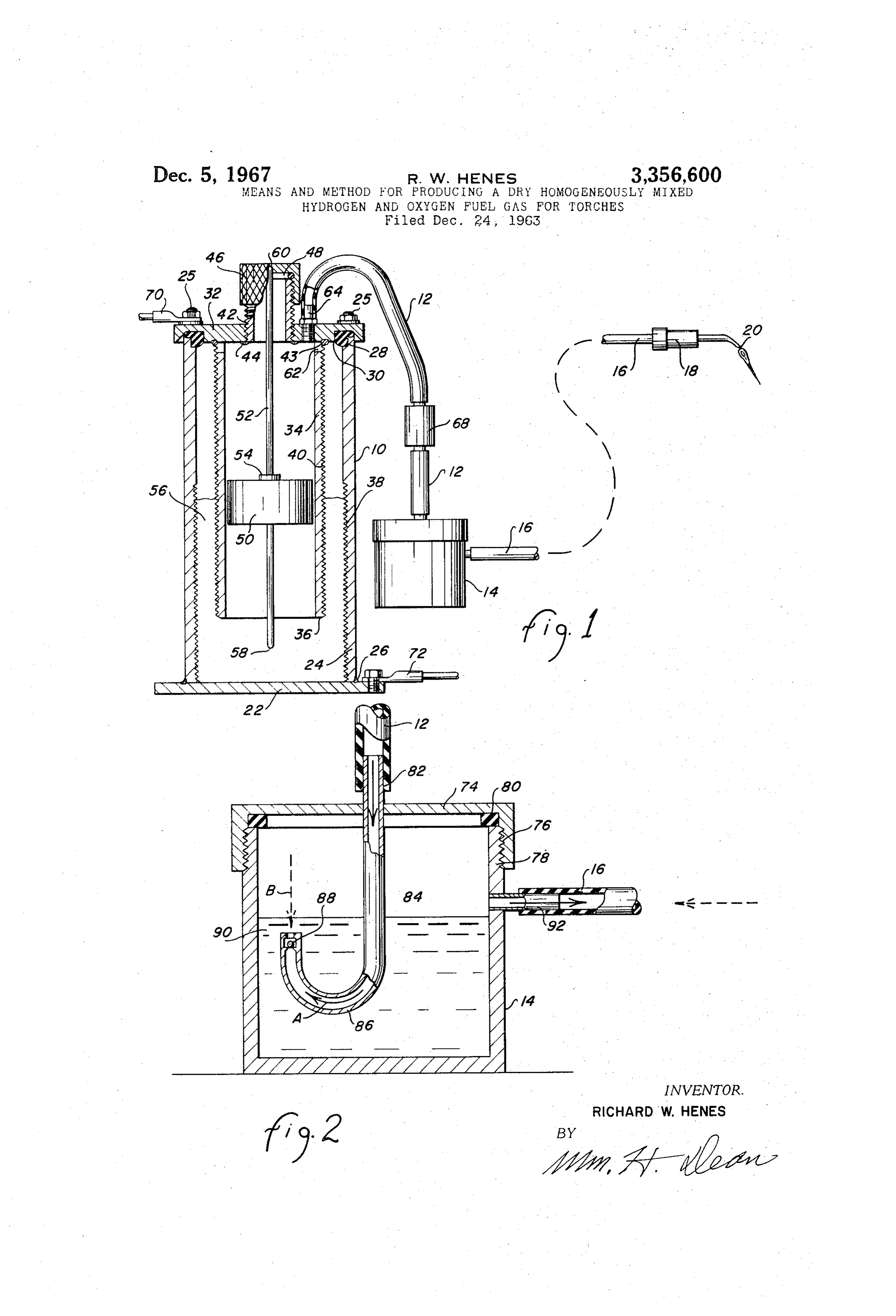
has been recognized that hydrogen and oxygen gases, Further objects and advantages of the invention may be when utilized as torch fuel, produce extremely high tem apparent from the following specification, appended claims peratures and these gases may be utilized in producing and accompanying very small diameter flames, and accordingly, the entrain 55 FIG. 1 is a side drawings in which: elevational view of a means for pro ment of water vapor seriously impairs the attainment of ducing a dry homogeneously mixed hydrogen and oxygen the high temperature in such small diameter flames So as fuel gas for torches in accordance with the present in to reduce the effectiveness of combustion to produce ex vention, and showing structure of an electrolytic gas tremely high temperatures at the flame cone adjacent generator and dryer in section to amplify the illustration; to a torch.
It has also been found that the entrainment of Water O andFIG. 2 is an enlarged sectional view of a drying tank may surround the cone of hydrogen and oxygen gas in accordance with the invention wherein a flow of hy mixtures emitted from a torch whether the torch diam drogen and oxygen gases may be passed through a drying eter be very small or relatively large, whereby the water agent or water collector before the gases reach a torch vapor surrounding the flame cone may have serious 65 for combustion.
thermal shock effects upon materials being heated by a Referring to FIG. 1 of the drawings, it will be seen that flame produced by the gases. the invention comprises an electrolytic gas generator 10 Another problem which becomes apparent when water having a hydrogen and oxygen gas delivery conduit 12 vapor is entrained in a hydrogen and oxygen gas mixture which delivers gas into a drying tank 14 from which the is that the water vapor tends to reduce the temperature of gases pass through a flexible conduit 16 to a torch 18 pro the flame and, consequently, its relative velocity, and, ac vided with a gas emitting tip 20. cordingly, the heat transfer rate to a work piece is re Referring to FIG. 1 of the drawings, it will be seen that
Page 3
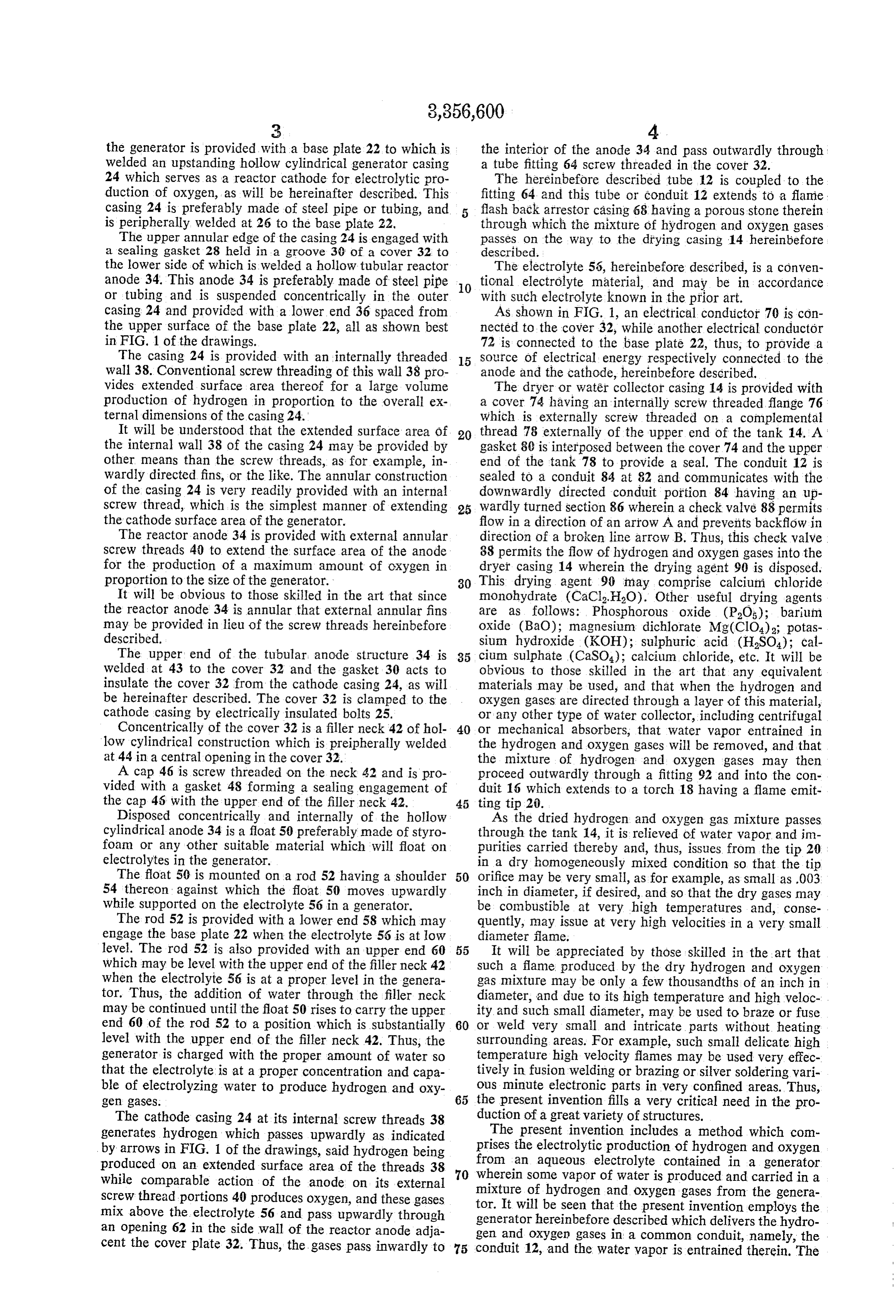
the generator is provided with a base plate 22 to which is the interior of the anode 34 and pass outwardly through welded an upstanding hollow cylindrical generator casing a tube fitting 64 screw threaded in the cover 32. 24 which serves as a reactor cathode for electrolytic pro The hereinbefore described tube 12 is coupled to the duction of oxygen, as will be hereinafter described. This fitting 64 and this tube or conduit 12 extends to a flame casing 24 is preferably made of steel pipe or tubing, and flash back arrestor casing 68 having a porous stone therein is peripherally welded at 26 to the base plate 22, through which the mixture of hydrogen and oxygen gases The upper annular edge of the casing 24 is engaged with passes on the way to the drying casing 14 hereinbefore a sealing gasket 28 held in a groove 30 of a cover 32 to described.
the lower side of which is welded a hollow tubular reactor The electrolyte 56, hereinbefore described, is a conven anode 34. This anode 34 is preferably made of steel pipe O tional electrolyte material, and may be in accordance or tubing and is suspended concentrically in the outer with such electrolyte known in the prior art. casing 24 and provided with a lower end 36 spaced from As shown in FIG. 1, an electrical conductor 70 is con the upper surface of the base plate 22, all as shown best nected to the cover 32, while another electrical conductor in FIG. 1 of the drawings. 72 is connected to the base plate 22, thus, to provide a The casing 24 is provided with an internally threaded 5 source of electrical energy respectively connected to the wall 38. Conventional screw threading of this wall 38 pro anode and the cathode, hereinbefore described. vides extended surface area thereof for a large volume production of hydrogen in proportion to the overall ex
The dryer or water collector casing 14 is provided with a cover 74 having an internally screw threaded flange 76 ternal dimensions of the casing 24. which is externally screw threaded on a complemental It will be understood that the extended surface area of 20 thread 78 externally of the upper end of the tank 14. A the internal wall 38 of the casing 24 may be provided by gasket 80 is interposed between the cover 74 and the upper other means than the screw threads, as for example, in end of the tank 78 to provide a seal. The conduit 12 is wardly directed fins, or the like. The annular construction sealed to a conduit 84 at 82 and communicates with the of the casing 24 is very readily provided with an internal downwardly directed conduit portion 84 having an up screw thread, which is the simplest manner of extending 25 wardly turned section 86 wherein a check valve 88 permits the cathode surface area of the generator. flow in a direction of an arrow A and prevents backflow in The reactor anode 34 is provided with external annular direction of a broken line arrow B. Thus, this check valve screw threads 40 to extend the surface area of the anode 38 permits the flow of hydrogen and oxygen gases into the for the production of a maximum amount of oxygen in dryer casing 14 wherein the drying agent 90 is disposed. proportion to the size of the generator. 30 This drying agent 90 may comprise calcium chloride It will be obvious to those skilled in the art that since monohydrate (CaCl2.H2O). Other useful drying agents the reactor anode 34 is annular that external annular fins are as follows: Phosphorous oxide (POs); barium may be provided in lieu of the screw threads hereinbefore oxide (BaO); magnesium dichlorate Mg(ClO4); potas described. sium hydroxide (KOH); sulphuric acid (H2SO4); cal The upper end of the tubular, anode structure 34 is 35 cium Sulphate (CaSO4); calcium chloride, etc. It will be welded at 43 to the cover 32 and the gasket 30 acts to obvious to those skilled in the art that any equivalent insulate the cover 32 from the cathode casing 24, as will materials may be used, and that when the hydrogen and be hereinafter described. The cover 32 is clamped to the oxygen gases are directed through a layer of this material, cathode casing by electrically insulated bolts 25. or any other type of water collector, including centrifugal Concentrically of the cover 32 is a filler neck 42 of hol 40 or mechanical absorbers, that water vapor entrained in low cylindrical construction which is preipherally welded the hydrogen and oxygen gases will be removed, and that at 44 in a central opening in the cover 32. the mixture of hydrogen and oxygen gases may then A cap 46 is screw threaded on the neck 42 and is pro proceed outwardly through a fitting 92 and into the con vided with a gasket 48 forming a sealing engagement of duit 16 which extends to a torch 18 having a flame emit the cap 45 with the upper end of the filler neck 42. 45 ting tip 20.
Disposed concentrically and internally of the hollow As the dried hydrogen and oxygen gas mixture passes cylindrical anode 34 is a float 50 preferably made of styro through the tank 14, it is relieved of water vapor and im foam or any other suitable material which will float on purities carried thereby and, thus, issues from the tip 20 electrolytes in the generator. in a dry homogeneously mixed condition so that the tip The float 50 is mounted on a rod 52 having a shoulder 50 orifice may be very small, as for example, as small as .003 54 thereon against which the float. 50 moves upwardly inch in diameter, if desired, and so that the dry gases may while supported on the electrolyte 56 in a generator. be combustible at very high temperatures and, conse-- The rod 52 is provided with a lower end 58 which may quently, may issue at very high velocities in a very small engage the base plate 22 when the electrolyte 56 is at low diameter flame.
level. The rod 52 is also provided with an upper end 60 55 It will be appreciated by those skilled in the art that which may be level with the upper end of the filler neck 42 Such a flame produced by the dry hydrogen and oxygen when the electrolyte 56 is at a proper level in the genera gas mixture may be only a few thousandths of an inch in tor. Thus, the addition of water through the filler neck diameter, and due to its high temperature and high veloc may be continued until the float 50 rises to carry the upper ity and such small diameter, may be used to braze or fuse end 60 of the rod 52 to a position which is substantially 60 or weld very small and intricate parts without heating level with the upper end of the filler neck 42. Thus, the surrounding areas. For example, such small delicate high generator is charged with the proper amount of water so temperature high velocity flames may be used very effec that the electrolyte is at a proper concentration and capa tively in fusion welding or brazing or silver soldering vari ble of electrolyzing water to produce hydrogen and oxy Ous minute electronic parts in very confined areas. Thus, gen gaSeS. 65 the present invention fills a very critical need in the pro The cathode casing 24 at its internal screw threads 38 duction of a great variety of structures. generates hydrogen which passes upwardly as indicated The present invention includes a method which com prises the electrolytic production of hydrogen and oxygen by arrows in FIG. 1 of the drawings, said hydrogen being from produced on an extended surface area of the threads 38 an aqueous electrolyte contained in a generator wherein some vapor of water is produced and carried in a while comparable action of the anode on its external 70 mixture of hydrogen and oxygen gases from the genera Screw thread portions 40 produces oxygen, and these gases tor. It will be seen that the present invention employs the mix above the electrolyte 56 and pass upwardly through generator hereinbefore described which delivers the hydro an opening 62 in the side wall of the reactor anode adja gen and OXygen gases in a common conduit, namely, the cent the cover plate 32. Thus, the gases pass inwardly to 75 conduit 12, and the water vapor is entrained therein. The
Page 4
water vapor, however, is removed in the drying casing or trolyte and producing a mixture of hydrogen and oxygen, chamber 14 along with any other impurities which may be then passing said mixture of hydrogen and oxygen through carried by the vapor. Accordingly, the hydrogen and oxy a water collector to remove water vapor therefrom, then gen gas mixture is purified and cleaned so that subsequent conducting said mixture of hydrogen and oxygen through usage of the gases at the torch tip 20 to produce a flame a small diameter torch orifice ranging in diameter from is not accompanied by any water vapor which would tend .003 inch to .050 inch, and then creating combustion of to evaporatively cool the flame and carry impurities into the dry mixture to produce a high velocity high tempera the gas flame and into a weld area which might be metal ture flame.
lurgically damaged by the impurities or adversely affected 2. A method of producing and burning a dry homo thermally by the water vapor issuing in surrounding rela O geneously mixed hydrogen and oxygen fuel gas for torches tionship with the flame cone. It will be appreciated by consisting of electrolytically decomposing an aqueous elec those skilled in the art that the water vapor might absorb trolyte and producing a mixture of hydrogen and oxygen, approximately 539 calories per gram, which is the heat of then passing said mixture of hydrogen and oxygen through vaporization at the boiling point of the water vapor, and, a water collector casing in relation to a chemical drying accordingly, the elimination of the water vapor greatly 15 agent therein to remove water vapor therefrom, then con increases the potential temperature and relative velocity ducting said mixture of hydrogen and oxygen through a of the torch flame emitted at the tip 20. Further, it will be Small diameter torch orifice ranging in diameter from .003 appreciated that elimination of the water vapor and im inch to .050 inch, and then creating combustion of the dry purities carried thereby provides a fuel which may effi of mixture to produce a high velocity high temperature flame ciently be passed through a very small torch orifice. The 20 small diameter, - water is, thus, prevented from causing partial or intermit References Cited tent restriction of flow through a small torch orifice rang ing from .003 inch in diameter to .050 inch in diameter. UNITED STATES PATENTS Thus, it will be appreciated that water vapor elimination 308,276 12/1884 Paine ---------- 204-278 X from the mixture of hydrogen and oxygen may be critical 25 558,176 4/1896 Huber ------------- 204-278 to the efficient operation of a torch having a small orifice 2,248,956 7/1941 Carvlin et al. ------ 48-128 through which the fuel mixture must pass in a uniform 2,810,455 10/1957 Veltman ------------- 55-35 and constant stream of flow rate.
It will be obvious to those skilled in the art that various OTHER REFERENCES modification of the present invention may be resorted to 30 Sperr, F. W., Jr.: “Dehydration of Manufactured Gas," in a manner limited only by a just interpretation of the American Gas Journal, Nov. 13, 1926, pp. 581-584. following claims.
I claim: HOWARD S. WILLIAMS, Primary Examiner.
1. A method of producing and burning a dry homo JOHN H. MACK, Examiner.
geneously mixed hydrogen and oxygen fuel gas for torches 35 consisting of electrolytically decomposing an aqueous elec D. R. VALENTINE, Assistant Examiner.
Provenance
- Collection
- Cited prior art
- Original PDF
- patentimages.storage.googleapis.com →
- Filed
- 1964-12-24
- Pages
- 4
- Method
- pdftotext (the PDF's own text layer) + pdftoppm 300dpi page scans
- Source
- Google Patents bibliographic record
- Granted
- 1967-12-05
- Inventors
- Richard W Henes; Henes Manufacturing Co
- Transcribed from
- patentimages.storage.googleapis.com →