patent · US2956093
Olefin and town gas production
11 October 1960
Page 1
Oct. 11, 1960 L. A. NICOLA 2,956,093
OLEFIN AND TOWN GAS PRODUCTION
Filed Feb. 25, 1958 2. Sheets-Sheet
ABSORPTION
TOWER
FIGURE I sigh-39
SEPARATOR
85 figy
GAS
STRIPPNG
UNIT sey
By -6-y?,24%ary Attorney
Page 2
Oct. 11, 1960 L. A. NICOLA 2,956,093 OLEFlN AND TOWN GAS PRODUCTION Filed Feb. 25, l958 2. Sheets-Sheet 2
FIGURE I
RECOVERY
ZONE
OLEFIN
DOLEFIN
CHEMICALS
REACTOR
OIL FEED
HEATER
d v FROM
LLOYD A. NICOLA inventor
Page 3
United States Patent Office sy-assasadavursesea-aivasamarassrs. Yusnarena
- Patented Oct. 11, 1960wevassaraam.
High temperature thermal cracking may be done under dense phase fluid bed conditions or under dilute solids
phase conditions characteristically employed in transfer line operation. Solids suitable for the practice of the
OLEFIN AND TOWN GAS PRODUCTION 5 present invention include, among others, sand, coke par Lloyd Arthur Nicolai, Baton Rouge, La., assignor to Esso ticles, ceramic materials, metallic solids, etc. While Research and Engineering Company, a corporation of basically the thermal cracking is done in the presence of
inert solids, it may, under certain circumstances, be de sirable to use solid materials having limited catalytic
Filed Feb. 25, 1958, ser, No. 717,373 10 characteristics such as spent catalyst, activated carbon or the like.
4. Claims. (C. 260-683) The present system is applicable to the treatment of a wide range of hydrocarbon oil fractions. Among feeds available to treatment are light naphthas, light hydro
The present invention is concerned with the production 15 carbon liquids, gas oils, diesel oil, reduced crudes, pe of unsaturates suitable for chemicals raw materials to troleum residue, asphalt-tar, shale oil and the like. gether with product amenable for utilization as town gas. The present invention offers considerable flexibility More specifically, it deals with high temperature thermal in that it essentially provides for the production of two
cracking by means of fluidized solids techniques and re product streams, namely, light unsaturated chemicals, covery of olefin rich and hydrogen rich fractions from the 20 and town gas. The relative proportion of each may be reaction vapors thus formed. controlled by varying the cracking intensity and thus it In recent years, there has been considerable desire in is readily adaptable to changes in market conditions for the petroleum industry to convert heavy, low valued hy olefins and town gas consumption. Particularly desir drocarbons into lighter more desirable products. To able sites for the practice of the present invention are wards this end of upgrading hydrocarbon fractions into 25 found in those areas, as for example Europe, in relatively higher valued products such as ethylene, propylene and short supply of fuel and having limited demand for other light unsaturates, both the steam cracking and chemicals products.
transfer line or chemicals coking processes have been de By way of clarification, the term "town gas' is used to veloped. Both these systems, in themselves, are well denote a combustible gas made and supplied for general known to those skilled in the art. 30 fuel use.
Heretofore, it has been standard practice in steam The terms 'gases” and “vapors' are used synonymously. cracking and high temperature transfer line operations to The various aspects and modifications of the present thermally crack the heavy oil feed to a conversion level invention will be made more clearly apparent by refer in the range of approximately 30-45 weight percent of ring to the following description, drawings and accom the feed to C and lighter compounds. It was felt that 35 panying examples.
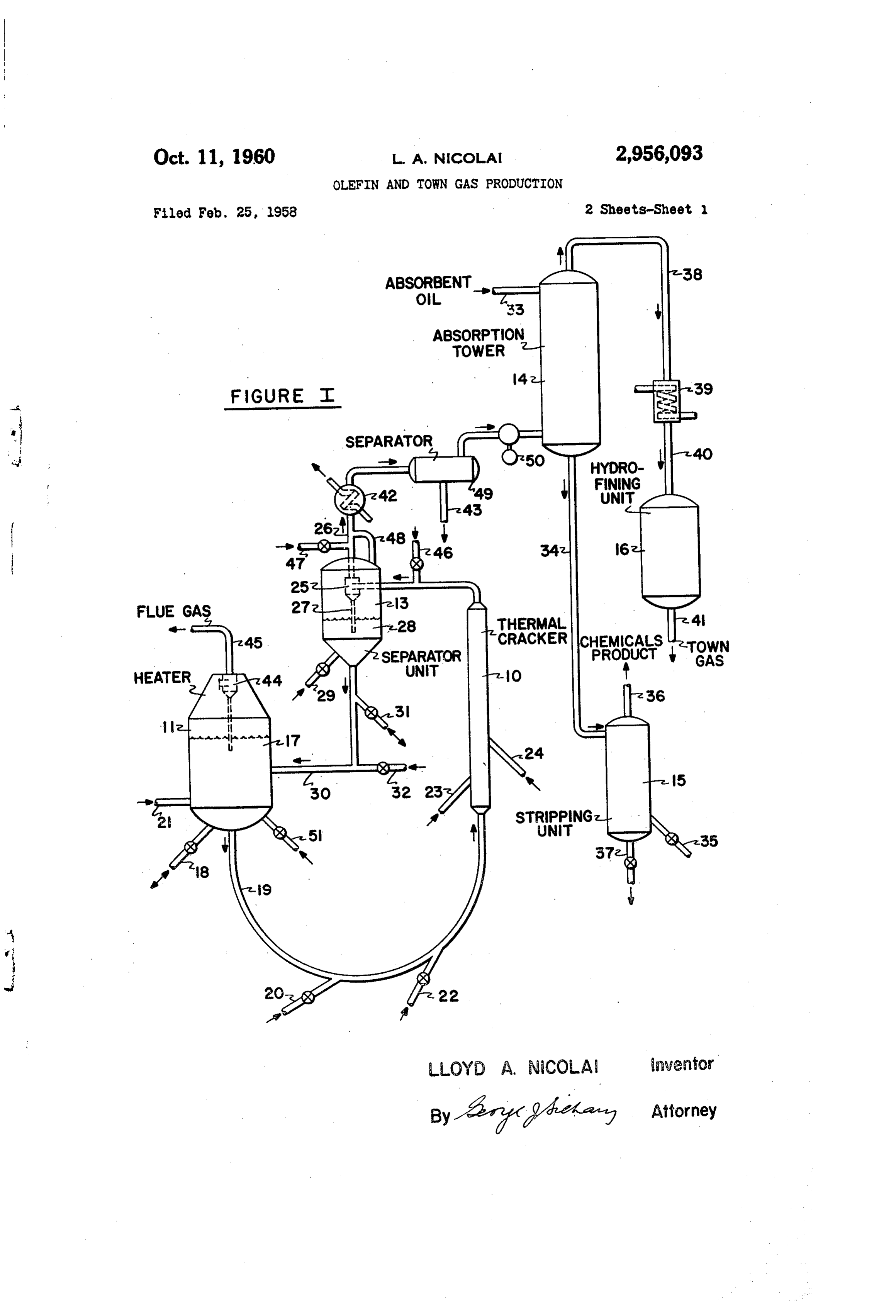
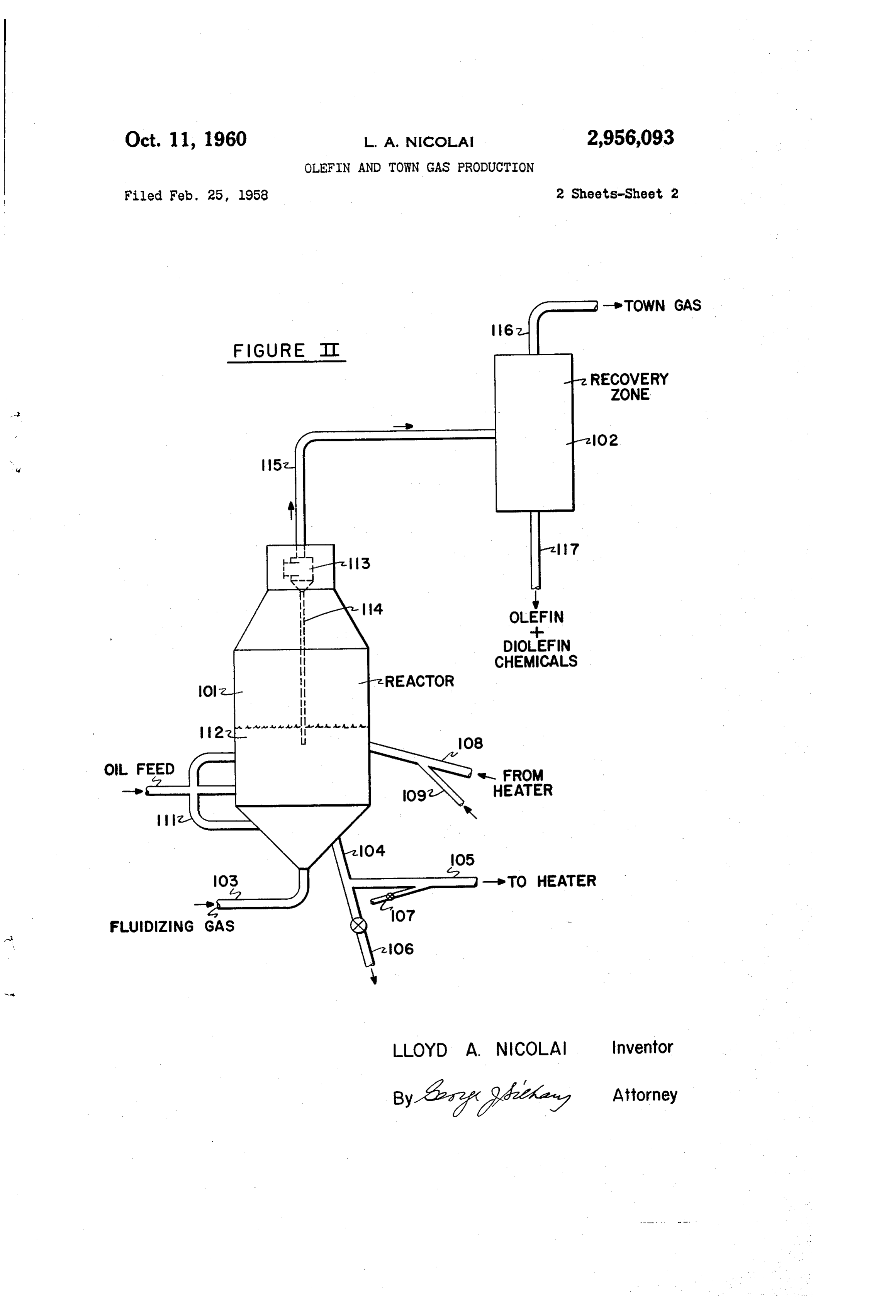
this level of cracking severity was desirable in that it pro Figure I illustrates an integrated combination process duced large quantities of unsaturated naphtha fractions, for high temperature transfer line cracking coupled with a good feed stream for resin manufacture. olefin recovery and hydrofining steps. - However, the prior art processes for high temperature Figure II depicts means for producing both chemicals cracking of heavy oil fractions depend heavily for their 40 and town gas under dense phase, fluid bed conditions. commercial success upon the market demand for their Turning to Figure I, there is shown a combination sys unsaturated naphtha product. There is relatively little tem consisting primarily of thermal cracker 10, heater 11, flexibility in their operations. Thus, even though suit finer separator 13 together with absorption tower 14 and hydro able feeds for thermal cracking may be readily available, 45 6. . . . . utilization of these prior art systems may be made im As indicated in the drawing, thermal cracker 10-is in practical because of limited demand for chemicals raw the form of an elongated, conduit-like reaction zone, material. normally referred to as a transfer line reactor. Heat The present invention serves to solve these difficulties for thermal conversion is supplied by the circulation of and sets forth a system of considerably greater flexibility 50 hot contact solids, e.g. sand, from heating zone 11 through than was heretofore known. In accordance with the the thermal cracker. - present invention, hydrocarbon oil feeds are subjected to Heater 11 is depicted as a fluid bed combustion zone high severity cracking conditions while utilizing fluid although a transfer line burner or moving bed zone could solids techniques. By use of relatively severe thermal alternatively be employed. As will be later further de conversion, the major portion of the feed constituents is 55 scribed, carbon coated reactions solids are circulated from separator 13 to heater 11 by means of conduit 30.
cracked to give a gasiform reaction product containing substantial portions of olefins, hydrogen and methane Oxygen-containing gas, e.g. air, is injected into the fluid therein. By means of a simple and inexpensive light bed 17 of carbon containing solids by means of inlet 21, olefins recovery step, the thermal cracking effluent is the combustion of the carbonaceous matter serving to segregated into an olefin rich stream suitable as a chemi 60 heat the solids to a temperature of about 50 to 200-F. cals raw material, and a second stream containing the above that of the reaction zone. When, as is illus major portions of product hydrogen and methane. This trated, a transfer line reactor is to be employed for ther second stream is either directly utilizable as a synthesis mal cracking, the combustion bed will be at a temperature or town gas, or in a preferred embodiment, is Subjected in the range of about 1350 to 1800° F. e.g. 1600° F. to a mild hydrofining step so as to hydrogenate polymer If sufficient fuel is not provided by the carbonaceous precursors, such as acetylenes and diolefins, which might 65 matter laid down on the solids during the thermal crack tend to plug burners and the like. The nature of the ing step, as will usually be the case, extraneous fuel such present system enables a relatively rough, olefin recovery as low valued heavy ends and/or portions of the town step to be entirely satisfactory in segregating the desired gas product may be added to the combustion bed through unsaturates product. Further, the hydrofining "clean up' inlet 5. - of the two gas product is simply and economically per 70 In order to maintain a constant solids mass inventory formed since no extraneous hydrogen need be added to in the system, solids may be added or witdrawn from the the reaction system, - burner through line 18, or by means of outlets in other
Page 4
parts of their circulation path such as conduit 31. Gen media pass through balance line 48 and are withdrawn erally, there is little net production of coke, and fine overhead through line 26 together with the bulk of the solids need be added to replace lost fines. Hot flue gases, reaction products. Solids circulation in conduit 30 is after having entrained solids removed therefrom in sep aided by one or more aeration taps 32 placed along the arator 44, are withdrawn overhead through line 45. Their solids passageway. Solids are conveniently added or latent heat may be recovered and utilized for various withdrawn through outlet 31.
purposes, such as supplying heat for stripping unit 15 After solids separation, the gasiform reaction products and/or heating unit 39. Separated entrained fines are are cooled, compressed and sent to an olefin recovery returned to the combustion bed as shown, or may be step. Unlike the recovery operations of prior art chemi recovered as such for direct passage to thermal cracker (i. O cals coking systems, the separation and recovery of light A portion of the hot contact solids is withdrawn from olefins is done in a cheap, relatively inefficient manner. heater 11 and passed by means of conduit 19 to transfer Since there are large quantities of olefins in the product line cracking Zone 10. Propelling gases such as steam, stream, only partial or incomplete olefin recovery need be light hydrocarbons, etc., introduced through taps 20 and utilized in order to remove the desired quantity of the 22, serve to convey the hot solids upwardly into and 5 light olefins and thereby give an olefin rich stream (based through thermal cracker 10 in the form of a rapidly mov on the thermal cracking effluent), and a second product ing gas-solids suspension. The solids-gas mixture gen fraction less rich in olefin and containing a high percent erally passes through the reaction zone as a suspension tage of hydrogen and methane therein. of approximately 2 to 20 lbs./cu. ft. density and at ve As shown in Figure I, the cheap, relatively inefficient locity of about 10 to 60 ft./sec., e.g. 30 ft./sec. 20 olefin recovery step may take the form of an oil absorp Hydrocarbon oil feed, such as a naphtha suitably pre tion process. After cooling in cooler 42, the product heated to a temperature of about 650 F., is introduced gases are separated from the quench liquid in separator into the rapidly flowing hot contact solids suspension by 49, compressed by compressor 50 and sent to absorp means of injector 23. If desired, oil injection means tion tower 14. The quench liquid is withdrawn through may be disposed longitudinally and circumferentially 25 line. 43 and may be recycled to the quench points. An about thermal cracker 10. By means of vertically absorbent oil such as pentane or the like, capable of spaced injectors such as inlets 23 and 24, the effective removing light olefins from a fluid stream, is introduced length of the thermal cracking zone, and hence the reac into the upper portion of tower 14 by inlet 33 at a rate tion period may be readily altered. of in the range of 0.5 to 2 moles/mole of inlet gas. The reaction conditions in thermal cracker 10 are 30 Countercurrent flow between the reaction products and maintained to give a greater severity of thermal conver the absorbent oil is preferably maintained, the olefin rich sion than would be practiced in standard transfer line stream being removed along with "spent' oil by outlet chemicals coking units. In accordance with the present gas34 and a second, hydrogen rich stream suitable for town invention, the oil feed is cracked to about 95 to 100 wt. product withdrawn through outlet 38. The tower percent conversion to C and lighter products on a coke operates generally at a pressure of 200-300 p.s.i.g. and free basis. If butadiene is also desired, the conversion ambient or cooling water tempertaure, e.g. 80-100 F. should be less, say about 70%, and the heavier compo Oil absorption processes, per se, are well known to nents, excepting butadiene, recycled to the cracking step. those skilled in the art and thus the operation of tower The cracking severity may be readily increased by in 14 need not be described in detail. Standard techniques creasing reaction temperature and residence time. In the of oil absorption tower construction and operations adapt embodiment presently described, a reaction temperature able for use in the present invention may be found be of 1500 F. and a residence interval (time of feed-solids ginning on page 668 of the "Chemical Engineer's Hand contact prior to quenching or other arrestment of the book,” Third Edition, 1950, McGraw-Hill. reaction) is about 0.6 second. The olefin rich stream withdrawn from tower 14 may be then subjected to conventional stripping in unit 15 for
Upon contact with the hot solids, the hydrocarbon oil separation is converted into light gaseous products and carbonaceous ene. Strippingof cracked products i.e. ethylene and propyl residue which is deposited upon the reaction solids. Sub the desired light gas introduced through line 35 vaporizes unsaturates, the chemicals products being stantial portions of hydrogen, methane, light olefins such as ethylene and propylene are formed together with other withdrawn overhead by line 36, while an oil phase, de hydrocarbon products. In accordance with the present 50 pleted in light olefins, is removed by outlet 37. The oil invention, the thermal cracking gasiform products con may, if desired, be recirculated back to absorption tower tain at least 35 vol. percent of light olefins (ethylene and 14.
propylene) and at least 15 vol. percent of hydrogen. The olefin rich, chemicals product stream withdrawn Reaction solids, propelling gas along with the vaporous by line 36 finds use in the production of resins and other polymeric constituents and represents a relatively high conversion products are withdrawn overhead and passed 55 priced to solids separation unit 13. A quenching agent such product. r as steam, light hydrocarbons or other liquid media may theWhile Fig. I illustrates the use of oil absorption for be introduced before and/or after solids separation by tivelyrecovery of light olefins products, other cheap, rela inefficient means for concentrating olefins into a means of quench inlets 46 and 47, respectively. It is desirable to quench the reaction vapors to at least 600° 60 chemicals product may be employed. For example, char F. to stop all cracking. Lower temperatures are prefer adsorption or the like may be utilized. Similarly, oil able because the following olefin absorption step requires absorption tower may operate in conjunction with stand much lower temperatures. ard distillation towers for purification of the individual As illustrated, separator unit 13 takes the form of an olefins. Numerous other modes of separating reaction enclosing chamber having one or more cyclone separa 65 effluent into an olefin rich stream and a hydrogen rich tors 25 therein. Of course, other conventional solids stream will be apparent to those skilled in the art, and Separation means such as vanes or the like may be em such methods are to be construed as falling within the ployed. Separated solids are passed through dipleg 27 teaching of the present invention. into the lower portion of unit 13 from which they are It should be clearly noted that the present invention, and the incomplete olefin recovery step employed therein, passed to heater 11. In the embodiment illustrated, a 70 offer mass 28 of contact solids is formed at the bottom of unit substantial advantages over those systems relying 13. Steam or other inert fluids are introduced into solids upon essentially complete recovery of olefins for use as mass 28 by line 29 so as to strip occluded hydrocarbons a chemical products. Since in accordance with the therefrom, and to facilitate flow of separated solids into present invention, it is generally desired to recover only return conduit 30. Stripped vapors and the fluidizing 75 about 5 to 50% of the total ethylene present in the reac
Page 5
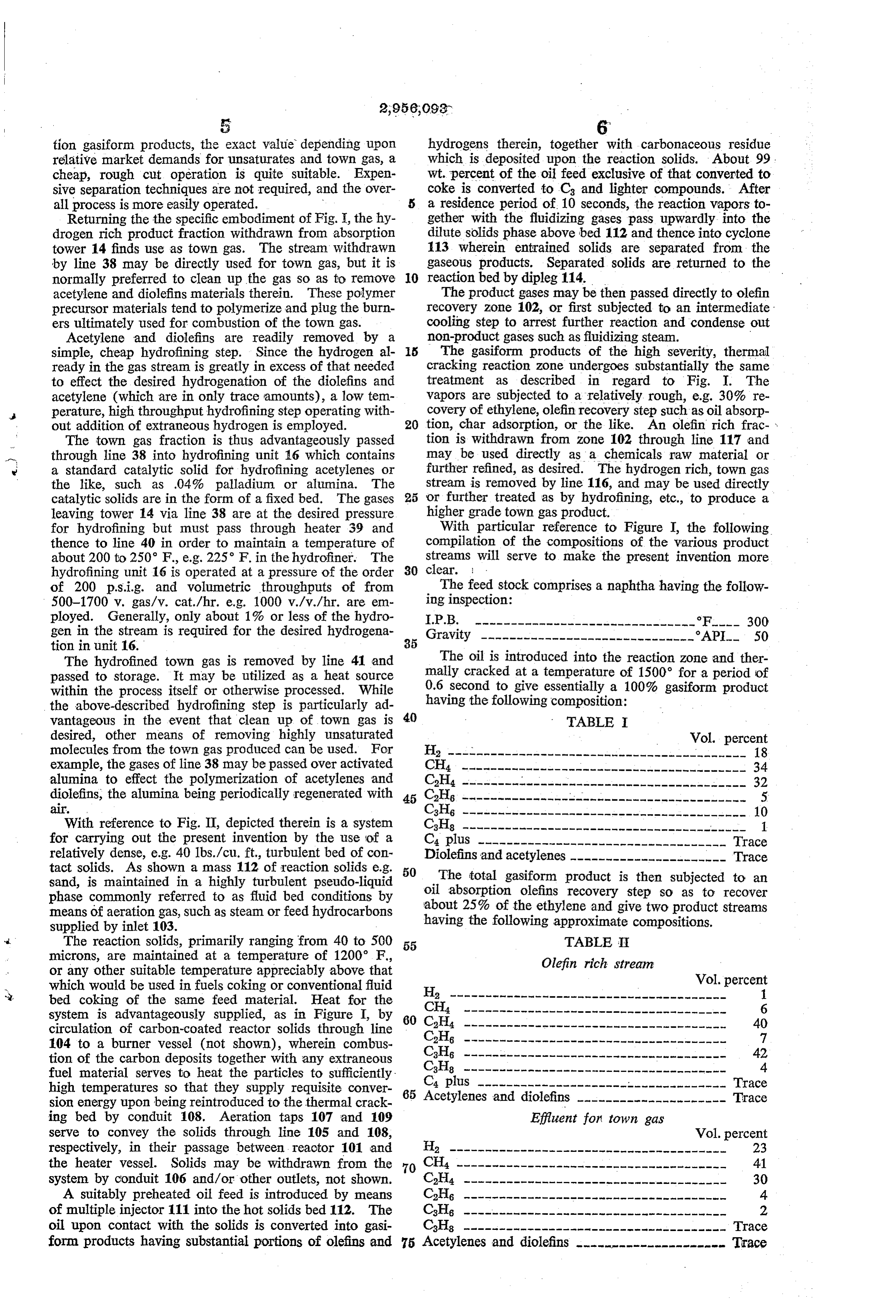
tion gasiform products, the exact value depending upon hydrogens therein, together with carbonaceous residue relative market demands for unsaturates and town gas, a which is deposited upon the reaction solids. About 99. cheap, rough cut operation is quite suitable. Expen Wt. percent of the oil feed exclusive of that converted to sive separation techniques are not required, and the over coke is converted to C and lighter compounds. After all process is more easily operated. w a residence period of 10 seconds, the reaction vapors to Returning the the specific embodiment of Fig. I, the hy gether with the fluidizing gases pass upwardly into the drogen rich product fraction withdrawn from absorption dilute solids phase above bed 112 and thence into cyclone tower 14 finds use as town gas. The stream withdrawn 113 wherein entrained solids are separated from the by line 38 may be directly used for town gas, but it is gaseous products. Separated solids are returned to the normally preferred to clean up the gas so as to remove O reaction bed by dipleg 114.
acetylene and diolefins materials therein. These polymer The product gases may be then passed directly to olefin precursor materials tend to polymerize and plug the burn recovery Zone 102, or first subjected to an intermediate - ers ultimately used for combustion of the town gas. cooling step to arrest further reaction and condense out Acetylene and diolefins are readily removed by a non-product gases such as fluidizing steam. simple, cheap hydrofining step. Since the hydrogen al 5 The gasiform products of the high severity, thermal ready in the gas stream is greatly in excess of that needed cracking reaction zone undergoes substantially the same to effect the desired hydrogenation of the diolefins and treatment as described in regard to Fig. I. The acetylene (which are in only trace amounts), a low tem vapors are subjected to a relatively rough, e.g. 30% re perature, high throughput hydrofining step operating with covery of ethylene, olefin recovery step such as oil absorp out addition of extraneous hydrogen is employed. 20 tion, char adsorption, or the like. An olefin rich frac The town gas fraction is thus advantageously passed tion is withdrawn from zone 102 through line 117 and through line 38 into hydrofining unit 16 which contains may be used directly as a chemicals raw material or a standard catalytic solid for hydrofining acetylenes or further refined, as desired. The hydrogen rich, town gas the like, such as .04% palladium or alumina. The stream is removed by line 116, and may be used directly catalytic Solids are in the form of a fixed bed. The gases 25 or further treated as by hydrofining, etc., to produce a leaving tower 14 via line 38 are at the desired pressure higher grade town gas product. for hydrofining but must pass through heater 39 and With particular reference to Figure I, the following thence to line 40 in order to maintain a temperature of compilation of the compositions of the various product about 200 to 250 F., e.g. 225 F. in the hydrofiner. The teams Will serve to make the present invention more hydrofining unit 16 is operated at a pressure of the order 30 CCa: ;
of 200 p.s.i.g. and volumetric throughputs of from The feed stock comprises a naphtha having the follow 500-1700 v. gas/v. cat./hr, e.g. 1000 v./v./hr. are em ing inspection:
ployed. Generally, only about 1% or less of the hydro IF.B. ------------------------------- F. 300 gen in the stream is required for the desired hydrogena tion in unit 16. 35 Gravity ------------------------------ API 50 The hydrofined town gas is removed by line 41 and mally The oil is introduced into the reaction zone and ther passed to storage. It may be utilized as a heat source cracked at a temperature of 1500 for a period of within the process itself or otherwise processed. While 0.6 second to give essentially a 100% gasiform product the above-described hydrofining step is particularly ad having the following composition: vantageous in the event that clean up of town gas is 40 TABLE I desired, other means of removing highly unsaturated Vol. percent molecules from the town gas produced can be used. For ------------------------------------------ 18 example, the gases of line 38 may be passed over activated CH4 ---------------------------------------- 34 alumina to effect the polymerization of acetylenes and C2H4 ---------------------------------------- 32 diolefins, the alumina being periodically regenerated with 45 C2H6 ---------------------------------------- 5
With reference to Fig. II, depicted therein is a system C3H8 ------------------------------------- - - - 1. for carrying out the present invention by the use of a C4 plus ----------------------------------- Trace relatively dense, e.g. 40 lbs./cu. ft, turbulent bed of con Diolefins and acetylenes ---------------------- Trace tact solids. As shown a mass 112 of reaction solids e.g. 50 The total gasiform product is then subjected to an sand, is maintained in a highly turbulent pseudo-liquid oil absorption olefins recovery step so as to recover phase commonly referred to as fluid bed conditions by about 25% of the ethylene and give two product streams means of aeration gas, such as steam or feed hydrocarbons having the following approximate compositions. supplied by inlet 103.
The reaction solids, primarily ranging from 40 to 500 55 TABLE I microns, are maintained at a temperature of 1200. F., Olefin rich stream or any other suitable temperature appreciably above that Vol. percent
which would be used in fuels coking or conventional fluid a --------------------------------------- 1. bed coking of the same feed material. Heat for the system is advantageously supplied, as in Figure I, by 60 C4 ------------------------------------- 6 circulation of carbon-coated reactor solids through line C2H4 ------------------------------------- 40 104 to a burner vessel (not shown), wherein combus C2H6 ------------------------------------- 7 tion of the carbon deposits together with any extraneous C3H6 ------------------------------------- 42 fuel material serves to heat the particles to sufficiently Cse ------------------------------------- 4. high temperatures so that they supply requisite conver 65 C4 Plus ----------------------------------- Trace sion energy upon being reintroduced to the thermal crack Acetylenes and diolefins --------------------- Trace ing bed by conduit 108. Aeration taps 107 and 109 Effluent for town gas serve to convey the solids through line 105 and 108, Vol. percent respectively, in their passage between reactor 101 and 2 --------------------------------------- 23 the heater vessel. Solids may be withdrawn from the 70 CH4 -------------------------------------- 41 system by conduit 106 and/or other outlets, not shown. C2H4 ------------------------------------- 30 A suitably preheated oil feed is introduced by means C2H6 ------------------------------------- 4. of multiple injector 111 into the hot solids bed 112. The C3H6 ------------------------------------- 2 oil upon contact with the solids is converted into gasi C3H8 ------------------------------------- Trace form products having substantial portions of olefins and 75 Acetylenes and diolefins ----a costs an assum was its an as Trace
Page 6
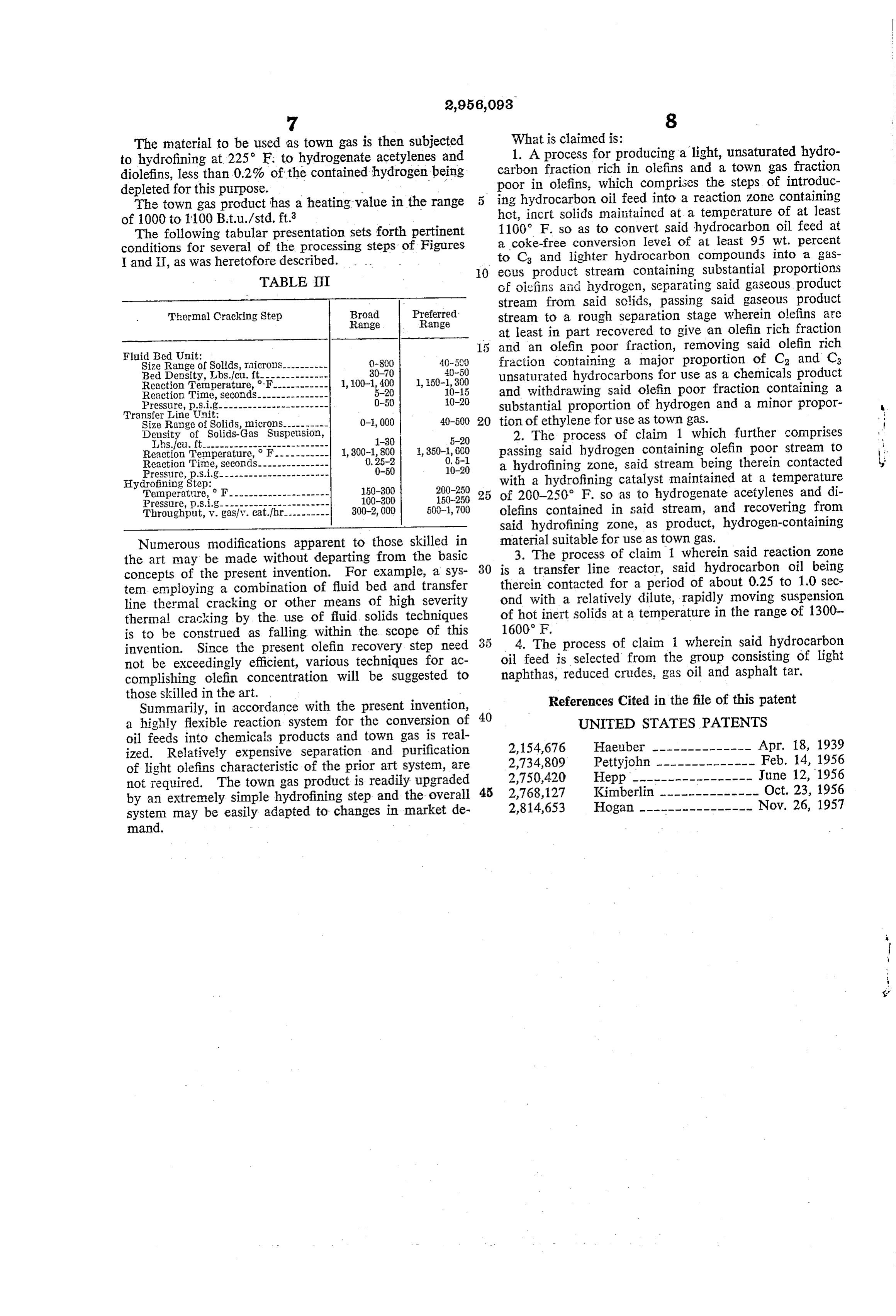
The material to be used as town gas is then subjected What is claimed is:
to hydrofining at 225 F. to hydrogenate acetylenes and 1. A process for producing a light, unsaturated hydro diolefins, less than 0.2% of the contained hydrogen being carbon fraction rich in olefins and a town gas fraction depleted for this purpose. - poor in olefins, which comprises the steps of introduc The town gas product has a heating value in the range 5 ing hydrocarbon oil feed into a reaction zone containing of 1000 to 1100 B.t.l../std. ft.3 hot, incrt solids maintained at a temperature of at least The following tabular presentation sets forth pertinent 1100 F. so as to convert said hydrocarbon oil feed at conditions for several of the processing steps of Figures a coke-free conversion level of at least 95 wt. percent I and II, as was heretofore described. to C and lighter hydrocarbon compounds into a gas ecus product stream containing substantial proportions
TABLE II 0. of olefins aid hydrogen, Separating said gaseous product stream from said solids, passing said gaseous product
Thermal Cracking Step Broad
Range
Preferred
Range stream to a rough separation stage wherein olefins are at least in part recovered to give an olefin rich fraction
Fluid Bed Unit:
r and an olefin poor fraction, removing said olefin rich
I5 fraction containing a major proportion of C2 and C3
Size Range of Solids, microns - 0-800 40-500
Bed Density, Libs.fcu. ft.---
Reaction Temperature,
unsaturated hydrocarbons for use as a chemicals product
Reaction Time, seconds. 5-20 10-15 and withdrawing said olefin poor fraction containing a
Transfer Line Unit:
0-50 10-20 substantial proportion of hydrogen and a minor propor
Size Range of Solids, microns---------- 0-1,000 40-500 20 tion of ethylene for use as town gas. Density of Solids-Gas Suspension,
Ihs.fcu. ft.-------------- 1-30 5-20 2. The process of claim 1 which further comprises
Reaction Temperature, 1,300-1,800 i, 350-1, 600 passing said hydrogen containing olefin poor stream to Reaction Time, seconds.--
a hydrofining zone, said stream being therein contacted
Hydrofining Step: with a hydrofining catalyst maintained at a temperature Temperature, F--------------------- 150-300 200-250 25 of 200-250 F. So as to hydrogenate acetylenes and di Pressure, p.S.i.g----------------------- 100-300 150-250
Throughput, v. gas/v. cat.fhr---------- 300-2,000 500-1,700 olefins contained in said stream, and recovering from said hydrofining zone, as product, hydrogen-containing
Numerous modifications apparent to those skilled in material suitable for use as town gas. the art may be made without departing from the basic 30 3. The process of claim 1 wherein said reaction zone concepts of the present invention. For example, a sys is a transfer line reactor, said hydrocarbon oil being tem, employing a combination of fluid bed and transfer therein contacted for a period of about 0.25 to 1.0 sec line thermal cracking or other means of high severity ond with a relatively dilute, rapidly moving suspension thermal cracking by the use of fluid solids techniques of hot inert solids at a temperature in the range of 1300 is to be construed as falling within the scope of this 35 1600. F.
4. The process of claim 1 wherein said hydrocarbon invention. Since the present olefin recovery step nee not be exceedingly efficient, various techniques for ac oil feed is selected from the group consisting of light complishing olefin concentration will be suggested to naphthas, reduced crudes, gas oil and asphalt tar. those skilled in the art.
Summarily, in accordance with the present invention, References Cited in the file of this patent a highly flexible reaction system for the conversion of 40 UNITED STATES PATENTS oil feeds into chemicals products and town gas is real 2,154,676 Haeuber -------------- Apr. 18, 1939 ized. Relatively expensive separation and purification of light olefins characteristic of the prior art system, are 2,734,809 Pettyjohn -------------- Feb. 14, 1956 not required. The town gas product is readily upgraded 2,750,420 Hepp ----------------- June 12, 1956 by an extremely simple hydrofining step and the overall 45 2,768,127 Kimberlin -------------- Oct. 23, 1956 system may be easily adapted to changes in market de 2,814,653 Hogan ---------------- Nov. 26, 1957 mand.
Provenance
- Collection
- Cited prior art
- Original PDF
- patentimages.storage.googleapis.com →
- Filed
- 1958-02-25
- Pages
- 6
- Method
- pdftotext (the PDF's own text layer) + pdftoppm 300dpi page scans
- Source
- Google Patents bibliographic record
- Granted
- 1960-10-11
- Inventors
- Nicolai Lloyd Arthur; Exxon Research and Engineering Co
- Transcribed from
- patentimages.storage.googleapis.com →