patent · US2793938
Production of a hydrogen rich gas and removal of carbon contained therein
28 May 1957
Page 1
Drawing sheet — no readable text.
Page 2
United States Patent Office Patented May 28, 1957
Still another object of this invention is to provide an improved method of recovering carbon produced in the 2,793,938 partial combustion of hydrocarbons to produce a gas rich in hydrogen.
PRODUCTION OF A HYDRO GEN RECH GAS AND 5 Yet another object of this invention is to recover heat REMOVAL OF CARBON CONTAINED THEREN from a carbon-water slurry produced in the removal of Sidney M. Frank, West Orange, N. J., assignor to The carbon from effluent gases from the partial combustion M. W. Keilogg Company, Jersey City, N. S., a corpo of hydrocarbons.
ration of Delaware These and other objects of the invention will become 0. more apparent from the following detailed description
Application December 15, 1954, Serial No. 475,598 and discussion.
5 Cairns. (Cl. 23-212) In its broad aspect this invention comprises treating a hot solids-water slurry, maintained under super at mospheric pressure, to separate the solids and recover
This invention relates to the recovery of heat and 15 heat by first passing the slurry to a zone of low pressure solids from a solids-water slurry. More particularly it and thereby flashing part of the water, further cooling relates to the recovery of heat and carbon from a carbon the remaining slurry by indirect heat exchange, separat water slurry produced in the conversion of a carbona ing the solids from the slurry by a conventional low ceous materiai to a gaseous product rich in hydrogen. 20 pressure separation process and combining the substan Several processes are available in the art for preparing tially carbon free water with the water flashed in the gases rich in hydrogen which are suitable for use in low pressure zone to provide a high temperature water the synthesis of hydrocarbons by the Fischer-Tropsch stream for further use.
reaction, in ammonia synthesis or in the synthesis of In a more specific aspect of this invention a carbona oxygenated organic compounds, such as methanol and 25 ceous material is converted under Super atmospheric isobutanol. The methods utilized commercially differ pressure to a gas rich in hydrogen, and carbon produced in their application and depend on the type and com in the reaction is scrubbed from the effluent gas with position of feed stocks available for conversion. For water. A slurry of carbon in water is removed from example, when it is desired to convert a normal gaseous the scrubbing zone and passed to a zone of lower pres hydrocarbon material, furnace reforming in the presence sure wherein a portion of the water is flashed as steam of a reforming catalyst is often preferred. When 30 and the slurry is lowered in temperature. The slurry heavier hydrocarbons are used to prepare a hydrogen is then cooled still further by indirect heat exchange and rich gas, that is, those hydrocarbons which are not nor passed through a filtering step for the removal of carbon. mally gaseous, for example, hydrocarbons or hydro The low temperature filtrate from this step is combined carbon mixtures having components of five or more with the steam from the low pressure zone whereby the carbon atoms, hydrocarbon fractions such as naphtha, steam is condensed and the filtrate is heated and the kerosene, heating distillates, light and heavy gas oil, heated liquid is returned to the scrubbing zone. topped crudes, residual oils, lubricating oil fractions, As indicated above this invention is broad in scope asphalt and other hydrocarbon oils, partial oxidation and it is not intended that its application be restricted to with oxygen is frequently used. The latter process is 40 the processing of a carbon-water slurry, nor that it be also used when it is desired to convert solid carbona limited by the specific process disclosed, namely the prep ceous materials such as coals, lignites, shale, etc., to a aration of a gas rich in hydrogen. It may also be used hydrogen-rich gas. it is with this method of converting to advantage in recovering solids and heat from any carbonaceous materials, that is by partial oxidation that solids-water mixture maintained under super atmos this invention is concerned. pheric pressure, for example such as a solids-water slurry A certain amount of carbon is almost unavoidably 45 obtained from a fluid catalytic cracking process, or a produced as a by-product in the process of converting fluid coking process, or a fluid hydroforming process etc. solid carbonaceous materials and hydrocarbons to hydro Any solids separable from water by filtration or by other gen. Since the carbon is normally produced in a finely low pressure separation means may be processed, includ divided state and thus is entrained at least in part in ing inert materials such as sand, pumice, quartz, etc., the product gases, it is easily carried from the reaction 50 and materials having catalytic properties, for example zone and may cause equipment plugging and costly shut metals and oxides thereof such as silica, alumina, boria, downs. For this reason, it is desirable to effect sep etc., and other common solid catalytic materials. In its aration of the carbon from the product gases as soon preferred embodiment this invention contemplates reuse as possible after completion of the partial oxidation re of the high temperature water stream, more usually in action. One method of doing this comprises contacting 55 the solids-scrubbing step, however, other use of this the gases with water to knock out the carbon. The stream is also within the scope of the invention, such as carbon then is conveniently removed from the System. for example as a heat eXchange medium. as a slurry in the water. Since the reaction gases are The conditions required for the conversion of carbo cooled by this method from a high to a relatively low naceous materials to a gas rich in hydrogen by partial temperature, a large amount of water is required. The 60 oxidation have been disclosed in numerous patents and carbon-water mixture although relatively low in tem are well known in the art. In general, elevated tempera perature contains a large amount of heat because of its tures are required, that is between about 1500 F. and bulk. It is desirable to recover this heat in a usable about 3000 F., the preferred temperature depending on form and at the same time separate carbon from the the feed stock employed. Steam may be used in the carbon-water slurry. 65 reaction to control the temperature and may also be It is an object of this invention to provide an improved used to reduce the partial pressure of the cii, if a hydro method of recovering solids and heat from a solids-Water carbon feed is used. The process may be carried out slurry.
Another object of this invention is to provide an im over a wide range of pressures from about atmospheric to as high as 1000 p.s. i.g., however, since the synthesis proved process for the production of a hydrogen-rich 70 processes gas suitable for use in the synthesis of ammonia, hydro synthesis ofpreviously mentioned, and particularly the ammonia, are usually carried out under high carbons and oxygenated organic compounds.
Page 3
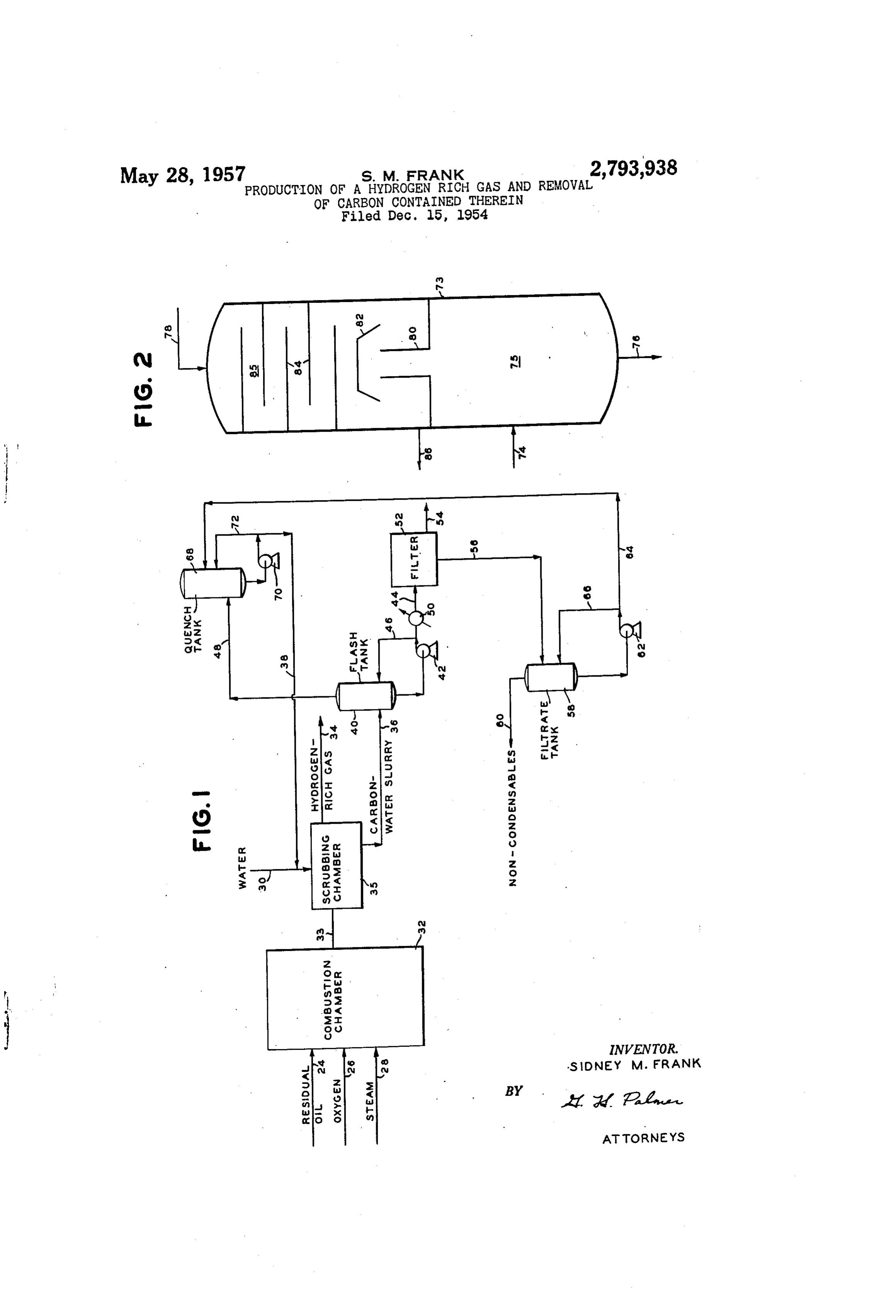
pressures it is customary to operate at pressures sub the temperature of the carbon-water slurry prior to filter stantially above atmospheric. ing. Further, the quantity of water vaporized from the In the subsequent discussion and description the in carbon-water slurry and the temperature of the steam and vention will be considered in relation to the treatment unvaporized slurry are dependent on the reduction in of a carbon-water slurry resulting from a partial com pressure which takes place in the expansion step. Ob bustion process; however, as stated previously this is viously, any reduction in pressure will provide some not intended in any way to limit the scope of the in steam, and the combination of this steam with cold vention. filtrate will provide a warmer recycle water than would Any of the carbonaceous materials previously men otherwise be available. As the pressure in the expansion tioned and including normally gaseous hydrocarbons may O step is progressively decreased, more and more steam is be used in preparing the hydrogen-rich gas, however, formed, but at progressively lower temperatures. Ulti more usually the lighter compounds and hydrocarbon mately, a minimum pressure between about 14 and about fractions down through gas oil, and the lube oil frac 20 p.s. i. g. is reached. This minimum exists when the tions are more valuable for the other uses. As a re quantity, the temperature and heat content of the steam sult, the available feed materials are normally limited to are such that condensation of this material in the filtrate the heavier petroleum fractions ranging in gravity from raises the temperature of the filtrate to the steam tem about 30 to as low as -5 API; namely, topped crude perature. It is impossible to expand below this pres oils, residual oils, fuel oils, asphalt, etc., and to solid sure and still condense all of the steam in the filtrate carbonaceous materials. In view of the present excess for maximum heat recovery. Of course if there is a use of heavy residual oils these materials are particularly 20 for excess low pressure steam elsewhere in the process, attractive as feed stocks from an economic view point. the aforesaid minimum pressure does not apply and the The oxygen required in carrying out the partial oxida expansion step may be carried out down to essentially tion process may be provided as a relatively pure mate atmospheric pressure. It is within the scope of this rial or it may be a mixture of oxygen and other compo invention to expand the carbon-water slurry to any pres nents; for example, air or air enriched with oxygen. Sure down to atmospheric; however, to provide for maxi When the effluent from the partial combustion reaction is mum recovery of heat in the filtrate, operation at or to be used in the synthesis of ammonia, it may be desir around the aforesaid minimum pressure is contemplated. able to supply the oxygen as air in order to provide the Conventional methods of separating liquids and solids, nitrogen required in the ammonia synthesis. In prepar in particular, filtration, involve operating at pressures ing a gas for use in other synthesis processes, it is usual 30 near or below atmospheric, usually between about 2.0 ly advantageous to carry out the partial oxidation reac and about 14.7 p. s. i. a. Since the pressure of the car tion with relatively pure oxygen in order to reduce the bon-water slurry leaving the expansion step is substantial quantity of gases in the reaction effluent. Even if am ly above the filtration pressure and the water in the monia is the product ultimately desired it may be advan slurry is at its boiling point it is necessary to cool the tageous to use relatively pure oxygen in order to reduce 35 slurry before filtration in order to prevent appreciable the quantity of gases in the reaction zone and thus the vaporization of water during this operation. The extent size of the reaction zone required. of this cooling varies with the filtration pressure, and In a typical embodiment of this invention, a residual oil the lower said pressure, the more cooling is required. In and water or steam are pre-heated and introduced into a the usual operation it is necessary to cool the slurry to combustion Zone wherein they are reacted with oxygen, 40 a temperature between about 70 F. and about 125 F. Cr an oxygen-containing gas. As a result of the reac before it enters the filter. It is possible to cool the slurry tions which take place, the hydrocarbon feed is sub to the filter to a lower temperature than is necessary to stantially converted to a mixture of hydrogen, carbon prevent vaporization during filtration and thereby lower monoxide and carbon dioxide, with some free carbon in the minimum allowable pressure in the expansion step the form of small particles. The over-all reaction is high and still obtain complete condensation of the flashed ly exothermic and the product gases leave the combustion steam in the filtrate. This, however, decreases rather than Zone at an elevated temperature. In order to decrease increases the heat recovery, therefore, it is preferred to the volume of gas to be handled, both in the combustion limit slurry cooling prior to filtration to a minimum. Zone and in the subsequent processing steps, a high pres 50 The method of operation described above effectively Sure is maintained on the system. recovers the major portion of the carbon product and at Removal of carbon from the reaction gases is effected the same time makes it possible to recover a maximum by contacting them with water in a scrubbing zone to amount of heat from the slurry water heat which in a form a carbon-water slurry. The mixture of carbon conventional operation would be lost from the system. and water is then passed from the combustion zone 55 In order to more clearly illustrate the invention and through an expansion step whereby a portion of the to provide a better understanding thereof, reference is Water present is flashed as steam and the remaining slurry had to the accompanying drawings of which: is lowered in temperature. The slurry is then filtered to Figure I is a diagrammatic illustration of a process remove the carbon. To prevent excessive amounts of flow arrangement for carrying out an embodiment of water from flashing in the filtering step, which is normally the invention and carried out under low pressures, frequently less than at 60 Figure II is an alternate arrangement in which the mospheric, it is necessary before filtering to further cool slurry expansion and steam condensation steps are car the carbon-water slurry. This may be conveniently car ried out in a single vessel.
ried out by conventional indirect heat exchange or by Referring to Figure I, a residual oil, oxygen and steam other conventional methods. The water filtrate which are introduced through conduits 24, 26 and 28 respec remains after the carbon is removed from the slurry is 65 tively into a combustion chamber 32 maintained under at a temperature substantially lower than the tempera Suitable conditions of temperature and pressure to pro ture of the steam previously flashed from the slurry. To vide a gaseous reaction product rich in hydrogen. In increase the heat content of the filtrate and effectively this specific illustration, the temperature is maintained utilize this low pressure steam, the two are combined, 70 at about 2200 F. and the pressure substantially above thereby condensing the steam and substantially increas atmospheric, namely about 450 p.s. i. g. Gaseous ef ing the quantity and temperature of the filtrate. The hot fluent from the combustion chamber containing free filtrate is then recycled for reuse as scrubbing water. carbon in the form of small particles is passed through The amount of recoverable heat regained by this meth conduit 33 into a scrubbing chamber. 35 wherein it is od of operation is dependent on two factors, the pres 75 contacted with water introduced through conduit 30 sure at which steam is formed in the expansion step and to remove the carbon. The temperature of the scrub
Page 4
bing water prior to its admission into the scrubbing Filtrate:
chamber is about 250 F. A mixture of the carbon and Carbon --------------------------- 40 water, in the form of a slurry is passed from the scrub Water ------- wn am - a un ups muna are up ar via - an a baar ru 28,900
bing chamber through conduit 36 and the hydrogen-rich Combined steam and filtrate: s gas product exits through conduit 34. Carbon --------------------------- 40 In the process of removing the carbon from the re Water ---------------------------- 33,500 action gases the water admitted to the scrubbing cham Temperatures: F. ber is heated and the carbon-water mixture leaves this Slurry to flash tank ----------------------- 380 chamber at a temperature of about 400 F. It is desir Flash tank ------------------------------ 260 able to recover a maximum amount of the heat from the 10 Filter ----------------------------------- 115 slurry and return it to the scrubbing chamber, preferably Quench tank ---------------------------- 250 by recycling the slurry water. In order to provide a re Pressures: P. s. i. g. usable water stream it is necessary first to effect the re Slurry to flash tank ----------------------- 400 moval of carbon from the carbon-water slurry. As the Flash tank ------------------------------ 20 initial step in this process, the mixture of carbon and 5 water is passed through conduit 36 and into a flash tank Filter ----------------------------------- -5 40 which is maintained at a lower pressure than the Quench tank ----------------------------- 14 pressure existing in the combustion chamber, namely Various modifications of the process illustrated and about 20 p.s. i. g. This reduction in pressure causes a specifically described are included within the scope of the portion of the water in the slurry to vaporize and form 20 invention. For example, as previously mentioned it is steam, which passes from the flash tank through con not necessary to limit the invention to a carbon-water duit 48. The remaining slurry is cooled thereby to slurry; any solids removable by filtration or other con about 260 F. The cooled material is withdrawn from ventional low pressure separation means may be processed the flash tank through conduit 44, is passed through in a similar manner.
conduit 44 and heat exchanger 50 into filter 52. To pro 25 In the specific illustration in Figure I, the flash tank 40 vide agitation of the slurry and prevent stoppage a por and quench tank 68 are shown as separate vessels. This tion of the cooled slurry may be recycled to the flash is not essential to the invention and the separate functions tank through conduit 46. performed in these vessels may be carried out in a single The construction of the conventional filter is such that vessel, as shown in Figure I. Referring to Figure II, the it is not readily adapted to high pressure operation. As 30 carbon-water slurry enters, the low pressure flash Zone.75 a result filtering operations are usually carried out at of vessel 73 through conduit 74 and the slurry cooled by atmospheric and less than atmospheric pressure. In this expansion leaves through conduit 76. Low pressure particular illustration the filtration step is carried out at steam flashed in this zone passes upward through a draw below atmospheric pressure and to prevent flashing of off tray 80, around baffle.82 and up through baffles 84. the water during filtration, the slurry is cooled by in 35 Cool filtrate from filtrate tank 58 enters the quench Zone direct heat exchange to about 115. F. in exchanger 50 85 of vessel 73 and passes downward countercurrent to before being admitted to the filter. Two streams leave the rising steam, thereby condensing this material. The the filter. The separated carbon exits through conduit heated filtrate and the condensed steam accumulate on 54 for further handling or processing (not shown). The drawoff tray 80 from which the combined liquid is with water filtrate leaves through conduit 56 and enters fil 40 drawn through conduit 86 for recycle to the scrubbing trate tank 58 wherein non-condensables admitted to the chamber 35.
system in the filtering operation, primarily air, are vented When using either vessel arrangement illustrated, the through conduit 60. The low temperature filtrate is temperature and pressure of the combined water filtrate then removed from tank 58 by pump 62 and is passed and steam condensate is governed by the temperature through conduit 64 into quench tank 68. If desired, a 45 and pressure of the slurry leaving the scrubbing chamber portion of this material may be recycled to the filtrate 35 and by the filtrate temperature. As previously dis tank through conduit 66. Steam from flash tank 40 cussed the amount of steam flashed in the low pressure also enters the quench tank through conduit 48 and is zone and the temperature of the combined filtrate and combined with the filtrate thereby condensing the steam and increasing the temperature of the filtrate to about 50 steam steam may be controlled within limits by varying the pressure. Normally this is accomplished by partial 250 F. To assure complete condensation, it is pre ly obstructing the flow of steam through conduit 48 ferred to admit the steam beneath the level of filtrate in Figure I or by decreasing the size of the opening in liquid in quench tank 68. The total liquid stream now the drawoff tray 80 in Figure II. at a substantially higher temperature and having a much Having thus described the invention by reference to a greater heat content is removed from the quench tank 55 specific example thereof, it is understood that no undue through pump 70, a portion is recycled through conduit limitations or restrictions are to be imposed by reason 72 and the net liquid is passed through conduit 38 to thereof, but that the scope of the invention is defined by join the water entering the scrubbing chamber.
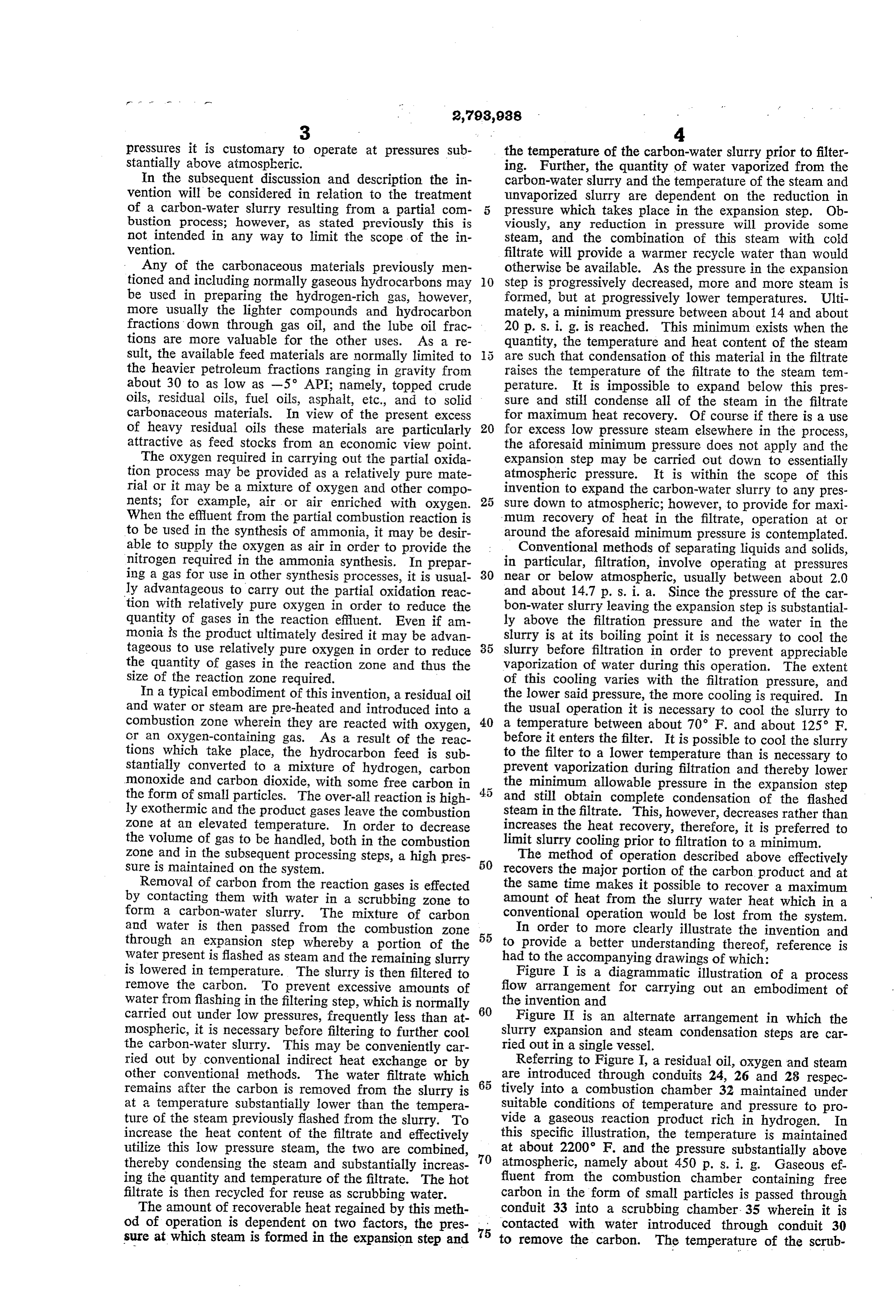
The following are presented as typical conditions en the appended claims.
countered in carrying out this invention on a com 60 I1. claim: In a conversion process in which a carbonaceous mercial scale. material is partially oxidized in a reaction Zone under EXAMPLE super atmospheric pressure in the presence of oxygen and Carbon separation and heat recovery step steam to produce a hot gaseous product containing free Flows: 65 carbon and the hot gaseous product is contacted with hot water in a scrubbing zone to remove the carbon and
Slurry to flash tank: Rate, 1b./hr. form a carbon-water slurry, the improvement which com Carbon --------------------------- 360 prises passing the carbon-water slurry while under pres Water ---------------------------- 34,800 sure to a zone of lower pressure wherein a portion of Steam to quench tank ------------------ 4,600 70 the water in the slurry is flashed as steam, separately re Slurry to filter: moving the steam and slurry from the Zone of lower
pressure, passing the slurry through a cooling Zone where
Water ---------------------------- 30,200 in its temperature is substantially lowered, passing the Filter cake:
Carbon --------------------------- 320 cooled slurry to a separation Zone for the removal 75 of carbon, combining the carbon free water with the steam
Page 5
Drawing sheet — no readable text.
Provenance
- Collection
- Cited prior art
- Original PDF
- patentimages.storage.googleapis.com →
- Filed
- 1954-12-15
- Pages
- 5
- Method
- pdftotext (the PDF's own text layer) + pdftoppm 300dpi page scans
- Source
- Google Patents bibliographic record
- Granted
- 1957-05-28
- Inventors
- Sidney M Frank; MW Kellogg Co
- Transcribed from
- patentimages.storage.googleapis.com →