patent · US2779714
Hydrocarbon reforming process
29 January 1957
Page 1
Drawing sheet — no readable text.
Page 2
United States Patent Office 2,779,714 Patented Jan. 29, 1957
Additional objects and advantages of the invention will be apparent from the description which follows:
2,779,714 Briefly stated, this invention comprises reforming naph tha at specified pressures and temperatures in the presence
HYDROCARBON REFORMING PROCESS of hydrogen and a catalyst while supplying heat from a Percival C. Keith, Peapack, N.J., assig or to Hydrocar Substantially isothermal source directly to the reactants bon. Research, Inc., New York, N. Y., a corporation undergoing reformation.
of New Jersey Supplying heat from a substantially isothermal source Application June 30, 1953, Serial No. 365,195 is a key facet of the invention. It is now possible to pre vent thermal cracking by not overheating the feed naph 4. Claims. (C. 196-50) tha. In fact, a reformation operated according to this in vention preferably preheats naphtha by indirect heat ex change with the products of reformation. In short, the
This invention relates to the treatment of hydrocarbon preheat temperature of the reactants supplied to the re oils in the naphtha and gasoline boiling point ranges. formation zone is generally at least about 50 F. below More particularly, it relates to a process for reforming the temperature of the reaction effluent leaving the refor naphthas in the presence of hydrogen at elevated tempera isnation of the zone. More frequently, the preheat temperature order of 100 F. below the temperature of the tures and pressures. reaction effluent. By removing the basic necessity for re Several reforming systems have been proposed for up 20 heat furnaces, addition of heat from the substantially iso grading the octane number of naphthas, e.g., hydroform ing, platforming, cat-forming, hourdry-forming, hyper Over andsource thermal permits efficient single stage operation.
forming and thermophore catalytic reforming. Basically, results a further elimination above advantage, of the reheat furnaces there i. e., more efficient catalyst all involve chemically changing certain constituents in utilization. When operating adiabatically with heat sup naphthas. Thus, naphthenes are dehydrogenated to form plied in the form of naphtha preheat, a substantial tem aromatic compounds; straight-chain paraffins are isomer ized to branched-chain paraffins; and some paraffins are perature Swing inside the reformation zone must be per mitted. Essentially, this swing ranges from a temperature dehydrocyclized to form ring compounds which may be level somewhat above the desired maximum reformation dehydrogenated to aromatics in the course of the reaction. 30 temperature to one somewhat below the desired minimum in all cases, constituents originally present in the naphtha reformation temperature.
are converted to compounds of increased octane number. catalysts, the naphtha mayFor example, when using active enter the reformation zone at
Unfortunately, less beneficial reactions also occur under 970 F. and be discharged for reheat reforming conditions. Thermal cracking occurs to pro suit, the catalyst last contacted by atthe860°F. As a re naphtha is not duce normally gasiform materials and carbon. Hydro effectively used because the temperature has dropped be cracking splits some compounds into lower molecular 35 low the level for satisfactory reformation. On the other weight fragments such as butanes, methane, etc. Accord hand, when securing heat from a substantially isothermal ingly, the desirable and undesirable reactions must be source, the naphtha may, for example, enter at 840 F., balanced off against each other to produce a maximum be heated inside the reformation yield for any specified improvement in octane number. before the endothermic reactions setzone to about 900 F. in, and from then on
Catalysts are uniformly utilized to accelerate the desired 40 never drop below 890 F. Thus, the reactions and, wherever possible, to repress the undesired satisfactory operating temperatures whennaphtha is still at it contacts the
catalyst near the exit of the reformer. In turn, this fea
The thermal characteristics of reforming processes com ture plicate the conversion. The desired reactions of aromati 45 all theofpreheat preheating to the lower temperature level allows to be secured bypassing the naphtha in in zation and dehydrocyclization are endothermic to an ex direct heat exchange relation with the reformation pro tent necessitating the introduction of heat. This heat is customarily introduced with the feed by preheating the ducts. -
hydrogen and naphtha above the desired reaction tem peratures which do not accelerate thermal cracking. tem The isothermal source of heat should itself be at
For peratures, and often by allowing some of the exothermic 50 this reason, hot flue gases are not satisfactory for heating hydrocracking reaction. Because high temperatures favor the reformation zone. A several hundred degree ten thermal cracking, it is not feasible to preheat naphtha perature differential across the heat exchange surfaces to a high temperature level. Prior art commercial instal in the reformer results in overheating the boundry layer lations have utilized multistage conversions, each stage of naphtha. Controlling operating adiabatically with reheat furnaces interposed 55 cure a lower differential, the flue gas temperature to se e.g., 75 F., requires an ex between stages. Even with such expedients and with the highly active platinum catalysts available to the art, con tremely large amount of flue gases to transfer the heat needed and a complex furnace system to secure flue gases siderable thermal cracking cannot be avoided. To escape at the desired temperature level. A most satisfactory thermal cracking, which is considered particularly detri source of isothermal heat is a mercury boiler. By appro mental to platinum catalysts, pressures of at least about O priate control of its vapor pressure, mercury can be 500 p.s. i. g. (pounds per square inch gauge) have been caused to condense substantially isothernally at any par used, only to produce other undesirable effects. Such ticular temperature in a wide range, e.g., 850 to 1000 F., high pressures tend to favor hydrocracking and repress de through heat exchange against the reactants in the refor hydrocyclization. Consequently, reformers have been mation zone. The condensed mercury can be revaporized operated at some compromise pressure level which in against the much hotterflue gases of a simple furnace. In volves an appreciable loss of yield due to thermal Crack 65 the light of the good heat exchange properties of mercury iiig and hydrccracking in order to achieve the desired in under condensing conditions, the temperature differential provement in octane number. across the heat exchange surface may be kept low, e.g., A prime object of this invention is to provide a single not more than 75 F. With such a low temperature dif stage catalytic reforming process, operated substantially ferential, overheating is automatically avoided because isothermally, wherein overheating with its consequent un 70 naphtha in the boundary layer can at worst only approxi desirable effect is avoided. mate the relatively low mercury temperature. The actual
Page 3
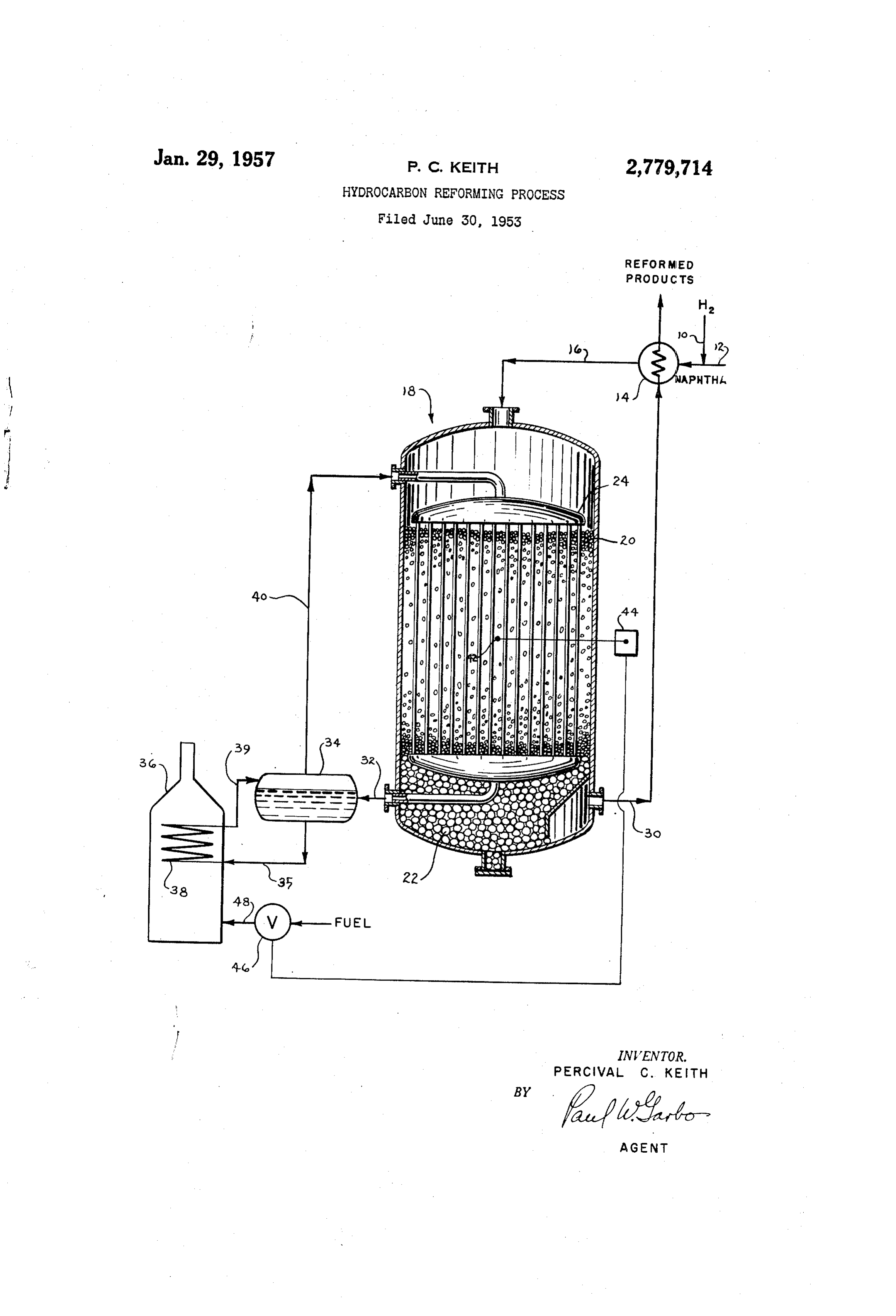
rate of heat transfer from condensing mercury attainable in heat exchanger 14 to the range of 800 to 860 F. against through a heat exchange surface is so large that incorp the reformer effluent. The total pressure on the feed mixture is in the range of 100 to 500 p.s. i. g. After orating the required amount of heat exchange surface preheating, into a reformer presents no serious problem. the feed mixture passes through line 16 to re It is a significant advantage of this invention that com 5 actor 18 holding a fixed bed of catalyst 20 supported by paratively small temperature changes in the reformation a permeable base 22 such as 1-inch ceramic balls. A Zone evidencing changes in heat requirements can sharply tubular heat exchanger 24 disposed in reactor 18 is in increase or decrease the heat supplied by the mercury denser contact with catalyst bed 20 and acts as a mercury con because such small temperature changes correspond to O to provide heat for the desired reforming reactions large fractions of the temperature differential between from a substantially isothermal source only 25 to 75 F. the mercury vapor and the reactants. Thus, a 5 F. above the reformation temperatures. The heat transfer change is 10% of a 50 F. temperature differential. Ap surfaces of exchanger 24 are disposed to provide maxi propriate changes in heat input to the mercury vaporizer mum contact with catalyst bed 20 and minimum obstruc easily compensate for shifts in heat requirements of the tion to the flow of the reactants.
reformation zone. By contact with heated catalyst and mercury condenser Optimum reforming conditions can be readily ascer 24, the feed mixture is rapidly heated to reforming tem tained by trials with the selected catalyst and the naphtha peratures, and from then on the endothermic heat neces feed stock. To generalize, reforming temperatures with sary for aromatization and dehydrocyclization is con tinuously absorbed from mercury condenser 24 at a rate in the contemplation of this invention may range between 20 sufficient to keep the reactants within a 25 F. constancy about 800 and 950 F., preferably between 875 and level during passage through catalyst bed 20. By the 950 F. When a temperature is selected as optimum for a particular naphtha and catalyst, the isothermal char time the naphtha enters inert base 22, reformation is acteristicts of heat exchange against condensing mercury completed. The reformed naphtha product still in ad can maintain reformation temperatures within a spread 25 mixture with hydrogen is removed through outlet line 30, cooled by passage through heat exchanger 14 and of about 25 F. For instance, at a selected temperature of 920 F., the naphtha undergoing reformation may be sent to a conventional recovery system. Hydrogen re covered from the reformed product is recycled to line 10 held within the temperature limits of 935 F. and 910 F. for admixture anew with fresh naphtha; the recycle gas Generally speaking, reformation at a pressure in the range of 100 to 500 p.s. i. g. is contemplated for the obtained after separating the reformed naphtha from the practice of this invention, preferably 200 to 500 p.s. i. g. reformer effluent frequently contains more than 75% by Below 100 p.s. i. g., coke formation becomes excessive volume of hydrogen.
so as to require too frequent catalyst regeneration. On The mercury condensed to impart heat to the reforma the other hand, pressures above 500 p.s. i. g. tend to ac tion is withdrawn from mercury condenser 24 through celerate unduly the hydro-cracking reaction. In the pres 35 line 32 and passed into mercury holding vessel 34. Liquid mercury flows from vessel 34 through line 35 to vaporiz sure range of 100 to 500 p.s. i. g., these two undesirable ing coil 38 inside furnace 36. Mercury vapors pass from reactions are minimized. To avoid these undesirable re actions to a satisfactory extent, the pressure and tempera tion coil 38 to condenser 24 by way of lines 39 and 40. Opera ture at which reformation is carried out may be deter of the furnace is controlled to maintain the reforma mined by simple trials. The diverse characteristics of 40 tion occurring in catalyst bed 20 at the selected tempera ture level. A thermocouple 42 embedded in catalyst the many naphthas which may be reformed according to the process of this invention prevent any clear correlation bed 20 is connected to a temperature controller 44 which of reforming pressure and temperature. Catalytically re in turn adjusts control valve 46 on the furnace fuel line forming in the preferred ranges of 200 to 500 p.s. i. g. 48. When the temperature in catalyst bed 20 drops, con and 875 to 950 F. will give very satisfactory increases troller 44 acts to open valve 46 and allow more fuel into in octane number and high gasoline yields for substan 45 furnace 36. The effect of increasing furnace heat is to tially all naphthas. increase the mercury vaporization rate and ordinarily the The complexity of the relationships between pressure, pressure and temperature of the mercury vapors inside temperature and yield is realized by the art, e. g., the condenser 24. In turn, the resultant increase in mercury Haensel article on Platforming in the April 1950 issue 50 pressure and temperature raises the temperature differen of Petroleum Processing. However, these are not the tial across the walls of condenser 24, forcing more heat only process variables which matter. Catalytic activity into catalyst bed 20 and thereby overcoming the indicated and space velocity are also recognized as critical from the deficiency. If the temperature in catalyst bed 20 rises, standpoint of yield and product quality. To a large ex controller 44 acting in the reverse direction rapidly de tent, the comparative effect of catalyst activity can be 55 creases the heat available to the reformation. This con balanced off against variations in space velocity whereby trol on the closed mercury system is sufficiently precise the same yield and quality can be obtained regardless of to maintain the reformation temperature at any point in the catalyst. To the extent that improved catalysts can the reaction mass within --5 F. of the desired tempera produce results uncompensable by this space velocity ture for that point. As already stated, the temperature factor, a slight temperature increase will substantially 60 assumed by the naphtha undergoing reformation (not in equate the product quality. The practice of this inven cluding the temperature rise necessary to bring the pre tion is not dependent on the activity of the catalyst used, heated naphtha to reforming temperatures) does not vary but the reforming temperature may now be set near the more than about 25 F. from start to finish of the reform upper limit of the reforming temperature range, for ex ing reaction.
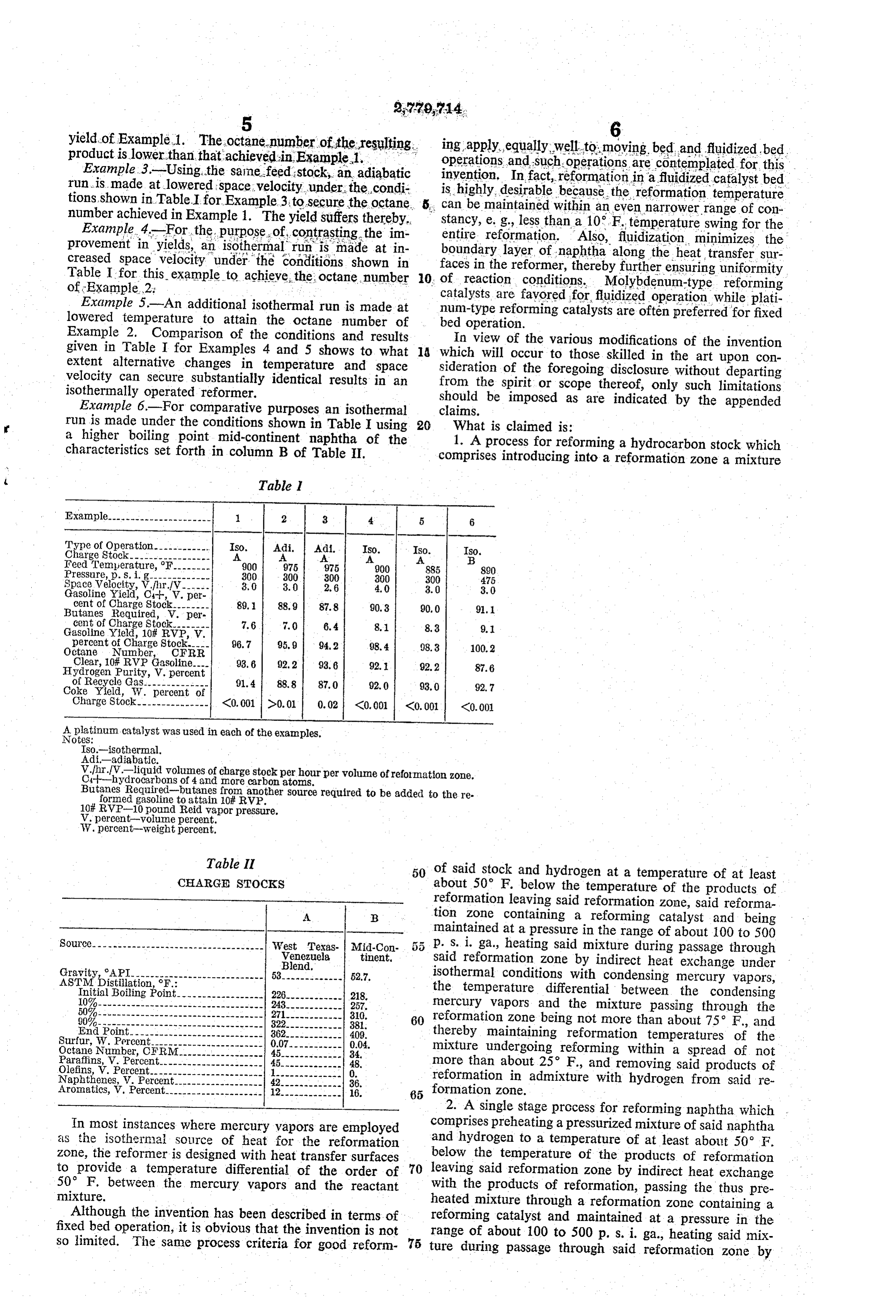
ample, when less active catalysts are used, without mate 65 For a further understanding of this invention, the fol rially increasing the yield loss due to thermal cracking lowing specific examples are set forth. because the overheating incident to adiabatic reforming Example 1-A West Texas-Venezuela blend having is avoided. the characteristics shown in column A of Table II is pre To explain more particularly the practice of this inven heated to the reforming temperature and then reformed tion, reference is now made to the accompanying draw 70 substantially isothermally under the conditions listed in ing which schematically illustrates, in sectional elevation, Table I for Example 1 to produce the yields and product a fixed bed reformer in which the invention may be car characteristics tabulated in that column. ried out.
A reasonably rich hydrogen stream (60% by volume Example 2-Using the same feed stock as in Example and higher hydrogen content) from line 10 is mixed with 1, an adiabatic run is made under the conditions shown feed naphtha from line 12 and the mixture is preheated 75 in Table I for Example 2 to secure substantially the same
Page 4
yield of Example 1. The octane number of the resulting. ing apply...equally well product is lower than that achieved in. Example 1. operations and is
Example 3-Using the same feedstock, an adiabatic invention. In fact, run.is made at lowered space.velocity under, the condit is highly, desirable tions shown in Table I for Example 3 to secure the octane. 5. can be maintained within an even narrower range of con number achieved in Example 1. The yield suffers thereby. stancy, e.g., less than a 10° F temperature swing for the Example 4. For the purpose of contrasting the im- entire reformation. Also, fluidization minimizes the provement in yields, an isothermal run is made at in- boundary layer of naphtha along the heat, transfer sur creased space velocity under the conditions shown in faces in the reformer, thereby further ensuring uniformity Table I for this example to achieve, the octane number 10 of reaction conditions. Molybdenum-type reforming of Example. 2: catalysts are favored for fluidized operation while plati Example 5.-An additional isothermal run is made at num-type reforming catalysts are often preferred for fixed lowered temperature to attain the octane number of bed operation. Example 2. Comparison of the conditions and results In view of the various modifications of the invention given in Table I for Examples 4 and 5 shows to what 13 which will occur to those skilled in the art upon con extent alternative changes in temperature and space sideration of the foregoing disclosure without departing velocity can secure substantially identical results in an from the spirit or scope thereof, only such limitations isothermally operated reformer. should be imposed as are indicated by the appended Example 6.-For comparative purposes an isothermal claims.
run is made under the conditions shown in Table I using 20 What is claimed is:
a higher boiling point mid-continent naphtha of the 1. A process for reforming a hydrocarbon stock which characteristics set forth in column B of Table II. comprises introducing into a reformation zone a mixture Table 1
Example.--------------------- 2 3. 4 5 6
Type of Operation.-----------. ISO. Adi. Adi. Iso. Iso. Iso. Charge Stock...------ A. A. A. A. A. B IFeed Temperature, F- - 900 975 975 900 885 890 Pressure, p. S. i.g------ 300 - 300 300 300 300 475 Space Velocity, Wihr.IW-----. 3.0 3.0 2.6 4.0 3.0 3.0 Gasoline Yield, C-, W. per cent of Charge Stock.-------- 89, 88, 9 87.8 90.3 90,0 91, Butanes Required, W. per cent of Charge Stock-------- 7.6 7.0 - 8.4 8. 8.3 9. Gasoline Yield, 10: RWP, W.
percent of Charge Stock.---- 96.7 95.9 94.2 93.4 98.3 100.2 Octane Number, CFRR
Clear, 10#Purity,
Hydrogen RWP Gasoline.---
W. percent 93, 6 92.2 93.6 92. 92.2 87.6 of Recycle Gas.------------. 91.4 88.8 87.0 92.0 93.0 92.7 Coke Yield, W. percent of
Charge Stock.--------------- <0.001 >0, 01 0.02 K0,00 <0.001 <0.001 A platinum catalyst was used in each of the examples.
Notes:
C4-hydrocarbons volumes of charge of 4 and stock per hour per volume of reformation zone.
more carbonatoms.
Butanes Required-butanes from another source required to be added to the re formed gasoline to attain. Of RVP.
10# RVP-10 pound Reid vapor pressure.
W. percent-volume percent.
W. percent-weight percent.
Table II 50 of said stock and hydrogen at a temperature of at least
CELARGE STOCKS about 50 F. below the temperature of the products of reformation leaving said reformation zone, said reforma
A. B tion Zone containing a reforming catalyst and being maintained at a pressure in the range of about 100 to 500
Source------------------------------------ West Texas- Mid-Col 55 p. S. i. ga., heating said mixture during passage through Venezuela tinent. said reformation zone by indirect heat exchange under
Blead,
Gravity, API.---------------------------- 58------------- 52.7.
ASTM Distiation, F: isothermal conditions with condensing mercury vapors, Initial Boiling Point.-----------------. 226------------ 218, the temperature differential between the condensing
mercury vapors and the mixture passing through the 90%------- 38. 60 reformation Zone being not more than about 75 F., and End Point.---
Surfur, W. Percent----- 409. thereby maintaining reformation temperatures of the
Octane Number, CFRM
34. mixture undergoing reforming within a spread of not
Paraffins, W. Percent-----
Olefins, W. Percent----- 48,
more than about 25 F., and removing said products of
Naphthenes, W. Percent-- 36. reformation in admixture with hydrogen from said re Aromatics, W. Percent---------- 16. 65 formation zone. 2. A single stage process for reforming naphtha which
In most instances where mercury vapors are employed comprises preheating a pressurized mixture of said naphtha as the isothernal source of heat for the reformation and hydrogen to a temperature of at least about 50 F. zone, the reformer is designed with heat transfer surfaces below the temperature of the products of reformation to provide a temperature differential of the order of 70 leaving said reformation zone by indirect heat exchange 50 F. between the mercury vapors and the reactant with the products of reformation, passing the thus pre mixture. heated mixture through a reformation zone containing a Although the invention has been described in terms of reforming catalyst and maintained at a pressure in the fixed bed operation, it is obvious that the invention is not range of about 100 to 500 p.s. i. ga., heating said mix so imited. The same process criteria for good reform 5 ture during passage through said reformation zone by
Page 5
indirect heat exchange under isothermal conditions with product mixture removed from said reformation zone condensing mercury vapors, the temperature differential and then is passed directly to said reformation zone. between the condensing mercury vapors and the mixture 4. The process of claim 2 wherein the temperature passing through the reformation zone being not more than differential between the condensing mercury vapors and about 75 F., and thereby maintaining reformation tem- 5, the mixture passing through the reformation zone is of peratures of the mixture undergoing reforming within a the order of 50 F.
spread of not more than about 25 F., and removing products of reformation in admixture with hydrogen said o the file of this patent References Cited in from said reformation Zone. UNITED STATES PATENTS 3. The process of claim 1 wherein the hydrocarbon 10 2,423,833 Hirsch ---------------- July 15, 1947 stock is preheated by indirect heat exchange with the 2,642,381 Dickinson ------------ June 16, 1953

Provenance
- Collection
- Cited prior art
- Original PDF
- patentimages.storage.googleapis.com →
- Filed
- 1953-06-30
- Pages
- 5
- Method
- pdftotext (the PDF's own text layer) + pdftoppm 300dpi page scans
- Source
- Google Patents bibliographic record
- Granted
- 1957-01-29
- Inventors
- Percival C Keith; Hydrocarbon Research Inc
- Transcribed from
- patentimages.storage.googleapis.com →