patent · US2748179
Gas manufacture
29 May 1956
Page 1
Drawing sheet — no readable text.
Page 2
Drawing sheet — no readable text.
Page 3
May 29, 1956 E. R. RETAILLIAU 2,748,179
GAS MANUFACTURE
Filed Oct. 25, 195l 3. Sheets-Sheet 3
% PENTANE FEED Cºol NVERTED TO Li Qu D
UNSaTuRAT zS ASO ARoMAT1GS
% PENTA NE FE Z 0 céonvE RTE DTo GAs
Edanorad R. Betailliau Save 26 er
Page 4
United States Patent Office Sacerated ?ay 29, 956
is vaporized and biended with a predetermined amount of oxygen-bearing gas such as ordinary air, although pure 2,748,179 oxygen may be used for certain purposes if desired. This mixture is then conditioned by a suitable heat treatment
GAS MANJFACTURE prior to being conducted into the cylinder of a compressor or of an unfired reciprocating engine where, as a result
Edmond R. Refailliau, CraEnford, N. J., assignor to Esso of the heat generated by compression of said mixture, Research and Engiaeering Company, a corporatics of the hydrocarbon is brought to a satisfactory level of ac Delaware tivation for causing it to react with the oxygen present
Appication October 25, 1951, Seria No. 253,08 O and produce a gas eminently suitable for use as city gas. 9 " Caimas. (C. 26-673) The B. t. u, value of the gas so produced is controlled by the quantity of oxygen-containing gas added and by the choice of oxygen or air. With the use of air, the dil uent nitrogen serves to reduce the B. t. u, value to the
The present invention relates to the oxidation of rela values used in city gas distribution which is usually around tively low molecular weight hydrocarbons. More par 500 B. t. u. On the other hand, if desired, a high B. t. u. ticularly, the present invention relates to the conversion gas suitable for the replacement of natural gas can be ob of relatively low molecular weight hydrocarbons which tained by partial or complete removal of the nitrogen are normally resistant to reforming reactions, into prod diluent by the additional use of suitable absorption proc ucts valuable as fuel and as intermediates for conversion 20 esses or by using steam instead of nitrogen as diluent. into products of high octane value. More specifically, The lack of availability of fuel gas or city gas at isolated the present invention relates to the generation of city gas points has long been felt. It has not been feasible to and hydrocarbon synthesis gas comprising hydrogen and build pipe lines or mains from centers wherein gas pro carbon monoxide, as well as the preparation of valuable ducer units are located, to distant areas. The use of olefins and armomatics, by oxidative cracking of said low 25 compressed city or natural gas is cumbersome and not molecular weight hydrocarbons in the presence of gaseous feasible on a large scale. By operating in accordance oxygen in the combustion space of a cyclically operat with the present invention, by setting up: a compressor, ing unfired internal combustion engine. or series of compressors or engines, at isolated points, Whereas it is well-known in the art that hydrocarbon manufactured gas of any desired B. t, u, value may be materia? may be reacted with oxygen to yield warious 30 produced in volume suitable for the load conditions oxygenated compounds. as well as hydrocarbons of lower required.
molecular weight, great difficulties have been encountered Particularly useful! as the hydrocarbon in this opera in attempting to carry out-such reactions on a commer tion are: the normally low molecular weight liquid hy cial scale. This is largely due to the fact that the reac drocarbons, such as in-pentane, n-hexane, and the like. tions. of oxygen with hydrocarbons are highly exothermic These hydrocarbons are difficult to convert into useful and that the heat thus evolved is locally so high as to products; for instance, it is either extremely difficult or cause many undesirable side reactions with the result that impossible to convert n-pentane into a cyclic hydrocar the yields. of the desirable products are extremely low, bon by hydroforming or reforming and it is very difficult usually less than 1.0% on the hydrocarbon feed. In the 40 to perform this operation on n-hexane. In the past, these few cases where such oxidation has been carried out in materials have been employed for solvents or they have commercial plants, it has been found necessary to dilute been subject to isomerization reaction and thus converted the reactants with enormous amounts of unreactive dil into a gasoline blending agent. In accordance with the uent material in order to obtain some control of the re present invention, this type of hydrocarbon is oxidatively action towards forming the desired compound. The size cracked in the compressors located at isolated spots, of the equipment required is very large with regard to the 45 whereby a large supply of manufactured gas is thus avail volume of the chemical compound produced and its cost able without the heavy cost entailed in building coal gas consequently extremely high; because of this, the oxida manufacturing plants or the cost of constructing gas mains tive treatment of hydrocarbon material has found applica and lines and piping gas large distances. tion only in cases where the relatively high value of the The size of compressors required to produce such gas oxygenated compound obtained could provide some re 50 by the process to be described in detail below is turn on the investment. It has now been found that con moderate. Thus, a single compressor having about a version of cheap hydrocarbon material by a compara 13/2 inch piston diameter and a 20 inch stroke and op tively inexpensive oxidation procedure may be performed erating at 200 R. P. M. will produce over a million cubic so as to give relatively high yields of valuable products feet per day of gas; if two or three compressors are emi such as aromatic and olefinic hydrocarbons together with 55 ployed, their size would be correspondingly smaller. some. oxygenated compounds such as carbonyls and al Smaller compressors would also be employed if higher cohols. As the source of hydrocarbon material, there may compression speeds are used. The cost of a single com be employed either gaseous hydrocarbons such as methane, pressor for producing a million cubic feet per day is in ethane and propane or liquid hydrocarbons such as, n-bu the range of about $15,000 to $20,000 and thus, it is tane, n-pentane, n-hexane and the like, which do not lend 60 readily seen that the process of the invention provides a themselves easily to reforming processes and these are convenient and inexpensive method of Supplying small converted in good yields to the above mentioned classes communities with manufactured gas. Also, if it is con of valuable compounds. The light unsaturated hydrocar templated to employ the manufactured gas as hydrocar bons are particularly valuable for alkylating purposes and bon synthesis gas, i. e. gas mixture comprising essen thus will contribute to increase the Supply of aviation 65 tially of carbon monoxide and hydrogen which is cata blending agents as will the aromatics produced in the proc lytically converted into high octane motor fuel by passage ess. On the other hand, the process may be so operated over a group VIII catalyst, this affords another means of as to produce a mixture of hydrocarbons highly suitable converting a low octane hydrocarbon into a high octane for illuminating purposes and the present application is material.
particularly concerned with these objects. Although the exact mechanism by which n-pentane is In accordance with the present invention, a low molec converted by oxygen into a multiplicity of other com ular weight hydrocarbon, such as n-pentane for example, pounds (chiefly among which carbon monoxide, hydro
Page 5
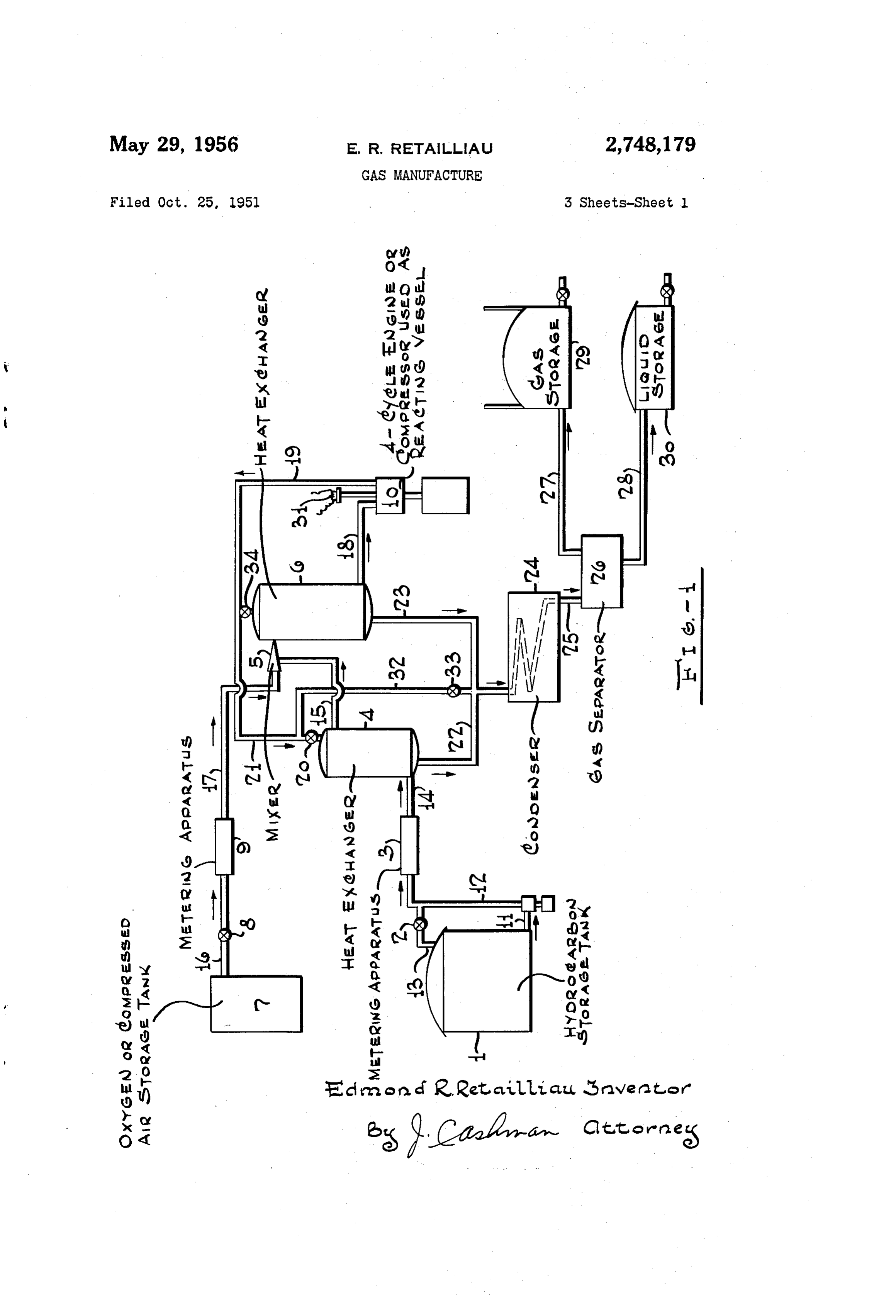
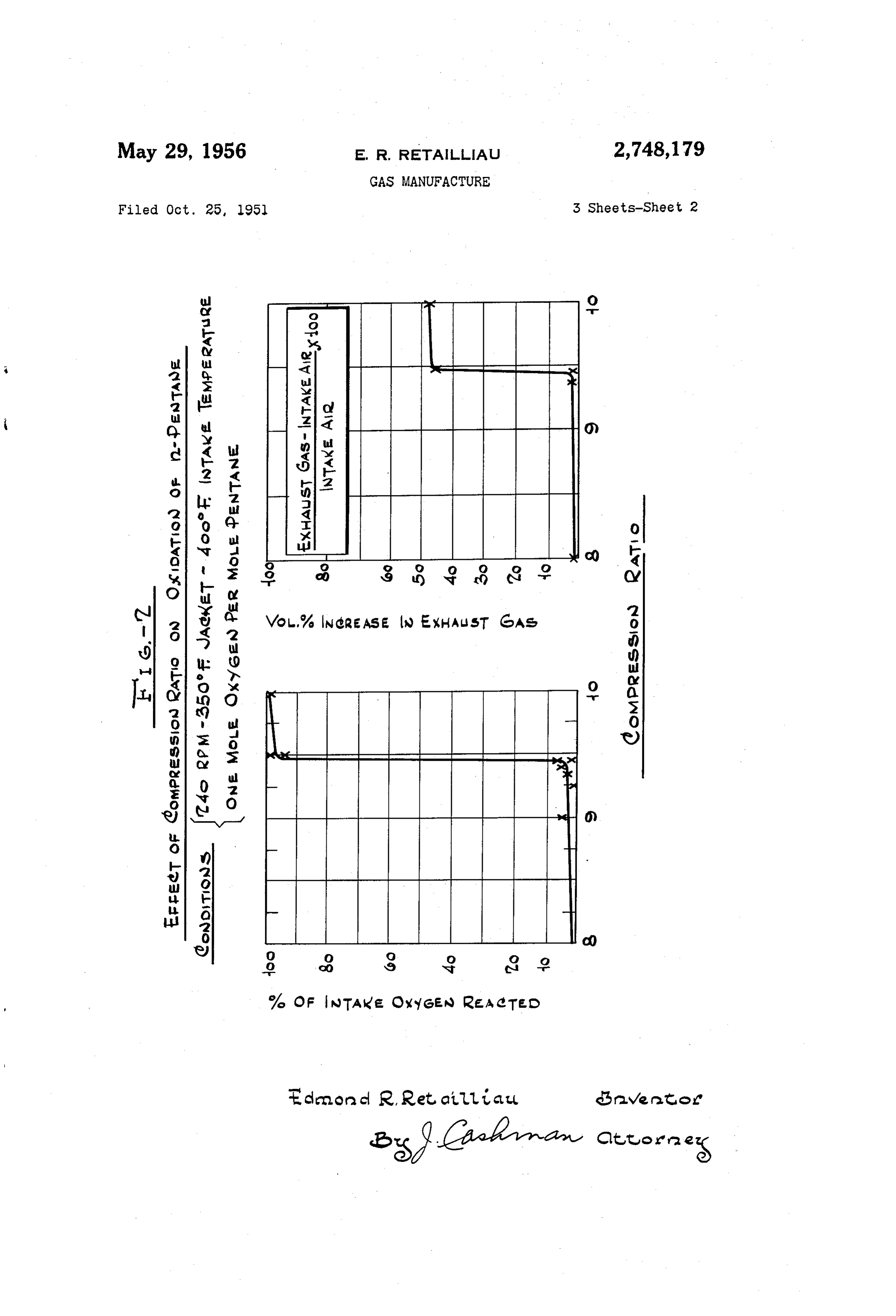
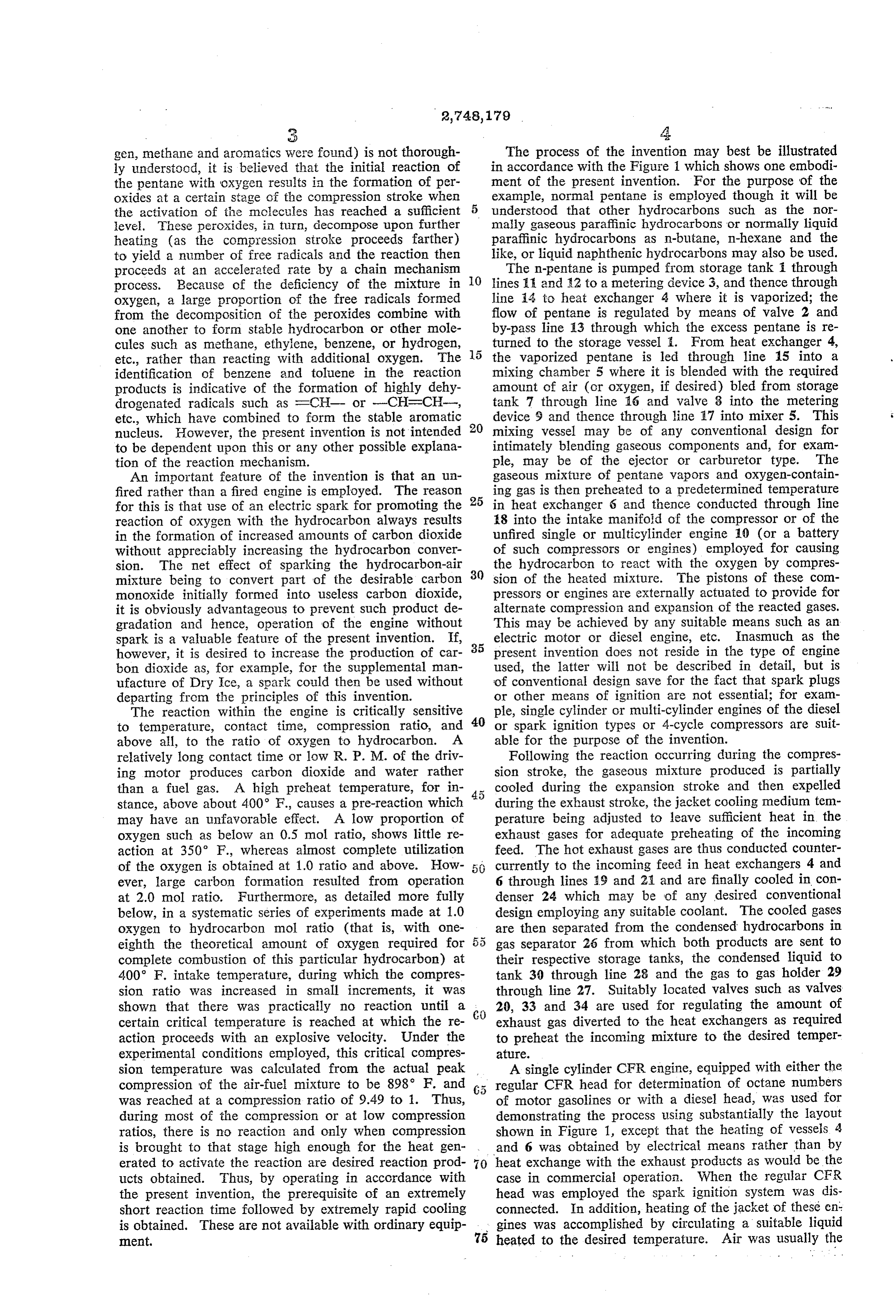
gen, methane and aromatics were found) is not thorough The process of the invention may best be illustrated ly understood, it is believed that the initial reaction of in accordance with the Figure 1 which shows one embodi the pentane with oxygen results in the formation of per ment of the present invention. For the purpose of the oxides at a certain stage of the compression stroke when example, normal pentane is employed though it will be the activation of the molecules has reached a sufficient understood that other hydrocarbons such as the nor level. These peroxides, in turn, decompose upon further mally gaseous paraffinic hydrocarbons or normally liquid heating (as the compression stroke proceeds farther) paraffinic hydrocarbons as n-butane, n-hexane and the to yield a number of free radicals and the reaction then like, or liquid naphthenic hydrocarbons may also be used. proceeds at an accelerated rate by a chain mechanism O The n-pentane is pumped from storage tank through process. Because of the deficiency of the mixture in lines 1 and 2 to a metering device 3, and thence through oxygen, a large proportion of the free radicals formed line 4 to heat exchanger 4 where it is vaporized; the from the decomposition of the peroxides combine with flow of pentane is regulated by means of valve 2 and one another to form stable hydrocarbon or other mole by-pass line 3 through which the excess pentane is re cules such as methane, ethylene, benzene, or hydrogen, turned to the storage vessel i. From heat exchanger 4, etc., rather than reacting with additional oxygen. The 15 the vaporized pentane is led through line 15 into a identification of benzene and toluene in the reaction mixing chamber 5 where it is blended with the required products is indicative of the formation of highly dehy amount of air (or oxygen, if desired) bled from storage drogenated radicals such as FCH- or -CH=CH-, tank 7 through line 16 and valve 8 into the metering etc., which have combined to form the stable aromatic 20 device 9 and thence through line 17 into mixer 5. This nucleus. However, the present invention is not intended mixing vessel may be of any conventional design for to be dependent upon this or any other possible explana intimately blending gaseous components and, for exam tion of the reaction mechanism. ple, may be of the ejector or carburetor type. The An important feature of the invention is that an un gaseous mixture of pentane vapors and oxygen-contain fired rather than a fired engine is employed. The reason 25 ing gas is then preheated to a predetermined temperature for this is that use of an electric spark for promoting the in heat exchanger 6 and thence conducted through line reaction of oxygen with the hydrocarbon always results 8 into the intake manifold of the compressor or of the in the formation of increased amounts of carbon dioxide unfired single or multicylinder engine 10 (or a battery without appreciably increasing the hydrocarbon conver of such compressors or engines) employed for causing sion. The net effect of sparking the hydrocarbon-air the hydrocarbon to react with the oxygen by compres mixture being to convert part of the desirable carbon sion of the heated mixture. The pistons of these com monoxide initially formed into useless carbon dioxide, pressors or engines are externally actuated to provide for it is obviously advantageous to prevent such product de alternate compression and expansion of the reacted gases. gradation and hence, operation of the engine without This may be achieved by any suitable means such as an spark is a valuable feature of the present invention. If, 35 electric motor or diesel engine, etc. Inasmuch as the however, it is desired to increase the production of car present invention does not reside in the type of engine bon dioxide as, for example, for the supplemental man used, the latter will not be described in detail, but is ufacture of Dry Ice, a spark could then be used without of conventional design save for the fact that spark plugs departing from the principles of this invention. or other means of ignition are not essential; for exam The reaction within the engine is critically sensitive 40 ple, single cylinder or multi-cylinder engines of the diesel to temperature, contact time, compression ratio, and or spark ignition types or 4-cycle compressors are Suit above all, to the ratio of oxygen to hydrocarbon. A able for the purpose of the invention. relatively long contact time or low R. P. M. of the driv Following the reaction occurring during the compres ing motor produces carbon dioxide and water rather sion stroke, the gaseous mixture produced is partially than a fuel gas. A high preheat temperature, for in cooled during the expansion stroke and then expelled stance, above about 400 F., causes a pre-reaction which during the exhaust stroke, the jacket cooling medium tem may have an unfavorable effect. A low proportion of perature being adjusted to leave sufficient heat in the oxygen such as below an 0.5 mol ratio, shows little re exhaust gases for adequate preheating of the incoming action at 350 F., whereas almost complete utilization feed. The hot exhaust gases are thus conducted counter of the oxygen is obtained at 1.0 ratio and above. How currently to the incoming feed in heat exchangers 4 and ever, large carbon formation resulted from operation 6 through lines 9 and 21 and are finally cooled in con at 2.0 mol ratio. Furthermore, as detailed more fully denser 24 which may be of any desired conventional below, in a systematic series of experiments made at 1.0 design employing any suitable coolant. The cooled gases oxygen to hydrocarbon mol ratio (that is, with one are then separated from the condensed hydrocarbons in eighth the theoretical amount of oxygen required for gas separator 26 from which both products are sent to complete combustion of this particular hydrocarbon) at their respective storage tanks, the condensed liquid to 400° F. intake temperature, during which the compres tank 30 through line 28 and the gas to gas holder 29 sion ratio was increased in small increments, it was through line 27. Suitably located valves such as valves shown that there was practically no reaction until a 20, 33 and 34 are used for regulating the amount of certain critical temperature is reached at which the re exhaust gas diverted to the heat exchangers as required action proceeds with an explosive velocity. Under the to preheat the incoming mixture to the desired temper experimental conditions employed, this critical compres ature.
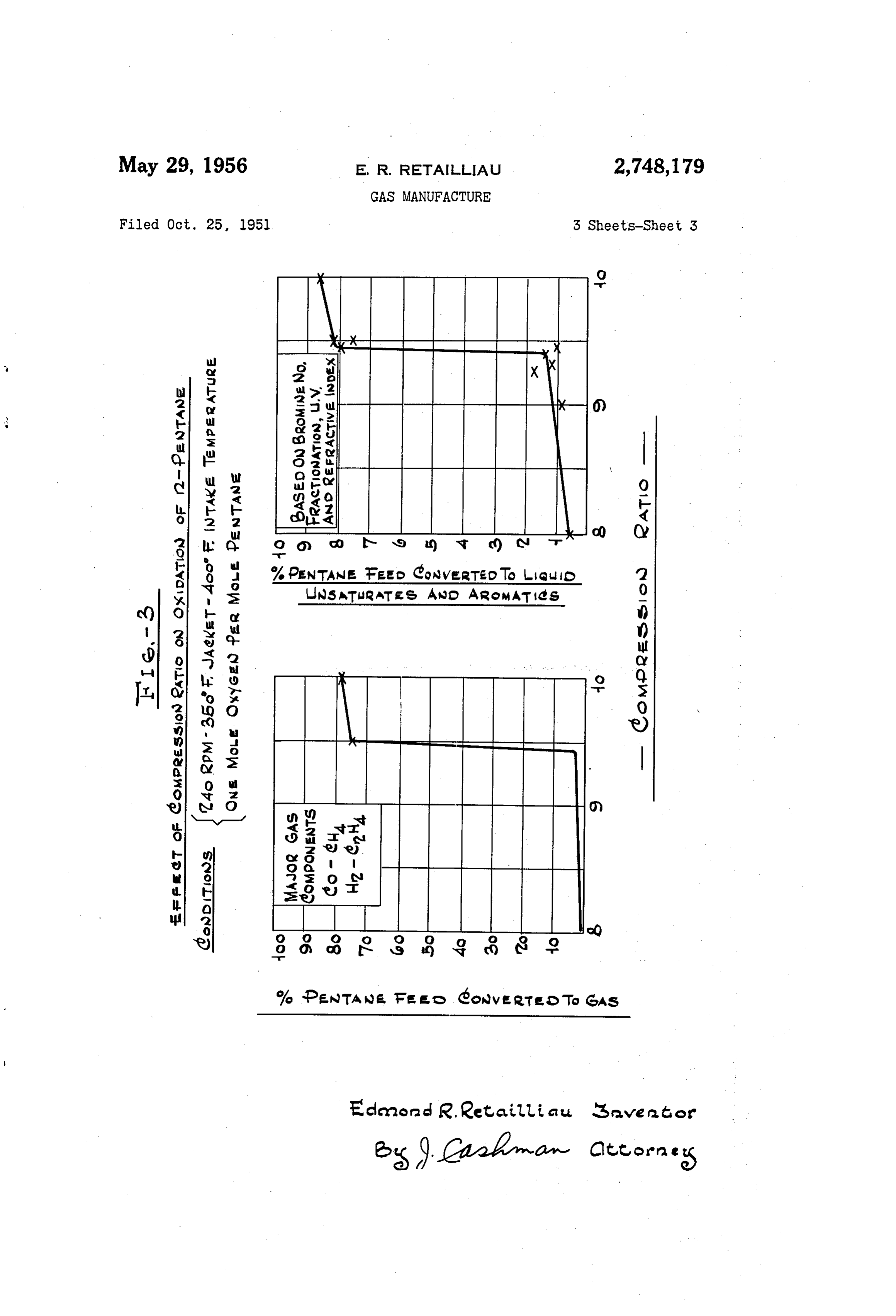
sion temperature was calculated from the actual peak A single cylinder CFR engine, equipped with either the compression of the air-fuel mixture to be 898 F. and regular CFR head for determination of octane numbers was reached at a compression ratio of 9.49 to 1. Thus, of motor gasolines or with a diesel head, was used for during most of the compression or at low compression demonstrating the process using substantially the layout ratios, there is no reaction and only when compression shown in Figure 1, except that the heating of vessels 4 is brought to that stage high enough for the heat gen and 6 was obtained by electrical means rather than by erated to activate the reaction are desired reaction prod heat exchange with the exhaust products as would be the ucts obtained. Thus, by operating in accordance with case in commercial operation. When the regular CFR the present invention, the prerequisite of an extremely head was employed the spark ignition system was dis short reaction time followed by extremely rapid cooling connected. In addition, heating of the jacket of these en is obtained. These are not available with ordinary equip gines was accomplished by circulating a suitable liquid ment. 75 heated to the desired temperature. Air was usually the
Page 6
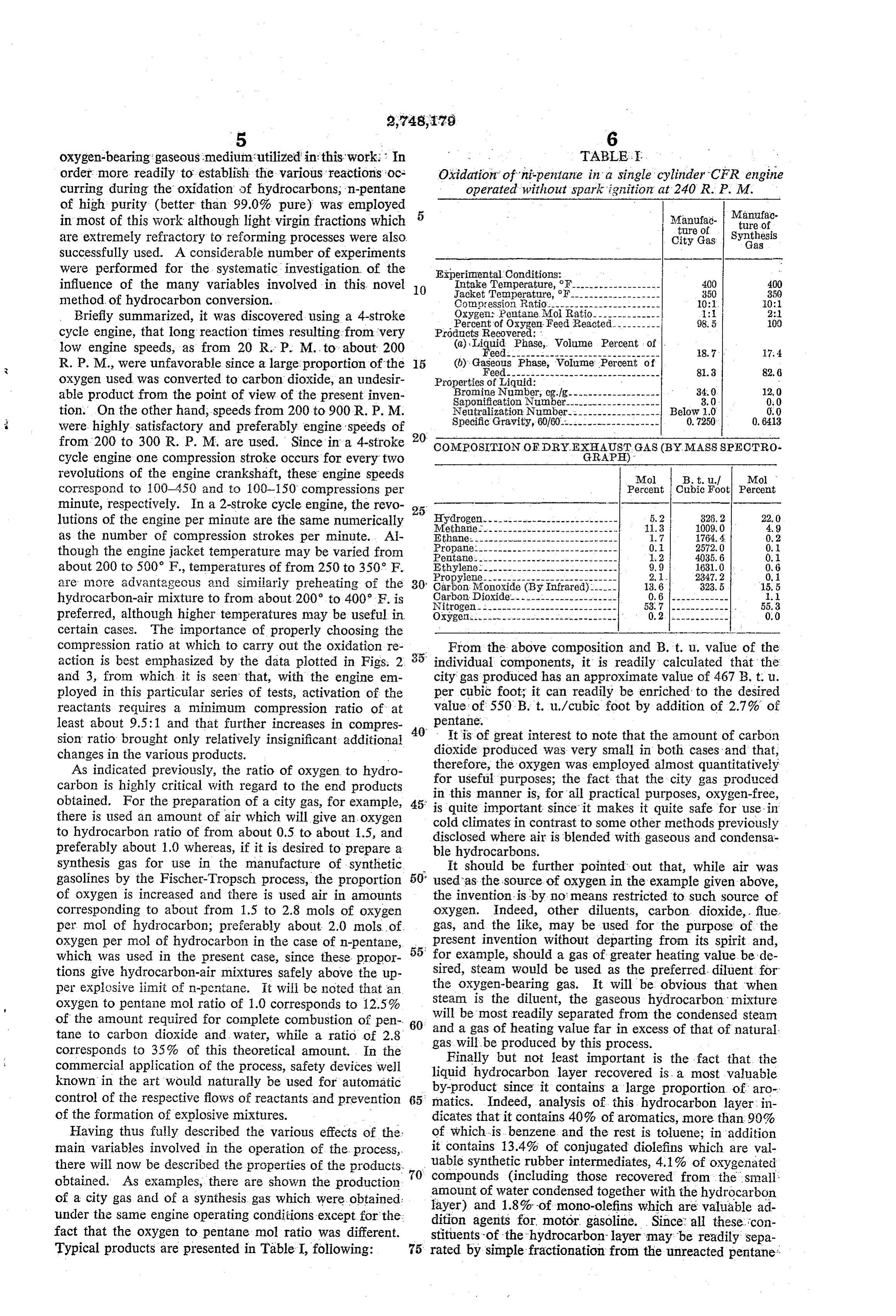
oxygen-bearing gaseous medium utilized in this work. In - TABLE. -
order more readily to establish the various reactions oc Oxidation of ni-pentane in a single cylinder CFR engine curring during the oxidation of hydrocarbons, in-pentane operated without spark ignition at 240 R. P. M. of high purity (better than 99.0% pure) was employed in most of this work although light virgin fractions which Manufac- M????' are extremely refractory to reforming processes were also ture of City Gas
Synthesis
Gas successfully used. A considerable number of experiments were performed for the systematic investigation of the Experinental Conditions:
influence of the many variables involved in this novel 0 Jacket Intake Temperature, F------------------- Temperature, F-
method of hydrocarbon conversion. Compression. Ratio ... 0: 0: Briefly summarized, it was discovered using a 4-stroke Oxygen: Pentane. MoRatio------. Percent of Oxygen. Feed Reacted.---------
cycle engine, that long reaction times resulting from very ProductsRecovered:
low engine speeds, as from 20 R. P. M.. to about 200 (a) ????? Phase, Volume Percent of . eed- ------------------------------- 8.7- 7.4
R R. P. M., were unfavorable since a large proportion of the 5 (b). Gaseous Phase, Volume Percent of Feed-------------------------------- 81.3 82.6 oxygen used was converted to carbon dioxide, an undesir Properties of Liquid:
able product from the point of view of the present inven Bromine Number, cg..fg------------------- 34,{}? 12.0 Saponification Number. 3.0 0.0 tion. On the other hand, speeds from 200 to 900 R. P. M. NeutralizationNumber-
Below 1.0
were highly satisfactory and preferably engine speeds of from 200 to 300 R. P. M. are used. Since in a 4-stroke 20. COMPOSITION OFDRY EXHAUST. GAS (BY.MASS SPECTRO cycle engine one compression stroke occurs for every two GRAPH)" revolutions of the engine crankshaft, these engine speeds MOl B. t. ud Mol correspond to 100—450 and to 100-150 compressions per percent Cubic Foot Percent minute, respectively. In a 2-stroke cycle engine, the revo 25.
lutions of the engime per minute are the same numerically Hydrogen----------------------------
as the number of compression strokes per minute. Al Ethame----- 1.7 ?764.4 0.2 though the engine jacket temperature may be varied from Propane 0. 2572.0 0.
about 200 to 500 F., temperatures of from 250 to 350° F. Ethylene
are more advantageous and similarly preheating of the 30" Carbon Monoxide (By infrared) 13.6 323.5 15.5 hydrocarbon-air mixture to from about 200 to 400 F. is Carbon Dioxide-----------------
preferred, although higher temperatures may be useful in Oxygen.------------------------------ 0.2 0.0 certain cases. The importance of properly choosing the compression ratio at which to carry out the oxidation re From the above composition and B.t. u, value of the action is best emphasized by the data plotted in Figs. 2. 35 individual components, it is readily calculated that the and 3, from which it is seen that, with the engine em city gas produced has an approximate value of 467 B. t. u. ployed in this particular series of tests, activation of the per cubic foot; it can readily be enriched to the desired reactants requires a minimum compression ratio of at value of 550. B. t. i./cubic foot by addition of 2.7% of least about 9.5:1 and that further increases in compres 40' pentane.
. It is of great interest to note that the amount of carbon sion ratio brought only relatively insignificant additional changes in the various products. dioxide produced was very small in both cases and that, As indicated previously, the ratio of oxygen to hydro therefore, the oxygen was employed almost quantitatively carbon is highly critical with regard to the end products for useful purposes; the fact that the city gas produced obtained. For the preparation of a city gas, for example, in this manner is, for all practical purposes, oxygen-free, there is used an amount of air which will give an oxygen iscoldquite important since it makes it quite safe for use in climates in contrast to some other methods previously to hydrocarbon ratio of from about 0.5 to about 1.5, and disclosed where air is blended with gaseous and condensa preferably about 1.0 whereas, if it is desired to prepare a ble hydrocarbons.
synthesis gas for use in the manufacture of synthetic It should be further pointed out that, while air was gasolines by the Fischer-Tropsch process, the proportion 50 used as the source of oxygen in the example given above, of oxygen is increased and there is used air in amounts the invention is by not means restricted to such source of corresponding to about from 1.5 to 2.8 mols of oxygen oxygen. Indeed, other diluents, carbon dioxide, flue. per mol of hydrocarbon; preferably about 2.0 mols of gas, and the like, may be used for the purpose of the oxygen per mol of hydrocarbon in the case of n-pentane, present invention without departing from its spirit and, which was used in the present case, since these propor 55 for example, should a gas of greater heating value be de tions give hydrocarbon-air mixtures safely above the up sired, steam would be used as the preferred diluent for per explosive limit of n-pentane. it will be noted that an the oxygen-bearing gas. It will be obvious that when oxygen to pentane mol ratio of 1.0 corresponds to 12.5% steam is the diluent, the gaseous hydrocarbon mixture of the amount required for complete combustion of pen 60 will be most readily separated from the condensed steam and a gas of heating value far in excess of that of natural tane to carbon dioxide and water, while a ratio of 2.8 gas will be produced by this process. corresponds to 35% of this theoretical amount. In the Finally but not least important is the fact that the commercial application of the process, safety devices well liquid hydrocarbon layer recovered is a most valuable known in the art would naturally be used for automatic by-product since it contains a large proportion of aro control of the respective flows of reactants and prevention 65 matics. Indeed, analysis of this hydrocarbon layer in of the formation of explosive mixtures. dicates that it contains 40% of aromatics, more than 90% Having thus fully described the various effects of the of which is . . benzene and the rest is toluene; in addition main variables involved in the operation of the process, it contains 13.4% of conjugated diolefins which are val there will now be described the properties of the products, 70 luable synthetic rubber intermediates, 4.1% of oxygenated compounds (including those recovered from the small obtained. As examples, there are shown the production of a city gas and of a synthesis gas which were obtained: amount of water condensed together with the hydrocarbon layer) and 1.8% of mono-olefins which are valuable ad under the same engine operating conditions except for the: dition agents for motor gasoline. Since: all these con fact that the oxygen to pentane mol ratio was different. stituents of the hydrocarbon layer may be readily sepa Typical products are presented in Table I, following: 75 rated by simple fractionation from the unreacted pentanei,
Page 7
which constitutes the remaining part of the hydrocarbon This process, therefore, provides a valuable means for layer, it is seen that a relatively important source of reve converting normal paraffins which have little value as nue is available which will make the manufacture of city motor fuel components into derivatives of far greater gas by this procedure relatively inexpensive and well value. Its versatility is well demonstrated by the fact adapted to the purpose intended. The unreacted pentane that olefins and oxygenated compounds are produced so separated can either be used for increasing the heating under the conditions just described without degradation value of the city gas manufactured when using air as to useless compounds, whereas, under different conditions, the source of oxygen-bearing gas or may be recycled to aromatics are obtainable besides providing the synthesis the process for the further production of additional city gas or city gas described in Table I. gaS. 0. What is claimed is:
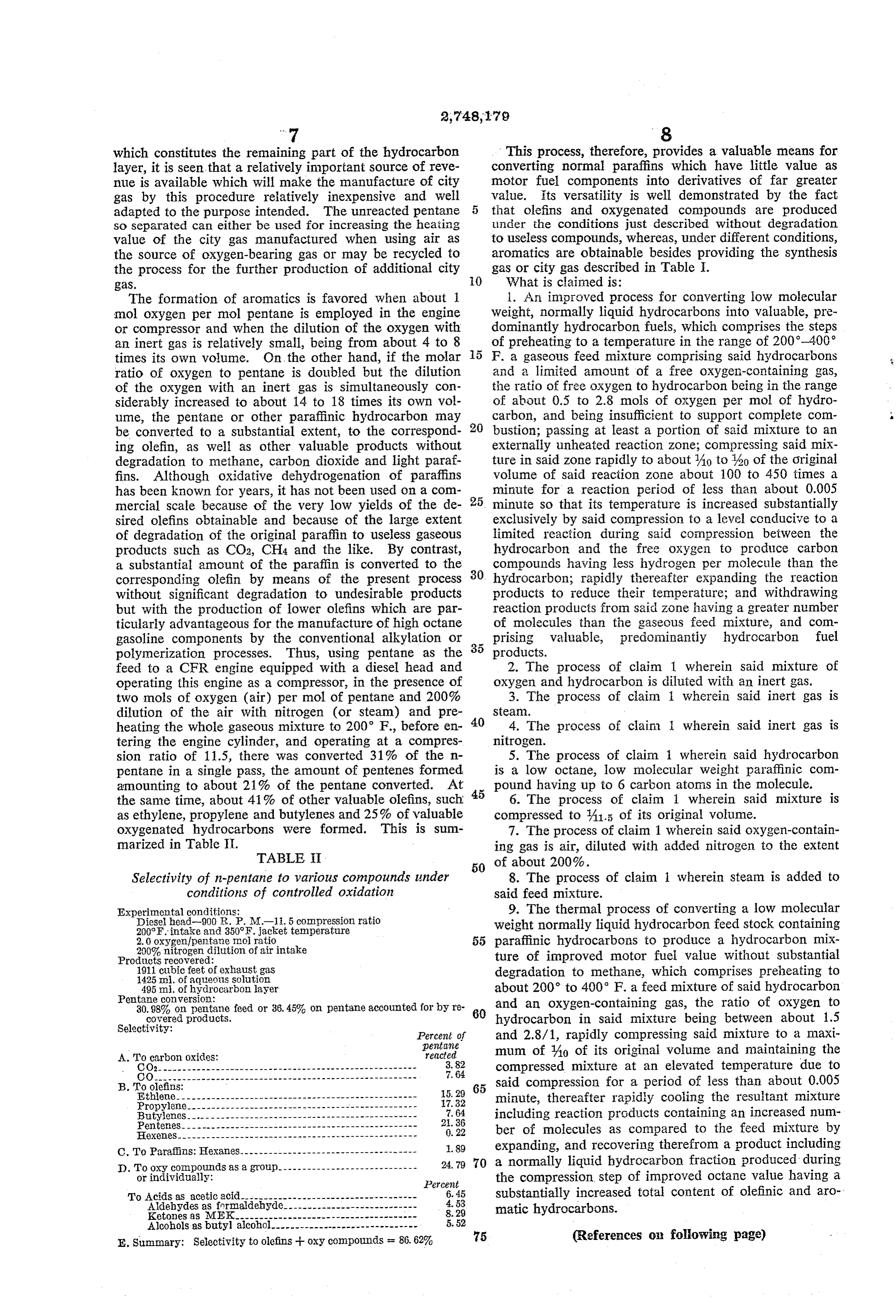
The formation of aromatics is favored when about 1. 1. An improved process for converting low molecular mol oxygen per mol pentane is employed in the engine Weight, normally liquid hydrocarbons into valuable, pre or compressor and when the dilution of the oxygen with dominantly hydrocarbon fuels, which comprises the steps an inert gas is relatively small, being from about 4 to 8 of preheating to a temperature in the range of 200-400 times its own volume. On the other hand, if the molar 5 F. a gaseous feed mixture comprising said hydrocarbons ratio of oxygen to pentane is doubled but the dilution and a limited amount of a free oxygen-containing gas, of the oxygen with an inert gas is simultaneously con the ratio of free oxygen to hydrocarbon being in the range siderably increased to about 14 to 18 times its own vol of about 0.5 to 2.8 mols of oxygen per mol of hydro ume, the pentane or other paraffinic hydrocarbon may carbon, and being insufficient to support complete com be converted to a substantial extent, to the correspond 20 bustion; passing at least a portion of said mixture to an ing olefin, as well as other valuable products without externally unheated reaction Zone; compressing said mix degradation to methane, carbon dioxide and light paraf ture in Said Zone rapidly to about A0 to 40 of the original fins. Although oxidative dehydrogenation of paraffins volume of said reaction zone about 100 to 450 times a has been known for years, it has not been used on a com 25 minute for a reaction period of less than about 0.005 mercial scale because of the very low yields of the de minute so that its temperature is increased substantially sired olefins obtainable and because of the large extent exclusively by said compression to a level conducive to a of degradation of the original paraffin to useless gaseous limited reaction during said compression between the products such as CO2, CH4 and the like. By contrast, hydrocarbon and the free oxygen to produce carbon a substantial amount of the paraffin is converted to the 30 compounds having less hydrogen per molecule than the corresponding olefin by means of the present process hydrocarbon; rapidly thereafter expanding the reaction without significant degradation to undesirable products products to reduce their temperature; and withdrawing but with the production of lower olefins which are par reaction products from said zone having a greater number ticularly advantageous for the manufacture of high octane of molecules than the gaseous feed mixture, and com gasoline components by the conventional alkylation or prising valuable, predominantiy hydrccarbon fuel polymerization processes. Thus, using pentane as the products.
feed to a CFR engine equipped with a diesel head and 2. The process of claim 1 wherein said mixture of operating this engine as a compressor, in the presence of oxygen and hydrocarbon is diluted with an inert gas. tvo mols of oxygen (air) per mol of pentane and 200% 3. The process of ciaim 1 wherein said inert gas is dilution of the air with nitrogen (or steam) and pre 40 Steann. - heating the whole gaseous mixture to 200 F., before en 4. The process of claim wherein said inert gas is tering the engine cylinder, and operating at a compres nitrogen.
sion ratio of 11.5, there was converted 31% of the n 5. The process of claim 1 wherein said hydrocarbon pentane in a single pass, the amount of pentenes formed is a low octane, low molecular weight paraffinic com amounting to about 21% of the pentane converted. At 45 pound having up to 6 carbon atoms in the molecule.
the same time, about 41% of other valuable olefins, such 6. The process of claim 1 wherein said mixture is as ethylene, propylene and butylenes and 25% of valuable compressed to Ali of its original volume.
oxygenated hydrocarbons were formed. This is sum 7. The process of claim 1 wherein said oxygen-contain marized in Table . ing gas is air, diluted with added nitrogen to the extent
TABLE I
Selectivity of n-pentane to various compounds under 8. The process of claim 1 wherein steam is added to conditions of controlled oxidation said feed mixture.
Experimental conditions: 9. The thermal process of converting a low molecular Diesel head-900 R. P. M.-1.5 compression ratio 200°F. intake and 350°F. jacket temperature weight normally liquid hydrocarbon feed stock containing 2.0 oxygen/pentanenol ratio. paraffinic hydrocarbons to produce a hydrocarbon mix 200% nitrogen dilution of air intake ture of improved motor fuel value without substantial Products recovered:
1911 cubic feet of exhaust gas 1425 ml. of aqueous solution degradation to methane, which comprises preheating to 495 m. of hydrocarbon layer about 200 to 400 F. a feed mixture of said hydrocarbon Pentane conversion:
30.98% on pentane feed or 36.45% on pentane accounted for by re 60 and an oxygen-containing gas, the ratio of oxygen to covered products.
Selectivity: hydrocarbon in said mixture being between about 1.5 Percent of pentame and 2.8/1, rapidly compressing said mixture to a maxi
A. To carbon oxides: reacted mum of Ao of its original volume and maintaining the
compressed mixture at an elevated temperature due to
B. T0 olefin 65 said compression for a period of less than about 0.005
minute, thereafter rapidly cooling the resultant mixture
ButyleneS--.- -- 7.64 including reaction products containing an increased num
0.22 ber of molecules as compared to the feed mixture by
C. To Paraffins: Hexanes.------------------------------------ 89 expanding, and recovering therefrom a product including D. To oxy compounds as a group. ---------------------------- 24.79 70 a normally liquid hydrocarbon fraction produced during or individually: the compression step of improved octane value having a To Acids as acetic acid--------- substantially increased total content of olefinic and aro- "
Aldehydes as formaldehyde 4.53 matic hydrocarbons.
Ketones as MEK---------- 8.29
E. Summary: Selectivity to olefins + oxy compounds = 86.62% 75 (References on following page)
Page 8
References Cited in file of this patent 2,274,204 Kipper ---------------- Feb. 24, 1942 UNITED STATES PATENTS 2196?362? Frey ------------------- Nov. 7, 1944 1,808,168 Hopkins ---------------- June 2, 1931 FOREIGN PATENTS 1,872,931 Goldsborough --------- Aug. 23, 1932 5 217,747 Great Britain ---------- June 26, 1924
Provenance
- Collection
- Cited prior art
- Original PDF
- patentimages.storage.googleapis.com →
- Filed
- 1951-10-25
- Pages
- 8
- Method
- pdftotext (the PDF's own text layer) + pdftoppm 300dpi page scans
- Source
- Google Patents bibliographic record
- Granted
- 1956-05-29
- Inventors
- Edmond R Retailliau; Exxon Research and Engineering Co
- Transcribed from
- patentimages.storage.googleapis.com →