patent · US2486895
Process for catalytic conversion of carbon oxides
1 November 1949
Page 1
Drawing sheet — no readable text.
Page 2
Patented Nov. 1, 1949 2,486,895
UNITED STATES PATENT OFFICE 2,486.895
PROCESS FOR, CA AC CONVERSION
OF CARBON OF DES
Claude W. Watson, Searsdale, N.Y., assignor to
The Texas Company, New York, N. Y., a cor poration of Delaware
Application December 7, 1945, Serial No. 633,481
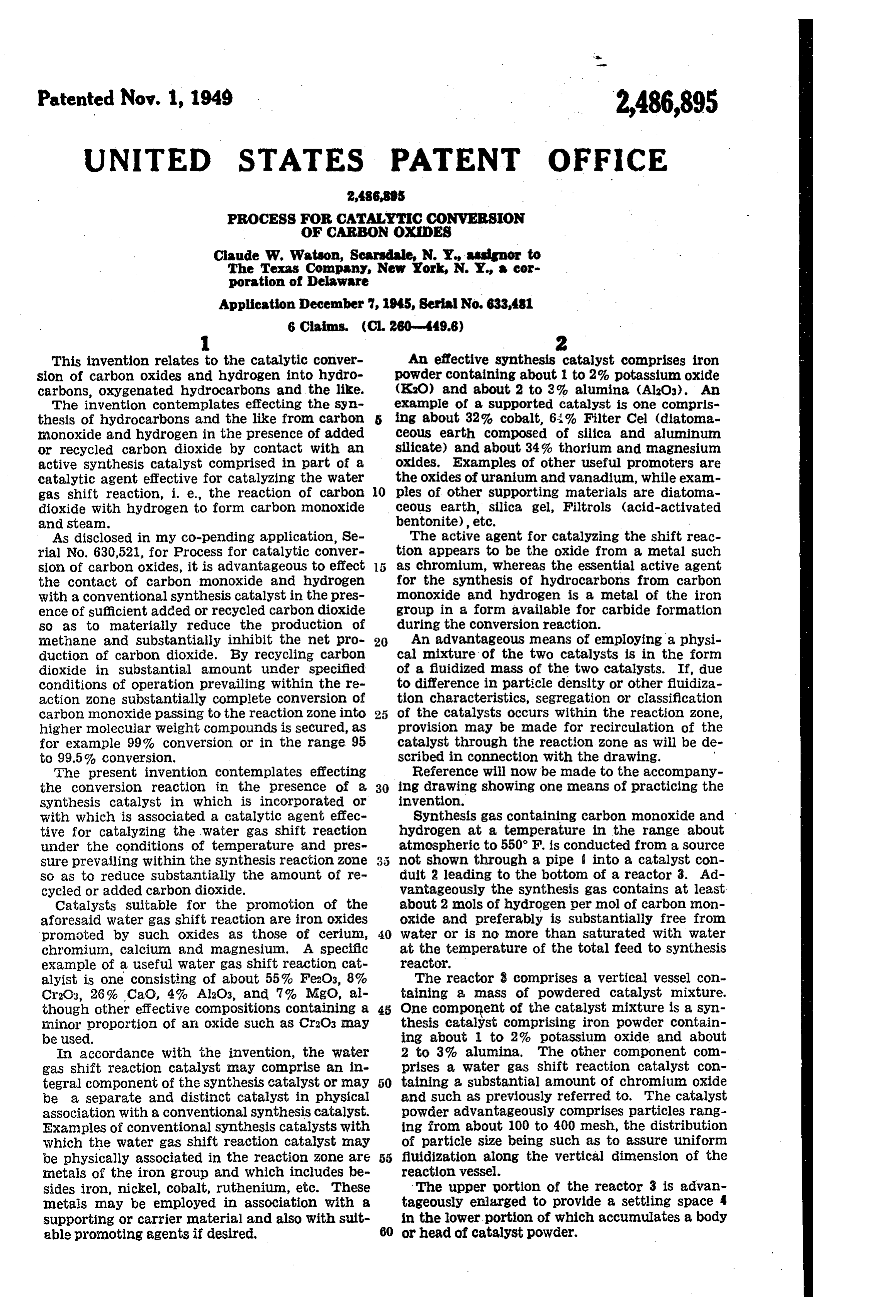
This invention relates to the Catalytic conver An effective synthesis catalyst comprises iron sion of carbon oxides and hydrogen into hydro powder containing about 1 to 2% potassium oxide carbons, oxygenated hydrocarbons and the like. (KO) and about 2 to 3% alumina (Al2O3). An The invention contemplates effecting the Syn example of a supported catalyst is one compris thesis of hydrocarbons and the like from carbon ing about 32% cobalt, 6.4% Filter Cel (diatoma monoxide and hydrogen in the presence of added ceous earth composed of silica and aluminum or recycled carbon dioxide by contact with an silicate) and about 34% thorium and magnesium active synthesis catalyst comprised in part of a oxides. Examples of other useful promoters are catalytic agent effective for catalyzing the water the oxides of uranium and vanadium, while exam gas shift reaction, i. e., the reaction of carbon 0 ples of other supporting materials are diatoma dioxide with hydrogen to form carbon monoxide ceous earth, silica gel, Filtrols (acid-activated and steam. bentonite), etc.
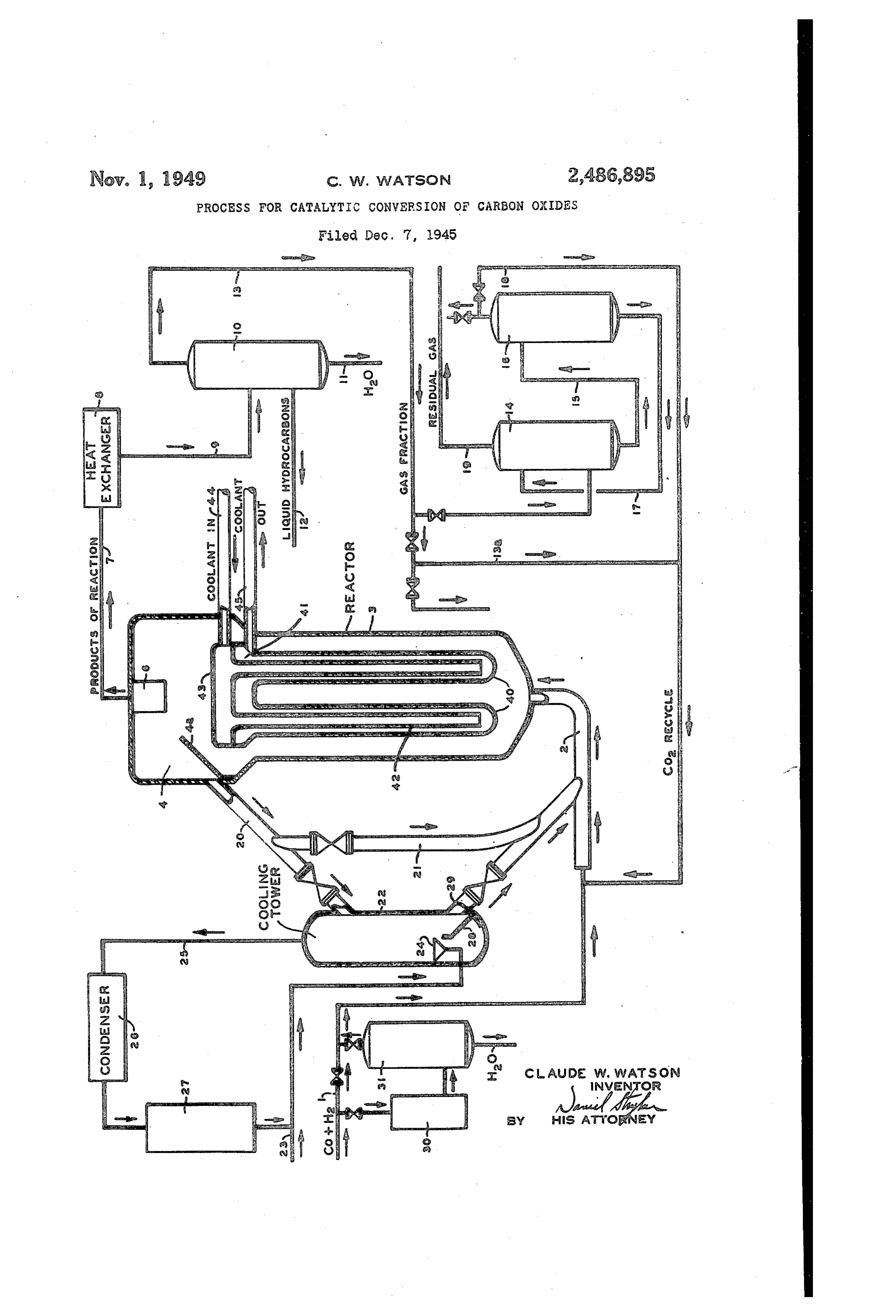
As disclosed in my co-pending application, Se The active agent for catalyzing the shift reac rial No. 630,521, for Process for catalytic conver tion appears to be the oxide from a metal such sion of carbon oxides, it is advantageous to effect as chronium, whereas the essential active agent the contact of carbon monoxide and hydrogen for the synthesis of hydrocarbons from carbon with a conventional synthesis catalyst in the pres monoxide and hydrogen is a metal of the iron ence of sufficient added or recycled carbon dioxide group in a form available for carbide formation so as to materially reduce the production of during the conversion reaction. methane and substantially inhibit the net pro 20 An advantageous means of employing a physi duction of carbon dioxide. By recycling carbon cal mixture of the two catalysts is in the form dioxide in substantial amount under specified of a fiuidized mass of the two catalysts. If, due conditions of operation prevailing within the re to difference in particle density or other fluidiza action Zone substantially complete conversion of tion characteristics, segregation or classification carbon monoxide passing to the reaction Zone into of the catalysts occurs within the reaction zone, higher molecular weight compounds is secured, as provision may be made for recirculation of the for example 99% conversion or in the range 95 catalyst through the reaction zone as will be de to 99.5% conversion. Scribed in connection with the drawing. The present invention contemplates effecting Reference will now be made to the accompany the conversion reaction in the presence of a 30 ing drawing showing one means of practicing the Synthesis catalyst in which is incorporated or invention.
with which is associated a catalytic agent effec Synthesis gas containing carbon monoxide and tive for catalyzing the Water gas shift reaction hydrogen at a temperature in the range about under the conditions of temperature and pres atmospheric to 550 F. is conducted from a source sure prevailing within the Synthesis reaction Zone 3 5 not shown through a pipe into a catalyst con so as to reduce substantially the amount of re duit 2 leading to the bottom of a reactor 3. Ad cycled or added carbon dioxide. vantageously the synthesis gas contains at least Catalysts suitable for the promotion of the about 2 mols of hydrogen per mol of carbon mon aforesaid water gas shift reaction are iron oxides oxide and preferably is substantially free from promoted by such oxides as those of cerium, 40 Water or is no more than saturated with water chromium, calcium and magnesium. A specific at the temperature of the total feed to synthesis example of a useful water gas shift reaction cat reactor.
alyist is one consisting of about 55% Fe2O3, 8% The reactor 3 comprises a vertical vessel con Cr2O3, 26% CaO, 4%. Al2O3, and 7% MgO, al taining a mass of powdered catalyst mixture. though other effective compositions containing a 45 One component of the catalyst mixture is a syn minor proportion of an oxide such as Cr2O3 may thesis catalyst comprising iron powder contain be used. ing about 1 to 2% potassium oxide and about In accordance with the invention, the water 2 to 3% alumina. The other component com gas shift reaction catalyst may comprise an in prises a water gas shift reaction catalyst con tegral component of the Synthesis catalyst or may 50 taining a substantial amount of chromium oxide be a separate and distinct catalyst in physical and such as previously referred to. The catalyst association with a conventional Synthesis catalyst. powder advantageously comprises particles rang Examples of conventional synthesis catalysts with ing from about 100 to 400 mesh, the distribution which the water gas shift reaction catalyst may of particle size being such as to assure uniform be physically associated in the reaction Zone are 55 fluidization along the vertical dimension of the metals of the iron group and which includes be reaction vessel.
sides iron, nickel, cobalt, ruthenium, etc. These The upper portion of the reactor 3 is advan metals may be employed in association with a tageously enlarged to provide a settling space 4 supporting or carrier material and also with suit in the lower portion of which accumulates a body able promoting agents if desired, 60 or head of catalyst powder.
Page 3
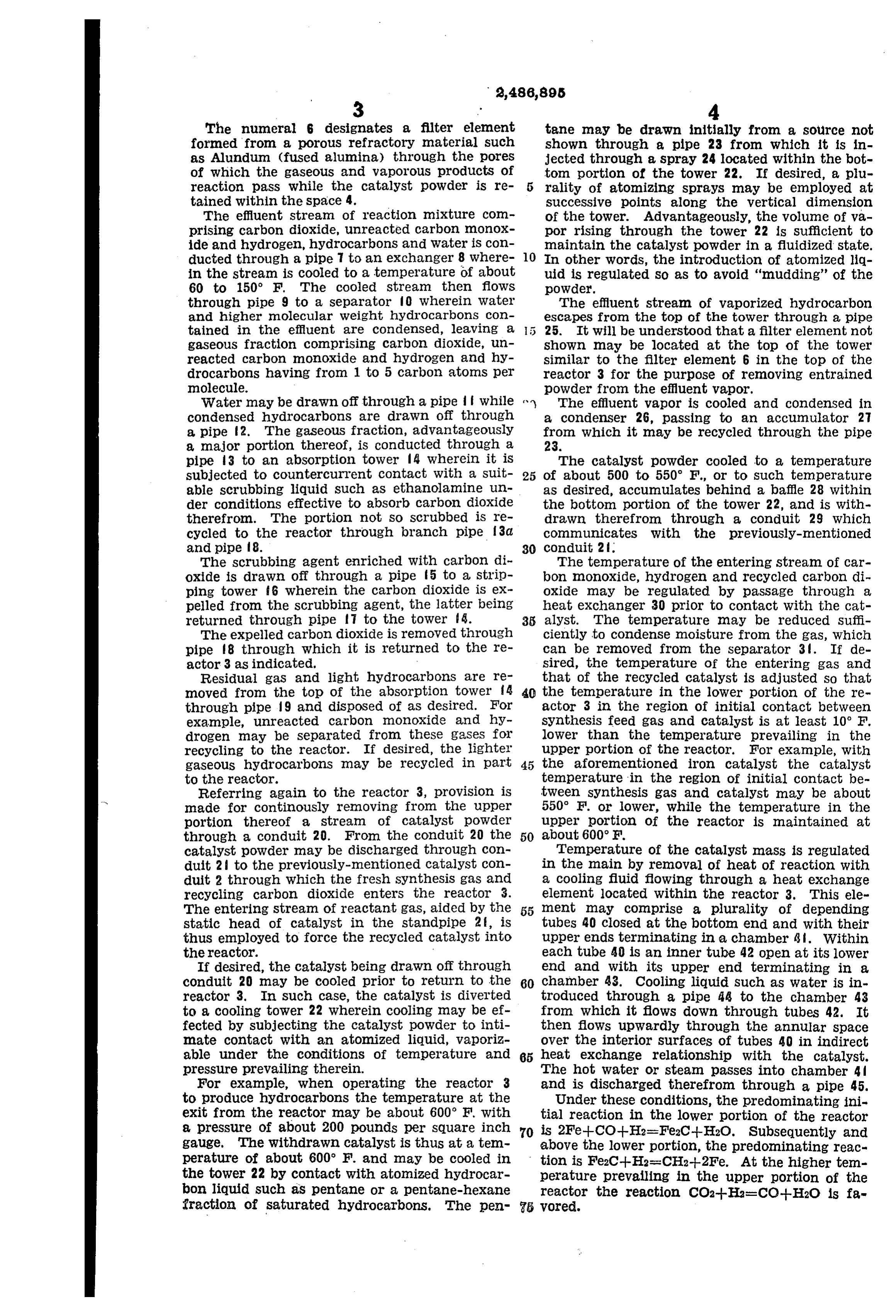
The numeral 6 designates a filter element tane may be drawn initially from a source not formed from a porous refractory material such shown through a pipe 23 from which it is in as Alundum (fused alumina) through the pores jected through a spray 24 located within the bot of which the gaseous and vaporous products of tom portion of the tower 22. If desired, a plu reaction pass while the catalyst powder is re rality of atomizing sprays may be employed at tained within the space 4. successive points along the vertical dimension The effluent stream of reaction mixture con of the tower. Advantageously, the volume of va prising carbon dioxide, unreacted carbon monox por rising through the tower 22 is sufficient to ide and hydrogen, hydrocarbons and Water is con maintain the catalyst powder in a fluidized State. ducted through a pipe 7 to an exchanger 8 where 10 In other words, the introduction of atomized liq in the stream is cooled to a temperature of about uid is regulated So as to avoid 'mudding' of the 60 to 150° F. The cooled stream then flows powder.
through pipe 9 to a separator 0 wherein Water The effluent stream of vaporized hydrocarbon and higher molecular weight hydrocarbons con escapes from the top of the tower through a pipe tained in the effluent are condensed, leaving a 25. It will be understood that a filter element not gaseous fraction comprising carbon dioxide, un shown may be located at the top of the tower reacted carbon monoxide and hydrogen and hy similar to the filter element 6 in the top of the drocarbons having from 1 to 5 carbon atons per reactor 3 for the purpose of removing entrained molecule. powder from the effluent vapor. Water may be drawn off through a pipe if while r The effluent vapor is cooled and condensed in condensed hydrocarbons are drawn off through a condenser 26, passing to an accumulator 2 a pipe 2. The gaseous fraction, advantageously from which it may be recycled through the pipe a major portion thereof, is conducted through a 23.
pipe 3 to an absorption tower 4 wherein it is The catalyst powder cooled to a temperature subjected to countercurrent contact with a suit 25 of about 500 to 550 F., or to such temperature able scrubbing liquid such as ethanolamine un as desired, accumulates behind a baffle 28 within der conditions effective to absorb carbon dioxide the bottom portion of the tower 22, and is with therefrom. The portion not so scrubbed is re drawn therefrom through a conduit 29 which cycled to the reactor through branch pipe 3d communicates with the previously-mentioned and pipe 8. 30 conduit 2.
The scrubbing agent enriched with carbon di The temperature of the entering stream of car oxide is drawn off through a pipe 5 to a strip bon monoxide, hydrogen and recycled carbon di ping tower 6 wherein the carbon dioxide is ex oxide may be regulated by passage through a pelled from the scrubbing agent, the latter being heat exchanger 30 prior to contact with the cat returned through pipe f7 to the tower f4. 35 alyst. The temperature may be reduced suffi The expelled carbon dioxide is removed through ciently to condense moisture from the gas, which pipe 8 through which it is returned to the re can be removed from the separator 3. If de actor 3 as indicated. sired, the temperature of the entering gas and Residual gas and light hydrocarbons are re. that of the recycled catalyst is adjusted so that moved from the top of the absorption tower 4 40 the temperature in the lower portion of the re through pipe 9 and disposed of as desired. For actor 3 in the region of initial contact between example, unreacted carbon monoxide and hy synthesis feed gas and catalyst is at least 10 F. drogen may be separated from these gases for lower than the temperature prevailing in the recycling to the reactor. If desired, the lighter upper portion of the reactor. For example, with gaseous hydrocarbons may be recycled in part 45 the aforementioned iron catalyst the catalyst to the reactor. temperature in the region of initial contact be Referring again to the reactor 3, provision is tween synthesis gas and catalyst may be about made for continously removing from the upper 550 F. or lower, while the temperature in the portion thereof a stream of catalyst powder upper portion of the reactor is maintained at through a conduit 20. From the conduit 20 the 50 about 600°F.
catalyst powder may be discharged through Con Temperature of the catalyst mass is regulated duit 2 to the previously-mentioned catalyst con in the main by removal of heat of reaction with duit 2 through which the fresh Synthesis gas and a cooling fluid flowing through a heat exchange recycling carbon dioxide enters the reactor 3. element located within the reactor 3. This ele The entering stream of reactant gas, aided by the 55 ment may comprise a plurality of depending static head of catalyst in the standpipe 2, is tubes 40 closed at the bottom end and with their thus employed to force the recycled catalyst into upper ends terminating in a chamber 3. Within the reactor. each tube 40 is an inner tube 42 open at its lower If desired, the catalyst being drawn off through end and with its upper end terminating in a conduit 20 may be cooled prior to return to the 60 chamber 43. Cooling liquid such as water is in reactor 3. In such case, the catalyst is diverted troduced through a pipe 44 to the chamber 43 to a cooling tower 22 wherein cooling may be ef from which it flows down through tubes 42. It fected by subjecting the catalyst powder to inti then flows upwardly through the annular space mate contact with an atomized liquid, vaporiz Over the interior surfaces of tubes 40 in indirect able under the conditions of temperature and 65 heat exchange relationship with the catalyst. pressure prevailing therein. The hot water or steam passes into chamber 4 For example, when operating the reactor 3 and is discharged therefrom through a pipe 45. to produce hydrocarbons the temperature at the Under these conditions, the predominating ini exit from the reactor may be about 600°F. with tial reaction in the lower portion of the reactor a pressure of about 200 pounds per square inch 70 is 2Fe--CO--H2=Fe2C-i-H2O. Subsequently and gauge. The withdrawn catalyst is thus at a tem above the lower portion, the predominating reac perature of about 600 F. and may be cooled in tion is Fe2C--H2=CH2--2Fe. At the higher tem the tower 22 by contact with atomized hydrocar perature prevailing in the upper portion of the bon liquid such as pentane or a pentane-hexane reactor the reaction CO2--Ha=CO-H2O is fa traction of saturated hydrocarbons. The pen 5 vored.
Page 4
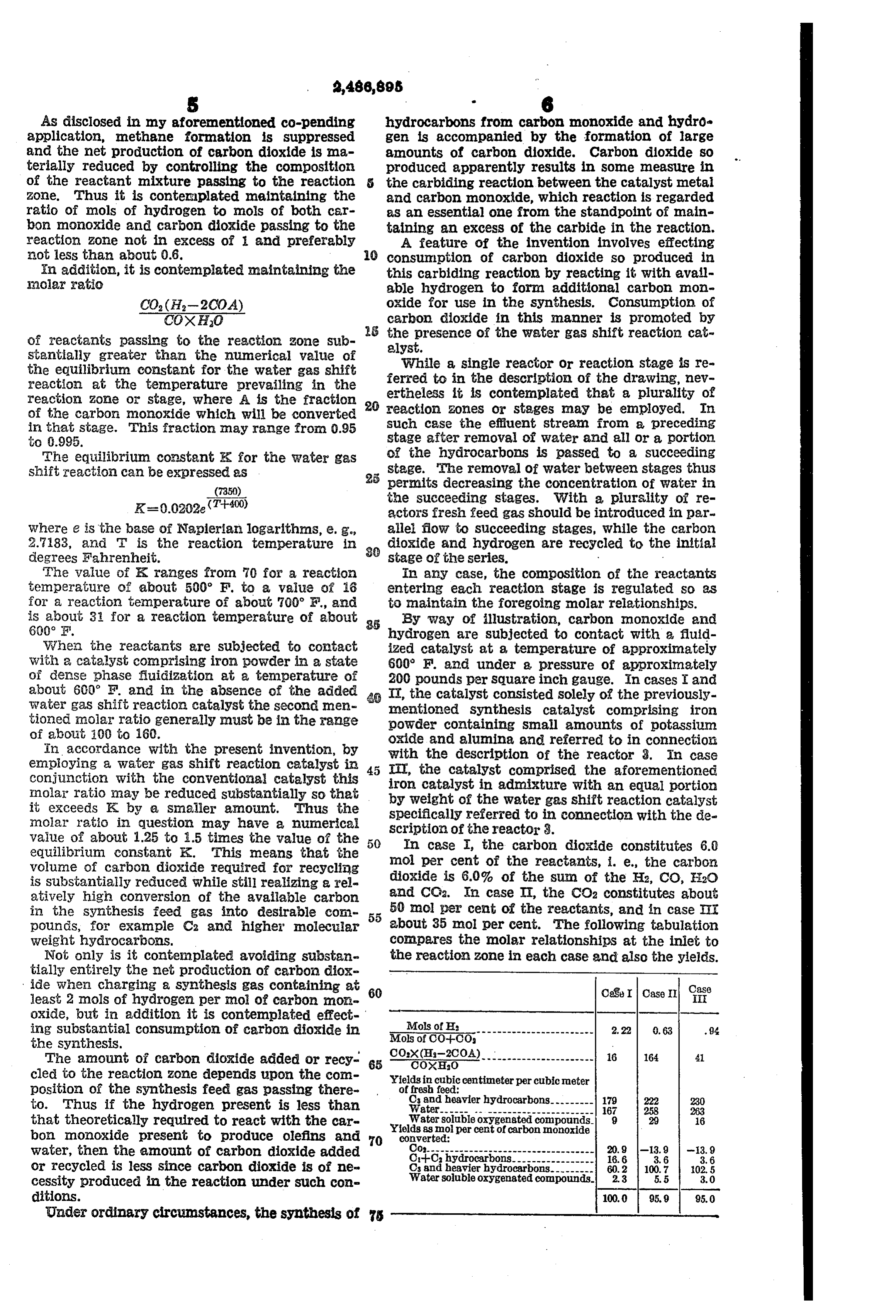
As disclosed in my aforementioned co-pending hydrocarbons from carbon monoxide and hydroe application, methane formation is suppressed gen is accompanied by the formation of large and the net production of carbon dioxide is ma amounts of carbon dioxide. Carbon dioxide so terially reduced by controlling the composition produced apparently results in some measure in of the reactant mixture passing to the reaction the carbiding reaction between the catalyst metal Zone. Thus it is contemplated maintaining the and carbon monoxide, which reaction is regarded ratio of mols of hydrogen to mois of both car as an essential one from the standpoint of main bon monoxide and carbon dioxide passing to the taining an excess of the carbide in the reaction. reaction zone not in excess of 1 and preferably A feature of the invention involves effecting riot less than about 0.6. consumption of carbon dioxide so produced in In addition, it is contemplated maintaining the this carbiding reaction by reacting it with avail Inolar ratio able hydrogen to form additional carbon non CO, (H-2COA) oxide for use in the Synthesis. Consumption of COXHO carbon dioxide in this manner is promoted by the presence of the water gas shift reaction cat
of reactants passing to the reaction zone Sub alyst.
stantially greater than the numerical value of While a single reactor or reaction stage is re the equilibrium constant for the water gas shift ferred to in the description of the drawing, nev reaction at the temperature prevailing in the reaction zone or stage, where A is the fraction 20 ertheless reaction it is contemplated that a plurality of zones or stages may be employed. In of the carbon monoxide which will be converted in that stage. This fraction may range from 0.95 such case the effluent stream from a preceding to 0.995. stage after removal of water and all or a portion. The equilibrium constant E for the water gas of the hydrocarbons is passed to a succeeding shift reaction can be expressed as stage. The removal of water between stages thus 25 permits decreasing the concentration of Water in (7350) the succeeding stages. With a plurality of re
K-0.0202e (Th400 actors fresh feed gas should be introduced in par where e is the base of Napierian logarithms, e.g., allel flow to succeeding stages, while the carbon 2.7183, and T is the reaction temperature in 8 dioxide and hydrogen are recycled to the initial degrees Fahrenheit. stage of the series.
The value of K ranges from 70 for a reaction In any case, the composition of the reactants temperature of about 500° F. to a value of 16 entering each reaction stage is regulated so as for a reaction temperature of about 700° S., and to maintain the foregoing molar relationships. is about 3 for a reaction temperature of about 35 By way of illustration, carbon monoxide and 60° E. hydrogen are subjected to contact with a fluid When the reactants are subjected to contact ized catalyst at a temperature of approximately with a catalyst comprising iro powder in a state 600 F. and under a pressure of approximately of dense phase fluidization at a temperature of 200 pounds per Square inch gauge. In cases and about 600 F. and in the absence of the added II, the catalyst consisted solely of the previously Water gas shift reaction catalyst the second men 49 merationed synthesis catalyst comprising iron tioned molar ratio generally must be in the range powder containing Small amounts of potassium of about 300 to 160. oxide and alumina and referred to in connection In accordance with the present invention, by with the description of the reactor 3. In case employing a water gas shift reaction catalyst in 45 l, the catalyst comprised the aforementioned conjunction with the conventional catalyst this iron catalyst in admixture with an equal portion In olar ratio may be reduced substantially so that by weight of the water gas shift reaction catalyst it exceeds K by a smaller amount. Thus the Specifically referred to in connection with the de molar ratio in question may have a numerica Scription of the reactor 3. value of about 1.25 to 1.5 times the value of the In case I, the carbon dioxide constitutes 6.0 equilibrium constant K. This means that he volume of carbon dioxide required for recycling mol per cent of the reactants, i. e., the carbon is substantially reduced while still realizing a re dioxide is 6.0% of the sum of the H2, CO, H2O atively high conversion of the available carbon and CO2. In case II, the CO2 constitutes about in the synthesis feed gas into desirable corn 50 mol per cent of the reactants, and in case III pounds, for example C2 and higher molecular about 35 mol per cent. The following tabulation Weight hydrocarbons. compares the molar relationships at the inlet to Not only is it contemplated avoiding substan the reaction zone in each case and also the yields. tially entirely the net production of carbon diox ide when charging a synthesis gas containing at 60 Case I Case II Case least 2 mols of hydrogen per not of carbon mor oxide, but in addition it is contemplated effect ing Substantial consumption of carbon dioxide in Mols of H ----------............... 2.22 0.63 .94 the Synthesis. Mols of CO--CO
The amount of carbon dioxide added or recy 65 COX(Hs-2COA)-...-------.............
COXHO
cled to the reaction zone depends upon the comi Yields incubic centimeter per cubic meter position of the synthesis feed gas passing there of fresh feed:
to. Thus if the hydrogen present is less than C and heavier hydrocarbons--------- 179 222 230
that theoretically required to react with the car Water soluble oxygenated compounds. 9 Yields as molper cent of carbon monoxide
bon monoxide present to produce olefins and 70 converted:
water, then the amount of carbon dioxide added Con----------------------------------- 20.9 -13.9 -3.9 C1--Ca hydrocarbons----------------- 16.6 3.6 3, 6 or recycled is less since carbon dioxide is of ne Cs and heavier hydrocarbons-------- 60.2 100.7 02.5 cessity produced in the reaction under such con Water soluble oxygenated compounds 2.3 5.5 3.0 ditions.
Under ordinary circumstances, the synthesis of
Page 5
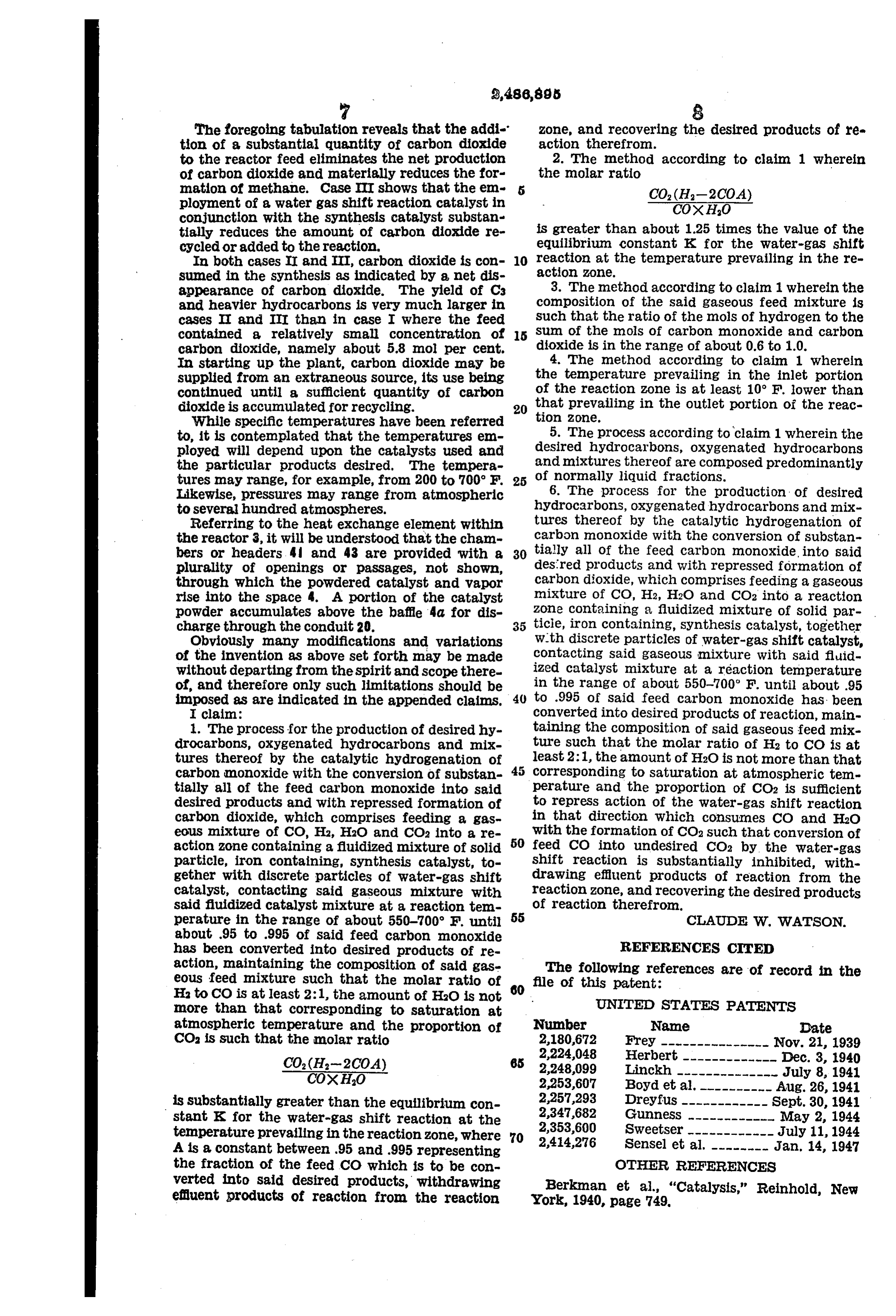
The foregoing tabulation reveals that the addis' zone, and recovering the desired products of rea tion of a substantial quantity of carbon dioxide action therefrom.
to the reactor feed eliminates the net production 2. The method according to claim 1 wherein of carbon dioxide and materially reduces the for the molar ratio nation of methane. Case I shows that the en CO, (H-2COA) ployment of a water gas shift reaction catalyst in COX HO conjunction with the synthesis catalyst substan tially reduces the amount of carbon dioxide re is greater than about 1.25 times the value of the cycled or added to the reaction. equilibrium constant K for the water-gas shift In both cases II and III, carbon dioxide is con O reaction at the temperature prevailing in the re sumed in the synthesis as indicated by a net dis action Zone.
appearance of carbon dioxide. The yield of C3 3. The method according to claim 1 wherein the and heavier hydrocarbons is very much larger in composition of the said gaseous feed mixture is cases II and III than in case I where the feed Such that the ratio of the mols of hydrogen to the contained a relatively Small concentration of 5 Sun of the mols of carbon monoxide and carbon carbon dioxide, namely about 5.8 mol per cent. dioxide is in the range of about 0.6 to 1.0. In starting up the plant, carbon dioxide may be 4. The method according to claim 1 wherein supplied from an extraneous Source, its use being the temperature prevailing in the inlet portion continued until a sufficient quantity of carbon of the reaction Zone is at least 10° F. lower than dioxide is accumulated for recycling. 20 that prevailing in the outlet portion of the reac While specific temperatures have been referred tion 2 One.
to, it is contemplated that the temperatures em 5. The process according to claim 1 wherein the ployed will depend upon the catalysts used and desired hydrocarbons, oxygenated hydrocarbons the particular products desired. The tempera and mixtures thereof are composed predominantly tures may range, for example, from 200 to 700°F. 25 of normally liquid fractions. Likewise, pressures may range from atmospheric 6. The proceSS for the production of desired to several hundred atmospheres. hydrocarbons, oxygenated hydrocarbons and mix Referring to the heat exchange element within tures thereof by the catalytic hydrogenation of the reactor 3, it will be understood that the cham carbon monoxide with the conversion of substan bers or headers, 4 and 43 are provided with a 30 tially all of the feed carbon monoxide, into said plurality of openings or passages, not shown, desired products and with repressed formation of through which the powdered catalyst and vapor carbon dioxide, which comprises feeding a gaseous rise into the space 4. A portion of the catalyst mixture of CO, H2, H2O and CO2 into a reaction powder accumulates above the baffle a for dis Zone containing a fluidized mixture of solid par charge through the conduit 20, 35 ticle, iron containing, synthesis catalyst, together Obviously many modifications and variations With discrete particles of water-gas shift catalyst, of the invention as above set forth may be made contacting said gaseous mixture with said fluid without departing from the spirit and scope there ized catalyst mixture at a reaction temperature of, and therefore only such limitations should be in the range of about 550-700°F. until about 95 imposed as are indicated in the appended claims. 40 to .995 of Said feed carbon monoxide has been claim: converted into desired products of reaction, main 1. The process for the production of desired hy taining the composition of said gaseous feed mix drocarbons, oxygenated hydrocarbons and mix ture such that the molar ratio of H2 to CO is at tures thereof by the catalytic hydrogenation of least 2:1, the amount of H2O is not more than that carbon monoxide with the conversion of substan corresponding to saturation at atmospheric tem tially all of the feed carbon monoxide into said perature and the proportion of CO2 is sufficient desired products and with repressed formation of to repress action of the water-gas shift reaction carbon dioxide, which comprises feeding a gas in that direction which consumes CO and H2O eous mixture of CO, Ha, H2O and CO into a re 50 With the formation of CO2 such that conversion of action Zone containing a fluidized mixture of solid feed CO into undesired CO2 by the water-gas particle, iron containing, synthesis catalyst, to shift reaction is substantially inhibited, with gether with discrete particles of water-gas shift drawing effluent products of reaction from the catalyst, contacting said gaseous mixture with reaction Zone, and recovering the desired products said fluidized catalyst mixture at a reaction tem of reaction therefrom.
perature in the range of about 550-700° E. until 55 CLAUDE. W. WATSON. about 95 to .995 of Said feed carbon monoxide has been converted into desired products of re REFERENCES CTED action, maintaining the composition of said gas The following references are of record in the eous feed mixture such that the molar ratio of 60 file of this patent:
Ha to CO is at least 2:1, the amount of H2O is not UNITED STATES PATENTS more than that corresponding to saturation at atmospheric temperature and the proportion of Number Name Date CO2 is Such that the molar ratio 2,180,672 Frey --------------- Nov. 21, 1939 CO, (H-2COA) 85 2,224,048 Herbert ------------- Dec. 3, 1940
COX HO 2,253,607 Boyd et al. ---------- Aug. 26, 1941 is Substantially greater than the equilibrium con 2,257,293 Dreyfus ------------ Sept. 30, 1941 stant K for the water-gas shift reaction at the 2,347,682 Gunness ------------ May 2, 1944
temperature prevailing in the reaction zone, where 70 2,414,276 Sweetser ------------ July 11, 1944 A is a constant between .95 and .995 representing Sensel et al. -------- Jan, 14, 1947 the fraction of the feed CO which is to be con OTHER REFERENCES verted into Said desired products, withdrawing Berkman et al., "Catalysis," Reinhold, New efluent products of reaction from the reaction York, 1940, page 749,
Provenance
- Collection
- Cited prior art
- Original PDF
- patentimages.storage.googleapis.com →
- Filed
- 1945-12-07
- Pages
- 5
- Method
- pdftotext (the PDF's own text layer) + pdftoppm 300dpi page scans
- Source
- Google Patents bibliographic record
- Granted
- 1949-11-01
- Inventors
- Claude W Watson; Texaco Inc
- Transcribed from
- patentimages.storage.googleapis.com →