patent · US2535042
Preparation of iron carbides
26 December 1950
Page 1
Patented Dec. 26, 1950 2,535,042
UNITED STATES PATENT OFFICE
PREPARATION OF IRON CARBES
Einst N. Cohn and Lawrence J. E. Hofer, Pitts burgh, Pa., assignors to the United States of
America, as represented by the Secretary of the
Enterior
No Drawing. Application January 5, 1950,
Serial No. 3,042
(Granted under the act of March 3, 1883, as
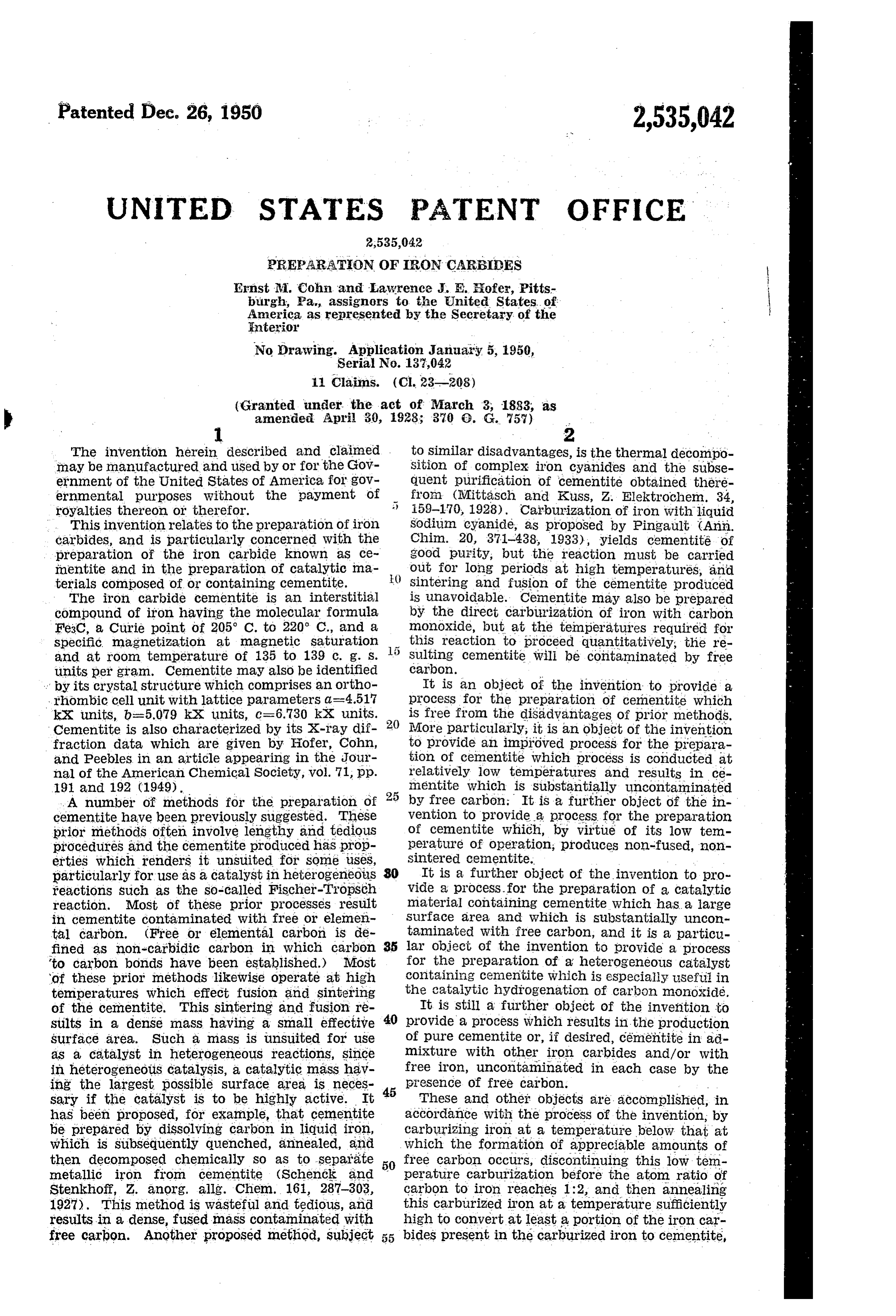
The invention herein described and claimed . to similar disadvantages, is the thermal decompo may be manufactured and used by or for the Gov Sition of complex iron cyanides and the subse ernment of the United States of America for gov Quent purification of cementite obtained there ernmental purposes without the payment of from (Mittasch and Kuss, Z. Elektrochem. 34, royalties thereon, or therefor. 159-170, 1928). Carburization of iron with liquid ... This invention relates to the preparation of iron Sodium cyanide, as proposed by Pingault (Ann. carbides, and is particularly concerned with the Chin. 20, 371-438, 1933), yields cementite of preparation of the iron carbide known as ce good purity, but the reaction must be carried mentite and in the preparation of catalytic ma
out for long periods at high temperatures, and terials composed of or containing cementite. Sintering and fusion of the cementite produced The iron carbide cementite is an interstitial is unavoidable. Cementite may also be prepared compound of iron having the molecular formula by the direct carburization of iron with carbon Fe3C, a Curie point of 205° C. to 220° C., and a monoxide, but at the temperatures required for specific magnetization at magnetic Saturation this reaction to proceed quantitatively, the re and at room temperature of 135 to 139 C. g. S. Sulting cementite will be contaminated by free units per gram. Cementite may also be identified Carbon. Y by its crystal structure which comprises an ortho It is an object of the invention to provide a rhombic cell unit with lattice parameters a-4.517 process for the preparation of cementite which kX units, b=5.079 kX units, c=6.730 kx units. 20 is free from the disadvantages of prior methods. Cementite is also characterized by its X-ray dif More particularly, it is an object of the invention fraction data, which are given by Hofer, Cohn, to provide an improved process for the prepara and Peebles in an article appearing in the Jour tion of cementite which process is conducted at nal of the American Chemical Society, vol. 71, pp. relatively low temperatures and results in ce 191 and 192 (1949). m 25 mentite which is substantially uncontaminated A number of methods for the preparation of by free carbon; it is a further object of the in cementite have been previously suggested. These vention to provide a process for the preparation prior methods often involve lengthy and tedious of cementite which, by virtue of its low tem procedures and the cementite produced has prop perature of operation, produces non-fused, non erties which renders it unsuited for some uses, SO Sintered cementite.
particularly for use as a catalyst in heterogeneous It is a further object of the invention to pro reactions such as the so-called Fischer-TropSch vide a process.for the preparation of a catalytic reaction. Most of these prior processes result material containing cementite which has a large in cementite contaminated with free or elemen Surface area, and which is substantially uncon tal carbon. (Free or elemental carbon is de taminated with free carbon, and it is a particu fined as non-carbidic carbon in which carbon 35 lar object of the invention to provide a process for the preparation of a heterogeneous catalyst to carbon bonds have been established.) Most containing of these prior methods likewise operate at high the catalyticcementite which is especially useful in hydrogenation of carbon monoxide.
temperatures which effect fusion and sintering of the cementite. This sintering and fusion re It is still a further object of the invention to sults in a dense mass having a small effective 40 provide a process which results in the production surface area. Such a mass is unsuited for use of pure cementite or, if desired, cementite in ad as a catalyst in heterogeneous reactions, since mixture with other iron carbides and/or with in heterogeneous catalysis, a catalytic mass hav free iron, uncontaminated in each case by the ing the largest possible surface area is neces 45 presence of free carbon. m sary if the catalyst is to be highly active. It These and other objects are accomplished, in has been proposed, for example, that cementite accordance with the process of the invention, by be prepared by dissolving carbon in liquid iron, carburizing iron at a temperature below that at which is subsequently quenched, annealed, and which the formation of appreciable amounts of then decomposed chemically so as to separate 50 free carbon occurs, discontinuing this low ten metallic iron from cementite (Schenck and perature carburization before the atom ratio of Stenkhoff, Z. anorg, allg. Chem. 161, 287-303, carbon to iron reaches 1:2, and then annealing 1927). This method is wasteful and tedious, and this carburized iron at a temperature sufficiently results in a dense, fused mass contaminated with high to convert at least a portion of the iron car free carbon. Another proposed method, subject 55 bides present in the carburized iron to cementite,
Page 2
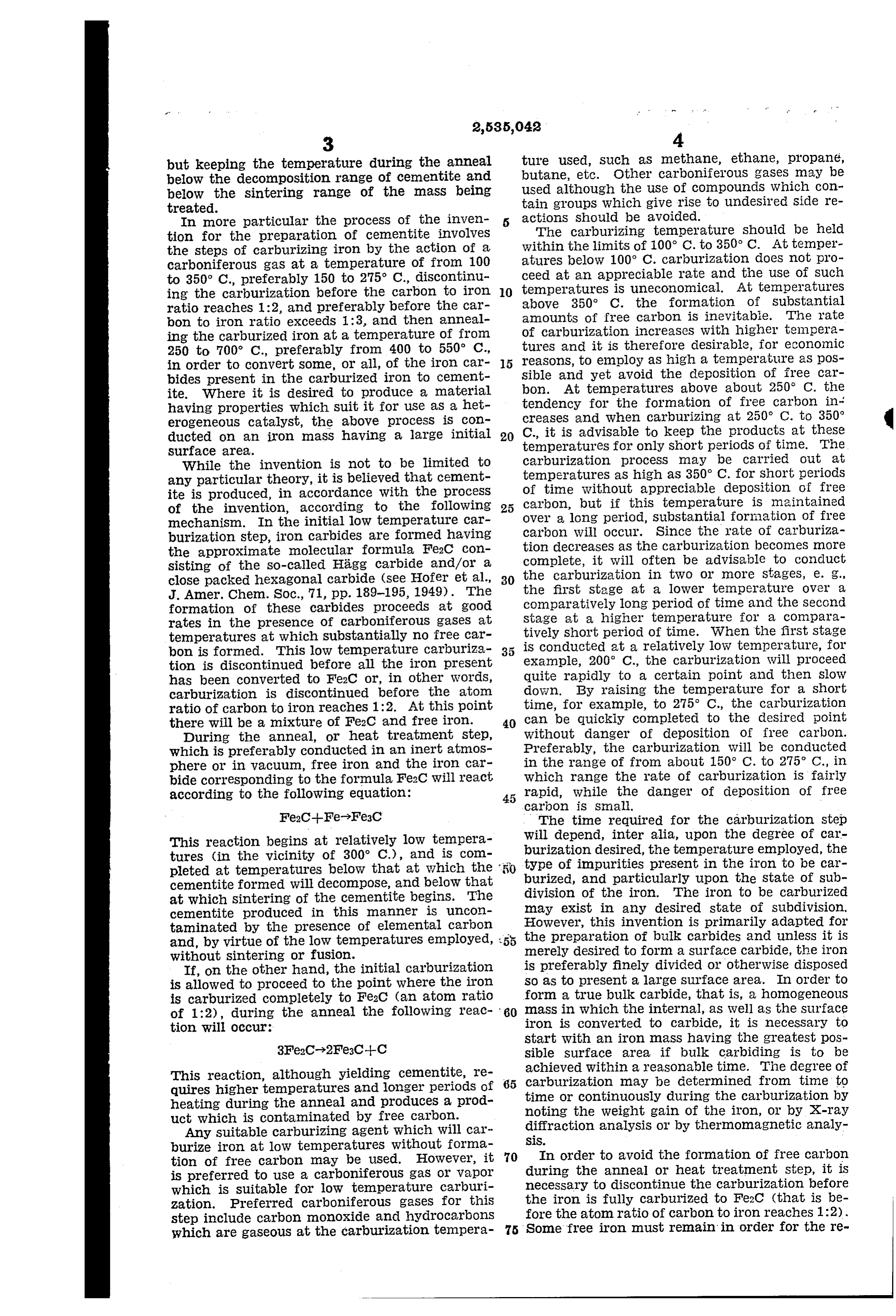
but keeping the temperature during the anneal ture used, such as methane, ethane, propane, below the decomposition range of cementite and butane, etc. Other carboniferous gases may be below the sintering range of the mass being used although the use of compounds which con treated. tain groups which give rise to undesired Side re In more particular the process of the inven 5 actions Should be avoided.
tion for the preparation of cementite involves The carburizing temperature should be held the steps of carburizing iron by the action of a within the limits of 100° C. to 350° C. At temper carboniferous gas at a temperature of from 100 atures below 100° C. carburization does not pro to 350° C., preferably 150 to 275° C., discontinu ceed at an appreciable rate and the use of such ing the carburization before the carbon to iron O temperatures is uneconomical. At temperatures above 350° C. the formation of substantial ratio reaches 1:2, and preferably before the car amounts of free carbon is inevitable. The rate bon to iron ratio exceeds 1:3, and then anneal of carburization increases with higher tempera ing the carburized iron at a temperature of from 250 to 700° C., preferably from 400 to 550° C., tures and it is therefore desirable, for economic reasons, to employ as high a temperature as pos in order to convert some, or all, of the iron car 15 Sible bides present in the carburized iron to cement and yet avoid the deposition of free car ite. Where it is desired to produce a material bon. At temperatures above about 250° C. the having properties which suit it for use as a het tendency for the formation of free carbon in erogeneous catalyst, the above process is con creases and When carburizing at 250° C. to 350° ducted on an iron mass having a large initial 20 C., it is advisable to keep the products at these temperatures for only short periods of time. The
Surface area.
While the invention is not to be limited to carburization process may be carried out at any particular theory, it is believed that cement temperatures as high as 350° C. for short periods ite is produced, in accordance with the process of time without appreciable deposition of free of the invention, according to the following 25 carbon, but if this temperature is maintained mechanism. In the initial low temperature car OVer a long period, Substantial formination of flee burization step, iron carbides are formed having Carbon will occur. Since the rate of carburiza the approximate molecular formula, Fe2C Con tion decreases as the carburization becomes more sisting of the so-called Hagg carbide and/or a complete, it will often be advisable to conduct close packed hexagonal carbide (see Hofer et al., 30 the carburization in two or more stages, e. g., the first stage at a lower temperature over a
J. Amer. Chem. Soc., 71, pp. 189-195, 1949). The comparatively long period of time and the second formation of these carbides proceeds at good Stage at a higher temperature for a compara rates in the presence of carboniferous gases at temperatures at which substantially no free car tively short period of time. When the first stage bon is formed. This low temperature carburiza 35 is conducted at a relatively low temperature, for tion is discontinued before all the iron present example, 200° C., the carburization will proceed has been converted to Fe2C or, in other words, quite rapidly to a certain point and then slow carburization is discontinued before the atom down. By raising the temperature for a short ratio of carbon to iron reaches 1:2. At this point time, for example, to 275° C., the carburization there will be a mixture of Fe2C and free iron. 40 can be quickly completed to the desired point During the anneal, or heat treatment step, without danger of deposition of free carbon. which is preferably conducted in an inert atmos Preferably, the carburization will be conducted phere or in vacuum, free iron and the iron car in the range of from about 150° C. to 275° C., in bide corresponding to the formula, Fe2C will react which range the rate of carburization is fairly according to the following equation: 45 rapid, while the danger of deposition of free carbon is small.
The time required for the carburization step
This reaction begins at relatively low tempera Will depend, inter alia, upon the degree of car tures (in the vicinity of 300° C.), and is con burization desired, the temperature employed, the pleted at temperatures below that at which the 50 type of impurities present in the iron to be car cementite formed will decompose, and below that burized, and particularly upon the state of sub at which sintering of the cementite begins. The division of the iron. The iron to be carburized cementite produced in this manner is uncon may exist in any desired state of subdivision. taminated by the presence of elemental carbon However, this invention is primarily adapted for and, by virtue of the low temperatures employed, the preparation of bulk carbides and unless it is without sintering or fusion. merely desired to form a surface carbide, the iron If, on the other hand, the initial carburization is preferably finely divided or otherwise disposed is allowed to proceed to the point where the iron So as to present a large surface area. In order to is carburized completely to Fe2C (an atom ratio form a true bulk carbide, that is, a homogeneous of 1:2), during the anneal the following reac 60 maSS in which the internal, as well as the surface tion will occur: iron is converted to carbide, it is necessary to start With an iron mass having the greatest pos sible surface area if bulk carbiding is to be achieved within a reasonable time. The degree of
This reaction, although yielding cementite, re 65 carburization quires higher temperatures and longer periods of may be determined from time to heating during the anneal and produces a prod time or continuously during the carburization by uct which is contaminated by free carbon. noting the weight gain of the iron, or by X-ray Any suitable carburizing agent which Will car diffraction analysis or by thermomagnetic analy burize iron at low temperatures without forma SS.
In order to avoid the formation of free carbon tion of free carbon may be used. However, it 70 during is preferred to use a carboniferous gas or vapor the anneal or heat treatment step, it is which is suitable for low temperature carburi necessary to discontinue the carburization before zation. Preferred carboniferous gases for this the iron is fully carburized to Fe2C (that is be step include carbon monoxide and hydrocarbons fore the atom ratio of carbon to iron reaches 1:2), which are gaseous at the carburization tempera 75 Some free iron must remain in order for the re
Page 3
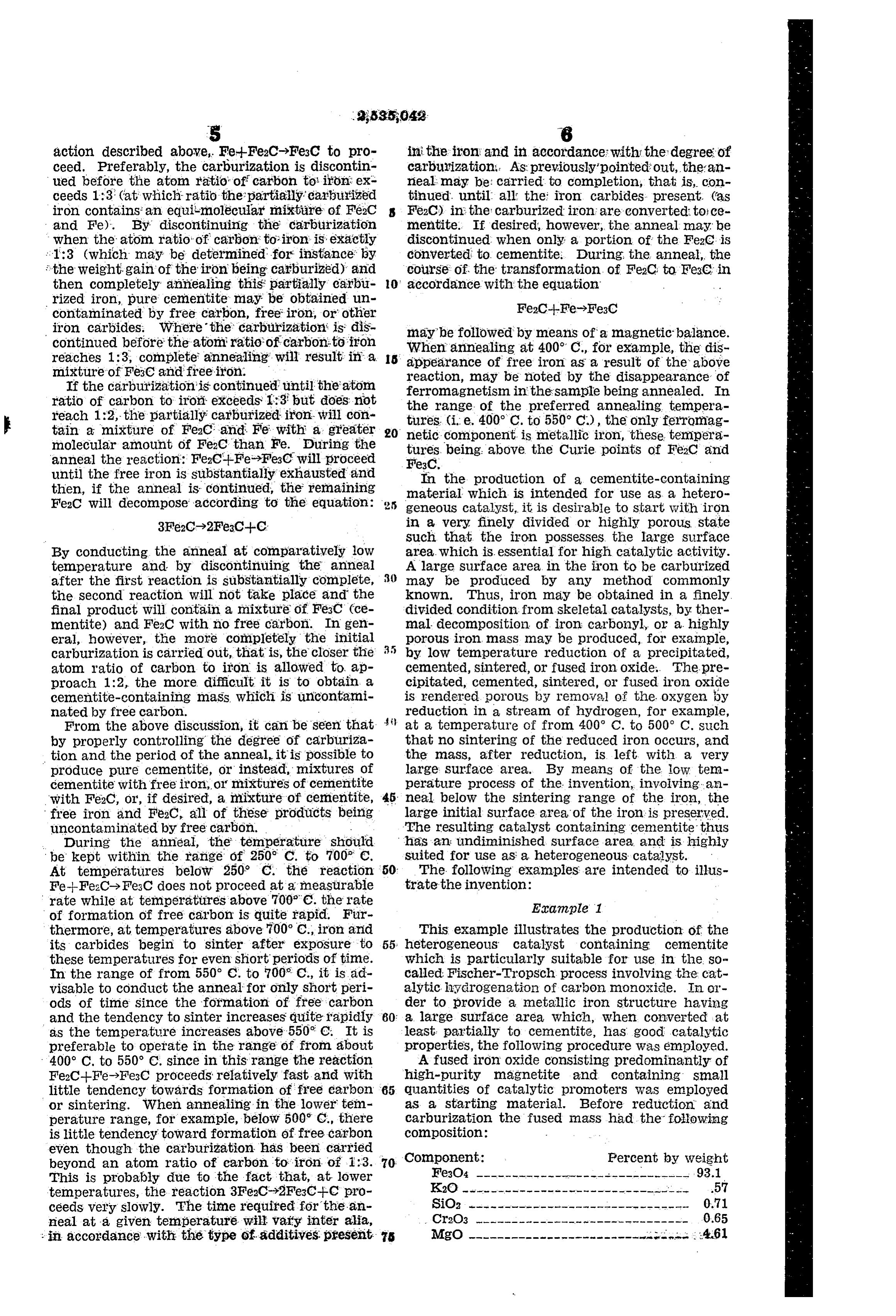
action described above, Fel-Fe2C->Fe3C to pro in the iron and in accordance: with the degree of ceed. Preferably, the carburization is discontin carbuilization. As previously pointed out, the an ued before the atom ratio of carbon to iron ex nieal may be: carried to completion, that is, con ceeds 1:3 (at which ratio the partially 'cabulized tinued, until all the iron carbides present. (as iron contains an equimolecular mixture of Fe2C Fe2C) in the carburized iron are converted to ce and Fe). By discontinuing the carburization mentite. If desired, however, the anneal may be when the atom ratio of carbon to iron is exactly discontinued when only a portion of the Fe2C. is ::1:3 (which may be determined for instance by
Šthe weight gain of the iron being carburized) and converted to cementite. During, the anneal, the course of the transformation of Fe3C: to Fe3C in then completely annealing this partially carbu O accordance with the equation rized iron, pure cementite may be obtained un contaminated by free carbon, free iron, or other iron carbides. Where the carburization is dis may be followed by means of a magnetic balance. continued before the atom ratio of carbon-t reaches 1:3, complete annealing will result in a When annealing at 400° C., for example, the dis appearance of free iron as a result of the above mixture of Fe3C and free iron.
If the carburization is continued tintil the atom reaction, may be noted by the disappearance of ferromagnetism in the sample being annealed. In ratio of carbon to iron exceeds 1:3, but does not the range of the preferred annealing tempera reach 1:2, the partially carburized iron will con tain a mixture of Fe3C: and Fe with a greater 20 tures (i.e. 400°C. to 550° C.), the only ferromag molecular amount of Fe2C than Fe. During the tures being aboveisthe netic component metallic iron, these tempera
Curie points of Fe2C and anneal the reaction: Fe2C--Fe->Fe3C will proceed Fe3C.
until the free iron is substantially exhausted and In the production of a cementite-containing then, if the anneal is continued, the remaining material which is intended for use as a hetero Fe2C will decompose according to the equation: geneous catalyst, it is desirable to start with iron in a very finely divided or highly porous state
Such that the iron possesses the large surface
By conducting the anneal at comparatively low area. Which is essential for high catalytic activity. temperature and by discontinuing the anneal 3. A large surface area in the iron to be carburized after the first reaction is substantially complete, may be produced by any method commonly the second reaction will not take place and the knoWn. Thus, iron may be obtained in a finely. final product will contain a mixture of Fe3C (ce divided condition from skeletal catalysts, by ther mentite) and Fe2C With no free carbor. In gen mal decomposition of iron carbonyl, or a highly eral, however, the more completely the initial porous iron mass may be produced, for example, carburization is carried out, that is, the closer the by low temperature reduction of a precipitated, atom ratio of carbon to iron is allowed to ap cemented, sintered, or fused iron oxide. The pre proach 1:2, the more difficult it is to obtain a cipitated, cemented, sintered, or fused iron oxide cementite-containing mass, which is uncontami is rendered porous by removal of the oxygen by nated by free carbon. reduction in a stream of hydrogen, for example, From the above discussion, it can be seen that at a temperature of from 400 C. to 500 C. Such by properly controlling the degree of carburiza that no sintering of the reduced iron occurs, and tion and the period of the anneal, it is possible to the mass, after reduction, is left with a very produce pure cementite, or instead, mixtures of large. Surface area. By means of the GW tena cementite with free iron, or mixtures of cementite perature process of the invention, involving al with Fe2C, or, if desired, a mixture of cementite, 45 neal below the sintering range of the iron, the free iron and Fe2C, all of these products being large initial surface area of the iron is preserved. uncontaminated by free carbon. The resulting catalyst containing cementite thus During the anneal, the temperature should has an undiminished surface area, and is highly be kept within the range of 250° C. to 700° C. suited for use as a heterogeneous catalyst. At temperatures below 250° C. the reaction 50: The following examples are intended to illus Fe--Fe2C->Fe3C does not proceed at a measurable trate the invention:
rate while at temperatures above 700° C. the rate Eacample 1 of formation of free carbon is quite rapid. Fur thermore, at temperatures above 700° C., iron arid This example illustrates the production of the its carbides begin to sinter after exposure to 55: heterogeneous catalyst containing cementite these temperatures for even short periods of time. which is particularly suitable for use in the so In the range of from 550° C. to 700° C., it is aid called Fischer-TropSch, process involving the cat visable to conduct the anneal for only short peri alytic laydrogenation of carbon monoxide. In or ods of time since the formation of free carbon der to provide a metallic iron structure having and the tendency to sinter increases quite rapidly 80: a large Surface area, which, when converted at as the temperature increases above 550°C. It is least partially to cementite, has good catalytic preferable to operate in the range of from about properties, the following procedure was employed. 400° C. to 550° C. since in this range the reaction A fused iron oxide consisting predominantly of Fe2C-Fe-2Fe3C proceeds relatively fast and with high-purity magnetite and containing small little tendency towards formation of free carbon 65 quantities of catalytic promoters was employed or sintering. When annealing in the lower tem as a starting material. Before reduction and perature range, for example, below 500 C., there Carburization the fused mass had the following is little tendency toward formation of free carbon composition:
even though the carburization has been carried beyond an atom ratio of carbon to iron of 1:3. 70. Component: Percent by weight
This is probably due to the fact that, at lower K2O ----------------------------- . . .57 temperatures, the reaction 3Fe2C-2Fe3C-C pro ceeds very slowly. The time required for the -an SiO2 -------- - ar area or - or 1-P - - - -re r ree -- a-- 0.71
neal at a given temperature will Waity inter alia, Cr2O3 ------------------------------ 0.65 : in accordance with the type of additives present s MgO ----------------------------, 4-6
Page 4
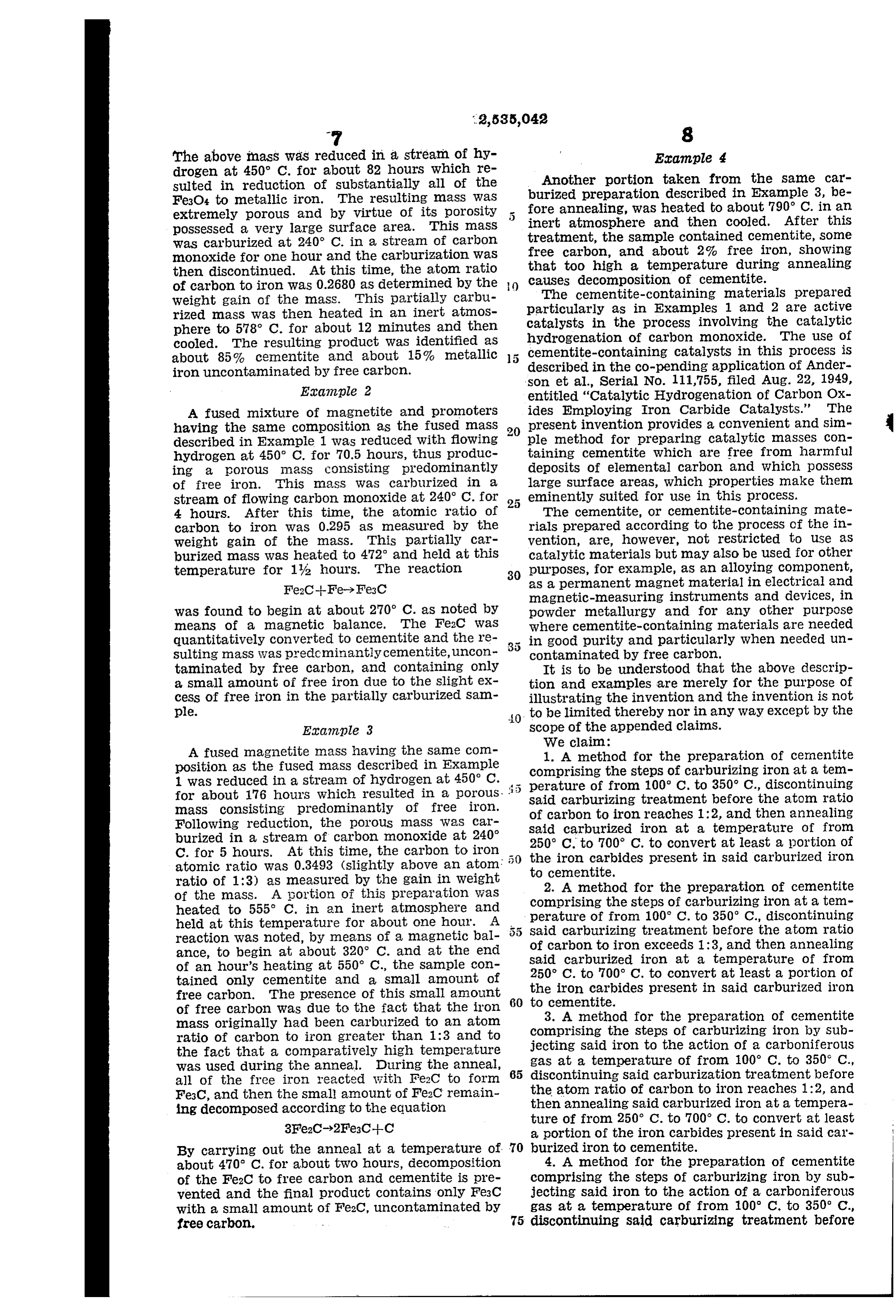
The above mass was reduced in a stream of hy Eacample 4 drogen at 450° C. for about 82 hours which re Another portion taken from the same car sulted in reduction of substantially all of the
Fe3O4 to metallic iron. The resulting maSS WaS burized preparation described in Example 3, be fore annealing, was heated to about 790° C. in an extremely porous and by virtue of its porosity 5 inert possessed a very large surface area. This maSS atmosphere and then cooled. After this was carburized at 240° C. in a stream of carbon treatment, the sample contained cementite, some monoxide for one hour and the carburization was free carbon, and about 2% free iron, showing then discontinued. At this time, the atom ratio that too high a temperature during annealing causes decomposition of cementite.
of carbon to iron was 0.2680 as determined by the O The cementite-containing weight gain of the mass. This partially carbu materials prepared rized mass was then heated in an inert atmos particularly as in Examples 1 and 2 are active phere to 578° C. for about 12 minutes and then catalysts in the process involving the catalytic hydrogenation of carbon monoxide. The use of cooled. The resulting product was identified as about 85% cementite and about 15% metallic cementite-containing catalysts in this process is iron uncontaminated by free carbon. described in the co-pending application of Ander Eacample 2 son et al., Serial No. 111,755, filed Aug. 22, 1949, entitled "Catalytic Hydrogenation of Carbon OX
A fused mixture of magnetite and promoters ides Employing Iron Carbide Catalysts.' The having the same composition as the fused maSS present invention provides a convenient and sim described in Example 1 was reduced with flowing ple method for preparing catalytic masses con hydrogen at 450° C. for 70.5 hours, thus produc taining cementite which are free from harmful ing a porous mass consisting predominantly deposits of elemental carbon and which possess of free iron. This mass was carburized in a large Surface areas, which properties make them stream of flowing carbon monoxide at 240° C. for eminently Suited for use in this process. 4 hours. After this time, the atomic ratio of The cementite, or cementite-containing mate carbon to iron was 0.295 as measured by the rials prepared according to the process of the in weight gain of the maSS. This partially Car vention, are, however, not restricted to use as burized mass was heated to 472 and held at this catalytic materials but may also be used for other temperature for 1/2 hours. The reaction 30 purposes, for example, as an alloying component, as a permanent magnet material in electrical and magnetic-measuring instruments and devices, in was found to begin at about 270° C. as noted by powder metallurgy and for any other purpose means of a magnetic balance. The Fe2C was where cementite-containing materials are needed quantitatively converted to cementite and the re in good purity and particularly When needed un Sulting maSS Was predicninantly cementite, luncon contaminated by free carbon, taminated by free carbon, and containing only It is to be understood that the above descrip a small amount of free iron due to the slight ex tion and examples are merely for the purpose of cess of free iron in the partially carburized Sam illustrating the invention and the invention is not ple. to be limited thereby nor in any way except by the Eacample 3 scope of the appended claims.
We claim:
A fused magnetite mass having the same com 1. A method for the preparation of cementite position as the fused mass described in Example comprising the steps of carburizing iron at a tem 1 was reduced in a stream of hydrogen at 450° C. perature of from 100° C. to 350° C., discontinuing for about 176 hours which resulted in a porous Said carburizing treatment before the atom ratio mass consisting predominantly of free iron. of carbon to iron reaches 1:2, and then annealing Following reduction, the porous mass was car Said carburized iron at a temperature of from burized in a stream of carbon monoxide at 240 250° C. to 700° C. to convert at least a portion of C. for 5 hours. At this time, the carbon to iron the iron carbides present in said carburized iron atomic ratio was 0.3493 (slightly above an atom to cementite.
ratio of 1:3) as measured by the gain in weight 2. A method for the preparation of cementite of the mass. A portion of this preparation was comprising the steps of carburizing iron at a tem heated to 555 C. in an inert atmosphere and perature of from 100° C. to 350° C., discontinuing held at this temperature for about one hour. A Said carburizing treatment before the atom ratio reaction was noted, by means of a magnetic bal of carbon to iron exceeds 1:3, and then annealing ance, to begin at about 320° C. and at the end Said carburized iron at a temperature of from of an hour's heating at 550° C., the Sample con 250° C. to 700° C. to convert at least a portion of tained only cementite and a small amount of free carbon. The presence of this Small amount 60 the iron carbides present in said carburized iron to cementite.
of free carbon was due to the fact that the iron mass originally had been carburized to an atom 3. A method for the preparation of cementite ratio of carbon to iron greater than 1:3 and to comprising the steps of carburizing iron by sub the fact that a comparatively high temperature jecting Said iron to the action of a carboniferous was used during the anneal. During the anneal, 85 gas at a temperature of from 100° C. to 350° C., all of the free iron reacted With Fe2C to form discontinuing Said carburization treatment before Fe3C, and then the small amount of Fe2C remain the atom ratio of carbon to iron reaches 1:2, and ing decomposed according to the equation then annealing said carburized iron at a tempera ture of from 250° C. to 700° C. to convert at least a portion of the iron carbides present in said car
By carrying out the anneal at a temperature of 70 burized iron to cementite.
about 470° C. for about two hours, decomposition 4. A method for the preparation of cementite of the Fe2C to free carbon and cementite is pre comprising the steps of carburizing iron by sub vented and the final product contains only Fe3C jecting said iron to the action of a carboniferous with a small amount of Fe2C, uncontaminated by gas at a temperature of from 100° C. to 350° C., free carbon, 75 discontinuing Said carburizing treatment before
Page 5
the atom ratio of carbon to iron exceeds 1:3, and 9. A method for the preparation of a catalytic then annealing Said carburized iron at a tempera material containing cementite which is Substan ture of from 250° C. to 700° C., to convert at least tially free from elemental carbon and which a portion of the iron carbides present in Said cai'- possesses a large surface area comprising the burized iron to cementite. steps of carburizing an iron mass which has been 5. A method for the preparation of cementite obtained by the reduction of an iron oxide at comprising the steps of carburizing iron by Sub a temperature below the sintering range of said jecting said iron to the action of a carboniferous maSS, by Subjecting said mass to the action of gas at a tenniperature of from 150° C. to 275 C., a carboniferous gas at a tenperature of from discontinuing said carburizing treatment before O 100° C. to 350° C., discontinuing said carburizing the aton ratio of carbon to iron exceeds 1:3, and treatment before the atom ratio of carbon to iron then annealing said carburized iron at a tempera exceeds 1:3, and then annealing said carburized ture of from 400° C. to 550° C., to convert at least mass at a temperature of from 250° C. to 700° C., a portion of the iron carbides present in said car but below the temperature at which Sintering burized iron to cementite. of said mass occurs, to convert at least a por 6. A method for the preparation of cementite tion of the carbides present in said carburized comprising the steps of carburizing iron by Sub iron mass to cementite while avoiding a decrease jecting said iron to the action of a carboniferous in the initial surface area of said iron. gas selected frcin the group consisting of carbon 10. A method for the preparation of a catalytic monoxide and hydrocarbon gases at a tempera material containing cementite which is substan ture of from 150 C. to 275 C., discontinuing Said tially free from elemental carbon and Which carburizing treatment before the aton ratio of possesses a large Surface area comprising the carbon to iron exceeds l:3, and then annealing steps of carburizing an iron mass which has been said carburized iron at a temperature of from prepared by reduction of a fused iron oxide at 400° C. to 550° C., to convert at least a portion of 25 a temperature below that at which Sintering of the iron carbides present in the carburized iron Said maSS Occurs by subjecting Said maSS to the to cementite. action of a carboniferous gas selected from the 7. A method for the preparation of a catalytic group consisting of carbon monoxide and hydro material containing cementite which is substan carbon gases at a temperature of from 150° C. tially free from elemental carbon and which 30 to 275 C., discontinuing said carburizing treat possesses a large surface area comprising the ment before the atom ratio of carbon to iron Steps of carburizing iron having a large surface exceeds 1:3, and then annealing said mass at a area, by subjecting said iron to the action of a temperature of from 400° C. to 550° C., to convert carboniferous gas at a temperature of from 100 at least a portion of the carbides present in said C. to 350° C., discontinuing said carburizing Carburized iron to cementite while avoiding a treatment before the atom ratio of carbon to iron decrease in the surface area of said iron. reaches 1:2, and then annealing said carburized 11. A method for the preparation of a catalytic iron at a temperature of from 250° C. to 700° C., material containing cementite which is substan Said temperature being below that at Which tially free from elemental carbon and which Sintering of Said iron occurs, to convert at least possesses a large Surface area comprising the a portion of the carbides present in said carbul steps of carburizing an iron mass which has been rized iron to cementite, while avoiding a decrease obtained by reduction of an iron oxide at a tem in the initial Surface area of said iron. perature below that at which sintering of said 8. A method for the preparation of a catalytic maSS occurs, by Subjecting said mass to the action material containing cementite which is substan of a carboniferous gas selected from the group tially free from elemental carbon and which consisting of carbon monoxide and hydrocarbon pOSSesses a large Surface area comprising the gases at a temperature of from 150° C. to 275° C., Steps of carburizing iron having a large surface discontinuing said carburizing treatment when area, by Subjecting Said iron to the action of the atom ratio of carbon to iron reaches 1:3, a carboniferous gas at a temperature of from 50 and then annealing said mass at a temperature 100 C. to 350° C., discontinuing said carburizing of from 400° C. to 550° C., to convert all of the treatinent before the atom ratio of carbon to carbides present in said carburized iron to iron exceeds 1:3, annealing said carburized iron cementite while avoiding a decrease in the ini at a temperature of from 250° C. to 700° C., said tial Surface area of said iron mass. temperature being below that at which sintering of said iron occurs, to convert at least a portion ERNST IM. COHN. of the carbides present in said carburized iron LAWRENCE. J. E. HOFER, to cementite, while avoiding a decrease in the initial Surface area of said iron, No references cited.
Provenance
- Collection
- Cited prior art
- Original PDF
- patentimages.storage.googleapis.com →
- Filed
- 1950-01-05
- Pages
- 5
- Method
- pdftotext (the PDF's own text layer) + pdftoppm 300dpi page scans
- Source
- Google Patents bibliographic record
- Granted
- 1950-12-26
- Inventors
- Ernst M Cohn; Lawrence J E Hofer
- Transcribed from
- patentimages.storage.googleapis.com →