patent · US2486894
Process for catalytic conversion of carbon oxides
1 November 1949
Page 1
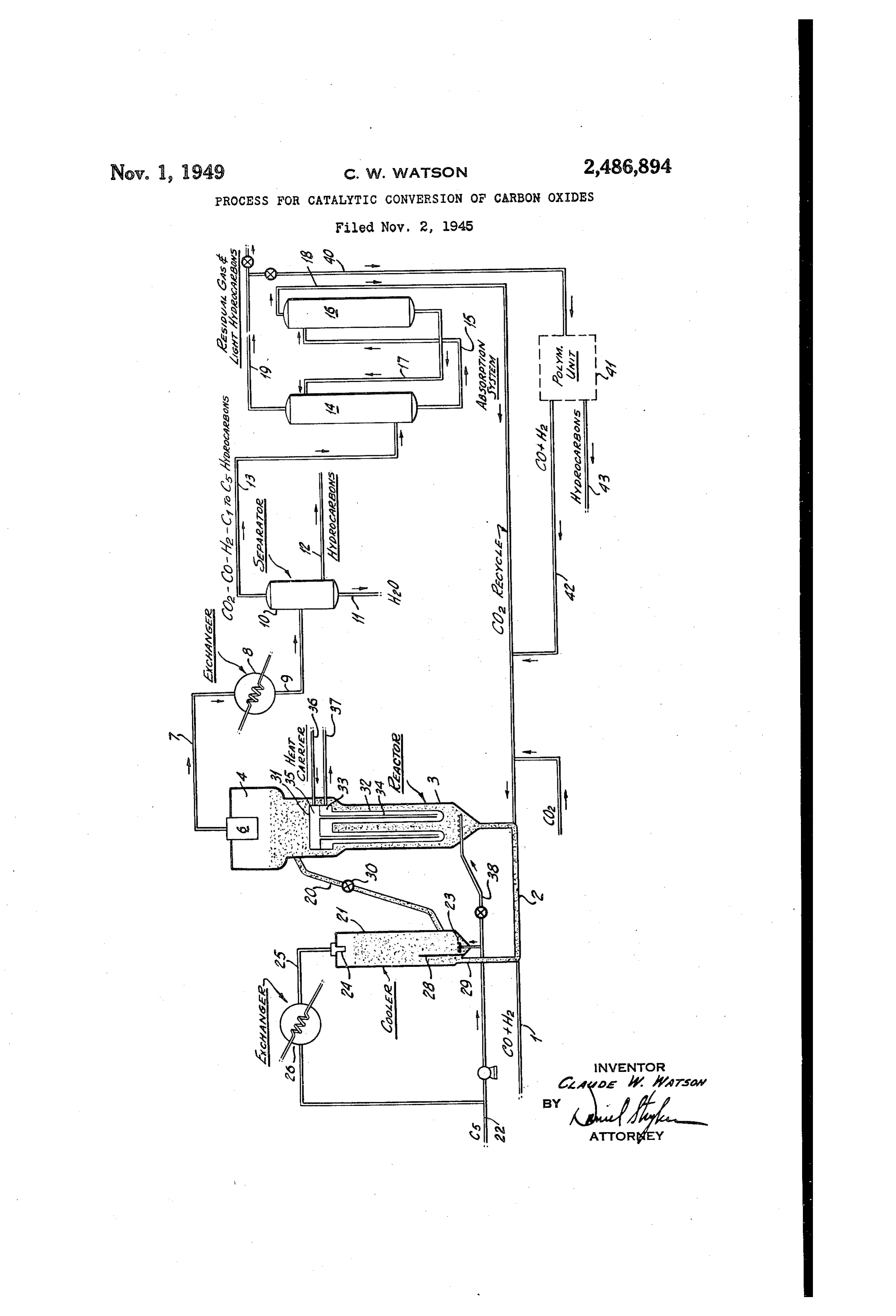
Drawing sheet — no readable text.
Page 2
Patented Nov. 1, 1949 2,486,894
UNITED STATES PATENT office 2,486,894
PROCESS FOR CATALYTIC CONVERSON OF
CARBONOXIDES
Claude W. Watson, Scarsdale, N. Y., assignor to
The Texas Company, New York, N. Y., a core poration of Delaware
Application November 2, 1945, Serial No. 626,425
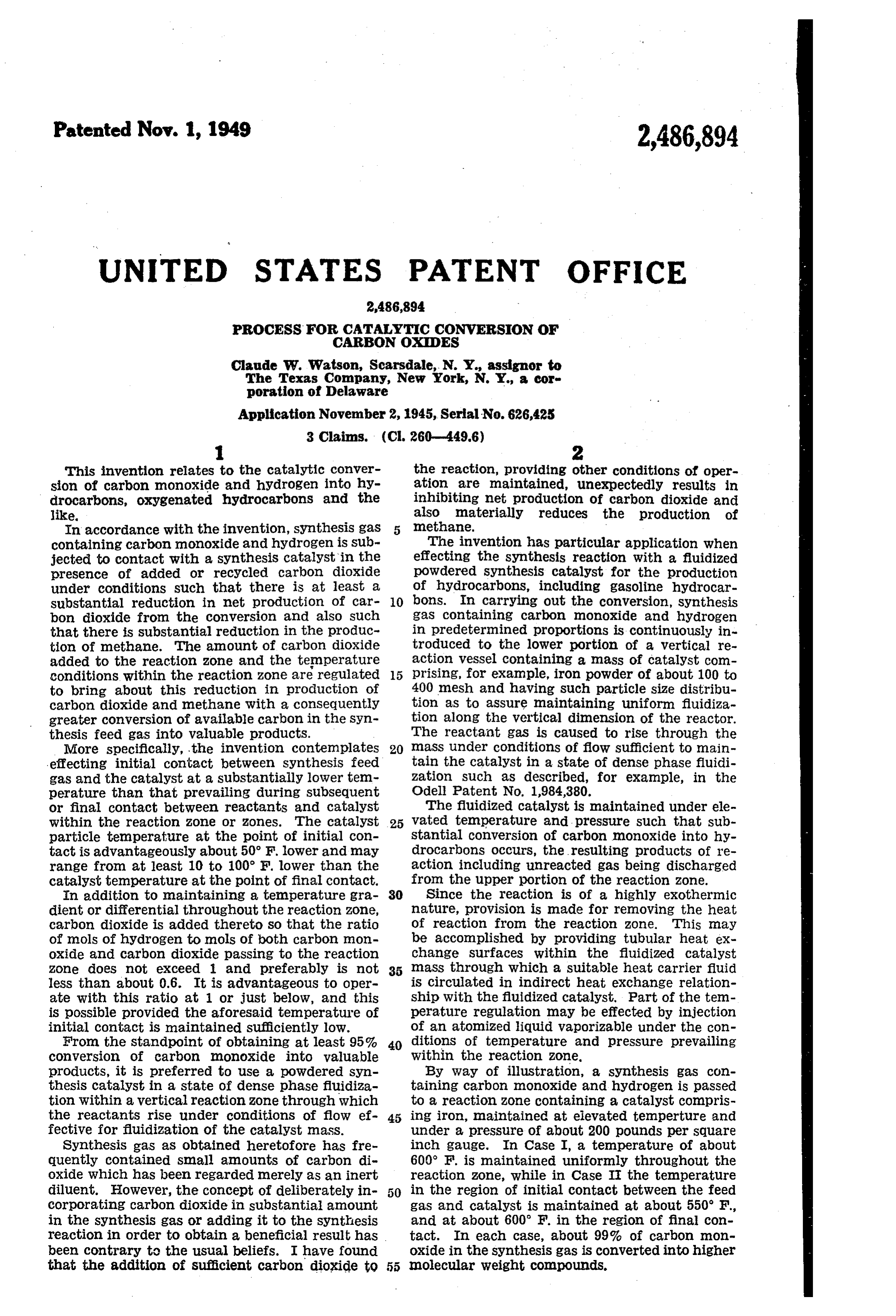
This invention relates to the catalytic conver the reaction, providing other conditions of oper sion of carbon monoxide and hydrogen into hy ation are maintained, unexpectedly results in drocarbons, oxygenated hydrocarbons and the inhibiting net production of carbon dioxide and like. also materially reduces the production of In accordance with the invention, synthesis gas methane.
containing carbon monoxide and hydrogen is Sub The invention has particular application when jected to contact with a synthesis catalyst in the effecting the synthesis reaction with a fluidized presence of added or recycled carbon dioxide powdered Synthesis catalyst for the production under conditions such that there is at least a of hydrocarbons, including gasoline hydrocar substantial reduction in net production of car O bons. In carrying out the conversion, synthesis bon dioxide from the conversion and also such gas containing carbon monoxide and hydrogen that there is substantial reduction in the produc in predetermined proportions is continuously in tion of methane. The amount of carbon dioxide troduced to the lower portion of a vertical re added to the reaction zone and the temperature action vessel containing a mass of catalyst com conditions within the reaction zone are regulated 5 prising, for example, iron powder of about 100 to to bring about this reduction in production of 400 mesh and having such particle size distribu carbon dioxide and methane with a consequently tion as to assure maintaining uniform fluidiza greater conversion of available carbon in the Syn tion along the vertical dimension of the reactor. thesis feed gas into valuable products. The reactant gaS is caused to rise through the More specifically, the invention contemplates 20 maSS under conditions of flow sufficient to main effecting initial contact between synthesis feed tain the catalyst in a state of dense phase fluidi gas and the catalyst at a substantially lower ten Zation such as described, for example, in the perature than that prevailing during subsequent Odell Patent No. 1,984,380. or final contact between reactants and catalyst The fluidized catalyst is maintained under ele within the reaction Zone or Zones. The catalyst 25 wated temperature and pressure such that sub particle temperature at the point of initial Con stantial conversion of carbon monoxide into hy tact is advantageously about 50 F. lower and may drocarbons occurs, the resulting products of re range from at least 10 to 100 F. lower than the action including unreacted gas being discharged catalyst temperature at the point of final contact. from the upper portion of the reaction zone. In addition to maintaining a temperature gra 30 Since the reaction is of a highly exothermic dient or differential throughout the reaction zOne, nature, provision is made for removing the heat carbon dioxide is added thereto SO that the ratio of reaction from the reaction zone. This may of mols of hydrogen to mols Of both carbon mon be accomplished by providing tubular heat ex oxide and carbon dioxide passing to the reaction change Surfaces within the fluidized catalyst Zone does not exceed and preferably is not 35 maSs through which a suitable heat carrier fluid less than about 0.6. It is advantageous to oper is circulated in indirect heat exchange relation ate with this ratio at 1 or just below, and this ship with the fluidized catalyst, Part of the tem is possible provided the aforesaid temperature of perature regulation may be effected by injection initial contact is maintained sufficiently low. of an atomized liquid vaporizable under the con From the standpoint of obtaining at least 95% 40 ditions of temperature and pressure prevailing conversion of carbon monoxide into valuable within the reaction zone.
products, it is preferred to use a powdered syn By Way of illustration, a Synthesis gas con thesis catalyst in a state of dense phase fluidiza taining carbon monoxide and hydrogen is passed tion Within a vertical reaction Zone through which to a reaction Zone containing a catalyst compris the reactants rise under conditions of flow ef 45 ing iron, maintained at elevated tenperture and fective for fluidization of the catalyst mass. under a pressure of about 200 pounds per square Synthesis gas as obtained heretofore has fre inch gauge. In Case I, a temperature of about quently contained small amounts of carbon di 600 F. is maintained uniformly throughout the oxide which has been regarded merely as an inert reaction Zone, while in Case II the temperature diluent. However, the concept of deliberately in in the region of initial contact between the feed corporating carbon dioxide in substantial amount gas and catalyst is maintained at about 550 F., in the Synthesis gas or adding it to the synthesis and at about 600 F. in the region of final con reaction in order to obtain a beneficial result has tact. In each case, about 99% of carbon mon been contrary to the usual beliefs. I have found oxide in the synthesis gas is converted into higher that the addition of sufficient carbon dioxide to 55 molecular weight compounds.
Page 3
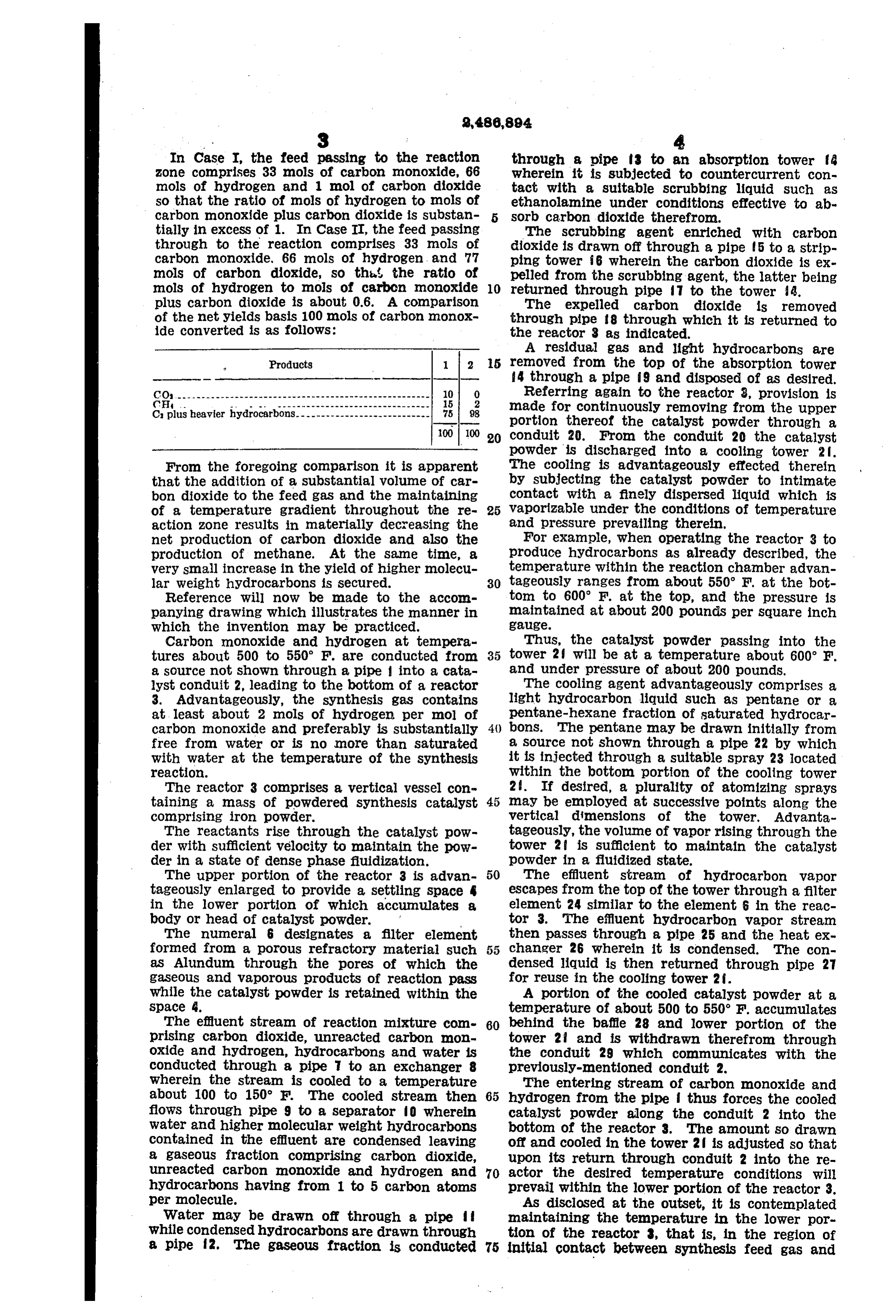
In Case I, the feed passing to the reaction through a pipe i 3 to an absorption tower få zone comprises 33 mols of carbon monoxide, 66 wherein it is subjected to countercurrent con mols of hydrogen and 1 mol of carbon dioxide tact with a suitable scrubbing liquid such as so that the ratio of mols of hydrogen to mols of ethanolamine under conditions effective to ab carbon monoxide plus carbon dioxide is substan sorb carbon dioxide therefrom.
tially in excess of 1. In Case II, the feed passing The scrubbing agent enriched with carbon through to the reaction comprises 33 nols of dioxide is drawn off through a pipe 5 to a strip carbon monoxide, 66 mols of hydrogen, and 77 ping tower 6 wherein the carbon dioxide is ex mols of carbon dioxide, so thb, the ratio of pelled from the scrubbing agent, the latter being mols of hydrogen to mois of carbon monoxide O returned through pipe 7 to the tower 4. plus carbon dioxide is about 0.6. A comparison The expelled carbon dioxide is removed of the net yields basis 100 mols of carbon monox through pipe f8 through which it is returned to ide converted is as follows: the reactor 3 as indicated. A residual gas and light hydrocarbons are 5 removed from the top of the absorption tower 4 through a pipe 9 and disposed of as desired.
Referring again to the reactor 3, provision is 75 98 made for continuously removing from the upper
C. plus heavier hydrocarbons SSSS SSSSS S Sq SS SS SS SSSS SSS q S S LSL SLLS LSL LSL SL S SMSSSSSSS S portion thereof the catalyst powder through a 100 100 20 conduit 20. From the conduit 20 the catalyst powder is discharged into a cooling tower 2.
From the foregoing comparison it is apparent The cooling is advantageously effected therein that the addition of a substantial volume of car by subjecting the catalyst powder to intimate contact with a finely dispersed liquid which is bon dioxide to the feed gas and the maintaining of a temperature gradient throughout the re 25 vaporizable under the conditions of temperature action zone results in materially decreasing the and pressure prevailing therein. net production of carbon dioxide and also the For example, when operating the reactor 3 to production of methane. At the same time, a produce hydrocarbons as already described, the very small increase in the yield of higher molecu temperature within the reaction chamber advan lar weight hydrocarbons is secured. 30 tageously ranges from about 550 F. at the bot Reference will now be made to the accorn tom to 600 F. at the top, and the pressure is panying drawing which illustrates the manner in maintained at about 200 pounds per Square inch which the invention may be practiced. gallge.
Carbon monoxide and hydrogen at tempera Thus, the catalyst powder passing into the tures about 500 to 550' F. are conducted from 35 tower 2 will be at a temperature about 600 F. a source not shown through a pipe i into a cata and under pressure of about 200 pounds. The cooling agent advantageously comprises a lyst conduit 2, leading to the bottom of a reactor light 3. Advantageously, the synthesis gas contains hydrocarbon liquid Such as pentane or a at least about 2 mols of hydrogen per mol of pentane-hexane fraction of Saturated hydrocar carbon monoxide and preferably is substantially 40 bons. The pentane may be drawn initially from free from water or is no more than Saturated a source not shown through a pipe 22 by which with water at the temperature of the synthesis it is injected through a suitable spray 23 located reaction. within the bottom portion of the cooling tower The reactor 3 comprises a vertical vessel con 2. If desired, a plurality of atomizing sprays taining a mass of powdered Synthesis catalyst 45 may be employed at successive points along the comprising iron powder. vertical dimensions of the tower. Advanta The reactants rise through the catalyst pow tageously, the volume of vapor rising through the der with sufficient velocity to maintain the pow tower 2 is sufficient to maintain the catalyst der in a state of dense phase fluidization. powder in a fluidized state. The upper portion of the reactor 3 is advan 50 The effluent stream of hydrocarbon vapor tageously enlarged to provide a settling space 4 escapes from the top of the tower through a filter in the lower portion of which accumulates a element 24 similar to the element 6 in the reac body or head of catalyst powder. Z tor 3. The effluent hydrocarbon vapor stream The numeral 6 designates a filter element then passes through a pipe 25 and the heat ex formed from a porous refractory material such 55 changer 26 wherein it is condensed. The con as Alundum through the pores of which the densed liquid is then returned through pipe 27 gaseous and vaporous products of reaction pass for reuse in the cooling tower 2. while the catalyst powder is retained within the A portion of the cooled catalyst powder at a Space A. temperature of about 500 to 550 F. accumulates The effluent stream of reaction mixture com 80 behind the baffle 28 and lower portion of the prising carbon dioxide, unreacted carbon mon tower 2 and is withdrawn therefrom through Oxide and hydrogen, hydrocarbons and water is the conduit 29 which communicates with the conducted through a pipe to an exchanger 8 previously-mentioned conduit 2. wherein the stream is cooled to a temperature The entering stream of carbon monoxide and about 100 to 150 F. The cooled stream then 65 hydrogen from the pipe thus forces the cooled flows through pipe 9 to a separator O wherein catalyst powder along the conduit 2 into the water and higher molecular weight hydrocarbons bottom of the reactor 3. The amount so drawn contained in the effluent are condensed leaving off and cooled in the tower 2 is adjusted so that a gaseous fraction comprising carbon dioxide, upon its return through conduit 2 into the re unreacted carbon monoxide and hydrogen and 70 actor the desired temperature conditions will hydrocarbons having from 1 to 5 carbon atoms prevail within the lower portion of the reactor 3. per molecule. As disclosed at the outset, it is contemplated Water may be drawn of through a pipe maintaining the temperature in the lower por While condensed hydrocarbons are drawn through tion of the reactor 3, that is, in the region of a pipe f2. The gaseous fraction is conducted 75 initial contact between synthesis feed gas and
Page 4
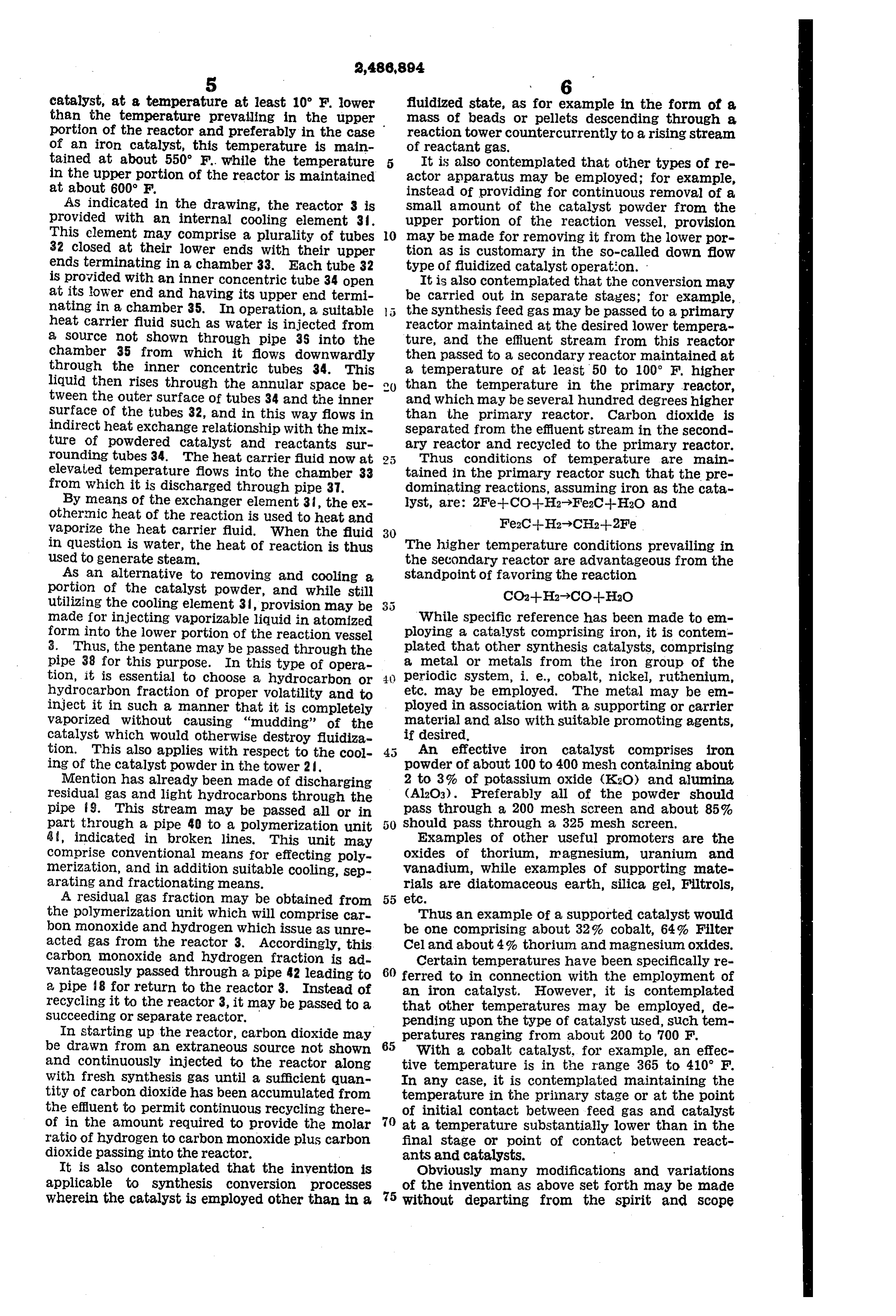
catalyst, at a temperature at least 10 F. lower fluidized state, as for example in the form of a than the temperature prevailing in the upper mass of beads or pellets descending through a portion of the reactor and preferably in the case reaction tower countercurrently to a rising stream of an iron catalyst, this temperature is main of reactant gas.
tained at about 550 F. while the temperature It is also contemplated that other types of re in the upper portion of the reactor is maintained actor apparatus may be employed; for example, at about 600 F. instead of providing for continuous removal of a As indicated in the drawing, the reactor 3 is Small amount of the catalyst powder from the provided with an internal cooling element 3. upper portion of the reaction vessel, provision This clement may comprise a plurality of tubes 10 may be made for removing it from the lower por 32 closed at their lower ends with their upper tion as is customary in the so-called down flow ends terminating in a chamber 33. Each tube 32 type of fluidized catalyst operation. is provided with an inner concentric tube 34 open It is also contemplated that the conversion may at its lower end and having its upper end termi be carried out in separate stages; for example, nating in a chamber 35. In operation, a suitable the synthesis feed gas may be passed to a primary heat carrier fluid such as water is injected from reactor maintained at the desired lower tempera a Source not shown through pipe 35 into the ture, and the effluent stream from this reactor chamber 35 from which it flows downwardly then passed to a secondary reactor maintained at through the inner concentric tubes 34. This a temperature of at least 50 to 100 F, higher liquid then rises through the annular space be than the temperature in the primary reactor, tween the outer surface of tubes 34 and the inner and which may be several hundred degrees higher Surface of the tubes 32, and in this way flows in than the primary reactor. Carbon dioxide is indirect heat exchange relationship with the mix separated from the effluent stream in the second ture of powdered catalyst and reactants sur ary reactor and recycled to the primary reactor. rounding tubes 34. The heat carrier fluid now at 2 5 Thus conditions of temperature are main elevated temperature flows into the chamber 33 tained in the primary reactor such that the pre from which it is discharged through pipe 37. dominating reactions, assuming iron as the cata By means of the exchanger element 31, the ex lyst, are: 2Fe--CO--H2->Fe2C--H2O and otherinic heat of the reaction is used to heat and
Vaporize the heat carrier fluid. When the fluid 30 in question is water, the heat of reaction is thus The higher temperature conditions prevailing in used to generate steam. the secondary reactor are advantageous from the As an alternative to removing and cooling a standpoint of favoring the reaction portion of the catalyst powder, and while still utilizing the cooling element 31, provision may be 3 5 made for injecting vaporizable liquid in atomized While specific reference has been made to emi form into the lower portion of the reaction vessel ploying a catalyst comprising iron, it is contem 3. Thus, the pentane may be passed through the plated that other synthesis catalysts, comprising pipe 38 for this purpose. In this type of opera a metal or metals from the iron group of the tion, it is essential to choose a hydrocarbon or periodic system, i. e., cobalt, nickel, ruthenium, hydrocarbon fraction of proper volatility and to etc. may be employed. The metal may be em inject it in such a manner that it is completely ployed in association with a supporting or carrier vaporized without causing “mudding' of the material and also with suitable promoting agents, catalyst which would otherwise destroy fluidiza if desired.
tion. This also applies with respect to the cool An effective iron catalyst comprises iron ing of the catalyst powder in the tower 2. powder of about 100 to 400 mesh containing about Mention has already been made of discharging 2 to 3% of potassium oxide (K2O) and alumina, residual gas and light hydrocarbons through the (Al2O3). Preferably all of the powder should pipe S. This stream may be passed all or in pass through a 200 mesh screen and about 85% part through a pipe 40 to a polymerization unit should pass through a 325 mesh Screen. 4, indicated in broken lines. This unit may Examples of other useful promoters are the comprise conventional means for effecting poly oxides of thorium, magnesium, uranium and merization, and in addition suitable cooling, sep vanadium, while examples of Supporting mate arating and fractionating means. rials are diatomaceous earth, silica gel, Filtrols, A residual gas fraction may be obtained from 55 e??.
the polymerization unit which will comprise car Thus an example of a supported catalyst would bon monoxide and hydrogen which issue as unre be one comprising about 32% cobalt, 64% Filter acted gas from the reactor 3. Accordingly, this Cel and about 4% thorium and magnesium oxides. carbon monoxide and hydrogen fraction is ad Certain temperatures have been specifically re vantageously passed through a pipe 42 leading to 60 ferred to in connection with the employment of a pipe 8 for return to the reactor 3. Instead of an iron catalyst. However, it is contemplated recycling it to the reactor 3, it may be passed to a that other temperatures may be employed, de Succeeding Or separate reactor. pending upon the type of catalyst used, such ten In Starting up the reactor, carbon dioxide may peratures ranging from about 200 to 700 F. be drawn from an extraneous source not shown 65 With a cobalt catalyst, for example, an effec and continuously injected to the reactor along tive temperature is in the range 365 to 410 F. With fresh Synthesis gas until a sufficient quan In any case, it is contemplated maintaining the tity of carbon dioxide has been accumulated from temperature in the primary stage or at the point the effluent to permit continuous recycling there of initial contact between feed gas and catalyst of in the amount required to provide the molar 70 at a temperature substantially lower than in the ratio of hydrogen to carbon monoxide plus carbon final stage or point of contact between react dioxide passing into the reactor. ants and catalysts.
It is also contemplated that the invention is Obviously many modifications and variations applicable to synthesis conversion processes of the invention as above set forth may be made wherein the catalyst is employed other than in a 75 without departing from the spirit and scope
Page 5
thereof, and therefore only such limitations determined conditions of temperature within the should be imposed as are indicated in the ap range about 500 to 700° F. and under superat pended claims. mospheric pressure, said catalyst comprising iron claim: maintained in a condition of dense phase fluid 1. In the catalytic hydrogenation of carbon ization in heat exchange relationship with a fluid monoxide to produce hydrocarbons, oxygenated heat carrier within the reaction zone effective to hydrocarbons and mixtures thereof wherein a maintain said predetermined temperature con synthesis gas stream comprising carbon monox ditions, the method comprising effecting initial ide and hydrogen in the relative proportions of contact between said synthesis gas stream and at least about 2 mols of hydrogen for each mol O the catalyst at a temperature within the range of carbon monoxide is passed in contact with a about 10 to 100 F. lower than the temperature of mass of powdered iron catalyst at predetermined final contact between reactants and catalyst, and conditions of temperature within the range of adding Carbon dioxide to the reactant stream about 500 to 700° E. and under a pressure of in amounts such that the ratio of mols of hy about 200 lbs. per sq. in. gauge, said catalyst be 5 drogen to the sum of the mols of carbon diox ing maintained in a condition of dense phase ide and carbon monoxide passing to the reac fluidization in indirect heat exchange relation tion zone is in the range of about 0.6 to 1.0 and ship with a fluid heat carrier within a reaction Such that net production of carbon dioxide from zone effective to maintain said predetermined the reaction zone is substantially inhibited and temperature conditions, the method comprising 20 the production of methane is at least materially effecting initial contact between said Synthesis reduced.
gas stream and the catalyst at a temperature of 3. The method according to claim 2 in which about 550° F., effecting final contact between re the initial contact between synthesis gas stream actants and çatalyst at a temperature of about and catalyst is at a temperature of about 50 to 600° F., and adding carbon dioxide to the re 25 100 F. lower than the final contact temperature actant stream in amounts such that the ratio between reactants and catalyst.
of mols of hydrogen to the sum of the mols of CLAUDE. W. WATSON. carbon dioxide and carbon monoxide passing to the reaction zone is about 0.6 and such that net REFERENCES CTED production of carbon dioxide from the reaction 30 The following references are of record in the zone is substantially inhibited and the produc file of this patent:
tion of methane is at least materially reduced.
2. In the catalytic hydrogenation of carbon UNITED STATES PATENTS monoxide to produce hydrocarbons, oxygenated Number Name Date hydrocarbons and mixtures thereof wherein a 35 2,248,099 Linckh -------------- July 8, 1941 synthesis gas stream comprising carbon monox 2,338,805 Dreyfus ------------ Jan. 11, 1944 ide and hydrogen in the relative proportions of 2,347,682 Gunness ----------- May 2, 1944 at least about 2 mols of hydrogen for each mol 2,353,600 Sweetser ----------- July 11, 1944 of carbon monoxide is passed in contact with a 40 2,393,909 Johnson ----------- Jan. 29, 1946 mass of solid particulate synthesis catalyst at pre 2,406,851 Redcay ------------- Sept. 3, 1946
Provenance
- Collection
- Cited prior art
- Original PDF
- patentimages.storage.googleapis.com →
- Filed
- 1945-11-02
- Pages
- 5
- Method
- pdftotext (the PDF's own text layer) + pdftoppm 300dpi page scans
- Source
- Google Patents bibliographic record
- Granted
- 1949-11-01
- Inventors
- Claude W Watson; Texaco Inc
- Transcribed from
- patentimages.storage.googleapis.com →