patent · US1837519
Apparatus for the treatment of hydrocarbonaceous liquids
22 December 1931
Page 1
Drawing sheet — no readable text.
Page 2
Patented Dec. 22, 1931 1837,519
UNITED STATES PATENT OFFICE
WABREN F. BLEECKER, OE BOULDIER, CoILORADo
APPARATUS FOR THE TREATMENT OF HYDROCARBONACEous LIQUIDs
Application filed July 14, 1928. Seriel Rio. 292,884.
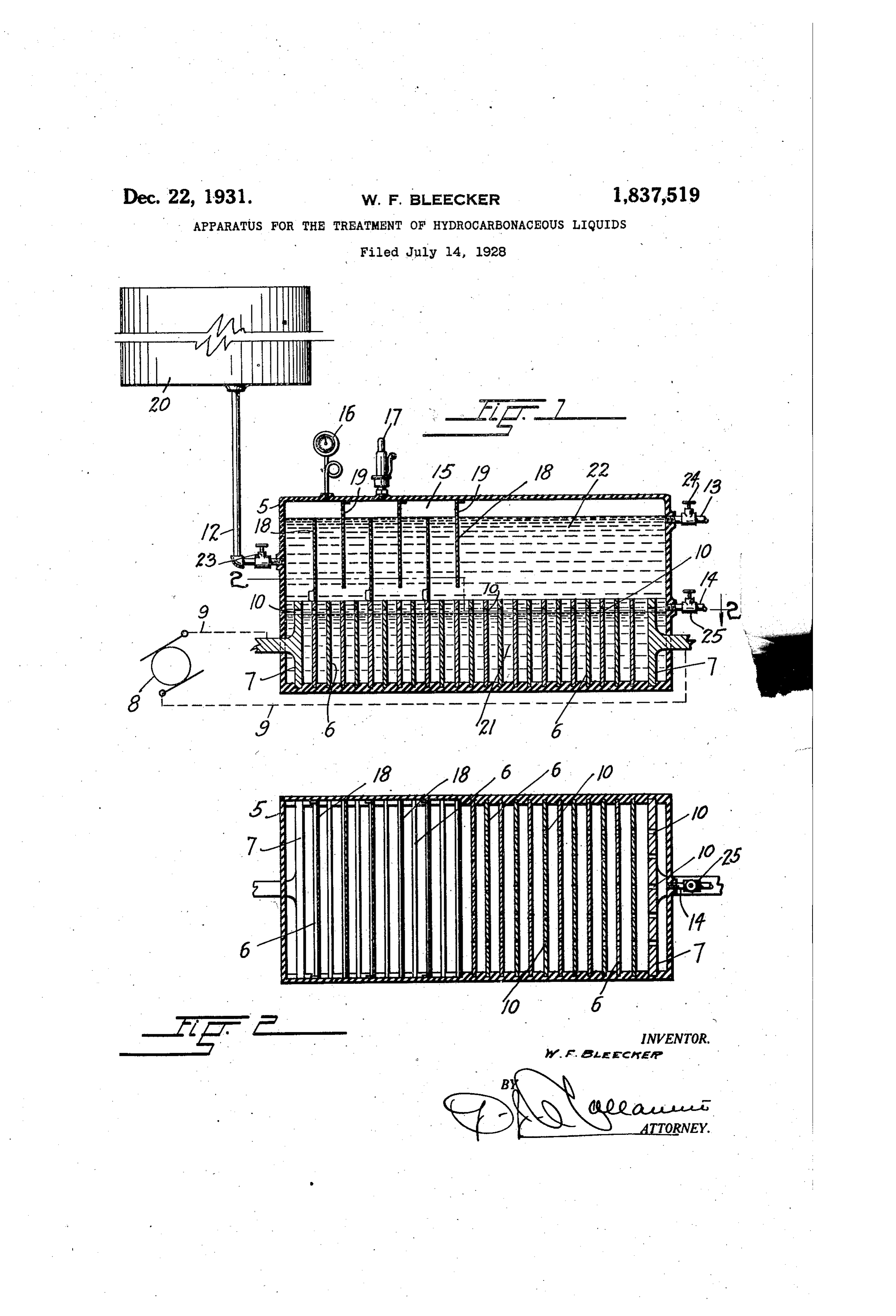
My invention relates to apparatus for the 6 extendin the lower portion of the container treatment of hydrocarbonaceous liquids of from one end of to the other. W the petroleum class for the purpose of ren The electrodes at opposite ends of the dering inactive or neutralizing certain cor series have terminals extending outside the ES rosive sulfur compounds frequently. found I container for their connection with a source Bg therein. of direct-current electricity 8, by a circuit in The treatment above referred to includes dicated in lines designated by the numera 9. the generation and admission of an oxidizing The electrodes are preferably composed of gas and it is described in detail and with inert conductive material such as graphite, No distinctive modifications in my applications magnetite, etc., and it is desirable that the for Patent Nos. 274,213, 274,214 and 274,215, electrodes at the ends of the series be made filed on the first day of May, 1928. . heavier than the others to provide ample con It is an object of the present invention to ductingarea, The electrodesareheldin con provide an electrolytic cell in which the tact with adjacent surfaces of the cell so as s treatment of the petroleum may be performed to prevent the passage of current around the expeditiously and to the best advantage. A Se further object is to provide a cell in which A preferred method consists in slotting the the oxidizing gas required in the process, is bottom, and the sides of the container and fit generated in the cell and is enclosed so that ting the edges of the electrodes in the slots, as it may impregnate the oil within the cell it shown in the drawings. 70 self or may, for the same purpose, be directed The electrodes are, of necessity, bi-polar, to a separate container under a pressure gen being positive on one side and negative on the erated cell.
by the accumulation of gases in the other.in the operation of the cell, it is desirable 25 In the preferred form of my invention, the that the level of the electrolyte is not appre oil is treated in the cell itself and an embodi ciably above the tops of the electrodes, and ment of the preferred-form of the invention provision is therefore made for the constant has been illustrated in the accompanying discharge of surplus electrolyte as will here drawings in which, inafter be more fully described. 30 Figure 1 represents a vertical sectional elle As an additional safeguard to the accumu vation of a cell made according to the inven lation of electrolyte above the electrodes, the tion, and latter may be provided with small holes 10, Figure 2 a horizontal section taken on the or as a variant with small notches, adjacent line 2-2, Figure 1. their upper edges, through which the electro 35 Like reference characters designate corre lyte may pass to the outlet provided for the 85 sponding parts throughout the views. purpose.
A closed container 5 of suitable dimensions The arrangement of the electrodes, as above and proportions is made of nonconducting described, prevents the electrolyte from ac material or it may be made of metal and cumulating above the electrodes and further 40 lined throughout with a nonconductive sub prevents the electrolyte from standing at the 90 stance. The object of this feature of the con ends or below the bottom edges of the elec struction is to compel the current entered into trodes except in negligible quantities, it being the cell at one end of a series of electrodes to essential for the efficient operation of the ap traverse the electrodes successively to the op paratus that the current passes through the 45 posite end of the cell, instead of seeking the series of electrodes and the bodies of electro 95. shortest path through a wall of the cell as lyte between the same and not through any would take place if the surfaces of the cell en portion of electrolyte without the extent of gaged by the electrolyte were, even in part, the electrodes. yx composed of a conductive substance. The cell has in connection with the space A series of equidistantly spaced electrodes above the series of electrodes, an oil-inlet 12, 100
Page 3
preferably located at an end of the container excess of that required for the electrolysis in and the cell has at the opposite end of the the cell. m container, two oil-outlets 13 and 14, the lower The oil may be supplied to the cell either one of which is alined with or slightly above by gravity or by a constant pressure pump, the plane of the tops of the electrodes, for the through the inlet conduit 12. In the draw. discharge of surplus electrolyte with the oil. ings, an elevated supply tank is shown at 20. The upper oil outlet, slightly below the top While the pressure under which the cell of the container, provides a space 15 for gases Operates, apparently does not affect the effi above the level of the oil. A pressure gauge ciency of absorption and oxidation of the O 16 indicates the pressure of gases in the space Sulphur compounds in the oil, increase of 75, 15 and a blow-off cock 17 maintains the gases pressure decreases the rate of evolution of in the cell at a predetermined maximum pres gas and it is therefore desirable to keep the STED pressure in the cell at a low limit in order not In the space of the cell above the electrodes, s nearest the end of the container at which the to interfere with the evolution of the desired quantity of gas at a given potential. 80 oil under treatment enters the same, are baffles In a cell having a capacity of five barrels 18 which in the treatment, function to keep of oil?????† kilowatt hour, using a current den the oil in a condition of agitation whereby to sity of fifty amperes per square foot and three permit of more rapid, more thorough and and one tenth volts potential between elec 20 more uniform absorption of the gas. Part trodes, a pressure of five pounds per square of the baffles may rest directly on the elec inch above atmospheric pressure, was found 85 trodes, as shown, while the others are sus to give satisfactory results.
pended from the top or roof of the container. t is desirable that the current density be The last mentioned baffles have in their sufficiently low to avoid heating, and in the 25 upper portions, small apertures 19 for the cir above given example, a current density of 90 culation of gas in the space 15 above the oil. about fifty amperes per square foot was ade The baffles are of particular advantage where quate.
oil containing wateris admitted to the cell for In the operation of the cell, the oil being ·30 treatment. The water is usually of the na admitted under pressure through the inlet ture of a brine, and in passing through the conduit 12, is supported in a separate body 95 cell in the form of an emulsion, the oil and 22 upon the electrolyte 21, which as stated water are, owing to the presence of the baf before, extends to a level approximately at or fles, partially broken and in many cases en closely adjacent to the tops of the electrodes. 35 tirely broken, whereby the water and the oil Any suitable electrolyte, such as caustic soda, are effectively separated. sodium carbonate or ? sodium sulphate may O The presence of brine in many oils, partic be used.
ularly sour oils, is also the main reason for The current passing from the source of the above stated arrangement of the elec electricity through the bi-polar electrodes trodes and for the provision of apertures at and the bodies of electrolyte between the O the top of the electrodes, it being apparent same, generates oxygen. The nascent oxygen
that the brine is an electrolyte and that it is rising to the top of the cell mixes with the oil, essential that the electrolyte be confined be it being understood that the pressure at which low a level closely adjacent that of the tops the oil is fed into the container, and the nat 45 of the electrodes. m ural pressure of the gases cause an intimate The number of electrodes for a given volt intermixture of the gases with the oil. Ex O age depends largely upon the ohmic resist cess gases escape by way of the blow-off valve ance of the electrolyte and the electrodes, the 17 which thus maintains the pressure in the decomposition voltage of the electrolyte and tank at a predetermined maximum. The 50 several minor indeterminate factors such as gases intermixing with the oil, neutralize and polarization, surface conditions, tempera render inactive the corrosive sulfur com 115 ture, etc. A one hundred and ten volt cell, pounds contained in the oil, and the oil being for example, may contain thirty-seven elec thereby purified to a condition in which it may be handled without harmful effects, is trodes, with a drop or fall of potential for discharged 55 each electrode of approximately three volts. from the container through the Potentials of 110 volts, 120 volts or 440 volts outletsBy
reason of the presence of two
may be used and under the same condition a One of which is at the electrolyte level and the 440 volt cell would contain approximately other at the oil level, the several elements one hundred and fifty electrodes.
BO It will be understood that any intermedi throughoutmaintained may be at their proper levels
ate voltage can be used as well, provided that The several conduits are provided with the ratio of potential to the number of elec valves designated in the drawings by the ref trodes as stated above, is maintained. An erence numerals 23, 24 and 25, and it is to be advantage of a cell of the described construc understood that in order to maintain the 65 tion is that it permits the use of potentials in levels, as stated hereinbefore, the valves in -
Page 4
the conduits 13 and 14 may be manually op series of electrodes, and the container having erated or a suitable mechanism may be pro an inlet for the admission of oil to the oil vided to make the regulation automatic.
It is to be understood that, if so desired, space, and baffles in the oil-space in the path the oil may be treated in a tank or container 5. Apparatusthrough of oil entering for the the inlet.
treatment oils bya 70 ofcircuit, 'separate from the cell, the gas being gener electrolysis, comprising an electric ated in the electrolyte as before, and thenee closed container, a series of spaced bi-polar. conducted to the gas container by means of electrodes in the container, included in the an appropriate conduit. In this modified
operation, the disadvantage of variations in circuit, there being a space in the container for the presence of a body of oil above the the amount of the electrolyte, is entirely series of electrodes, and the container having avoided and a more constant composition of an inlet for the admission of oil to the oil electrolyte in treating sour oils which are ac ?? and baffles projecting alternately from companied by water solutions, is possible. the plane of
The operation illustrated in the drawings from the top the of tops of the electrodes, and the container, in the path of 80 and hereinbefore described is, however, of oil entering the oil-space through the inlet. distinct advantage in that it provides for a 6. Apparatus for the treatment more compact apparatus and the utilization electrolysis, comprising an electricofcircuit, oils by
of oxygen, which is thought to be the most 20 desirable agent for treating the oil nearer its closed container, a series of spaced bi-polar source, and therefore, to a relatively larger electrodes circuit, in the container, included in the 85 there being a space in the container extent, nascent.
Another advantage of the first described series of electrodes,ofand for the presence a body of oil above the the container having operation is that it gives amore complete de 25 emulsification action for breaking oils con an inlet for the admission of oil to the oil taining emulsions. space and an outlet defining a gas-space above 90 What claim and desire to secure by Let the body ters Patent is:
the of oil, and baffles in the oil-space, in path of oil entering through the inlet, 1. Apparatus for the treatment of oils by certain baffles extending in the gas space and 30 electrolysis, comprising an electric circuit, a having apertures for the passage of gas. 7. Apparatus for the treatment of oils by 95 closed container, and a series of spaced bi electrolysis polar electrodes in the container, included in a closed interiorlycomprising an electric circuit, the circuit, there being a space in the con a series of spaced bi-polar non-conductive container, tainer for the presence of a body of oil above ing the lower portion of the electrodes divid
the series of electrodes, and the container outer electrodes of the series being container, the having two outlets for oil at different eleva in the circuit, overflow means to restrict connected 00 tions, the lower outlet being at or adjacent to level of an electrolyte to said lower portion the the plane of the tops of the electrodes.
2. Apparatus for the treatment of oils by of the container, leaving an oil space above 40 electrolysis, comprising an electric circuit, a the same, overflow means to restrict the level closed container, and a series of spaced and in of oil in said space, leaving a space for gases the upper portionmeans apertured bi-polar electrodes in the container, pressure-regulating of thetocontainer, maintain anda included in the circuit, there being a space in maximum pressure above atmospheric, in the
the container for the presence of a body of oil gas space.
above the series of electrodes, and the con 8. Apparatus for the treatment of oils by O tainer having two outlets for oil at different electrolysis comprising an electric circuit, a elevations, the lower outlet being at or adja closed interiorly non-conductive container, a cent to the plane of the tops of the electrodes. series of spaced bi-polar electrodes dividing 3. Apparatus for the treatment of oils by 50 electrolysis, comprising an electric circuit, a the lower portion of the container, the outer closed container, a series of spaced bi-polar electrodes of the series being connected in 115 electrodes in the container, included in the the circuit, overflow means to restrict the level circuit, there being a space in the container of an electrolyte to said lower portion of the for the presence of a body of oil above the portion andleaving container, a space an oil space above said for gases above the oil series of electrodes, and the container having space, and pressure regulating means to main an inlet for the admission of oil to the oil tain a maximum pressure, more than atmos space, and means in the oil-space to cause pheric, in the gas space. w agitation inlet.
of the oil entering through the 9. Apparatus for the treatment of oils by 60 electrolysis comprising an electric circuit, a 4. Apparatus for the treatment of oils by closed electrolysis, comprising an electric circuit, a series of interiorly non-conductive container, a 25 closed container, a series of spaced bi-polar the lowerspaced portion bi-polar electrodes dividing of the container, the outer electrodes in the container, included in the electrodes of the series being connected in the circuit, there being a space in the container 65 for the presence of a body of oil above the circuit, overflow means to restrict the level of an electrolyte to said lower portion of the 130
Page 5
container, leaving an oil space above said portion and a space for gases above the oil space, pressure regulating means to main tain a maximum pressure, more than atmos pheric, in the gas space, and means for enter ing oil under pressure into the oil space. In testimony whereof I have affixed my signature.
WARREN F. BLEECKER.

Provenance
- Collection
- Cited prior art
- Original PDF
- patentimages.storage.googleapis.com →
- Filed
- 1928-07-14
- Pages
- 5
- Method
- pdftotext (the PDF's own text layer) + pdftoppm 300dpi page scans
- Source
- Google Patents bibliographic record
- Granted
- 1931-12-22
- Inventors
- Warren F Bleecker
- Transcribed from
- patentimages.storage.googleapis.com →