patent · US1505338
Gas for blowpipe use
19 August 1924
Page 1
Patented Aug. 19, 1924. 1,505,338
JOHN HARRIS, OF LAKEWOOD, OHIO, ASSIGNOR. To CARBO-oxYGEN coMPANY., of
PITTSBURGH, PENNSYLVANIA, A CORPORATION OF DELAWARE.
GAs FoR BLow PIPE USE. . .
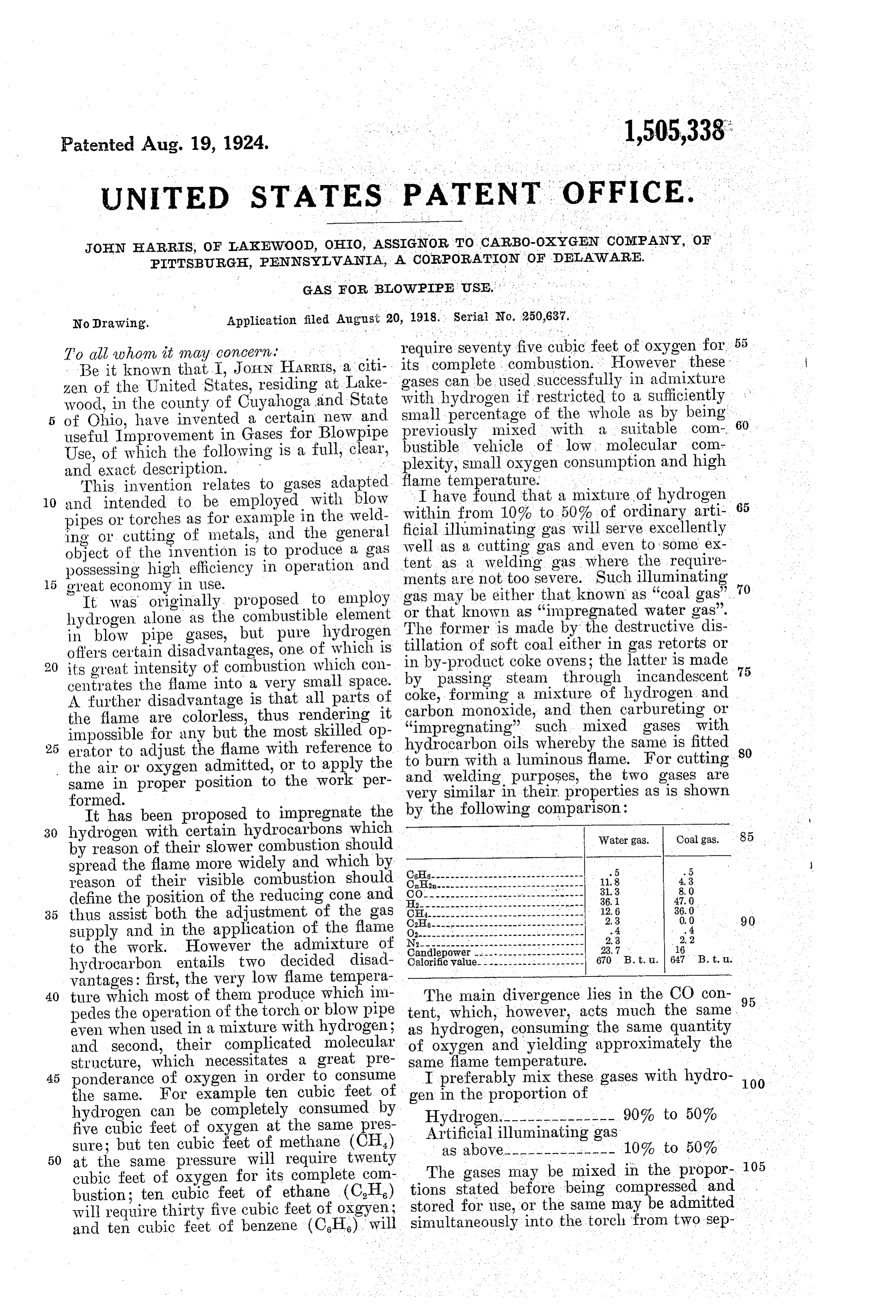
No Drawing, Application filed August 20, 1918. Serial No. 250,637. To all whom it may concern. require Seventy five cubic feet of oxygen for Be it known that I, JoHN HARRIs, a citi gases its complete combustion. However these Zen of the United States, residing at Lake With hydrogen can be used successfully in admixture wood, in the county of Cuyahoga and State Small percentageif ofrestricted the to a sufficiently whole as by being 60 of Ohio, have invented a certain new and previously mixed with a suitable useful Improvement in Gases for Blowpipe bustible vehicle of low molecular com Use, of which the following is a full, clear, plexity, Small oxygen consumption and com high
This invention relates to gases adapted flame temperature. ". . . . .. I have found that a mixture of hydrogen
10 and intended to be employed with blow pipes or torches as for example in the Weld ficial within from 10% to 50% of ordinary arti 65 ing ol' cutting of metals, and the general well asilluminating gas will serve excellently object of the invention is to produce a gas tent as aa cutting gas and even to some ex Welding gas where the require possessing high efficiency in operation and ments are not too severe. Such illuminating 5 great economy in use.
It was originally proposed to employ gas may be either that known as “coal gas” 70 hydrogen alone as the combustible element The or that known as impregnated water gas'. in blow pipe gases, but pure hydrogen former is made by the destructive dis offer's certain disadvantages, one of which is tillation of soft coal either in gas retorts or 20 its great intensity of combustion which con in by-product coke ovens; the latter is made 75 centrates the flame into a very small space. coke, by passing steam through incandescent A further disadvantage is that all parts of carbonforming a mixture of hydrogen and monoxide, and then carbureting or the flame are colorless, thus rendering it "impregnating such mixed gases with impossible for any but the most skilled op 25 erator to adjust the flame with reference to hydrocarbon oils whereby the same is fitted 80 the air or oxygen admitted, or to apply the to burn with a luminous flame. For cutting same in proper position to the work per and welding purposes, the two gases are very similar in their properties as is shown formed.
It has been proposed to impregnate the by the following comparison:
30 hydrogen with certain hydrocarbons which Water gas. Coal gas. 85 by reason of their slower combustion should spread the flame more widely and which by .. 5 .. 5 reason of their visible combustion should 11.8
define the position of the reducing cone and 36.1 47.0 thus assist both the adjustment of the gas 12.6
supply and in the application of the flame .. 4
to the work. However the admixture of 23.7 16 hydrocarbon entails two decided disad 670. B. t.u. 647 B. t. I. vantages: first, the very low flame tempera 40 ture which most of them produce which inn The main divergence lies in the CO con pedes the operation of the torch or blow pipe tent, which, however, acts much the same, 95 even when used in a mixture with hydrogen; as hydrogen, consuming the same quantity and second, their complicated molecular of oxygen and yielding approximately the structure, which necessitates a great pre same flame temperature.
45 ponderance of oxygen in order to consume I preferably mix these gases with hydro 100 the same. For example ten cubic feet of gen in the proportion of hydrogen can be completely consumed by Hydrogen.-------------- 90% to 50% five cubic feet of oxygen at the same pres sure; but ten cubic feet of methane (CH) ArtificialaS illuminating gas
50 at the same pressure will require twenty cubic feet of oxygen for its complete com The gases may be mixed in the propor bustion; ten cubic feet of ethane (CH) tions stated before being compressed and will require thirty five cubic feet of oxgyen; stored for use, or the same may be admitted and ten cubic feet of benzene (CH) will simultaneously into the torch from two sep
Page 2
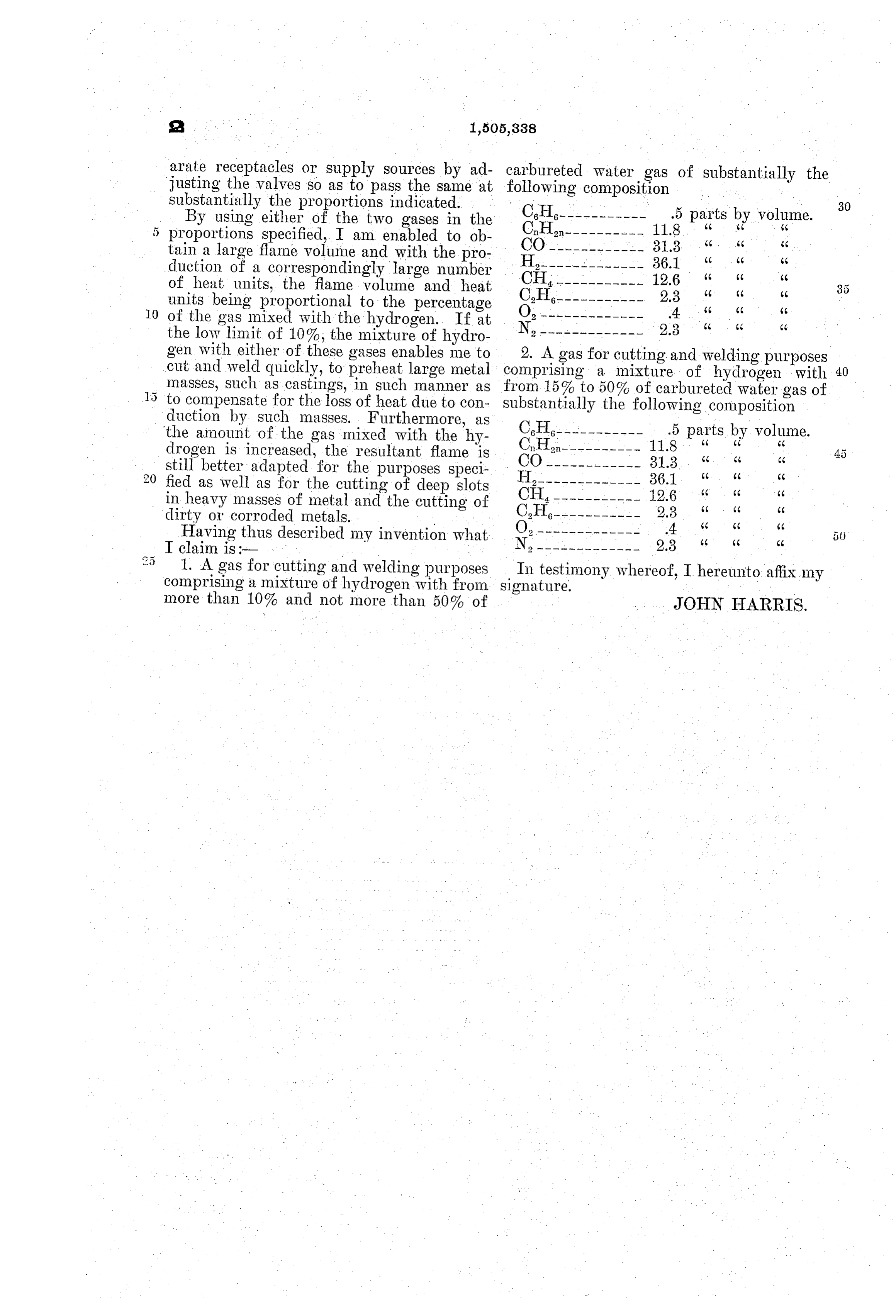
arate receptacles or supply sources by ad carbureted water gas of substantially the justing the valves so as to pass the same at following composition substantially the proportions indicated.
By using either of the two gases in the CH----------- .5 parts by volume. 30 5 proportions specified, I am enabled to ob C. Han - - - - - - - - - - 11.8 G6 G6 6.
tain a large flame volume and with the pro CO------------
duction of a correspondingly large number Ci. 12.6 66 : “ of heat units, the flame volume and heat units being proportional to the percentage
O of the gas mixed with the hydrogen. If at .
the low limit of 10%, the mixture of hydro N. ------------- 2.3 GG gen with either of these gases enables me to 2. A gas for cutting and welding purposes cut and Weld quickly, to preheat large metal comprising a mixture of hydrogen with 40 masses, such as castings, in such manner as from 15% to 50% of carbureted water gas of to compensate for the loss of heat due to con substantially the following composition duction by such masses. Furthermore, as the amount of the gas mixed with the hy CoHo----------- .5 parts by volume. drogen is increased, the resultant flame is CH n - - - - - - - - - - 11.8 GG c G
still better adapted for the purposes speci CO" 33 c : : 45
fied as well as for the cutting of deep slots Cit. GG in heavy masses of metal and the cutting of C.H.----------- 2.3 * * GGis
dirty or corroded metals.
Having thus described my invention what O. - -- --- -- -- 4
I claim is:- N - - - - - - - - - -- - - - 2.3 G GG
1. A gas for cutting and welding purposes In testimony whereof, I hereunto affix my comprising a mixture of hydrogen with from signature.
more than 10% and not more than 50% of JOHN HARRIS.
Provenance
- Collection
- Cited prior art
- Original PDF
- patentimages.storage.googleapis.com →
- Filed
- 1918-08-20
- Pages
- 2
- Method
- pdftotext (the PDF's own text layer) + pdftoppm 300dpi page scans
- Source
- Google Patents bibliographic record
- Granted
- 1924-08-19
- Inventors
- Harris John; CARBO OXYGEN Co
- Transcribed from
- patentimages.storage.googleapis.com →