patent · US3913033
Cw organic dye laser
14 October 1975
Page 1 — bibliographic record
United States Patent 19 1 l) 3,913,033 Tuccio et al. 45) Oct. 14, 1975 54 CW ORGANIC OYE LASER Dyes, Soviet Physics, Vol. 11, No. 3, Nov.-Dec. 75 Inventors: Sam A. Tuccio; Otis. G. Peterson, 1968), pp. 304–318.
both of Rochester, N.Y. Pappalardo et al., Long Pulse Laser Emission From Rhodamine 6G Using Cyclooctatetraene, Appl. Phys.
73) Assignee: Eastman Kodak Company, Let., Vol. 16, No. 7, (April 1, 1970), pp. 267-268. Rochester, N.Y. Snavely, Dye Lasers, S.P.I.E. Journal, Vol. 8, (May 22 Filed: July 1, 1974 1970), pp. 1 19-125.
21 Appl. No.: 484,726 Primary Examiner-William L. Sikes Related U.S. Application Data Attorney, Agent, or Firm-D. I. Hague
abandoned, which is a continuation-in-part of Ser. 57 ABSTRACT
No. 51,790, July 2, 1970. A method and apparatus for producing continuous 52 U.S. C. ....................... 331/94.5 L 331/94.5 C emission from a lasing medium comprising organic (51) Int. Cl.’............................................ HO1S3/20 dye molecules in solution. Continuous emission is ac 58 Field of Search..................... 331/94.5; 330/4.3; complished by flowing the medium through a focused
optical cavity while simultaneously producing a popu lation inversion in that portion of the medium flowing 56 References Cited in close proximity to the focal point of the cavity. The
UNITED STATES PATENTS
population inversion is produced by pumping the me dium longitudinally, along the optical axis of the cav 3,055,257 9/1962 Boyd et al.......................... 331194.5 ity, preferably by the focused output of a continuous OTHER PUBLICATIONS wave argon laser. Sufficient thermal energy is continu Snavely, Flashlamp-Excited Organic Dye Lasers, ously dissipated from the medium to maintain the op Proc. IEEE, Vol. 57, No. 8, (Aug. 1969), pp. tical homogeneity thereof at or above the quality re 1374-1390. quired for continuous emission. Stepanov et al., Lasers Based on Solutions of Organic 30 Claims, 5 Drawing Figures
Page 2
Drawing sheet — no readable text.
Page 3
Drawing sheet — no readable text.
Page 4
Drawing sheet — no readable text.
Page 5
CW ORGANIC DYE LASER for more than a few microseconds in duration. See, for insstance, an article entitled "Flashlamp Excited Or
This is a continuation, of application Ser. No. ganic Dye Lasers' by B. B. Snavely, published in the 17,595, filed Feb. 22, 1971 and now abandoned, proceedings of the IEEE, Vol. 57, No. 8 (1969). As is which is a continuation-in-part of our copending appli well known, stimulating emission from fluorescing or cation Ser. No. 51,790, entitled “CW Organic Dye La ganic dyes relies on radiative transitions taking place as ser", filed July 2, 1970. molecules in the excited singlet state return to the
BACKGROUND OF THE INVENTION
ground singlet state. Rather than returning directly to ground from the excited state, however, there is a small
The present invention relates to lasers and particu 10 probability that molecules will return indirectly by un larly to an organic dye laser having the unique capabil dergoing radiationless transitions from the excited sin ity of continuous emission. glet to a lower-lying triplet state and then to ground. During the last decade, considerable attention was Such radiationless transitions obviously compete with focused on the problems attendant the task of provid the laser process and thereby represent losses to the ing a continuous wave (CW) laser having the capability 15 system. That is to say, energy used to pump or excite of being continuously spectrally turned over a rela molecules to a state from which lasing may occur is tively broad band of wavelengths within the optical wasted if molecules return to ground via the triplet spectrum; i.e., the ultraviolet, visible and near-infrared state. While the probability of transitions from the sin spectral regions. Such attention was undoubtedly stim glet to triplet state is small, the probability of transi ulated, in part, by the expressed interests of those who 20 tions from the triplet state to ground is almost equally foresaw a myriad of scientific and commercial applica as small. Thus, the triplet state tends to act as a trap for tions in such fields as spectroscopy, communications, excited molecules and thereby depletes the supply of photo-chemical manufacture, image-recording, etc. molecules available for the laser process. Notwithstanding intense interest and efforts, however, In addition to depleting the supply of molecules, the little headway was made for several years in providing 25 triplet state is also detrimental to the laser process in practical solutions to the problems presented. Granted, that transitions within the triplet manifold (i.e. triplet a vast array of new lasing materials was discovered dur triplet transitions) are spin-allowed and the optical ab ing the first six years of laser technology, many being sorption associated with these transitions is strong. Un adapted for use in CW laser systems; however, the fluo fortunately, the corresponding absorption band gener rescence spectra of such materials, being primarily 30 ally overlaps the singlet state fluorescence spectrum. based upon atomic transitions in the visible portion of Consequently, the accumulation of molecules in the the spectrum, constituted lines and, as such, presented triplet state produces large optical losses at the wave no possibility of continuous tunability in the visible lengths for which laser emission is most probable. In spectrum. fact, the absorption associated with triplet-triplet pro In 1966, a significant stride toward the final solution 35 cesses can be strong enough to quench or even prevent of a CW tunable laser was made when P. P. Sorokin laser emission in less than a microsecond. and J. R. Lankard demonstrated that coherent radia Fortunately, recent experiments have shown that it is tion could be stimulated from fluorescent organic dyes possible to chemically quench the triplet state lifetime in solution. See IBM Journal, Vol. 10, p. 162 (1966). 40 (the reciprocal of the probability of triplet-singlet tran Unlike the fluorescence of other lasing materials, the sitions) of many organic dyes to a time sufficiently fluorescence of organic dyes is broadband, commonly short as to prevent the buildup of a triplet state concen spanning several hundred angstrom units within the 0.2 tration large enough to prevent continuous operation; to 1.2 micron spectral range. Such broadband fluores see, for instance, an article by B. B. Snavely and F. P. cence, being based upon molecular rather than atomic Schäfer, entitled “Feasibility of CW Operation of Dye transitions, enables the so called "dye laser' to be spec 45 Lasers", Physics Letters, Vol. 28A, No. 11, (1969). By trally tuned to any wavelength within a substantial por the addition of molecular oxygen, for example, to sev tion of its fluorescence band. Because of the vast num eral known organic dye solutions, the lifetime of the ber of organic dyes and the fact that each dye has a triplet state of the dye can be reduced to permit the unique fluorescence band, the dye laser has received molecules, normally trapped in the triplet state, to rap wide acclaim as being the first truly tunable laser capa 50 idly return to the ground state in a time sufficiently ble of operating throughout the optical spectrum. short to permit continuous laser emission. Similar re In the Sorokin and Lankard experiments, laser action sults in attempts at triplet life-time quneching have was accomplished by arranging the dye solution within been obtained by employing cyclooctatetraene as a a conventional parallel reflector cavity and pumping triplet quencher in ethanol solutions of the organic the solution by the output of a giant pulse or Q 55 dyes rhodamine 6G and B, and by employing anthra switched ruby laser. Because of the pulse duration of cene in ethanol solutions of dichlorofluoroescein. The the pumping source, laser action in the dye solution effectiveness of chemical quenching is, of course, was limited to less than a microsecond. Thus, the dye strongly dependent on the probability of singlet to trip laser of Sorokin and Lankard, although spectrally tun 60 let transition as well as the responsiveness of the triplet able, represented only a partial solution to the abovei state to the particular quenching additive. In other dentified task. words, the intersystem crossing rate can be so high that Heretofore, despite innumerable efforts, continuous no amount of additive or no known additive will suffice wave operation of an organic dye laser has never been to sufficiently quench the triplet state concentration. achieved. Generally, the barriers confronting CW oper 65 However, in addition to quenching the lifetime of the ation have been twofold. First, it is generally accepted triplet state by chemical additives, another method of that the uncontrolled accumulation of molecules in the coping with triplet-state losses is to physically prevent metastable triplet state will prevent dye laser emission the buildup of triplet-state molecules in the active or
Page 6
pumped volume of the laser cavity. It has been found ents in the medium which, in turn, give rise to refrac . that an accumulation of triplet-state molecules can be tive index gradients or optical inhomogeneities. Such prevented to some extent if not entirely by simply flow gradients disrupt the uniform propagation of energy in ing the dye solution through the active volume at a high the medium and thereby, produce critical losses in the velocity. This technique has the effect of maintaining power density of the excitation source and in the per the population density of molecules in the triplet state centage of photons available for stimulating further at a low value relative to singlet-state molecules, emission. To date, these losses have not been reduced thereby minimizing absorption losses and maximizing to a level required for CW operation. the number of molecules available for laser action. The only drawback to this approach is that its utility is to O SUMMARY OF THE INVENTION some extent limited to lasers in which the active vol. The primary object of the present invention then is . ume is relatively small. It has been found that the life to provide a laser having the capabilities of continuous time of the triplet state in the active region of the laser emission and continuous spectral tunability. cavity must be limited to times of the order of or less Another object of the invention is to provide anor than a microsecond. For "mechanical', as opposed to 5 ganic dye laser having the unique capability of continu “chemical', quenching, the rate of flow through the ac ous emission of coherent radiation at a wavelength. tive volume must be such that the dye molecules tra which is tunable over a substantial portion of the fluo verse the active region in this length of time. Where the rescence band of the particular organic dye comprising dimension to be traversed is of the order of a millimeter the lasing medium.
or more, relatively high pressure is required to achieve 20 Still another object of the invention is to provide a the required transit time. However, in the case of fo tunable liquid laser which is capable of emitting coher cused cavities, it has been found that the pressures re entradiation having a narrow spectral bandwidth, sub quired for producing such transit times are not at all.
impractical. In fact, by combining the chemical and stantially band pass less than 1 angstrom unit, selectable within a of several hundred angstrom units.
mechanical approaches to triplet quenching, it is possi 25
Still another object of the present invention is to pro ble to vastly extend the number of dyes adapted for use vide a method for continuously producing stimulated in CW systems far beyond those particular dyes whose triplet lifetime can be sufficiently reduced by eitherap emissionThe CW from a solution of organic dye molecules.
dye laser of the invention comprises a fo proach alone. cused resonant cavity (e.g., hemispherical, spherical or
From the foregoing, it is apparent that optical losses confocal cavities) associated with the metastable triplet state have been ume. The cavity is having adapted a relatively small active vol to permit longitudinal exci effectively overcome and presently present no major tation of fluorescent organic dye solution disposed barrier to sustained laser action. However, the second barrier to continuous wave operation, that being the 35 tinuous energy source, such as an argon-ionfrom therein. Excitation radiation is introduced a con problem of overcoming optical losses produced by into the dye solution through one of the reflectivelaser, CW thermal effects introduced during pumping, has never rors comprising the cavity and is focused within themir ac been heretofore solved and is thus the subject of con tive volume of the cavity at a power density sufficient cern of the present invention.
It is basic that, in order for any active medium to lase 40 to produce the necessary number of excited molecules. continually, it is essential (1) to continuously maintain anddissipate
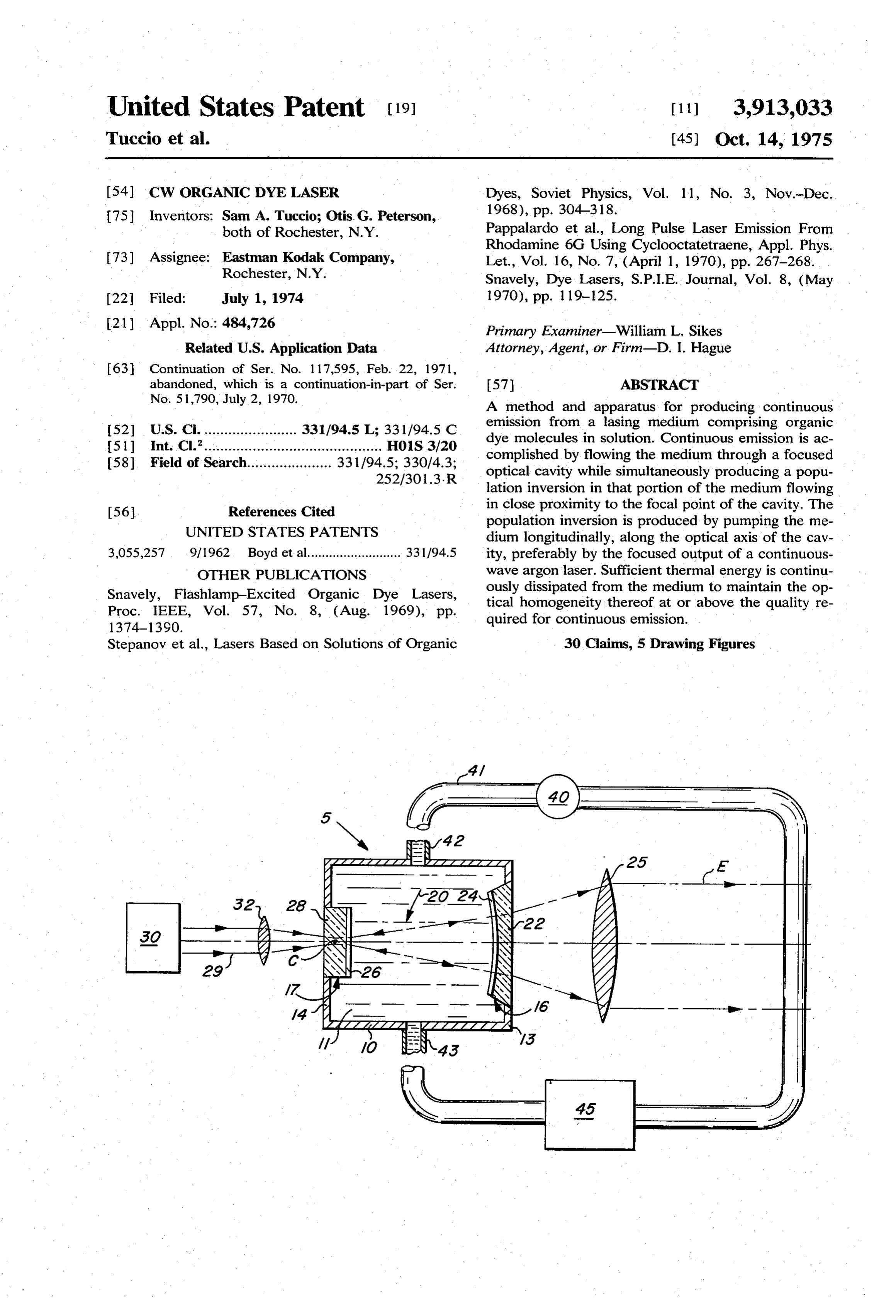
To thermal energy generated during pumping, a population inversion in at least a portion of the active homogeneitymaintain thereby of the substantially constant the optical dye solution, the transparent dye, medium, and (2) to continuously stimulate emission of cell windows, through which pumping energy is intro photons from that portion of the medium wherein the duced into the active medium, preferably comprise a population inversion is created by bombarding it with a sufficient percentage of those photons emitted at the 5 material of relatively high thermal conductivity, such as lasing frequency as to maintain the power density re sapphire, diamond, or beryllium oxide. The mainte quired for the critical inversion within the capability of nance of optical homogeneity is also assisted by the use the excitation or pumping source. The basic problem in of a dye solvent whose refractive index changes only providing these essentials for organic dye lasers is the slightly with temperature and by a pumping and heat. problem of maintaining, during continued pumping, 50 exchanging apparatus whereby the dye solution may be the requisite optical homogeneity in the active medium advanced through the excited region of the cavity at a rapid rate and cooled before being recirculated as to permit (1) the power density of the excitation ra through diation to remain at or above the threshold value re the cavity. Such circulating apparatus may also quired for producing the necessary population inver 55 serve to assist in reducing optical losses produced by sion, and (2) a sufficient fraction of those photons the metastable triplet state of the dye molecules. emitted at the lasing frequencies to be redirected, by The above and other objects of the invention, its na the reflective members of the optical cavity, back ture and its various advantages, can be more readily un through the excited medium so as to maintain constant derstood by referring to the accompanying drawings the power density threshold required for lasing. During 60 and to the detailed description thereof which follows. operation, the molecules absorb radiation provided by BRIEF DESCRIPTION OF THE DRAWINGS, the source of excitation and thereby become excited into upper states. As is well known, the transition of FIG. 1 is a schematic representation of the energy these excited molecules back to the ground state in levels of an organic dye molecule.
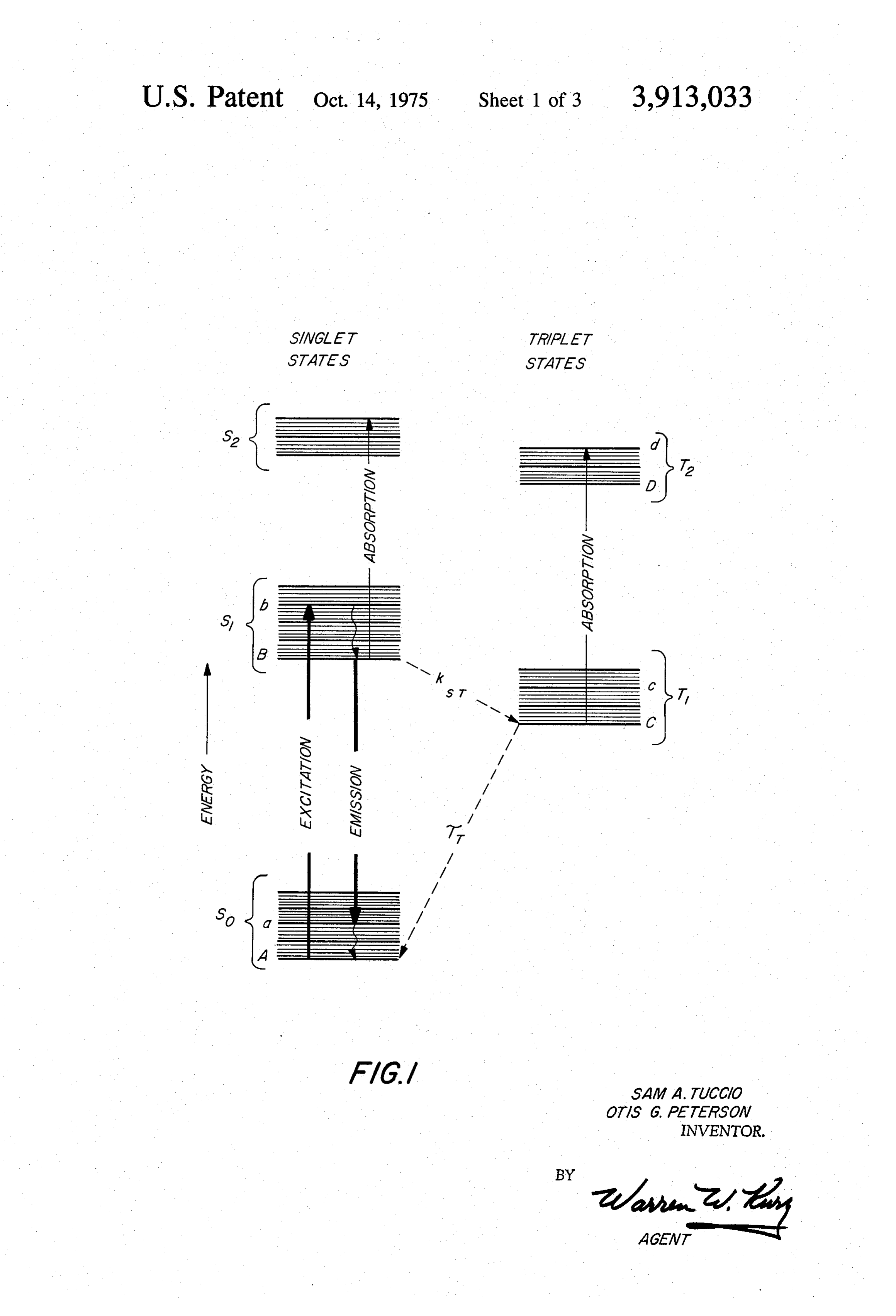
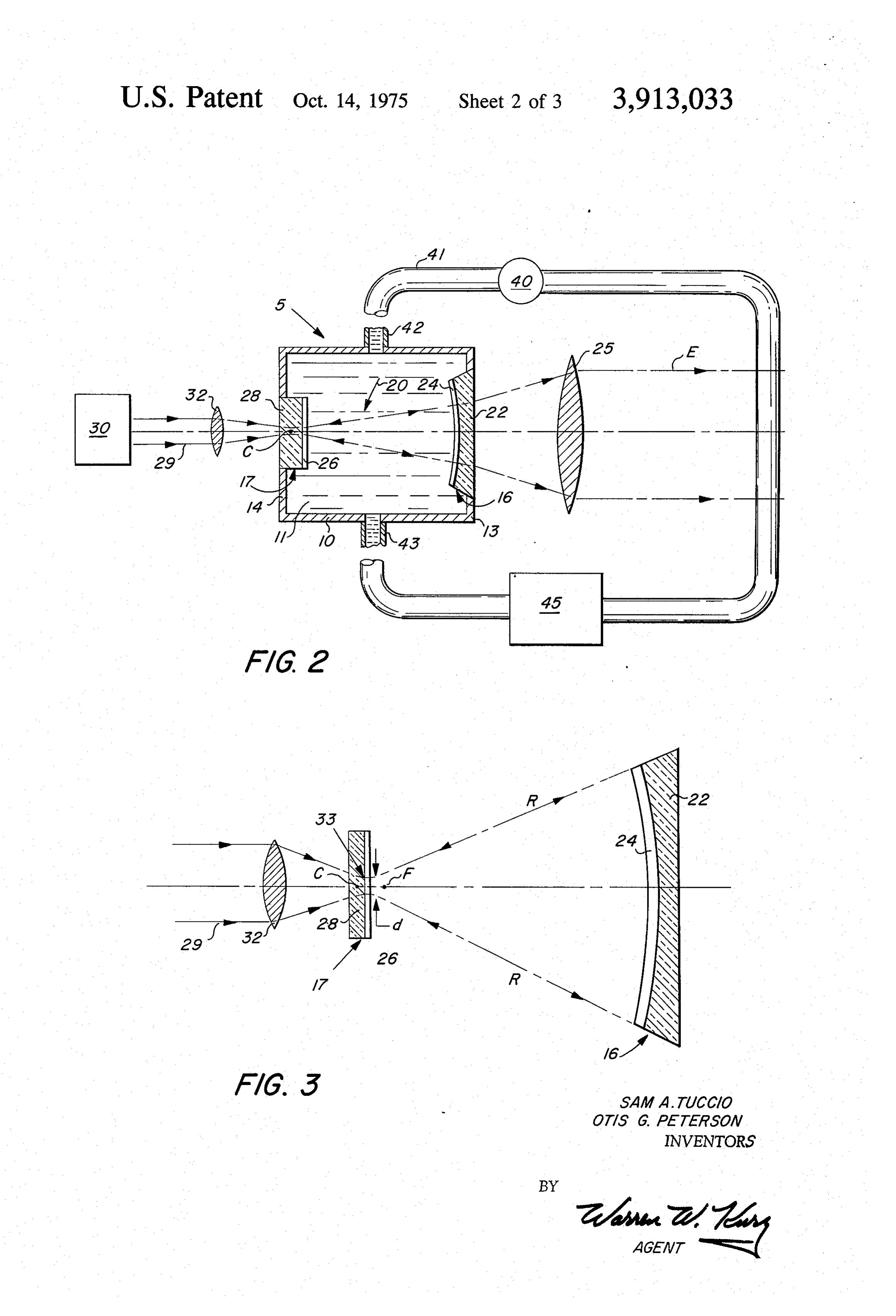
clude radiative transitions, in which photons are given 65 FIG. 2 is a schematic view of a CW organic dye laser off, as well as radiationless transitions, in which thermal system in accordance with a preferred embodiment; energy is given off. A non-uniform addition of thermal FIG.3 is a magnified view of the active volume of the energy to the active medium produces thermal gradi laser cavity;
Page 7
FIG. 4 is a schematic illustration of another embodi molecules. For organic dye molecules, t is typically ment in which the cavity mirrors are disposed outside about 5 X 10 seconds.
the dye cell; The photon energy for which the optical absorption FIG. 5 is a schematic view of a tunable CW organic of the molecule is a maximum is greater than the pho dye laser according to another embodiment of the in ton energy at the fluorescence maximum. Thus, the ab vention. sorption band is centered at a shorter wavelength than DETAILED DESCRIPTION OF PREFERRED the fluorescence band. The difference in energy be
EMBODIMENTS
tween absorption and emission processes is taken up by the radiationless transitions b - Banda - A. The sep
To define certain terms referred to subsequently 10 aration between fluorescence and singlet absorption herein, and to schematically illustrate those properties spectra is important for the dye laser since the unex of an organic dye molecule which affect its capability cited dye is then substantially transparent to radiation to fluoresce over a continuum of wavelengths, an en within the fluorescence band.
ergy level diagram is presented in FIG. 1. The heavy As previously indicated, transitions other than those horizontal lines represent the vibrational states of the 15 between the excited and ground singlet states represent dye molecule and the lighter horizontal lines represent losses to the system. By far the most serious losses its fine structure. Absorption of pumping or excitation occur when molecules in the excited singlet state at energy and laser emission are represented by the transi tempt to return to the ground singlet state via a lower tions A -> b and B - a, respectively. Other transitions 20 lying triplet state. This indirect process of decay, com represent losses in the laser process. monly known as intersystem crossing, is detrimental to The electronic ground state of the molecule is a sin laser action for several reasons.
glet state, designated as So, which spans a range of ener First, and most obvious, intersystem crossing com gies determined by the quantized vibrational and rota singletwith petes fluorescence in de-energizing the excited state. Thus, molecules are depleted from the ex tional exictation of the molecule. The energy spacing 25 between the vibrational levels is typically of the order for cited singlet state which would otherwise be available of 1400 to 1700 cm. The energy spacing between ro triplet-singlet laser emission. Secondly, since singlet-triplet and tational levels, being smaller than the spacing between bility of intersystem transitions are spin-forbidden, the proba vibrational levels by a factor of approximately 100, tem crossing rate constant crossing, governed by the intersys provide a near continuum of states between the vibra 30 lifetime of the triplet state kst, is quite small and the tional levels. The first and second excited singlet and The actual value of TT depends upon experimentallarge. TT correspondingly con triplet states are designated as S1, and S2, and T and T2, ditions; for a carefully degassed and purified dye solu respectively.
Like the electronic ground state, each excited elec tion, a lifetime of 10 second is typical. Since the trip tronic state of the molecule consists of a similar contin 35 let lifetime is usually several orders of magnitude uum of energy levels, and optical transitions between tends longer than the fluorescence lifetime, the triplet state these electronic levels give rise to the broad absorption depletes to act as a trap for excited molecules and thereby and emission spectra characteristic of the dye mole laser process. the number of molecules available for the cule.
Thirdly, triplet-triplet transitions are spin-allowed, and the corresponding strong absorption
As the first step of the laser process the molecules are 40 band generally overlaps the singlet state fluorescence excited from the lowest levels of the ground singlet spectrum. Consequently, the accumulation of mole state So to higher vibrational-rotational levels of the cules in the triplet state produces large optical losses at first excited singlet state S by absorbing radiation pro the wavelengths at which laser emission is most proba vided by an excitation or pumping source. Such excita ble.
tion is commonly provided by illuminating the dye mol 45 Optical absorption between excited singlet states, ecules with the output of a flashlamp or with the beam such as the process connecting S and S2 in FIG. 1, is of another laser having suitable spectral characteristics. also a possible source of optical loss in the dye laser. As stated above, molecular excitation is indicated by The importance of this process is difficult to assess, the transition A -> b. The molecular energy then de 50 however, since little information has been gathered to cays nonradiatively to level B, a lower level of the S. date.
state, as indicated by the wavy line between b and B. From the foregoing discussion it is readily apparent The laser emission results from the stimulated transi that triplet-state losses are extremely detrimental to tion between levels B and a. Level a is a higher lying continuous laser action. If unchecked, such losses are vibrational-rotational state of So. The laser process is 55 capable of quenching laser emission in less than a mi then terminated by the nonradiative decay between a crosecond after emission commences, no matter what and A, the lowest possible singlet state. dye molecules comprise the active medium. Presently, Before coherent emission can be produced from the our most effective method of controlling triplet-state organic dye media, the concentration of molecules in losses is to introduce an additive into the dye solution the excited singlet state S1 must reach a certain mini 60 which serves to, in effect, shorten the triplet state life mum value, commonly referred to as the "critical in time (i.e., increase the probability of T - So transi version', the magnitude of which depends upon the tions) to a value which prevents accumulation of mole losses of the complete laser system. cules in the triplet state. For many dyes, the addition of The decay of radiation emitted in the spontaneous molecular oxygen serves this purpose. Usually, suffi singlet-state process B - a, known as fluorescence, is 65 cient oxygen can be added by simple aerating the dye governed by the lifetime t of state B. As used hereinaf solution. The triplet state of other dyes, such as certain ter, T will be taken as the exponential decay lifetime for members of the fluorescein family, respond to the addi the fluorescence of the large number of excited dye tion of anthracene to the dye solution. Moreover, trip
Page 8
7 8 - - -- -
let-state losses can also be controlled by physically re tuting that equation (2) in equation (4) it may be...shown,
ducing the ratio of triplet-to-singlet-state molecules in the active volume. This can be accomplished by flow ing the active medium through the active volume at a AFA) rate such that the transit time through the active vol -
ume is reduced to a value equal to the triplet state life times achieved with chemical quenching. A derivation By simply solving for the triplet-state lifetime tr, it of the theoretical upper limit for the triplet-state life may be shown that the triplet-state lifetime within the time within the active volume of the laser cavity is pro active volume must be less than ... vided below. 10
With reference to an article entitled "Intersystem
Crossing Rate and Triplet State Lifetime for a Lasing AF (X)
Dye', by J. P. Webb et al., published in J. Chem. Phys., (5.) 8 cmN resort)) seconds, Vol. 53, (1970), the optical gain G of any dye laser of cavity length x at wavelength X may be defined by the 15 in order to render continuous emission feasible at expression wavelength N. Such a lifetime, although rarely, if ever, (1) G = N* ox) - N, a.() - N or(X) - L/x, this short in duration in a pure dye solution, can be achieved by the aforementioned chemical and mechan where L is the extrinsic loss incorporating all in ical quenching techniques. s tracavity losses except the dye absorbances and is as 20 Referring now to FIG. 2, a continuous-wave dye laser sumed independent of wavelength over the tuning 5 according to a preferred embodiment is shown to range, N, N and N are the numbers of molecules in comprise a stainless steel dye cell 10 wherein a fluores the excited singlet state, the singlet ground state and cent organic dye solution 11 is contained. Disposed in the triplet ground state, respectively, o(X) and o(M) opposing walls 13 and 14 of the dye cell are mirrors 16 and ot(A) are the stimulated emission cross section, 25 and 17, respectively, which together define a hemi molecular singlet and triplet absorption cross sections, spherical resonant optical cavity 20. Mirror 16 is spher respectively. G is a Beer's law gain coefficient defined ically concave toward mirror 17 and comprises a spher in terms of the ratio of an incident photon flux I to a ically concave support plate 22, fabricated from dense final photon flux I after one round trip through the cav flint or the like, and a reflective dielectric coating 24 ity. 30 which is highly, but not totally, reflective to electro The stimulated emission cross section, orCN), can be magnetic radiation within the fluorescence band of the shown to be proportional to the singlet fluorescence dye solution; i.e., the wavelengths at which laser action line shape F(M) and the fourth power of the wavelength is possible. Preferably, the concave mirror 16 transmits and inversely proportional to the fluorescence lifetime approximately 2% of radiation within such fluores Or 35 cence band. In this manner dye laser emission E can be extracted from the cavity and collimated by collimating
MF(A) lens 25. Spaced from the concave mirror 16 slightly (2) g(M) = 8 at TcM within the center of curvature c thereof is a reflective dielectric coating 26 which, together with its optically 40 flat support plate 28, comprises mirror 17. While the where the fluorescence line shape is normalized so that
F(A)da = db (quantum yield) reflectance of coating 26 is nearly 100% over the fluo. and c is the velocity of light in a vacuum and N is the rescence band of the dye solution, it is relatively trans refractive index of the dye solution. parent to radiation within the absorption band of the Since the ratio of the number of molecules in the trip 45 dye solution, preferably transmitting 75% or more of let state N to the number in the excited singlet N is such radiation. Like its coating, support plate 28 also approximately equal to the ratio of the transition prob comprises a material highly transparent to radiation ability out of the triplet state, ks, to the transition within the dye solution absorption band. In this man probability out of the triplet state, 1?t, it is apparent ner, radiation 29 emanating from an external continu that the number of molecules in the triplet state can be 50 ous-wave source 30 having a spectral distribution expressed as (3) N = N*ks T adapted to excite the dye molecules comprising the dye where T is the triplet state lifetime. solution can enter the dye cell. External source 30 pref Substituting equation (3) in the gain equation (1) it erably comprises a CW laser.
is apparent that As best illustrated in FIG. 3 wherein the optical cav ity is magnified and slightly exaggerated for clarity, ex
G(A) = N*(a,(A) - ksitor(A) ) - No,(A) - Lly. 55 citation energy emanating from CW source 30 is fo It is quite clear that, in order for there to be photon cused by condensing lens 32 of focal length F substan production or gain in the laser the coefficient of N* tially on the surface of coating 26 to form a diffraction must be positive or limited waist 33 having a minimum diameter d at the 60 inner surface of coating 26. The power density of such o(X) - ksaro (A) >O stated otherwise, excitation energy at the inner surface of coating 26 must be sufficient to produce a population inversion in og(N) the dye solution. The geometrical parameters of con (4) ks r or(N) cave mirror 16 and its spacing from mirror 17 are 65 chosen such that its mode volume (i.e. its diffraction
This criterion must be met at some wavelength if a dye limited waist) is substantially identical to that of lens 32. solution is to lase continuously. Equation (4) presents at or near the inner surface of coating 26. This "mode the theoretical limit for continuous emission. By substi matching” technique assures that the excitation energy
Page 9
and the laser emission will diverge in approximately the fabricated from a transparent material having a rela same manner so the absorption of excitation energy tively high coefficient of thermal conductivity. Support will occur within the laser mode. The mode volume of 28 thus tends to act like a 'heat sink' for thermal en the laser cavity, that portion of the cavity through ergy in the laser systems. Sapphire, diamond or beryl which stimulated photons of the lasing wavelength lium oxide are suitable materials for support plate 28. travel, is defined by radii R of concave mirror 16 and The thermal dissipation provided by the recirculation the distance between mirrors 16 and 17. However, that part of the mode volume in which a population inver 28 the of dye solution and by the heat sink support plate serves to constantly maintain the focusing proper sion is actually produced, the so-called “active vol ties (i.e. the optical homogeneity) of the dye solution ume', extends from the inner surface of coating 26 and support plate
only a short distance toward concave mirror 16. This ous laser emission.28 at a quality required for continu distance (i.e. the length of the active volume) is deter be constantly focused inonly
Not the must the excitation energy dye solution at or above mined by the concentration of dye molecules within the the power density threshold required for a population mode volume. Preferably, the dye concentration is ad inversion, but also a sufficient percentage of those pho justed such that substantially all of the incident excita 15 tons emitted by the molecules in the active tion energy is absorbed before the focused beam of ex must be redirected back toward and refocusedvolume within citation energy diverges significantly. the active volume in order to achieve continuous laser With respect to the dye solution, as indicated previ emission.
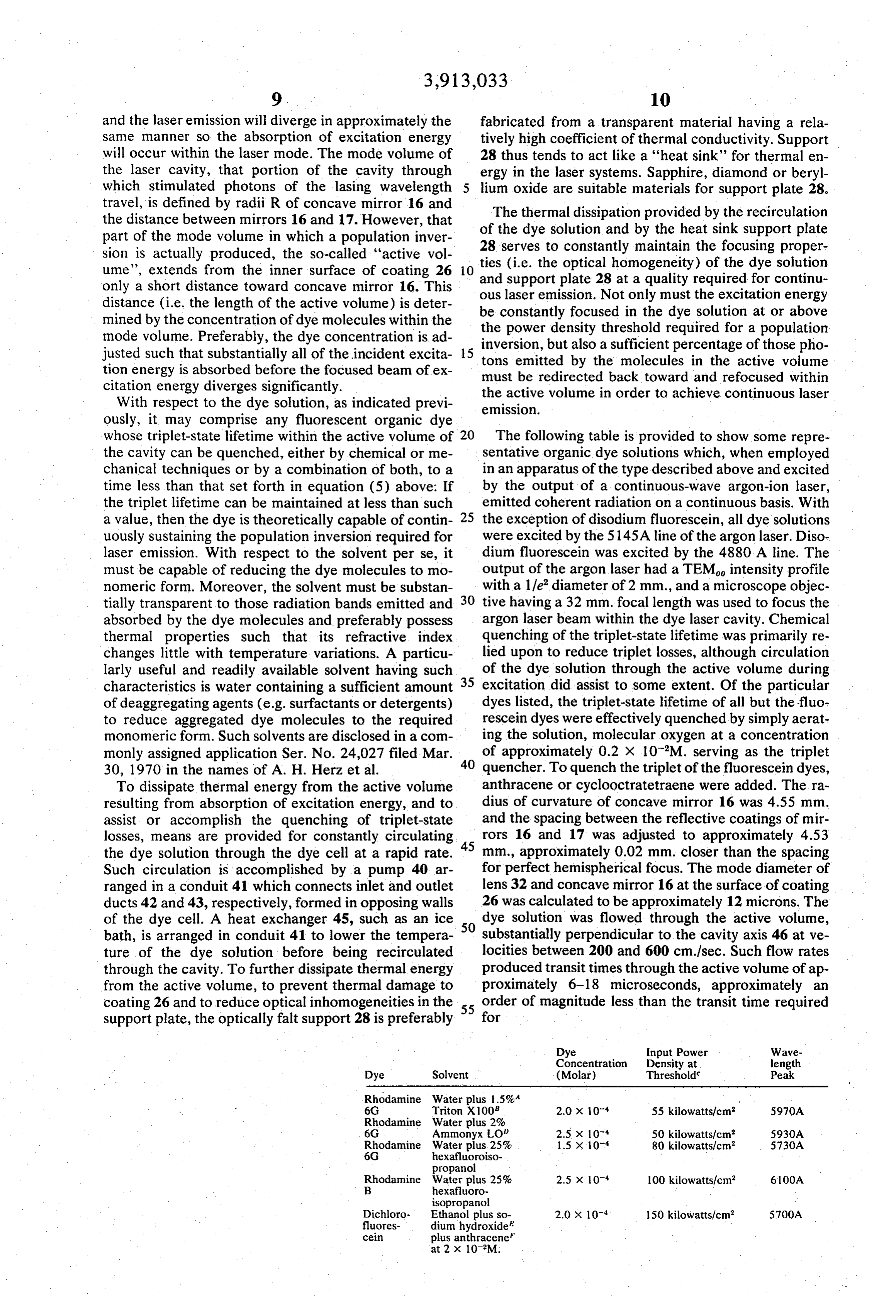
ously, it may comprise any fluorescent organic dye whose triplet-state lifetime within the active volume of The following table is provided to show some repre the cavity can be quenched, either by chemical or me sentative organic dye solutions which, when employed chanical techniques or by a combination of both, to a in an apparatus of the type described above and excited time less than that set forth in equation (5) above: If by the output of a continuous-wave argon-ion laser, the triplet lifetime can be maintained at less than such emitted coherent radiation on a continuous basis. With a value, then the dye is theoretically capable of contin 25 the exception of disodium fluorescein, all dye solutions uously sustaining the population inversion required for were excited by the 5145A line of the argon laser. Diso laser emission. With respect to the solvent per se, it dium fluorescein was excited by the 4880 A line. The must be capable of reducing the dye molecules to mo output of the argon laser had a TEM intensity profile nomeric form. Moreover, the solvent must be substan with a 1/e diameter of 2 mm., and a microscope objec tially transparent to those radiation bands emitted and 30 tive having a 32 mm. focal length was used to focus the absorbed by the dye molecules and preferably possess argon laser beam within the dye laser cavity. Chemical thermal properties such that its refractive index quenching of the triplet-state lifetime was primarily re changes little with temperature variations. A particu lied upon to reduce triplet losses, although circulation larly useful and readily available solvent having such 35 of the dye solution through the active volume during characteristics is water containing a sufficient amount excitation did assist to some extent. Of the particular of deaggregating agents (e.g. surfactants or detergents) dyes listed, the triplet-state lifetime of all but the fluo to reduce aggregated dye molecules to the required rescein dyes were effectively quenched by simply aerat monomeric form. Such solvents are disclosed in a com ing the solution, molecular oxygen at a concentration monly assigned application Ser. No. 24,027 filed Mar. 40 of approximately 0.2 x 10 M. serving as the triplet 30, 1970 in the names of A. H. Herz et al. quencher. To quench the triplet of the fluorescein dyes, To dissipate thermal energy from the active volume anthracene or cyclooctratetraene were added. The ra resulting from absorption of excitation energy, and to dius of curvature of concave mirror 16 was 4.55 mm. assist or accomplish the quenching of triplet-state and the spacing between the reflective coatings of mir losses, means are provided for constantly circulating 45 rors 16 and 17 was adjusted to approximately 4.53 the dye solution through the dye cell at a rapid rate. mm., approximately 0.02 mm. closer than the spacing Such circulation is accomplished by a pump 40 ar for perfect hemispherical focus. The mode diameter of ranged in a conduit 41 which connects inlet and outlet lens 32 and concave mirror 16 at the surface of coating ducts 42 and 43, respectively, formed in opposing walls 26 was calculated to be approximately 12 microns. The of the dye cell. A heat exchanger 45, such as an ice 50 dye solution was flowed through the active volume, bath, is arranged in conduit 41 to lower the tempera substantially perpendicular to the cavity axis 46 at ve ture of the dye solution before being recirculated locities between 200 and 600 cm./sec. Such flow rates through the cavity. To further dissipate thermal energy produced transit times through the active volume of ap from the active volume, to prevent thermal damage to proximately 6-18 microseconds, approximately an coating 26 and to reduce optical inhomogeneities in the 55 order of magnitude less than the transit time required support plate, the optically falt support 28 is preferably for
Concentration Density at length
Dye Solvent (Molar) Thresholds Peak
Rhodamine Water plus 1.5%.
6G Triton X100 2.0 x 10⁴ 55 kilowattsfiem 597OA
Rhodamine Water plus 2% 6G Ammonyx LOP 2.5 x 10⁴ 50 kilowattsfiem 5930A
Rhodamine Water plus 25% 15 x 104 80 kilowattsform 5730A 6G hexafluoroiso propanol
Rhodamine Water plus 25% 2.5 x 10⁻⁴ 100 kilowattsdom 6100A
B hexafluoro isopropanol
Dichloro- Ethanol plus so- 2.0 x 10⁴ 50 kilowattsdom 5700A fluores- dium hydroxide cein plus anthracene'
Page 10
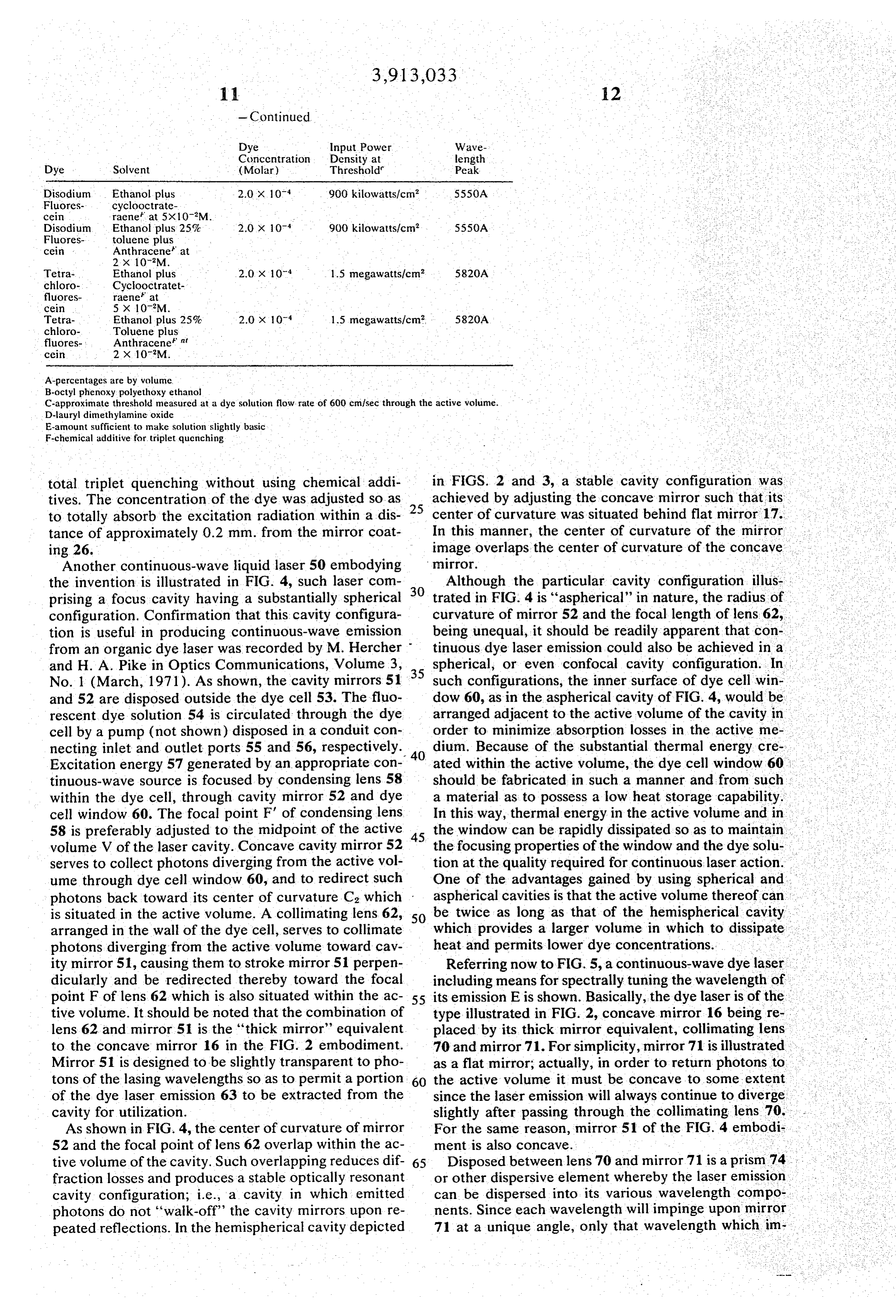
- Continued
Concentration, Density at length
Dye Solvent (Molar) Threshold Peak Disodium Ethanol plus 2.0 x 10 900 kilowattsicn 5550A Fluores- cyclooctrate
Disodium Ethanol plus 25% 2.0 x 10⁴ 900 kilowattsfon 5550A Fluores- toluene plus cein Anthracene at
Tetra. Ethanol plus 2.0 x 10⁴ 1.5 megawattsicn 5820A chloro- Cyclooctratet fluores- raene at
Tetra- Ethanol plus 25% 2.0 x 10⁴ 1.5 megawattsfem 582OA chloro- Toluene plus fluores- Anthracene
A-percentages are by volume
B-octyl phenoxy polyethoxy ethanol
C-approximate threshold measured at a dye solution flow rate of 600 emisec through the active volume. D-lauryl dimethylamine oxide
E-amount sufficient to make solution slightly basic
F-chemical additive for triplet quicnching
total triplet quenching without using chemical addi in FIGS. 2 and 3, a stable cavity configuration was tives. The concentration of the dye was adjusted so as achieved by adjusting the concave mirror such that its to totally absorb the excitation radiation within a dis 25 center of curvature was situated behind flat mirror. 17. tance of approximately 0.2 mm. from the mirror coat In this manner, the center of curvature of the mirror ing 26. image overlaps the center of curvature of the concave Another continuous-wave liquid laser 50 embodying mirror.
the invention is illustrated in FIG. 4, such laser com 30 Although the particular cavity configuration illus prising a focus cavity having a substantially spherical trated in FIG. 4 is "aspherical' in nature, the radius of configuration. Confirmation that this cavity configura curvature of mirror 52 and the focal length of lens 62, tion is useful in producing continuous-wave emission being unequal, it should be readily apparent that con from an organic dye laser was recorded by M. Hercher tinuous dye laser emission could also be achieved in a and H. A. Pike in Optics Communications, Volume 3, spherical, or even confocal cavity configuration. In No. 1 (March, 1971). As shown, the cavity mirrors 51 35 such configurations, the inner surface of dye cell win and 52 are disposed outside the dye cell 53. The fluo dow 60, as in the aspherical cavity of FIG. 4, would be rescent dye solution 54 is circulated through the dye arranged adjacent to the active volume of the cavity in cell by a pump (not shown) disposed in a conduit con order to minimize absorption losses in the active me necting inlet and outlet ports 55 and 56, respectively. - 40 dium. Because of the substantial thermal energy cre Excitation energy 57 generated by an appropriate con ated within the active volume, the dye cell window 60 tinuous-wave source is focused by condensing lens 58 should be fabricated in such a manner and from such within the dye cell, through cavity mirror 52 and dye a material as to possess a low heat storage capability. cell window 60. The focal point F of condensing lens In this way, thermal energy in the active volume and in 58 is preferably adjusted to the midpoint of the active 45. the window can be rapidly dissipated so as to maintain volume V of the laser cavity. Concave cavity mirror 52 the focusing properties of the window and the dye solu serves to collect photons diverging from the active vol tion at the quality required for continuous laser action. ume through dye cell window 60, and to redirect such One of the advantages gained by using spherical and photons back toward its center of curvature C2 which aspherical cavities is that the active volume thereof can is situated in the active volume. A collimating lens 62, 50 be twice as long as that of the hemispherical cavity arranged in the wall of the dye cell, serves to collimate which provides a larger volume in which to dissipate photons diverging from the active volume toward cav heat and permits lower dye concentrations. ity mirror 51, causing them to stroke mirror 51 perpen Referring now to FIG. 5, a continuous-wave dye laser dicularly and be redirected thereby toward the focal including means for spectrally tuning the wavelength of point F of lens 62 which is also situated within the ac 55 its emission E is shown. Basically, the dye laser is of the tive volume. It should be noted that the combination of type illustrated in FIG. 2, concave mirror 16 being re lens 62 and mirror 51 is the 'thick mirror' equivalent placed by its thick mirror equivalent, collimating lens to the concave mirror 16 in the FIG. 2 embodiment. 70 and mirror 71. For simplicity, mirror 71 is illustrated Mirror 51 is designed to be slightly transparent to pho as a flat mirror; actually, in order to return photons to tons of the lasing wavelengths so as to permit a portion 60 the active volume it must be concave to some extent of the dye laser emission 63 to be extracted from the since the laser emission will always continue to diverge cavity for utilization. slightly after passing through the collimating lens 70. As shown in FIG. 4, the center of curvature of mirror For the same reason, mirror 51 of the FIG. 4 embodi 52 and the focal point of lens 62 overlap within the ac ment is also concave.
tive volume of the cavity. Such overlapping reduces dif 65 Disposed between lens 70 and mirror 71 is a prism 74 fraction losses and produces a stable optically resonant or other dispersive element whereby the laser emission cavity configuration; i.e., a cavity in which emitted can be dispersed into its various wavelength compo photons do not “walk-off' the cavity mirrors upon re nents. Since each wavelength will impinge upon mirror peated reflections. In the hemispherical cavity depicted 71 at a unique angle, only that wavelength which im:
Page 11
pinges perpendicularly will be returned to the active stimulated radiation to be redirected back through volume and thereby stimulate further emission at that said portion to produce laser action wavelength. Thus, by simply pivoting mirror 71 about 2. The apparatus of claim 1 wherein at least one of its pivot pin 76, it is possible to selectively reflect radia said reflective means is at least partially transparent to tion of a desired wavelength through the resonant cav 5 said excitation radiation for admitting excitation radia ity and thereby spectrally tune the output of the dye la tion into said portion.
ser. Preferably, mirror 71 is slightly transparent to the 3. The apparatus of claim 1 wherein said cavity has fluorescence spectrum of the organic dye solution so as a substantially hemispherical configuration. to permit extraction of the dye laser emission from the 4. The apparatus of claim 1 wherein said maintaining cavity for utilization. It should be apparent that, in ad 10 means comprises a substantially enclosed cell for con dition to prisms and the like, diffraction gratings, pelli taining said solution, said cell having a wall which is cles, etalons, and various filters (e.g., interference, substantially transparent to said excitation radiation for electrooptic, acoustooptic, etc.) could be used to spec admitting excitation radiation into said portion. trally tune the dye laser output. 5. The apparatus of claim 4 wherein at least one of While the invention has been described with particu 15 said reflective means comprises a wall of said cell. lar reference to preferred embodiments, it should be 6. The apparatus according to claim 1 wherein said apparent that various modifications and changes can be dissipating means comprises a heat sink positioned in made without departing from the spirit and scope of the the vicinity of the center of curvature of said effectively invention as defined by the appended claims. concave reflective means.
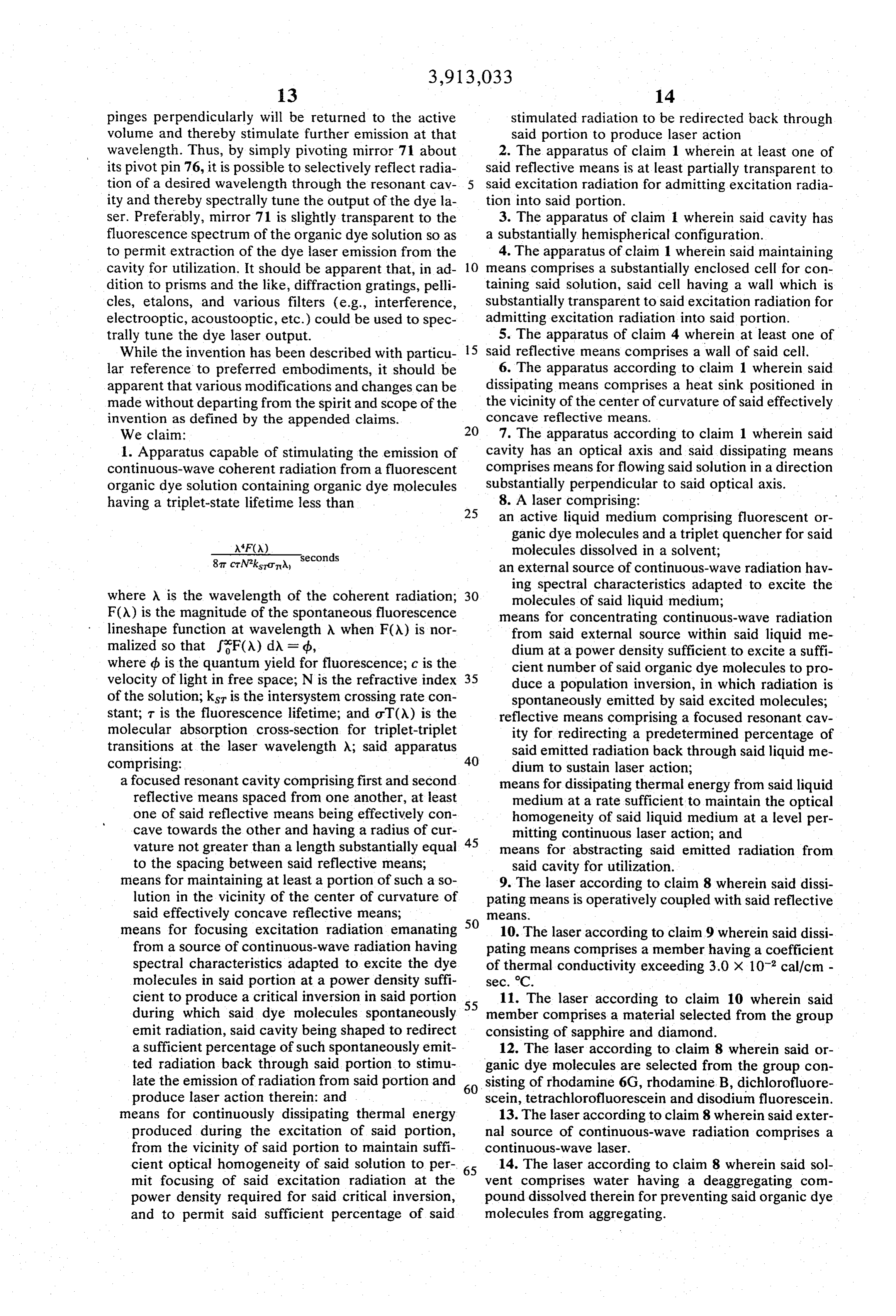
We claim: 7. The apparatus according to claim 1 wherein said 1. Apparatus capable of stimulating the emission of cavity has an optical axis and said dissipating means continuous-wave coherent radiation from a fluorescent comprises means for flowing said solution in a direction organic dye solution containing organic dye molecules substantially perpendicular to said optical axis. having a triplet-state lifetime less than 8. A laser comprising:
25 an active liquid medium comprising fluorescent or ganic dye molecules and a triplet quencher for said
8 crinkcN2koa,A. Secos molecules dissolved in a solvent;
an external source of continuous-wave radiation hav ing spectral characteristics adapted to excite the where X is the wavelength of the coherent radiation; molecules of said liquid medium; F(X) is the magnitude of the spontaneous fluorescence means for concentrating continuous-wave radiation lineshape function at wavelength X when F(M) is nor from said external source within said liquid me malized so that F(X) d\, = db, dium at a power density sufficient to excite a suffi where ds is the quantum yield for fluorescence; c is the cient number of said organic dye molecules to pro velocity of light in free space; N is the refractive index 35 duce a population inversion, in which radiation is of the Solution; ksr is the intersystem crossing rate con spontaneously emitted by said excited molecules; stant; it is the fluorescence lifetime; and oT(M) is the reflective means comprising a focused resonant cav molecular absorption cross-section for triplet-triplet ity for redirecting a predetermined percentage of transitions at the laser wavelength A, said apparatus said emitted radiation back through said liquid me
dium to sustain laser action;
a focused resonant cavity comprising first and second means for dissipating thermal energy from said liquid reflective means spaced from one another, at least medium at a rate sufficient to maintain the optical one of said reflective means being effectively con homogeneity of said liquid medium at a level per cave towards the other and having a radius of cur 45 mitting continuous laser action; and vature not greater than a length substantially equal means for abstracting said emitted radiation from to the spacing between said reflective means; said cavity for utilization. means for maintaining at least a portion of such a so 9. The laser according to claim 8 wherein said dissi lution in the vicinity of the center of curvature of pating means is operatively coupled with said reflective said effectively concave reflective means; CaS.
means for focusing excitation radiation emanating 50 10. The laser according to claim 9 wherein said dissi from a source of continuous-wave radiation having pating means comprises a member having a coefficient spectral characteristics adapted to excite the dye of thermal conductivity exceeding 3.0 x 10 cal/cm molecules in said portion at a power density suffi sec. C.
cient to produce a critical inversion in said portion 55 11. The laser according to claim 10 wherein said during which said dye molecules spontaneously member comprises a material selected from the group emit radiation, said cavity being shaped to redirect consisting of sapphire and diamond.
a sufficient percentage of such spontaneously emit 12. The laser according to claim 8 wherein said or ted radiation back through said portion to stimu ganic dye molecules are selected from the group con late the emission of radiation from said portion and 60 sisting of rhodamine 6G, rhodamine B, dichlorofluore produce laser action therein: and scein, tetrachlorofluorescein and disodium fluorescein. means for continuously dissipating thermal energy 13. The laser according to claim 8 wherein said exter produced during the excitation of said portion, nal source of continuous-wave radiation comprises a from the vicinity of said portion to maintain suffi continuous-wave laser.
cient optical homogeneity of said solution to per 65 14. The laser according to claim 8 wherein said sol mit focusing of said excitation radiation at the vent comprises water having a deaggregating com power density required for said critical inversion, pound dissolved therein for preventing said organic dye and to permit said sufficient percentage of said molecules from aggregating.
Page 12
15. The laser according to claim 8 wherein said fo 20. The method of claim 19 wherein said maintaining cused resonant cavity comprises a spaced pair of reflec step further comprises flowing the medium through tive means, at least one of said reflective means being said cavity in a direction substantially perpendicular to effectively concave toward the other and having an ef a line connecting said spaced pair of reflective means. fective radius of curvature not greater than the spacing 5 21. Apparatus for use with a fluorescent organic dye between said reflective means. solution capable of fluorescing over a continuum of . .. . . 16. The laser according to claim 15 wherein said dis wavelengths and a continuous-wave source of radiation sipating means comprises a heat sink positioned in the having spectral characteristics capable of exciting the i. vicinity of the center of curvature of said effectively molecules of the dye solution to higher vibrational concave reflective means. 10 rotational energy levels, said apparatus comprising: 17. The laser according to claim 15 wherein said res a. a focused resonant cavity including first and sec onant optical cavity has a substantially hemispherical ond reflective elements spaced from one another, configuration, the other of said reflective means being each of said elements being at least partially reflec a plane mirror positioned in the vicinity of the center tive to the radiation stimulated in said cavity, said of curvature of said effectively concave reflective 15 reflective elements being shaped to redirect the leaS. stimulated radiation back and forth through a dif 18. A method for stimulating the emission of coher fraction limited waist located between said reflec ent radiation from an active liquid medium comprising tive elements; - organic dye molecules in a solvent, said method.com b. means for positioning such dye solution in the vi prising the steps of: 20 cinity of said diffraction limited waist; providing a resonant optical cavity comprising a c. means for focusing the excitation radiation ema spaced pair of reflective means, at least one of said nating from the source of continuous-wave radia reflective means being effectively concave toward tion in the vicinity of said diffraction limited waist the other and having a radius of curvature not 25 at a power density sufficient to excite a sufficient greater than a length substantially equal to the number of molecules of the dye-solution in said vi spacing between said reflective means, cinity to produce the critical population inversion positioning at least a portion of said active medium required for laser action; . . . . . . in the vicinity of the center of curvature of said ef d. means for maintaining the optical homogeneity of fectively concave reflective means; the dye solution in the vicinity of said diffraction maintaining the triplet state lifetime of the organic 30 limited waist at the level required to sustain contin dye molecules situated in said portion at a value uous laser action from the dye solution; and , less than e. a tuning means, including a lens and a dispersive element for causing oscillation within said cavity at
a single or a few of the fluorescing wavelengths of seconds the dye solution. . . ...
22. The invention according to claim 21 wherein said:
optical homogeneity maintaining means comprises where X is the wavelength of said coherent electromag means for dissipating thermal energy from the vicinity netic radiation, F(X) is the magnitude of the spontane ous fluorescence lineshape function at wavelength M 40 of said diffraction limited waist at a rate which permits passage of a sufficient percentage of the redirected ra when F(X) is normalized so that F(X) dM = b, diation to sustain laser action. . . . . .. where d is the quantum yield for fluorescence; c is the 23. The invention according to claim 22 wherein said, velocity of light in free space; N is the refractive index of the solution; ksi is the intersystem crossing rate con 45 dissipating means comprises means for flowing the dye solution through said cavity in the vicinity of said dif stant; t is the fluorescence lifetime; and ot(X) is the fraction limited waist.
molecular absorption cross-section for triplet-triplet 24. Apparatus capable of stimulating the emission of transitions at the laser wavelength M, continuous-wave coherent radiation, said apparatus directing radiant energy having spectral characteris comprising: - tics adapted to excite the dye molecules into said 50 a fluorescent organic dye solution containing organic portion at a power density sufficient to produce a dye molecules, said organic dye molecules having critical inversion in which a substantial fraction of a triplet-state lifetime maintainable at a predeter the dye molecules in said portion are excited to a mined value less than metastable state in which radiation is spontane ously emitted from said portion, said reflective 55 means serving to redirect a sufficient percentage of XF(x) said spontaneously emitted radiation back through 8ar c t Nkstor(A) seconds said portion at a power density sufficient to pro duce laser action; and where X is the wavelength of the coherent radiation, , dissipating thermal energy from said medium at a 60 F(X) is the magnitude of the spontaneous fluorescence rate sufficient to maintain the optical index of the lineshape function at wavelength a when F(A) is nor- . medium sufficiently homogeneous so that said malized so that F(X) da CF d, power densities are maintained at levels sufficient where d is the quantum yield for fluorescence, c is the to sustain continuous laser action. velocity of light in free space, N is the refractive index 19. The method of claim 18 wherein said dissipatings of the solution, ks is the intersystem crossing rate con stant, it is the fluorescence lifetime, and c T(N) is the step comprises positioning a heat sink in the vicinity of the center of curvature of said effectively concave re molecular absorption cross-section for triplet-triplet flective means. transitions at the laser wavelength N.;
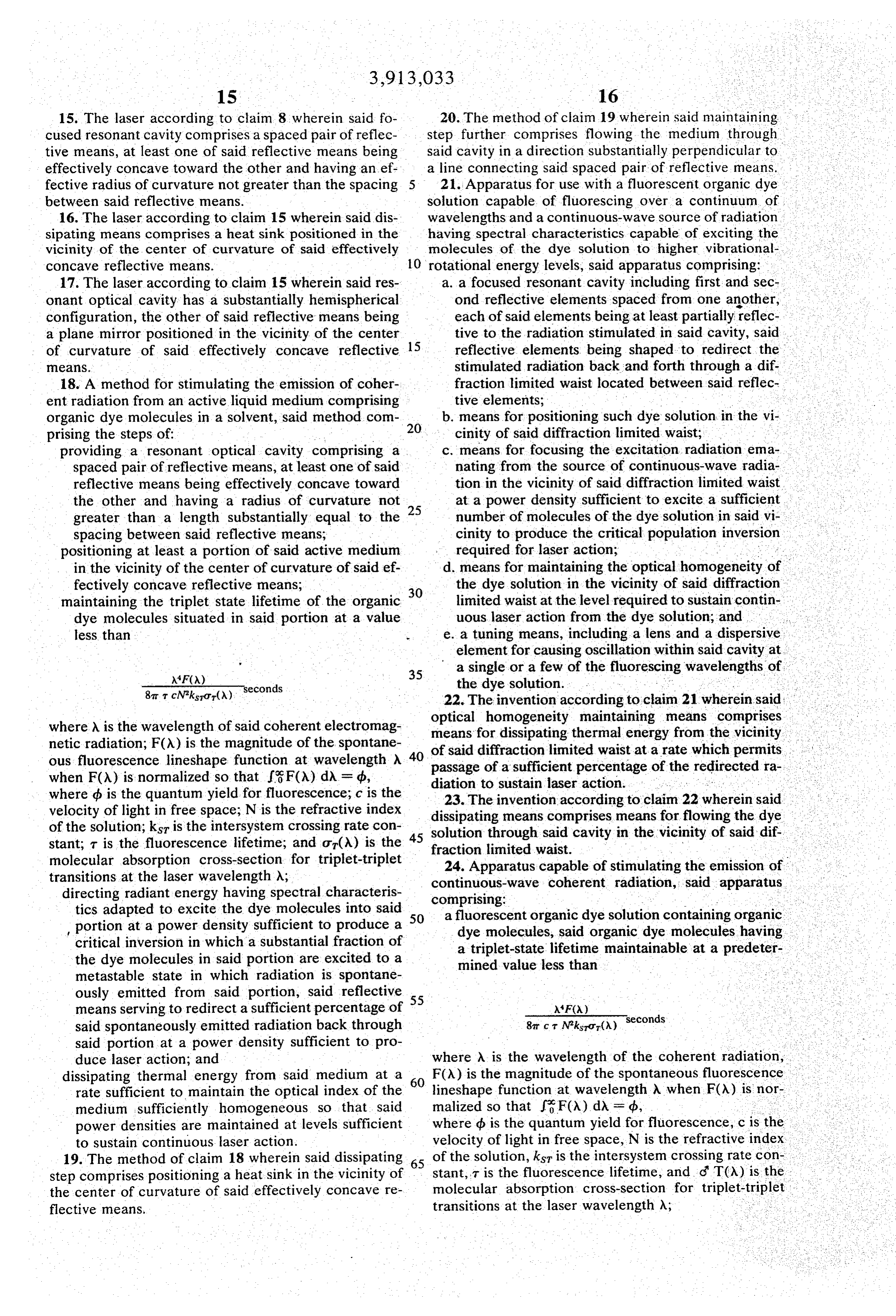
Page 13
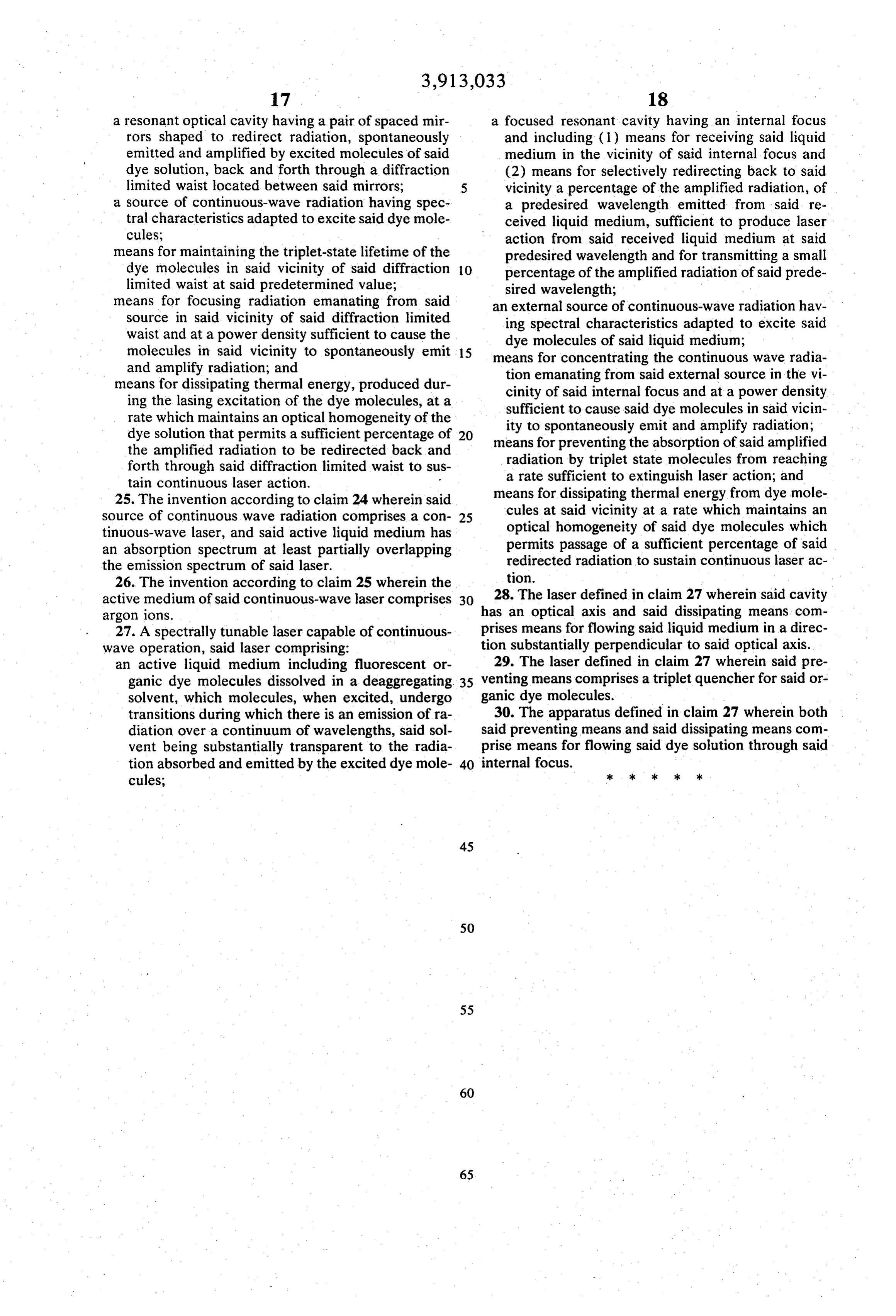
a resonant optical cavity having a pair of spaced mir a focused resonant cavity having an internal focus rors shaped to redirect radiation, spontaneously and including (1) means for receiving said liquid emitted and amplified by excited molecules of said medium in the vicinity of said internal focus and dye solution, back and forth through a diffraction (2) means for selectively redirecting back to said limited waist located between said mirrors; vicinity a percentage of the amplified radiation, of a source of continuous-wave radiation having spec a predesired wavelength emitted from said re tral characteristics adapted to excite said dye mole ceived liquid medium, sufficient to produce laser cules; action from said received liquid medium at said means for maintaining the triplet-state lifetime of the predesired wavelength and for transmitting a small dye molecules in said vicinity of said diffraction O percentage of the amplified radiation of said prede limited waist at said predetermined value; sired wavelength;
means for focusing radiation emanating from said an external source of continuous-wave radiation hav source in said vicinity of said diffraction limited ing spectral characteristics adapted to excite said waist and at a power density sufficient to cause the dye molecules of said liquid medium; molecules in said vicinity to spontaneously emit 5 means for concentrating the continuous wave radia and amplify radiation; and tion emanating from said external source in the vi means for dissipating thermal energy, produced dur cinity of said internal focus and at a power density ing the lasing excitation of the dye molecules, at a sufficient to cause said dye molecules in said vicin rate which maintains an optical homogeneity of the ity to spontaneously emit and amplify radiation; dye solution that permits a sufficient percentage of 20 means for preventing the absorption of said amplified the amplified radiation to be redirected back and radiation by triplet state molecules from reaching forth through said diffraction limited waist to sus a rate sufficient to extinguish laser action, and tain continuous laser action.
25. The invention according to claim 24 wherein said means for dissipating thermal energy from dye mole Source of continuous wave radiation comprises a con 25 cules at said vicinity at a rate which maintains an tinuous-wave laser, and said active liquid medium has optical homogeneity of said dye molecules which an absorption spectrum at least partially overlapping permits passage of a sufficient percentage of said the emission spectrum of said laser. redirected radiation to sustain continuous laser ac 26. The invention according to claim 25 wherein the tion.
active medium of said continuous-wave laser comprises 30 28. The laser defined in claim 27 wherein said cavity argon ions. has an optical axis and said dissipating means com 27. A spectrally tunable laser capable of continuous prises means for flowing said liquid medium in a direc wave operation, said laser comprising: tion substantially perpendicular to said optical axis. an active liquid medium including fluorescent or 29. The laser defined in claim 27 wherein said pre ganic dye molecules dissolved in a deaggregating. 35 venting means comprises a triplet quencher for said or solvent, which molecules, when excited, undergo ganic dye molecules.
transitions during which there is an emission of ra 30. The apparatus defined in claim 27 wherein both diation over a continuum of wavelengths, said sol said preventing means and said dissipating means com vent being substantially transparent to the radia prise means for flowing said dye solution through said tion absorbed and emitted by the excited dye mole 40 internal focus. k . k k k sk cules;
Page 14
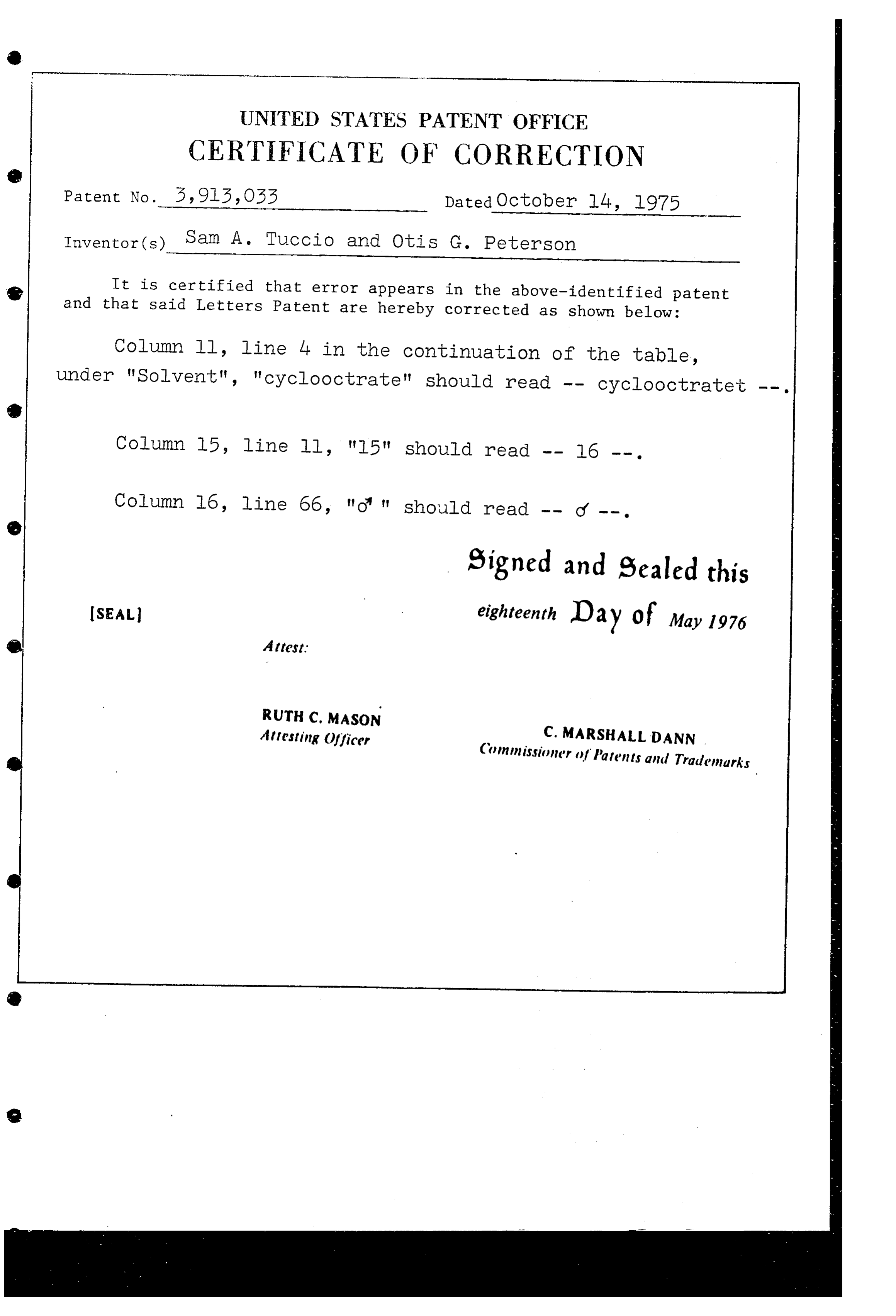
UNITED STATES PATENT OFFICE
CERTIFICATE OF CORRECTION
Patent No. 3,913, O33 Dated October l4, l975 Inventor(s) Sam A. Tuccio and Otis G. Peterson
It is certified that error appears in the above-identified patent and that said Letters Patent are hereby corrected as shown below: Column ill, line 4 in the continuation of the table, under "Solvent", "Cyclooctrate" should read -- cyclooctratet --.
Column l5, line ll, "l5" should read -- l6 --.
Column l6, line 66, "O'" should read -- d --.
Signed and Sealed this
SEAL eighteenth Day of May 1976 Attest.
RUTH c. MAsoN
Mttesting Officer C. MARSHALL DANN Commissioner of Patents and Trademarks
Provenance
- Collection
- Cited prior art
- Original PDF
- patentimages.storage.googleapis.com →
- Filed
- 1974-07-01
- Pages
- 14
- Method
- pdftotext (the PDF's own text layer) + pdftoppm 300dpi page scans
- Source
- Google Patents bibliographic record
- Granted
- 1975-10-14
- Inventors
- Sam A Tuccio; Otis G Peterson; Eastman Kodak Co
- Transcribed from
- patentimages.storage.googleapis.com →