report
Science Explained: atoms and matter (excerpt)
1 January 1995
Page 129
Sel & N COE
EXPLAINED
The World of Science in Everyday Life Colin A. Ronan, General Editor
A HENRY HOLT REFERENCE BOOK
HENRY HOLT AND COMPANY
NEW YORK
Page 130
Hemy Hoh and Company, ine
Publuaders mince 1 bbb ' 11S West 18th Scrwet
New Yors. New York 10011
Hany Holt © iss
in everyday lie / gemeral eden, Colm A. Ronan — iat ed
Pp. cm = (Henry Holt reference book) 1, Scmence—M taceilemes—Populay works. L Roman, Colm A.
0. Sere.
Henry Holt Books are available for special
Promonons and premuums. For details contact Director. Spee! Markets.
All frst editions are printed on ecid-free paper.
Previous page clockwise from top lifting a balloon with hot geses: atoms set free; energy's endless flow in a car trip;
looking mside the brain: head office:
a plant with « strange sense - touch.
vocky meighbors: sister Earth and brother Mars; modeling reslity im a virtual
world; power in your pocket from a battery
Senerating electricity; the photon and the flower - color from the atomic paintboz; plants gathering light for life
ontents
Space
Introduction 11
Our place in space 12
Land, sea, and air 14
Origins of life 16
The struggle for survival 18
A place to live 20
Onur local star 22
The giver of life 24
Earth's rocky neighbors 26
Great balls of gas 28
Planetary attendants 30
Space debris 32
Systems of stars 34
How stars are born 36
The dying light 38
Black holes 40
Creation of the cosmos 42
The unfolding universe 44
Energy
Introduction 47
Making things move 48
Simple machines 50
Machines in motion 52
What is pressure? 54
Working under pressure 56
Energy's endless flow 58
Earth's energy store 60
Energy without limit 62
Harnessing energy 64
Sparks and attractions 66
Generating electrical energy 68 The energy spectrum 70
Visible energy 72
The light of science 74
Beyond violet 76
Over the rainbow 78
A matter of degree 80
Heating up &2
Sound: vibrant energy 84
Good vibrations 86
Sound effects 88
Falling for gravity 90
Defying gravity 92
Page 131
ATOMS AND MATTER
The intimate bonds
Molecules are made when atoms become bonded together.
But just what is it that makes these bonds?
see seem unlikely partners. Their electron clouds make them negatively charged on the outside. Since like charges repel, atoms might be expected to repel each other. The key to bonding lies in the atom’s electron shell structure.
One way bonding can happen is by the sharing of electrons between atoms with one or more electrons “missing” from their outer shells. This process is called covalent bonding and happens between the atoms of elements called the non-metals and transition metals in the periodic table.
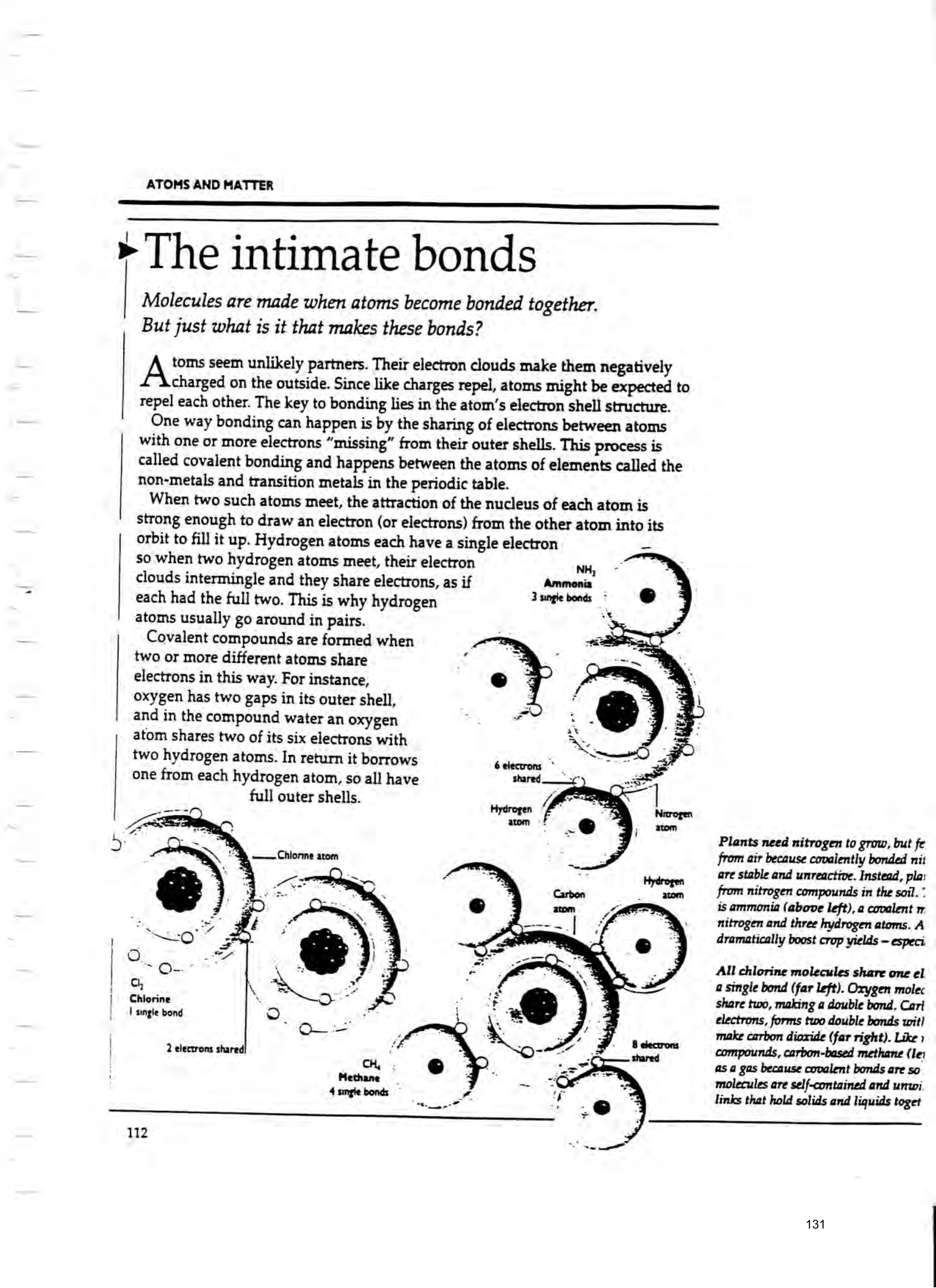
When two such atoms meet, the attraction of the nucleus of each atom is strong enough to draw an electron (or electrons) from the other atom into its orbit to fill it up. Hydrogen atoms each have a single electron so when two hydrogen atoms meet, their electron clouds intermingle and they share electrons, as if each had the full two. This is why hydrogen atoms usually go around in pairs.
Covalent compounds are formed when two or more different atoms share electrons in this way. For instance, oxygen has two gaps in its outer shell, and in the compound water an oxygen atom shares two of its six electrons with two hydrogen atoms. In return it borrows one from each hydrogen atom, so all have full outer shells.
Ammonia 3 single bonds =
Plants need nitrogen to grow, but fe from air because covalently bonded nit are stable and unreactive. Instead, pla:
from nitrogen compounds in the soil.” is ammonia (above left), a covalent rr, nitrogen and three hydrogen atoms. A dramatically boost crop yields ~ especi
All chlorine molecules share one el a single bond (far left). Oxygen molec share two, making a double bond. Cari electrons, forms two double bonds wit!
make carbon dioxide (far right). Like } compounds, carbon-based methane (le as a gas because covalent bonds are so
molecules are self-contained and unwi links that hold solids and liquids toget
Page 132
Ser aio
ATOMS AM
MATTER
> nade < com
> Thetey > eereror
P Casstyey the demercs toate > Hesed recs iwity
D> What's cer
imi
+ Nea, 1aii2s
bic) J ; =e 9 © Compounds
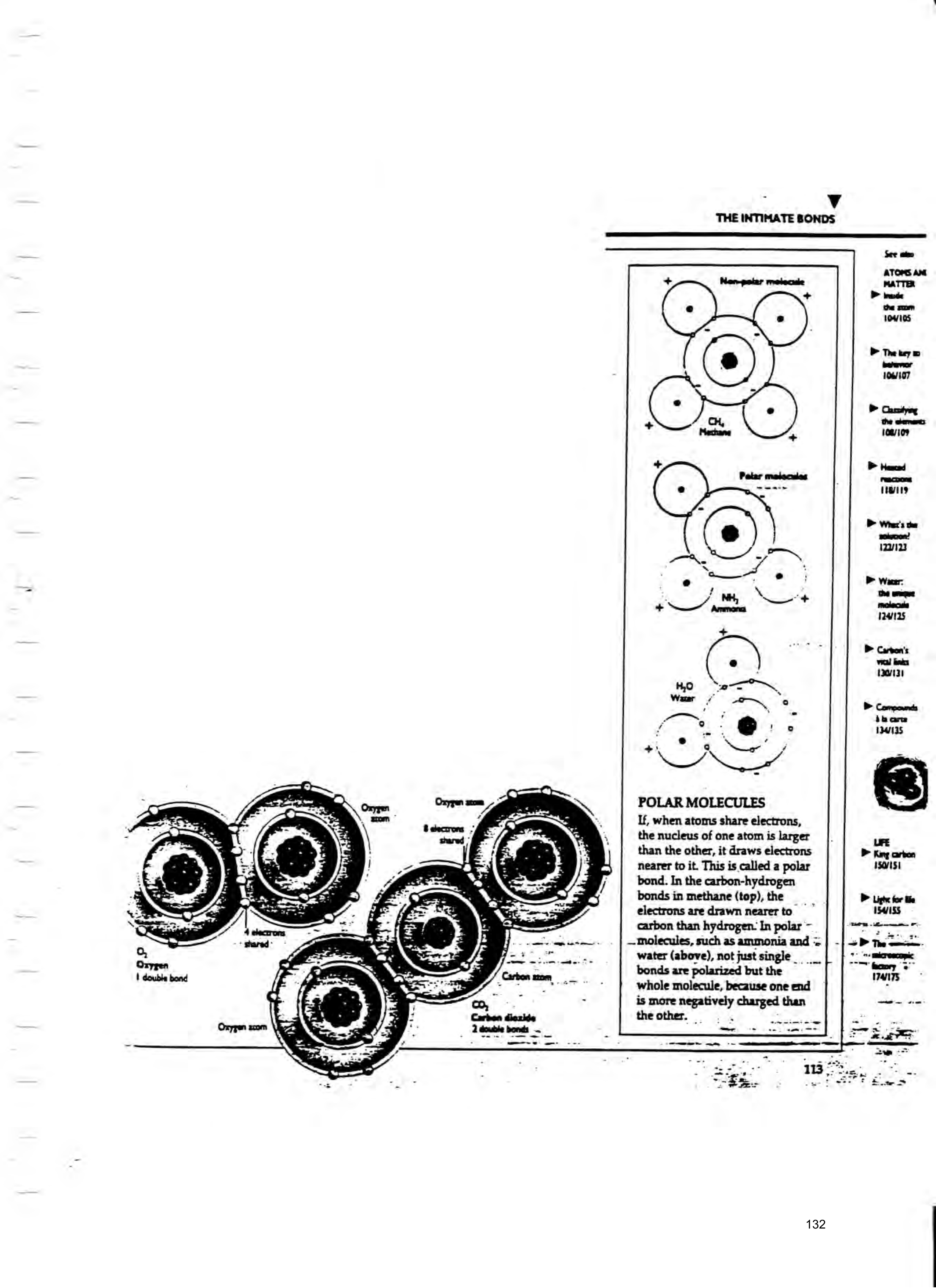
POLAR MOLECULES
If, when atoms share electrons, the nucleus of one atom is larger FE than the other, it draws electrons > King carbon nearer to it. This is called a polar 1SO/I51 bond. In the carbon-hydrogen bonds in methane (top), the = D> Lighe for te electrons are drawn nearerto ISA/ISS carbon than hydrogen: In polar - et Nee ~mMolecules, such as ammonia and = | -} +P the —— water (above), not justsingle =| f 7 7” bonds are polarized but the os whole molecule, because one end " is more negatively charged than iting sie theother. .. OF ey ar Py ~-e ee PETE Las
Page 133
~~ ATOMS AND MATTER ~ —?> ce See ee
Ca Attraction of opposites. -~ | aT: DF Se eer ee a a
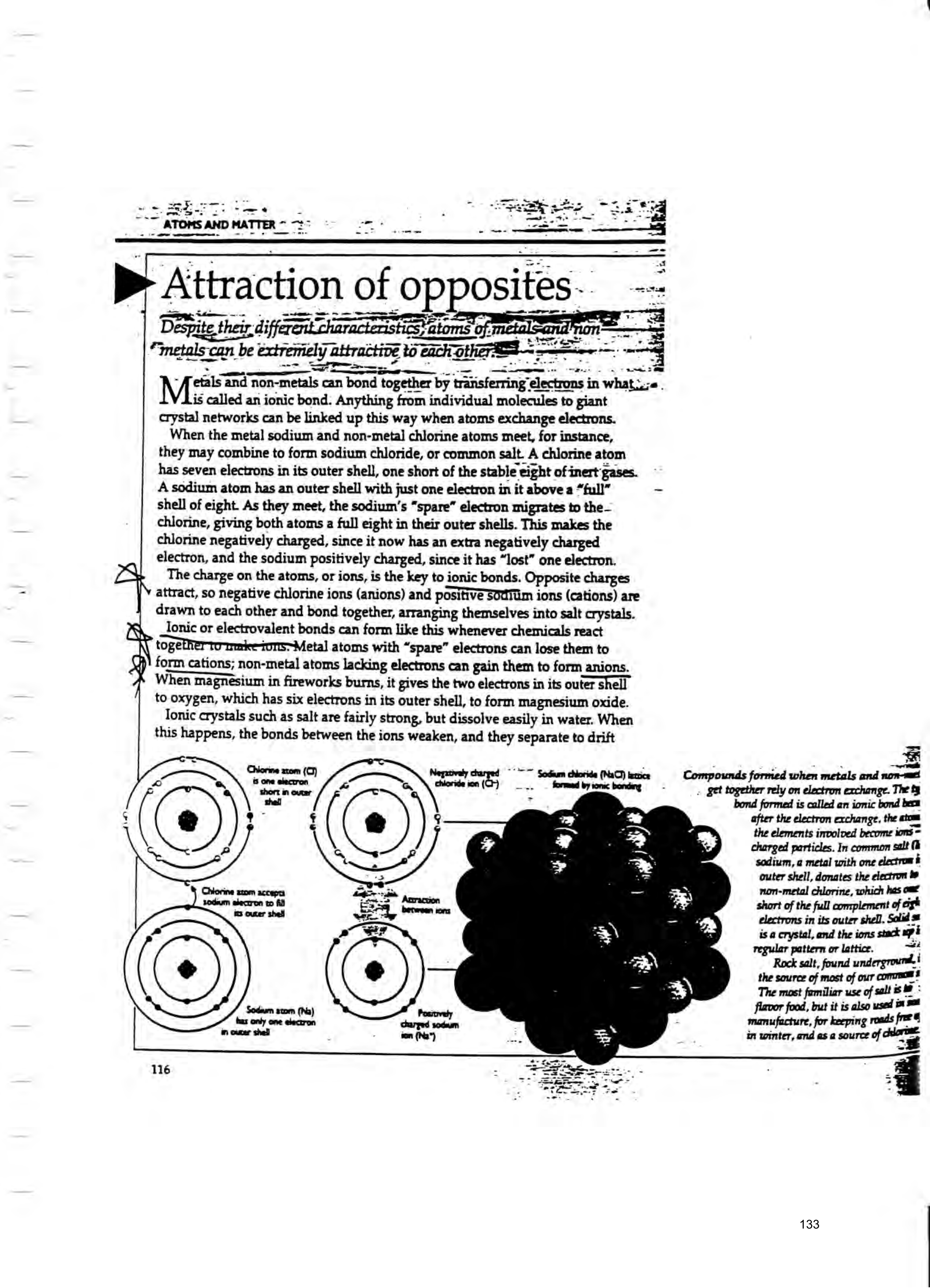
Despite thei, differcd.char CHERISH GS, RLOMIS OMEN LOT aa *“metals-can be extremely attractive to each other =~ ——— — - an nn Ee. ctiaeet ek ff tae ~ A etals and non-metals can bond together by transferring electrons in what..;« is called an ionic bond. Anything from individual molecules to giant crystal networks can be linked up this way when atoms exchange electrons.
When the metal sodium and non-metal chlorine atoms meet, for instance, they may combine to form sodium chloride, or common salt. A chlorine atom has seven electrons in its outer shell, one short of the stable eight of inert gases.
A sodium atom has an outer shell with just one electron in it above a “full” = shell of eight. As they meet, the sodium’s “spare” electron migrates to thechlorine, giving both atoms a full eight in their outer shells. This makes the chlorine negatively charged, since it now has an extra negatively charged
electron, and the sodium positively charged, since it has “lost” one electron.
The charge on the atoms, or ions, is the key to ionic bonds. Opposite charges attract, so negative chlorine ions (anions) and positive S0tium ions (cations) are drawn to each other and bond together, arranging themselves into salt crystals.
lonic or electrovalent bonds can form like this whenever chemicals react toge Toris-Metal atoms with “spare” electrons can lose them to form cations; non-metal atoms lacking electrons can gain them to form anions. 4s When magnesium in fireworks burns, it gives the coke ictus in its outer shell to oxygen, which has six electrons in its outer shell, to form magnesium oxide.
Ionic crystals such as salt are fairly strong, but dissolve easily in water. When this happens, the bonds between the ions weaken, and they separate to drift
~~ Sedaum chioride (NaCl) lerzice -. _ Seormmad by tonic bonding
Compounds forsied when metals and somal - get together rely on electron exchange. The ty bond formed is called an ionic bond beru
after the electron exchange, the atom the elements irolved become tons = charged particles. In common salt (h sodium, a metal with one electrom & outer shell, donates the electron te short of the full complement of eig# electrons in its outer shell. Solid is a crystal, and the ions stack up’ regular pattern or lattice. er;
Rock salt, found underground. i
the source of most of our commaam #
The most familiar use of salt 5 ° flavor food, but it is also used = 90 manufacture, for keeping roads free ¢ in winter, and asa source of CAS
Provenance
- Pages
- pages 129–133 of 140
- Binder
- WFC Project Binder 423-DA
- Method
- pdftoppm 300dpi + tesseract 5 (eng), orientation-corrected
- Source
- WFC International Independent Test-Evaluation Report (1995), scanned binder
- Attribution
- Colin A. Ronan (general editor), Henry Holt and Company
- Reproduced material
- Reproduced inside Meyer's 1995 report as bound; copyright is the original author's.