report
Cliffs Quick Review, Chemistry: bonding, acids and bases (excerpt)
1 January 1995
Page 134
Drawing sheet — no readable text.
Page 135
Cliffs Quick Review Chemistry
The Cliffs Notes logo, the names "Cliffs," "Cliffs Notes," and "Cliffs Quick Review," and the black and yellow diagonal stripe cover design are all registered trademarks belonging to Cliffs Notes, Inc., and may not be used in whole or in.part without written permission.
FIRST EDITION
© Copyright 1993 by Cliffs Notes, Inc.
All Rights Reserved
Printed in U.S.A.

Page 136
CHEMICAL
BONDING
and you can interpolate this value in the first column of the previous chart to find that such a bond would be about 4% ionic and 96% covalent, which is virtually a pure covalent bond.
Problem 11. Use the chart of electronegativity and the chart of bond types to interpret the bonding in magnesium chloride, MgCl.
Other Bonds
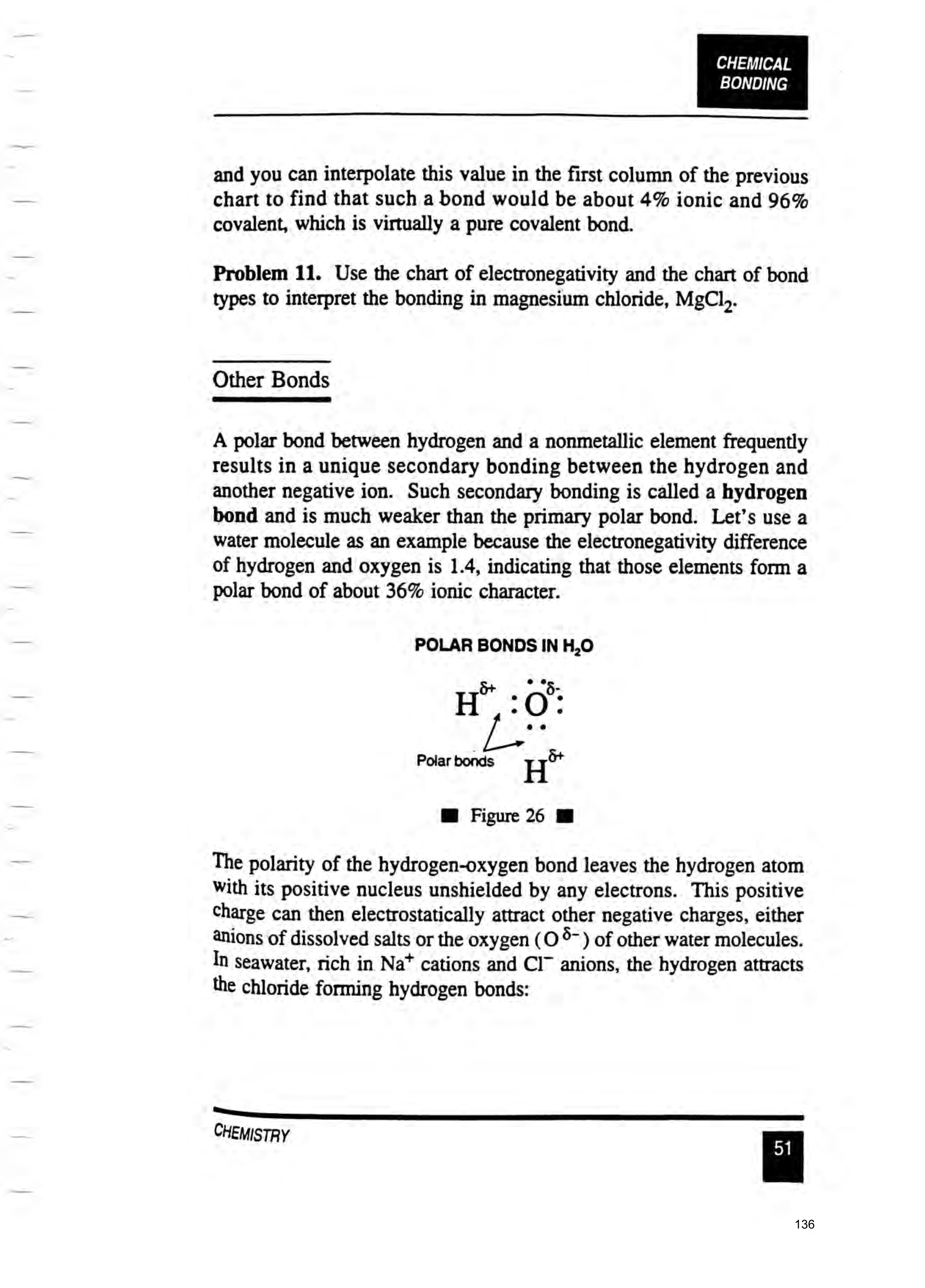
A polar bond between hydrogen and a nonmetallic element frequently results in a unique secondary bonding between the hydrogen and another negative ion. Such secondary bonding is called a hydrogen bond and is much weaker than the primary polar bond. Let’s use a water molecule as an example because the electronegativity difference of hydrogen and oxygen is 1.4, indicating that those elements form a polar bond of about 36% ionic character.
POLAR BONDS IN H,0
Polar bonds H” m@ Figure 26
The polarity of the hydrogen-oxygen bond leaves the hydrogen atom with its positive nucleus unshielded by any electrons. This positive Charge can then electrostatically attract other negative charges, either anions of dissolved salts or the oxygen (O 5) of other water molecules. In seawater, rich in Na* cations and CI~ anions, the hydrogen attracts the chloride forming hydrogen bonds:
CHE,
MISTRY
Page 137
CHEMICAL
BONDING
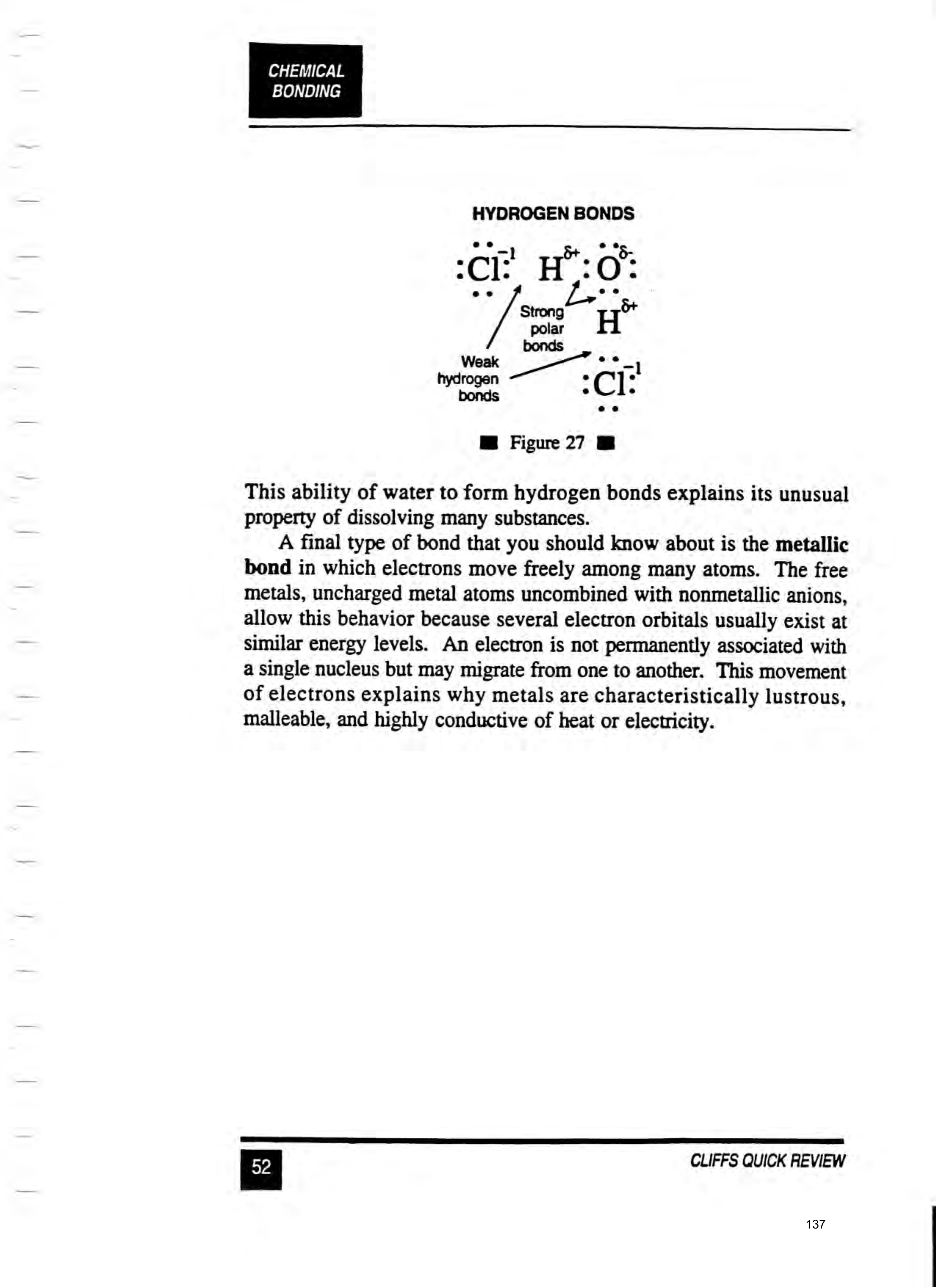
HYDROGEN BONDS
This ability of water to form hydrogen bonds explains its unusual property of dissolving many substances.
A final type of bond that you should know about is the metallic bond in which electrons move freely among many atoms. The free metals, uncharged metal atoms uncombined with nonmetallic anions, allow this behavior because several electron orbitals usually exist at similar energy levels. An electron is not permanently associated with a single nucleus but may migrate from one to another. This movement of electrons explains why metals are characteristically lustrous, malleable, and highly conductive of heat or electricity.
CLIFFS QUICK REVIEW
Page 138
ACIDS
AND BASES
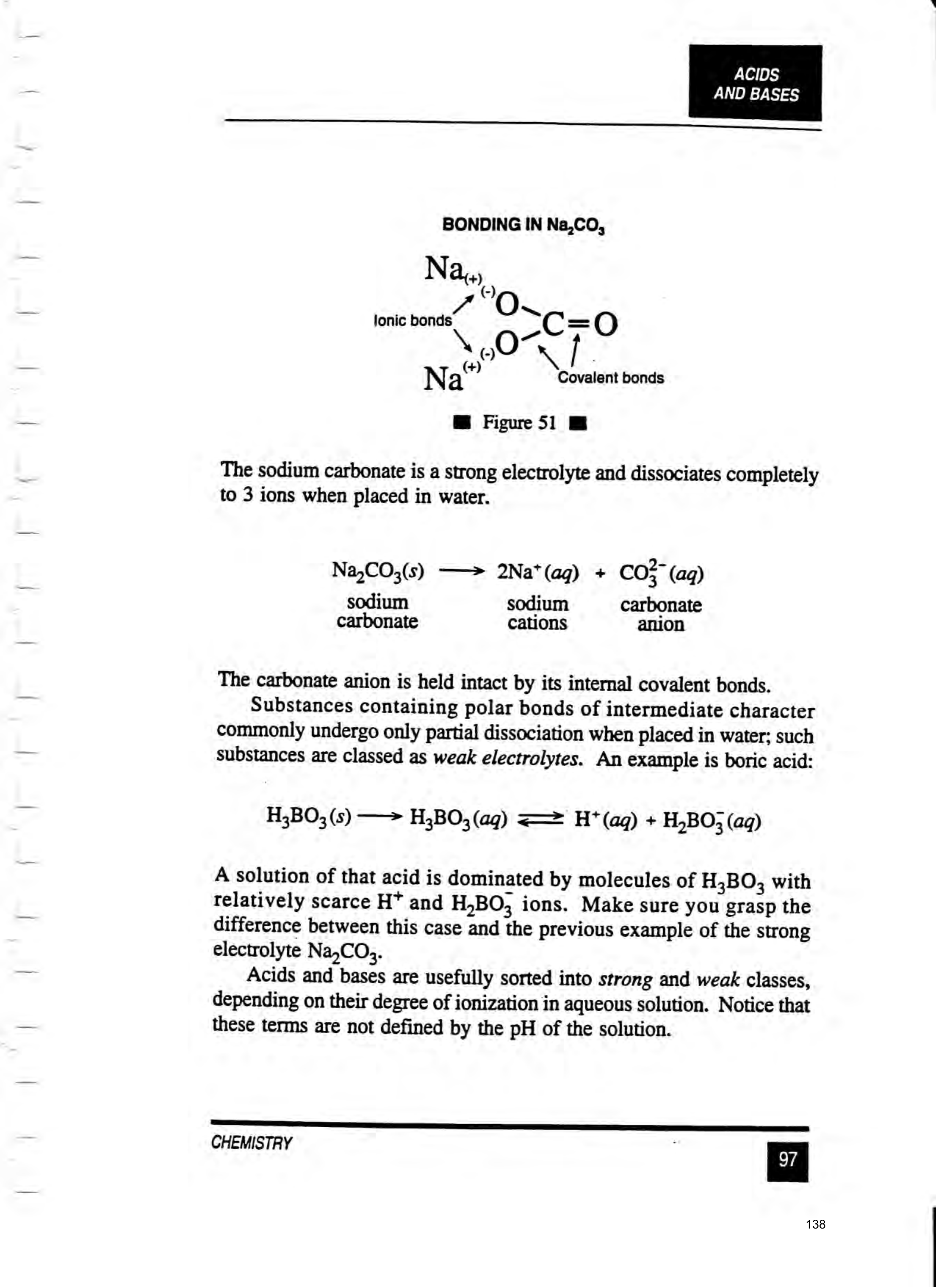
BONDING IN Na.CO,
lonic bonds pe a = O
Na” Covalent bonds
@ Figure 51
The sodium carbonate is a strong electrolyte and dissociates completely to 3 ions when placed in water.
sodium sodium carbonate carbonate cations anion
The carbonate anion is held intact by its internal covalent bonds. Substances containing polar bonds of intermediate character
commonly undergo only partial dissociation when placed in water; such
substances are classed as weak electrolytes. An example is boric acid:
A solution of that acid is dominated by molecules of HBO, with relatively scarce H* and H,BO, ions. Make sure you grasp the difference between this case and the previous example of the strong electrolyte Na,CO .
Acids and bases are usefully sorted into strong and weak classes, depending on their degree of ionization in aqueous solution. Notice that these terms are not defined by the pH of the solution.
CHEMISTRY ;
Page 139
ACIDS
AND BASES
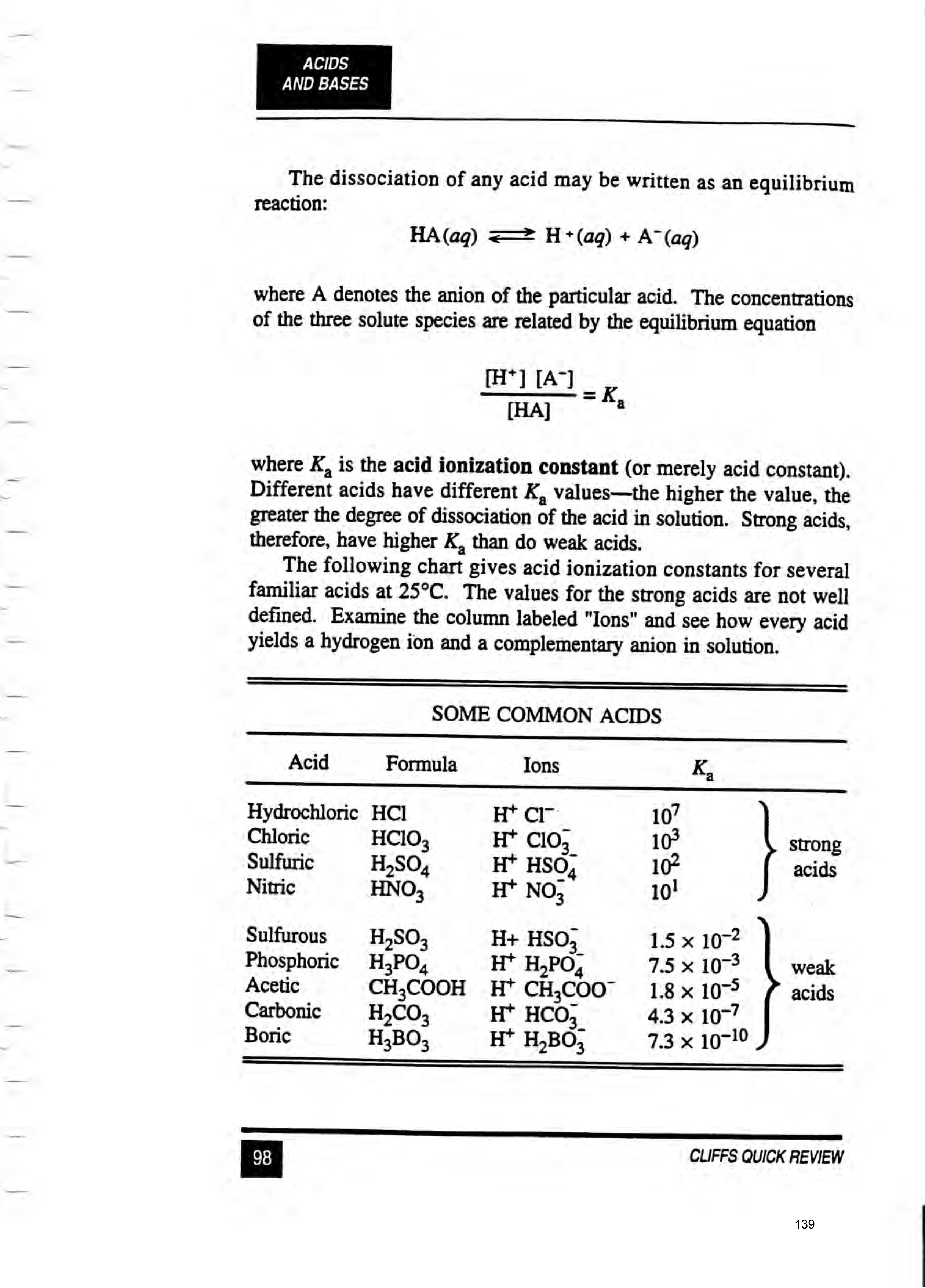
The dissociation of any acid may be written as an equilibrium reaction:
where A denotes the anion of the particular acid. The concentrations of the three solute species are related by the equilibrium equation
IIA) _
where K, is the acid ionization constant (or merely acid constant). Different acids have different K, values—the higher the value, the greater the degree of dissociation of the acid in solution. Strong acids, therefore, have higher K, than do weak acids.
The following chart gives acid ionization constants for several familiar acids at 25°C. The values for the strong acids are not well defined. Examine the column labeled "Ions" and see how every acid yields a hydrogen ion and a complementary anion in solution.
SOME COMMON ACIDS
Acid Formula Ions K,
Hydrochloric HCI HY CI 107
Chloric HCIO, H* ClO, 10° . strong
Sulfuric H,SO, Ht HSO, 10? acids
Nitric HNO, H* NO, 10! J
Sulfurous H,SO, H+ HSO,; 15x10? |
Phosphoric HPO, H* H,PO, 7.5x10³ | weak
Acetic CH;COOH H*CH,;COO” 18x10 ff acids
Carbonic HCO, H* HCO; 4.3 x 1077
CLIFFS QUICK REVIEW
Provenance
- Pages
- pages 134–139 of 140
- Binder
- WFC Project Binder 423-DA
- Method
- pdftoppm 300dpi + tesseract 5 (eng), orientation-corrected
- Source
- WFC International Independent Test-Evaluation Report (1995), scanned binder
- Attribution
- Harold D. Nathan, Cliffs Notes
- Reproduced material
- Reproduced inside Meyer's 1995 report as bound; copyright is the original author's.