(902)
Carbon Atom
Where it is first named
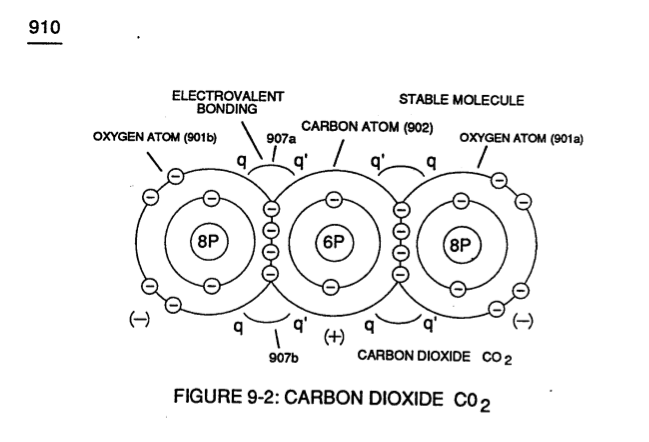
Carbon Dioxide molecule 0>2 (910) Electrovalent Bonding forces (q - q') comes into existence when unlike Carbon Atom (902) shares electrons with each of two Oxygen Atoms (901a / 901b) since the accepted and captured covalent electrons migrates toward both oxygen atom (901a and 901b) nucleus proton-cluster of eight particles having a greater total positive static charge than Carbon Atom (902) nucleus proton-cluster of only six ... …
How it is written
- (902) 3×
Drawings 2
-
Page 25 · WFC 417 — WFC 417
-
(910) of Figure (9-2) · Electrovalent Bonding
Where it is named · 3
Electrovalent Bonding 3×
-
Carbon Atom (902)
Carbon Dioxide molecule 0>2 (910) Electrovalent Bonding forces (q - q') comes into existence when unlike Carbon Atom (902) shares electrons with each of two Oxygen Atoms (901a / 901b) since the accepted and captured covalent electrons migrates toward both oxygen atom (901a and 901b) nucleus proton-cluster of eight particles having a greater total positive static charge than Carbon Atom (902) nucleus proton-cluster of only six ... …
-
Carbon Atom (902)
… the accepted and captured covalent electrons migrates toward both oxygen atom (901a and 901b) nucleus proton-cluster of eight particles having a greater total positive static charge than Carbon Atom (902) nucleus proton-cluster of only six ... forming polar charged (B+ / B- ) Carbon Dioxide CO2 molecule (910).
-
Carbon Atom (902)
… electrons (total ten 10 electrons as to only eight B protons) causes both oxygen atoms (901a / 90lb) to individually take-on a negative electrical charge (B-) while the center positioned Carbon Atom (902) emanates a positive electrical charge (B+) of equal but opposite electrical intensity (q - q') when its shared electrons is/are being used/accepted by unlike oxygen atoms (901a / 901b).