Aaron Murakami wrote:
Thanks for sharing that here - a great topic! 
An attempt to figure out what S1R9A9M9's circuit was is what led me to developing my plasma ignition method. If you look at his convoluted diagram he posted that hardly anyone could figure out - it is basically connecting the half rectified out put of an inverter over the spark plug gap - and it was a large appliance relay that made the right connections. When the hv spark is made, the lower voltage high current from that inverter jumps the gap and that is what his ignition is.
Everyone claimed the inverter was needed to make the effect and some tried with capacitors. Capacitors worked, but they also thought it had to be connected to the inverter still to get the effect. Because of John Bedini's old diagrams of the Gray motor with the reversed diode at the top of the HV rod, I instantly knew all those explanations were false and posted the first evidence ever showing the capacitor could be charged with a power source and be completely disconnected from the power source (free floating potential) and then applied to the ignition coil and it worked. So not only did it prove the connection to the inverter (ac power source) was irrelevant to the effect, it also proved that I could simultaneously use the same capacitor as the input power source to the primary of the ignition coil and also act as the low voltage source that would jump the gap after the hv spark was made.
I don't know what "other capacitor discharge method" you are talking about that is supposed to be "too fast for proper operation", but my own method is of course extremely fast - but the primary plasma discharge method is basically the same as what S1R was doing wit his circuit.
That plasma doesn't necessarily expand water, it instantly dissociates the hydrogen from oxygen so that is where the expansion comes from, then the hydrogen detonates very fast and very hot and that is what ignites the rest of the freed hydrogen and further dissociates more hydrogen from water, etc...
Revizal was the first to use this kind of plasma ignition to run an engine just on water after all these experiments and it was a small motorbike engine. It ran on tap water for maybe 20-30 seconds. But the plasma needs to be pretty big for that to the point it will destroy plugs fast and will explode and chip other pieces of metal it touches - most likely like the edges of valves, etc... So running an engine on water is not a problem if you have a big enough discharge but will simultaneously destroy your plug and engine. I would like to see that S1R engine torn apart and examined to see what the longer term situation is.
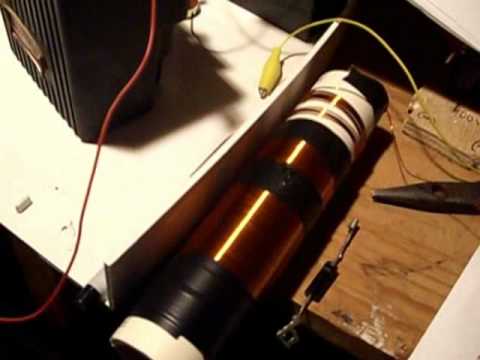
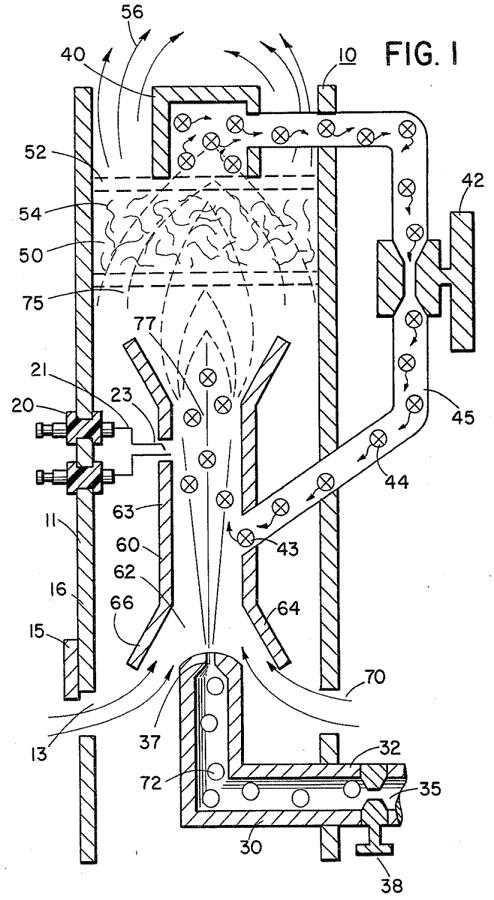
Here is an old "choking" method that I posted years ago from Ralph Bergstresser, a friend of Tesla:
It can extend the time that the spark is at the gap.
Do you have a pic or video of the Georgia man's methods?
Hi Aaron,
Excellent case study!!! Infact it reminds me of Stan's obscure 'Wiper arm'' Variable Inductance in his VIC circuit
the Magnetic Interaction in that 'Variability' is actually a Temporally variability rather than Spatial one in the sense of its 'wiper arm'like in variable resitor or rheostat.
and yes just as you rightly point out, the Ignition System of 1976 was not of CDI origin hence the High-Voltage attend was of Inetrrupter type (Switched Inductor if i may so call it) and this coil Inductor is meant for that type of HV Spike (Parallel Resonant) and not for the Switched Capacitor Discharge type (Series Resonant). i'm sure if one underrstand the Interaction of the coil it can be designed to work just as well with the CDI type may be with the Inclusion of a Capacitor along with it.
I still belive S1R did use the Alternator along with the Enhanced Capacitor Plasma Ignition system that you describe, it is just that it can be done many ways...he chose to disclose the inverter while still keeping the core stuff with him (Alternator) Sine wave from an Alternator is pure Magneto electric and not susceptable to disrruptive Discharges that initiate Tesla Impulse power surges (Modern Engineers would call it Reactive power Impulse or Transients) but an Inverter is very susceptable...the rough secreat is High-Voltage Sine wave and Low-Voltage 'Square-Wave'' the mix of which gives you the Tesla Impulse..
be it for Liquid dielectric Polarization or Gaseous/vapour polarization, the Alternator is the key to produce the sine wave High-Voltage for the 'method of conversion'.
Rgds,
Faraday88.