patent · US6245309
Method and devices for producing hydrogen by plasma reformer
12 June 2001
Page 1 — bibliographic record
(12) United States Patent (10) Patent No.: US 6,245,309 B1 Etievant et al. (45) Date of Patent: Jun. 12, 2001
(54) METHOD AND DEVICES FOR PRODUCING FOREIGN PATENT DOCUMENTS
HYDROGEN BY PLASMA REFORMER
(75) Inventors: Claude Etievant, Versailles; Mustapha OTHER PUBLICATIONS Roshd, Saint Nom la Breteche, both of Chapelle et al., French Patent abstract 2,724,860 Mar. (FR) 1996.* (73) Assignee: H2-Tech S.A.R.L (FR) * cited by examiner
Primary Examiner Steven P. Griffin (*) Notice: Subject to any disclaimer, the term of this ASSistant Examiner Maribel Medina patent is extended or adjusted under 35 (74) Attorney, Agent, or Firm Mason, Kolehmainen, U.S.C. 154(b) by 0 days. Rathburn & Wyss (21) Appl. No.: 09/331,746 (57) ABSTRACT (22) PCT Filed: Dec. 23, 1997 One of these devices comprises: a reaction with cold plasma (86) PCT No.: PCT/FR97/02396 (10b), for producing the reforming of a primary mixture consisting of fuel gas (hydrocarbon or alcohol), as well as
S371 Date: Jun. 24, 1999 oxygen and/or water vapor, thus producing a Secondary mixture containing in particular hydrogen, carbon dioxide
S 102(e) Date: Jun. 24, 1999 and carbon monoxide; an intake piece (18) for mixing these (87) PCT Pub. No.: WO98/28223 constituents, co-operating with a burner (42) and an asso ciated combustion chamber (40) to bring the resulting pri
PCT Pub. Date:Jul. 2, 1998 mary mixture to a high temperature, before it is introduced (30) Foreign Application Priority Data into the reaction chamber (10a); a ring-shaped chimney (48) enclosing this chamber for maintaining it at a relatively high
Dec. 24, 1996 (FR) .................................................. 96 15944 temperature; a high frequency alternating high Voltage (51) Int. Cl." ................................. C01B3/24; H05F 3/00 source (58), modulated by brief periodical low frequency pulses and electrodes (62-66) for generating Silent (52) U.S. Cl. .............................. 423/248; 204/164; 95/55; discharges, in the reaction chamber (10b) thus generating a 96/7 cold plasma producing a high chemical reactivity to the gas (58) Field of Search ............................ 423/248; 204/164; mixture present; a membrane (12) with high Selective per 315/111.21; 96/4, 7; 95/55 meability for extracting the nascent hydrogen, arranged (56) References Cited between the chamber (10b) and a chamber for collecting the hydrogen (14); a thermal insulating sheath (50) enclosing
cells, fitted on electric Vehicles or on portable generator Set.
5,266,175 * 11/1993 Murphy ........................... 204/157.43 5,498,278 3/1996 Edlund ..................................... 96/11 18 Claims, 5 Drawing Sheets
Page 2
Drawing sheet — no readable text.
Page 3
Drawing sheet — no readable text.
Page 4
Drawing sheet — no readable text.
Page 5
Drawing sheet — no readable text.
Page 6
Drawing sheet — no readable text.
Page 7
METHOD AND DEVICES FOR PRODUCING annular reaction chamber of great length and Small diameter HYDROGEN BY PLASMA REFORMER containing a catalyst material consisting of nickel-coated granules. The outside wall of the reaction chamber is a metal
BACKGROUND OF THE INVENTION sheath and its inside wall is a membrane having relatively 1. Field of the Invention
Selective permeability for hydrogen, consisting of a porous ceramic, formed of a plurality of layers of decreasing
The invention concerns a method and devices for produc thickness and porosity from the inside to the outside, with a ing hydrogen by a plasma reforming operation. thin catalytic metal layer on the outside. The membrane With regard to the devices, the invention concerns hydro constitutes the wall of a chamber for collecting the hydrogen gen generators that are easily transportable and relatively produced. The reaction chamber is heated externally by gas inexpensive, adapted to produce Substantially pure hydrogen burners.
for any purpose. The main use of Such generators is to feed The advantages of the above method are Selective in Situ fuel cells installed on electrical cars or incorporated in extraction of the nascent hydrogen produced. This shifts the generator Sets. point of thermodynamic equilibrium of conversions in With regard to the method, the invention concerns the 15 accordance with equations (1), (2) and (3) in the direction of production of a gas flow containing hydrogen for feeding a a more complete reaction and increases the rate of fuel cell operating at low temperature from a primary gas reforming, i.e. the rate of conversion of methane to hydro mixture comprising a combustible gas and Steam and/or gen. The method has many disadvantages, which include: OXygen or air. (1) limited application to Steam reforming, (2) relatively fast 2. Background of the Invention aging and deterioration of the catalysts, requiring them to be replaced periodically, (3) production of a gas mixture
Hydrogen generators of the kinds with which the inven formed of CO, CO and H. Consequently, a method of the tion is concerned include a reaction chamber that is main above kind must include at least one additional Stage for tained at all times at a relatively high temperature Suitable producing either Substantially pure hydrogen or a gas mix for reforming a primary gas mixture placed in a reactional 25 ture containing hydrogen Suitable for a fuel cell operating at State. A primary mixture of this kind comprises a combus low temperature.
tible gas (hydrocarbon, alcohol, carbon monoxide, etc), A substantially identical result obtained in the laboratory oxygen and/or Steam. In the reaction chamber the primary is described in an article by E. Kikuchi published by mixture undergoes endothermic or exothermic reforming ELSEVIER, in Catalysis Today 25 (1995), pages 333-337. that is more or leSS complete and in accordance with In the above article, the reactor again includes a sheath chemical equations (1) to (4) below, which equations enclosing an annular space containing a Standard catalyst describe reforming a Stoichiometric mixture of methane, material and a Selective hydrogen extraction membrane. The OXygen and Steam. membrane is a composite material formed of a thin (5 to 13 CH+2HO->CO+4H-->strongly endothermic reaction (1) microns thick) layer of palladium or palladium-silver alloy 35 deposited on a hollow porous ceramic Support. In this case
CH+HO->CO+3H->moderately endothermic reaction (2) the conversions described by equations (1), (2) and (3) CO+HO->CO+H->moderately exothermic reaction above are complete if the pressure is 9 bars and the tem (3) perature is 500 C. This is because of the extraction of the
CH+O->CO+2H-estrongly exothermic reaction (4) nascent hydrogen produced, which shifts the thermody 40 namic equilibrium in the direction of more complete con
Similar equations can be written in the case of reforming version. The drawbacks of this method are similar to those a primary gas mixture containing another hydrocarbon or an of the Minet patent.
alcohol. Published European patent application No. 0600 621 A1, Such reforming converts the primary gas mixture into a filed by ROLLS-ROYCE in 1993, describes equipment for Secondary gas mixture formed of hydrogen and carbon 45 reforming a primary mixture of methane and Steam which dioxide as well as, usually, carbon monoxide and a residue includes means for additional treatment of carbon monoxide of unconverted primary mixture. contained in the Secondary mixture produced. The equip Equations (2) and (3) above describe the intermediate ment includes a reaction chamber including a significant Steps generally involved in reforming in accordance with mass of catalyst material adapted to assure endothermic equation (1). 50 conversion in accordance with equations (1) and (2). To this Thus carbon monoxide is generally produced during any end the temperature in the reaction chamber is raised to a operation of reforming a hydrocarbon or an alcohol. Carbon relatively high value by internal input of heat produced by monoxide is known to act as a poison for one particularly partial oxidation of the methane by the exothermic reaction interesting type of fuel cell, operating at low temperature described by equation (4). Reactors containing a particular and including a Solid polymer electrolyte (proton exchange 55 catalyst material assure additional slightly exothermic con membrane (PEM) cells). Consequently, additional process version of the carbon monoxide to carbon dioxide at rela ing of the Secondary mixture is essential for eliminating the tively low temperature and in accordance with equation (3). carbon monoxide if the hydrogen obtained is to be usable This type of equipment, which is costly and bulky, is Suitable directly in this type of fuel cell. for fixed industrial applications but not for transportable A distinction can be drawn between prior art reforming 60 hydrogen generators.
reaction chambers that use chemical catalysts and those Methods of producing hydrogen including hot plasma which use a hot plasma to constitute a reactional medium. reforming of a mixture of hydrocarbons and Steam are The documents commented on hereinafter describe three described in two further documents: (1) French patent types of reaction chamber. application No. 94/11209 filed by Pompes Manu Entreprise U.S. Pat. No. 4,981,676, granted in 1991 to Minet et al., 65 et al. (called PME hereinafter) and (2) an article by O’Brien describes a method for reforming a primary gas mixture of et al. of MIT published in an IEEE document in August methane and Steam. The reforming is carried out in an 1996.
Page 8
The PME reaction chamber uses a hot plasma produced hydrogen, directly usable to feed a PEM type fuel cell by periodic electrical arcs sliding between two electrodes operating at low temperature, under advantageous economic with a widening gap. The electrodes are connected to a conditions.
permanent high Voltage and are Swept continuously by a A generator of Substantially pure hydrogen in accordance relatively strong flow of the gas to be reformed. The sliding 5 with the invention comprises:
electrical arcs have a two-fold function, namely: ionizing the a reaction chamber for reforming a primary gas mixture gases passing through the Space between the electrodes and formed of at least one combustible gas (hydrocarbon, heating them to a high-level thermal equilibrium state (4,000 alcohol or carbon monoxide), oxygen or air and/or K to 10,000 K). The high-energy electrons created in this Steam to produce a Secondary gas mixture including way Stimulate the chemical reactivity of the gases con hydrogen and carbon dioxide and, generally, carbon cerned. On leaving the Space between the electrodes these monoxide and a residue of the injected primary mix very hot gases, which are highly chemically reactive, are ture, diluted in the remainder of the volume of the reaction chamber, which reduces their reactivity and their average heating means associated with Said chamber in order to temperature. Their final temperature is further reduced by 15 establish and to maintain therein a relatively high virtue of the fact that the chamber is disposed in a hollow average temperature Suitable for the particular reform jacket through which The primary gas mixture flows and is ing to be effected;
thus preheated before it is injected into the chamber. Hydro and is characterized in that it includes: gen and carbon monoxide are therefore produced at the same means for generating a cold plasma in the reaction time. In operation, the PME reaction chamber uses a very chamber, to constitute a reactive medium therein, large quantity of electricity to produce hydrogen. This adapted to Stimulate the chemical reactivity of the gases makes this chamber entirely unsuitable for Systems for present without Significantly increasing the average producing electricity external use, whether transportable or temperature of those gases, not, especially as installing a prior art membrane that is a membrane having a high Selective permeability for selectively permeable to hydrogen in a PME chamber would 25 hydrogen, forming a partition between the cold plasma not appear to be obvious to the skilled perSon. reaction chamber and a chamber for collecting the The O'Brien reaction chamber uses a plasma torch pro hydrogen produced.
ducing a permanent electrical arc rotating between two According to one particular feature of the invention the coaxial electrodes connected to a high Voltage Supply. The means for generating a cold plasma in the reaction chamber functions and drawbacks of the O'Brien chamber are virtu are adapted to create Short, periodic, low-current electrical ally the same as those of the electrical arc of the PME discharges therein.
reaction chamber. Accordingly, this chamber is also unsuit The preamble of the above definition of a hydrogen able for producing a generator of Substantially pure hydro generator in accordance With the invention Specifies that any gen. primary gas mixture containing at least one combustible gas, 35 Steam and/or air or oxygen can be used. In the absence of
SUMMARY OF THE INVENTION oxygen, a Steam reforming operation is carried out in A first object of the invention is to develop a method and accordance with equations (1), (2), (3). In the absence of to construct apparatus for producing highly pure hydrogen Steam, partial oxidation of the combustible gas is carried out that can be used directly in a PEM type low temperature fuel 40 in accordance with equation (4). In the presence of oxygen cell. and Steam, the flowrates of the incoming gases can be A Second object of the invention is to provide transport adjusted The to obtain auto-thermal reactions.
means for heating the gases to be reformed are able hydrogen generators of high efficiency, in particular outside the reaction chamber (burners) or inside it (partial consuming little electricity, adapted to be installed on elec oxidation of the combustible trical cars or to be incorporated in electrical generator Sets of 45 outside it, if this is necessary togas), or both inside it and optimize energy consump
Small or medium power rating. tion.
A third object of the invention is to develop a method and The main feature of the invention is a novel combination to construct apparatus for producing hydrogen using Small of two means that have never been combined to construct a amounts of catalyst materials. generator of Substantially pure hydrogen. The two means are In accordance with the invention, a method of producing 50 a cold plasma and a membrane that is highly Selective for a gas flow intended to feed a fuel cell operating at low hydrogen.
temperature, from a primary gas mixture containing a com A cold plasma, generated in a gas mixture comprises two bustible gas and Steam and/or oxygen and/or air, in which very different populations: a population that is very much in Said primary mixture, after preheating, is fed into a reaction the minority made up of high energy electrons and therefore area at a moderate temperature where a Secondary gas 55 at a very high temperature (1 to 5.10 K) and the other, much mixture is produced, containing in particular hydrogen, more numerous, made up of ions, atoms, radicals and carbon dioxide and, generally, carbon monoxide and a molecules and which remains at an average temperature residue of primary mixture, is characterized in that Said (500 K to 1,000 K in the case of the invention), imposed by reaction is a cold plasma reforming operation and in that Said other means. The chemical reactivity of the gases concerned reforming operation is followed either by a Step of recovery 60 is then Strongly stimulated, purely by virtue of the presence of the hydrogen by extraction, using a membrane having a of this very Small population of high-energy electrons uni high Selective permeability for hydrogen, or a step of formly produced and distributed throughout the gas mixture recovering a mixture of hydrogen and carbon dioxide by concerned. However, this Small very hot population hardly oxidation of the carbon monoxide present in the Secondary modifies the average temperature of the mixture. mixture obtained. 65 This property of a cold plasma is explained by the fact that The above method makes it possible to produce Substan in a medium of the above kind electron collisions can create tially pure hydrogen, or at the least a gas mixture containing populations of excited atoms and molecules, molecular ions
Page 9
S 6 and very chemically active radicals that are not normally FIGS. 4 and 5 are diagrammatic sectional views of encountered in a neutral gas. In all industrial hydrogen hydrogen generators including reaction chambers in which a production installations that are currently operating, initiat cold plasma is respectively generated by microwaves and by ing and promoting of various chemical reactions in the pulsed corona discharge and means for treating the resulting initial mutual mixture (which is a priori Stable) use an Secondary mixture comprising particular catalyst media appropriate catalyst material. In a gas ionized by a cold respectively Suited to completing the required conversion plasma, the same reactions are triggered and/or accelerated and oxidizing the carbon monoxide produced. merely by the presence of particularly active Species gen erated by the plasma. Consequently, Such reactions can be DETAILED DESCRIPTION OF THE observed in the absence of any catalyst material, a cold 1O PREFERRED EMBODIMENTS plasma constituting a particular reactional medium, replac FIG. 1 shows a cylindrical reaction chamber 10a Sur ing the material and having the same functions, which it rounded by a membrane 12 that is selectively permeable to performs better in various respects. hydrogen. The enlargement 1a shows a partial Section of one One means of generating a cold plasma is to produce particular embodiment electrical discharges, in particular corona discharges, rather 15 relatively thick externalofSupport the membrane 12. It comprises a 12a of porous ceramic (for than electrical arcs, between two electrodes at a high poten example alumina) 2 mm thick, a thin coating 12b, usually 20 tial difference and carrying a low current. Electrical arcs are to 100 microns thick, of one of the metals known to occur between two electrodes dipping into a gas if Selective permeability to hydrogen andknown for their in particular:
the Voltage applied to them briefly exceeds a particular Vanadium, niobium, palladium, palladium-silver threshold (for example 20 kV) set by the operating condi Silicon, and a mono-atomic non-metallic inner layeror12c,even of tions. When the arc is established, the voltage between the carbon or Sulfur, for example. This type of Super-permeable electrodes becomes low and the current very high. membrane is described by A. I. Livshits in an article printed On the other hand, corona electrical discharges, which in “Journal of Nuclear Materials 170", 1990 (pages 79–92) generate the cold plasma used in the context of the published invention, remain in their own State and are not the initial 25 membrane by North-Holland. Another embodiment of the phases of production of periodic electrical arcs described by layer 12c. In this not 12 does have any mono-atomic non-metallic case, the metallic coating 12b of the
PME. These corona discharges are generated by the periodic Support 12a is preferably ultra-thin, in other words has a short voltages which have an amplitude either below or thickness less than 20 microns. The membrane 12 is Sur above the arc-striking threshold, although in the latter case rounded by an annular cylindrical chamber 14 for collecting the applied high Voltage is always of insufficient duration to hydrogen externally delimited by a metal wall 16 that is Strike an arc.
The electrical energy Supplied to the gases concerned to impermeable to hydrogen.
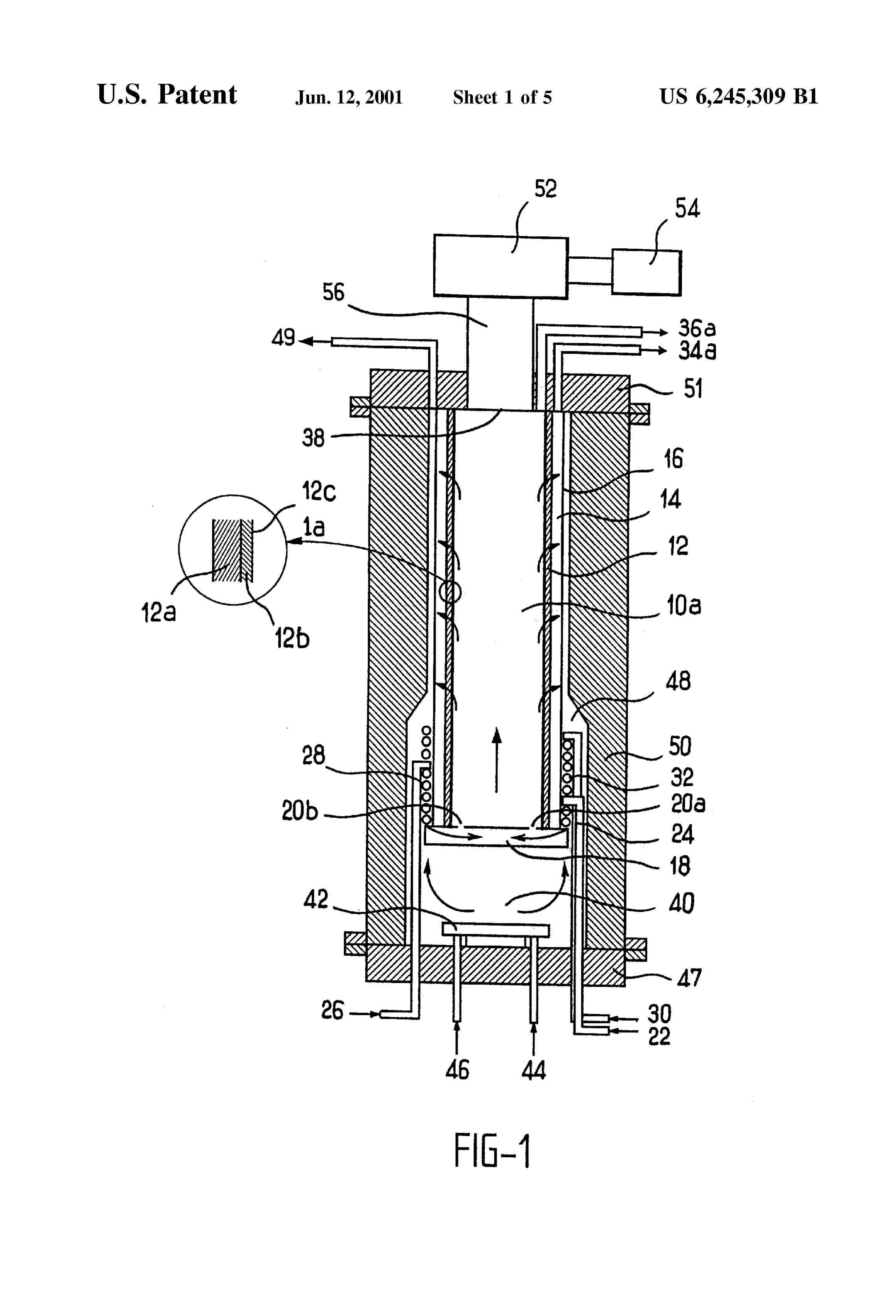
generate a cold plasma of this kind is very low (around 10%) 18Atwiththethreebase of the reaction chamber 10a is an entry part functions, namely mixing, heating and inject compared to the total thermal energy which must be Supplied to the gases to carry out the intended reforming. 35 ing the reactive gases concerned. A turbulent flow of the The membrane highly Selective to hydrogen forms a gases is obtained by means of nozzles (not shown) Suitably partition between the reaction chamber and the hydrogen oriented for this purpose and mounted in openings 20a, b in collecting chamber and allows immediate extraction of the the ceiling of the part 18. The mixer 18 is connected (1) to nascent hydrogen. The effect of this is to enable virtually a fuel (alcohol or hydrocarbon) Supply conduit 22 via a complete reforming of the mixture concerned. 40 spiral heat exchanger 24, (2) to a steam Supply conduit 26 By virtue of the above arrangements, apparatus that is via a Superheater 28 of the same kind, and (3) to an oxygen relatively compact, relatively inexpensive and consumes (or air) Supply conduit 30 via another, similar heat exchanger little electricity provides particularly efficient reforming of 32.
the primary mixture concerned and Substantially pure hydro Under the entry part 18 of the reaction chamber 10a is a gen can be produced that can be used for direct feeding of 45 combustion chamber 40 at the base of which is a burner 42 fuel cells. fed with combustible gas mixture via a conduit 44 and with BRIEF DESCRIPTION OF THE DRAWINGS air via a conduit 46. The gases burned in the chamber 40 are evacuated via an annular chimney 48 which opens to the
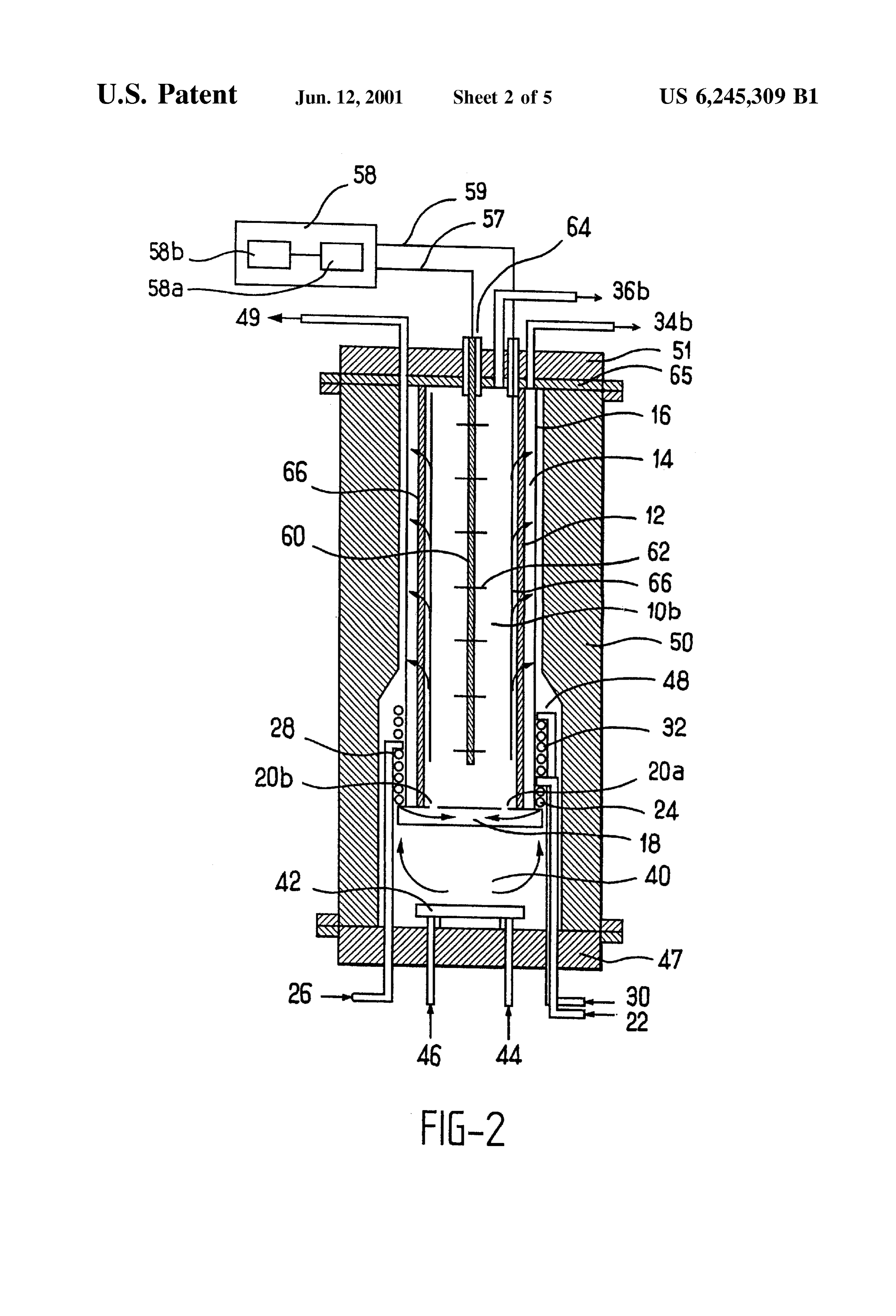
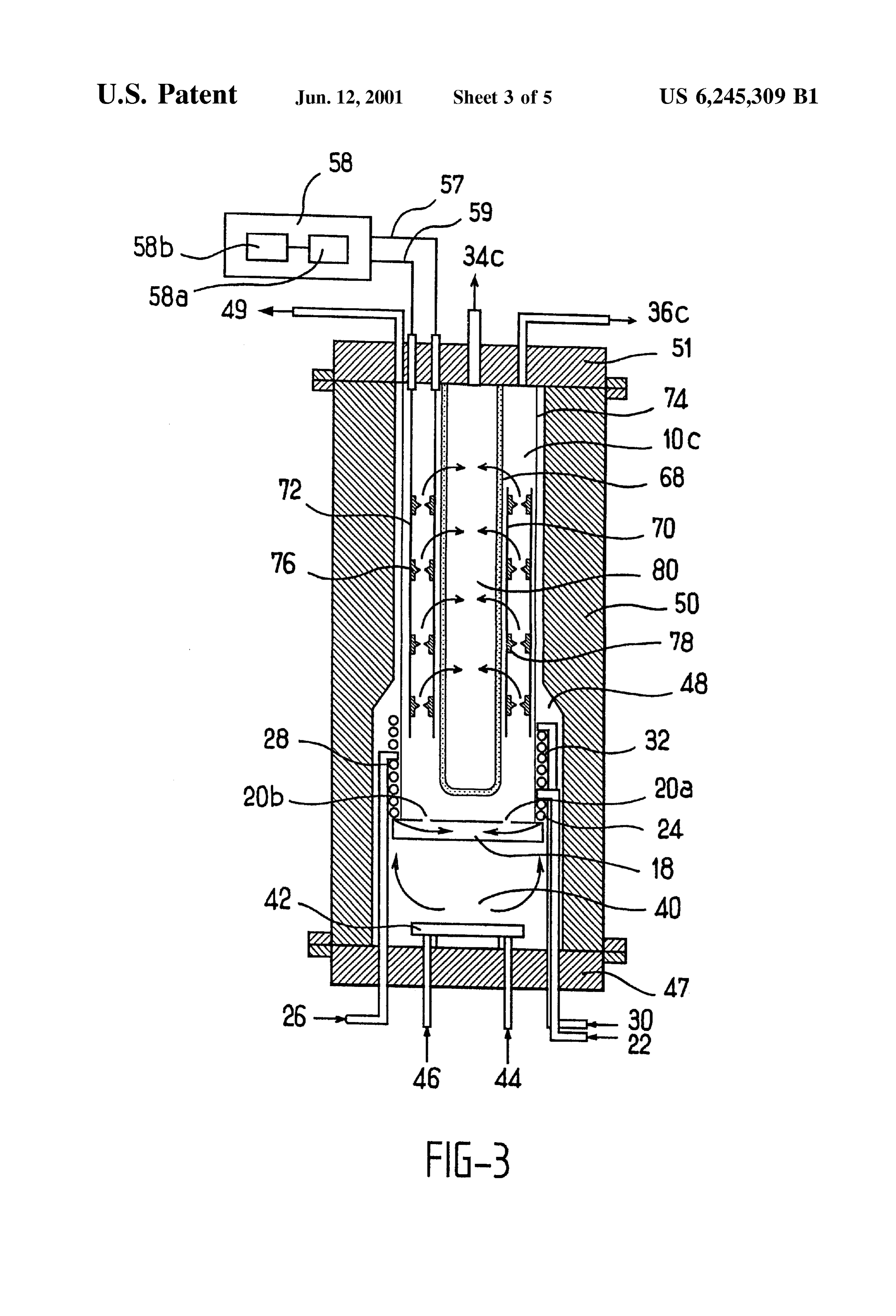
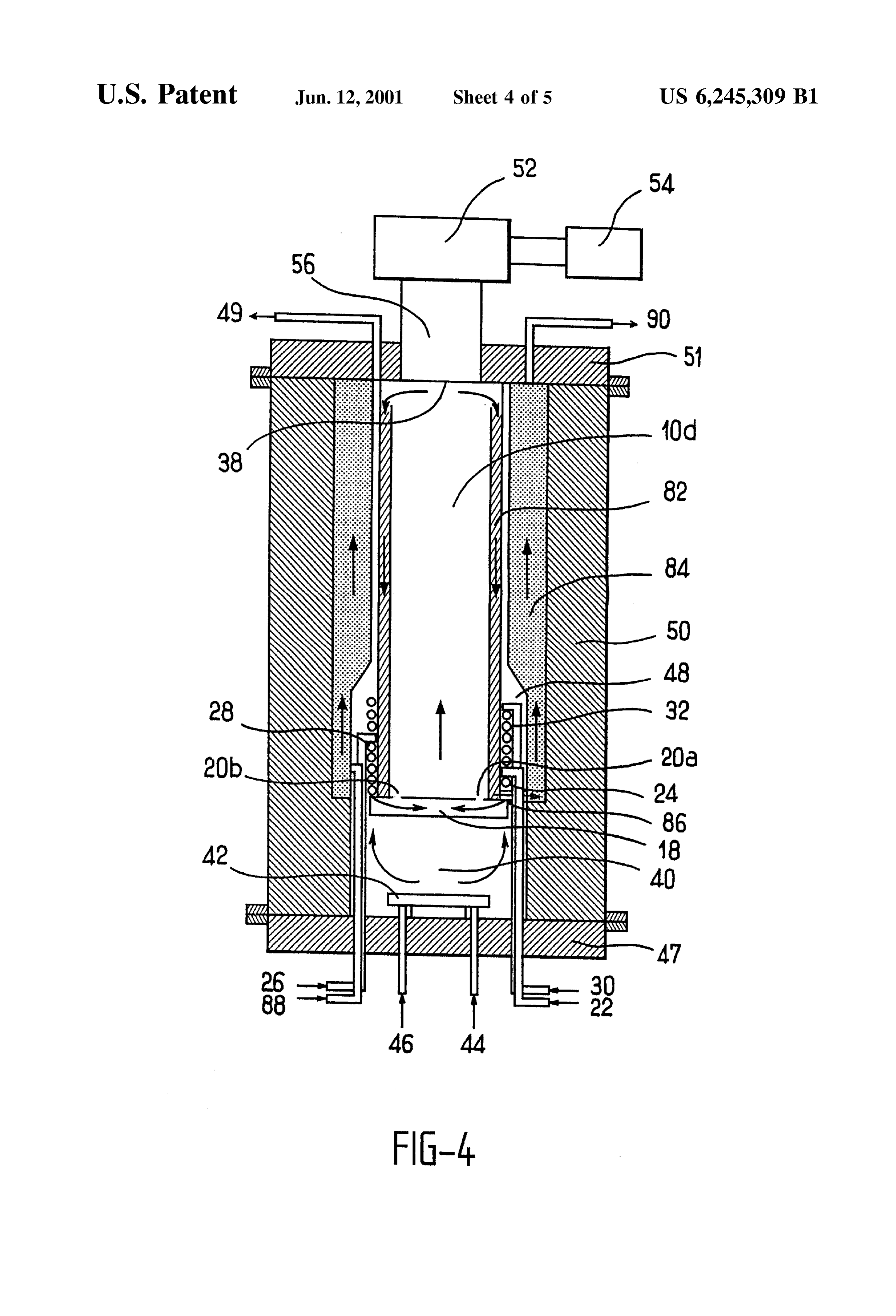
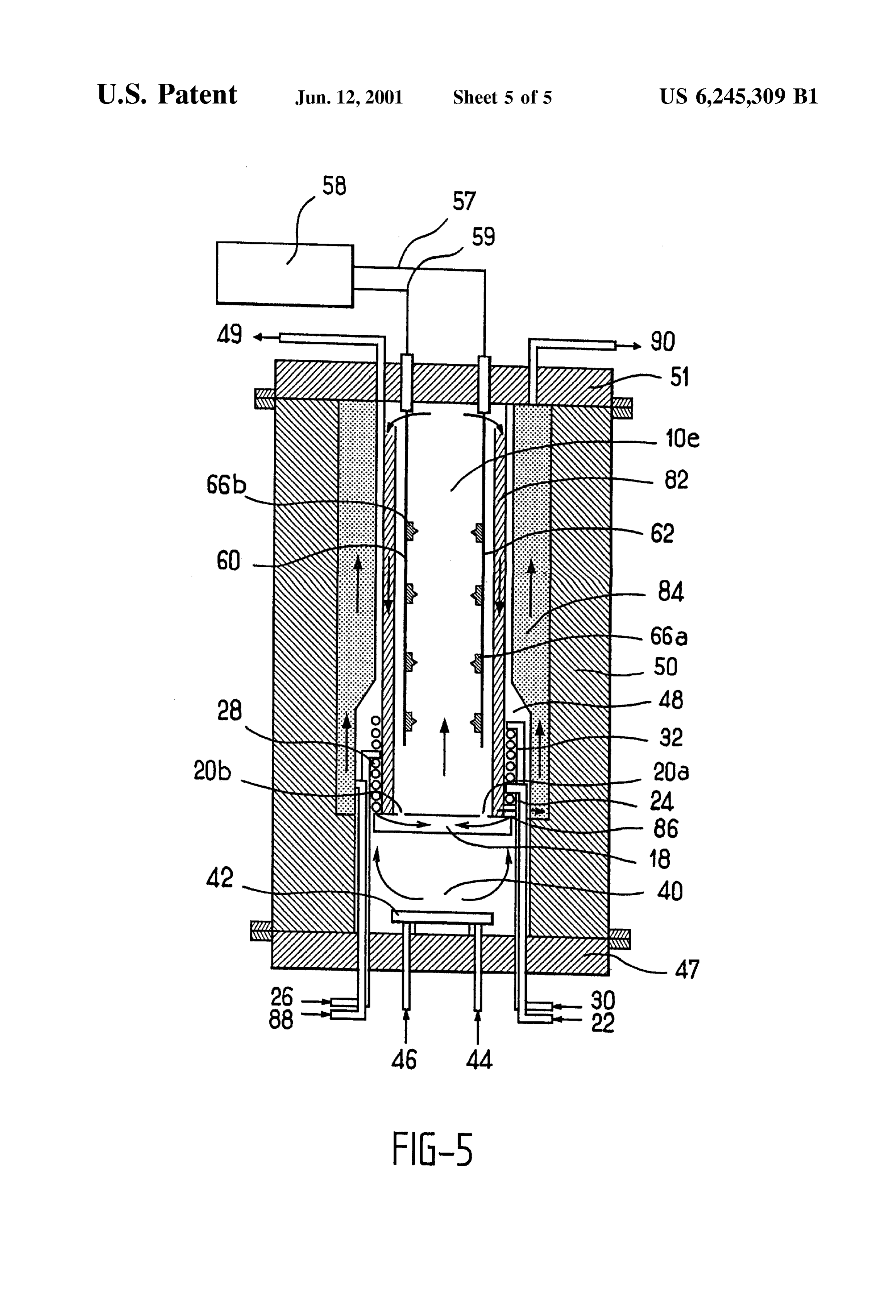
The features and advantages of the invention will emerge outside via an exhaust pipe 49 and which surrounds the more precisely from the following description of embodi 50 hydrogen collecting chamber 14 and the heat eXchangerS24, ments of the invention given by way of non-limiting 28 and 32. The combustion chamber 40 and the annular example and with reference to the accompanying drawings, chimney 48 are surrounded by a relatively thick thermally in which: insulative jacket 50 made of Silica wool, for example, and FIG. 1 is a diagrammatic longitudinal Sectional view of a having a bottom 47 and a lid 51. A conduit 34a removes hydrogen generator including a reaction chamber in which a 55 hydrogen from the hydrogen collecting chamber 14. A cold plasma is produced by microwaves, a membrane that is conduit 36a removes residual Secondary mixture from the permeable to hydrogen Surrounding the chamber; reaction chamber 10a. The top of the reaction chamber 10a FIG. 2 is a diagrammatic longitudinal Sectional view of a is closed by a window 38 that is permeable to microwaves. hydrogen generator including a reaction chamber in which a To generate a cold plasma in the reaction chamber 10a a cold plasma is produced by pulsed corona discharge, a 60 microwave generator 52 (a magnetron operating at 3 GHZ, membrane that is permeable to hydrogen Surrounding the for example) fed by a supply 54 delivering pulses of 20 to chamber; 30 kV at a frequency of 1 to 10 kHz and with a duration of FIG. 3 is a diagrammatic Sectional view of a hydrogen a few microSeconds is connected by a waveguide 56 to the generator including a reaction chamber in which a cold window 38 in the chamber 10a. The chamber 10a constitutes plasma is produced between the electrodes by corona 65 a resonant cavity for the microwaves applied to it and discharges, a membrane permeable to hydrogen being dis therefore has a longitudinal dimension equal to an integer posed in that chamber; number of half-wavelengths of the microwaves. Microwave
Page 10
electrical discharges are therefore created in the gas mixture The reaction chamber 10c shown in FIG. 3 differs from concerned, Similar to corona electrical discharges. To that 10b shown in FIG. 2 primarily because a membrane 68 improve their efficacy, metal Spikes insulated from each that is Selectively permeable to hydrogen and in the shape of other can be installed in the reaction chamber. a closed ended tube is disposed at the center of the reaction The reaction chamber 10b shown in FIG. 2 differs from chamber 10c. The wall of the membrane 68 is identical to the that 10a shown in FIG. 1 in terms of the means for wall of either embodiment of the membrane 12 described generating a cold plasma therein. Here these means com above. The reaction chamber 10c contains metal grids prise a Supply 58 delivering a pulsed alternating high Voltage 70-72, of cylindrical shape, for example, respectively con and electrodes 62-66 respectively connected to the high nected to the conductors 57-59 connecting the voltage Voltage terminal of the Supply and to ground. The Supply 58 supply 58, with the result that the pulsed AC high voltage is includes an HF generator 58a producing a high frequency applied to the grid 72 and ground, to the grid 70, which which is modulated by an appropriate LF circuit 58b. For Surrounds the membrane 68. The external wall 74 of the example, the Supply 58 delivers an alternating high Voltage chamber 10c is an insulator impermeable to hydrogen and with an amplitude of 10 to 20 kV at a frequency of adapted to withstand the relatively high pressure in the approximately 1 MHZ modulated by Squarewave signals at 15 reaction chamber 10c. The grid 72 is close to the wall 74 but a frequency of approximately 1 kHz and having a pulse there is no risk of provoking unwanted electrical discharges. duration of a few microseconds. The amplitude of the At least one grid is equipped with radial electrodes 76-78. applied HF alternating Voltages is generally Slightly greater The interior of the membrane 68 is a chamber 80 for than the arc-striking threshold, the duration of the pulses collecting hydrogen and has an axial evacuation conduit (one half the HF period in each direction) obviously being too short to cause arcing. The number of HF periods in a 34C. The interior of the membrane 68 is a chamber 80 for collecting hydrogen which has an axial outlet conduit 34c.
modulation pulse and the exact value of the HF frequency The chamber 10c has an outlet conduit 36c for the residual are determined in accordance with the Specific operating conditions. The frequency and/or duration of the modulation Secondary mixture.
pulses is/are adjusted according to the average electrical FIGS. 4 and 5 show two other embodiments of the power to be Supplied to the gas to generate the required cold 25 invention that do not include any membrane for extracting plasma. the nascent hydrogen produced in the reaction chambers. In The high voltage output terminal of the supply 58 is both cases the membrane is replaced by two annular spaces connected by a heavily insulated first conductor 57 to a rigid 82-84 coaxial with the reaction chambers 10d, e. Additional metal rod 60 disposed at the center of the reaction chamber treatment of the Secondary mixture produced in these cham 10b. The rod 60 carries radial electrodes 62 in the form of bers by reforming the primary mixture in accordance with Spikes. The relatively large number of Spikes is regularly equations (1) to (4) is performed in these spaces. The annular arranged along the rod 60, the total number of Spikes and the space 82 surrounds each reaction chamber 10d, e. The optimum distance between their levels being determined by upstream end of this space communicates with the down systemactic experimentation The rod 60 is rigidly fixed to a stream end of this chamber. The space 82 is filled with Sealed passage 64 which is strongly electrically insulated 35 nickel-coated granules, a catalyst for converting methane to and fitted into a flange 65 closing the reaction chamber 10b. hydrogen. The annular Space 84 Surrounds the annular A second conductor 59 connected to the ground of the chimney 48 of the combustion chamber 40. The base of the Supply 58 is connected to a circular Section cylindrical fine space 84 communicates with the downstream end of the metal grid 66. The grid 66 is installed in the reaction Space 82 via a conduit 86 and with an oxygen Supply via a chamber 10b in the close vicinity of the inside face of the 40 conduit 88. The annular space 84 is filled with platinum membrane 12. This causes corona discharges between the coated granules, a catalyst for oxidizing carbon monoxide. spike electrodes 62 and the grid 66. An outlet conduit 90 for the treated secondary mixture is The grid 66 is near the hydrogen extraction membrane 12 connected to the top of the annular space 84. and is at ground potential rather than at the high potential of Referring to FIGS. 1, 2 and 3, the burner 42 is fed at 44 the Supply 58. This is in order to prevent electrical dis 45 with a combustible gas mixture that could comprise the charges that would otherwise occur between the grid 66 and residual Secondary gas mixture recovered from one of the the membrane 12, necessarily connected to the ground of the outlet conduits 36a, b, c and additional fuel, possibly iden entire apparatus. This would damage the thin metal layers tical to that feeding the reaction chambers 10a, b, c at 22. that the membrane 12 Surrounding the reaction chamber The three heat exchangers 24-28-32 at the base of the generally contains. AS for the rod 60 Supporting the Spike 50 annular chimney 48 of the combustion chamber 40 through electrodes 62 and fed with the very high alternating Voltage which pass the three components of the primary mixture to from the supply 58, it should be noted that there is no be reformed (namely the combustible gas, the Steam and the Significant Stray electrical capacitance between the elec oxygen (or air) supplied via the conduits 22-26-30) preheat trodes 62 and the ground of those components in parallel each component before feeding them into the entry part 18 with the high impedance established between the electrodes 55 of the reaction chamber 10a, b, c. 62 and the grid 66 before and during the required electrical In the entry part 18 the three components are mixed discharges. This is because of the Strongly insulated passage completely and strongly heated by the flame of the burner 64 of the rod 60 through the flange 65 and the relatively great 40. The required temperature of the primary mixture is distance between the electrodes 62 and the other compo around 500 C. if the fuel is methane or 250 to 300° C. in nents of the apparatus. This achieves production that is not 60 the case of methanol. Each fuel (including the methane disturbed by Such discharges. mixed with the carbon monoxide, produced at the same time Because of the high frequency AC voltage delivered by by apparatus for gasification of a heavy, liquid or Solid fuel) the Supply 58, a layer of insulating material having a high has a temperature characteristic of its conversion into hydro dielectric constant can be associated with one of the elec gen. Consequently, the intensity of the flame of the burner 42 trodes 62-66. If necessary, this layer is porous. This creates 65 depends on the nature of the combustible gas to be reformed. barrier discharges that are particularly effective in generat The injector nozzles mounted in the openings 20a, b in the ing a cold plasma. ceiling of the entry part 18 introduce a turbulent flow of the
Page 11
heated primary mixture into the reaction chamber 10a, b, c Generators of Substantially pure hydrogen in accordance concerned. Efficient heat eXchange is thereafter established with the invention are obviously not intended only for between the totality of the primary mixture and the outside feeding fuel cells. These generators are particularly Suitable wall of the reaction chamber 10a, b, c concerned with which for equipping industrial and university chemistry laborato the mixture is in contact. This outside wall of the chamber ries. In this application they are preferably fed with natural 10a, b, c is directly (FIG. 3) or indirectly (FIGS. 1-2) heated gas from the gas main.
by the burned gases flowing in the annular chimney 48 of the A plurality of membranes 68 selectively permeable to combustion chamber 40. hydrogen and in the form of closed ended tubes could be A cold plasma is created throughout the primary gas installed in the same cold plasma reaction chamber. In this mixture present in the chambers by electrical discharges case the plasma is generated between two groups of elec produced in the reaction chamber by pulsed microwaves (at trodes insulated from each other and respectively connected 10a) or by electrodes 62-66 or 76–78 fed with pulsed AC to the high Voltage Supply and to ground. The two groups of high voltages (at 10b, c). This produces a secondary gas electrodes are preferably similar to those described above, in mixture as defined above. The membrane 12 (FIG. 1-2) or particular metal grids or metal rods carrying Spikes. They are 68 (FIG. 3) which is selectively permeable to hydrogen 15 installed in the reaction chamber to Suit the arrangement of extracts the nascent hydrogen as it is produced in the the membranes adopted. In this way, for a given Volume of Secondary mixture and transferS it into the hydrogen col the reaction chamber, the Surface area of the membranes and lecting chamber 14 or 80. This action of the selective therefore the total capacity for extraction of hydrogen are membrane 12 or 68 also brings about positive displacement increased. The hydrogen collecting chambers of these mem of the point of thermodynamic equilibrium of the reaction, branes are connected to a single removal conduit external to as mentioned above. Also, the preSSure in the chamber must the reaction chamber.
be high enough to feed a fuel cell directly. The porous support 12a of the membranes 12 and 68 that In the current state of the art of membranes selectively are Selectively permeable to hydrogen need not be of permeable to hydrogen available off the Shelf, the maximum ceramic. Any porous refractory Solid material is Suitable for hydrogen production capacity of a cold plasma reaction 25 a Support of this kind.
chamber is significantly greater than the extraction capacity The two steps characteristic of the method in accordance of any known membrane. Consequently, to obtain the great with the invention of producing a gas flow containing est possible benefit from the methane to hydrogen conver hydrogen either alone or mixed with carbon dioxide for Sion capabilities of cold plasma chambers, it is essential to directly feeding a fuel cell operating at low temperature need maximize the hydrogen extraction capacity of the mem not be implemented in the same apparatus. In this case, branes concerned, in particular by increasing the Surface adequate treatment of the Secondary gas mixture produced area of those membranes. by the first apparatus is carried out in Second apparatus near The benefit of a generator of Substantially pure hydrogen the first apparatus.
in accordance with the invention is therefore obvious. Com Obviously, many modifications and variations of the pared to apparatus with the same function currently used in 35 present invention are possible in light of the above teach industry, a generator in accordance with the invention has: ings. Thus, it is to be understood that, within the Scope of the (1) much lower overall dimensions and weight, (2) signifi appended claims, the invention may be practiced otherwise cantly lower operating temperatures, (3) a consequently than as Specifically described above.
reduced heating energy , (4) minimum maintenance What is claimed and desired to be secured by Letters requirements, (5) a relatively low overall cost, and (6) the 40 Patent of the United States is:
possibility of being easily installed in mass-produced elec 1. A generator of Substantially pure hydrogen, including: trical cars or readily transportable Small and medium-power a reaction chamber into which is injected a primary gas electrical generator Sets. mixture formed of at least one combustible gas Selected A relatively large gassification unit must be used if gas oil, form the group consisting of a hydrocarbon, an alcohol coal or wood is to be used to fire a fixed electrical power 45 and carbon monoxide, and Steam and/or oxygen and/or Station of relatively high power and high energy efficiency air; wherein the generator further includes: comprising a generator of Substantially pure hydrogen in heating means being associated with the reaction cham accordance with the invention and a fuel cell. ber in order to establish and to maintain therein a Referring to FIGS. 4 and 5, reactors using catalysts, predetermined average temperature; complementary to the cold plasma reaction chambers, are 50 means for producing in the reaction chamber electrical used to treat the Secondary mixture produced and render it discharges at a current which is low enough to directly usable in certain types of fuel cell, other than the prevent the formation of electric arcs So as to gen PEM type, operating at relatively high temperatures. The erate a cold plasma adapted to Stimulate the chemical annular reactor 82 containing nickel-coated granules com reactivity of the primary gas mixture without Sig pletes the conversion of the methane to hydrogen effected in 55 nificantly increasing the average temperature of the cold plasma chambers 10d, e. The annular reactor 84, those gases in order to reform the primary gas which contains platinum-coated granules and receives mixture to produce a Secondary gas mixture contain oxygen, oxidizes the carbon monoxide contained in the ing hydrogen, carbon dioxide, carbon monoxide and Secondary mixture passing through it to convert it into a residue of the primary gas mixture, and carbon dioxide. The two hydrogen generators shown in 60 means for removing hydrogen from the Secondary gas FIGS. 4-5 are improved forms of apparatus in accordance mixture.
with the invention that have advantages over prior art 2. A hydrogen generator according to claim 1 wherein the apparatus with the same function. They are Smaller and leSS means for removing the hydrogen from the Secondary gas costly. They are suitable for fixed or relatively untransport mixture comprise a membrane having a high Selective able medium-power installations. 65 permeability for hydrogen disposed as a separator partition The invention is not limited to the embodiments and between the reaction chamber and a chamber for collecting applications described. the hydrogen produced.
Page 12
3. A hydrogen generator according to claim 1 wherein the chamber carries a large number of radial electrodes and heating means comprise a burner which is fed with a gas is connected to the high Voltage Supplied by the Supply; mixture comprising Said combustible gas. a metal grid in the close vicinity of the membrane is 4. A hydrogen generator according to claim 1 wherein the connected to the ground of the Supply. means for producing low current electrical discharges in the 10. A hydrogen generator according to claim 4 wherein: reaction chamber comprise: the means for removing the hydrogen from the Secondary two electrodes insulated from each other, disposed in the gas mixture comprise a membrane having a high Selec reaction chamber and respectively connected by con tive permeability for hydrogen disposed as a separator ductors to the high Voltage and ground terminals of a high Voltage Supply delivering periodic short pulses partition between the reaction chamber and a chamber having an amplitude which is either less than the for collecting the hydrogen produced, arc-striking threshold or greater than that threshold but the reaction chamber Surrounds the membrane that is of insufficient duration to Strike an arc, Selectively permeable to hydrogen; the electrode to which the Voltage is applied is Strongly the membrane is in the shape of a closed ended tube and insulated from the general ground of the equipment. 15 encloses a hydrogen collecting chamber; 5. A hydrogen generator according to claim 4, wherein the the outside wall of the chamber is electrically insulating, Supply comprises: a first electrode connected to the high Voltage of the an HF circuit producing a high frequency alternating Supply is disposed in the near vicinity of the wall; and Voltage at a frequency in the order of 1 MHZ and having a Second electrode connected to the ground of the Supply a maximum amplitude of a few kilovolts, is disposed in the near vicinity of the membrane. an LF circuit producing Short pulses having a frequency 11. A hydrogen generator according to claim 10 wherein in the order of 1 kHz and a duration of a few the generator microSeconds, applied as modulating pulses to the HF plurality of membranes includes, in the same reaction chamber, a circuit.
in the shape of closed ended tubes 6. A hydrogen generator according to claim 1 wherein the 25 disposition, Shape and number ofgroups and a plurality of associated of electrodes, the the electrodes depending means for producing low current electrical discharges in the on the disposition of the membrane adopted. reaction chamber comprise: 12. A generator of Substantially pure hydrogen according a microwave generator fed by a high Voltage Supply to claim 1 wherein:
modulated by Short periodic pulses having a frequency the reaction chamber has at the base an entry part pro in the order of 1 kHz and a duration of a few micro
Seconds, vided with a bottom and a ceiling and adapted to mix and heat gases to constitute said primary mixture;
the longitudinal dimension of the reaction chamber is an Said bottom being eXposed to the flame of a burner in a integer number of half-wavelengths of the microwaves combustion chamber;
produced.
7. A generator of Substantially pure hydrogen according to 35 Said ceiling incorporating openings fitted with nozzles claim 2 wherein the membrane which is highly selectively adapted to inject a turbulent flow of the resulting heated permeable to hydrogen comprises: primary gas mixture into the reaction chamber. a hollow Support having a relatively thick wall made of a 13. A hydrogen generator according to claim 12 wherein: porous Solid refractory material; and the combustion chamber includes an annular chimney an ultra-thin coating of a metal permeable to hydrogen 40 Surrounding the reaction chamber; deposited on the face of the Support constituting a wall heat eXchangers fed with respective components of the of the reaction chamber. primary gas mixture to be obtained are disposed at the 8. A generator of ultra-pure hydrogen according to claim base of Said chimney and discharge into the entry part; 2 wherein the membrane having a highly Selective perme 45 a thermally insulative jacket Surrounds the combustion ability to hydrogen comprises: chamber and the annular chimney. a hollow Support having a relatively thick wall made of a 14. A generator of relatively pure hydrogen according to Solid porous refractory material; claim 1 wherein the means for removing hydrogen from the a thin coating of a metal permeable to hydrogen deposited Secondary gas mixture include:
on the face of the Support Serving as a wall of the 50 two additional reaction chambers disposed in Series reaction chamber; around and after the reaction chamber, Said additional Said coating being provided on the outside with a mono chambers containing respective catalysts adapted to atomic non-metallic layer Such as Sulfur or carbon So improve Said reforming and then to eliminate the that the membrane can behave as a Superpermeable carbon monoxide from Said Secondary gas mixture in membrane for nascent atomic hydrogen produced dur 55 order to produce a final gas mixture formed principally ing reforming. of hydrogen and carbon dioxide. 9. A hydrogen generator according to claim 4 wherein: 15. A hydrogen generator according to claim 14 wherein the means for removing the hydrogen from the Secondary Said additional chambers comprise:
gas mixture comprise a membrane having a high Selec a first annular space Sharing a wall with the reaction tive permeability for hydrogen disposed as a separator 60 chamber;
partition between the reaction chamber and a chamber a Second annular space around the first one and Separated for collecting the hydrogen produced, from it by an annular chimney associated with the the membrane which is Selectively permeable to hydrogen combustion chamber;
Surrounds the reaction chamber and constitutes its the first Space contains a first catalyst adapted to complete outside wall; 65 the reforming carried out in the reaction chamber; a rigid metal rod firmly mounted on a Strongly electrically the Second Space contains a Second catalyst adapted to insulated Sealed passage at the center of the reaction convert carbon monoxide into carbon dioxide;
Page 13
the upstream and downstream Sides of the first Space at a current which is low enough to prevent the forma respectively communicate with the downstream Side of tion of electric arcs, which triggers a reaction of the reaction chamber and with the upstream Side of the reforming the primary gas mixture and which produces Second Space; a Secondary gas mixture formed in particular of the upstream and downstream sides of the Second Space hydrogen, carbon dioxide, carbon monoxide and a are respectively connected to an oxygen or air Supply residue of primary mixture, and conduit and to a conduit for removing the final gas (c) extracting the hydrogen from the Secondary gas mix ture.
mixture obtained in this way; 17. A method of producing a flow of gas consisting mainly a thermal protection jacket Surrounds Said Second Space. of hydrogen according to claim 16 wherein the hydrogen is 16. A method of producing a flow of gas consisting mainly extracted by means of a membrane having a high Selective of hydrogen for feeding a fuel cell from a primary gas permeability for hydrogen.
mixture formed of a combustible gas and Steam and/or 18. A method of producing a gas flow consisting mainly oxygen and/or air, wherein the method includes the Steps of: of hydrogen according to claim 16 wherein the hydrogen is (a) heating the primary gas mixture which is fed into a 15 extracted by oxidizing the carbon monoxide present in the reaction Zone at a temperature Suitable for reforming Secondary mixture obtained and recovering a mixture com the primary gas mixture, prising hydrogen and carbon dioxide. (b) producing in the reaction Zone a cold plasma gener ated in the primary gas mixture by electric discharges k k k k k
Provenance
- Collection
- Cited prior art
- Original PDF
- patentimages.storage.googleapis.com →
- Filed
- 1997-12-23
- Pages
- 13
- Method
- pdftotext (the PDF's own text layer) + pdftoppm 300dpi page scans
- Source
- Google Patents bibliographic record
- Granted
- 2001-06-12
- Inventors
- Claude Etievant; Mustapha Roshd; H2-Tech Sarl
- Transcribed from
- patentimages.storage.googleapis.com →