patent · US6221310
System for extracting sodium metal from sodium hydroxide with methane as a reductant
24 April 2001
Page 1 — bibliographic record
(12) United States Patent (10) Patent No.: US 6,221,310 B1 Checketts et al. (45) Date of Patent: Apr. 24, 2001
(54) SYSTEM FOR EXTRACTING SODIUM FOREIGN PATENT DOCUMENTS
METAL FROM SODIUM HYDROXIDE WITH
METHANE ASA REDUCTANT 603825 12/1924 (FR). * cited by examiner (75) Inventors: Jed H. Checketts; Kent E. Hatfield, Primary Examiner Roy King both of Salt Lake City; Ramaswami Assistant Examiner Tima McGuthry-Banks
Neelamegham, South Jordan, all of (74) Attorney, Agent, or Firm M. Reid Russell
(73) Assignee: Powerball Industries, Inc., Salt Lake
City, UT (US) A reactor System that includes a reactor nozzle for use with a reactor vessel and proceSS for its use for producing Sodium (*) Notice: Subject to any disclaimer, the term of this metal, by a reaction of an alkali hydroxide, preferably patent is extended or adjusted under 35 Sodium hydroxide, as a reactant, with methane gas as a U.S.C. 154(b) by 0 days. reductant, at high heat. The invention includes heating apparatus there with for Supplying heated Sodium hydroxide (21) Appl. No.: 09/350,385 and methane gas along with oxygen or compressed air to a reactor nozzle that Sprays the materials therethrough to (22) Filed: Jul. 9, 1999 provide a breakup of the materials into fine particulates with 7 mixing thereof in a burner area or portion of a reactor vessel (51) Int. Cl.' ..................................................... C22B 26/10 EE" provideE.
(52) U.S. Cl. ............................. 266/48; 266/153; 266/268 Sodium hydroxide and methane, producing Sodium metal (58) Field of Search ..................................... 266/268, 153, VaporS along with carbon monoxide and hydrogen gases, 266/48 which vapors and gases are then passed to a quench assem bly that cools the vapor and gas flow to below the conden (56) References Cited sation temperature of Sodium, causing Sodium metal to
with the carbon monoxide and hydrogen gases vented there 342.897 6/1886 Castner .................................. 75/590 from. The quench assembly includes first and Second quench 380,775 4/1888 Thowless ............................... 75/590 coolers that Sequentially receive, and in Stages cool, the E. I Rless on 25 Vapor and gas flow with the produced Sodium metal to enter 2,391,728 * 12/1945 McConica, III et al. .............. 75/590 the Storage tank below the sodium metal level therein with 2,642,347 6/1953 Gilbert ................................... 48.216 the storage tank further including a volume of a liquid 2,685,346 8/1954 Deyrup et al. ... 420/570 having a lesser Specific gravity than, and is non-reactive 2,774,663 * 12/1956 Kirk .............. - - - - - - 75/590 with, Sodium metal for prohibiting a back reaction of the 2,930,689 3/1960 McGriff ... ... 426/558 Sodium metal.
3,823,014 7/1974 Chong .................................... 75/590 4,455,176 6/1984 Fuhrhop ................................. 266/48 13 Claims, 3 Drawing Sheets
CARBONDOXDE CARBONDIOXOE HYDROGEN
WATER WAPOR WATER WAPOR CARBONMONOXDE
NITROGEN NITROGEN CARBONDOXIDE
OSEN cy. WATERYAPOR
27- 3a 66
Page 2
Drawing sheet — no readable text.
Page 3
Drawing sheet — no readable text.
Page 4
Drawing sheet — no readable text.
Page 5
SYSTEM FOR EXTRACTING SODIUM condensing Sodium metal. The above cited Systems are each METAL FROM SODIUM HYDROXIDE WITH essentially a batch System, unlike the present invention, that METHANE ASA REDUCTANT is a continuous System where Sodium metal is produced in liquid form and is continuously drawn from a bottom Vessel
BACKGROUND OF THE INVENTION of a quench chamber, and neither involves a use of Sodium 1. Field of the Invention hydroxide and methane as reactants. Nor do the either of the A System, apparatus and process for practice for the Systems of these patents proved, as does the invention, a novel mixing spray nozzle that directs individual flows of reduction of Sodium hydroxide with natural gas in the the heated reactants against one another to break the flows presence of heat to produce, after quenching, Sodium metal into fine particulates, mixing them together in a high heat as a product of the thermodynamic reaction. atmosphere, to react and produce vaporous Sodium metal, 2. Prior Art and carbon monoxide and hydrogen gasses, with the mix The invention is in a System and apparatus for practicing then quenched to liquify Sodium metal that is then removed a proceSS where Separate flows of a heated liquid Sodium for use. With Such quenching taken place in a vessel or hydroxide, oxygen and heated methane are sprayed through 15 vessels that maintain a cooled Surface, Such as a coil a mixing nozzle to Strike one another and mix for burning in receiving a coolant liquid passed therethrough and/or may a burner area of a reactor vessel, with vaporous Sodium include Spraying of a non-reactive coolant into the vaporous metal, carbon monoxide and hydrogen gases, the product of mix as it enters the quench cooler, which quenching con that burning that is passed from the reactor vessel for denses out Sodium metal from the reactant vapors that is then quenching to rapidly cool and liquify the Sodium into metal drained into a Storage vessel.
that is then passed to a storage vessel with the carbon A U.S. Pat. No. 2,930,689 to McGriff teaches a Sub monoxide and hydrogen gases passed for discharge or merged combustion of methane in molten Sodium carbonate recycling in the System. and includes a separation wall to prevent the combustion Apparatus and processes for refining Sodium metal are old gases, water and carbon dioxide, from entering into the in the art, with a recent U.S. patent application Ser. No. 25 reaction of methane or carbon with Sodium carbonate. The 09/262,876 filed Mar. 5, 1997, by one of the inventors being McGriff process requires an operating temperature of from an example of a new System to include a reactor vessel 1150 to 1250 degrees C, with carbon or methane fed into the wherein a heated mixture of Sodium hydroxide and methane hot Sodium carbonate, and with Sodium carbonate continu is provided to vaporize the mix into Sodium metal vapors, ously added. The proceSS requires a continuous addition of carbon monoxide and hydrogen gas, which mix is then carbon, preferably coke in powdered form, to perpetuate the quenched to Separate out the liquid Sodium metal from the reaction. In practice, handling of a Solid material, Such as gases, with the liquid Sodium then passed for use. Unique carbon, is a disadvantage that is not present in a practice of therefrom, the present invention provides a nozzle arrange the invention. Further, McGriff 689 does not include a ment for Spraying Separate flows of heated Sodium mixing nozzle or quenching arrangement like that of the hydroxide, oxygen and methane together in a burner area of 35 present invention, but provides for an immediate reaction at a reactor vessel creating a chemical reaction that produces a high heat to produce vaporous Sodium metal like that of the Sodium metal vapor, and carbon monoxide and hydrogen invention.
gases, which mix is passed to a quench chamber wherein While McGriff 689, like the invention, teaches a use of Vaporized Sodium metal is condensed to a liquid that is methane as one of the reactants for producing Sodium metal, drawn off for use. 40 that production is from a molten Sodium carbonate, and Very earlier apparatus and processes are shown in U.S. further, unlike the invention, it requires that carbon, in Pat. No. 342,897 to Castner; U.S. Pat. Nos. 380,775 and powdered form, be continuously passed into the reaction 380,776 to Thowless; and U.S. Pat. No. 460,985 to Netto, as vessel. Also, unlike the invention, the McGriff 689 patent examples of Systems that utilize a carbonaceous material as provides for burning of the introduced methane producing a a reactive agent, usually carbon in powder form, that is to 45 high heat in the presence of carbon, with methane fed into react with the compound containing Sodium or potassium in hot Sodium carbonate and with carbon, as Solid coke in the presence of high heat to produce free Sodium. Such powdered form, continuously added for the reaction to processes have, however, not only required that a number of proceed. Further the McGriff 689 patent does not deal with complex StepS be performed to finally produce Sodium metal problems inherent in quenching Sodium metal from a mix of and, unlike the invention, they have generally been Single 50 gaseous carbon monoxide (CO) and Sodium (Na), and fails batch processes only. to recognize and deal with a back reaction as will occur as Additionally, a French Patent No. 603,825, shows sodium the gases cool where Sodium metal tends to react with metal being reacted with iron in powder form by first carbon monoxide to produce Sodium carbonate (Na2CO), Vaporizing the mix and then condense out Sodium vapor at which problem of back reaction the invention addresses and temperatures below the Sodium condensation temperature. 55 Solves.
Such proceSS has, however, required that it be conducted in Further, a patent to Deyrup, U.S. Pat. No. 2,685,346, like a vacuum and that Sodium vapors as are produced be the invention, incorporates a Step of quenching of a hot removed from a reaction Zone and condensed. Further, in the Vapor containing a free alkaline metal to cool the alkaline 825 patent, like a later U.S. Pat. No. 2,642,347 to Gilbert, metal to a molten State, and deals with a handling of a back Sodium metal vapor is produced from a condensation of 60 reaction as the Sodium vapor is quenched from the carbon Sodium carbonate that has been reacted with carbon at a heat monoxide and Sodium gases. Unlike the invention, however, of from 1000 degrees C to 1200 degrees C, which vapor the Deyrup 346 patent involves a use of large amounts of ization takes place after the Sodium metal vapor has been tin, must be operated at high temperatures, and, of course, conducted away from the reaction. Condensation in the does not involve a mixing Spray nozzle arrangement like that Gilbert 347 patent utilizes surfaces of steel balls that are 65 of the invention. Also, the Deyrup 346 patent teaches a maintained at a temperature below that required for Sodium multi-step process to provide for a quenching of the Sodium Vaporization, with vapor contact with the Steel ball Surfaces metal and accordingly, in its operation, it is likely that a large
Page 6
percentage of the collected Sodium metal will be lost to back Still another object of the present invention is to provide reaction, and further the system of the Deyrup 346 patent is a reactor vessel and process for practice therein to efficiently not continuous. produce Sodium metal that is essentially automated and, SUMMARY OF THE INVENTION except for a close monitoring or temperatures and pressures in a reactor vessel, requires little human involvement in a
It is a principal object of the present invention to provide continuous refining of Sodium metal from a liquid Sodium a System, apparatus and process for Separating out Sodium hydroxide.
metal from a mixture of heated Sodium hydroxide as a The System, apparatus and process of the invention is for reactant with the Sodium hydroxide, heated methane and processing Sodium hydroxide (NaOH) as a reactant that is oxygen Sprayed together through a single nozzle apparatus combined with, in a preferred embodiment, methane gas or into a high heat area of a reactor vessel to produce metal other appropriate combustible hydrocarbon as a reductant, Sodium in a vapor State along with carbon monoxide and and reducing the mixture by high heat in the presence of hydrogen gases, with the vapor and gaseous mix then oxygen to produce a combined flow of vaporized Sodium quenched to liquify Sodium metal that is drawn off for use. metal and carbon monoxide and hydrogen gases. The System Another object of the present invention is to provide a and apparatus includes a reactor nozzle wherethrough are System, apparatus and proceSS for continuously producing 15 Simultaneously passed, preferably, Separate flows of heated Sodium metal from a reaction of heated Sodium hydroxide as Sodium hydroxide and methane and oxygen, with the nozzle the reactant with methane as a reductant in the presence of directing the flows therefrom to impinge upon and mix with oxygen to produce high heat in a reactor vessel, forming a one another, forming fine particulates within a burn area of a reactor vessel, with the constituents in the combined flows
Vapor and gaseous mix of Sodium metal, carbon monoxide immediately and hydrogen that is then rapidly quenched to produce liquid from the mix reacting and producing vaporous Sodium metal forming carbon monoxide and hydrogen
Sodium metal, with carbon monoxide and hydrogen as off gasses. The Sodium metal vapors gases that are exhausted to atmosphere or are recycled into to a first of two quench coolers that,and gases are then passed preferably, also receives the System.
a flow of a coolant liquid that is non-reactive with Sodium
Another object of the present invention is to provide an 25 metal nozzle apparatus and process to produce, from a reaction of reduce directed therein, and thence to a Second to further the temperature of the vaporous and gaseous mix, to hot Sodium hydroxide as a reactant with methane as a precipitate Sodium metal therefrom. A back reaction of the reductant in the presence of oxygen combined as a mixture liquid Sodium metal to Sodium carbonate (NaCO) is dis and injected into a reactor vesselburner Zone to produce a temperature that is well above the vaporization temperature couraged by the injection of the coolant liquid and the Speed of quenching and, along with the presence of an inert gas, of sodium metal of approximately two thousand (2,000) to preferably nitrogen, in the reactor vessel and quench cooler. twenty-eight hundred (2800) degrees F., to vaporize sodium The Sodium metal is then passed to a holding vessel that metal from the mixture and form carbon monoxide and hydrogen gases, the Sodium metal vapors and gases to pass contains a material that is non-reactive with and is lighter to a quench chamber for rapid cooling, precipitating Sodium 35 than sodium metal to float thereon that is preferably the coolant liquid as passed to the first quench cooler that is metal from the flow that is collected and passed from the circulated from the holding vessel to the first quench cooler. quench unit for processing, with the gases passed for venting The Sodium metal is thereby contained in a non-reactive or recycling. State until it is drawn off for use. The System is operated as Another object of the present invention is to provide, for a continuous process, with the temperature in the top or practicing the process of the invention, a quench apparatus 40 burner Zone of the reaction vessel wherein the Sodium arranged as primary and Secondary, or first and Second hydroxide, Oxygen and methane are sprayed from the Single chambers that operate in Series to receive and, in passage of nozzle, maintained at from two thousand (2,000) to twenty the vapor and gaseous mix, to cool the mix to below the eight hundred (2,800) degrees F., preferably approximately condensation temperature of Sodium metal, condensing out twenty-five hundred (2,500) degrees F., with the reaction to Sodium metal while discouraging a back reaction of the 45 produce Sodium metal, along with carbon monoxide and Sodium metal. hydrogen gases taking place at approximately nineteen Still another object of the present invention is to provide, hundred (1,900) degrees F. The quenching process is pref in a quenching apparatus of the invention, for performing a erably conducted in an inert atmosphere and at leSS than rapid cooling of the vaporized and gaseous mix constituents, atmospheric pressure, minimizing the number of molecules that is a two stage first and Second vessel arrangement 50 as are present as could react with the Sodium metal causing provided to efficiently precipitate of essentially all the a back reaction producing Sodium carbonate. In a practice of available Sodium metal from the vaporous and gaseous mix. the process of the invention, the proceSS constituents con Still another object of the present invention is to provide Sisting of flows of heated Sodium hydroxide and methane a simple spray nozzle for Spraying Separate flows of the along with oxygen are Separately and continuously passed constituents of heated Sodium hydroxide, methane and oxy 55 through the nozzle of the invention, Spraying against one gen from the Single nozzle that directs the flows together another to mix and form fine particulates in a burner portion creating fine thoroughly mixed particulates in a burner of the reactor vessel wherein a flame area is maintained. An portion or Section of a reactor vessel, providing a rapid immediate reaction thereby takes place that produces vapor reaction of the constituents at high heat to form a flow of ous Sodium metal along with carbon monoxide and hydro Sodium metal vapors, and carbon monoxide and hydrogen 60 gen gases that are then passed to a quench assembly for rapid gases, with that flow then passed through first and Second cooling. Sodium metal is thereby produced, with the carbon quench chambers that cool the flow to condense Sodium monoxide and hydrogen gases vented as waste or are for metal. passed recycling to be burned for heating, as desired. Still another object of the present invention is to prevent Sodium hydroxide that is the reactant in a practice of the a back reactor of the condensed Sodium metal during a 65 process of the invention may be a waste product, as is continuous production of liquid Sodium metal that can then produced in a number of commercial processes, or may be drawn from the quench vessel as a continuous process. Supplied from any number of Sources.
Page 7
S 6
BRIEF DESCRIPTION OF THE DRAWINGS employed within the Scope of this disclosure. So arranged, the oxygen flow that is injected through passage 15 pro
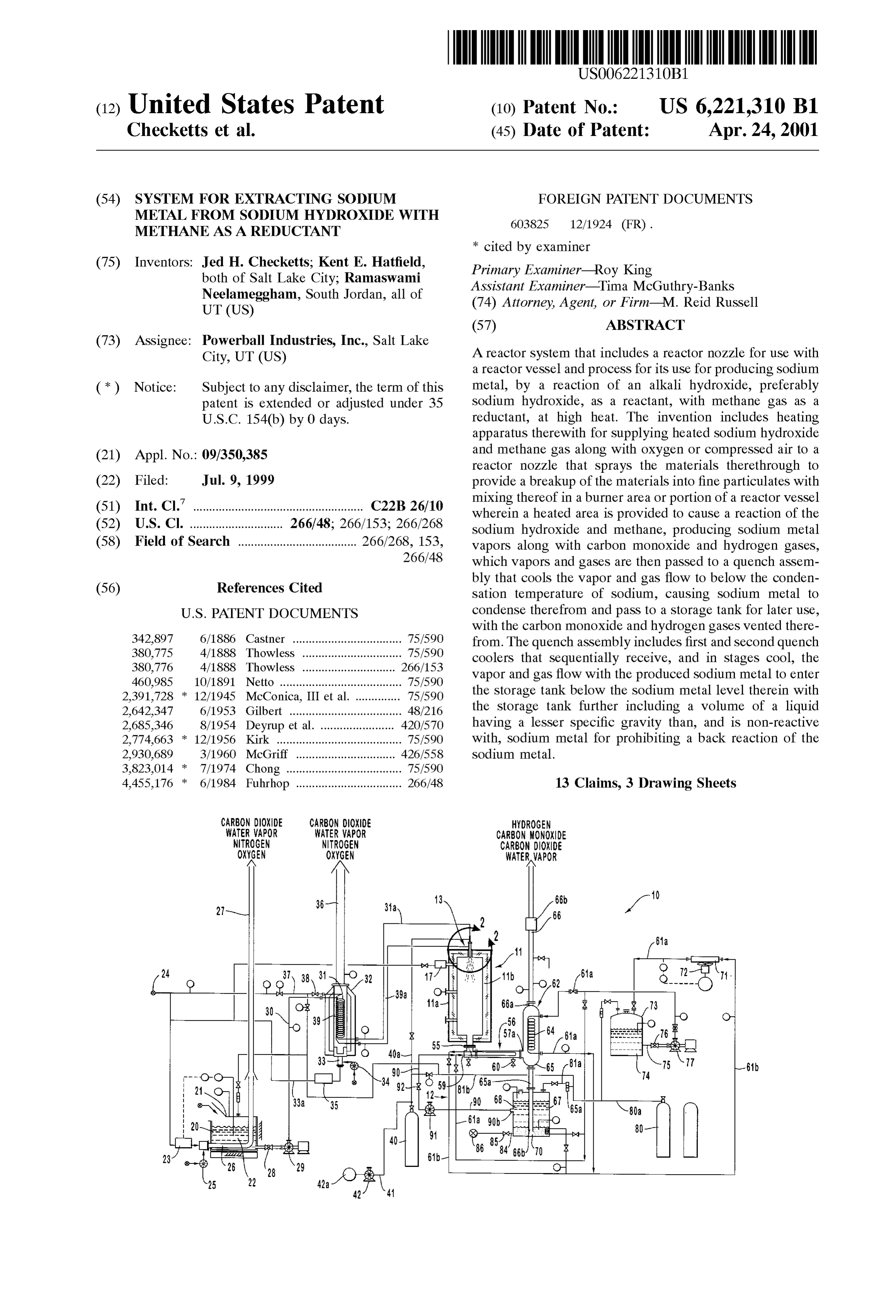
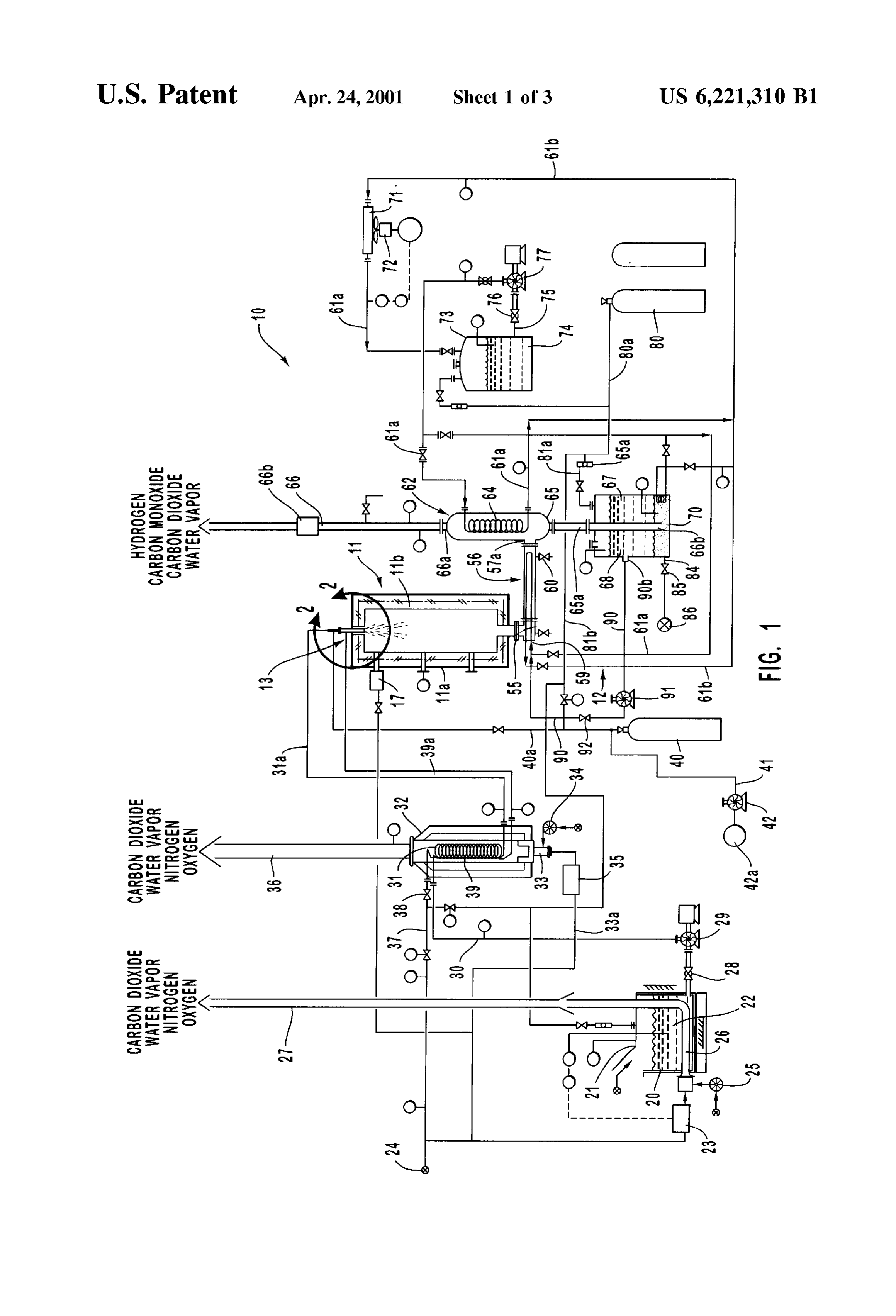
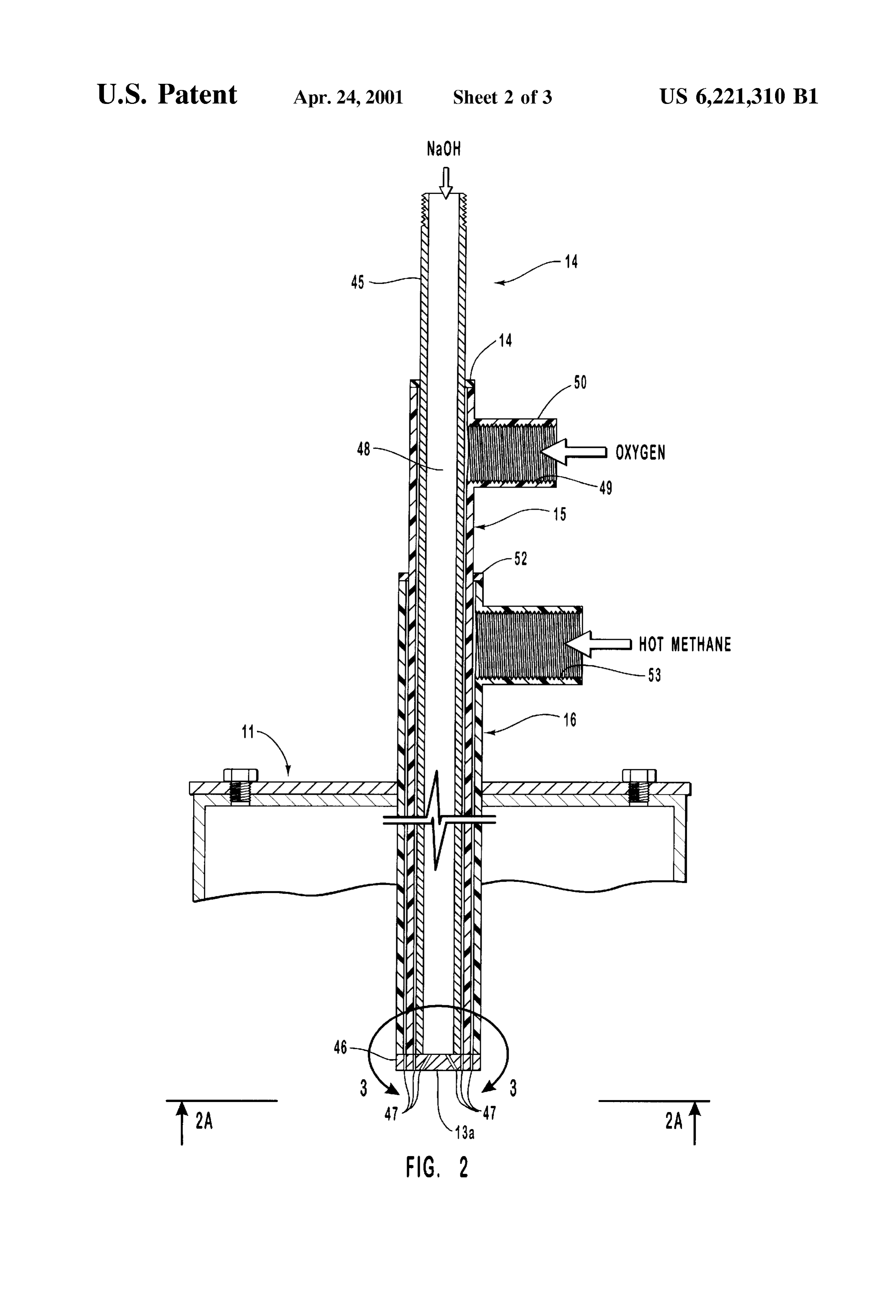
In the drawings that illustrate that which is presently motes a high heat of burning in the top Section 11a or burner regarded as the best mode for carrying out the invention: portion that receives the heated fine particulate mixture of FIG. 1 is a Schematic of a Sodium metal production Sodium hydroxide and methane and oxygen, providing a facility of the invention where Sodium metal is produced in rapid temperature to the mixture to increase to approxi a reaction of heated Sodium hydroxide with heated methane mately between two thousand (2,000) and twenty-eight in an oxygen environment and at a high heat, where the (2,800) degrees F., to cause an immediate reaction or crack reaction constituents are separately sprayed from a single ing of the mix into Sodium metal vapor and carbon mon nozzle that directs the Sprays against one another, forming a oxide and hydrogen gases. At this high heat, the reaction will flow of well mixed fine particles within a burner area of a be almost instantaneous and the combined vapor and gas reactor vessel, thereby cracking the mixture to produce eous mix can then be passed to the quench assembly for Vaporous Sodium metal along with carbon monoxide and rapid cooling, causing the Sodium metal vapor to condense hydrogen gases, with the vapor and gases then passed for to a liquid that can then be drawn off, as Set out and rapid cooling in a two stage quenching apparatus, wherein 15 discussed in detail hereinbelow.
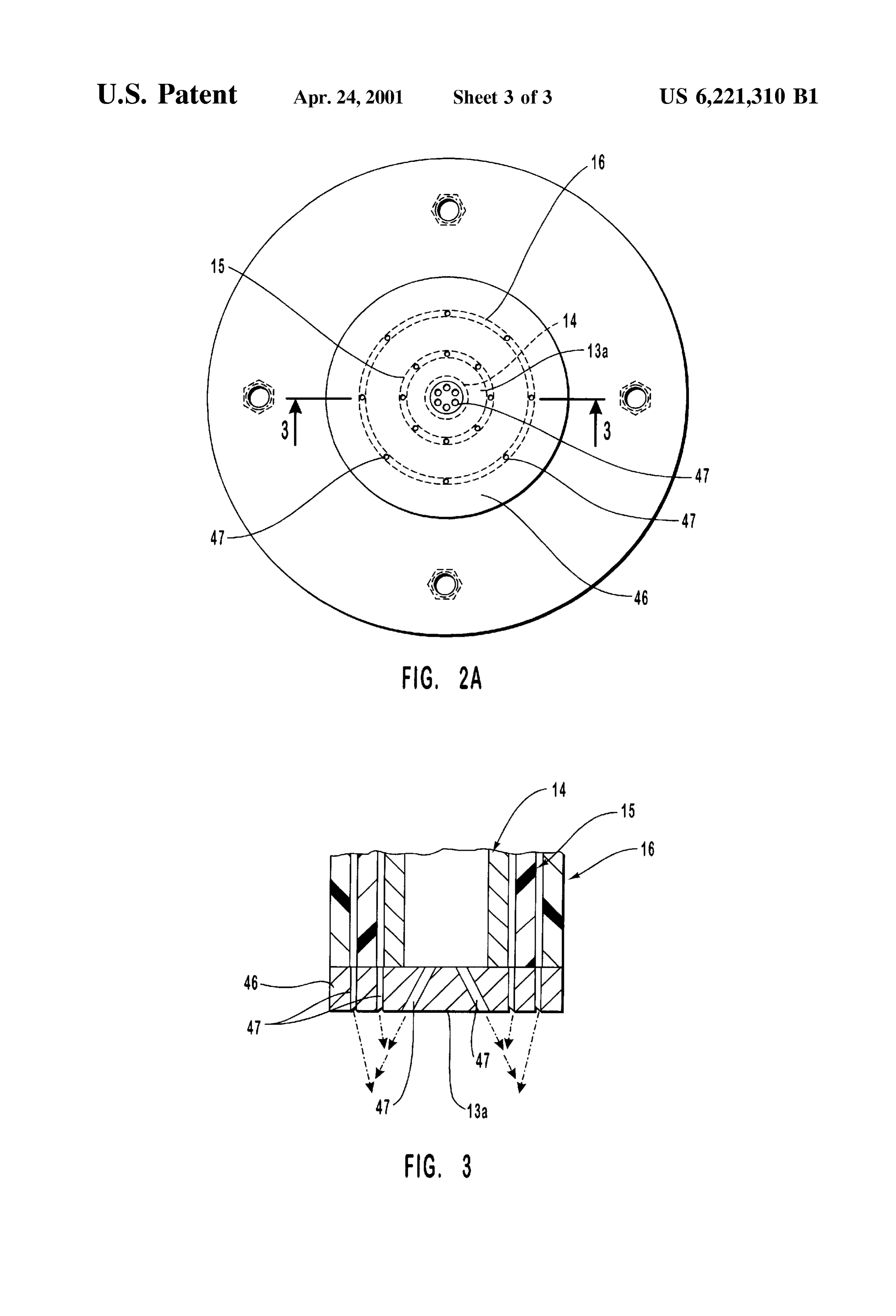
Sodium metal is condensed from the mix and is passed to a The plant 10 includes a caustic or sodium hydroxide Storage vessel wherein it is maintained beneath a non (NaOH) tank 20 that receives, through a hinged top 21, a reactive material to discourage any back reaction until Supply of caustic Sodium hydroxide 22 that is preferable an drawn therefrom for use; anhydrous NaOH caustic prills or beads though, it should be FIG. 2 is an enlarged Sectional view taken along the line understood, Such caustic can be a waste product from 2-2 of FIG. 1 of the reactor nozzle of the invention; another manufacturing process, within the Scope of this FIG. 2A shows a lower end plan view of the reactor nozzle disclosure. A burner 23 receives a high pressure flow of of FIG. 2; methane gas from a Source 24 for burning and directs the FIG. 3 shows an enlarged end view of the end of the burner output, that is mixed with air from a blower 25, nozzle of FIG. 2 showing the reactive materials being 25 through a line 26 that runs through the tank 20, heating the Sprayed out of the nozzle end, Striking one another forming Sodium hydroxide 22, to vent, through a line 27, carbon fine mixed particles that provide a large Surface area for dioxide,
Sodium water vapor, nitrogen and oxygen. The caustic hydroxide solution is initially heated in tank 20 to reaction.
approximately seven hundred fifty (750) degrees F. and is
DETAILED DESCRIPTION then passed therefrom through a valve 28 and is pumped by pump 29 through line 30 into a heating coil 31 that is
FIG. 1 shows a schematic of a plant 10 for refining sodium contained in vessel 32. Aburner 33 is mounted in the vessel metal from a reactant of Sodium hydroxide with, preferably, 32 bottom to receive methane that is fed thereto through a methane as a reductant in the presence of oxygen at a high feed line 33a that receives the flow of methane from a high or cracking heat in a reactor vessel 11, shown herein as a 35 preSSure methane Source 24. The methane gas is mixed with cylinder, through it should be understood, another shape of air that is provided through a blower 34 and a burner control vessel could be So used, to vaporize Sodium metal from the 35 provides a desired heat output, with the vessel 32 vented constituent mix, and with the Sodium metal then condensed through line 36. After passage of the Sodium hydroxide from a vaporous and gaseous mix in a quench assembly 12. Solution through coil 31 it emerges into line 31a having a In the Schematic of FIG. 1, the plant includes a Single 40 temperature that has been raised to approximately two reactor vessel 11 along with a pair of Separate Serially thousand (2,000) degrees F. Additionally, methane gas, connected chambers or coolers as the quench assembly 12. under pressure, is directed through a line 37 to pass through The reactor vessel 11, as shown in the drawings, incorpo a valve 38 and is directed through a line 39 that parallels the rates a reactor nozzle 13 that is configured to have three coil 31, to emerge from the vessel 32 as line 39a that Separate longitudinal passages 14, 15 and 16, respectively 45 contains the methane that has been heated to a temperature there through, with the individually passages for of approximately fifteen hundred (1,500) degrees F. The transporting, respectively, a Sodium hydroxide Solution that respective heated Sodium hydroxide Solution and methane has been heated to approximately two thousand (2,000) gas travel through the Separate passages through the nozzle degrees F. through the center passage 14, with oxygen gas 13 and are mixed together by Spraying them through an passed through the middle passage 15; and with methane gas 50 injection plate 46, the flows to strike one another in front of that has been heated to approximately fifteen hundred a nozzle face 13a, and with oxygen or compressed air (1,500) degrees F. through the outer passage 16, as shown in provided through a line 41 from a compressor 42 that draws FIGS. 2 and 3. It should, however, be understood that, in fresh air through an inlet 42a that is also directed through the practice, the oxygen flow can be a compressed air flow nozzle 13 from a tank 40 and through a line 40a, wherein within the scope of this disclosure and can be combined with 55 line 41 may be connected as an alternative or to augment the the Sodium hydroxide flow, allowing for a use of a reactor flow of oxygen from tank 40. The respective gases and nozzle 13 having only a center passage 14 and an outer Sodium hydroxide Solution are injected under pressure from passage 16, within the Scope of this disclosure and further the reactor nozzle 13 Striking one another apart from the than a hydrocarbon other than methane can be utilized as the nozzle face 13a, as Set out below. reductant within the Scope of this disclosure. The liquid and 60 The reactor nozzle 13 is mounted, as shown in FIG. 1, in gaseous mix is thereby injected into a top Section 11a of the the head or top end 11a of the reactor vessel 11 that reactor vessel 11 and into a burner area of the reactor vessel preferably has ceramic walls 11b, as the vessel liner, that will that receives a burnable material, preferably methane or withstand the effects of the high heat atmosphere therein natural gas, through a gas pilot 17 that extends into the along with the effects of the heat stimulated reaction of the vessel top Section 11a or burner portion that is ignited to 65 heated caustic Solution and methane that produces a rapid produce a hot fire, though another burnable material can be Vaporization of Sodium metal, and the ceramic vessel walls So used, or even an electric furnace arrangement can be So are non-reactive with Sodium metal to prevent any unwanted
Page 8
back reaction of the vaporized Sodium metal to form Sodium flow is passed through the gas pilot 17 and is ignited within carbonate (NaCO). The reactor nozzle 13 provides for the top area 11a to provide a flame or burner area that Separated passage of the heated methane and Sodium receives the Sprays from reactor nozzle 13. So arranged, an hydroxide Solutions along with oxygen or compressed air for immediate reaction of the Sodium hydroxide and methane mixing these constituents in front of its injection end 13a, as will take place in the reactor vessel top area 11a, forming shown in FIGS. 2 and 3. Preferably, the sodium hydroxide Vaporized Sodium metal and carbon monoxide and hydrogen passage 14 is a center tube or pipe 45 that is open the length gases by the reaction:
thereof and has its injection end covered with an injection plate 46 wherein a plurality of Spaced holes or perforations 47 are formed, that pass the Separate Sodium hydroxide The vapor and gaseous mix are then passed from the reactor methane and oxygen flows. The Spaced holes or perforations vessel 11 through a bottom vent 55 and into an inlet 57 of 47 act as nozzles for directing Sodium hydroxide, methane a first quench cooler 56 of the quench assembly 12. and oxygen or compressed air Sprays under preSSure there The first quench cooler 56, as shown in FIG. 1, is a hollow through to impinge or Strike one another So as to cause both vessel, identified as a tube or cylinder 58 though another a break up of the Sprayed constituents into fine particulates 15 shape of vessel could be So used, that connects at a vapor and and turbulence to thoroughly mix the respective flows gas inlet 57, to bottom vent 55 of the reactor vessel to pass together in the high heat environment as is present at the top the flow from that reactor vessel 11 and into the cylinder 58. 11a of the reactor vessel 11. The combined fine particulate The cylinder 58 is closed across end 59 wherethrough inlet constituents provide a large Surface area that will rapidly be and exhaust coolant lines 61a and 61b, respectively are heated to provide complete reaction of the Sodium hydroxide passed that connect into a chill coil 60 that is positioned and methane to form, respectively, Sodium metal in vapor within an open longitudinal center area of the cylinder 58. ous form, along with carbon monoxide and hydrogen gases. Further, which cylinder 58 and end 59 adjacent to vapor and The oxygen or compressed air as is passed through a nozzle gas inlet 57, can be connected to a spray end 90a of an inert chamber 48 is to promote combustion in the reactor vessel fluid flow line 90 that connects at 90b into a liquid sodium providing the preferred high heat of between two thousand 25 tank 67 to drain an inert fluid 68 therefrom. So arranged, (2,000) to twenty-eight (2,800) degrees F. and is approxi inert fluid 68 removed from tank 67 is pumped by pump 91 mately twenty-five (2,500) degrees F. that, in turn, provides to pass through a valve 92 and be sprayed into the vapor and for a rapid reaction or cracking of the constituents in the gaseous flow passed into the first quench cooler 56. This flows, producing Sodium metal. Further, where compressed Spray of inert fluid 68 to provide, as a direct quench, for an air is so used, a large Volume of nitrogen (N) is thereby initial cooling of the flow to initially lower the mix tem present that is, of course, inert and prevents an undesired perature and provides for a formulation of an envelope back reaction of the Sodium metal vapors into Sodium around the individual Sodium particles, preventing an carbonate (Na2CO). unwanted back reaction of Sodium into Sodium carbonate The reactor nozzle 13, in addition to its center pipe 45, (NaCO). The chill coil 60 to provide rapid cooling to the includes an inner sleeve 48 having an open annular space 35 Vapor and gas flow receives a coolant flow pumped along its length, is closed acroSS its upper end at 49 and therethrough, creating a cold outer Surface that is contacted includes a feed port 50 whereto the line 4.0a from the oxygen by the vapor and gas flow from the reactor chamber. So or compressed air Source is connected. Oxygen or com arranged, the vapor and gas flow is initially or further cooled pressed air is passed through the feed port 50 and flows and is then passed through a vent coupling 57a to a Second between the pipe 45 carry the heat sodium hydroxide 40 quench cooler 62 of the quench assembly 12. solution and outer sleeve 51 that transports the heated The Second quench cooler 62 is also shown as a cylinder methane with the oxygen or compressed air flow thereby 63, though another vessel shape could be So used, and heated by the pipe 45 and sleeve 51 walls which oxygen or wherein a final chill coil 64 is fitted that is to receive the compressed air flow is passed through holes or perforations Vapor and gaseous mixture flow thereover, cooling that flow 47 in the injection plate 46, Spraying into the Sprays of 45 to below the vaporization temperature of Sodium metal. So Sodium hydroxide and methane which sprayed flows are arranged, Sodium metal is thereby condensed out of the thereby broken into fine particulates with the fine particles Vapor and gaseous flow to a liquid State and falls through a presenting a large reaction Surface and are thoroughly mixed discharge end 65 of the cylinder 63 to pass through a line with the oxygen presence to promote a rapid heating of the 65a and into a liquid sodium holding tank 67, shown as a mixed flows in the flame area at the top 11a of reactor vessel 50 volume 70. In practice, the temperature of the vaporous and 11 producing a rapid reaction or cracking. The reactor nozzle gaseous mix within the Second quench cooler 62 is reduced 13 further includes the outer sleeve 51 that has an open to below three hundred (300) degrees F., whereat sodium annular cavity therealong, is closed acroSS its top end 52 and metal vapors condenses into a liquid, with the carbon includes a feed port 53 whereto is connected line 39a. monoxide and hydrogen gases as remain in the flow, along Heated methane gas or other Suitable hydrocarbon, Such as 55 with Some carbon dioxide and water vapor, then exhausted heating oil, propane (CH), or the like is passed from line through a cylinder vent end 66a and passed through an 39a through feed port 53 to travel through the outer sleeve exhaust line or Stack 66 to atmosphere or to a recycling line annular cavity and out the holes or perforations 47 formed for reprocessing and use in a plant System, not shown, as is in the injection plate, Spraying therefrom into engagement practical and profitable to the process, within the Scope of with the Sprays of Sodium hydroxide and oxygen or com 60 this disclosure. In which passage through the Stack 66 the pressed air, So as to thoroughly mix therewith and react with gases are passed through a flame arrester 66b that is to the sodium hydroxide in the high heat atmosphere. In FIG. eliminate a possibility of an unwanted ignition of the mix of 3 is shown the respective Sprays as are sprayed out from gases, including the gaseous hydrogen.
holes or perforations 47 impinge or Strike one another, Shown in FIG. 1, the line 65a extends into the liquid providing fine thoroughly mixed flow of particles. 65 Sodium tank 67 to just above the bottom thereof to discharge In FIG. 1 the sprays from reactor nozzle 13 are shown liquid Sodium from the Second quench cooler 62 through end sprayed into the top area 11a of the reactor vessel 11. A fuel 66b to below the level of the liquid sodium 70 maintained
Page 9
therein. Further, to maintain the integrity of the Sodium comprising, a reactor vessel; Separate Sources of Sodium metal 70, precluding a back reaction thereof where the hydroxide and methane; means for heating each of Said Sodium metal reacts to form a Sodium hydroxide, the Sodium Separate Sources of Sodium hydroxide and methane, a reac metal 70 is covered by a layer of an inert liquid 68, such as tor nozzle; means for passing Said heated Sodium hydroxide kerosene, though other liquid could be So used within the and methane into first and Second passages that are formed scope of this disclosure. As set out above, the inert liquid 68 in a housing of Said reactor nozzle that is fitted into Said preferably kerosene or other appropriate liquid can be drawn reactor vessel; a Source of oxygen and means for passing out of the liquid sodium tank 67 to serve as an initial coolant Said oxygen into Said reactor vessel, and which said first and for lowering the temperature and encapsulating Sodium Second passages each include an exhaust port that is fitted metal particles in the first quench cooler 56. Such drawing into a nozzle face and mounts an orifice end therein, and off of inert fluid 68 should be limited so as not to uncover which individual ports receive Separate flow of Said Sodium the liquid sodium to with, of course, the inert liquid 68 as is hydroxide and methane that are transported as Separate flows directed into the first quench cooler 56 to return to the liquid and are Sprayed through the orifice ends, which said orifices Sodium tank 67 through the discharge end 65 of the second are formed to individually direct said flows of sodium quench cooler 62. 15 hydroxide and methane gas against one another, Spaced from Like the coolant liquid Supplied to the first quench cooler Said reactor nozzle end So as to mix and form Sodium 56, a refrigerant is Supplied to and discharged from the hydroxide and methane flows that mix with the oxygen flow second quench cooler 56 through branches of lines 61a and passed into Said reactor vessel, providing fine particulates, 61b, respectively, Line 61a is connected to a refrigerant flow means for providing a heat area within a reaction portion of from a dowtherm cooler 71 that condenses the refrigerant by Said reactor vessel where the temperature is from two cooling it, as illustrated by a fan 72, and directs that liquid thousand to twenty eight hundred degrees F, to raise the refrigerant into a Surge tank 73. The liquid refrigerant, temperature of the mixture of Sodium hydroxide, methane shown at 75, is then passed through a valve 75 to a pump 76 and oxygen particles to where a reaction takes place that into the line 61 a that branches to flow to both the first and produces Sodium metal vapors, carbon monoxide and hydro second quench coolers 56 and 62. The discharge flow from 25 gen gases, means for venting Said Sodium vapors, carbon each quench cooler then flows through branched return lines monoxide and hydrogen gases to a quench assembly means 61b, with line 61b connected to an inlet side of the dowtherm for cooling Said vapor and gaseous mix below the conden cooler 71. sation temperature of Sodium metal, liquefying Sodium To prohibit the occurrence of a back reaction in the metal; means for passing Said liquid Sodium metal to a reaction or cracking proceSS as takes place in the reactor Sodium metal Storage tank, and means for venting Said vessel, a nitrogen Source, shown as a tank 80, is linked carbon monoxide and hydrogen gases through an exhaust. through line 80a to a manifold 81 that is connected through 2. The System as recited in claim 1, wherein the reactor line 81a into the top of Sodium holding tank 67 to provide noZZle housing includes a third passage that is connected to a nitrogen atmosphere above the kerosene 68 level. Further, receive the oxygen flow through an entry port means in Said a branch line 81b from the manifold 81 connects into the 35 reactor nozzle, and Said third passage directs said oxygen Supply line 4.0a from the oxygen Source tank 40 that passes flow into an orifice in the reactor nozzle end, Spraying that nitrogen therethrough to control the Volume of oxygen as is flow therefrom to strike and mix with the sprays of sodium passed through nozzle 13 to a Volume to Support combustion and hydroxide and methane.
in the top 11a or reactor vessel 11 only, to provide that 3. The System as recited in claim 1, further including essentially all of the oxygen as is Supplied with the Sodium 40 means for heating the flows of Sodium hydroxide and hydroxide and methane into the reactor vessel will be methane prior to their passage into the reactor nozzle. consumed in the combustion taking place there or, as an 4. The System as recited in claim 1, wherein the reactor alternative, with a use of compressed air, the flow into nozzle vessel is a cylinder whose interior is lined with fire bricks 13 will contain both oxygen and nitrogen without a need for and wherein is fitted the reactor nozzle, and which Said a separate Source of nitrogen gas. Sodium metal 70 is drawn 45 reactor vessel is open to pass a flow of vaporous and gaseous from beneath the level in tank 67 from a discharge line 84, Sodium metal, carbon monoxide and hydrogen therethrough through a valve 85 and pump 86 for use. into the quench assembly means, and including a means for Hereinabove has been shown and described a preferred maintaining an area within Said cylinder that receives the apparatus and System of my invention for producing Sodium mixed Sprays of Sodium hydroxide and methane and oxygen metal from sodium hydroxide reacted with methane in the 50 at a temperature between two thousand and twenty-eight presence of a high heat of approximately two thousand hundred degrees F, causing a reaction of Said Sodium (2,000) to twenty-eight hundred (2,800) degrees F. to crack hydroxide and methane to produce, as reaction products, a mixed sprays of Sodium hydroxide and methane with oxy discharge flow of hot Sodium metal vapors and carbon gen alone or with oxygen in compressed air, to produce monoxide and hydrogen gases.
Sodium metal vapors from the reaction Sodium metal vapor 55 5. The System as recited in claim 4, further including a with carbon monoxide and hydrogen gases, with the Sodium Source of a fluid that is inert to Sodium metal; and means for metal vapors then condensed into a liquid by a rapid cooling directing Said fluid into the quench assembly means and into of the vapor and gaseous mix, which Sodium metal is then the discharge flow.
drained off in a continuous process. It should, however, be 6. The system as recited in claim 5, wherein the fluid is understood that the present disclosure is made by way of 60 kerosene.
example only and that variations are possible without 7. The System as recited in claim 4, wherein the quench departing from the Subject matter coming within the Scope assembly means includes a first quench cooler having a of the following claims and a reasonable equivalency housing that is open and connects to receive the discharge thereof, which Subject matter we regard as our invention. flow of hot Sodium metal vapors and carbon monoxide and We claim: 65 hydrogen gases from the reactor vessel, includes a cooling 1. A System for extracting Sodium metal from a reaction coil means containing a refrigerant media whereover Said of Sodium hydroxide and methane gas at high heat discharge flow is directed, initially cooling Said discharge
Page 10
flow that is then passed through a housing vent end; and a a pump means through lines connected into the coils of both Second quench cooler that includes a housing arranged to the first and Second quench coolers.
receive Said discharge flow through an inlet end and includes 11. The System as recited in claim 1, further including an a Secondary cooling coil wherethrough a refrigerant media is exhaust line from the Sodium metal Storage tank that passed, and whereover Said discharge flow is directed, connectsreceived Sodium metal from the quench assembly means and reducing the vapor and gases mixture temperature to below below a level of Sodium metal in Said Sodium metal the condensation temperature of Sodium metal that thereby Storage tank, and Said Sodium metal Storage tank connects to a line to receive a Volume of kerosene therein that floats is liquified and the liquified Sodium metal is directed out of upon a Sodium metal discharge opening in Said Second quench reactiontheofVolume of Sodium metal to prohibit a reverse Said Sodium metal.
cooler housing to pass into a Sodium metal collection tank, 12. The System as recited in claim 1, further including with the remaining carbon monoxide and hydrogen gases means for cooling the Sodium metal vapors and carbon passed through a vent Stack of Said Second quench cooler.
8. The system as recited in claim 7, further including a monoxide and hydrogen gas from a temperature of approxi Source of nitrogen gas and means for Supplying Said nitrogen to a temperature of hundred mately twenty-five degrees F. in the reactor vessel approximately three hundred degrees F.
gas into the quench assembly and Sodium metal collection 15 in the quench assembly means. tank.
13. The system as recited in claims 1, wherein sodium 9. The system as recited in claim 8, wherein the nitrogen hydroxide gas is connected into the line Supplying oxygen to the reactor temperatureisofheated by passage through a heating coil to a nozzle to maintain a desired oxygen content to Support degrees F. priorfrom to thirteen hundred to seventeen hundred passage into the reactor nozzle; and the burning in Said reactor chamber and be fully consumed methane is heated in a line that parallels Said heating coil to therein.
10. The system as recited in claim 7, wherein the refrig a temperature of from Seventeen hundred to twenty-one erant is maintained in a closed System traveling from a hundred degrees F. prior to passage into the reactor nozzle. dowtherm cooler to a Surge tank wherefrom it is pumped by k k k k k
Provenance
- Collection
- Cited prior art
- Original PDF
- patentimages.storage.googleapis.com →
- Filed
- 1999-07-09
- Pages
- 10
- Method
- pdftotext (the PDF's own text layer) + pdftoppm 300dpi page scans
- Source
- Google Patents bibliographic record
- Granted
- 2001-04-24
- Inventors
- Jed H. Checketts; Kent E. Hatfield; Ramaswami Neelameggham; Powerball Industries Inc
- Transcribed from
- patentimages.storage.googleapis.com →