patent · US5804329
Electroconversion cell
8 September 1998
Page 1 — bibliographic record
United States Patent (19) 11 Patent Number: 5,804,329 Amendola (45) Date of Patent: Sep. 8, 1998 54 ELECTROCONVERSION CELL 4,397.925 8/1983 Magahed. 4,492,741 1/1985 Struthers ............................. 429/105 X 75 Inventor: Steven Amendola, Ocean, N.J. 4,808.282 2/1989 Gregory.
73 Assignee: National Patent Development OTHER PUBLICATIONS Corporation, New York, N.Y.
“Derwent Information Limited” 1963 Thru Weekly Update 21 Appl. No.: 579,781 9547/UP, 9547/UPEQ, 9542/UPA, 9536/UPB; WPI 9544/
22 Filed: Dec. 28, 1995 Search on Articles “Systems: OS Dialog OneSearch” dated (51) Int. Cl. ................................................ H01M 4/58 Dec. 1, 1995 (62 pages). 52 U.S. Cl. .............................. 429/34; 429/41; 429/105; Primary Examiner John S. Maples 429/210 Attorney, Agent, or Firm Fish & Richardson P.C.
58 Field of Search ..................................... 429/105, 101, 429/41, 34, 12, 210 57 ABSTRACT 56) References Cited Boron redox Species can provide electrochemical cells for battery or energy Storage Systems that are characterized by
ating cost, recharge efficiency, Safety, environmental impact, 2,876,179 3/1959 Birdwhistell et al.. Serviceability and longevity.
3,892,592 7/1975 Fukuda et al.. 69 Claims, 8 Drawing Sheets
AR BREATHING CELL
LOAD
PERMSELECTIVE
MEMBRANE
AR BREATHING
ELECTRODE
BPOLAR MEMBRANE) BPOLAR
MEMBRANE)
Page 2
Drawing sheet — no readable text.
Page 3
Drawing sheet — no readable text.
Page 4
Drawing sheet — no readable text.
Page 5
Drawing sheet — no readable text.
Page 6
Drawing sheet — no readable text.
Page 7
Drawing sheet — no readable text.
Page 8
Drawing sheet — no readable text.
Page 9
Drawing sheet — no readable text.
Page 10
ELECTROCONVERSION CELL halogen; and X, where X is a halogen. Preferred agents are: perchlorate (CIO), chlorate (CIO), chlorite (CIO),
FIELD OF THE INVENTION hypochlorite (OCl), chlorine (Cl), bromine (Br-), bromate (BrO), iodate (IO) or other comparable halogen/oxygen
This invention is in the general field of electrochemical compounds. Other preferred agents are those which contain conversion, using, for example, electrochemical cells. elements that may easily change between two or more BACKGROUND OF THE INVENTION oxidation States, in general, Starting in the higher State. These compounds may or may not be Soluble in the carrier
Pressing requirements for clean transportation, load lev medium, and they may be used as a Solution, slurry, paste, eling of electric utilities, as well as many other electrochemi gel or any other desired form. Preferred agents include: a) cal applications have promoted Significant research for new Mn(VII)O(e.g., sodium permanganate); b) Fe(VI)Of electrochemical cells. Energy density, cost, cycle life, (e.g., sodium ferrate); c) Ce(IV)OH(NO) (basic cerium recharge efficacy, Safety, environmental effects, and Service nitrate); d) Ce(IV)(NOs) (e.g., as ammonium cerium ability are among the factors to be considered in producing nitrate); e) Fe(III)(CN), (ferricyanide); f) Cr(VI)Ol a battery Suitable for practical use in many applications. 15 (chromate); g) Sn(IV)Of (stannate); h) Bi(V)O. The ability to convert chemical to electrical energy and (bismuthate); i) Mn(IV)O,j) Ag(I).O; k) Ag(II)O; 1) Ce(IV) back again has been well known for almost two centuries. O; m) Pb(IV)O; n) Ni(III)O(OH); o) Ni(IV)O; p) Co(III) However, certain applications, Such as electric Vehicles, O(OH); q) N(V)O (e.g., ammonium nitrate, sodium have requirements for energy density, low cost, and long nitrate, lithium nitrate, calcium nitrate), r) NO (e.g., Sodium nitrite); S) ISOslf (e.g., ammonium or Sodium cycle life which are difficult to meet when constructing peroxydisulfate);
commercially practical cells that are operable and Safe. For t) compounds containing Cu(III), Tl(III), example, a high theoretical energy density (see the discus Hg (II), Se (VI), or Te(VI); or u) R(NO), where R is an Sion of this term below) may in Some cases be associated alkyl, aryl, or arylakyl organic group and n=1-6 (e.g., mono with increased weight of the components, thereby undercut or poly- or pernitro organic compounds). Note that Vale ting the theoretical advantages. 25 neces are Supplied simply to aid in understanding the nature of the oxidizing agents, but not necessarily as a claim
SUMMARY OF THE INVENTION limitation. Still other oxidizing agents are trinitrobenzoic acid, heXanitrobenzene, or trinitrobenzene.
I have discovered that the use of boron redox Species can The anolyte and catholyte of the battery may be separated provide an electrochemical cell with a favorable balance of by a permiselective membrane, Such as an anionic characteristics, Such as available energy, energy density, membrane, a cationic membrane, or a bipolar membrane. capital and operating cost, recharge efficiency, Safety, envi The cathode may be an air breathing cathode, e.g., with a ronmental impact, Serviceability and longevity. catholyte which can be oxidized by air (e.g., in basic Accordingly one aspect of the invention generally fea Solution) to produce an agent that then oxidizes borohydride tures an electrochemical Storage medium comprising a car 35 to borate with the generation of electrical current, preferably rier mixed with a reduced boron-containing compound in a cycle that includes regenerating the catholyte after it has (preferably borohydride), the reduced compound being oxi generated electricity by oxidizing the borohydride, thus dizable to an oxidized boron-containing compound allowing its reuse. For example, the catholyte can contain (preferably borate or polyborates in non-aqueous Systems iodate (IO), ferricyanide and ferrocyanide; chromate and using a halogen containing reducing agent, borontrichloride 40 Cr+3; manganese at Valence +2 and +3; tin at Valence +2 and may be produced) concurrent with the generation of an +4, Cobalt at Valence +2 and +3; a catalyst to aid the electric current when the Storage medium is in electrical reoxidation of the oxidation agent to the higher oxidation contact with an electrode that carries current generated State by air. The battery may include a chamber Separate during that oxidation. The carrier may be an aqueous or a from the cathode compartment in which reoxidation of the non-aqueous Solution, e.g., a liquid that dissolves the 45 catholyte takes place. The battery may include two units, one reduced compound and contacts the electrode So that the that is the direct air breather, and another unit which reduced boron-containing compound can provide electrons comprises a catholyte which can be oxidized by air and can directly to the electrode, rather than indirectly through a then oxidize borohydride to borate with the generation of Stable intermediate Such as hydrogen. Preferred non electrical current using air indirectly. The battery may also aqueous liquids include anhydrous ammonia; dimethylfor 50 include a bipolar electrode. It may have external Storage mamide; dimethylsulfoxide, amines, non-amine organic tanks for Storage of the anolyte, the catholyte, or both the bases, alcohols, alkene carbonates, and glycols, Specific anolyte and the catholyte. The cell to generate electricity by liquids include tripropylamine; pyridine, quinoline, trietha oxidation of borohydride may be physically Separated from nolamine, monoethanolamine; ethylene glycol, propylene the cell to generate the borohydride from the borate, or it glycol, methanol; ethanol; ethylene carbonate; and propy 55 may be the Same cell as that used to generate borohydride lene carbonate. The non-aqueous Solution may include a from borates. A controller may be connected to at least one Solubilizer or a conductivity enhancer, Such as EDTA, crown Source of a reactant, to determine the transport of the ethers, cryptates, and quaternary ammonium Salts. reactant to the anode or the cathode, and a monitor which In another aspect of the invention, the Storage medium is determines a battery characteristic and produces a signal to positioned to be the anode of a battery, which includes an 60 the controller in response to monitored values of the char anode and a cathode in electrical communication. The acteristic. For example, at least one probe responds to a reduced compound is oxidizable to an oxidized boron characteristic Selected from, conductivity, Voltage, current containing compound concurrent with the discharge of the and power output, ion concentration, pH, index of refraction, battery, e.g., when the reduced compound contacts the colorimetric, (chemical oxygen demand), turbidity, density electrode and delivers electrons to it. Available air may be 65 to generate an input signal, the input signal being transmitted the oxidizing agent, or the battery may include an oxidizing to an electronic processor, the processor being connected to agent, Such as: O2, compounds comprising oxygen and a the controller which controls flow into a battery compart
Page 11
ment. The battery electrode may include a conductive Sub recovered, e.g., Species comprising metals or compounds Strate Such as Stainless Steel which is coated. Electrodes that from aqueous and/or non aqueous Systems. AS before, in this are particularly useful (e.g., to avoid generating hydrogen) method, a bipolar electrode may be used; also, a permise include a) an alloy of bismuth, thallium, cadmium, tin, lective membrane maybe used, e.g., an anionic membrane, gallium, lead or indium; b) mercury or mercury amalgam a cationic membrane, or a bipolar membrane. Oxygen may ated with other metals or mercury coated on a conductive be released from an anode while producing borohydride in substrate; c) tellurium or tellurides. The electrode may a catholyte. An oxidized species may be produced as a include additional materials to improve corrosion resistance product in an anode chamber. Non-borohydride boranes may or other properties of the electrode. The may be a bipolar be produced by adding partial reduction adducts or other electrode having two sides, one of the Sides being coated adducts to the catholyte, Such as cyanide ion, amide ion, with Said Substance, and a Second Side being coated with a halide ions, and pseudohalides.
material of low oxygen overVoltage Such as gold, or iridium In yet another aspect, the invention generally features oxide, alternatively the Second Side is a Standard air breath transporting a borohydride anion from a generation point to a consumption point, by applying an electrical potential to a ing electrode. The bipolar electrode comprises a sheet of Solution conductive material, Such as Stainless Steel or gold plated 15 produce of oxidized borohydride at the generation point to borohydride in a first cell and transporting the copper, or another appropriate metal. The electrode may borohydride have a Smooth or high Surface area of foam metal or tubes, borohydride Solution to the consumption point where the is provided for oxidization in a second cell.
cylinder, fibers, or another geometric shape, powder, coated Also, spent Solution comprising oxidized borohydride may or uncoated catalyzed or uncatalyzed. be transported from the consumption point to the generation Batteries as described above may be configured as a Site and applying the electrical potential to the spent Solution Sealed unit of physical size and shape and correct Voltage at the generation point to produce borohydride in the first range to meet form fit and function specifications of a cell. The resulting borohydride may be used as described Standard battery for a consumer electronic or electrical above. Alternatively, it may be combined with water to device. e.g., a button for a hearing aid, AAA, AA, A, B, C, generate hydrogen by reduction of water, e.g., catalyzed by D; 9 Volt; a computer battery; a cellular phone battery. Also, 25 the presence of transition metal compounds Such as a cobalt the battery may be characterized by Voltage and current (II) compound (e.g., cobalt(II)hydroxide). The hydrogen production Suitable for ignition and Starter motor operation may be collected and transported to a hydrogen consumption in a vehicle powered by an internal combustion engine, or it point, e.g., an industrial hydrogen user. The oxidized boro may be Suitable for installation on a vehicle that uses hydride Solution may be transported back to the generation electricity either partially or entirely to propel the vehicle. point to be reused for generation of borohydride. The battery may also be suitable for storage of electricity for This System may be used with cells that are configured to applications Such as electric utility load leveling and other be Suitable for installation on a vehicle that uses electricity means of Storage of electricity. This aspect of the invention either partially or entirely to propel the vehicle, or they may also features generating a current over time by connecting be used for Storage of electricity for applications Such as the battery to a load, in which case the current is generated 35 electric utility load leveling and other means of Storage of by oxidation of the reduced boran-containing compound. electricity. In short, this aspect features a System of trans The battery may be recharged by applying an electrical porting borohydride as a method of transporting energy to a potential to the anode to regenerate borohydride anion from given location, e.g., a System of transporting and distributing borate anion. Alternatively, discharged anolyte Solution may borohydride such that vehicles that operate with borohydride be replaced with anolyte comprising borohydride anion 40 may fill up with fresh borohydride and discharge the borates. Suitable for oxidation to borate anion. The borate solution is converted to borohydride solution Another aspect of the invention features Synthesizing a with a cell for Synthesizing borohydride, e.g., for recharging borane ion (borohydride) by electrical reduction of borate a battery, by electrical reduction of borate ion. ion, e.g., as a method of recharging a battery. The Synthesis The System benefits from the very high energy of elec may be monitored using of a probe which generates an 45 trode couples based on the use of borohydrides at the anode. electrical Signal representative of a characteristic Selected Additionally, the System is versatile because the reactants from ORP, conductivity, Voltage, current and power input, can be used in a wide variety of chemical environments, for ion concentration, pH, index of refraction, colorimetric, both secondary and primary cells. “Secondary” refers to the COD, turbidity, density, Said Signal being transmitted to an ability to recharge the cell and “primary refers to a System electronic processor, the processor being connected to the 50 where the original reactants are used only once and not controller which controls flow into a battery compartment regenerated by a charging reaction. Another feature that which is connected to a regulate flow into each provides versatility is the solubility of reactants in water or compartment, e.g., via pumps, valves and other appropriate other Solvents, enabling configurations in which the reac conveyances. Typically, the borate and borohydride ion are tants are flowed through a cell or kept Stationary in a paste in an aqueous carrier. The cathode of the cell can be an 55 or gel or Solution.
electrode of high hydrogen overpotential, the reduction of The reactants may be varied to include a wide variety of borate ions being accomplished by applying a potential to an oxidizing agents for the cathode of the battery, including electrode which may be comprised of an alloy of bismuth, oxygen which may be taken in from ambient air. This thallium, cadmium, tin, lead, gallium and indium. flexibility allows many configurations from low power-long Alternatively, the electrode for application of a potential is 60 life to high power-long life as needed. The ability to store comprised of mercury or mercury amalgamated with other liquid fuel external to the cell is key to providing a long metals or mercury coated on a conductive Substrate. The range System where electrode area is independent from the electrode may also contain tellurium or tellurides. Such total energy Stored, for example, in applications Such as electrodes inhibit the release of hydrogen gas while current utility load leveling and automotive transportation. The is passed through. Electrode additives to improve charac 65 spent liquid can be rapidly exchanged for fresh liquid teristics Such as corrosion resistance may be added. Other instead of actually having to recharge the System using highly reduced species (in addition to borohydride) may be electricity.
Page 12
S 6
The term “Electroconversion Cell' includes operation An alternative nomenclature is to call the anode of the either to convert electricity to chemicals or chemicals to discharging cell the negative electrode. Indeed electrons electricity and operation as either a primary cell or a flow out of this side of the battery and travel through the load Secondary cell or a fuel cell or a Synthesis cell or any to the positive Side of the battery. During recharge electrons combination of the above. flow into the negative electrode and this designation does DEFINITIONS not change based on whether the battery is charging or Cell refers to any electrochemical System whether pro discharging.
ducing or consuming electricity and/or producing and con Energy is used in units of watt-hours (wh) or kilowatt Suming chemicals. Battery refers to any combination of cells hours (kwh) or kilojoules (kJ). Power is used in units of used to produce electricity. Primary cell refers to a cell watts (w) or kilowatts (kW). Energy density refers to an designed to deliver electricity but not to be recharged. amount of energy available from a certain Volume of cell or Secondary refers to a cell that can both deliver electricity material, expressed, for example as watt-hours per liter and be recharged. Fuel cell refers to a cell that generates (wh/l) or in kilowatts per liter (kWh/l). Specific energy refers electricity by consuming "fuels' Such as hydrogen, hydra to energy available from a certain mass of cell or material, Zine or methanol with oxygen and generally will produce 15 expressed as watt-hours per kilogram. (wh/kg) or kilowatts electricity as long as fuels are Supplied but does not reverse per kilograom (kWh/kg). Energy density and specific energy its function to recharge or produce the materials that it has are related to each by the density of the material or System. consumed. AS noted, Electroconversion Cells refers to cells Specific power refers to the amount of power available per defined below having the ability to function in one or more unit weight usually in Watts/kg. A Sparger is a device that of Several modes.
In the following equations, references to a voltage (E” or facilitates gas/liquid contact, for example, a device with fine pores that breaks up a gas flow into very fine bubbles to
E') imply standard conditions and are provided for calcu lations only. Cells that operate at conditions (including achieve a very high Surface area interface with a liquid. The inventor uses a unit of his own definition: the concentrations, temperatures and pressures) other than stan dard will exhibit different voltages. Nothing about the volt 25 Volt-Faraday (“V-F"). This V-F unit is found by multiplying age listed should be considered in any way as limiting the the Voltage of a reaction by the number of electrons partici rich variety of cells and battery combinations offered by the pating in the reaction. It is a quick way to determine Electroconversion Cell, nor does the listing imply past or available energies for batteries. Thus, 37.31 V-F equals one future actual attainment of the listed voltage. E” refers to the kilowatt-hour (1000 watt-hours); one V-F equals 26.8 watt voltage of a complete reaction and E' refers to a half hours.
reaction which occurs in one part of a cell while another half In many examples the inventor calculates the theoretical reaction must be occurring in the cell as well. energy density or theoretical Specific energy. These are for “Electrode” is a very broad term and refers to a conduc comparison purposes and should not be construed as being tive material that conducts electrons in or out of a cell. achievable in any real battery system. Nor should any such Anodes and cathodes are both electrodes. Bipolar electrodes 35 number be considered as a requirement for any embodiment (one side is the anode the opposite side is the cathode to an of the Electroconversion Cell. Theoretical calculations do adjacent cell) are electrodes. Electrodes can be Solid or liquid. Air breathing electrodes must interact with a gas as not take into account any containers, electrodes, pumps or any auxiliary gear that may be required to make a real cell.
well. In recent years a very wide variety of electrodes has Such calculations are useful to predict at the outset whether become available. Electrodes may be as Simple as a sheet of a particular chemistry has even a theoretical chance of Steel or may be a “foam metal' or colloidal, or a powder. 40 achieving a certain goal.
Electrodes can be almost any shape including Sheets (plates), tubes, cylinder, cubes, spheres or almost any shape Other embodiments will be apparent to those skilled in the that can be designed for a given purpose. They may have art from the following description of the preferred embodi many characteristics, porous, non-porous, flow through, ments and from the claims.
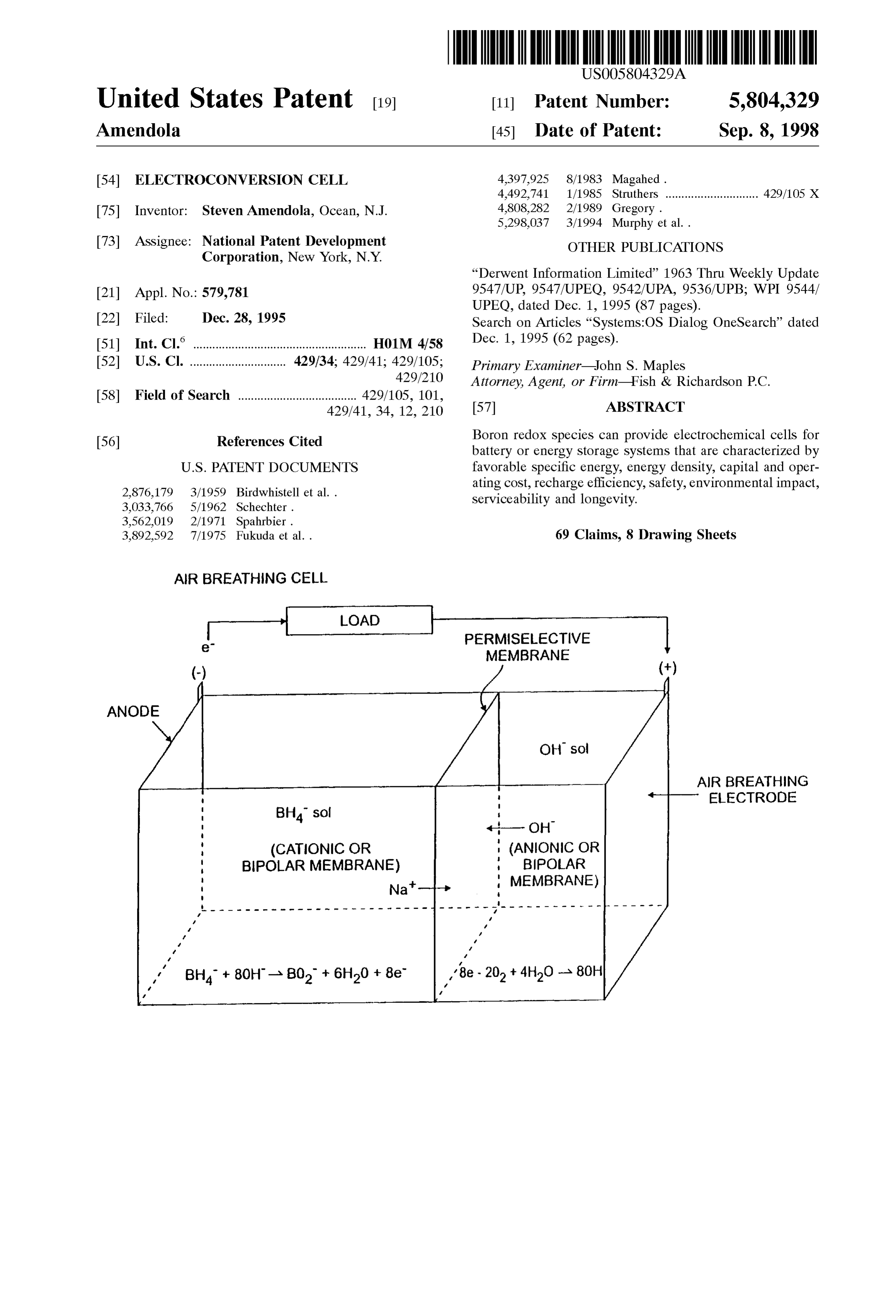
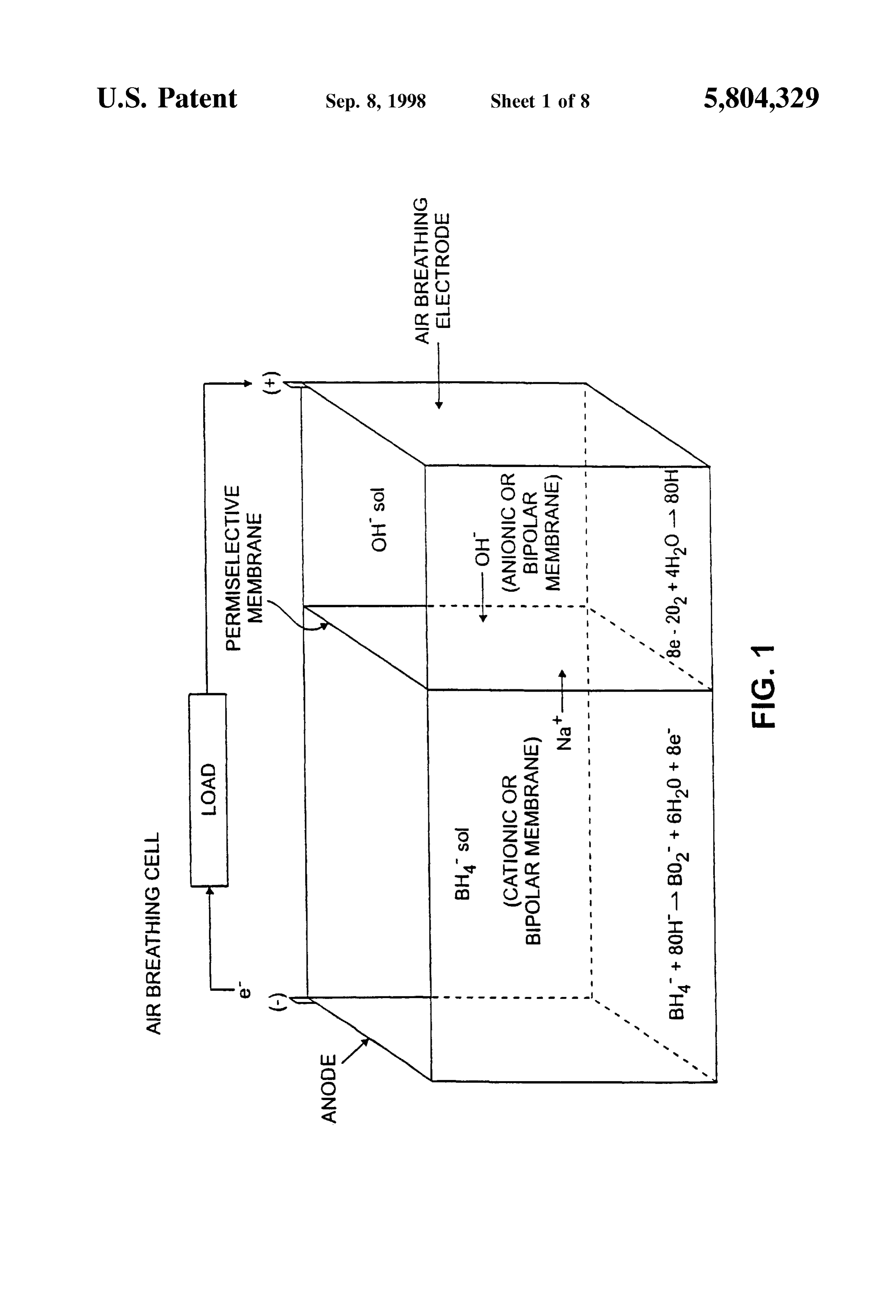
Scavenger and on and on. While any number of these 45 BRIEF DESCRIPTION OF THE DRAWINGS electrode types are uSeable in the Electroconversion Cells to obtain a desired result, none is specifically required to utilize FIG. 1 is a diagrammatic representation of a battery having a borohydride-using anode and an air-breathing the electrochemistry as revealed in this invention. Therefore, cathode.
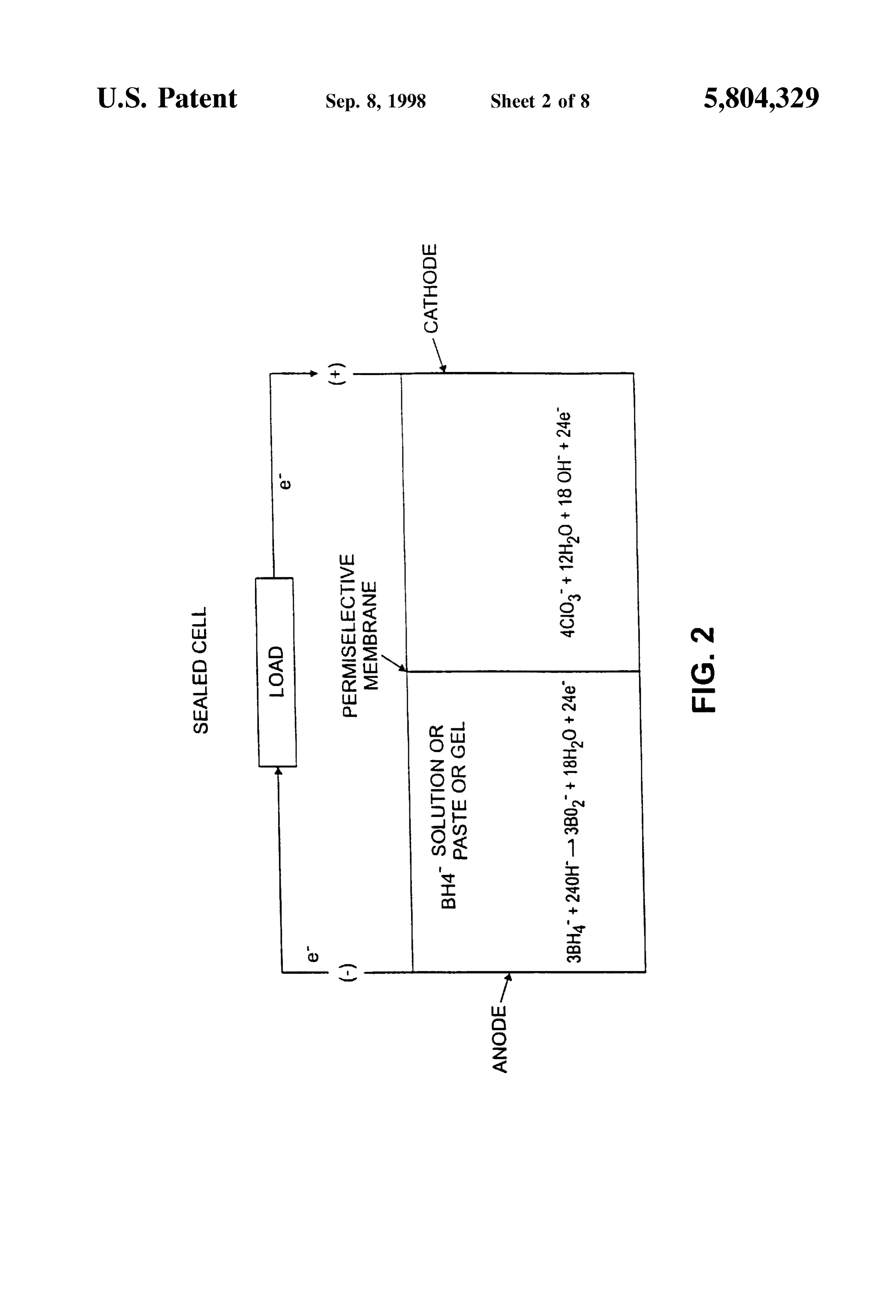
whenever electrodes are mentioned, any configuration of electrodes used in a real battery or cell that utilizes the 50 FIG. 2 is a diagrammatic representation of a battery chemistry as disclosed herein is considered as an embodi having a borohydride-using anode and a cathode Separated ment of this invention. by a permiselective membrane.
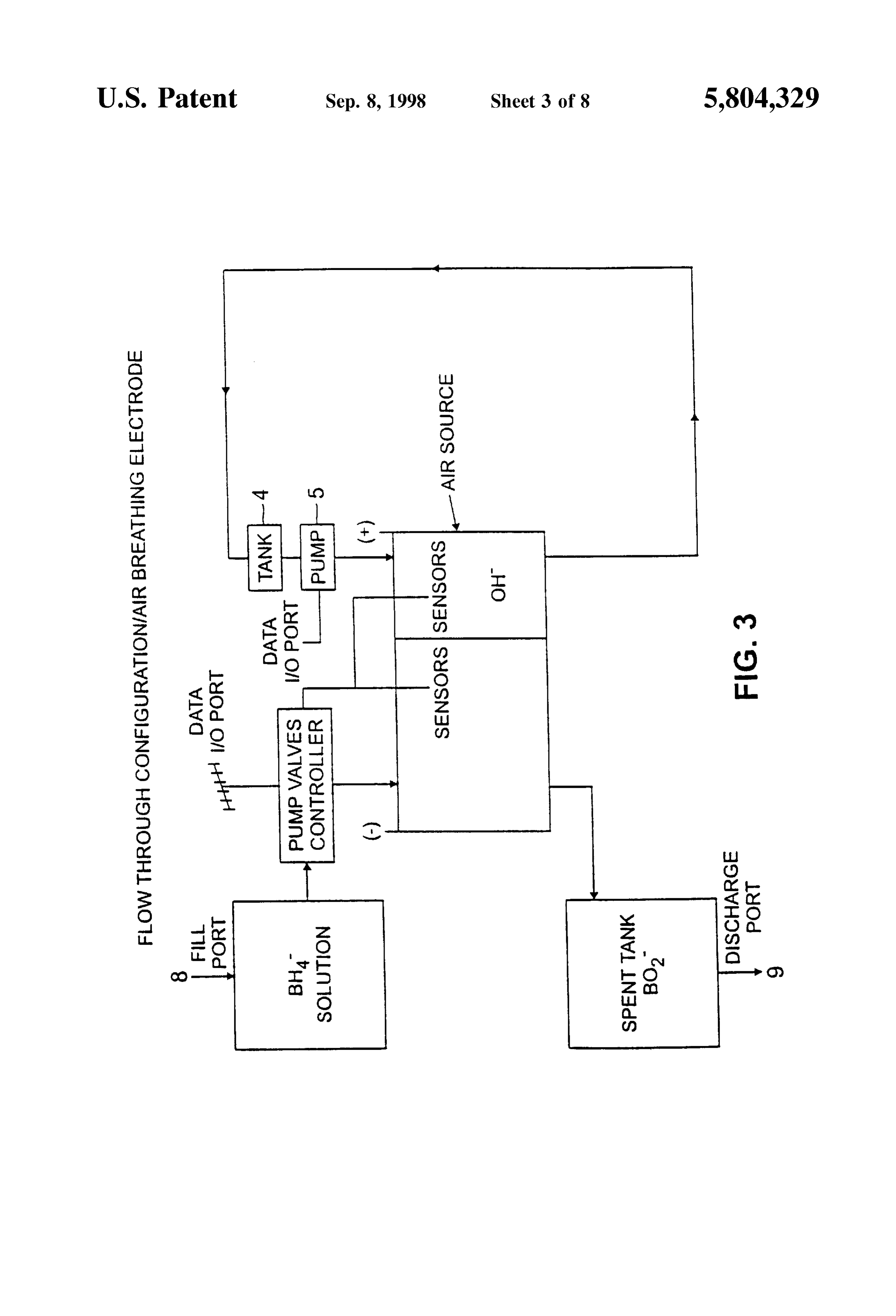
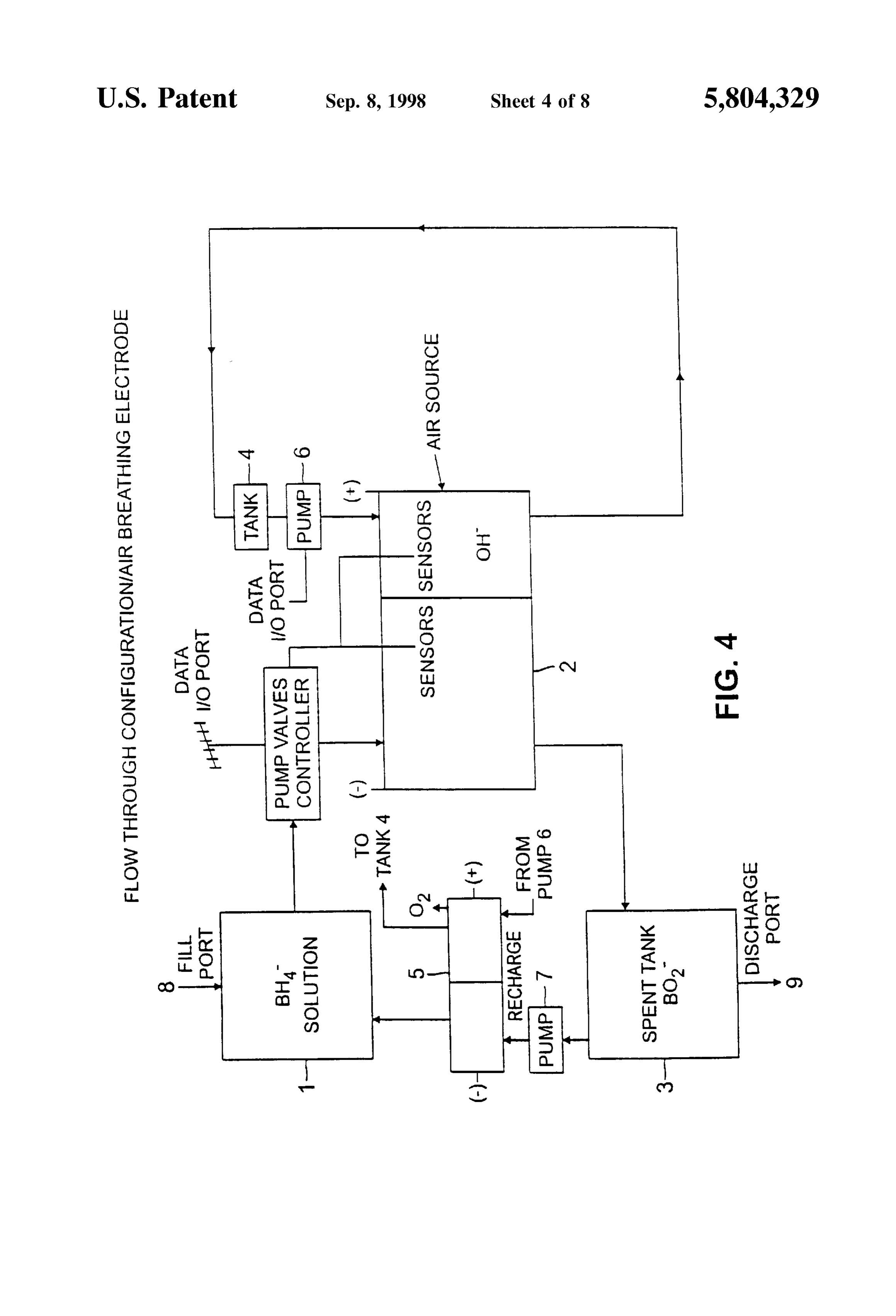
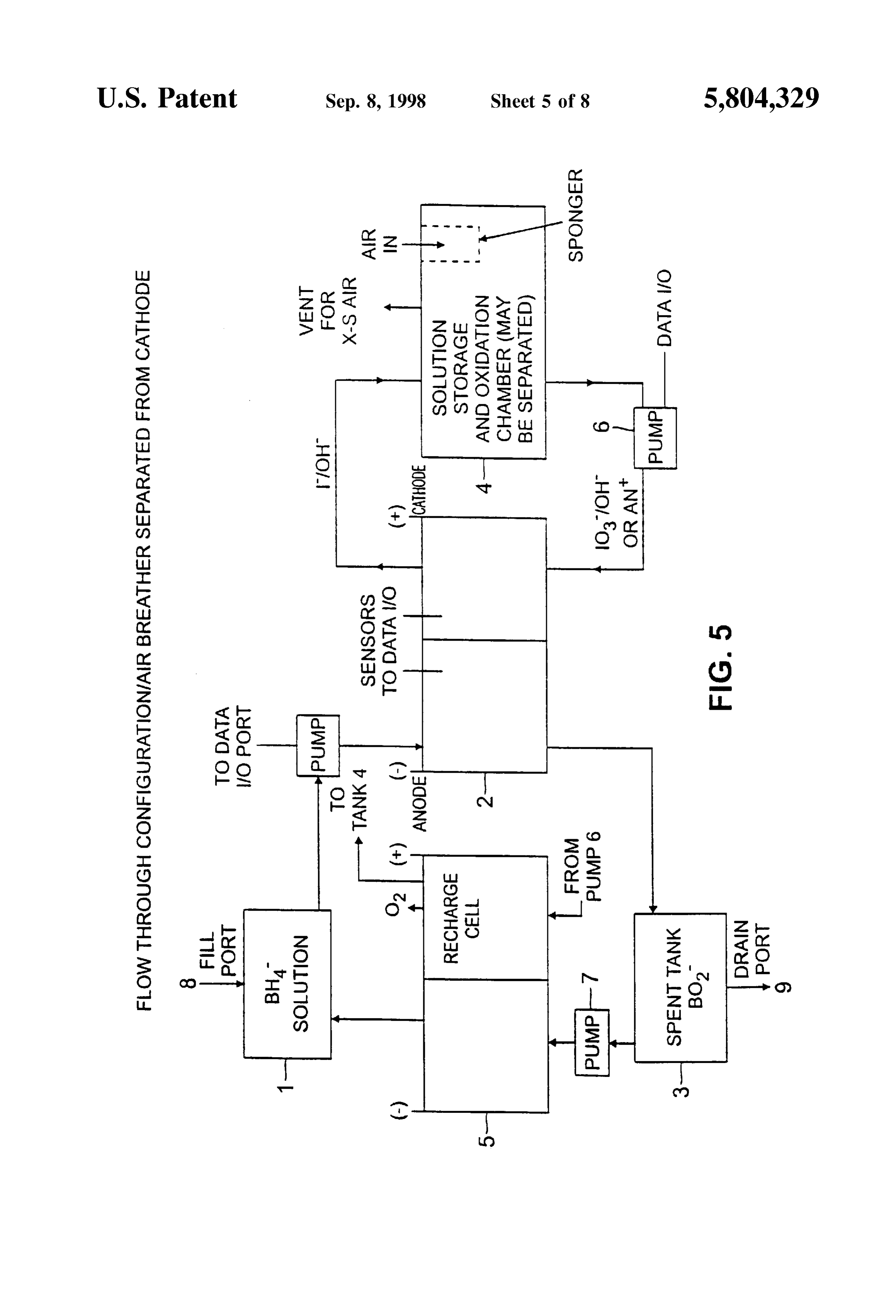
When a cell is operating to discharge and thereby produce FIGS. 3-5 are diagrammatic representations of a batteries electricity the electrode that interacts with the “fuel” that with flow-through reagents.
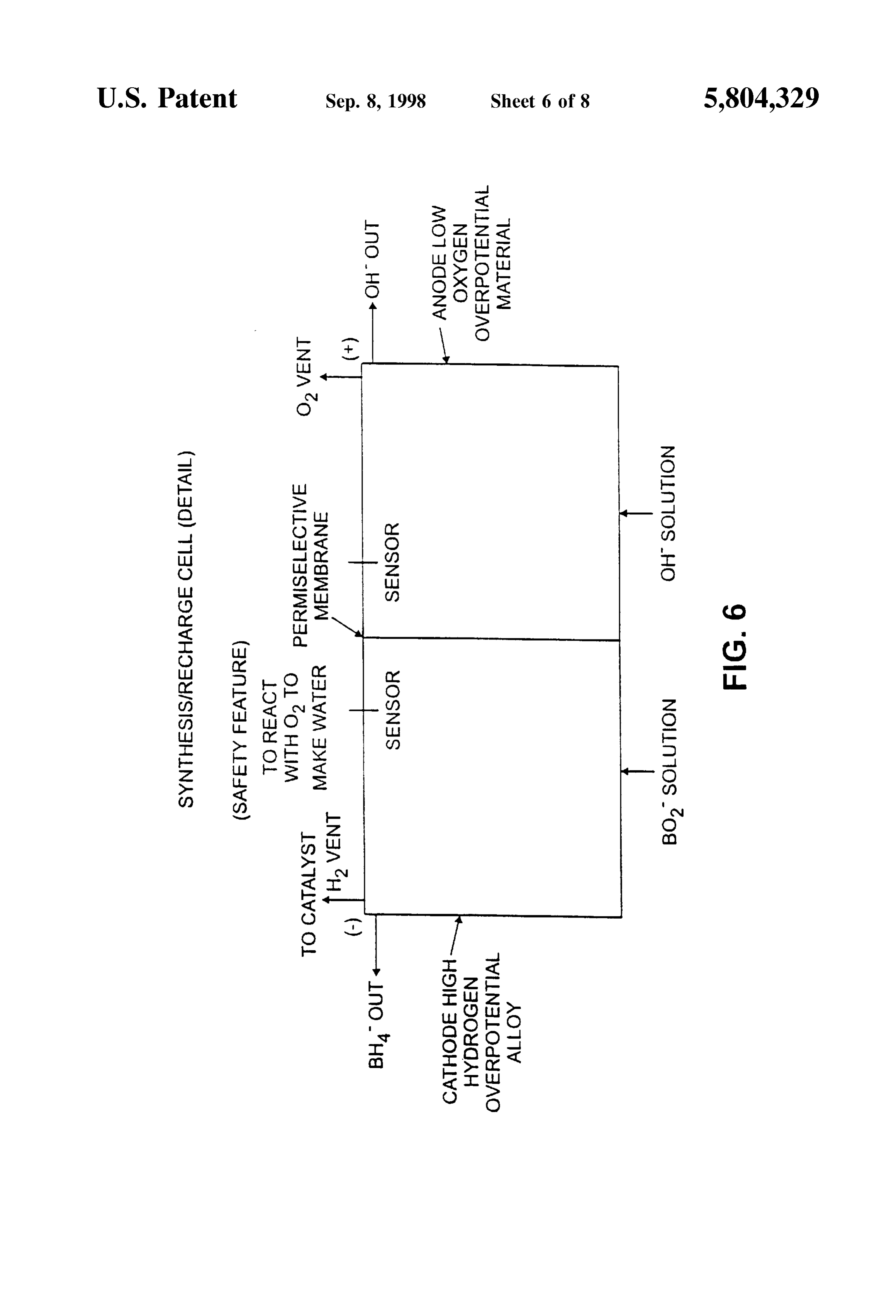
gets oxidized is called the anode. The liquid in this chamber 55 FIG. 6 is a diagrammatic representation of a cell used to is called the anolyte. The other half of cell has an electrode recharge a discharged borohydride cell or to generate boro called a cathode and the Solution in this chamber is called the hydride electrochemically.
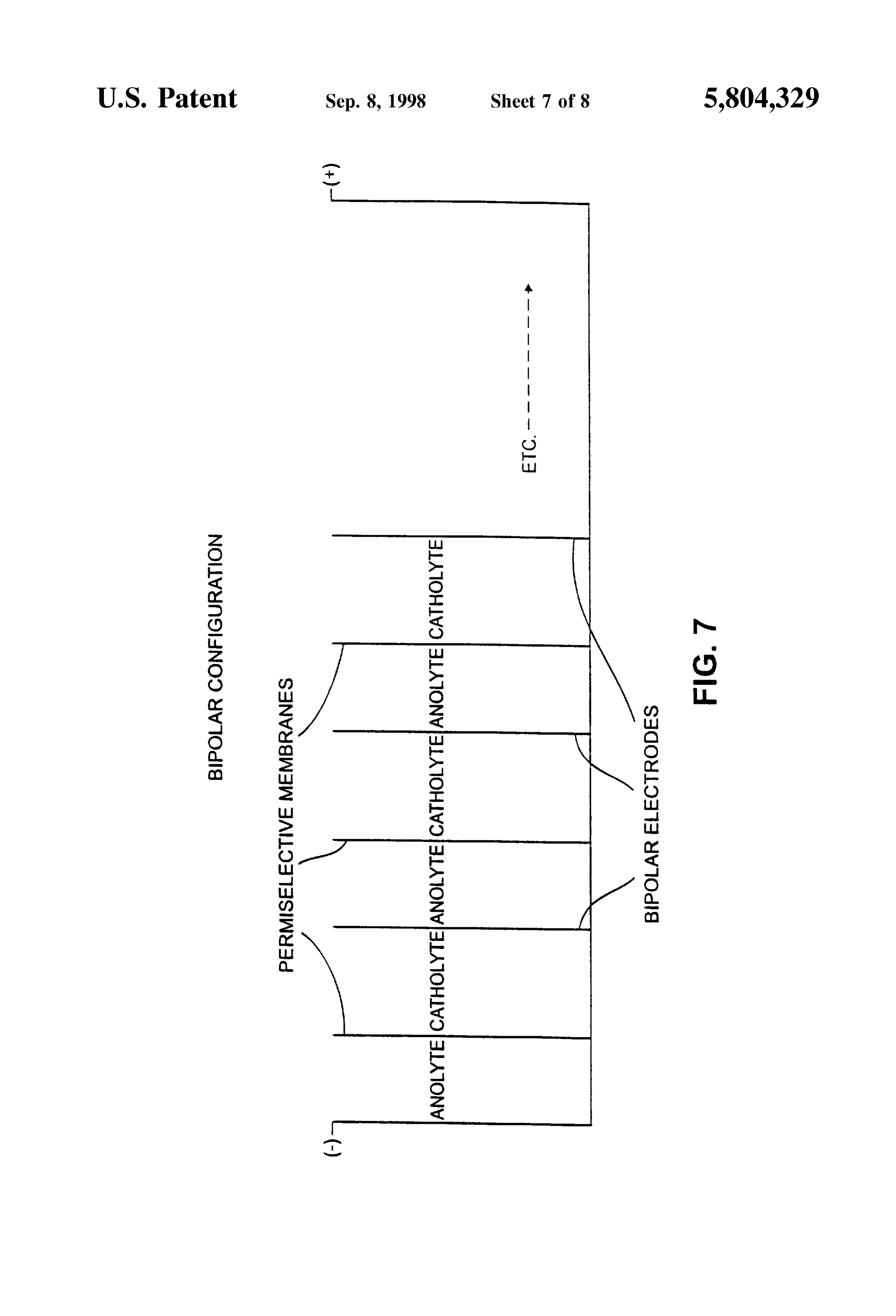
catholyte. In a cell with no barrier to maintain different FIG. 7 is a diagrammatic representation of a System of chemistries (Such as the common lead-acid battery) the bipolar electrodes.
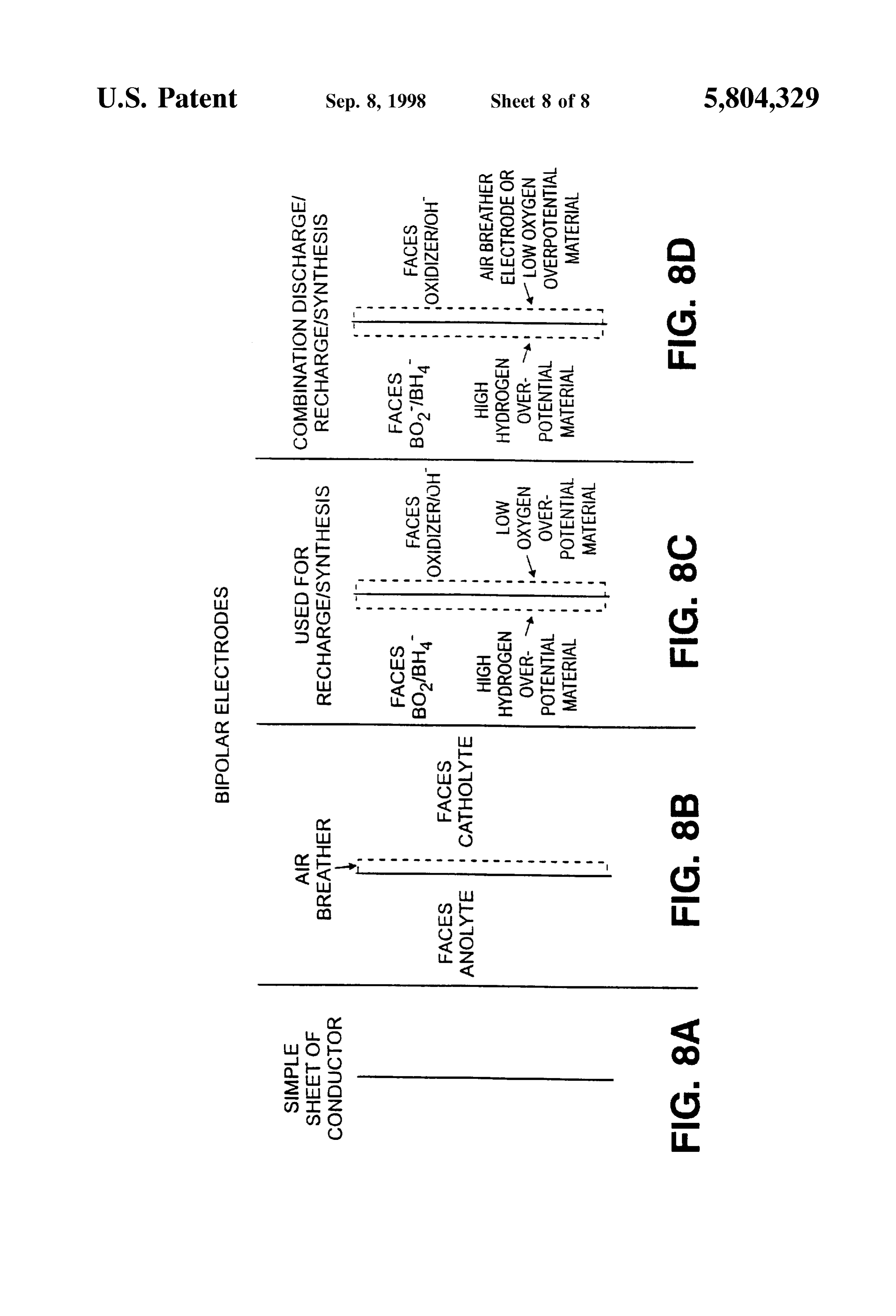
anolyte and catholyte are one in the same (in the lead-acid 60 FIGS 8A-8D are diagrammatic representations of various battery it is Sulfuric acid) and is often simply called the types of bipolar electrodes. electrochemical cells. electrolyte. In any event electrolyte as used herein will refer to any conducting liquid or Suspension in any function. DETAILED DESCRIPTION OF THE When a battery is being recharged, electricity is being put INVENTION into the cells. Under these conditions the components func 65 The key half reaction which defines the fuel side (anode tions reverse and the anode is now the cathode and Visa or negative) of the cell is based on borohydride ions. The WCS. reaction is
Page 13
energy to mechanical motion at 2.5 to 3 times the efficiency
Equation (1) above is written for an aqueous system but is of an internal combustion engine, then ranges and power of the same order available from conventional automobiles will not limited to such a system. One embodiment of the be available with an auto equipped with a borohydride based Electroconversion Cell would use an air breathing electrode cell as described herein.
to provide the other half-cell reaction required to make a At the energy densities available from borohydride complete cell. This reaction is Solutions, an electric utility theoretically could store one gigawatt-hour (10 watt-hours) of electricity in a 125,000 gallon tank. An electric car of normal weight using acces
The net reaction for equations (1) and (2) is found by adding Sories Such as air conditioning theoretically could travel over the two reactions to get 300 miles with a 30 or 35 gallon tank. These predictions BH +2 O->BO +2 H, O E=1.641V (3) compare favorably with conventional lead-acid cells based on the reaction:
Borohydride ion is stabilized by hydroxide ions. The
Solution can release hydrogen gas if catalyzed or acidified. 15
Therefore, in battery applications, gas releasing conditions which gives 4 V-F (it is a 2 electron reaction) for 642 grams are to be avoided. Release of hydrogen gas is undesirable of reactants (not counting the water required) or 6.23 V-F per because it can in Some circumstances lower the energy kilogram or only 167 wh/kg. Solely on the basis of the available and cause a variety of other undesirable charac theoretical chemistry, the borohydride System could provide teristics for the cell as described herein. Therefore materials considerably more energy than a lead-acid System. to be in contact with the sodium borohydride solution should AS yet another point of comparison, the current mid-term be chosen to avoid gas releasing reactions. Other factors to goal for development of an advanced battery established by be considered are pH and the presence of material that may the United States Advanced Battery Consortium (USABC) catalyze borohydride decomposition. The presence of is for an energy density between 100 wh/liter and 135 hydroxide ions (high pH) is desirable, and exogenous 25 wh/liter and a specific energy of between 80 and 100 wh/kg. hydroxide ions (such as sodium hydroxide) will typically be The long term goal of a battery uSeable in an electric Vehicle added in varying quantities as required for a stable System would be 200 wh/Kg.
and desired conductivities for any given application. Other One of the many advantages of using a liquid fuel (anode) materials may be added to enhance the conductivity or other and electrolyte is that Solid reactants that are usually in the attributes of the cell. form of plates may be eliminated. Since electrodes only need The Gibbs Free Energy referred to as “delta G” for to be electron collectors a relatively simple and robust equation (3) is 1,270 kJ/mole of reactants. Oxygen is derived design can be achieved. Higher Voltages can be achieved by from the air and the molecular weight of Sodium borohy connecting the necessary number of cells in Series, dride (any borohydride Salt Such as lithium or ammonium, alternatively, another method of achieving a Series connec etc. is useable as a Source of borohydride with appropriate 35 tion is to use what are known as bi-polar electrodes. In considerations for the nature of each material) is 37.83 certain embodiments of the Electroconversion Cell, bi-polar grams per mole. Therefore, the energy available from one electrodes can be simple sheets of the proper conductor. In pound of sodium borohydride is 15,200 kJ/pound or 33,500 other batteries where the electrode is also the fuel, a more kJ/Kg. Sodium borohydride is soluble in water to about 44% complex design typically results.
by weight and therefore a Saturated Solution of this Salt 40 Additionally, the electrode area can be designed to deliver would contain 14,700 kJ/Kg or since the density of this the necessary power for the given application. If additional Solution is 1.25 gm/ml the energy available from the Solution energy is required in a given application, the size of the would be 18,400 kJ/liter. To convert these heat energy terms Storage for the borohydride Source can be increased, rather into electrical terms one kilowatt-hour equals 3,600 kJ so than having to increase electrode area. In a rechargeable cell over 5.11 kwh per liter would be available at 100% effi 45 using a Solution of borohydride, an external Storage tank of ciency. (In the units used by the Advanced Battery Consor appropriate size may be used to give the desired total energy tium: 5,110 watt hours/liter). At higher temperatures greater Storage requirements. This feature is especially useful in solubilities of borohydride are possible and even higher electric utility load leveling, electric automobiles and emer energies would be available. In anhydrous ammonia the gency electrical applications Such as lighting or uninterrupt Solubility is higher and even higher Stored energies would be 50 able power supplies (UPS) as used in the computer industry available if required. just to name a few. In a cell where the borohydride is a paste AS a quicker calculational method the inventor uses the or gel or in general not fluidly mobile Such as cells for unit he coined “volt-faraday' hereinafter “V-F' which is applications Such as computers or toys or cell phones, etc., calculated by Simply multiplying the Voltage of the cell by the chamber size may be increased to hold more borohydride the number of the electrons in the reaction. This method 55 and thereby increased Stored energy. enables rapid Sorting through available energies of various All drawings are conceptual and not drawn to Scale and couples. One kilowatt-hour equals 37.31 V-F. By way of are for illustrative purposes only.
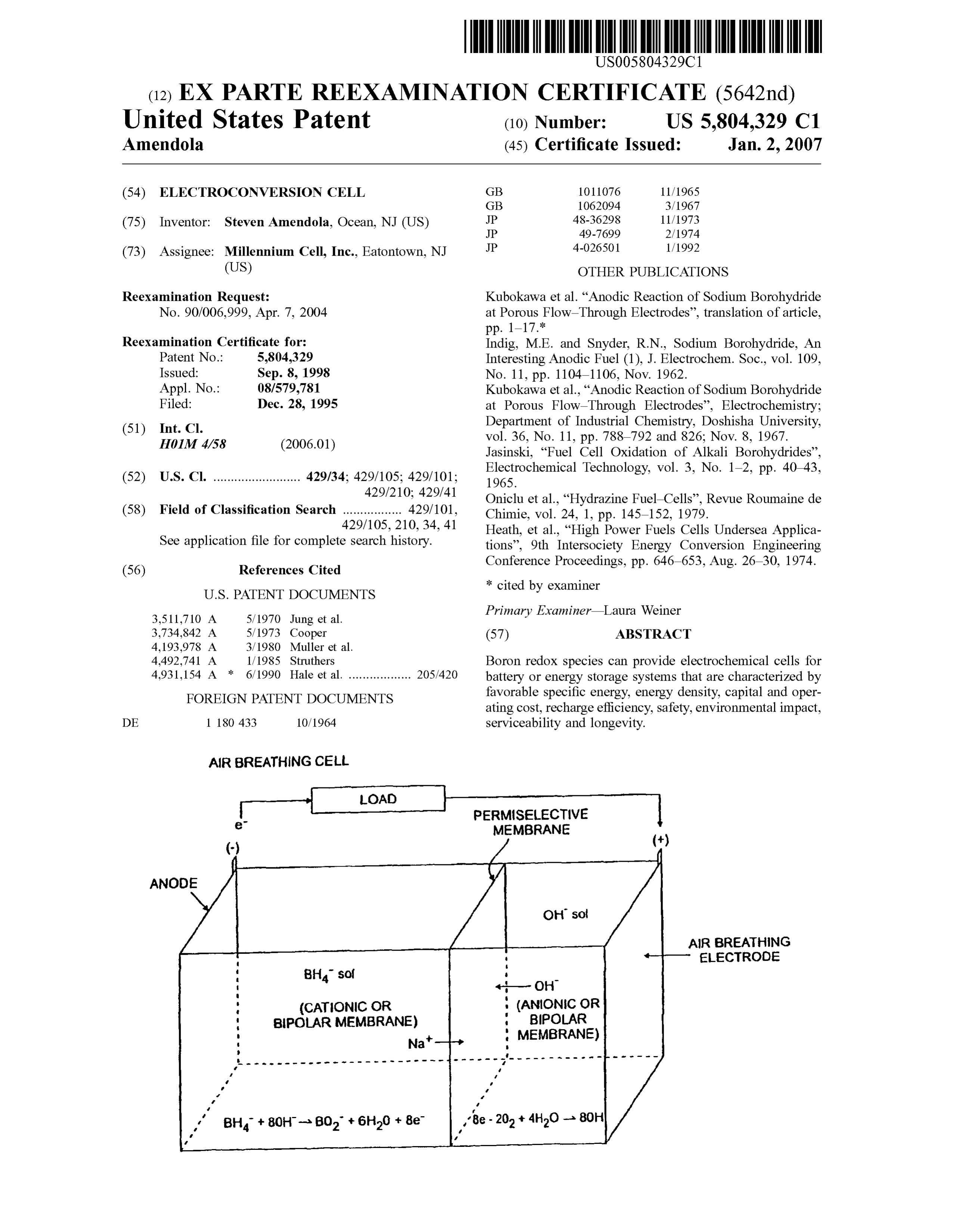
illustration the above System in equation (3) would give In FIG. 1, the basic cell is shown with no moving parts 1.641 Vx8 Fardays of electrons=13.128 V-F per mole of and an air breathing electrode. Known air breathing elec reactants. This equals 347.0 V-F/Kg or for a 44% solution of 60 trodes or electrodes developed in the future generally may density 1.25 equals 190.9 V-F/liter or 5.11 kWh/liter, the be used, if they are chemically compatible with the chosen Same as calculated above. electrolyte System. AS can be seen the two half reactions AS an energy comparison, the theoretical energy available Simultaneously occur in the respective chambers Separated in a liter of gasoline is about 33,000 kJ. So a liter of this by a permiselective ion eXchange membrane. Several com borohydride solution has about 56% of the theoretical 65 mercially available membranes which allow only certain energy available in a gallon of gasoline. ASSuming that an ions to pass through are placed between the anode and electrochemical cell and an electric motor can convert cathode compartments. In the air breathing configuration an
Page 14
ion Selective membrane is required to prevent the Self discharge of the cell, as will occur with many air breathing FIG. 3 shows the flow through configuration of the type electrodes, which tend to have high Surface area and borohydride System with an air breathing electrode. catalysts to promote the reactions at Sufficiently high rates to Additional oxidizing agents which would be Suitable for provide reasonable currents. Several commercially available a primary cell type configuration, whether flow-through or membranes would be suitable for use in the Electroconver not, would include but are not limited to the following Sion Cell. ESSentially the membrane can either be cationic, compounds or their Solutions: oxyhalides, Such as Salts of allowing only the transport of the cations (Sodium, Na' in chlorates, perchlorate, bromates, iodates, hypochlorates, etc. this case. Or they may be anionic allowing the transport of Typical compounds would be Salts. Such as lithium perchlo hydroxide ion but not borohydride. Bipolar membranes may rate or Sodium hypochlorite Solution. Although ammonium also be used in any design that may require its use. Transport perchlorate exhibits low solubility in water it is quite soluble of borate ion (the product of discharge) would be acceptable in anhydrous ammonia.
in a non-rechargeable System or a rechargeable System that Transition metal ions in higher oxidation States Perman was able to recover borate from both fluid reservoirs. The ganates and manganates. Mn(VI), Mn(VII) or Mn(IV) (such cell will operate with either type of membrane and the 15 as manganese dioxide), ferrates (Fe(VI) or Fe (III)), or Specific application will determine the Suitable membranes Chromates (Cr(VI)), nickel oxides (Ni(III)), tin (Sn(IV)), for that particular application. Certain applications may even Silver oxides, etc. may be used. Care must be exercised to dispense with the membrane if the borohydride is essentially insure that the material chosen does not catalyze the decom not dissolved but Suspended in a medium that prevents the position of borohydride as in equation (15), or to insure that transport of the borohydride to the air breathing cathode. In direct contact between the material and borohydride is not this embodiment if the borohydride “paste” or “gel' is made permitted if catalytic action is possible. Typical compounds by Suspension of the powder in a material that affords low include Sodium permanganate, Sodium ferrate, potassium Solubility of borohydride. A conductive compound may also ferricyanide, Sodium chromate, Sodium Stannate, etc. be added to enhance the over all conductivity. These cells Halogens or interhalogen compounds. These materials, may be manufactured to form batteries of almost any size 25 when dissolved in aqueous base, form oxyhalide Salts. and capacity for a given application. They can be recharge Nitrates and nitrites Salts. Such as ammonium nitrate or able if the proper electrodes are used as Specified later in this Sodium nitrite. These compounds are very Soluble in water disclosure. and exceptionally Soluble in anhydrous ammonia. In FIG. 2 the same type of cell as FIG. 1 is depicted but Organonitro compounds: Nitrobenzoic or dinitro or trini instead of the air breathing electrode the oxidizing agent is trobenzoic acids exhibit good solubility in hydroxide stored in the cell. This configuration lowers the theoretical Solutions, and they will form the corresponding amine and Specific energy considerably but still gives Suitable specific alcohol (i.e., nitrobenzoic acid will form aminophenol) energies. The embodiment in FIG. 2 may be used where a Peroxydisulfates. Peroxydisulfates, Such as ammonium or Sealed cell is required or there is no air available. Most Sodium peroxydisulfate, may be used. Since this anion does primary cells made today, which include C or 'D' or AA 35 not transfer oxygen but only accepts electrons, the oxygen to or 'AAA or hearing aid type button batteries (among many form borates will come from hydroxide which must also be others), fall into this category. Properly designed, these cells made available for the reaction. Due to the instability of can also be made to be rechargeable. The Electroconversion peroxides to basic Solution it is recommended for unusual Cell may operate as a normal primary battery or as a primary applications.
battery with borohydride flowing through the anode and an 40 The Voltage for cells using a material from the above list, oxidizing Solution flowing through the cathode. or other materials, can vary widely. When using compounds In general the oxidizer used in the cathode compartment Such as ferrates or peroxydisulfates or oxyhalides the total will contain oxygen in a form that can react with borohy cell Voltage can exceed 3 volts. Such Systems help to dride according to equation (1) to produce borates and maintain high energy densities. Several Such Systems would electricity. The net Voltage will depending on which oxidizer 45 also be Suitable for Secondary cells, where the reduced is chosen. Species can be reoxidized electrolytically. Generally, the AS an example in an aqueous System a highly Soluble Oxyhalides, transition metal ions, peroxydisulfates and Some Source of oxygen would be Sodium chlorate or perchlorate. organonitrates can be reoxidized in Such a Secondary cell. Under the predominantly basic conditions of the cell the half In FIG. 3, Solution in tank 1 is pumped through cell 2 and reaction would be (for chlorate) 50 discharged into tank 3 while drawing electricity out of cell 2. The pumping rate may be varied to handle varying demands on the cell, thereby providing a wide range of
With 4 units of equation (5) added to 3 units of equation (1) power levels for a given electrode area in the cell. Tank 4 and the following net equation is obtained pump 5 are provided on the cathode Side of the battery, and 55 they match flows to maintain Sufficient ion concentration 3 BH +4 CIO >3 BO +4 Cl--6 HO E=1.86V (6) near the electrode to maintain power output. Optionally, The energy available is 1.86x24 Faradays=44.64 V-F per flow rates may be controlled by a computer (chip). Data three moles of borohydride and four moles of chlorate. from sensors via I/O devices which monitor conditions Such Assuming sodium salts, the total weight of this is 539.25 as ORP or conductivity or other parameters can be the input grams. This equals 82.78 V-F/Kg which equals 2.22 kWh/ 60 that determines net flow.
Kg. At roughly 40% concentration and density 1.25 the In this configuration, as well as many others, the flexibil energy density would be nearer to 1.1 kWh/liter, Still gen ity that is offered becomes apparent. What is created here has erally useful for current Sealed batteries. both the properties of a rechargeable battery and a fuel cell. It is not essential that the oxidizer provide oxygen. Other This is very important for applications Such as utility load chemistries are Suitable. In basic aqueous Systems borates 65 leveling or electric Vehicles which may need to make long will Still dominate the products. So even if a halogen Such trips without long recharges. But the option of recharging as chlorine is used as an oxidizer the net reaction is whenever that is desired is not sacrificed. In a typical fuel
Page 15
cell where the products are usually water and (sometimes It should be noted that the electrochemical synthesis of depending on the fuel) carbon dioxide or nitrogen. In a fuel borohydride from borate solution is a novel synthetic cell these are essentially considered electrochemical prod method for the production of borohydride. Therefore any ucts of combustion and the products have no value for references to recharging the cell also apply to the embodi regenerating the original reactants. In the Electroconversion ment where a cell is operated for the purpose of manufac Cell the discharge product is useful for recovering the turing borohydrides. For efficiency, Such regeneration pref borohydride. Although water can be reconverted back to erably uses an electrode with high hydrogen overpotential. hydrogen and oxygen for a fuel cell and borohydride rep resents a method of Storing hydrogen gas (as discussed later A 4
System with relaxed design requirements is shown in FIG.
and 5, where recharging cell (5) is a separate cell from the in this disclosure) the actual reaction taking place is that in charging equation (1). If the borohydride were catalyzed to release its equivalentcell. to a
It should be noted that this recharging cell is cell for manufacturing borohydrides. There hydrogen gas then a cell which has an anode that could fore any embodiments which refer to the recharging cell are catalyze the oxidation of hydrogen to water would be also referring to an electrosynthesis cell. in this way the required. The theoretical reaction Voltage would only be 1.23 V and the theoretical energy density would drop to charging and discharging electrodes to be optimized for their about 3.8 kwh/l. The borate product would still have to be 15 respective functions. In other respects, FIG. 4 is the same recharged in a separate cell at the higher Voltage and the net System as FIG. 3, with a separate cell for the recharging. cycle efficiency of the System of recovering uSeable elec FIG. 5 shows a cell in which a secondary electrolyte is tricity would decrease by at least 43%. (1.23 V/1.65 V-75% circulated past an air Sparger. The use of the Secondary and since 75% is the maximum efficiency of both the charge electrolyte avoids the use of an air breathing electrode which and discharge 75%x75%-57%: 100%-57%=43%). must act as both electrode and air disperser. The air is Therefore, it is understood that the Electroconversion Cell is Sparged into the electrolyte and oxidizes a species that is not simply a fuel cell or variant thereon but a truly new then Sent to the cathode where the Species is reduced. The approach in electrochemical technology. reduced Species is then returned to the Sparging chamber to If a cationic membrane is used the necessary hydroxide be oxidized again, completing the cycle. Any electrochemi ion for the anolyte can be added in the form of hydroxide. 25 cal couple that can be oxidized by air and then react in the This technique lowers the Overall Specific energy. However cathode chamber to provide the oxidizing Source for the Some hydroxide should be available to help the kinetics of borohydride may be used in this application. In this mode, the two half reactions even though there is no net consump to maximize the Voltage of the cell, a couple should be tion. An anionic or bipolar membrane will allow the hydrox chosen with a potential as close to oxygen as possible. ide produced in equation (2) to cross over and be available An example of the reaction Sequence for the Sparging for reaction (1). As the cell is discharged the mass of the configuration in FIG. 5 is as follows. electrolytes increases due to oxygen intake. This mass is mostly transferred from the cathode to the anode compart ment. It may also be physically delivered by pump or over Since equation (8) has a lower potential than equation (2), flow from the cathode compartment to the anode compart 35 (the oxidation potential of oxygen in basic Solution) the net ment. If a cationic or bipolar membrane is used the Sodium reaction below will proceed in the chamber where the air is ions transport from the anode compartment to the cathode admitted.
compartment to maintain charge balance during discharge.
For this reason the tanks for holding the spent Solutions 2 I+3 O-2 IO, E=0.15V (9) should be larger than the Storage tanks for the fresh Solutions 40 to accommodate the extra mass. During recharge the reac This reaction may be aided by catalysts placed on the tions are reversed. A separate recharge cell is envisioned as Sparger and/or in the Solution chamber itself. The catalysts an option. This will allow optimizing the electrodes for the may be homogeneous or heterogenous as desired to maxi different chemical function that they perform during dis mize the efficiency of the system. The ability of air to charge and recharge. Additionally, conditions can be main 45 oxidize a given Species is determined by pH, and concen tained So that the proper mass transfer occurs during trations as well as catalysts, temperature and pressure. recharge So there is no net migration of hydroxide or water Therefore, under proper conditions certain couples may be over many cycles. However due to the open and flexible oxidizable even though the Standard potentials indicate that nature of the System a fresh fill up or a simple addition of the may not be possible. Electrochemical calculations and dia desired components would Solve any imbalances that may 50 grams Such as Pourbaix or predominance area diagrams occasionally occur. should be consulted. It should be noted that often peroxide In the configuration in FIG. 3, although the cell can be ion is an intermediate in Such reactions and this limits the recharged by using electricity, the cell may also be recharged actual oxidizing ability of air. However, in other Solvents by draining tank 2 through port 9 and refilling tank 1 through Such as ammonia, peroxide formation is more common and port 8 with fresh borohydride solution. For an electric 55 completely different couples become available for use. automobile this is equivalent to a “fill-up' on the road. So Fewer materials are Suitable for this function than for use with this feature, rather than being limited by a power rate in the primary cell, Since the material has to be regenerated of recharge dictated by the available power, the liquids can by oxygen. The Fe(III)/Fe(II) couple (complexed for solu be exchanged. The spent liquid could then be recharged in bility in basic medium or a pumpable slurry) and other a external cell to regenerate the borohydride electrically. 60 transition metals, chromate/Cr(III), Mn(II)/Mn(III), Sn(IV) This solution could then be sold to other motorists. The /Sn(II), Co(II)/Co(III) catalyzed by activated charcoal in the Station essentially charging for electricity plus a profit and Sparging chamber can be used. Also, chlorate/chlorite etc. not for borohydride perse. A Smaller regenerating unit could can be used.
also be set up at the home of a vehicle owner where just one The Solution generated in equation (9) may then be or two extra charges of borohydride could be made available 65 circulated into the cathode chamber and the net reaction (for anytime that the owner did not have time to wait for a regular the iodate/iodide couple) will occur in the Electroconversion recharge. Cell.
Page 16
3 BH +4 IO 3 BO +4 I+6 HO E=1.5OV (10) BO +2 HO->BH +2 O, E=-1.65V (11) Since the Solution is constantly being recirculated, only a The negative Voltage indicates that electricity must be put in Small amount of fluid just enough to provide for maximum to drive the reaction in the direction shown. Certain impor flow rates-need be in the tank 4. The net reaction is still that in reaction (3) except that the reaction voltage is 1.50 V tant conditions are required to allow this reaction to proceed instead of 1.65 V. Using this particular intermediary results efficiently. At Such negative a Voltages it is easier to disso in an approximate 9% loSS in available energy due to ciate water into hydrogen and oxygen. Fortunately, the reduction in Voltage being delivered. This energy is of oxygen is a desired product. Releasing gases from physical course generated as heat in reaction (9) and is the lost 0.15 electrodes is a proceSS which is extremely dependent on both volts. 1O the composition and the physical characteristics of the This embodiment is useful in situations where a high electrode. The release of oxygen from a basic Solution of Specific energy air breathing design is desired but also a very water is the reverse of equation (2) high peak power System is also desired. In the air breathing configurations in FIGS. 3 and 4 the peak power is limited by the Surface area of the air breathing electrode, (among other 15 In reviewing the above discussion of theoretical Voltages, things). Since there may be design and cost constraints on using a direct air breathing electrode, this embodiment it should be kept in mind that the actual Voltage required to allows a design for very high air input rates (it may even be release the free gas is higher than theoretical. The difference compressed) to allow for high power. Another advantage to between the theoretical Voltage and the actual Voltage this configuration is a Substantially reduced response time. required is referred to as the overpotential (or overvoltage). Since both the anolyte and catholyte may be stored in their In the case of an oxygen-releasing electrode this potential is respective tanks when a high power demand is quickly referred to as the oxygen overpotential. Likewise with the required (e.g., the depressing of an accelerator pedal in an hydrogen electrode it is called the hydrogen overpotential. electric car) both liquid flow rates can be quickly increased The overpotential is dependent on both the gases evolved into the cell. This embodiment is also useful when a bipolar and the electrode material. Further, high current densities cell and a net air consuming System is desired together. This 25 and lower temperatures favor higher overpotentials. embodiment would eliminate the need to distribute air to all A low oxygen overpotential electrode is desired to maxi the cathodes in the bi-polar cell. mize the efficiency of reaction (12). Materials with low Another embodiment of the Electroconversion Cell would oxygen overpotentials are gold, iridium oxide, manganese be to have a main cell system as in FIG.3 or 4 that as a direct dioxide among others that are well known in the industry. air breathing electrode to provide the bulk of the energy at These electrodes may be made of base metal materials. Such the highest efficiencies and also have another System as in as StainleSS Steel and coated with the desired material. FIG. 5 that uses the Sparging chamber to oxidize another Producing the borohydride requires the reverse of reaction compound to provide the necessary peak power as required. 1 which is
In this embodiment the Sparging unit (4) as shown in FIG.
5 could (but doesn’t necessarily have to) be smaller than the 35 air electrode unit. The designer then can avoid building a At Such a negative Voltage, the release of hydrogen from very large Surface area air breathing electrode to do the water is more favorable as follows entire job on its own. The result is an overall Smaller System with equivalent performance (specific energy verses specific 2 HO+2 e H+2 OH- E/2=0.8277 (14) power). The borohydride solution to feed the two cells may 40 be drawn out of the same tank or different tanks as desired If reaction (14) proceeds instead of Reaction (13) the cell in this embodiment. will not recharge and energy is being wasted. Therefore in In these embodiments, a Second Set of electrodes for order to insure that reaction (13) proceeds, an electrode with recharging may be used to recharge the fluid. Of course the a high hydrogen overpotential is required for the recharge option to drain tank 2 and fill tank 1 is still part of this 45 side of the cell. An overpotential of at least the difference in embodiment. voltages between reactions (13) and (14), 0.4123 V, will be An additional flexibility offered by this system is that, in required and higher overpotentials are desirable So as to any flow cell with varying power outputs and flow rates, minimize reaction (14) as much as possible. Soft metals normally all of the borohydride in the solution is not have a tendency to have high hydrogen overpotentials. completely converted as it passes through the cell. Conse 50 Mercury for example has been used for many decades to quently even though tank 1 may be nearly empty, as an recover sodium metal (E'=-2.7V) from aqueous solutions emergency reserve, the used liquid in tank 2 could be to produce Sodium hydroxide. Mercury of course is a liquid pumped up to tank 1 (through the recharge cell if it is there and would also have environmental considerations. or just a pipe) to provide an emergency reserve. Since the However, mercury liquid or a coating on the Surface of borohydride concentration would be low, degraded perfor 55 another metal would work to allow reaction (14) to proceed mance would be expected but a motorist may still be able to at high efficiency and is considered an embodiment of the get to that recharge Station. Electroconversion Cell. Other Soft metals which are solid are An additional advantage of these configurations is that also within the scope of the Electroconversion Cell. These determining the remaining energy is simply a function of would include but are not limited to Bismuth, lead, tin, how much fresh Solution remains in tank 1. Accurate mea 60 thallium, cadmium, gallium and indium. Various alloys of Surements of the energy left in multiple batteries is more these metals exhibit very high overpotentials. Tellurium difficult. poisons the ability of an electrode to form hydrogen gas and FIG. 6 shows the recharging cell. Although this cell may can be incorporated as the free element or as a telluride of actually be the same cell as cell 2 the flexibility allowed with the other metals listed above. The innumerable combination this System permits the two cells to be separate. During 65 of alloys available allows designers to chose the material recharge equation (3) will be reversed to produce borohy based on hydrogen overpotential, corrosion resistance to the dride and oxygen gas as follows: different environments, cost and mechanical qualities just to
Page 17
mention Some of the parameters. AS can be readily Seen the will release about 116.3 grams of hydrogen. This is more optimal recharging cell would have a high Surface area (and hydrogen than available from other Sources of hydrogen. therefore low current density) anode coated with gold or Even cryogenic liquid hydrogen only has a density of 70 iridium oxide. The cathode would have a smaller (higher grams per liter. Hydrogen pressurized to 6000 psi has a current density) electrode coated with a Soft metal alloy. density of only 36 grams per liter. Hydrogen Stored in alloys While it is possible to design a single cell that can efficiently Such as rare-earth-nickel alloys Store about 1% hydrogen by charge and discharge, the Electroconversion Cell frees the weight. This times the density of the alloy gives densities designer to make use of yet another option (that of choosing Slightly higher than liquid hydrogen but less than borohy between two cells or one) to produce an elegant Solution for dride Solution. In any event the alloys are very expensive and not as easily handled as a liquid. The borohydride a given application.
It should be noted that by necessity any rechargeable Solution preSSure is also easier and Safer to handle than liquid or high hydrogen battery represents an electrochemical Synthesis of the reac An even higher density is available if the borohydride is tants. Borohydride Salts are useful chemical agents and are widely used in the chemical industry as reducing agents. The handled as the Solid or as a pumpable Slush or a higher cost of production by current methods is high Since boro 15 temperature solution at about 80 to 90% by weight. Thereby hydride is made by reaction sodium hydride with either doubling the amount of hydrogen available to over 200 boron trifluoride or boric esters of organic alcohols. Large grams per liter. This is 2240 liters of hydrogen from one liter quantities of by-products are produced which must be sepa of material delivered. (Some water would need to be added rated from the borohydride. In contrast the production of at the site). This is over 79 scf of hydrogen gas from one liter borohydride from cheap borates and even borax and elec of material. To Store hydrogen gas at this density a System tricity represents a Significant improvement in production operating at almost 33,000 psi would be required. (That costs and could even spur a “borohydride economy' where preSSure is typical of the pressure developed inside a rifle an infrastructure arises to distribute energy for electric barrel as it is fired) utilities for example, or hydrogen to a refinery for example The spent liquid is a Solution of borate which can be sent (borohydride releases hydrogen gas under a variety of 25 back to the regenerating facility and converted back to conditions) or borohydride Solution for vehicles as an easily borohydride by adjusting the pH if necessary, and electro pumpable and storable solution of borohydride. lyzing in a cell to Synthesize borohydride, essentially pro The electrodes made out of these alloys and the reaction (13) represent novel materials for use in the electrochemical Viding a closed loop with electricity and water as the synthesis of borohydrides. reactants and hydrogen and oxygen as the products. The These electrodes may also be used in any reduction where energy required to do this is still favorable as opposed to a high hydrogen overVoltage is required. Materials. Such as transporting the electricity a great distance due to line losses. titanium, Vanadium, other transition metals as well as the It is also competitive with converting the borohydride to rare earth metals may be recovered from aqueous Solutions electricity first and using this electricity to generate hydro using these electrodes as cathodes in an electrochemical 35 gen Since available electrolysis cells only operate at about 70 plating type of operation. Methods for producing these to 75% efficiency. Therefore if the goal of the transport is to materials generally rely on the reduction of anhydrous actually end up with hydrogen gas as a feedstock then the chlorides with an active metal Such as magnesium or direct catalytic reaction in equation (15) is reasonable. If the Sodium. Vanadium is reduced from its oxides and aluminum in a thermite type of reaction. All these methods are expen 40 goal of transport is to transport electricity as a final product Sive and have problems of recovering the metal from a fused then direct conversion of the borohydride in an Electrocon Salt matrix. These electrodes may also be used in any version according to equation (1) would be more Suitable. electrochemical Synthesis where a high reduction potential is AS mentioned earlier Several applications may require desired. Organic compounds may be reduced electrically dealing in higher Voltages than the cell Voltage. When a with cheap water as a proton Source for example. 45 bipolar cell is desired it can be made using the chemistry of The synthesis of borohydride from borates is relatively this invention and is schematically shown in FIG. 7. The cell clean and efficient. The products are oxygen, and the boro can be used either in a capacity to generate electricity or as hydride. A small amount of hydroxide will be present but a device for synthesizing borohydrides. In FIG. 7 the bipolar this is beneficial as the basic conditions Stabilize the Solu tion. For energy and most other uses the hydroxide may 50 arrangement consists of a bipolar electrode, the anolyte, remain. If the recovery of the dried product is required it permiselective membrane, catholyte. The Sequence then may be separated from the borohydride by one of several repeats. Each Sequence represents a cell. (the two end existing methods. electrodes are not bipolar but regular with only one face in The cheap availability of borohydride allows the solutions contact with electrolyte.) The battery can be sealed and can to be pumped from one location to another where it may be 55 be rechargeable or not as desired. The battery can be flow converted back to electricity. The borohydride can also be a through, which would require a manifold to distribute the very Safe and cheap method of transporting hydrogen. AS an electrolyte to each chamber. If it is a direct air breather air example refineries today are often net users of hydrogen. would also need to be distributed to each cathode chamber Borohydride Solution could be transported (via pipeline, barge, rail or road, etc.) to a site requiring hydrogen. If the 60 as Note well.
that in all the electrodes shown and in contrast to
Solution is acidified or catalyzed by a transition metal catalyst Such as cobalt, hydrogen is released: many conventional electrodes, the electrode itself is not part of the electrochemistry, and the materials that the electrode
BO2 + 4H2 (15) are made of do not change in chemical composition. AS a 65 result, electrode life and ease of design are improved. Even
Reaction 15 releases large quantities of hydrogen. If a 44% though the materials of the electrode may enhance the w/w solution of borohydride is acidified one liter of Solution chemistry taking place, the electrode itself does not change.
Page 18
FIGS. 8A-8D show various type of bipolar electrodes that Other Embodiments would be useful in various applications. These electrodes are Other embodiments are within the following claims. by no means limiting of the many possibilities. FIG. 8 A What is claimed is:
shows a simple plate which acts only as an electron collec 1. An electrochemical Storage medium comprising a car tor. It may be used in a configuration as shown in FIG. 5 rier mixed with a borohydride compound, the borohydride where the air is Sparged into a separate chamber and this compound being oxidizable to an oxidized boron-containing liquid is delivered to each cathode chamber. The borohy compound concurrent with the generation of an electric dride Solution is manifolded into each anode chamber to current, the Storage medium being in electrical contact with operate the System. Of course a Sealed System as shown in an electrode for carrying current generated during that FIG. 2 could also be configured in a bipolar mode with the oxidation.
electrode shown in FIG. 8 A. 2. The storage medium of claim 1 in which the oxidized The electrode in FIG. 8 B shows one side of the electrode compound is a borate (BO).
as an air breather. These electrodes require high Surface area 3. The storage medium of claim 1 in which the carrier is are usually catalyzed and would also require Space for the 15 an aqueous Solution.
catholyte. 4. The storage medium of claim 1 in which the carrier is The electrode in FIG.8 C shows a bipolar electrode which a non-aqueous Solution.
is more optimized for the recharging cell or cell made for 5. The storage medium of claim 4 in which the carrier is manufacturingborohydrides. This electrode is coated with a a non-aqueous Solution comprising a liquid that dissolves high hydrogen overVoltage material on the Side of the cell the compound.
that faces the borate/borohydride solution. The other side of 6. The storage medium of claim 5 in which the carrier is the electrode has a low oxygen overpotential material coated Selected from the group consisting of anhydrous ammonia; on the Side facing the oxidizer Side of a cell. This electrode amines, non-amine organic bases, alcohols, alkene carbon would be Suitable for either the recharge cells as depicted in ates, and glycols.
FIG. 4 and 5 or as an electrode for the cell 2 in FIG. 5 or as 7. The storage medium of claim 5 in which the carrier is the electrode for manufacturing borohydrides. 25
The electrode in FIG. 8 D is a combination electrode for
Selected from the group consisting of:
use in the direct air breathing configurations. One Side can dimethylformamide; dimethylsulfoxide, tripropylamine; be coated with a high hydrogen overVoltage material and pyridine, quinoline; triethanolamine; monethanola faces the borate/borohydride solution. The other side has an mine; ethylene glycol, propylene glycol, methanol, air breathing electrode. This electrode could be used in a ethanol; ethylene carbonate, and propylene carbonate. bipolar configuration of cell 2 in FIG.3 and 4. It can also be 8. The storage medium of claim 5 in which the non used in the recharge cell 5 in FIG. 4 and 5. Since this aqueous Solution comprises a Solubilizer or a conductivity recharge cell (5) is also the Synthesis cell for manufacturing enhancer.
borohydrides this electrode would also be suitable for manu 9. The storage medium of claim 5 in which the non facturing borohydrides. 35 aqueous Solution comprises an agent Selected from the group Further versatility results because many borohydride salts consisting of EDTA, crown ethers, cryptates, and quaternary are significantly Soluble in other Solvents besides water. For ammonium Salts.
instance the solubility of sodium borohydride in dimethyl 10. The storage medium of claim 1 positioned to be the formamide at 20° C. is about 18% by weight. This increases anode of a battery.
at higher temperatures. If a cell needed to operate in an 40 11. A battery comprising an anode and a cathode in environment that was not suitable for water this solvent may electrical communication, be used instead. AS mentioned earlier Sodium borohydride is the anode comprising a carrier mixed with a borohydride very Soluble in anhydrous ammonia. This System would compound, the borohydride compound being oxidiz allow very low temperature operations as well as very
Specific energies. This System would also allow for instance 45 able to an oxidized boron-containing compound con the utilization of the extremely high solubility of materials current with the discharge of the battery. Such as ammonium nitrate as a high concentration oxidizer 12. The battery of claim 11 in which the oxidized com as the catholyte. pound is a borate (BO).
Complexing agents (Such as crown ethers) or other agents 13. The battery claim 11 in which the carrier is a solution. that increase the Solubility of a borohydride in any given 14. The battery of claim 11 in which the carrier is an Solvent may also be used and are considered as coming 50 aqueous mixture.
under the Scope of this invention. 15. The battery of claim 11 in which the carrier is a Although permiselective membranes allow transfer of non-aqueous mixture.
non-ionic materials acroSS the membrane by osmotic pres 16. The battery of claim 11 in which the cathode com Sure two different Solvent Systems may be incorporated in prises a catholyte which includes an oxidizing agent. the same cell. As an example a dimethylformamide/ 55 17. The battery of claim 16 in which the oxidizing agent borohydride solution could be the anolyte and a water is selected from: air, O, compounds comprising oxygen and Sodium hydroxide solution could be the catholyte. a halogen; and X2, where X is a halogen. In yet another embodiment the permiselective membrane 18. The battery of claim 17 in which the oxidizing agent could be eliminated and two liquids which are not soluble in is perchlorate (CIO), chlorate (CIO), chlorite (CIO), each other but can each dissolve the required electrolyte can 60 hypochlorite (OCl), chlorine (Cl), bromine (Br-), bromate form a cell. As an example Sodium borohydride dissolved in (BrO), or iodate (IO).
water would be the anolyte. A halogen Such as chlorine 19. The battery of claim 16 in which the oxidizing agent dissolved in a solvent Such as chloroform could be the is a) MnO; b) Fe0); c) CeOH(NO); d) Ce(NO) catholyte. A phase transfer catalyst (Such as a quaternary f; e) (Fe(CN): f) CrOf; g) SnOf; h) BiO; ammonium halide salt, RNX) for transport of chloride 65 i) MnO,j) AgO; k) AgO; 1) CeO2, m) PbO; n) NiO(OH); acroSS the barrier would be an option to provide conductiv o). NiO; p) CoO(OH); q) NO; r) NO;s)SOs); t) ity. compounds containing Cu(III), TI(III), Hg (II), Se (VI), or
Page 19
Te(VI); or u) R(NO), where R is an alkyl, aryl, or arylakyl monitor to determine a battery characteristic and to produce organic group and n=1-6. a signal to the controller in response to monitored values of 20. The battery of claim 16 in which the oxidizing agent the characteristic.
is trinitrobenzoic acid, heXanitrobenzene, or trinitrobenzene. 43. A battery as in claim 42 where the monitor comprises 21. A battery as in claim 11 in which the anode comprises at least one probe which generates an input Signal responsive an anolyte, the cathode comprises a catholyte, and the to a characteristic Selected from the group consisting of anolyte and catholyte are Separated by a permiselective ORP, conductivity, Voltage, current and power output, ion membrane. concentration, pH, index of refraction, colorimetric, COD, 22. A battery as in claim 21 in which the membrane is an turbidity and density, the input Signal being transmitted to an anionic membrane. electronic processor, the processor being connected to the 23. A battery as in claim 21 where the membrane is a controller which controls flow into a battery compartment. cationic membrane. 44. A battery as in claim 11 or claim 26 which comprises 24. A battery as in claim 21 where the membrane is coated. an electrode comprising a conductive Substrate which is bipolar. 45. A battery as in claim 11 or claim 26 which comprises 25. A battery as in claim 11 where the cathode is an air 15 an electrode, the electrode comprising a Substance Selected breathing cathode. from the group consisting of: a) an alloy of bismuth, 26. A battery as in claim 11 which comprises a catholyte thallium, cadmium, tin, lead, gallium, or indium; b) mercury, which can be oxidized by air to produce an agent that then mercury amalgamated with other metals, or mercury coated oxidizes borohydride to borate with the generation of elec on a conductive Substrate; c) tellurium or tellurides. trical current. 46. A battery as in claim 11 or claim 26 which comprises 27. A battery as in claim 26 wherein the catholyte is an electrode, the electrode comprising a material to enhance reoxidized by air in a cycle after it has generated electricity corrosion resistance.
by oxidizing the borohydride, thus allowing its reuse. 47. A battery as in claim 45 in which the electrode 28. A battery as in claim 26 wherein the catholyte com comprises a material to enhance corrosion resistance. prises of oxidizing agents that can be oxidized by air in basic 25 48. The battery of claim 45 in which the electrode is a Solution. bipolar electrode comprising two Sides, one of the Sides 29. Abattery as in claim 28 wherein the catholyte contains being coated with Said Substance, and a Second Side being iodate (IO) and I. coated with a material of low oxygen overVoltage. 30. A battery as in claim 28 in which the catholyte 49. A battery as in claim 45 in which the electrode is a contains ferricyanide and ferrocyanide. bipolar electrode having two sides, one of the Sides being 31. A battery as in claim 28 in which the catholyte coated with Said Substance, and a Second Side having an air contains chromate and Cr+3. breathing electrode.
32. A battery as in claim 28 in which the catholyte 50. Abattery as in claim 38 in which the bipolar electrode contains manganese at Valence +2 and +3. comprises a sheet of conductive material. 33. A battery claim 28 in which the catholyte contains tin 35 51. A battery as in claim 50 in which the conductive at Valence +2 and +4. material is stainless Steel or gold plated copper. 34. A battery as in claim 28 in which the catholyte 52. A battery as in claim 11 comprising an electrode contains Cobalt at Valence +2 and +3. having a Surface whose texture is Smooth. 35. A battery as in claim 28 in which the catholyte 53. A battery as in claim 11 configured as a Sealed unit. comprises a catalyst to aid the reoxidation of the oxidation 40 54. Abattery as in claim 53 in which the battery is chosen agent to the higher oxidation State by air. from the group consisting of: a button for a hearing aid; 36. A battery as in claim 26 comprising a chamber AAA; A, B, C, D; 9 volt; a computer battery; and a cellular Separate from the cathode compartment in which reoxidation phone battery.
of the catholyte takes place. 55. A battery as in claim 11 characterized by voltage and 37. A battery as in any one of claims 26-36 comprising 45 current production Suitable for ignition and Starter motor two units, one that is the direct air breather, and another unit operation in a vehicle powered by an internal combustion which comprises a catholyte which can be oxidized by air engine.
and can then oxidize borohydride to borate with the gen 56. A battery as in claim 11 or 26 in which at least one of eration of electrical current. the cells is configured to be Suitable for installation on a 38. A battery as in claim 11 or claim 26 which contains a 50 vehicle that uses electricity either partially or entirely to bipolar electrode. propel the vehicle.
39. A battery as in claim 11 or claim 26, further compris 57. A battery as in claim 37 in which at least one of the ing external Storage tanks for Storage of anolyte, catholyte or cells is configured to be Suitable for installation on a vehicle both anolyte and catholyte. that uses electricity either partially or entirely to propel the 40. The battery of claim 11 or claim 26 comprising a cell 55 vehicle.
which is used both to generate electricity from the oxidation 58. Abattery as in claim 11 or 26 configured to be suitable of the borohydride and which is physically separated from a for Storage of electricity for electric utility load leveling. Second cell for generating the borohydride from the oxidized 59. A battery as in claim 37 configured to be suitable for compound. Storage of electricity for electric utility load leveling. 41. The battery as in claim 11 or claim 26 comprising a 60 60. The battery of claim 45 in which the electrode is a cell which is used both to generate electricity from the bipolar electrode comprising two Sides, one of the Sides oxidation of the borohydride and to generate the borohy being coated with Said Substance, and a Second Side being dride from the oxidized compound. coated with gold or iridium oxide. 42. A battery as in claim 11 or claim 26 comprising a 61. A battery as in claim 11 comprising an electrode controller connected to at least one Source of a reactant, the 65 having a high Surface area.
controller determining the transport of the reactant to the 62. The battery as in claim 61 in which the high surface anode or the cathode, the battery further comprising a area is foam metal, tubes, cylindrical fibers, or powder.
Page 20
63. The battery as in claim 11 comprising a coated 67. The batter of claim 66 in which the inhibitor com electrode. prises bismuth, thallium, cadmium, tin, lead, gallium, or 64. A battery as in claim 11 comprising a catalyst to indium.
catalyze an electrochemical reaction. 68. The batter of claim 66 in which the inhibitor is 65. The battery of claim 11 further characterized in that mercury or mercury amalgamated with or coated on other the battery is rechargeable when an electrical potential is metals.
applied to the anode to re-generate the borohydride com pound from the oxidized boron-containing compound. 69. The batter of claim 66 in which the inhibitor is 66. The battery of claim 11 or claim 65 further charac tellurium or a telluride.
terized in that the battery further comprises an inhibitor to inhibit release of hydrogen gas.
Page 21
(12) EX PARTE REEXAMINATION CERTIFICATE (5642nd)
United States Patent (10) Number: US 5,804,329 C1 Amendola (45) Certificate Issued: Jan. 2, 2007 (54) ELECTROCONVERSION CELL GB 1011076 11, 1965
(75) Inventor: Steven Amendola, Ocean, NJ (US) JP 48-36298 11, 1973
(73) Assignee: Millennium Cell, Inc., Eatontown, NJ JP 4-026501 1, 1992 (US) OTHER PUBLICATIONS
Reexamination Request: Kubokawa et al. “Anodic Reaction of Sodium Borohydride No. 90/006,999, Apr. 7, 2004 at Porous Flow Through Electrodes', translation of article,
Reexamination Certificate for: Indig, M.E. and Snyder, R.N., Sodium Borohydride. An Patent No.: 5,804,329 Interesting Anodic Fuel (1), J. Electrochem. Soc., vol. 109, Issued: Sep. 8, 1998 No. 11, pp. 1104–1106, Nov. 1962. Appl. No.: 08/579,781 Kubokawa et al., “Anodic Reaction of Sodium Borohydride Filed: Dec. 28, 1995 at Porous Flow Through Electrodes'. Electrochemistry; (51) Int. Cl. Department of Industrial Chemistry, Doshisha University, HOLM 4/58 (2006.01) vol. 36, No. 11, pp. 788–792 and 826; Nov. 8, 1967. Jasinski, "Fuel Cell Oxidation of Alkali Borohydrides'.
Electrochemical Technology, vol. 3, No. 1-2, pp. 40–43, (52) U.S. Cl. ......................... 429/34; 429/105; 429/101; 1965.
429/210; 429/41 Onicluet al., “Hydrazine Fuel-Cells’. Revue Roumaine de (58) Field of Classification Search ................. 429/101, Chimie, vol. 24, 1, pp. 145–152, 1979. 429/105, 210, 34, 41 Heath, et al., “High Power Fuels Cells Undersea Applica
See application file for complete search history. tions, 9th InterSociety Energy Conversion Engineering
3,511,710 A 5/1970 Jung et al. Primary Examiner Laura Weiner 3,734,842 A 5/1973 Cooper (57) ABSTRACT
4,492,741 A 1, 1985 Struthers Boron redox species can provide electrochemical cells for 4,931,154. A * 6/1990 Hale et al. .................. 205/420 battery or energy storage systems that are characterized by FOREIGN PATENT DOCUMENTS favorable specific energy, energy density, capital and oper ating cost, recharge efficiency, safety, environmental impact,
DE 1 180 433 10, 1964 serviceability and longevity.
AR BREATHING CELL
LOAD
PERMSELECTIVE
MEMBRANE
ANODE
AR BREATHING
ELECTRODE
Page 22
EX PARTE 16. The battery of claim 11 in which the cathode com REEXAMINATION CERTIFICATE prises a catholyte which includes an oxidizing agent. 22. A battery as in claim 21 II in which the membrane
ISSUED UNDER 35 U.S.C. 307 is an anionic membrane.
THE PATENT IS HEREBY AMENDED AS 23. A battery as in claim 21 II where the membrane is a cationic membrane.
INDICATED BELOW.
24. A battery as in claim 21 II where the membrane is
Matter enclosed in heavy brackets appeared in the bipolar. 26. A battery as in claim 11 which comprises a wherein patent, but has been deleted and is no longer a part of the the catholyte includes an electrochemical couple which can patent; matter printed in italics indicates additions made 10 be oxidized by air to produce an agent that then oxidizes to the patent. borohydride to borate with the generation of electrical AS A RESULT OF REEXAMINATION, IT HAS BEEN current).
DETERMINED THAT: 29. A battery as in claim 28 26 wherein the catholyte
contains iodate (IO) and I.
Claims 2-4, 12, 15, 19, 21, 25, 27 28, 31, 35, 37, 44, 46, 30. A battery as in claim 28 26 in which the catholyte 47 and 52–65 are cancelled. contains said couple is ferricyanide and ferrocyanide. 32. A battery as in claim 28 26 in which the catholyte
Claims 1, 5, 7–9, 11, 13–14, 16, 22–24, 26, 29, 30, 32-34, contains manganese at Valence +2 and +3 said couple is 38-42, 45 and 66–69 are determined to be patentable as Mn(II)/Mn(III).
amended. 33. A battery as in claim 28 26 in which the catholyte contains tin at Valence +2 and +4 said couple is Sn(II)/Sn
Claims 6, 10, 17, 18, 20, 36,43 and 48–51, dependent on (IV). 34. A battery as in claim 28 26 in which the catholyte an amended claim, are determined to be patentable. contains Cobalt at Valence +2 and +3 said couple is New claims 70 and 71 are added and determined to be 25 Co(II)/Co(III).
patentable. 38. A battery as in claim 11 or claim 26 which contains a bipolar electrode having a first and second side.
1. An electrochemical storage medium comprising a non 39. A battery as in claim 11 or claim 26 further aqueous carrier mixed with a borohydride compound, the comprising at least one external storage tanks tank for borohydride compound being oxidizable to an oxidized 30 storage of anolyte, catholyte or both anolyte and catholyte. boron-containing a borate compound concurrent with the 40. The battery of claim 11 or claim 26 comprising a cell generation of an electric current, the storage medium being which is used both to generate electricity from the oxidation in electrical contact with an electrode for carrying current of the borohydride compound and which is physically sepa generated during that oxidation. rated from a second cell for generating the borohydride 35 compound from the oxidized borate compound.
5. The storage medium of claim 4 I in which the 41. The battery as in claim 11 or claim 26 comprising a borohydride compound is dissolved in the carrier is a cell which is used both to generate electricity from the non-aqueous solution comprising a liquid that dissolves the oxidation of the borohydride compound and to generate the compound. borohydride compound from the oxidized borate com
7. The storage medium of claim 5 in which the carrier is 42. A battery as in claim 11 or claim 26 comprising a selected from the group consisting of: controller connected to at least one source of a reactant, the dimethylformamide: dimethylsulfoxide, tripropy controller determining the transport of the reactant to the lamine; pyridine; quinoline, triethanolamine, monetha anode or the cathode, the battery further comprising a nolamine; ethylene glycol; propylene glycol; methanol, 45 monitor to determine a battery characteristic and to produce ethanol, ethylene carbonate, and propylene carbonate. a signal to the controller in response to monitored values of 8. The storage medium of claim 5 in which the non the characteristic.
aqueous solution carrier comprises a solubilizer or a con 45. Abattery as in claim 11 or claim 26 which comprises ductivity enhancer. an electrode, wherein the electrode comprising is a Sub 9. The storage medium of claim 5 in which the non 50 stance selected from the group consisting of: a) an alloy aqueous solution carrier comprises an agent selected from alloys of bismuth, thallium, cadmium, tin, lead, gallium, or the group consisting of EDTA, crown ethers, cryptates, and indium; b) mercury, mercury amalgamated with other quaternary ammonium salts. metals, or mercury coated on a conductive Substrate, and c) 11. A battery comprising an anode and a cathode in tellurium or tellurides.
electrical communication, 55 66. The battery of claim 11 or claim 65 further charac the anode comprising an anolyte comprising a carrier terized in that the battery further comprises an inhibitor to mixed with a borohydride compound and the cathode inhibit release of hydrogen gas. comprising a catholyte, the borohydride compound 67. The batter battery of claim 66 in which the inhibitor being oxidizable to an oxidized boron-containing a comprises bismuth, thallium, cadmium, tin, lead, gallium, or borate compound concurrent with the discharge of the 60 indium.
battery, wherein the anolyte and Catholyte are sepa 68. The batter battery of claim 66 in which the inhibitor rated by a permiselective ion exchange membrane. is mercury or mercury amalgamated with or coated on other 13. The battery of claim 11 in which the borohydride metals.
compound is dissolved in the carrier is a solution. 69. The batter battery of claim 66 in which the inhibitor 14. The battery of claim 11 in which the borohydride 65 is tellurium or a telluride.
compound is suspended in the carrier is an aqueous mix 70. The storage medium of claim I, wherein the borohy ture. dride compound is suspended in the carrier.
Page 23
71. The battery of claim 16 in which the oxidizing agent pounds containing Cu(III), TI(III), Hg (II), Se(VT), or Te(VI), is selected from the group consisting of MnO, FeOf, and an Organonitro compound of formula R(NO), where R CeOH(NO), Ce(NO), Fe(CN), CrO. is an alkyl, aryl, or arylakyl organic group and n is 1-6. SnOf, BiO, MnO, AgO, AgO, CeO, PbO. NiO
(OH), NiO, CoO(OH), N0, N0; SOs, com- k . . . .

Provenance
- Collection
- Cited prior art
- Original PDF
- patentimages.storage.googleapis.com →
- Filed
- 1995-12-28
- Pages
- 23
- Method
- pdftotext (the PDF's own text layer) + pdftoppm 300dpi page scans
- Source
- Google Patents bibliographic record
- Granted
- 1998-09-08
- Inventors
- Steven Amendola; National Patent Development Corp
- Transcribed from
- patentimages.storage.googleapis.com →