patent · US5698107
Treatment for acid mine drainage
16 December 1997
Page 1 — bibliographic record
United States Patent (19) 11 Patent Number: 5,698,107 Wurzburger et al. 45 Date of Patent: Dec. 16, 1997 54 TREATMENT FOR ACID MINEDRAINAGE 4,176,057 11/1979 Wheatley et al. ...................... 210/137 4,695,378 9/1987 Ackman .................................. 210/98
I76) Inventors: Stephen Ray Wurzburger, P.O. Box 5,401,420 3/1995 Siefert et al. ... 210/912 "C", Goodyear's Bar, Calif. 95944; 32: 6/1995 Herbst ..................................... 204/149 James Michael Overton, 1127 Nickel 5,427, 91 6/1995 Kuyucak et al. .. ... 210,724 La., Yuba City, Calif. 95991 5,443,719 8/1995 Johnson et al. ......................... 210101 Primary Examiner-Peter A. Hruskoci 21 Appl. No.: 613,606 Assistant Examiner-Betsey J. Morrison
Attorney, Agent, or Firm-Robert Samuel Smith 6 57 ABSTRACT 51) Int. Cl. ............................................... CO2F1/461 52 U.S. Cl. ......................... 210/695; 210/716; 210,724; An apparatus and method for removing contaminating metal 210/726; 210/748; 21.0/912; 205/742; 205/771 ions and sulfate ions from acidic aqueous solution such as 58 Field of Search .................................... 210,695, 702, waste mine water which features passing the solution 210/709, 716, 717, 723, 724, 726, 738, between pairs of electrodes, each pair of electrodes 748,912; 205/742,771 impressed with a voltage selected according to specific ion species and then adding chemical agents to raise the pH and 56) References Cited form precipitates of the metal and sulfate ions. The precipi tate is then separated from the water with settling and
3,511,777 5/1970 Spinola ................................... 21049 during at least the first mixing step. 4,014,766 3/1977 Watanabe......... ... 205,746 4,169,035 9/1979 Stummer et al. ....................... 204/260 11 Claims, 3 Drawing Sheets
ble G 7 14 O
SLUDGE 37
Page 2
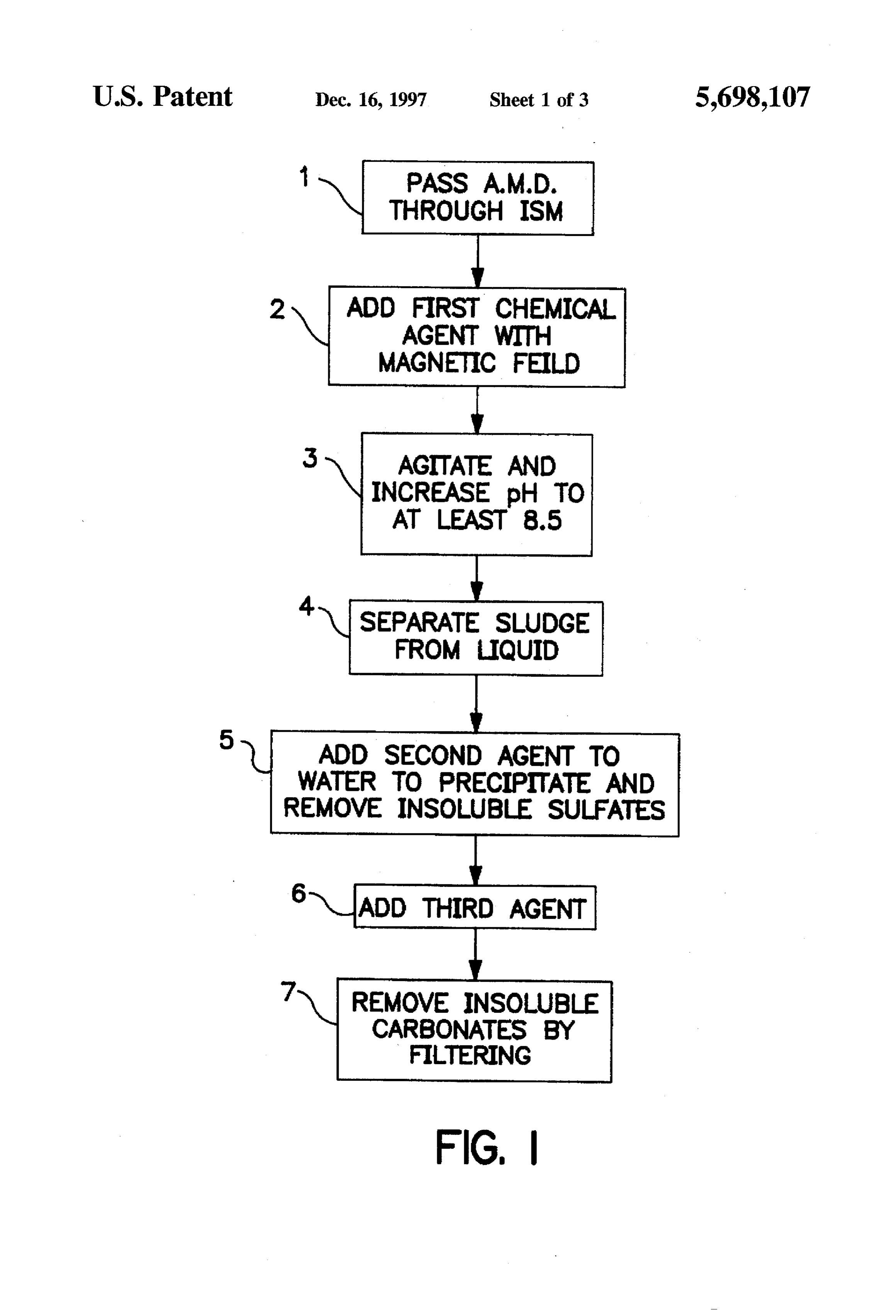
PASS A.M.D.
THROUGH ISM
2 ADD FIRST CHEMICAL
AGENT WITH
MAGNEC FELD
INCREASE pH TO
AT LEAST 8.5
*\sEPARATE sLUDGE
FROM QUID
ADD SECOND AGENT TO
1 WATER TO PRECPATE AND
REMOVE INSOUBLE SULFATES
NJADD THIRD AGENT
7\ | REMOVE INSOLUBLE
CARBONATES BY
FILTERNG
FIG,
Page 3
Drawing sheet — no readable text.
Page 4
Drawing sheet — no readable text.
Page 5
TREATMENT FOR ACD MNE ORANAGE recovery. They are therefore not feasibly recoverable nor recyclable and are classified as hazardous waste with all the
FIELD OF THE INVENTION problems and expense of hazardous waste storage. This invention relates to methods for the removal of 5 Treatments of waste water containing large concentra contaminating heavy and light metal ions from aqueous tions of waste water produces water having a large concen Solutions such as acid mine drainage and particularly to a tration of SO-even though the pH is in an otherwise acceptable range.
method which incorporates magnetic, electrolytic and The Iron Mountain Mine Site located near Redding, Calif. chemical techniques. and the Berkeley Pitlocated at Butte, Mont., are particularly BACKGROUND AND PRIOR ART 10 notorious examples of the undesireable environmental impact of A.M.D At the IronMountain Site, there are fifteen
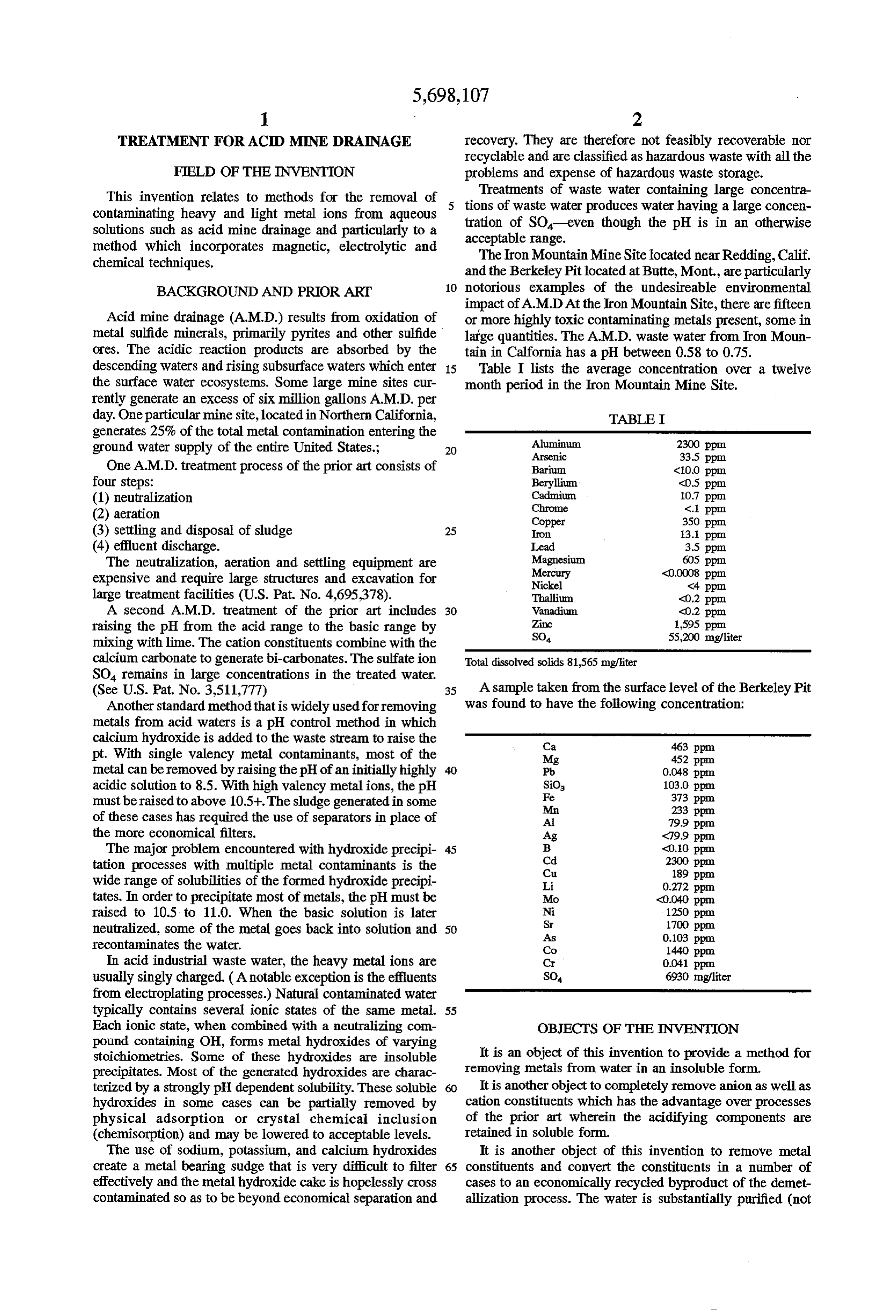
Acid mine drainage (A.M.D.) results from oxidation of or more highly toxic contaminating metals present, some in metal sulfide minerals, primarily pyrites and other sulfide large quantities. The A.M.D. waste water from Iron Moun ores. The acidic reaction products are absorbed by the tain in California has a pH between 0.58 to 0.75. descending waters and rising subsurface waters which enter 15 Table I lists the average concentration over a twelve the Surface water ecosystems. Some large mine sites cur month period in the Iron Mountain Mine Site. rently generate an excess of six million gallons A.M.D. per day. One particularmine site, located in Northern California, TABLE I generates 25% of the total metal contamination entering the Aluminum 2300 ppm ground water supply of the entire United States.; Arsenic 33.5 ppm One A.M.D. treatment process of the prior art consists of Barium <100 ppm. four steps: Beryllium <0.5 ppm (1) neutralization Cadmium 10.7 ppm
(2) aeration Copper 350 ppm (3) settling and disposal of sludge 25 Iron 3.1 ppm. (4) effluent discharge. Lead 3.5 ppm The neutralization, aeration and settling equipment are Magnesium 605 ppm expensive and require large structures and excavation for Mercury <0.0008 ppm
large treatment facilities (U.S. Pat. No. 4,695.378). Thalium <0.2 ppm A second A.M.D. treatment of the prior art includes 30 Wanadium <0.2 ppm raising the pH from the acid range to the basic range by Zinc 1,595 ppm mixing with lime. The cation constituents combine with the SO 55,200 mg/liter calcium carbonate to generate bi-carbonates. The sulfate ion Total dissolved solids 81,565 mg/liter SO remains in large concentrations in the treated water.
(See U.S. Pat. No. 3,511,777) 35 A sample taken from the surface level of the Berkeley Pit Another standard method that is widely used for removing was found to have the following concentration: metals from acid waters is a pH control method in which calcium hydroxide is added to the waste stream to raise the Ca 463 ppm pt. With single valency metal contaminants, most of the Mg 452 ppm metal can be removed by raising the pH of an initially highly Pb 0.048 ppm acidic solution to 8.5. With high valency metalions, the pH SiO
must be raised to above 10.5+. The sludge generated in some M 233 ppm of these cases has required the use of separators in place of Al 79.9 ppm the more economical filters. Ag <79.9 ppm The major problem encountered with hydroxide precipi 45 B <0.10 ppm tation processes with multiple metal contaminants is the C 2300 ppm
wide range of solubilities of the formed hydroxide precipi Li 0.272 ppm tates. In order to precipitate most of metals, the pH must be Mo <0.040 ppm raised to 10.5 to 11.0. When the basic solution is later N 1250 ppm neutralized, some of the metal goes back into solution and 50 Sr. 1700 ppm
recontaminates the water. Co 1440 ppm In acid industrial waste water, the heavy metal ions are Cr 0.041 ppm usually singly charged. (Anotable exception is the effluents SO 6930 mg/liter from electroplating processes.) Natural contaminated water typically contains several ionic states of the same metal. 55
Each ionic state, when combined with a neutralizing com OBJECTS OF THE INVENTION pound containing OH, forms metal hydroxides of varying stoichiometries. Some of these hydroxides are insoluble It is an object of this invention to provide a method for precipitates. Most of the generated hydroxides are charac removing metals from water in an insoluble form. terized by a strongly pH dependent solubility. These soluble It is another object to completely remove anion as well as hydroxides in some cases can be partially removed by cation constituents which has the advantage over processes physical adsorption or crystal chemical inclusion of the prior art wherein the acidifying components are (chemisorption) and may be lowered to acceptable levels. retained in soluble form.
The use of sodium, potassium, and calcium hydroxides It is another object of this invention to remove metal create a metal bearing sudge that is very difficult to filter 65 constituents and convert the constituents in a number of effectively and the metal hydroxide cake is hopelessly cross cases to an economically recycled byproduct of the demet contaminated so as to be beyond economical separation and allization process. The water is substantially purified (not
Page 6
merely neutralized) and thus creates a second recyclable Step 5. The clarified"demetalized" A.M.D. is then mixed product, a soil conditioning agent and water. The waste with a second agent in sufficient amount to precipitate water is thereby neutralized and in a condition suitable for insoluble sulfates. The precipitated sulfates are separated discharging into the ground water system from the clarified liquid fraction such as by settling and dewatering in a filter press. A prefered second agent is
SUMMARY calcium hydroxide which forms calcium sulfate.
This invention is directed toward a treatment process of Step 6: The clarified A.M.D. is then mixed with a third acid mine drainage (A.M.D.) which includes the steps: agent in Sufficient amount to adjust the pH to a range of 7.5 subjecting the drainage to an electric field between two to 8.2 and precipitate insoluble carbonates. The preferred electrodes; third agent is sodium bicarbonate.
mixing the A.M.D with a first chemical agent that raises Step 7: The insoluble carbonates are filtered from the A.M.D. leaving water that is suitable for discharge into the the pH to at least 8.0, said mixing performed in a environment.
magnetic field;
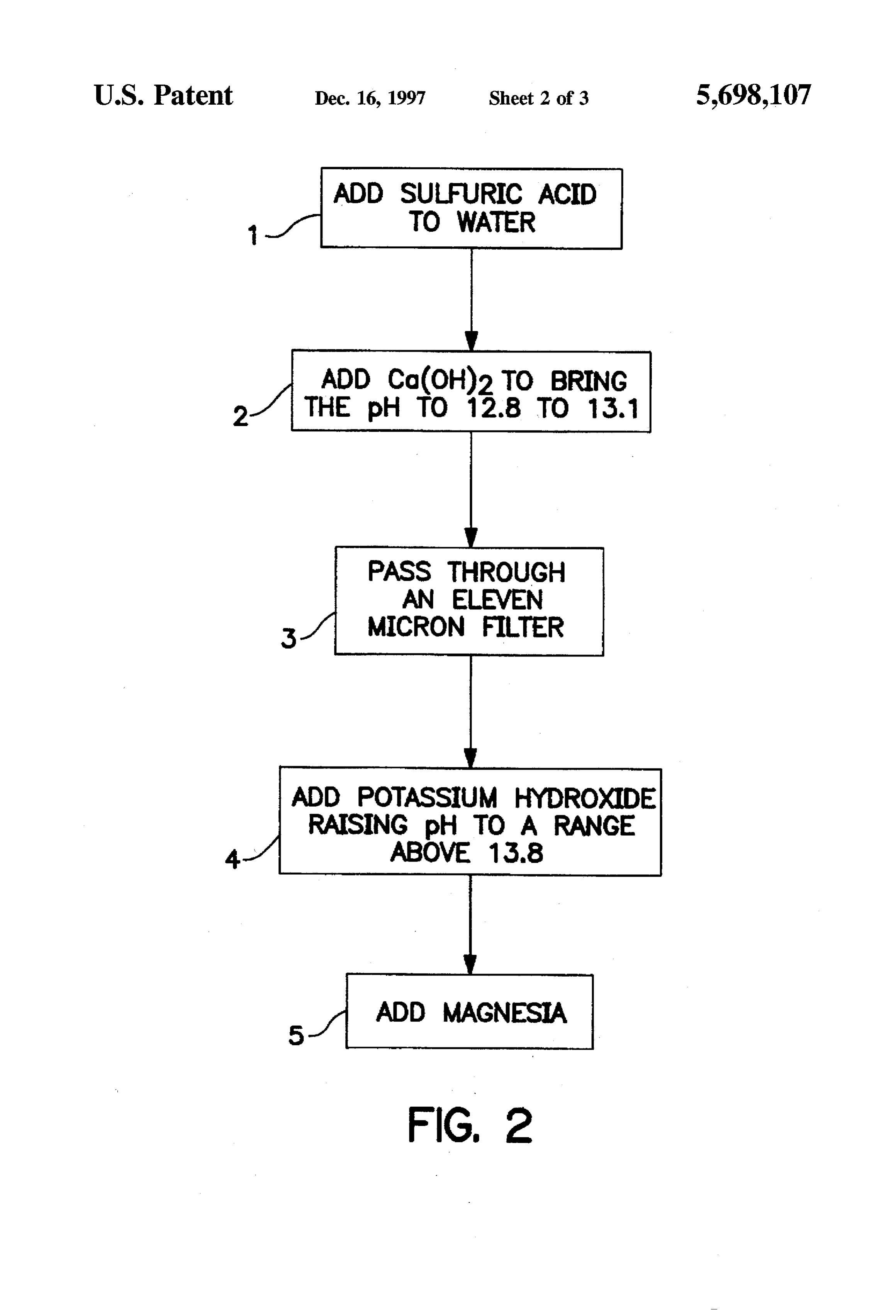
allowing the mixture to digest in a chamber for a period 15 agent FIG. 2 shows the steps for preparing the first chemical of time to allow a sludge to form; applied in step 2 of the method of FIG.1. Referring to
separating the liquid fraction from the solid fraction of the In step 1, 40 ml of concentrated sulfuric acid (Be 12) is A.M.D. such as by settling and passing the separated added to one liter of water.
sludge through a filter press to produce a filter cake and 20 clarified water solution; In step 2, Ca(OH) is added to bring the pH of the solution adding a second chemical agent to the water solution to up to a range of 12.8 to 13.1.
precipitate insoluble sulfates; In step 3, the solution is passed through an eleven micron filter adding a thickener and passing the A.M.D. through a filter than eleven thereby removing any particulates of Ca SO, larger microns.
press to remove precipitated sulfates; 25 In step 4, sufficient potassium hydroxide is added to bring adding a third chemical agent to reduce the pH to slightly the pH to a range of 13.8 to 14 thereby producing a base basic and precipitate carbonates which are removed solution.
with a filter press.
Variations of these steps may be considered which are oneIn liter step 5, magnesia is added in the amount of 10 grams per of base solution thereby formulating the first within the scope of the invention. A preferred embodiment 30 chemical agent.
is described in following paragraphs.
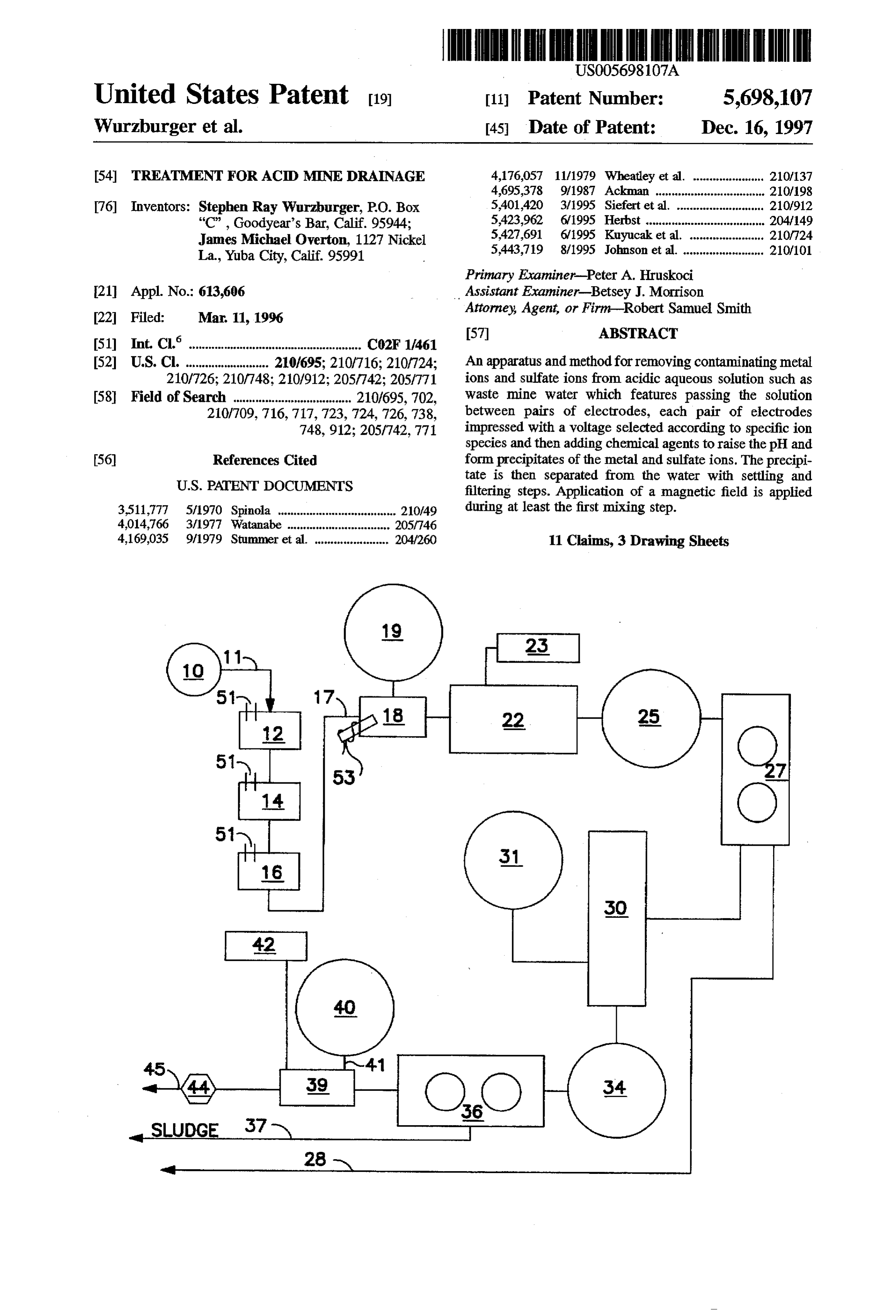
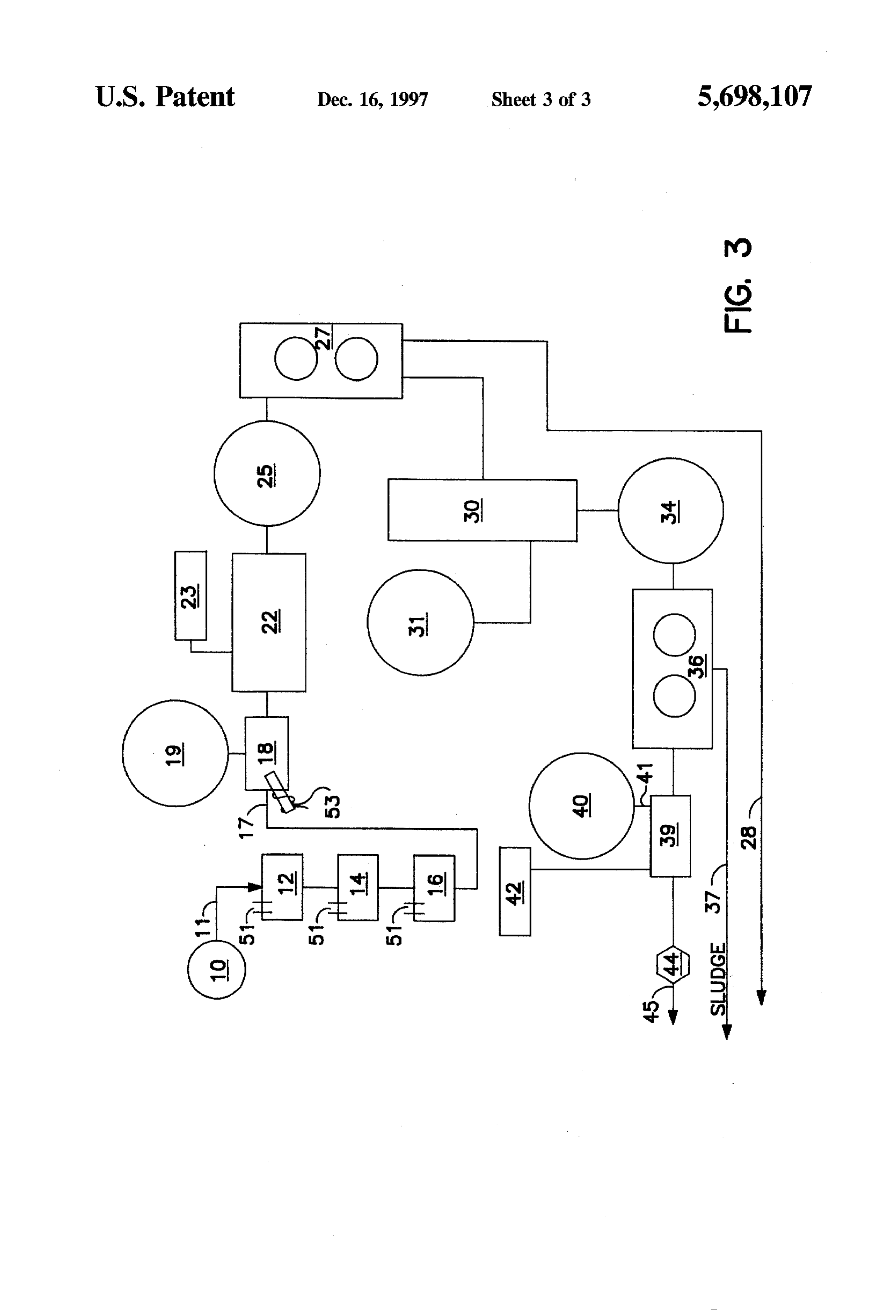
FIG. 3 shows schematic diagram of the apparatus for
BRIEF DESCRIPTION OF THE FIGURES: performing the steps of the process. There is shown a flow control tank 10 where the flow rate of A.M.D. is controlled
FIG. 1 is a list of steps in performing the method of this 35 and supplied through conduit 11 to three "ion state modifi invention. cation” stations 12, 14 and 16. Each I.S.M. station has a pair FIG. 2 is a list of steps for preparing the first chemical of carbon electrodes 51 spaced about 1.5 inches apart. In one agent. embodiment a voltage of 9.5 to 12 volts is impressed across FIG. 3 is a schematic diagram of the apparatus for the electrodes of the first LS.M. station, a voltage of 22.5 to perfoming the process of FIG. 1. 25 volts is impressed across the electrodes of the second I.S.M. station 14, a voltage of 51.5 to 55 volts is impressed
DESCRIPTION OF PREFERRED across the electrodes of the third L.S.M. station 16. EMBODIMENTS: The A.M.D. then enters a mixing tank 18 through conduit 17 where a solution of a first chemical agent is added from
Turning now to a discussion of the drawings, FIG. 1 lists 45 source the steps in practicing the method of the invention. 19. The mixing is preferentially performed in the presence of a magnetic field imposed by a magnet array 53.
Step 1: A.M.D. is passed serially through a number of In examples presented in following paragraphs, the plastic “ion state modification” chambers. Each chamber has a pair mixing tank was six inches in diameter and 13 magnets, each of electrodes, preferably carbon, across which an electric having a strength of 55 kilogauss were arranged in a ring field is applied. The voltage between the electrodes in each 50 with the north pole of each magnetic in contact with the wall chamber is selected to optimize the "conditioning” of a of the tank.
particular class of ionic species (e.g., single valence, double The solution is then passed to a digestion tank 22 where valence, triple valence). reaction of the constituents continues for about one half hour Step 2: A first chemical agent is added to A.M.D. and as the pH rises to about 7.5 as detected by monitor 23. A mixed in the presence of a magnetic field in a sufficient 55 sludge of precipitated metal oxides and hydroxides forms amount to raise the pH to about 7.5. A preferred first during this step resulting in a sludge that is permitted to chemical agent is prepared according to steps listed in settle out when the mix passes through a settling (thickener) following paragraphs. tank 25. A prefered settling tank is of the well known type Step 3: The mixture is agitated in a digesting tank for having inclined surface up which the liquid passes while the about thirty minutes where a slurry of precipitates is formed heavy precipitate settles downward. The sludge settling out and the pH increases to at least 8.5. of settling tank 25 passes through a filter press 27 and the Step 4: The A.M.D. enters a settling tank where precipi dewatered sludge is removed through line 28, tate is separated as sludge from clarified liquid fraction and Filtered "demetallized” effuent flows out to chemical the sludge is further dewatered by passage through a filter mixer 30 where a second chemical agent from reservoir 31 press. At this point in the process, the original contaminating 65 is mixed with the effluent which precipitates out the SO. metal ions have been removed from the A.M.D. and the The second chemical agentis prefereably calcium hydroxide A.M.D. is said to be "demetalized'. so that the precipitate formed is calcium sulfate. The effluent
Page 7
is then passed to a settling unit 34 where the CaSO settles Example III: IRON MOUNTAIN MINE from the liquid fraction and is passed through filterpress 36. A500ml sample of IronMountain mine water was treated Here the sludge is filtered and compression dried and in 'ion state modification' devices which involved immers discharged through line 37. ing carbon electrodes in the solution and applying, The effluent enters chemical mixer 38 where a third successively, voltages of 10 volts, 12 volts, and 54 volts, application chemical agent is added from reservoir 40 through conduit Then the sample of each volage being for a period of 3 minutes. was placed in a mixer where MgO was 41. The third chemical agentis preferably sodium bicarbon added in the presence of a magnetic field as described in ate and is added in an amount sufficient to adjust the pH to Example L. MgO was added in an amount sufficient to raise a range of 7.5 to 8.2 as indicated by pH sensor 42. O the pH to about 8.0. The treated solution was allowed to The pH stabilized solution enters filter 44 where the digest for 30 minutes with agitation dining which time carbonates are removed by filtration and water from which precipitate was framed. Then the sludge was separated from metal contaminants and sulfate radicals have been removed the liquid fraction with a vacuum filter. TABLE IV lists the is discharged through line 45. concentrations of major contaminants measured by an EPA The following examples are illustrative of the invention. 5 certified laboratory.
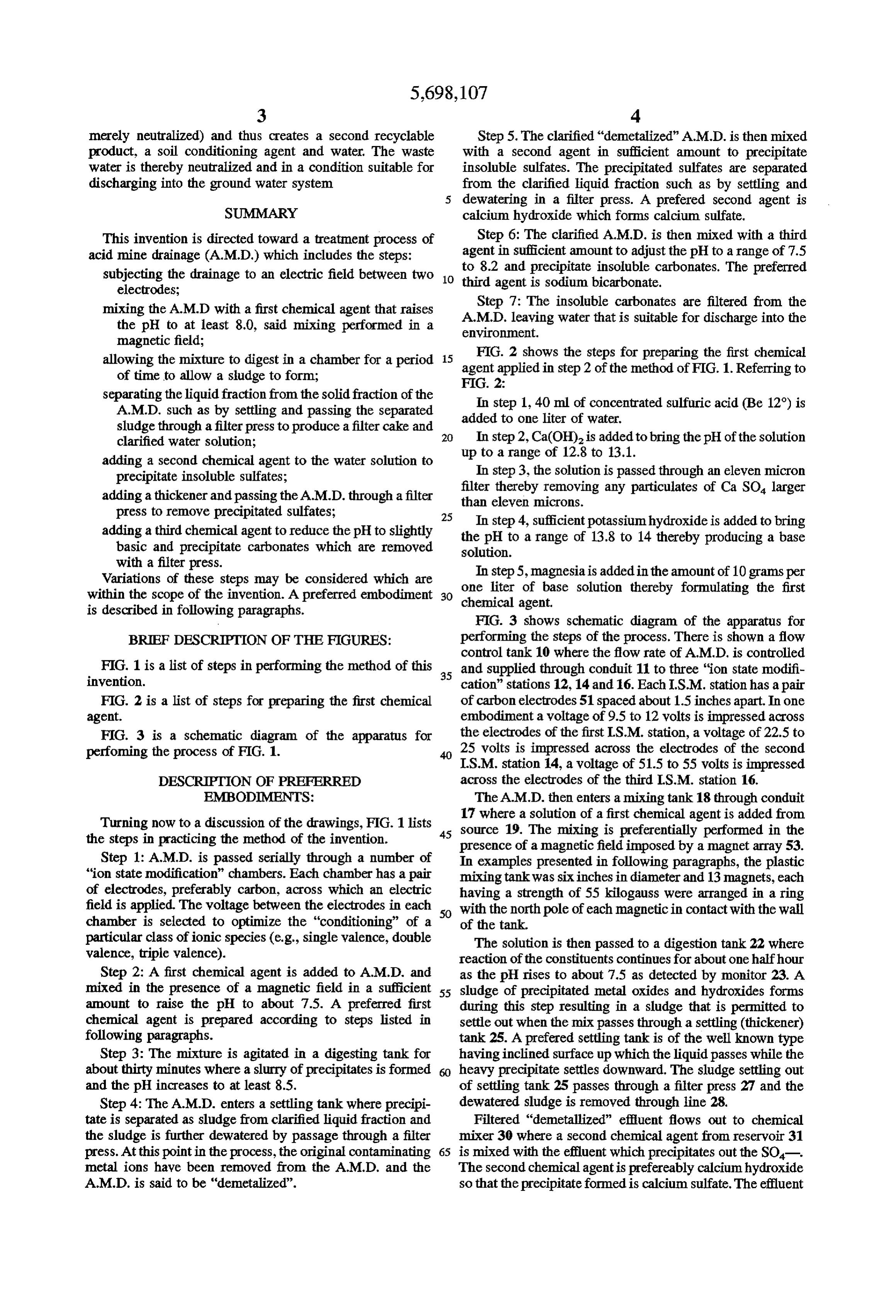
Example I: Berkeley Pit TABLE TV A500 ml sample of A.M.D. (pH-2.9) was treated in “ion state modification” devices which involved immersing car before treatment after treatment for removal of metals bon electrodes in the solution and applying, successively, Cadmium 10.7 ppm <0.020 ppm (below detectable limits) voltages of 10 volts, 12 volts, and 54 volts, application of Cobalt <0.5 ppm <0.020 ppm (below detectable limits) each volage being for a period of 3 minutes. Then the sample Copper 350.0 ppm <0.020 ppm (below detectable limits) was placed in a mixer where MgO was added in the presence Nickel <4.0 ppm <0.020 ppm (below detectable limits) of the magnetic field generated by the six magnets posi 2inc 1595 ppm <0.020 ppm (below detectable limits) tioned as described above. MgO was added in an amount SO- 55,200.0 ppm 17,000.0 ppm Sufficient to raise the pH to about 8.0. The treated solution 25 was allowed to digest for 30 minutes with agitation during Example IV:
which time precipitate was formed. Then the sludge was A second 500ml sample of Berkeley Pit Water was treated separated from the liquid fraction with a vacuum filter. in the same manner as described in example L. Then the TABLE II lists the concentrations of major contaminants treated water was put through a second process where a measured by an EPA certified laboratory 30 second agent, Ca(OH) was added causing a white precipi tate to form. The Ca(OH) was added until no further
TABLE precipitate was detected.
The sample was analyzed by an independent certified EPA before treatment after treatment for removal of metals laboratory who provided the test results listed in TABLEV. Cadmium 2.3 ppm <0.020 ppm (below detectable limits) 35
Cobalt 1.4 ppm k0.020 ppm (below detectable limits) TABLE W Copper 1890 ppm KO,020 ppm (below detectable limits)
Nickel 1250.0 ppm 0044 ppm untreated sample after treatment for removal of metals
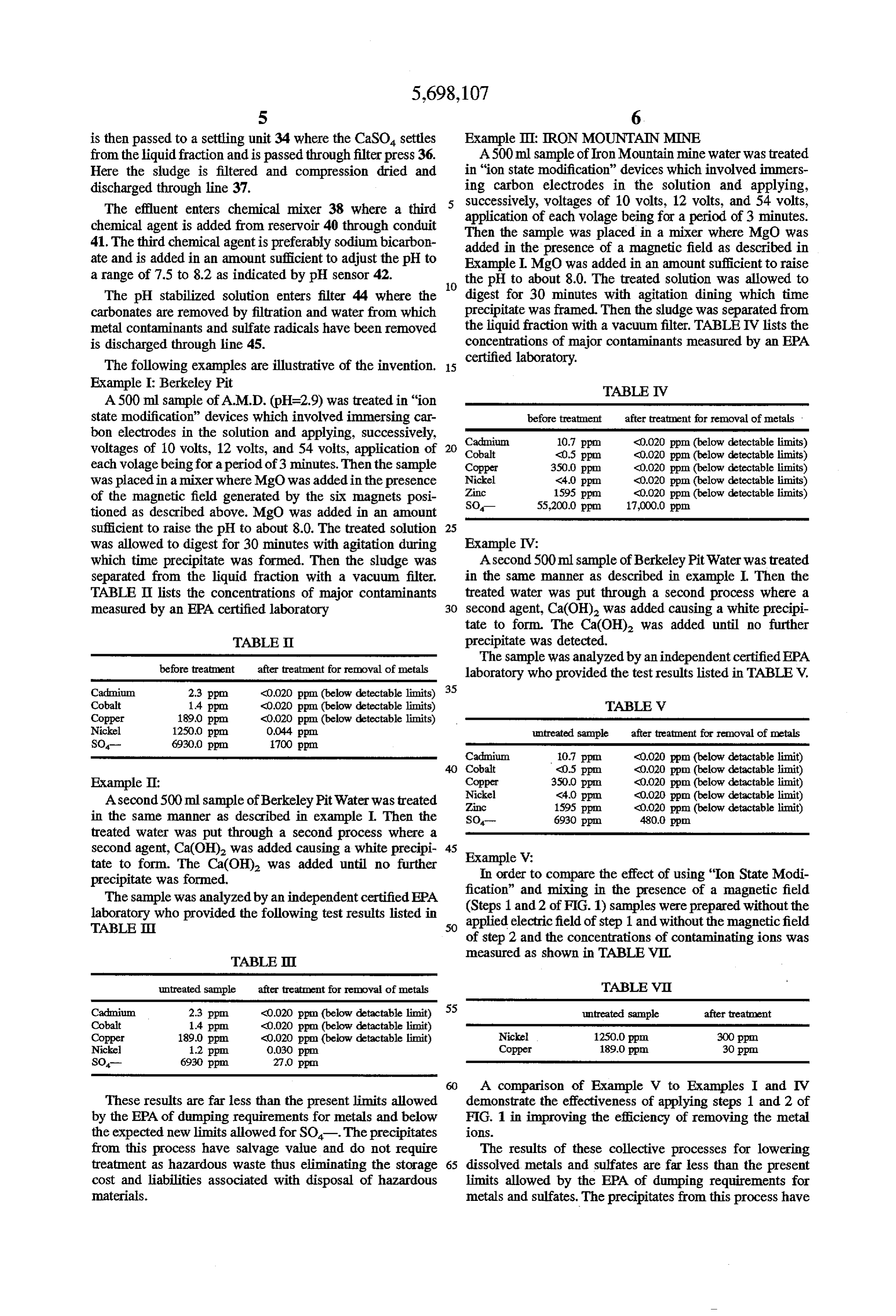
Cadmium 10.7 ppm K0.020 ppm (below detactable limit)
Cobalt <0.5 ppm <0.020 ppm (below detactable limit)
Example II Copper 350.0 ppm K0.020 ppm (below detactable limit) A second 500ml sample of Berkeley Pit Water was treated Nickel <4.0 ppm K0.020 ppm (below detactable limit) Zinc 1595 ppm K0.020 ppm (below detactable limit) in the same manner as described in example I. Then the SO- 6930 ppm 480.0 ppm treated water was put through a second process where a second agent, Ca(OH) was added causing a white precipi 45 tate to form. The Ca(OH) was added until no further Example V
In order to compare the effect of using "Ion State Modi precipitate was formed.
The sample was analyzed by an independent certified EPA fication”1 andand mixing in the presence of a magnetic field laboratory who provided the following test results listed in (Steps applied 2 of FIG. 1) samples were prepared without the electric field of step 1 and without the magnetic field
TABLE 50 of step 2 and the concentrations of contaminating ions was measured as shown in TABLE VII.
TABLE I
untreated sample after treatment for removal of metals TABLE WI
Cadmium 2.3 ppm K0.020 ppm (below detactable limit) 55 untreated sample after treatment Cobalt 1.4 ppm K0.020 ppm (below detactable limit)
Copper 189.0 ppm 40,020 ppm (below detactable limit) Nickel 1250.0 ppm 300 ppm Nicke 1.2 ppin 0.030 ppm Copper 189.0 ppm 30 ppm
A comparison of Example V to Examples I and IV
These results are far less than the present limits allowed demonstrate the effectiveness of applying steps 1 and 2 of by the EPA of dumping requirements for metals and below FIG. 1 in improving the efficiency of removing the metal the expected new limits allowed for SO-. The precipitates OS.
from this process have salvage value and do not require The results of these collective processes for lowering treatment as hazardous waste thus eliminating the storage 65 dissolved metals and sulfates are far less than the present cost and liabilities associated with disposal of hazardous limits allowed by the EPA of dumping requirements for materials. metals and sulfates. The precipitates from this process have
Page 8
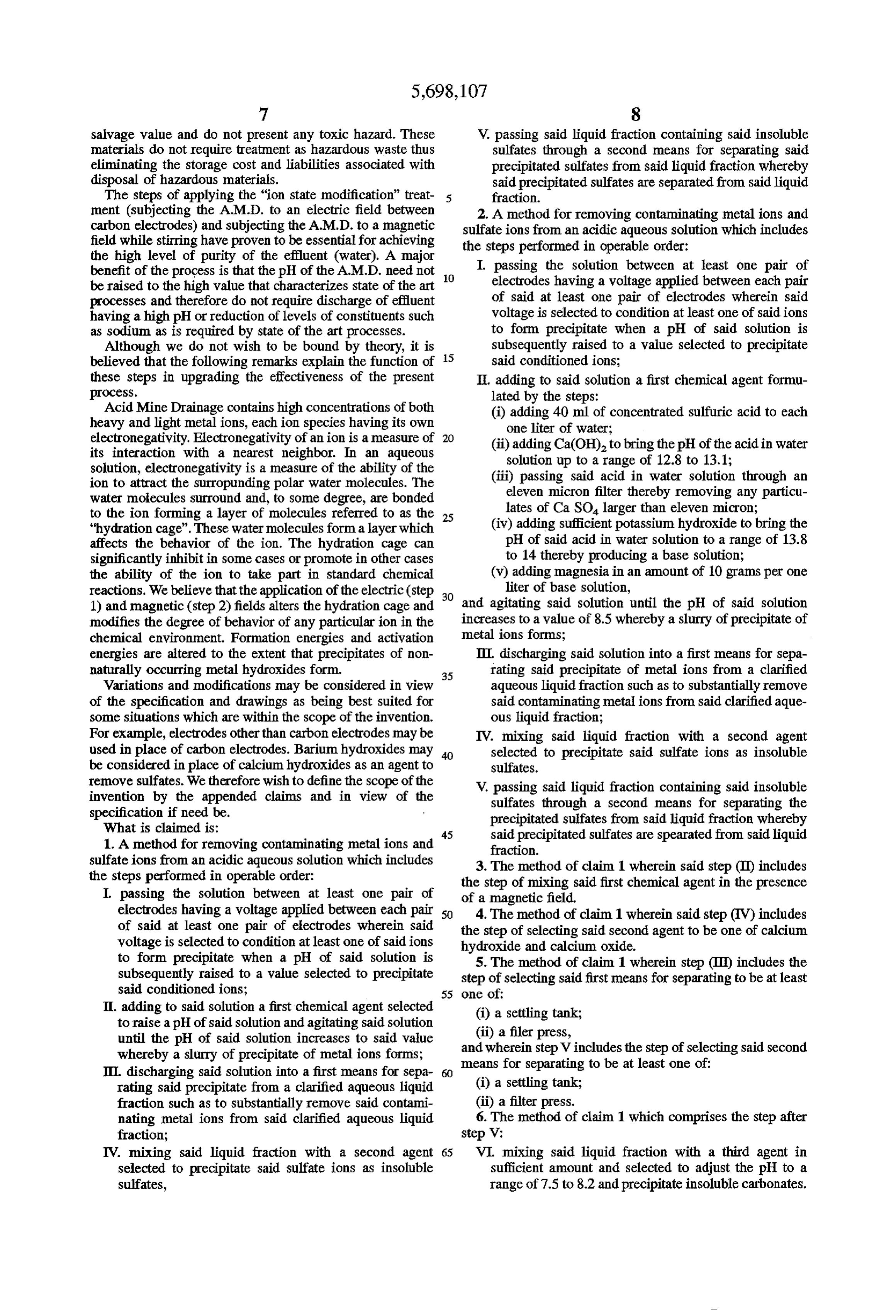
salvage value and do not present any toxic hazard. These V. passing said liquid fraction containing said insoluble materials do not require treatment as hazardous waste thus Sulfates through a second means for separating said eliminating the storage cost and liabilities associated with precipitated sulfates from said liquid fraction whereby disposal of hazardous materials. said precipitated sulfates are separated from said liquid The steps of applying the “ion state modification” treat 5 fraction.
ment (subjecting the A.M.D. to an electric field between 2. A method for removing contaminating metalions and carbon electrodes) and subjecting the A.M.D. to a magnetic sulfate ions from an acidic aqueous solution which includes field while stirring have proven to be essential for achieving the steps performed in operable order: the high level of purity of the effluent (water). A major benefit of the process is that the pH of the A.M.D. need not 10 I. electrodes passing the solution between at least one pair of having a voltage applied between each pair be raised to the high value that characterizes state of the art processes and therefore do not require discharge of effluent of said at least one pair of electrodes wherein said having a high pH or reduction of levels of constituents such voltage is selected to condition at least one of said ions as sodium as is required by state of the art processes. to form precipitate when a pH of said solution is Although we do not wish to be bound by theory, it is subsequently raised to a value selected to precipitate believed that the following remarks explain the function of 15 said conditioned ions;
these steps in upgrading the effectiveness of the present II. adding to said solution a first chemical agent formu process. lated by the steps:
Acid Mine Drainage contains high concentrations of both (i) adding 40 ml of concentrated sulfuric acid to each heavy and light metal ions, eachion species having its own one liter of water;
electronegativity. Electronegativity of an ion is a measure of (ii) adding Ca(OH) to bring the pH of the acid in water its interaction with a nearest neighbor. In an aqueous solution up to a range of 12.8 to 13.1; solution, electronegativity is a measure of the ability of the (iii) passing said acid in water solution through an ion to attract the surropunding polar water molecules. The eleven micron filter thereby removing any particu water molecules surround and, to some degree, are bonded lates of CaSO larger than eleven micron; to the ion forming a layer of molecules referred to as the 25 (iv) adding sufficient potassium hydroxide to bring the "hydration cage". These water molecules formalayer which affects the behavior of the ion. The hydration cage can pH of said acid in water solution to a range of 13.8 significantly inhibit in some cases or promote in other cases to 14 thereby producing a base solution; the ability of the ion to take part in standard chemical (v) adding magnesia in an amount of 10 grams per one reactions. We believe that the application of the electric (step 30 liter of base solution, 1) and magnetic (step 2) fields alters the hydration cage and and agitating said solution until the pH of said solution modifies the degree of behavior of any particular ion in the increases to a value of 8.5 whereby a slurry of precipitate of chemical environment. Formation energies and activation metal ions forms;
energies are altered to the extent that precipitates of non III. discharging said solution into a first means for sepa naturally occurring metal hydroxides form. 35 rating said precipitate of metal ions from a clarified Variations and modifications may be considered in view aqueous liquid fraction such as to substantially remove of the specification and drawings as being best suited for said contaminating metal ions from said clarified aque some situations which are within the scope of the invention. ous liquid fraction;
For example, electrodes other than carbon electrodes may be IV. mixing said liquid fraction with a second agent used in place of carbon electrodes. Barium hydroxides may selected to precipitate said sulfate ions as insoluble be considered in place of calcium hydroxides as an agent to Sulfates.
remove sulfates. We therefore wish to define the scope of the V. passing said liquid fraction containing said insoluble invention by the appended claims and in view of th sulfates through a second means for separating the specification if need be. precipitated sulfates from said liquid fraction whereby What is claimed is: 45 said precipitated sulfates are spearated from said liquid 1. A method for removing contaminating metal ions and fraction.
sulfate ions from an acidic aqueous solution which includes 3. The method of claim 1 wherein said step (II) includes the steps performed in operable order: the step of mixing said first chemical agent in the presence I. passing the solution between at least one pair of of a magnetic field.
electrodes having a voltage applied between each pair 50 4. The method of claim 1 wherein said step (TV) includes of said at least one pair of electrodes wherein said the step of selecting said second agent to be one of calcium voltage is selected to condition at least one of said ions hydroxide and calcium oxide.
to form precipitate when a pH of said solution is subsequently raised to a value selected to precipitate step5. of The method of claim 1 wherein step (III) includes the selecting said first means for separating to be at least said conditioned ions; 55 one of:
II. adding to said solution a first chemical agent selected (i) a settling tank;
to raise a pH of said solution and agitating said solution until the pH of said solution increases to said value and(ii)wherein a filer press, step Vincludes the step of selecting said second whereby a slurry of precipitate of metal ions forms; means for separating to be at least one of: III. discharging said solution into a first means for sepa rating said precipitate from a clarified aqueous liquid (i) a settling tank;
fraction such as to substantially remove said contami (ii) a filter press.
nating metal ions from said clarified aqueous liquid 6. The method of claim 1 which comprises the step after fraction; step V:
IV. mixing said liquid fraction with a second agent 65 VI. mixing said liquid fraction with a third agent in selected to precipitate said sulfate ions as insoluble sufficient amount and selected to adjust the pH to a sulfates, range of 7.5 to 8.2 and precipitate insoluble carbonates.
Page 9
7. The method of claim 6 which comprises passing said voltage applied between said first pair of elctrodes is in a liquid fraction containing insoluble carbonates through a range of 9.0 to 12.0 volts, a second value of said voltage third means for separating said insoluble carbonates from applied between said second pair of electrodes is in a range said liquid fraction. of 22 to 24 volts, and a third value of voltage between said 8. The method of claim 6 which includes the step of 5 third pair of electrodes is in a range of 50 to 55 volts. selecting said third agent to be sodium bicarbonate. 11. The method of claim 1 wherein said conditioned ions 9. The method of claim 1 which includes the step of selecting said electrodes to be carbon. form precipitate when a pH of said solution is subsequently 10. The method of claim 1 which includes the step of said raised to a value of 8.5.
at least one pair of electrodes being a first pair, and a second 10 pair and a third pair of electrodes and a first value of said ; :: * : :
Provenance
- Collection
- Cited prior art
- Original PDF
- patentimages.storage.googleapis.com →
- Filed
- 1996-03-11
- Pages
- 9
- Method
- pdftotext (the PDF's own text layer) + pdftoppm 300dpi page scans
- Source
- Google Patents bibliographic record
- Granted
- 1997-12-16
- Inventors
- Stephen Ray Wurzburger; James Michael Overton
- Transcribed from
- patentimages.storage.googleapis.com →