patent · US5454853
Method for the production of steel
3 October 1995
Page 1 — bibliographic record
United States Patent (19) 11 Patent Number: 5,454,853 Edelson 45) Date of Patent: Oct. 3, 1995 (54) METHOD FOR THE PRODUCTION OF 57 ABSTRACT
STEEL
In a method for the production of steel in an environmentally 75 Inventor: Jonathan Edelson, Princeton, N.J. benign fashion, energy sources other than conventional (73) Assignee: Borealis Technical Incorporated fossil fuels are used to produce reductant fuels. These Limited, Eli, Israel reductant fuels are used for the reduction of iron ore and its conversion to steel. Furthermore, these reductant fuels may 21 Appl. No.: 258,503 be stored in order to smooth fluctuations in the primary (22 Filed: Jun. 10, 1994 energy supply. Electrical energy may be stored to smooth out (51) Int. Cl. ........................ C22B 4/00 short term fluctuations in the primary energy source. Energy 52 U.S. Cl. ................... ... 75/10.43; 7.5/10.34 for the reduction and conversion process may be supplied in 58) Field of Search ... w w w w w was a 75/10.43, 10.34 part directly from the primary energy source, avoiding inefficiencies in the production and storage of the reductant (56 References Cited fuel. Possible primary energy sources include solar power,
2,805,930 9/1957 Udy ........................................ 75/10.34 plants, as well as conventional constant power output from
OTHER PUBLICATIONS
an ordinary power plant.
Gretz; Korf, and Lyons; Hydrogen in the Steel Industry;
Primary Examiner-Peter D. Rosenberg 7 Claims, 1 Drawing Sheet
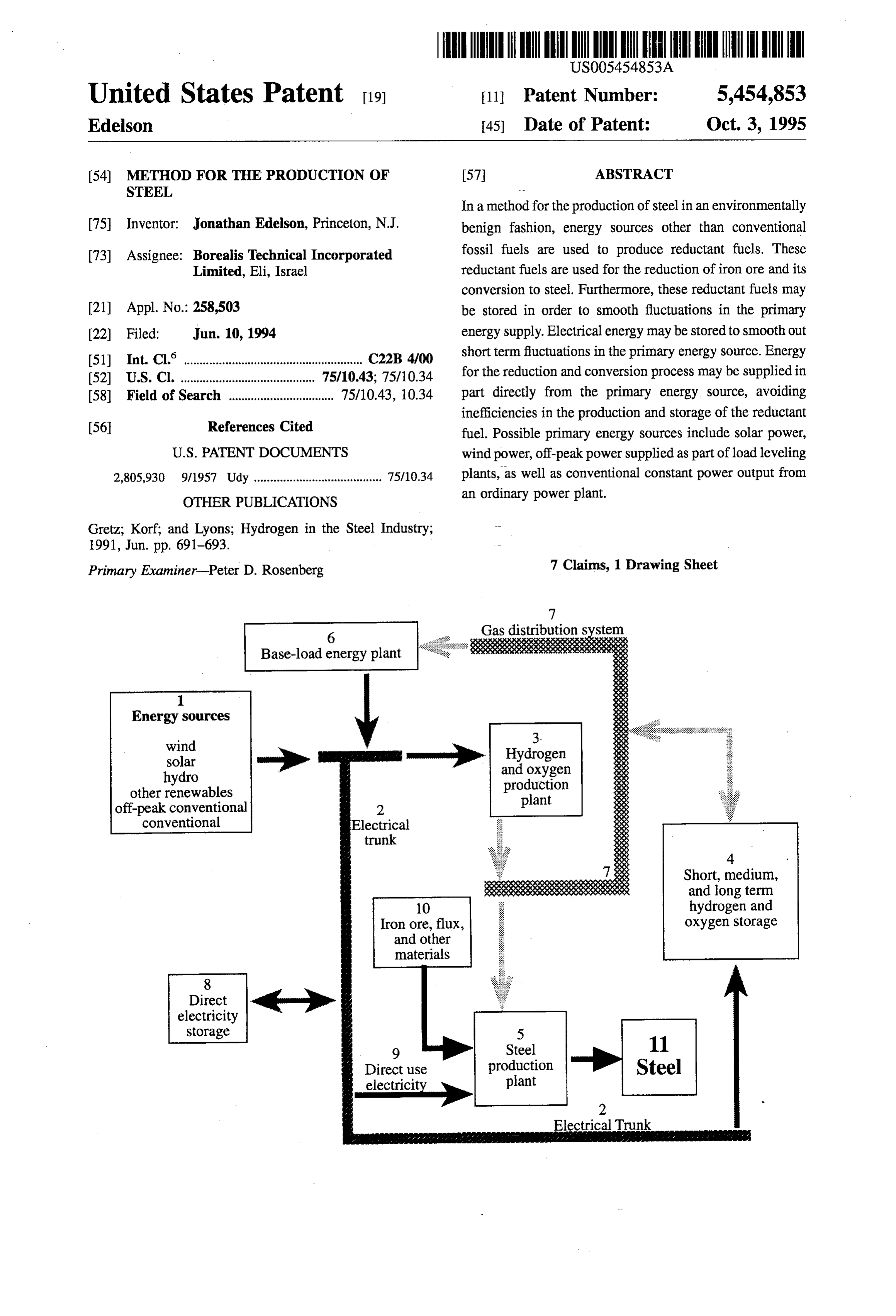
Gas distribution system
XXXXXXXXXKSXXXXXXXXX
Base-load energy plant
Energy sources wind 3.
solar mo Hydrogen hydro and oxygen other renewables production
trunk
Short, medium, and long term hydrogen and
Iron ore, flux, oxygen Storage and other materials
Direct electricity storage
Direct use production Steel
Electrical Trunk.
Page 2
Drawing sheet — no readable text.
Page 3
METHOD FOR THE PRODUCTION OF steel making in a non-polluting fashion. In a paper by J. STEEL Gretz et al., published in the International Journal of Hydro
hydrogen produced via electrolysis from hydroelectric
BACKGROUND-CROSS-REFERENCE TO power was proposed as a steel plant fuel. Although this RELATED APPLICATIONS paper presents a viable alternative to fossil fuels, it does not present any method for the actual use of hydrogen in this
This invention may make use of the reduction process fashion.
disclosed in my patent application soon to be filed under the OBJECTS AND ADVANTAGES title "Method for Reducing Particulate Iron Ore to Molten 10
Iron with Hydrogen as Reductant.” Accordingly, besides the objects and advantages of the methods of producing steel described in my above patent,
BACKGROUND-FIELD OF INVENTION several objects and advantages of the present invention are The present method relates to the field of energy use in the following:
metallurgical processing. It is the primary object of the present invention to provide a steel making process which makes extensive or total use of
BACKGROUND OF THE INVENTION renewable energy resources.
An advantage of the present invention is improved envi
Conventional steel production methods make extensive 20 ronmental compatibility of the steel making process use of fossil fuels. Use of these fuels leads to many undes through reduced carbon emissions and other pollutant ired side products such as carbon dioxide, carbon monoxide, emissions.
sulfur dioxide, nitrogen oxides, and others. Many of these An advantage of the present invention is improved prod side products are released into the atmosphere, for example, uct quality through the elimination of impurities intro through smoke stacks. The use of fossil fuels has a detri 25 duced with fossil fuels.
mental impact on the environment: acid rain, airborne car An advantage of the present invention is reduced costs in cinogens, global warming, and smog are all partially attrib the event that carbon taxes are implemented. uted to fossil fuel use. To account for the externalities of fossil fuels, various carbon taxes have been proposed. If steel makinganprocess
It is also object of the present invention to provide a which makes use of produced reduc such taxes become law, then there will be a strong profit 30 tant fuels.
motive to move away from fossil fuels.
The most energy intensive step in steel making is the An advantage of the present invention is that the reductant initial reduction of the iron ore to the metallic state. Most can be made chemically pure, with resultant improve commonly, this step is accomplished by using a blast fur ments in product quality. nace. These furnaces use vast quantities of coal (i.e. fed as 35 An advantage of the present invention is that reductant of coke) both to heat the reduction reaction and to supply the suitable quality is readily produced, as is the case with reductant gas. Replacement processes for the blast furnace fossil fuels where suitable reductant material must be have used natural gas for the reduction process. These located.
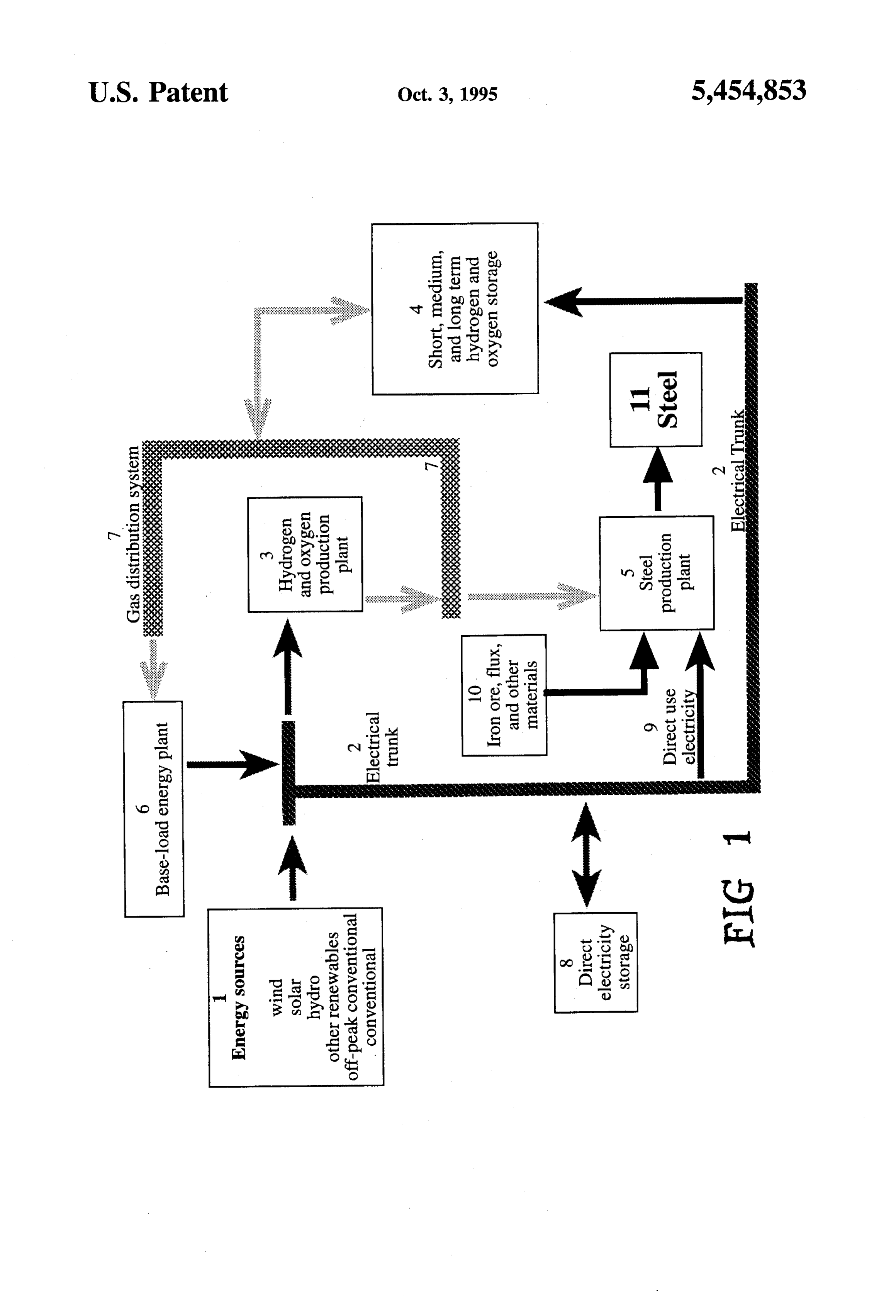
replacement processes have led to greater energy efficiency Further objects and advantages of this invention will become and lower carbon emissions. However, the products of 40 ensuing descriptions.apparent from a consideration of the figure and direct-reduction processes are not generally usable in steel conversion processes which expect blast furnace metal. DESCRIPTION OF DRAWING Additionally, carbon emissions can not be eliminated simply through the use of alternative fossil fuels. FIG. 1 is a flowchart showing the energy and materials Carbon can be used as a renewable resource, in which 45 flows in a simplified embodiment of the present invention. some of the fuel based emissions will be recovered naturally. LIST OF REFERENCE NUMERALS For example, some of the oldest iron processing methods involve the use of charcoal. These processes produce large 1 energy sources: wind, solar, hydro, other renewables, quantities of carbon dioxide. However, the charcoal comes off-peak conventional, conventional from the partial combustion of trees, and the carbon in the 50 2 electrical trunk trees comes from the air. Thus, the net carbon dioxide 3 hydrogen and oxygen production plant emission is zero. This process is problematic given the 4 short, medium, and long term gas storage product impurities which would be introduced by the char coal. Although carbon dioxide emissions would be net Zero, 5 steel production plant there would be excessive emissions of other pollutants, 55 6 base-load energy plant especially particulate pollutants. While the general principal 7 gas distribution system of using renewable resources to prevent pollution remains 8 direct energy storage valid, the use of plant based charcoal is unlikely to be viable. 9 direct use electricity
The use of natural gas and charcoal, while potential 10 iron ore, flux, and other materials improvements over the use of coal, only address part of the 60 11 steel problem of pollution in steel production. Specifically, they only address energy usage in the reduction step, not in the DESCRIPTION OF THE INVENTION other processes associated with the production of steel.
Furthermore, the use of natural gas would only decrease the The current invention is a reduction to practice of the emissions of carbon dioxide and other pollutants. A useful 65 concept presented by J. Gretz et al., in a paper published in improvement would use alternatives to conventional energy the International Journal of Hydrogen Energy, volume 16, sources in order to supply all of the energy necessary for number 10, pages 691-693 (1991).
Page 4
Electrical power from a number of sources is used as the systems which use several different reductant fuels in dif primary energy supply. These sources can include any one or ferent roles. For example, sodium could be used as a more of the following: wind power, solar power, hydro reductant, with hydrogen being used as the heating fuel. power, as well as off-peak power in a demand side manage Hydrogen is advantageous because large scale electrolytic ment system or even conventional power from a dedicated plants are already well known in industry. Large scale power plant, as well as other sources of electrical power. storage of hydrogen is used widely in industry, and the use This electricity is used to produce a reductant fuel which is of hydrogen is well known in the metals industry. then used in the iron and steel making process. As the steel With reference to FIG. 1: Electricity from one or more of making process requires a certain amount of direct heat, energy sources 1 is fed to an electrical trunk 2. Electrical some fraction of the electricity may be diverted directly to 10 trunk2 may or may not be grid connected. If electrical trunk the steel making process for use in electric heating. Along 2 is not grid connected, then it need not be grid synchro with the reductant fuel, oxygen is produced, some of which nized, and need not be frequency stable. Electrical power is is stored for use in various heating and steel conversion distributed to a hydrogen and oxygen production plant 3, tasks. Most of the oxygen remains as a valuable byproduct. short, medium, and long term gas storage 4, and a steel Storage for the reductant fuel and oxygen is provided in 15 production plant 5. Additional power may be supplied to the order to smooth out variable electrical power supplies. For electrical power distribution system by a base-load energy example, if solar power were used as the primary energy plant 6, which supplies the minimal electrical power needs supply, then the reductant fuel would be produced only when of the system when energy sources 1 are unavailable. the solar cells are providing power. Part of this fuel would Hydrogen and oxygen production plant 3 uses electricity be used immediately, but most of it would be stored to allow 20 to produce hydrogen and by product oxygen via-the well for continuous operation. When the electrical power is known electrolytic process, or any other process available. available, some of it may be used directly, bypassing the fuel The product gasses are fed to a gas distribution system 7. production step for part of the energy use. Additionally, a Plumbing details of gas distribution system 7 are well small amount of electrical power may be stored to smooth understood in the art, and therefore not described. Gas out short term power fluctuations. 25 distribution system 7 supplies hydrogen and oxygen to steel The fuel storage may be of several types, a mix of which production plant 5 for direct use, to short, medium, and long is selected based on site parameters. Basically, storage may term gag storage 4 for later use, and to base-load energy be expensive in terms of use, or expensive in terms of capital plant 6 to supply electrical power when energy sources 1 are outlay. A proper mix of these storage systems must be made unavailable.
in order to minimize costs. For example, low pressure gas 30 Short, medium, and long term gas storage 4 consists of storage is the cheapest to use in terms of the energy cost of several storage media, the precise mix being determined by storing the fuel. However, low pressure gas storage requires the economics of the individual media and the variability in large variable volume containers, which are expensive. the primary energy supply. Gas storage methods are well Pressurized storage systems require smaller tanks, which known in the prior art, and therefore are not described. can be less expensive for a given amount of mass storage. 35 Steel production plant 5 consists of a reduction furnace, However, compression of gas for a pressurized storage steel conversion process, casting equipment, and forming system is costly in terms of energy use. The densest storage equipment. The reduction furnace may be of the type is attained with liquefied storage. Per unit mass stored the described in a patent application to be filed by this inventor, storage tanks are inexpensive, however the liquefaction equipment is expensive and the liquefaction process very 40 or it may be a direct-reduction furnace, such as is used in the steel industry, modified to operate with hydrogen. It may energy intensive. Selection of the proper storage mix may be even be a blast furnace converted for hydrogen operation, as made from consideration of the variability in energy supply described in a patent application to be filed by this inventor. and the need to remain continuously operational. However, such blast furnace operations would entail carbon The reductant fuel, either from storage or directly from 45 dioxide emissions, as blast furnace operation requires coke. the reductant plant, is used to supply energy for the iron and In the latter case, the carbon dioxide emissions are non steel processes. The reductant fuel is supplied to the reduc optimal. However, such carbon dioxide emissions would be tion furnace both as a reagent and as a heat source. The reduced to roughly 10% of the values found in conventional reductant fuel is combusted with the oxygen to provide heat blast furnace operations.
for the steel conversion steps. Finally, the reductant fuel may 50 Reduced product from the reduction process is supplied to combusted with the oxygen in a power plant in order to the steel conversion process. Depending on the reduction produce electricity. The use of a power plant is needed to step, the steel conversion process may be a melting and supply the minimal electricity needs of such items as motors, purification step, a de-carburizing step, or a ladle-refining lighting equipment, etc. when electricity from the primary step. If the reduction step uses the process disclosed in my energy source is unavailable. 55 co-pending patententitled "Method for Reducing Particulate As noted above, when available, the electricity from the Iron Ore to Molten Iron with Hydrogen as Reductant,' then primary sources is used directly, bypassing the conversion of the steel conversion process is the simple ladle-refining step. electricity to fuel and back again to electricity. In all cases, heat for the steel conversion process may be The used reductant may be cleaned of impurities and supplied through the combustion of hydrogen and oxygen. recycled. In the case of hydrogen as the reductant fuel, the 60 When electricity is available, heat may be supplied through reduction productis water mixed with unused hydrogen. The electrical heating processes. Additional oxygen may be water may be condensed out of the top gas stream. Other supplied for the use of de-carburization processes. impurities are scrubbed out, and the hydrogen reused. The The final steel product is cast into slabs for later shaping. water can be reused in the electrolysis plant to make more The casting process does not generally require an external hydrogen. 65 heat input, however, it may require electricity. This electric In the preferred embodiment, the reductant fuel is hydro ity is provided either by energy source 1, or by base-load gen. However, other reductant fuels are possible, as are energy plant 6, as necessary.
Page 5
S 6
SUMMARY, RAMIFICATIONS, AND SCOPE equivalents including but not limited to iron ore, mill This invention is a method for the production of steel. scale, nickel ore, or other ferrous metals chemically While the above description contains many specificities, combined with oxidative elements, in suitable reduc these should not be construed as limitations on the scope of 5 tion means using said reductant fuel for chemical the invention, but rather as an exemplification of one pre reduction potential and combusting said reductant fuel ferred embodiment thereof. Many other variations are pos to provide heat for the reduction reaction, whereby the sible. For example, the electrical energy storage system electrochemically produced reductant fuel may be used could be made much larger, to the point where it would to produce metals using electrical power of irregular supplant storage of the reductant fuel. Possible methods for 10 availability as the sole source of energy and reduction storing such large quantities of electricity include supercon potential, and whereby said electrochemically pro ducting magnetic energy storage systems, or compressed gas duced reductant fuel may be of substantially greater energy storage. Other variations would include the process purity than conventional reductants, thus enhancing the ing of other ferrous metals. Accordingly the scope of the quality of said metallic product. 2. A method as in claim 1 wherein said reductant fuel is invention should be determined not by the embodiment 15 hydrogen.
illustrated, but by the appended claims and their legal 3. A method as in claim 2 wherein said hydrogen is equivalents. produced by the electrolysis of water. I claim: 4. A method as in claim3 wherein said water is recovered 1. A method for the production of a reduced metallic from product from metal ores or ore equivalents comprised of the 20 5. Athemethod exhaust gas stream of said iron reduction process. as in claim 2 wherein said iron reduction following steps: means is a hydrogen smelting reduction furnace. a) producing a reductant fuel in suitable electrochemical 6. A method as in claim 1 wherein electrical heating by means wherein electrical power from suitable electrical suitable electrical heating means supplements said use of source means, including but not limited to one or more reductant fuel for heating of said reduction process, replac of the following: renewable electrical resources, off 25 ing entirely or in part said use of reductant fuel for heating peak mains electricity, conventional power plants, is as electrical power becomes available, whereby electrical used to disassociate suitable source material into said power may be directly used when said electrical power is reductant fuel and oxidant byproducts, and available, thus increasing the efficiency of the use of said b) storing said reductant fuel in suitable storage means of electrical power.
sufficient capacity to provide said reductant fuel during 30 7. A method as in claim 1 wherein said reductant fuel is any expected period of insufficient production of said further used to supply heat for conversion of said metallic reductant fuel, whereby use of said reductant fuel is iron to steel.
isolated from production of said reductant fuel, and c) reducing a material consisting of metal ore or ore 35
Provenance
- Collection
- Cited prior art
- Original PDF
- patentimages.storage.googleapis.com →
- Filed
- 1994-06-10
- Pages
- 5
- Method
- pdftotext (the PDF's own text layer) + pdftoppm 300dpi page scans
- Source
- Google Patents bibliographic record
- Granted
- 1995-10-03
- Inventors
- Jonathan Edelson; Borealis Technical Inc Ltd
- Transcribed from
- patentimages.storage.googleapis.com →