patent · US535267
Electrolytic conduit for beer or other liquids
5 March 1895
Page 1
Drawing sheet — no readable text.
Page 2
Drawing sheet — no readable text.
Page 3
UNITED STATES PATENT OFFICE.
?L OU IS W A GN ER AND JOHN MI A RIR, OF BALTI MORE, MARY ILAND.
ELECTR O LYTIC C O N D U T FOR B E ER O R OTHER LI QUI DS.
SPECIFICATION forming part of Letters Patent No. 585,267, dated March 5, 1895. Application filed November 12, 1894, Serial No. 528,562, (No model.)
To a// ?????, it may concer?: Fig. 5 is a similar view of another form of Be it, known that we, LOUIS WAGNER and electrode.
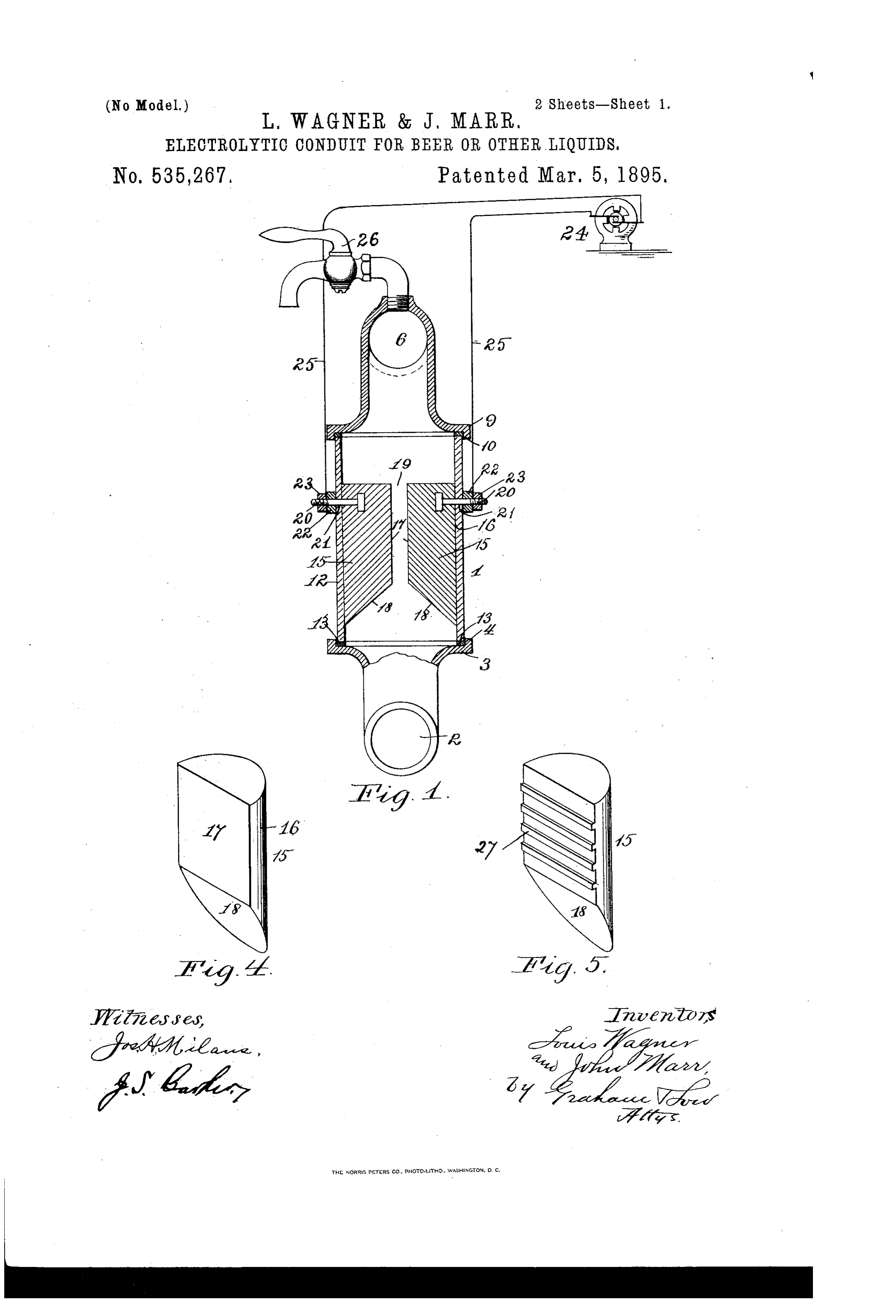
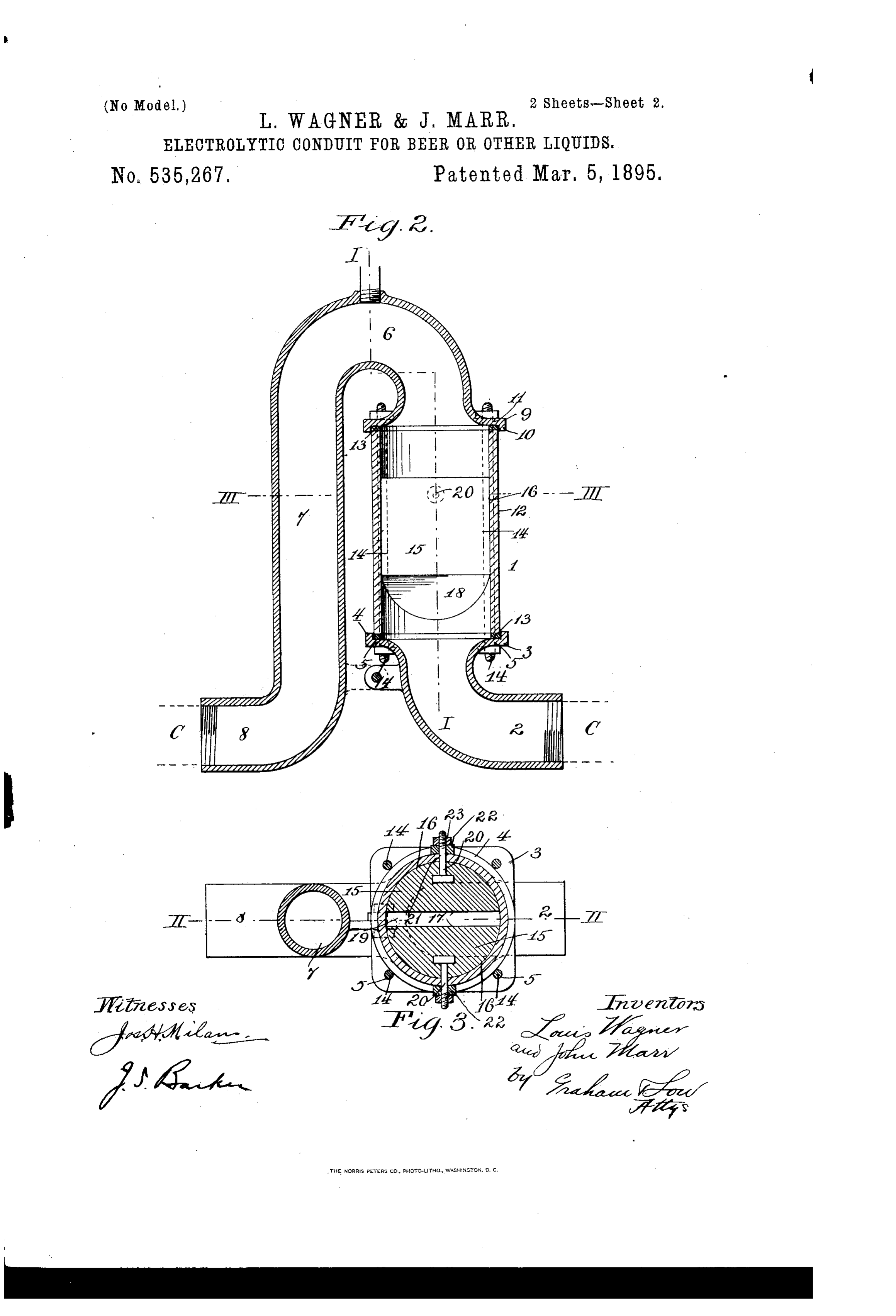
JOHN MARR, citizens of the United States of Referring to the drawings 1 is a conduit 5 5 America, residing at Baltimore, Maryland, which may be the draw-off pipe for the fine 5 have invented certain new and useful Im beer from the shavings-cask, the pipe lead provements in Electrolytic Conduits for Beer ing from the fermenting vat, or a conduit or other Liquids, of which the following is a from any desired source of supply of the specification. liquid to be treated. The lower portion of ?? Our invention relates to that class of ap this conduit is preferably an elbow 2 provided Io paratus in or by which an electric current, at its upper end with a horizontal flange 3, preferably of an alternating character, may with a vertical collar or flange 4, and within be applied to or through liquids for the pur the latter with a shoulder 5. pose, among other things, of destroying the 6 is a continuation of the conduit , in the life of organisms which would otherwise cause form of a goose-neck, the limb 7 of which re I5 the deterioration or souring of beer, or effect turns downward parallel with the ascending similar or other objectionable results in other limb of the conduit, and terminates in an liquids. elbow 8 in line with the elbow 2. The device It is the object of our invention to effect may then be conveniently interposed in any 7 ? these results in a more simple, effective and existing conduit, as C, without displacing or 2c economical manner, and to such end consists diverting the latter. The elbow is formed in a conduit provided with opposing elec with a flange 9, collar 10, and shoulder 11, trodes which limit the passage of liquid, or similar to those of the part 2. other material through the conduit and spread Interposed and held between the shoulders or disperse it in a comparatively thin sheet 5 and 11 and having its ends within the col 25 over their opposing surfaces. lars 4 and 10, is a sight-tube or section 12 It further consists in a conduit having op composed in whole or in part of suitable ma posing electrodes of peculiar shape as herein terial such as glass, So that the liquid passing after set forth. through the conduit, and any electrolyzing It further consists in a conduit which is at action upon it, may be here observed. The 3o the same time a sight-glass or tube of trans upper and lower ends of the tube 12 rest upon parent insulating material, provided interi rubber or other packing rings 13, and the orly with and Supporting opposing electrodes. parts 2 and 6 are firmly clamped upon it by It further consists in an electrolyzing de bolts 14 parallel with the tube and passing vice adapted to be interposed in a beer or through the flanges 3 and 9.
5 other conduit. The electrodes, of carbon or other suitable It further consists in certain parts and com conducting material, are indicated at 15 and binations thereof hereinafter set forth and are mounted within and insulated by the tube claimed. 12. They, in conjunction with the tube or with In order to make our invention more clearly any filling or obstructing material which may 40 understood we have shown in the accompany be employed, restrict the free passageway ing drawings means for carrying it into prac through the tube to a relatively narrow open tical effect, without limiting our improve. ing or slit 19 which is situated directly be ments, in their useful applications, to the tween the electrodes, whereby their operative 95 particular construction which, for the sake of faces, from one to the other of which the 45 illustration, we have delineated. electric current passes, are brought close to In said drawings:-Figure 1 is a vertical gether and the liquid spread and dispersed sectional view, on line I-II, Fig. 3, of a con so as to have all of its parts and organisms duit and electrodes embodying our invention. therein, efficiently treated. To this end we ?. ? ? Fig. 2 is a similar view on line II-II, Fig. 3. prefer to form the electrodes as shown, with So Fig. 3 is a horizontal sectional view on line semi-cylindrical rear faces 16 fitting closely III—III, Fig. 2. Fig. 4 is a perspective of to the wall of the tube 12, with flat opposing one of the electrodes in its preferred form. operative or conducting faces 17 and with in
Page 4
clined bottom faces 18 whereby the liquid is ticles and organisms from the middle of the 6o directed to the narrow free passage 19. Se passage 19 into contact with the electrodes. cured in or to, or formed with the electrode Such corrugation is indicated at 27 in Fig. 5. is a conductor 20 which passes through the The electrodes may be solid, or of other suit tube 12 by an aperture 21. able construction.
22 is a washer at the outside of said aper The device or apparatus may be situated at 65 ture through which also the conductor 20 any suitable point in a beer making plant, passes, and 23 is a nut Screwed upon the end and may be the means of finally drawing off of the conductor and clamping the electrode the finished beer.
I. ? in place. We claim
The source of electrical energy is indicated 1. In an apparatus for the electrical treat- to diagrammatically at 24 from the opposite poles ment of beer or other liquid, a conduit-section of which conductors 25 lead respectively to composed of glass, serving as a sight-tube and the two electrodes, and may be conveniently adapted to be interposed in a conduit, and op connected thereto by being clamped beneath. posing electrodes supported within and sub the nuts 23. stantially midway the length of said conduit- 75 Such being the arrangement of the parts it section leaving a central narrow space be will be observed that the fluid, for instance tween them for the passage of the liquid, as beer from the shavings-cask, coming along the set forth.
2 ? conduit C will be caused to pass into the elbow 2. In an apparatus for the electrical treat 2. Its course being thence upward as it ment of beer or other liquid, a conduit-section 8o passes the electrodes, it is caused by gravity composed of glass, serving as a sight-tube and to fill all parts of the tube 12 so that all the adapted to be interposed in a conduit, and op operative faces of both electrodes are encoun posing electrodes supported within and sub 25 tered by the liquid (which would not neces stantially midway the length of said conduit sarily be the case if the tube 12 lay horizon section with their adjacent faces substantially 85 tally and the flow of liquid were not suffi parallel leaving a central narrow space be cient to fill the conduit). The liquid being tween them extending diametrically across spread into a thin body or sheet by the re the conduit to expose said space to view, as stricting action of the surfaces 18, all particles set forth.
in it are brought into contact with or in close 3. In an apparatus for the electrical treat 9 O proximity to the operative faces 17 and caused ment of beer or other liquid, a tubular conduit to furnish a part of the conducting means for Section composed of non-conducting material the electric current from one such surface to and adapted to be interposed in a conduit, 35 the other, whereby any organisms are killed and opposing electrodes, each of semi-cylin or rendered harmless. By mounting the elec drical form and supported within and sub trodes entirely in a tube or chamber of non stantially midway of the length of said con conducting material, the electrical energy is duit-section with their adjacent faces sub not dissipated but caused to act through the stantially parallel leaving a central narrow electrodes alone and on the thin sheet of liq space between them for the passage of the uid between them. liquid, as set forth. . ?? 26 is a sampling and vent cock in the con 4. In an apparatus for the electrical treat duit, and preferably situated at the extreme ment of beer or other liquid, a conduit sec top of the bend 6. It serves to deliver a sam tion composed of glass, serving as a sight-tube 45 ) le of the electrically treated liquid. In case and adapted to be interposed in a conduit, the electrolytic action is sufficiently strong to and opposing electrodes having transversely decompose into gas any constituents of the ribbed faces supported within and substan liquid, such gas will collect in the bend 6, and tially midway the length of said conduit-sec may be suffered to escape through the cock tion with their adjacent ribbed faces substan 26 at intervals or as it collects, thus prevent tially parallel leaving a central narrow sinu ing its accumulation from interfering with the ous space between them for the passage of the I KU free passage of the liquid. liquid, as set forth.
In order to cause all parts of the passing In witness whereof we have here unto signed liquid to make contact with or come nearer to our names in the presence of two witnesses. 55 the electrodes, the opposing surfaces 17 of one LOUIS WAGNER. or both of the latter may be transversely JOIIN MARR. ribbed or corrugated so that the liquid next . Witnesses:
to said surfaces will be retarded, causing the CHAS. W. PARKER, liquidtoroll oversaid surfaces and bring par JNO. S. BARKER.
Provenance
- Collection
- Cited prior art
- Original PDF
- patentimages.storage.googleapis.com →
- Pages
- 4
- Method
- pdftotext (the PDF's own text layer) + pdftoppm 300dpi page scans
- Source
- Google Patents bibliographic record
- Granted
- 1895-03-05
- Transcribed from
- patentimages.storage.googleapis.com →