patent · US4798861
Surface treatment of polymers
17 January 1989
Page 1 — bibliographic record
United States Patent (19) 11 Patent Number: 4,798,861 Johnson et al. 45 Date of Patent: Jan. 17, 1989 (54) SURFACE TREATMENT OF POLYMERS 56) References Cited
(75 inventors: Ian M. Johnson; Ian M. Moody;
Peter Flesher, all of West Yorkshire, 4,021,399 5/1977 Hunter et al. ....................... 524/801 England 4,043,952 8/1977 Ganslaw .................. ... 525/360
73) Assignee: Allied Colloids Limited, England 4,645,568 2/1987 Kurps et al. ........................ 524/801 (21) Appl. No.: 934,157 Primary Examiner-Joseph L. Schofer Assistant Examiner-Peter D. Mulcahy
Attorney, Agent, or Firm-Ostrolenk, Faber, Gerb & (22 Filed: Nov. 24, 1986 Soffen 30 Foreign Application Priority Data 57 ABSTRACT Nov. 27, 1985 GB United Kingdom ................. 852.9198 The properties of water soluble or, especially water swellable polymer particles are improved by surface cross linking that is caused by providing a dispersion of 51 int. Cl'............................ C08F 2/16; C08F 8/00 gel polymer particles in an organic solvent, reacting the 52 U.S. C. .................................... 524/458; 524/460; surfaces of these particles with dissolved cross linking 524/801; 524/832; 525/360; 525/362; 525/363 agent and azeotropically distilling the dispersion.
525/360, 362,363 9 Claims, No Drawings
Page 2
SURFACE TREATMENT OF POLYMERS
stabiliser that includes hydrophobic groups and carbox ylic acid groups.
Swellable insoluble polymers are made by polymeri
It is known that polymer particles that are water sation of monomer in an aqueous phase containing dis soluble or water swellable can be preferentially cross 5 solved cross linking agent. The tendency of such parti linked at their surfaces by reaction of their surfaces with cles to be very soft and/or to stick to one another ("gel a cross linking agent, in order to increase the rate of blocking') when they are swollen is reduced by increas water absorption or water dispersability of the particles. ing the amount of cross linking agent, but this reduces In GB No. 679,716 the water dispersibility of natural the absorptive capacity. It would be desirable to soluble alginate polymers is increased by providing the 10 achieve high absorptive capacity in particles that re surface of the particles with a screening substance. In mained separate from one another even when highly particular an insoluble alginate is formed on the surface. swollen. Reduction of interparticulate adhesion would For instance the alginate particles are suspended in an also be desirable during the dissolution of soluble parti ethanolic solution of calcium chloride, in which they cles.
are not soluble, and warmed to a temperature of 50 C. 15 Despite the recommendations in U.S. Pat. No. until the alcohol has evaporated. 4,043,952 and in much of the prior art to treat dry poly In U.S. Pat. No. 3,251,814 dry polyacrylamide parti mer particles in a non-aqueous system with the surface cles, for instance made by crushing or grinding solvent cross linking agent, we have found that much better dried polyacrylamide, are slurried or otherwise con results are achieved when the polymer is highly swollen tacted with a treating solution comprising lower alka 20 by the presence therein of a large amount of water nol, water and water soluble chromic salt. The treating during crosslinking. We have found that it is possible to solution is drained or filtered off and the polymer parti obtain very satisfactory improved properties, especially cles are then dried. In another process described in this in cross-linked polymers, by a very economic process patent, acrylamide is polymerised while in aqueous even when the surfaces are contaminated by hydropho solution, chromium trichloride is added and after four 25 bic stabiliser. In particular, in the invention we can hours at 60' C. the product is diluted and methanol is achieve a greatly increased rate of water uptake and can added to precipitate the polymer. This process however also obtain a stronger gel structure without damaging apparently cannot give the desired preferential surface the gel capacity.
cross linking since the chromium cross linking agent is In the invention, polymer particles that are water present in the aqueous phase during polymerisation and 30 soluble or water swellable and that are cross linked at so presumably the particles will have substantially uni their surfaces are made by reacting the surfaces of the form cross linking throughout their diameter. particles with a dissolved first cross linking agent while In U.S. Pat. No. 4,043,952, dry particles of water-sol the particles are dispersed in an organic solvent in uble and water-swellable synthetic and natural poly which they are insoluble and then separating the parti mers are suspended in a non-solvent for the polymer 35 cles from the organic solvent, and in this process the containing a polyvalent metal compound. After heating particles are introduced into the organic solvent in the for a period of time the particles are separated, e.g., by form of gel particles containing at least 40% by weight filtration or evaporation, and the particles may then be water based on water plus polymer and the particles are further dried. The particles are dry at the time of intro dried, and the cross linking reaction completed, by duction to the non-solvent but in some of the examples azeotropic distillation of the dispersion. the non-solvent is a blend of 10% water with methanol Thus in the invention the cross linking reaction is or ethanol or 20% water with dioxane. Metal ions that performed in the present of a substantial amount of are used to crosslink the surface of the particles include water, which is introduced in the gel particles and not aluminium, chromium, zirconium, zinc, manganese, as a mixture with the organic solvent. This gives greatly cobalt, barium and tin ions. They may be introduced in 45 improved results and also has the advantages that previ any form that is ionisable or soluble in the dispersing ous drying of the polymer particles is unnecessary and medium, including materials such as aluminium isopro that the amount of water can be selected without regard poxide. to its miscibility with the organic solvent and, it also has All these methods require the initial production of the advantage that the organic solvent can be water polymer particles that are dry. Since the particles, irre 50 immiscible. This is particularly desirable as azeotropic spective of whether they are natural or synthetic poly distillation with water immiscible solvents is much more mers, are always initially produced in the form of solu easily effected, under safer azeotroping conditions, than tions or aqueous gels, they have to be dried, generally with the water miscible solvents that will form azeo by thermal drying, prior to the surface cross linking and tropes.
if aqueous cross linking agent is used they then have to 55 The water content of the gel particles is generally at be redried. least 50% by weight and often in the range 50 to 70% The known treatments can greatly improve distribu by weight.
tion of the soluble or swellable particles when added to It is generally necessary for the dispersion to be stabi excess water, and known swellable particles can have lised, during the azeotroping, by the inclusion of a dis satisfactory gel capacity. However the particles (espe cially the swellable particles) tend to absorb liquid persion stabiliser that may include an emulsifier, e.g., a fatty acid derivative, but preferably includes a poly slower than would be desired. As a result liquid, e.g., meric stabiliser. This may be any of the amphipathic urine, may run off before it can be absorbed.
Some production methods yield gel particles having polymeric stabilisers that are suitable for stabilising polymer dispersions. Suitable materials are described in very hydrophilic surfaces but others result in the parti 65 EP 0126528. They are generally copolymers of hydro cles having slightly hydrophobic surfaces, and this fur phobic monomers with hydrophilic monomers, e.g., as ther impairs the rate of water uptake. This is a particular described in that patent. The monomers may both be problem when the particles are coated by a polymeric acrylic, e.g., C8-24 alkyl esters of (meth) acrylic acid or
Page 3
N-C8-24 alkyl acrylamides or methacrylamides copo Synthetic polymers that are surface cross linked in lymerised with a non-ionic, cationic or hydrophilic the invention may be non-ionic but best results are ob acrylic monomer. When the hydrophilic monomer pro tained with mildly or highly anionic polymers, since the vides carboxylic acid (or salt) groups in the polymer, anionic groups form cross linkages with multivalent particularly beneficial results can be obtained in the 5 metal ions as cross linking agent. invention by reaction of these groups with the cross The monomer or monomers from which the syn linking agent. The amount of dispersion stabiliser is thetic polymers are formed are usually ethylenically typically 0.05 to 5% based on polymer particles (dry unsaturated, and are usually acrylic but can be other weight). vinyl monomers or allyl monomers. They are generally As is explained in more detail below, the gel polymer 10 water soluble although blends of water soluble and particles can be pre-formed and then combined with the water insoluble monomers may sometimes by used, generally provided the blendisitself water soluble. The organic solvent or they can be formed in situ in the monomers are usually 5-100% anionic and 0-95% non organic solvent and the first cross linking agent can be ionic, preferably present during their formation. 50-100% anionic and 0-50% non The polymer can be wholly naturally occurring (or 15 OC modified naturally occurring) polymer such as a gum, freeAnionic monomers may be free carboxylic acids or sulphonic acids but are usually present as salts with cellulosic or carbohydrate polymer. Preferably how alkali, usually sodium ever the polymer comprises a synthetic polymer formed boxylic monomers mayorbe potassium, or ammonia. Dicar present as anhydrides. Suit from a water soluble monomer or monomer blend. It able carboxylic acids include may consist of such synthetic polymer or it may com acid, maleic acid and itaconicacrylic acid. acid, methacrylic
Suitable sulphonic prise a blend of synthetic polymer with a naturally acids include styrene sulphonic acid and 2-acrylamido occurring polymer.
The dispersion of polymer in water-immiscible liquid 2-methyl propane sulphonic acid. Suitable non-ionic used in the process may be the product of a process in 25 N-substitutedinclude monomers acrylamide, methacrylamide and acrylamides, and hydroxy alkyl acrylates which an aqueous solution of a polymer is dispersed such as hydroxyethyl acrylate or methacrylate. Partic into a water-immiscible liquid and the resultant disper ularly preferred polymers are those formed from acrylic sion is azeotroped. For example, any of the processes acid (generally as sodium salt) homopolymer or copo discussed in EP No. 0128661 may be used. Such a pro lymerised with, usually, a minor amount of acrylamide. cess is of particular use for the treatment of natural 30 The polymer can be water soluble and linear (and the water-soluble polymers such as cellulosics or xanthan polymerisation or other biopolymers. The dissolved cross linking agent a cross linkingisagent therefore conducted in the absence of in the aqueous polymerisation may be incorporated, for example, after partial drying phase). However the invention is of most value when but before final azeotroping.
When the polymer comprises synthetic polymer 35 the able polymer is a cross linked insoluble but water swell polymer as a result of including second cross link formed from water soluble monomer or monomer blend ing reagent in the aqueous polymerisation mixture. This by gel polymerisation, the dispersion of gel particles reagent must therefore be soluble in the aqueous mono containing at least 40% by weight water may be pro mer. Usually the amount of such a reagent is more than duced by granulating an aqueous polymer gel and 10 ppm, often more than 50 ppm. Usually the amount is blending it with the organic solvent. For instance the below 3000 ppm, and often below 1000 ppm. Best re monomer or monomer blend may be subjected to bulk sults are generally achieved at values of 100 to 500ppm. gel polymerisation and the resultant aqueous polymer The second cross linking agents can be any of the gel granulated in known manner. For instance it may be ionic or covalent cross linking agents suitable for cross granulated by shearing or milling in a liquid medium, linking polymers formed from water soluble monomers, which may be the organic solvent, or it may be commi 45 but are preferably water soluble di- or poly-ethyleni nuted in known manner in air and the resultant particles cally unsaturated compounds.
stirred into the organic solvent. If desired the gel may Examples of suitable polyfunctional compounds in be partially dried before the particles are blended with clude divinyl compounds such as divinyl benzene and the organic solvent but it is economically wasteful, and divinyl diethylene glycol diether; allyl compounds such technically undesirable, to dry the gel to a water con SO as ally methacrylate, allyl acrylate, diallyl phthalate tent below the 40% or higher water content that is to and diallyl sucrose; polyfunctional acrylates and meth prevail during the cross linking reaction. acrylates such as glycol diacrylate, glycol dimethacry When the polymer gel is to be made by bulk gel late, pentaethritol tetra-acrylate and trimethylol pro polymerisation, it may consist solely of synthetic poly pane trimethacrylate; polyfunctional acrylamides and mer or it may comprise both natural and synthetic poly 55 methacrylamides such as N,N' methylene bis acrylam mers. It may be the product of a graft copolymerisation ide; N-methylolacrylamide, poly-N-methylol acrylam process of water-soluble polymerisable monomers onto ide, glycidyl acrylate, glycidyl methacrylate, polyol a carbohydrate or derivatives and/or it may be a physi polyglycidal ethers such as ethylene glycol diglycidyl cal blend (i.e. non-chemically linked) of synthetic and ether, and epichlorohydrin.
natural polymer, for example produced by the 60 The polymerisation mixture may contain other con polymerisation of water-soluble polymerisable mono ventional ingredients, for example initiators. Typically mer in the presence of dissolved or swollen natural the initiators will be redox or thermal initiators. polymer, generally carbohydrate. Preferably the gel particles are made by reverse phase In particular exothermic bulk gel polymerisation may polymerisation of aqueous monomer or monomer blend be conducted on a mixture of polymerisable monomers 65 in the organic solvent, which must therefore be a water and ungelatinised polysaccharide, whereby the polysac immiscible solvent. Thus an aqueous solution of the charide is gelled by the exotherm, as described in No. monomer or monomer blend is dispersed in a continu WO86/00315. ous phase of the water immiscible liquid containing
Page 4
polymeric stabiliser, and the monomer is polymerised, aqueous solution of first cross linking agent into the all in conventional manner for reverse phase polymeri water immiscible liquid, since emulsification will result sation processes. in the aqueous solution being imbibed by the surfaces of Accordingly, a preferred process for making polymer the polymer gel particles in the liquid. Similarly, when particles that are water soluble or swellable and that are the organic solvent is a water miscible solvent into crosslinked at their surfaces and that are formed from a which pre-formed polymer is dispersed useful results water soluble monomer or monomer blend comprises can be achieved by dissolving the first cross linking forming the particles by reverse phase polymerisation, agent into the water miscible solvent. in a water immiscible solvent containing polymerisation The first cross linking agent can be any compound stabiliser, of the monomer or monomer blend while 10 that can be in solution in the dispersion, either dissolved dissolved in water in an amount sufficient to give at in the surface layer of the water phase of the polymer least 40% water based on water plus polymer, cross gel particles or preferably, dissolved in the organic linking the surfaces of the particles while dispersed in solvent phase and substantially insoluble in the aqueous the solvent by reaction with a dissolved first cross link phase. The first cross linking agent can be any of the ing agent and drying the particles, and completing the 15 covalent cross linking agents discussed above as second cross linking reaction, by azeotropic distillation of the crosslinking agents but preferably the first crosslinking organic solyent. agent is a polyvalent metal. This may be introduced in When the first cross linking agent is added to the the form of an oil soluble derivative of the metal or it dispersion after the formation of the gel polymer parti may be introduced in some other form that will react cles but before the azeotroping, we find the product has 20 with other chemical species in the dispersion, e.g., with much better properties than when it is added after azeo stabiliser or emulsifier, to form a suitable oil soluble troping (i.e., after the particles are dry). Thus there is derivative. This reaction appears to be especially benefi more uniform, and especially more rapid uptake, of cial when the stabiliser includes anionic groups and the water and less gel blocking, especially when the parti first cross linking agent is a polyvalent metal. cles were initially cross linked. 25 The metal must have a valency of at least 2 and pref These improvements are achieved to a much larger erably 3. For example the metal may comprise barium, extent by including the first cross linking agent in the calcium, zinc, manganese, tin, zirconium, chromium or solvent during the polymerisation, especially when the other transition metals, but aluminium is preferred. Suit polymerisation mixture also includes a water-soluble able oil soluble derivatives are organometallic com second cross linking agent in the aqueous phase. Nor 30 pounds having sufficient hydrophobicity in the organic mally the first cross linking agent is insoluble in water part moiety that they partition into the water-immisci and is dissolved into the organic solvent before the polymerisation starts, although useful effects can also be ble solvent phase. The derivatives may be selected from salts of organic acids, metal complexes, such as amine or obtained if it is added during polymerisation. Thus a ammonium complexes, metal alkoxides, metal alkyls preferred process comprises forming a suspension of an 35 and metal acetyl acetonates. Preferred examples are aqueous solution of one or more monomers including a alkoxides having from 2 to 10 carbon atoms in the alkyl water soluble second cross linking agent within a water group, generally from 3 to 6 carbon atoms. Readily immiscible solvent in which is dissolved a water insolu available compounds are propoxides and butoxides, ble first cross linking agent and that also includes a especially isopropoxide and secondary butoxide deriva polymeric stabiliser inducing polymerisation and then tives of multivalent metals, the most preferred com azeotroping. pound being aluminium isopropoxide alone or mixed The resultant polymer particles can have rapid water with aluminium secondary butoxide.
uptake and high gel capacity but can be very much drier The organic solvent is generally water immiscible to the touch and very much more easily separated into and it must consist of or include a volatile solvent capa individual particles, even when highly swollen, than 45 ble of forming an azeotrope with water. Usually in conventional particles. This ease of separation and dry addition to that solvent, it will include a less volatile sensation is, prior to the invention, normally associated solvent. The components are selected from those con with very high levels of internal cross linking and, ventionally used for reverse phase polymerisation such therefore, low gel capacity. The invention permits the as aliphatic, aromatic and napthenic hydrocarbon sol dry firm gel structure to be obtained at a much higher 50 vents and oils e.g. mineral, diesel and vegetable oils, gel capacity than previously. chlorinated hydrocarbons and aromatic or higher ali The reverse phase polymerisation is normally con phatic esters such as fatty glycerides, dibutyl phthalate ducted as a reverse phase suspension polymerisation to and dioctylphthalate, and mixtures of any of these. The form particles typically having a dry size of at least 30 liquids are inert non-solvents for the water-soluble or microns. It is very surprising that better results are 55 water-swellable polymer and should be non-toxic. achieved by polymerising the corresponding monomer The dispersion that is azeotroped generally contains a droplets in an organic solution of the first cross linking stabiliser and/or water-in-oil emulsifier. Conventional agent than by polymerising them in an organic solvent water-in-oil emulsifiers such as are known to be useful and then adding the first cross linking agent or by incor in process in which water-in-oil dispersions are azeo porating both first and second crosslinking agents in the troped may be used in the process. A stabiliser may be monomer droplets. for instance an amphipathic polymeric stabiliser, such as Generally it is preferred for all processes that the first the stabilisers describes in, for instance, EP No. 126528. cross linking agent should be soluble in the organic When, as is preferred, the dispersion is initially made by solvent and generally it is preferred for all processes reverse phase polymerisation process then the stabiliser that it should be insoluble in water. However when 65 present for this purpose will usually be satisfactory for using a natural polymer or a previously formed reverse stabilising the dispersion during the azeotroping step. phase or comminuted gel polymer, useful results can After forming the dispersion of gel particles in the sometimes be achieved by, for instance, emulsifying an organic solvent in the presence of the dissolved first
Page 5
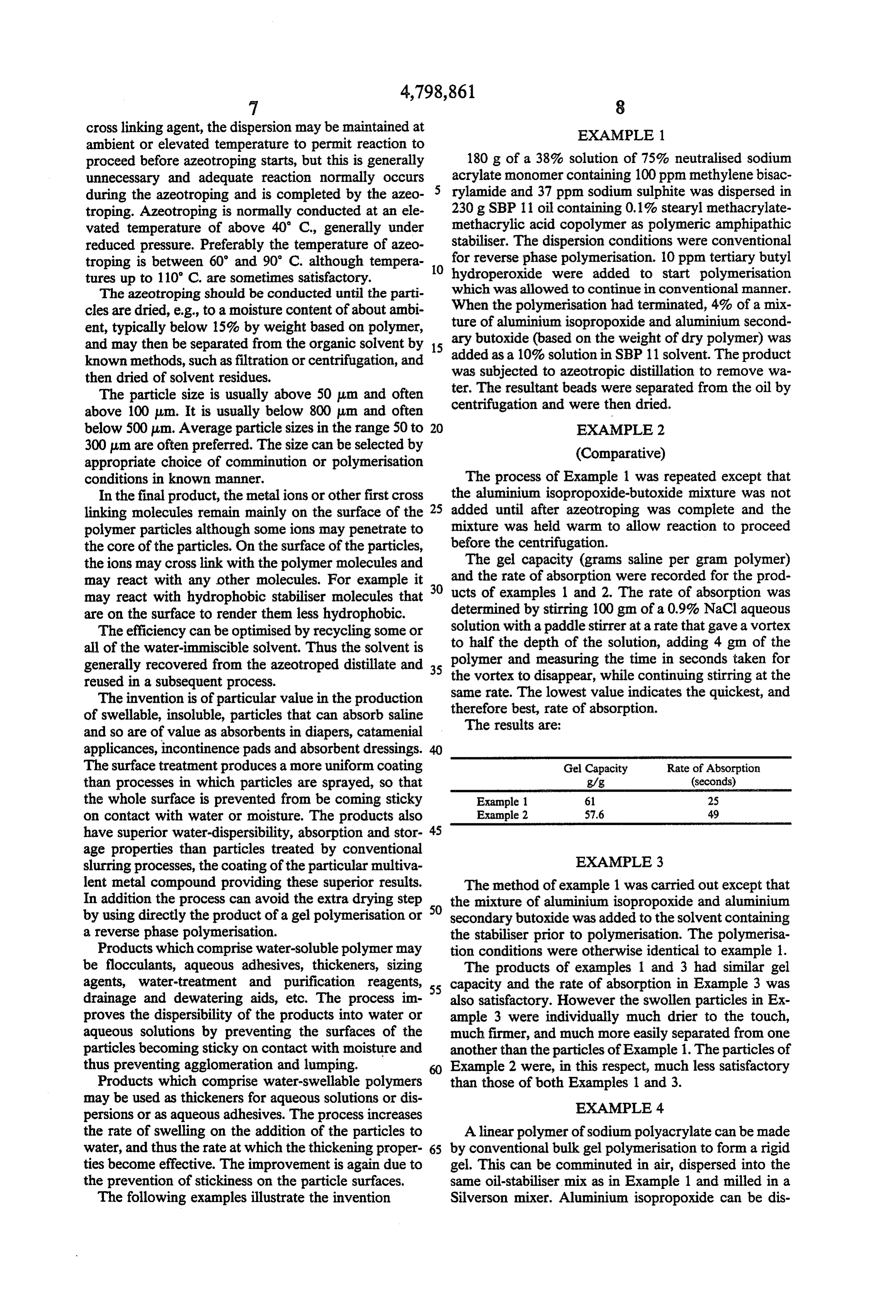
cross linking agent, the dispersion may be maintained at EXAMPLE 1 ambient or elevated temperature to permit reaction to proceed before azeotroping starts, but this is generally 180 g of a 38% solution of 75% neutralised sodium unnecessary and adequate reaction normally occurs acrylate monomer containing 100 ppm methylene bisac during the azeotroping and is completed by the azeo rylamide and 37 ppm sodium sulphite was dispersed in troping. Azeotroping is normally conducted at an ele 230 g SBP 11 oil containing 0.1% steary methacrylate vated temperature of above 40 C., generally under methacrylic acid copolymer as polymeric amphipathic reduced pressure. Preferably the temperature of azeo stabiliser. The dispersion conditions were conventional troping is between 60 and 90° C. although tempera O for reverse phase polymerisation. 10 ppm tertiary butyl tures up to 110' C. are sometimes satisfactory. hydroperoxide were added to start polymerisation The azeotroping should be conducted until the parti which was allowed to continue in conventional manner. cles are dried, e.g., to a moisture content of about ambi When the polymerisation had terminated, 4% of a mix ent, typically below 15% by weight based on polymer, ture of aluminium isopropoxide and aluminium second and may then be separated from the organic solvent by 15 ary butoxide (based on the weight of dry polymer) was added as a 10% solution in SBP 11 solvent. The product known methods, such as filtration or centrifugation, and was then dried of solvent residues. subjected to azeotropic distillation to remove wa ter. The
The particle size is usually above 50 m and often centrifugation resultant beads were separated from the oil by above 100 p.m. It is usually below 800 m and often and were then dried. below 500 am. Average particle sizes in the range 50 to EXAMPLE 2 300 pm are often preferred. The size can be selected by (Comparative) appropriate choice of comminution or polymerisation conditions in known manner. The process of Example 1 was repeated except that In the final product, the metal ions or other first cross the aluminium isopropoxide-butoxide mixture was not linking molecules remain mainly on the surface of the 25 added until after azeotroping was complete and the polymer particles although some ions may penetrate to mixture was held warm to allow reaction to proceed the core of the particles. On the surface of the particles, before the centrifugation.
the ions may cross link with the polymer molecules and The gel capacity (grams saline per gram polymer) may react with any other molecules. For example it 30 and the rate of absorption were recorded for the prod may react with hydrophobic stabiliser molecules that ucts of examples 1 and 2. The rate of absorption was are on the surface to render them less hydrophobic. determined by stirring 100gm of a 0.9% NaCl aqueous The efficiency can be optimised by recycling some or solution with a paddle stirrer at a rate that gave a vortex all of the water-immiscible solvent. Thus the solvent is to half the depth of the solution, adding 4 gm of the generally recovered from the azeotroped distillate and 35 polymer and measuring the time in seconds taken for the vortex to disappear, while continuing stirring at the reused in a subsequent process.
The invention is of particular value in the production same rate. The lowest value indicates the quickest, and of swellable, insoluble, particles that can absorb saline therefore best, rate of absorption. The results are:
and so are of value as absorbents in diapers, catamenial applicances, incontinence pads and absorbent dressings.
The surface treatment produces a more uniform coating Gel Capacity Rate of Absorption than processes in which particles are sprayed, so that g/g (seconds) the whole surface is prevented from be coming sticky Example 1 61 25 on contact with water or moisture. The products also Example 2 57.6 49 have superior water-dispersibility, absorption and stor age properties than particles treated by conventional slurring processes, the coating of the particular multiva EXAMPLE 3 lent metal compound providing these superior results. The method of example 1 was carried out except that In addition the process can avoid the extra drying step 50 the mixture of aluminium isopropoxide and aluminium by using directly the product of a gel polymerisation or secondary butoxide was added to the solvent containing a reverse phase polymerisation. the stabiliser prior to polymerisation. The polymerisa Products which comprise water-soluble polymer may tion conditions were otherwise identical to example 1. be flocculants, aqueous adhesives, thickeners, sizing The products of examples 1 and 3 had similar gel agents, water-treatment and purification reagents, 55 capacity and the rate of absorption in Example 3 was drainage and dewatering aids, etc. The process im also satisfactory. However the swollen particles in Ex proves the dispersibility of the products into water or ample 3 were individually much drier to the touch, aqueous solutions by preventing the surfaces of the much firmer, and much more easily separated from one particles becoming sticky on contact with moisture and another than the particles of Example 1. The particles of thus preventing agglomeration and lumping. Example 2 were, in this respect, much less satisfactory Products which comprise water-swellable polymers than those of both Examples 1 and 3.
may be used as thickeners for aqueous solutions or dis EXAMPLE 4 persions or as aqueous adhesives. The process increases the rate of swelling on the addition of the particles to A linear polymer of sodium polyacrylate can be made water, and thus the rate at which the thickening proper 65 by conventional bulk gel polymerisation to form a rigid ties become effective. The improvement is again due to gel. This can be comminuted in air, dispersed into the the prevention of stickiness on the particle surfaces. same oil-stabiliser mix as in Example 1 and milled in a The following examples illustrate the invention Silverson mixer. Aluminium isopropoxide can be dis
Page 6
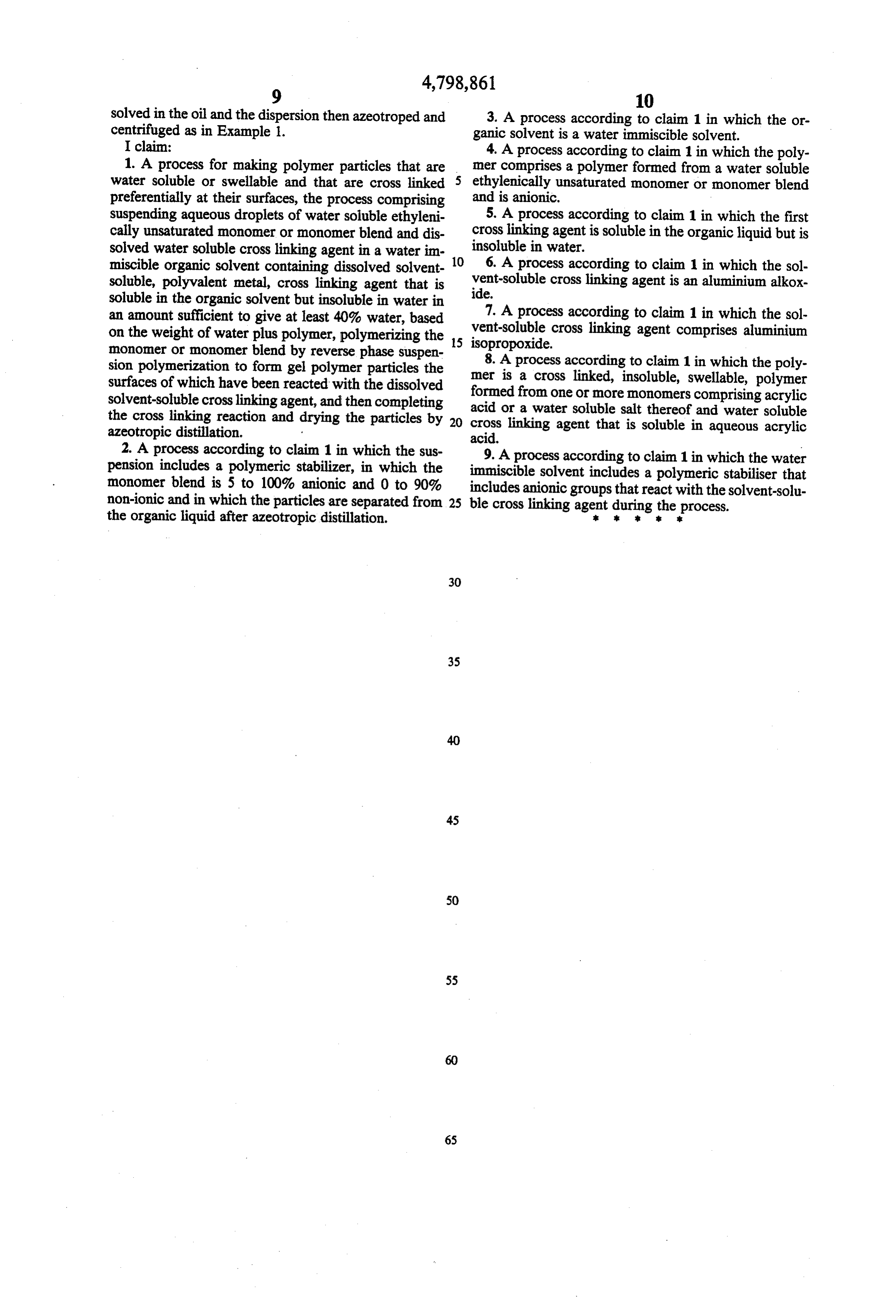
solved in the oil and the dispersion then azeotroped and 3. A process according to claim 1 in which the or centrifuged as in Example 1. ganic solvent is a water immiscible solvent. I claim: 4. A process according to claim 1 in which the poly 1. A process for making polymer particles that are mer comprises a polymer formed from a water soluble water soluble or swellable and that are cross linked ethylenically unsaturated monomer or monomer blend preferentially at their surfaces, the process comprising and is anionic.
suspending aqueous droplets of water soluble ethyleni 5. A process according to claim 1 in which the first cally unsaturated monomer or monomer blend and dis cross linking agent is soluble in the organic liquid but is solved water soluble cross linking agent in a water im 10 insoluble in water.
miscible organic solvent containing dissolved solvent 6. A process according to claim 1 in which the sol soluble, polyvalent metal, cross linking agent that is ide.vent-soluble cross linking agent is an aluminium alkox soluble in the organic solvent but insoluble in water in 7. A process according to claim 1 in which the sol an amount sufficient to give at least 40% water, based vent-soluble on the weight of water plus polymer, polymerizing the 15 isopropoxide. cross linking agent comprises aluminium monomer or monomer blend by reverse phase suspen 8. A process according to claim 1 in which the poly sion polymerization to form gel polymer particles the surfaces of which have been reacted with the dissolved mer is a cross linked, insoluble, swellable, polymer solvent-soluble crosslinking agent, and then completing formed from one or more monomers comprising acrylic acid or a water soluble salt thereof and water soluble the cross linking reaction and drying the particles by 20 cross linking agent that is soluble in aqueous acrylic azeotropic distillation. acid.
2. A process according to claim 1 in which the sus 9. A process according to claim 1 in which the water pension includes a polymeric stabilizer, in which the immiscible solvent includes a polymeric stabiliser that monomer blend is 5 to 100% anionic and 0 to 90% includes anionic non-ionic and in which the particles are separated from 25 ble cross linkinggroups agent that react with the solvent-solu during the process.
the organic liquid after azeotropic distillation. ak
Provenance
- Collection
- Cited prior art
- Original PDF
- patentimages.storage.googleapis.com →
- Filed
- 1986-11-24
- Pages
- 6
- Method
- pdftotext (the PDF's own text layer) + pdftoppm 300dpi page scans
- Source
- Google Patents bibliographic record
- Granted
- 1989-01-17
- Inventors
- Ian M. Johnson; Ian M. Moody; Peter Flesher; Allied Colloids Ltd
- Transcribed from
- patentimages.storage.googleapis.com →