patent · US3983005
Integral element for the analysis of cholesterol
28 September 1976
Page 1 — bibliographic record
United States Patent (19) [11] 3,983,005 Goodhue et al. (45) Sept. 28, 1976 54) INTEGRAL ELEMENT FOR THE ANALYSIS OTHER PUBLICATIONS
OF CHOLESTEROL
75 Inventors: Charles T. Goodhue; Hugh A. "Method and Composition for Blood Serum Choles Risley; Roy E. Snoke; Gary M. terol Analysis" Research Disclosure vol. 127 pp.
Underwood, all of Rochester, N.Y.
73) Assignee: Eastman Kodak Company, Primary Examiner-A. Louis Monacell Rochester, N.Y. Assistant Examiner-C. A. Fan (22 Filed: Apr. 7, 1975 Attorney, Agent, or Firm-Arthur L. Girard (21) Appl. No.: 565,897 57 ABSTRACT Related U.S. Application Data An integral analytical element for analysis of liquids 63l Continuation-in-part of Ser. No. 454,621, March 25, for their cholesterol content is disclosed. The element 1974, abandoned. is of the type which comprises at least two superposed layers including a spreading layer and a reagent layer 52 U.S. Cl........................... 195/103.5 R; 195/127 in fluid contact and, optionally, a support. Cholesterol 511 Int. Cl'............................................ C12K 1104 oxidase and a composition for the hydrolysis of cho 58) Field of Search..................... 195/127, 103.5 R; lesterol esters comprising lipase having cholesterol es 23/253 TP terase activity and protease are included in the ele ment such that cholesterol esters contained in a sam 56) References Cited ple applied to the spreading layer are saponified to UNITED STATES PATENTS free cholesterol and free cholesterol is decomposed in 3,298,789 1/1967 Mast ............................ 95/103.5 R the presence of cholesterol oxidase to produce a de 3,607,093 9/1971 Stone........................... 195/103.5 R tectable change related to the total cholesterol con 3,798,004 3/1974 Zerachia et al................. 23/253 TP tent of the sample.
3,802,842 4/1974 Lange et al.................. 195/103.5 R 3,847,553 1 1/1974 Verbeck ..................... 195/27 67 Claims, 3 Drawing Figures
Page 2
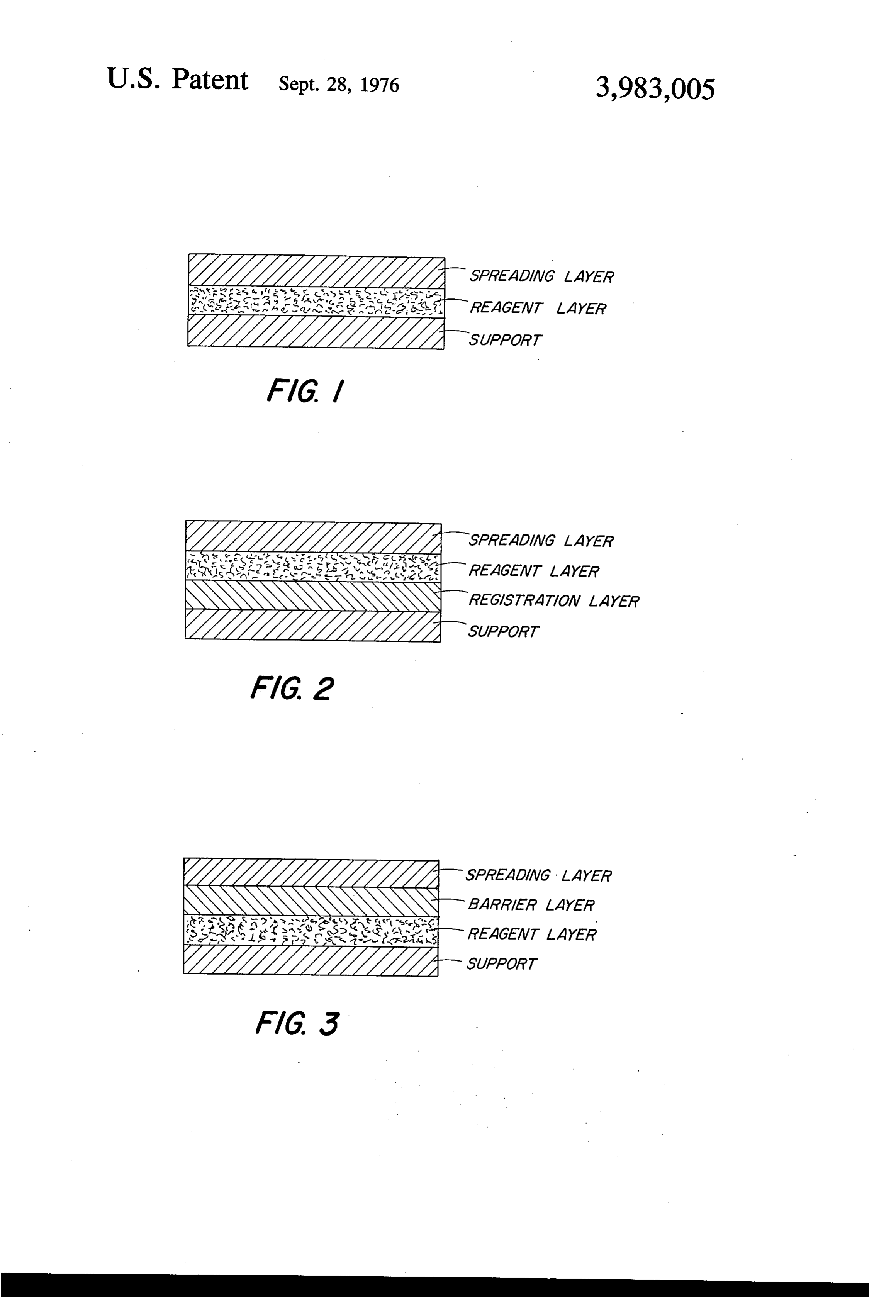
Drawing sheet — no readable text.
Page 3
INTEGRAL ELEMENT FOR THE ANALYSIS OF
aforementioned Research Disclosure, Vol. 126, pp. 46
CHOLESTEROL
-50 (1974), to assay for free cholesterol. The method of this
This application is a continuation-in-part of U.S. still requires German publication is a solution method and the handling of corrosive materials to
Patent Application Ser. No. 454,621 filed Mar. 25, 5 hydrolyze the cholesterol esters which may be present 1974 and now abandoned. in blood serum in addition to the sometimes unwieldy BACKGROUND OF THE INVENTION handling of solutions to perform the assay. There is no 1. Field of the Invention suggestion in either of these references to use choles The present invention relates to integral elements for 10 terol
oxidase in an essentially dry analytical web.
Pat. No. 3,607,093 to Stone issued Sept. 21, the essentially dry analysis of total cholesterol in aque 1971 suggests incorporating cholesterol oxidase into ous solutions, such as blood serum.
2. Description of Related Art liquid permeable membranes of uniform composition Known quantitative analyses of total cholesterol (i.e., useful in the assay of, for example, biological fluids. the sum of both free and esterified cholesterol) aque 15 There total is no suggestion that an assay composition for cholesterol including free and esterified choles ous solutions such as blood serum, have generally in volved the handling of corrosive chemicals to hydro terol can be incorporated into a membrane of this or lyze the cholesterol esters to free cholesterol (i.e., any other type.
chemically unreacted or combined cholesterol in its Belgian Pat. No. 81 1,728 describes a composition molecular form) and analyze for free cholesterol such 20 and method for the determination of total cholesterol. techniques are generally complex and not easily auto The composition comprises a chemical system having mated. In the best known conventional technique, cholesterol oxidase activity and a chemical system hav blood serum is extracted with an organic solvent, cho ing cholesterol ester hydrolase activity obtained lesterol esters in the extract are saponified with alco through the extraction of animal or human pancreas, holic KOH and free cholesterol is isolated and assayed 25 liver or intestines and means for determining hydrogen using known techniques which generally involve the peroxide released by the action of the cholesterol oxi handling of corrosive chemicals such as fuerric per dase on cholesterol released by the cholesterol ester chlorate and sulfuric acid. hydrolase. According to this patent, the cholesterol The incorporation of reagent sequences of this type ester hydrolase requires the presence of abiliary cofac into “dry” analytical systems is, quite obviously, very 30 tor and specifically prescribes that the test composition difficult if not impossible.
Belgian Pat. No. 801,742 describes unique integral be free of proteolytic activity. There therefore exists a need for further simplified assays for total cholesterol, elements for use in the qualitative and quantitative to avoid analysis of liquids such as blood serum and urine, which chemicalthe undesirable reagent handling and complex elements preferably comprise a porous spreading layer quired for this assay. and preparations currently re
in fluid contact or communication with a reagent layer which comprises at least one material interactive with a SUMMARY OF THE INVENTION component or decomposition product of a component The elements and compositions of the present inven of the liquid. This patent includes no suggestion that tion any total cholesterol assay composition, much less one 40 terolprovide a greatly simplified assey for total choles of the type described herein, could be incorporated venient form whichsubstantially which utilizes dry reagents in a con requires no reagent mixing and into a dry analytical element.
Research Disclosure, Vol. 127, pp. 54-56 (1974), which can be almost totally automated to permit rapid determination of total cholesterol with a minimum of describes a totally enzymatic method for the hydrolysis laboratory technician participation. of cholesterol esters in solution using a lipase having 45 cholesterol esterase activity and a protease. There is no According to the present invention there are pro suggestion that the hydrolysis technique can be incor vided integral elements for the analysis of total choles porated into an essentially dry web-form analytical terol in aqueous liquids containing cholesterol and/or element useful for total cholesterol assay. cholesterol esters. The element comprises a spreading Research Disclosure, Vol. 127, pp. 39-42 (1974), 50 layer in fluid contact with a reagent layer and contains describes a totally enzymatic, quantitative, single solu a. a cholesterol ester hydrolyzing composition com tion assay for cholesterol in aqueous solutions contain prising lipase having cholesterol esterase activity ing both free and esterified cholesterol using the fore and protease; and going cholesterol hydrolysis technique combined with a b. cholesterol oxidase.
cholesterol oxidase degradation of free cholesterol. 55 The various materials are disposed within the ele The assay solution may also include a hydrogen perox ment so that cholesterol is released when the choles ide detection system based on a peroxidase containing terol esters within a liquid sample are saponified by the indicator system of the type which has been used for hydrolyzing composition and free cholesterol is decom glucose and uric acid assay. There is no indication in posed in the presence of cholesterol oxidase, to pro that publication that the assay composition can be used 60 duce in the element a detectable change that is related, in an essentially dry web-form element. preferably quantitatively, to the total cholesterol con The preparation of cholesterol oxidase is described in tent of the liquid sample. Optionally, the element may Research Disclosure, Vol. 126, pp. 46-50, (1974), and include a support.
German Offenlegungsschrift 2,246,695 published Mar. The cholesterol oxidase and the cholesterol ester 26, 1973. 65 hydrolyzing compositions are preferably incorporated German Offenlegungsschrift No. 2,246,695 pub into the element as follows:
lished Mar. 26, 1973 describes the use of a cholesterol a. both in the reagent layer; oxidase enzyme different from that described in the b. both in the spreading layer; or
Page 4
c. the cholesterol ester hydrolyzing composition in ter. As such, the uniform concentration can also be the spreading layer and some or all of the choles termed a uniform apparent concentration. (The terol oxidase in the reagent layer. spreading layer is synonymously referred to herein as The reagent layer optionally contains an indicator the metering layer.) In the context of this invention, the composition which can react with at least one decom spread component will, of course, include one or more position product of cholesterol to produce in the ele of cholesterol, cholesterol esters or decomposition ment a detectable change such as a color change, re products of cholesterol. It will be appreciated that such lated to the total cholesterol concentration of a liquid an apparent concentration can be achieved with con sample applied to the element. centration gradients present through the thickness of or In a highly preferred embodiment, the cholesterol O otherwise in the spreading layer. Such gradients do not ester hydrolyzing composition and the cholesterol oxi present any difficulty to obtaining quantitative test dase are contained in a spreading layer which is sepa results and can be accommodated using known calibra rated from a reagent layer containing an indicator com tion techniques.
position by an intervening hydrophilic barrier layer The spreading layer can be an isotropically porous selectively permeable to hydrogen peroxide. In this 15 layer. Reference herein to isotropic porosity identifies embodiment, the indicator composition preferably pro the fact of substantial porosity in all directions within duces a photometrically quantifiable product. the spreading layer. It will be understood that the de DESCRIPTION OF THE DRAWINGS gree of such porosity may be variable, if necessary or desirable, for example, regarding pore size, percentage
FIGS. 1, 2 and 3 depict various alternative embodi 20 of void volume or otherwise. It shall be understood that ments of the analytical elements described in the in the term isotropic porosity (or isotropically porous) as stant application. used herein should not be confused with the terms DESCRIPTION OF PREFERRED EMBODIMENTS isoporous or ionotropic often used with reference to filter membranes to signify those membranes having
Integral analytical elements having a spreading layer 25 pores that are continuous between membrane surfaces. and a reagent layer are described in copending U.S. Likewise, isotropic porosity should not be confused Patent Application Ser. No. 538,072 filed Jan. 2, 1975 with the term isotropic, used in contradistinction to the in the names of E. P. Przybylowicz and A. G. Millikan. term anisotropic, which signifies filter membranes hav The elements described herein comprise: ing a thin “skin' along at least one surface of the mem 1. a spreading layer which serves to deliver uniform 30 brane. See for example, Membrane Science and Tech concentrations of analyte per unit to; nology, James Flinn Ed, Plenum Press, New York 2. a reagent layer in fluid contact with the spreading (1970).
layer; and As will be appreciated, the extent of spreading is 3. optionally, a support. dependent in part on the volume of liquid to be spread. Various reagents which serve to hydrolyze choles 35 However, it should be emphasized that the uniform terol esters contained in a liquid sample applied to the apparent concentration obtained with spreading is sub spreading layer, to decompose cholesterol including stantially independent of liquid sample volume and will cholesterol liberated by such hydrolysis and to provide occur irrespective of the extent of spreading. As a re detectable changes related to the total cholesterol con sult, elements of this invention generally do not require tent of the liquid are incorporated into one or more 40 precise sample application techniques. However, a layers of the element. particular liquid sample volume may be desirable for Reference herein to fluid contact between a spread reasons of preferred spread times or the like. Because ing layer and a reagent layer in an integral analytical the elements of this invention are able to produce element identifies the ability of a fluid, whether liquid 45 quantitative results using very small sample volumes or gaseous, to pass in such element between super that can be entirely taken up within a conveniently posed regions of the spreading layer and the reagent sized region of the spreading layer (e.g., one square layer. Stated in another manner, fluid contact refers to centimeter), there is no need to remove excess mois the ability to transport components of a fluid between ture from the element after application of a liquid sam the layers in fluid contact. Although such layers in fluid 50 ple. Further, because spreading occurs in the spreading contact can be contiguous, they may also be separated layer and the spread component is provided to the fluid by intervening layers as described in detail hereinafter. contacting reagent layer without apparent substantial However, layers in the element that physically inter lateral hydrostatic pressure, there is not the “ringing' vene a spreading layer and reagent layer in mutual fluid problem often seen with prior analytical elements when contact will not prevent the passage of fluid between 55 soluble reagents were used.
the fluid contacting spreading and reagent layers. The spreading layer need only produce a uniform The Spreading Layer: As used herein, the term concentration of spread component per unit area at its spreading layer refers to a layer, isotropically porous or surface facing a reagent layer with which the spreading otherwise, that can accept a liquid sample, whether layer is in fluid contact, and it is very convenient to applied directly to the spreading layer or provided to it determine whether a particular layer can be suitable for from a layer or layers in fluid contact with the spread 60 spreading purposes by means of the simple test de ing layer, and within the layer distribute (i.e., meter) scribed in the aforementioned Przybylowicz and Milli the solvent or dispersion medium of the sample and at kan application Ser. No. 538,072, and incorporated least one dissolved or dispersed component such that a herein by reference.
uniform concentration of such component is provided Isotropically porous layers can be prepared using a at the surface of the spreading layer facing the reagent 65 variety of components. In one aspect, particulate mate layer(s) of the element. It should be understood that rial can be used to form such layers, wherein the iso the uniformity of such concentration is a uniformity as tropic porosity is created by interconnected spaces measured by techniques like those described hereinaf between the particles. Various types of particulate
Page 5
matter, all desirably chemically inert to sample compo products of cholesterol. Exemplary interactive materi nents under analysis, are useful. Pigments, such as tita als are discussed hereinafter under "Reagents'. nium dioxide, barium sulfate, zinc oxide, lead oxide, The distribution of interactive materials (i.e., re etc., are desirable. Other desirable particles are diato agents) can be obtained by dissolving or dispersing maceous earth and microcrystalline colloidal materials them in the matrix material. Although uniform distribu derived from natural or synthetic polymers. Such mi tions of reagents are often preferred, they may not be crocrystalline materials are described in an article enti necessary if the interactive material is, for example, an tled "Colloidal Macromolecular Phenomena, Part II, enzyme such as cholesterol oxidase. Novel Microcrystals of Polymers' by O. A. Battista et 10 Desirably, reagent layers are uniformly permeable to al published in the Journal of Applied Polymer Science, such spread components. Uniform permeability of a Vol. II, pages 481-498 (1967). Microcrystalline cellu layer refers to permeability such that, when a homoge lose, which is commercially available from FMC Cor neous fluid is provided uniformly to a surface of the poration under the name Avicel, is an example of such layer, measurements of the concentration of such fluid within the layer, made with identical equipment and a colloidal material which is satisfactory for use in the under present invention. Spherical particles of uniform size or 15 gions identical conditions but through different re of a surface of the layer, will yield (i.e., be capa sizes, such as resinous or glass beads, can also be used ble of yielding) and may be particularly desirable where uniform pores uniform permeability, substantially equal results. By virtue of are advantageous, such as for selective filtration pur ents within, for example, undesirable concentration gradi poses. If a particulate material of choice is not adher 20 a reagent layer as described ent, as in the case of glass beads or the like, it can be herein, are avoided.
treated to obtain particles that can adhere to each registrationThe choice of a matrix material for the reagent or other at points of contact and thereby facilitate forma able and dependent layers described herein is, of course, vari tion of an isotropically porous layer. As an example of the element as well asonthetheparticular intended method of use of suitable treatment, non adherent particles can be 25 als which are incorporated therein asinteractive materi coated with a thin adherent layer, such as a solution of after. Desirable matrix materials candescribed herein include hydro hydrophilic colloid like gelatin or polyvinyl alcohol, and brought into mutual contact in a layer. When the philic materials including both naturally occurring sub stances like gelatin, gelatin derivatives, hydrophilic colloid (i.e., binder) coating dries, the layer integrity is cellulose derivatives, polysaccharides such as dextran, maintained and open spaces remain between its com 30 gum arabic, agarose and the like, and also synthetic ponent particles. substances such as water-soluble polyvinyl compounds As an alternative or in addition to such particulate like poly(vinyl alcohol) materials, the spreading layer can be prepared using an acrylamide polymers, etc.and poly(vinyl pyrrollidone), isotropically porous continuous polymer phase. It is as cellulose esters and the like can also materials Organophilic such be useful, and possible to prepare such polymers using techniques 35 choice of materials in any instance will reflect the useful in forming "blush” polymers. "Blush” polymer the use parameters for any particular element. For exam layers can be formed on a substrate by dissolving a ple, when protease is used to assist in hydrolysis of polymer in a mixture of two liquids, one of which is a cholesterol esters as described below, gelatin is not a lower boiling, good solvent for the polymer and the particularly suitable reagent matrix. To enhance per other of which is of a higher boiling point and is a 40 meability of the reagent layer, if not porous, it is often non-solvent or at least a poor solvent for the polymer. useful to use a matrix material that is moderately swell Such a polymer solution is then coated on the sub able in the solvent or dispersion medium of liquid strate, and dried under controlled conditions. The under analysis. The choice of a reagent layer matrix, in lower boiling solvent evaporates more readily and the any given instance, also depends in part on the optical coating can become enriched in the liquid which is a 45 or other properties of the resultant layers, depending poor solvent or non-solvent. As evaporation proceeds, on whether, for example, colorometric or fluorometric under proper conditions, the polymer forms as an iso sensing of the analytical result is intended. tropically porous layer. Many different polymers can In addition to its permeability, the reagent layer is be used, singly or in combination, for preparing iso desirably substantially free from any characteristic that tropically porous "blush” polymer spreading layers for 50 might appear as or contribute to mottle or other noise use in this invention, typical examples being polycar in the detection of an analytical result produced in an bonates, polyamides, polyurethanes and cellulose es integral element of the invention. For example, varia ters such as cellulose acetate. tions in color or in texture within the reagent layer, as A wide range of materials are useful as the spreading may occur in fibrous materials such as papers are used layer. Usually, however, materials that are resistant to, 55 as a permeable medium, may be disadvantageous due i.e. substantially non-swellable upon contact with, the to non-uniform reflectance or transmittance of detect liquid under analysis are desired. Swelling of about ing energy, e.g., when the detectable change has oc 10-40% of the layer's dry thickness may be normal. curred in and is detected in the reagent layer. Also, The Reagent Layer(s): Reagent layers in the ele although fibrous materials like filter and other papers ments of this invention are desirably permeable, prefer 60 are highly permeable overall, they typically exhibit ably uniformly permeable, and optionally porous if widely ranging degrees of permeability between regions appropriate, to components spreadable within the me of the paper, for example, based on structural varia tering or spreading layer. As used herein the term per tions such as fiber dimensions and spacing. As a result, meability includes permeability arising from porosity, such materials are not considered uniformly permeable ability to swell or any other characteristic. Such layers 65 and, as such, are not preferred in reagent layers of the generally include a matrix in which is distributed, i.e., present invention.
dissolved or dispersed, a material that is interactive Reagents: The total reagent system of the preferred with cholesterol, cholesterol esters or decomposition embodiment of the present invention can be looked at
Page 6
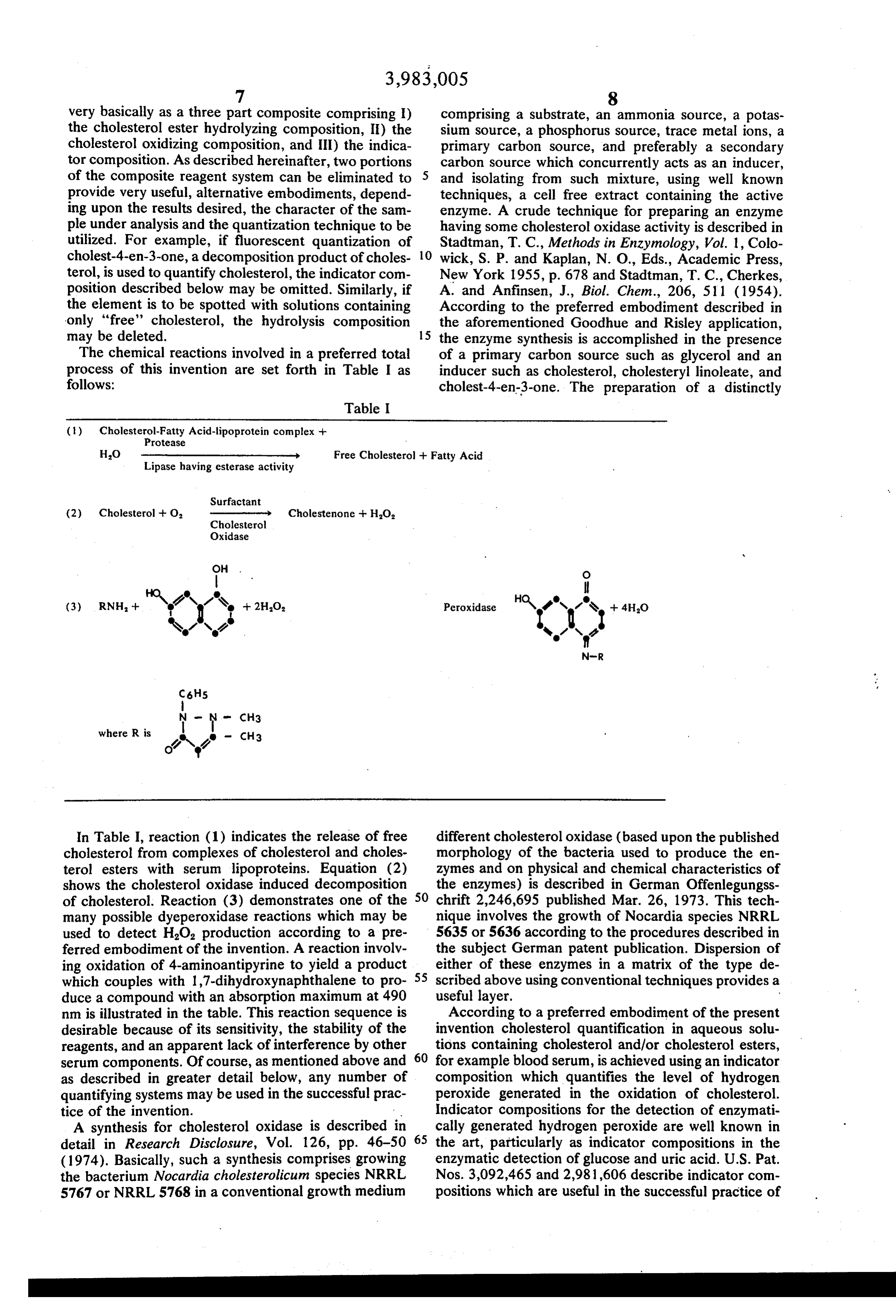
very basically as a three part composite comprising I) comprising a substrate, an ammonia source, a potas the cholesterol ester hydrolyzing composition, II) the sium source, a phosphorus source, trace metal ions, a cholesterol oxidizing composition, and III) the indica primary carbon source, and preferably a secondary tor composition. As described hereinafter, two portions carbon source which concurrently acts as an inducer, of the composite reagent system can be eliminated to 5 and isolating from such mixture, using well known provide very useful, alternative embodiments, depend techniques, a cell free extract containing the active ing upon the results desired, the character of the sam enzyme. A crude technique for preparing an enzyme ple under analysis and the quantization technique to be having some cholesterol oxidase activity is described in utilized. For example, if fluorescent quantization of Stadtman, T. C., Methods in Enzymology, Vol. 1, Colo cholest-4-en-3-one, a decomposition product of choles- 10 wick, S. P. and Kaplan, N. O., Eds., Academic Press, terol, is used to quantify cholesterol, the indicator com New York 1955, p. 678 and Stadtman, T. C., Cherkes, position described below may be omitted. Similarly, if A. and Anfinsen, J., Biol. Chen., 206, 511 (1954). the element is to be spotted with solutions containing According to the preferred embodiment described in only "free' cholesterol, the hydrolysis composition the aforementioned Goodhue and Risley application, may be deleted. 15 the enzyme synthesis is accomplished in the presence The chemical reactions involved in a preferred total of a primary carbon source such as glycerol and an process of this invention are set forth in Table I as inducer such as cholesterol, cholesteryl linoleate, and follows: cholest-4-en-3-one. The preparation of a distinctly Table I (1) Cholesterol-Fatty Acid-lipoprotein complex +
Protease
HO --m-m-b Free Cholesterol + Fatty Acid
Lipase having esterase activity
Surfactant (2) Cholesterol - O --> Cholestenone - HO,
Cholesterol
Oxidase
(3) Peroxidase + 4HO
where R is
In Table I, reaction (1) indicates the release of free different cholesterol oxidase (based upon the published cholesterol from complexes of cholesterol and choles morphology of the bacteria used to produce the en terol esters with serum lipoproteins. Equation (2) zymes and on physical and chemical characteristics of shows the cholesterol oxidase induced decomposition the enzymes) is described in German Offenlegungss of cholesterol. Reaction (3) demonstrates one of the 50 chrift 2,246,695 published Mar. 26, 1973. This tech many possible dyeperoxidase reactions which may be nique involves the growth of Nocardia species NRRL used to detect HO, production according to a pre 5635 or 5636 according to the procedures described in ferred embodiment of the invention. A reaction involv the subject German patent publication. Dispersion of ing oxidation of 4-aminoantipyrine to yield a product 55 either of these enzymes in a matrix of the type de which couples with 1,7-dihydroxynaphthalene to pro scribed above using conventional techniques provides a duce a compound with an absorption maximum at 490 useful layer.
nm is illustrated in the table. This reaction sequence is According to a preferred embodiment of the present desirable because of its sensitivity, the stability of the invention cholesterol quantification in aqueous solu reagents, and an apparent lack of interference by other tions containing cholesterol and/or cholesterol esters, serum components. Of course, as mentioned above and composition for example blood serum, is achieved using an indicator which quantifies the level of hydrogen as described in greater detail below, any number of quantifying systems may be used in the successful prac peroxide generated in the oxidation of cholesterol. tice of the invention. . Indicator compositions for the detection of enzymati A synthesis for cholesterol oxidase is described in 65 cally generated hydrogen peroxide are well known in detail in Research Disclosure, Vol. 126, pp. 46-50 the art, particularly as indicator compositions in the (1974). Basically, such a synthesis comprises growing enzymatic detection of glucose and uric acid. U.S. Pat. the bacterium Nocardia cholesterolicum species NRRL Nos. 3,092,465 and 2,981,606 describe indicator com 5767 or NRRL 5768 in a conventional growth medium positions which are useful in the successful practice of
Page 7
the present invention. The hydrogen peroxide indicator 4. Polyphenols, such as catechol, guaiacol (which compositions generally comprise a substance having forms an orange color), orcinol, pyrogallol (producing peroxidative activity, preferably peroxidase and an a reddish or yellow color), pp-dihydroxydiphenyl and indicator material which undergoes a color formation phloroglucinol;
or change in the presence of hydrogen peroxide and 5. Aromatic acids, such as salicyclic, pyrocatechuic oxygen. Alternatively, the indicator material may be and gallic acids;
one or more substances which undergo no substantial 6. Leuco dyes, such as leucomalachite green (to color change upon oxidation in the presence of H2O, produce malachite green) and leucophenolphthalein and peroxidase, but which in their oxidized form react (desirably employed in an alkaline medium); with a color-forming or -changing substance to give O 7. Colored dyes, such as 2,6-dichlorophenolindo visible quantitative evidence of chemical reaction. U.S. phenol;
Pat. No. 2,981,606 in particular provides a detailed 8. Various biological substances, such as epineph description of such color indicator compositions. The rine, the flavones, tyrosine, dihydroxyphenylalanine latter color forming composition, i.e., one which pro (producing an orange-reddish color) and tryptophan; duces color by virtue of an intermediate or color cou 15 9. Other substances, such as gum guaiac, guaiaconic pling reaction, is preferred in the practice of the pre acid, potassium, sodium, and other water soluble io sent invention. Such a system involves incorporating dides; and bilirubin (producing a greenish color); and into either the layer containing the cholesterol oxidase 10. Such particular dyes as 2,2'-azine-di(3-ethylben or another contiguous or separated stratum or layer in zothiazoline-(6)-sulfonic acid) and 3,3'-diaminobenzi fluid contact with that containing the cholesterol oxi 20 dine.
dase, the components of the color or other energy The color indicator composition of the present inven absorbing or emitting indicator composition. This can tion preferably comprises 4-methoxy-1-naphthol which be accomplished merely by dispersing the components undergoes self coupling in its oxidized state or a combi of the indicator composition described below into a nation of 1,7-dihydroxynaphthalene and 4-aminoanti reagent layer matrix of the type described above, pref 25 pyrine (HCl). In the latter composition the oxidized erably gelatin, and coating as described in the Przyby pyrine compound couples with the naphthalene. The lowicz and Millikan application referred to above. concentrations of the components of the various color A peroxidase is an enzyme which will catalyze a reac indicator compositions tion wherein hydrogen peroxide oxidizes another sub herein are dependent touseful a in the elements described large extent upon the con stance. The peroxidases are generally conjugated pro 30 centration of cholesterol in the sample, the sophistica teins containing iron porphyrin. Peroxidase occurs in tion of the detection apparatus, etc., and horseradish, potatoes, figtree sap and turnips (plant determinable by the skilled artisan. Typicalare readily values are peroxidase); in milk (lacto peroxidase); and in white shown in the examples below.
blood corpuscles (verdo peroxidase); also it occurs in As mentioned above, the preferred element of the microorganisms. Certain synthetic peroxidases, such as 35 present disclosed by Theorell and Maehly and Acta Chem. drolyzinginvention also includes a cholesterol ester hy composition which saponifies any cholesterol
Scand., Vol. 4, pages 422-434 (1950), are also satis esters present in a sample applied to the element to factory. Less satisfactory are such substances as hemin, "free' cholesterol. Such a hydrolyzing composition is methemoglobin, oxyhemoglobin, hemoglobin, hemo chromogen, alkaline hematin, hemin derivatives, and 40 described in detail in Research Disclosure, Vol. 127, pp. 54-56 (1974). This hydrolysis composition comprises a certain other compounds which demonstrate peroxida lipase having esterase activity and a protease. This tive or peroxidase-like activity, namely, the ability to combination of enzymes quite unexpectedly saponifies catalyze the oxidation of another substance by means the cholesterol esters in a highly efficient manner with of hydrogen peroxide and other peroxides. out the requirement for biliary cofactors etc. Other substances which are not enzymes but which 45 A number of lipases hydrolyze cholesterol esters to possess peroxidase-like activity are: iron sulfocyanate, some degree as described in the aforementioned Re iron tannate, ferrous ferrocyanide, chromic salts (such search Disclosure publication which is incorporated as potassium chromic sulfate) absorbed in silica gel, herein by reference.
etc. These substances are not as satisfactory as peroxi A useful screening technique for determining the dase per se. 50 esterase activity of lipase enzymes comprises adding a Color-forming substrates of peroxidase and peroxi fixed amount of a lipase preparation to a standard cho dase-like substances which produce a color formation lesteryllinoleate solution at pH 7.0, incubating at 37°C in the presence of hydrogen peroxide and peroxidase under N, for 2 hours and determining the amount of which may be employed in the indicator of the present ester left in the solution by the hydroxylamine method invention include the following substances with a cou 55 of J. Vonhoeffmayr and R. Fried, Z. Klin. Chem. U. pler where necessary: Klin. Biochem., 8, 134 (1970). Using this technique, 1. Monoamines, such as aniline and its derivatives, any lipase which demonstrates a cholesterol esterase ortho-toluidine, para-toluidine, etc.; activity which releases above about 25 mg% choles 2. Diamines, such as ortho-phenylenediamine, N,N'- terol dimethyl-para-phenylenediamine, N,N'-diethyl phenyl 60 usefulininthethescreening procedure should be considered practice of the present invention.
enediamine, benzidine (which produces a blue or The lipase presentin the element of the instant inven brown color), dianisidine (turns green or brown), etc.; tion may be any plant or animal lipase that demon 3. Phenols, such as phenol perse (producing a yellow color), thymol, ortho-, meta and para-cresols (produc stratesabove.
esterase activity, such as is described herein
Among the useful lipases it is preferred to use a ing a green-yellow color, a pink color and a milky sus 65 microbial lipase such as the lipase from Candida cylin pension, respectively), alpha-naphthol (producing a dracca and lipases having similar activity. Specifically magenta color), beta-naphthol (producing a white pre preferred commercial lipases include wheat germ lip cipitate), etc.; ase supplied by Miles Laboratories of Elkhart, Indiana,
Page 8
Lipase 3000 supplied by Wilson Laboratories, Steapsin intervene the spreading and reagent or registration supplied by Sigma Chemical Co. (both of the former layers. Such a layer may, however, intervene a reagent are pancreatic enzymes), and Lipase M (from Candida and registration layer where such structure is appropri cylindracca) supplied by Enzyme Development Co. ate. Reflectance can be provided by a layer also serv Proteases in general may be used in conjunction with ing, for example, as a spreading layer or it can be pro the lipase, as described elsewhere herein. These in vided by an additional layer that may not have an addi clude by way of example, chymotrypsin. Streptomyces tional function within the element. Pigments, such as griseus protease (commercially available under the titanium dioxide and barium sulfate, are reflective and registered trademark "Pronase'), proteases from As can be used to advantage in a reflecting layer. Bush pergillus oryzae, Bacillus subtilis, elastase, papain, and 10 polymers can also constitute a suitable reflecting mate bromelain. Mixtures of such enzymes may of course rial. As can be appreciated, pigment spreading layers also be employed. may be useful for this purpose as can blush polymer Supports: The integral analytical elements of the layers that may also be spreading layers. In one pre present invention can be self-supporting or the spread ferred aspect, blush polymer layers can also incorpo ing layer, reagent layer and any other associated layers 15 rate a pigment to enhance spreading and/or reflectivity. can be coated on a support. Useful support materials, The amount of pigment that can be included in a layer when such are used, include paper and polyolefin together with blush polymer is highly variable, and coated paper, as well as a variety of polymeric materi amounts of from about 1 to about 10 parts by weight of als such as cellulose acetate, poly(ethylene terephthal 20 pigment per part by weight of blush polymer are pre ate), polycarbonates and polyvinyl compounds such as ferred, with from about 3 to about 6 parts pigment per polystyrenes, etc. The support can be opaque or it can part of blush polymer being most preferred. transmit light or other energy depending, of course, on Filtering layers may also be present in the element. the mode of detection used. A support of choice in any The composition and preparation of such layers are case will be compatible with the intended mode of 25 remove well known in the art and, when present, they serve to result detection. Preferred supports include transpar from the sample components which could in ent support materials capable of transmitting electro terfere with the indicating reaction or otherwise hinder magnetic radiation of a wavelength within the region quantification. Thus, in the use of the multilayer analyt between about 200 nm and about 900 nm. The Support ical element for analysis of cholesterol in whole blood, need not, of course, transmit over the entire 200-900 30 a separate filtering layer could serve to remove red nm region, although for fluorometric detection of ana blood cells while transmitting the serum to the layer lytical results, for example in detecting cholest-4-en the below. In the analysis of blood serum or other fluids, 3-one through the support, it is desirable for the Sup filtering layer may serve to remove unwanted com port to transmit over a wider band or, alternatively, to ponents which could hinder or confuse the primary selectively transmit at the absorption and emission indicating reaction. Alternatively, the aforementioned spectra of the fluorescent material. It may also be desir 35 blush
If the polymer layers may also serve as filtering layers.
element is to be used for analysis of whole blood, able to have a support that transmits one or more nar row wavelength bands and is opaque to adjacent wave it0.5is todesirable that any filtering layer have a pore size of 5 microns.
length bands. This could be accomplished, for example, The incorporation of a protease into a reagent layer by impregnating or coating the support with one or 40 whose more colorants having suitable absorption characteris gelatin matrix is composed primarily of, for example, or some other natural or synthetic material tics. When an element includes a support, the reagent layer is interposed in the element between the support which is attacked by protease will result in the normal and the spreading layer. Specifically preferred trans proteolytic such as by reactions when such reagent layer is wetted, sample application to the element. Although mission ranges for elements of the present invention 45 Some measurements can be made in an element which will be apparent from the discussion of the various preferred indicator compositions discussed above. includes the protease and consequently the hydrolyzing When used, supports having thicknesses of between most composition in a gelatin or similar reagent matrix, it is about 1 and about 10 mils have been found satisfac desirable that the hydrolyzing composition be tory, although the thickness can vary broadly depend 50 incorporated into a spreading layer, which is resistant ing on such factors, for example, as the intensity of the to the action of the protease and that, as a further measure to protect the gelatin (or similar) matrix of the detecting radiation and the sensitivity of the detecting reagent layer from the protease, that a protective bar apparatus. - other Layers: The analytical element of the present rier layer be incorporated into the element. In this invention is preferably adapted for use in an analytical configuration, it is also desirable to place the choles system employing reflection techniques of spectropho 55 terol oxidase in the spreading layer with the compo tometric analysis, and consequently generally includes nents of the hydrolyzing composition so that indication a layer which functions as a reflecting layer and thereby requires only that the relatively small hydrogen perox ide molecules be permitted to cross the barrier layer provides a suitable background for spectrophotometric while the larger protease enzyme molecules are prohib measurement of colorimetric or other indicator reac ited from migrating into the protease susceptible re tions through the support side of the element. The 60 agent reflecting layer will permit the passage of cholesterol, layer. Optionally, the cholesterol oxidase may be cholesterol esters and/or decomposition products of incorporated into the reagent layer and a barrier layer cholesterol to the reagent or registration layer and which permits passage of the relatively small choles should provide an effective background for reflection terol molecule while inhibiting passage of the large spectrophotometry. A white background is generally 65 protease molecule used.
The barrier layer may be comprised of any of a large preferred for this purpose. In view of its function as a variety background for indicator formed in the reagent or ponentsofofmaterials compatible with the various com the element. Preferred materials include registration layer, any reflective layer will normally
Page 9
hydrophilic polymeric materials which permit migra binder comprises acetone, xylene, and dichloroethane tion of the hydrogen peroxide or free cholesterol as just in ratios of from about 3.5:2:1.1 to 4.5:1:0. described in the desired fashion while excluding the Equipment and techniques suitable for simultaneous protease enzyme and demonstrate no inhibitory effect coating of various individual layers within either the on any of the other components of the system. Particu spreading layer or the reagent layer are described in larly preferred as the protective barrier layer is a coat U.S. Pat. No. 2,932,855 issued Apr. 19, 1960. ing of agarose or a poly(acrylamide) resin, e.g., The thickness of the spreading layer is variable and poly(isopropylacrylamide). will depend in part on the intended sample volume, Element Preparation: In preparing integral analytical which for convenience and cleanliness the spreading elements of this invention, the layers can be performed 10 layer should be able to absorb, and on the layer's void separately and laminated to form the overall element. volume, which also affects the amount of sample that Layers prepared in such a manner are typically coated can be absorbed into the layer. Spreading layers having from solution or dispersion on a surface from which the a thickness of from about 50 microns to about 300 dried layer can be physically stripped. However, a con microns have been particularly useful, although wider venient method which can avoid the necessity for mu 5 variations in thickness are acceptable and may be desir tiple stripping and lamination steps is to coat an initial able for particular elements. layer on a stripping surface or a support, as desired, and When preparing an isotropically porous spreading thereafter to coat successive layers directly on those layer, it is useful to have void volume comprise at least coated previously. Such coating can be accomplished about 25% of the total layer volume, and void volumes by hand, using a blade coating device or by machine, 20 of from 50-95% may be desirable. Variations in void using techniques such as dip or bead coating. If ma volume of porous spreading layers can be used advan chine coating techniques are used, it is often possible to tageously to modify element characteristics such as coat adjacent layers simultaneously, using hopper coat total permeability of the spreading layer or the time ing techniques well known in the preparation of light needed for sample spreading to occur. As can be appre sensitive photographic films and papers. Interlayer 25 ciated, void volume within the layer can be controlled, adhesion problems can be overcome without harmful for example, by selecting particulate materials of ap effect by means of surface treatments including ex propriate size, or by varying the solvents or drying tremely thin application(s) of subbing material such as conditions when isotropically porous "blush” polymers are used in photographic films. are used in the spreading layer. The void volume of any Certain of the reagent materials may be incorporate 30 such layer can be calculated with reasonable accuracy into the spreading layer. Specifically, the enzymatic by a variety of techniques such as the statistical method cholesterol hydrolysis system described herein, can be described in Chalkley, Journal of the National Cancer incorporated into this layer to obtain cholesterol ester Institute, 4, 47 (1943) and by direct weighing and de hydrolysis before the sample reaches the reagent layer termining the ratio of actual weight of the layer to the containing the materials which act upon the free cho 35 weight of solid material equal in volume to that of the lesterol. Furthermore, the cholesterol oxidase may also layer, comparably composed of constituents from the be incorporated into this layer with the underlying layer. It will be appreciated that the pore size in any reagent layer containing only materials interactive with case should be sufficient to permit spreading of choles decomposition products of cholesterol to produce a terol, cholesterol esters and decomposition products of detectable change. A further alternative provides for 40 cholesterol as may be appropriate in view of the loca incorporation of portions of the cholesterol oxidase in tion of the various interactive materials in the element. both the spreading and reagent layers. Since cholesterol oxidase, as most enzymes, operates According to a preferred embodiment of the present most efficiently within a relatively narrow pH range, it invention, wherein the spreading layer performs the is generally preferred, to obtain a highly efficient ele functions of filtering and spreading, the layer is advan 45 ment, to buffer the layer containing this enzyme at tageously prepared by simultaneously coating two some operative pH value. Thus, although it is possible strata of a binder such as cellulose acetate dissolved in to obtain enzymatic activity outside of an optimum a mixed organic solvent to provide "blush” polymer range, it is desirable to buffer the layer containing the layers as described below. Such a technique simplifies cholesterol oxidase between about 5.5 and 8.5 and the manufacturing operation by reducing the multiple 50 preferably between about 6.0 and 7.0. Techniques for coating of multiple layers to a single multiple coating achieving this type of buffering are well known in the operation while providing a highly useful spreading art and involve dissolving or dispersing the buffering and/or filtering layer. Optionally, if desired, either or agent in the reagent system prior to coating. Suitable both of the discrete layers may contain dispersed buffering agents for buffering to the aforementioned therein a reflective pigment such as TiO2. 55 pH are described in detail by Good in Biochemistry 5, The physical structure of layers prepared in this fash 467 (1966). Particularly useful buffers include the ion consists of an isotropically porous upper layer phosphates such as potassium phosphate, the so-called which functions primarily as a metering or spreading Tris, and Hepes buffers and dimethyl glutarate. layer to provide a substantially uniform concentration The action of oxygen on free cholesterol in the pres of analyte per unit area to an underlying layer in spite 60 ence of cholesterol oxidase produces hydrogen perox of variations in volume of sample applied (as described ide and cholest-4-en-3-one. Thus, if a solution contain above), and a porous underlayer which functions pri ing free cholesterol is to be analyzed, an element con marily as a filter layer. The porosity of these two strata taining only cholesterol oxidase could be used. Con is controlled during manufacture by the use of different 65 centrations of between about 100 and about 5000 units ratios of mixed organic solvents as described in British of enzyme per square meter and preferably between Pat. No. 134,228 or in the discussion of "blush” poly about 500 and about 2000 units per square meter can mer layers hereinabove. A particularly useful combina be used. A unit of cholesterol oxidase is defined for tion of solvents when cellulose acetate is used as the purposes of the invention as the amount of enzyme
Page 10
required to oxidize one micromole of cholesterol in one utilizes a layer of agarose at a coverage of from about minute at 37°C. Cholest-4-en3-one fluoresces at 290 0.25 to about 0.70 g/m. Useful coverage of barrier nm and the concentration thereof can be measured by composition may, however, vary outside of this limited direct fluorescence measurements. Similar concentra range and coverages of between about 0.1 and 3.5 g/m' tions of cholesterol oxidase are useful when the com- 5 have been found useful.
plete hydrolysis and indicator compositions are also As all of the layers described herein are preferably incorporated into the element. This concentration of formed by coating from solutions or dispersions as enzyme may, of course, be varied over a broad range described in the aforementioned Przybylowicz and and very limited experimentation will permit the skilled Millikan application, it is often necessary to include artisan to determine optimum levels for his particular 10 coating aids which impart uniform coating properties element. to the layers.
For reagent layers, a coating solution or dispersion Whatever coating aids are used for this purpose, or including the matrix and incorporated interactive ma those described below, it is important that they do not terials can be prepared, coated as discussed herein and inhibit the lipase or any of the other reagents present in dried to form a dimensionally stable layer. The thick- 15 any of the various reagent layers. Particularly useful ness of any reagent layer and its degree of permeability coating aids for this purpose include nonionic surfac are widely variable and depend on actual usage. Dry tants such as the octyl phenoxy polyethoxy ethanols thicknesses of from about 10 microns to about 100 commercially available from Rohm and Haas Co. microns have been convenient. under the Triton tradename (X-100, 102, 165, 305 and The hydrolyzing composition may be incorporated 20 405 being particularly useful), (p-nonylphenoxy) glyc into the cholesterol oxidase reagent layer, however, erol commercially available from Olin Mathieson Corp. according to a highly preferred embodiment of the under the tradename Surfactant 10G, and polyethylene present invention, the hydrolysis composition is incor glycols such as the Carbowax materials available from porated into the spreading layer, for example by dis Union Carbide.
persing the enzymes in a lyophilized state in the coating 25 Furthermore, although the coating aids serve to im medium used to form the spreading layer, and then part uniform, desirable coating characteristics to the coating this mixture over the reagent layer as described various layers, it is desirable to have in the layer which in Przybylowicz and Millikan. According to this em includes the cholesterol oxidase from about 0.5 to bodiment, spreading of the sample and hydrolysis of about 5 g/m, and preferably from about 1 to about 3 any cholesterol esters are accomplished substantially 30 g/m, of a surfactant. Although the intended reactions simultaneously and cholesteric materials in the sample will take place without surfactant present, quantitative reach the reagent layer in the form of free cholesterol. results are enhanced when it is present. It is believed Such an element configuration utilizes the time needed that the surfactant assists in achieving proper oxidation to spread the sample also to prepare it for immediate of the free cholesterol by the oxidase enzyme. Concen reaction with the cholesterol oxidase in the reagent 35 trations of surfactant above about 5g/m, although they layer. As another alternative, a distinct contiguous or can be desirable, may cause degradation of the physical separated reagent layer which includes the hydrolyzing properties of the element. Nonionic surfactants have composition may be incorporated between the spread been found particularly useful. Among the particular ing layer and the cholesterol oxidase containing layer surfactants found useful are the polyethylene glycol to accomplish hydrolysis before the sample reaches the 40 ethers of linear alcohol such as Tergitol 15-S-7 and cholesterol oxidase. 15-S-9 available from Union Carbide Corp., deoxycho Wherever the enzymatic cholesterol ester hydrolyz late, octylphenoxy polyethoxy ethanol commercially ing composition is incorporated, optimum results are available from Rohm and Haas Company under the achieved when the matrix is buffered to a pH of be tradename Triton X-100, 102, 405 and sodium salt of tween about 5 and 9.5 and preferably between about 45 alkylaryl polyether sulfonate commercially available 7.0 and 8.0. Thus, when the hydrolyzing composition is from Rohm and Haas Company under the tradename incorporated into the reagent layer, or into another Triton X-200. Optimum quantitative results have been layer with the cholesterol oxidase, a pH of about 7.0 obtained when the coating aid or surfactant is an octyl produces optimum results. Similar pH's are used when phenoxy polyethoxy ethanol of the type commercially the hydrolyzing composition is present in a second 50 available from Rohm and Haas under the tradename reagent layer or in the spreading layer. Triton X-100.
The concentration of lipase and protease in whatever layer the hydrolysis system is incorporated may vary theUseexamples of the Element: Thus, in use, as demonstrated by which follow, a drop size sample on the over a broad range. Generally, however, concentra order of from about 5 to about 50 p.1 is applied to the tions of lipase ranging from about 90,000 to about 55 spreading or other outermost layer using known drop 270,000 U/m and protease ranging from about 36,000 application techniques. In passages through the spread to about 105,000 U/m have been found useful. Below ing layer the sample drop is spread so that a metered these levels substantially complete hydrolysis is doubt amount thereof is delivered to the underlying reagent ful. Concentrations of these components above these layer. Also during passage through the spreading layer levels, although perhaps useful, are not commercially 60 or the reagent layer depending upon the embodiment attractive. According to a preferred embodiment of the used, cholesterolesters contained in the applied sample present invention, lipase levels on the order of from are saponified to cholesterol, and cholesterol thus about 150,000 to about 2000,000 U/m' and protease formed or otherwise contained in the sample contacts concentrations of from about 72,000 to about 90,000 cholesterol oxidase in the presence of oxygen to pro U/m are used. 65 duce H2O, and cholest-4-ene-3-one. The detectable Barrier layers as described above are preferred in the change produced directly by the latter product or by same manner as the other layers of the element. A the intervention of a reagent composition which reacts highly preferred embodiment of the present invention with the H2O, can then be quantitated using known
Page 11
techniques and the concentration of total cholesterol Test Serum present in the applied sample determined. (mg% Cholesterol) D 660 nm (12 min at 37°C) The following examples are included to illustrate 122 0.12 further the present invention. 244 0.18
EXAMPLE 1.
EXAMPLE 3
An analytical element for the analysis of free choles An analytical element for the anaylsis of total choles terol in a liquid such as blood serum is prepared in the '' terol in blood serum is prepared in the following man following manner. A sample of gelatin subbed 7 mil ner. A sample of gelatin subbed 7 mil poly(ethylene poly(ethylene terephthalate) film support is coated terephthalate) film support is coated with an reagent with a first reagent layer comprising gelatin (21.5 layer comprising gelatin (21.5 g/m'), peroxidase g/m), peroxidase (7,000 U/m), 4-methoxy-1-naph 15 (7,000 U/m), cholesterol oxidase (430 U/m), 1,7- thol (750 mg/m), bis (vinylsulfonylmethyl)ether (129 dihydroxy naphthalene (656 mg/m), 4-aminoantipy mg/m) and phosphate buffer to pH 6.93. The first rine hydrochloride (635 mg/m) and 4-amino-5,6-dihy reagent layer is then overcoated with a second reagent droxy-2-methylpyrimidine (10.8 mg/m) at a pH of 7.0. layer comprising gelatin (5.56 g/m), octyl phenoxy A barrier layer comprising agarose (108 mg/m) was polyethoxy ethanol (170 mg/m”0, cholesterol oxidase 20 then applied followed by an interlayer comprising poly (54 U/m), and phosphate buffer to pH 7.0. An inter (n-isopropylacrylamide) (323 mg/m) and, as de layer comprising poly (n-isopropylacrylamide) (540 scribed in Example 2, a spreading layer containing mg/m) is then applied to the element followed by a hydrolysis enzymes.
spreading layer comprising blushed cellulose acetate Upon use as described in Example 2, comparable (9.7 g/m), and titanium dioxide (64.5 g/m). 25 quantitative results are obtained. To evaluate the coated element a series of choles terol standards varying in concentration from 50 to 400 Example 4 mg% are prepared by dissolving cholesterol in Gafac An analytical element for the analysis of total choles LO-529 (a sodium salt of complex organic phosphate terol in a liquid such as blood serum is prepared as in esters, available from GAF Corporation, Dyestuff and 30 Example 3 with the following exceptions. Chemical Division). 1. The reagent layer contains 4-methoxy-1-naphthol The coating is spotted with 10 p.1 drops of the above (750 mg/m) instead of 1,7-dihydroxy naphthalene and described cholesterol solutions, a spectrophotometer at 4-aminoantipyrine.
37°C with a 660 nm interference filter is used to follow 2. The cholesterol oxidase is coated in the spreading color development at times varying from 5-20 minutes. 35 layer (450 U/m).
Uniformly colored spots producing quantitative results Upon evaluation, as in Example 2, the following consistent with the varying time and concentration quantitative results are obtained.
parameters are obtained.
EXAMPLE 2 (mg% Cholesterol) D 660 nm (12 min at 37°C)
An analytical element for the quantitative analysis of 366 0.3
total cholesterol in a liquid such as blood serum is 45 prepared in the following manner. A sample of a gelatin subbed 7 mil poly(ethylene terephthalate) film support EXAMPLE 5 is coated with an reagent layer comprising gelatin (21.5 An analytical element for the analysis of total choles g/m) peroxidase (7,000 U/m), bis(vinylsulfonylme terol in a liquid such as blood serum is prepared exactly thyl)ether (430 mg/m), cholesterol oxidase (1,936 50 as in Example 3 except the cholesterol oxidase was U/m), octylphenoxypolyethoxy ethanol (Triton X coated in the spreading layer (450 Ulm').
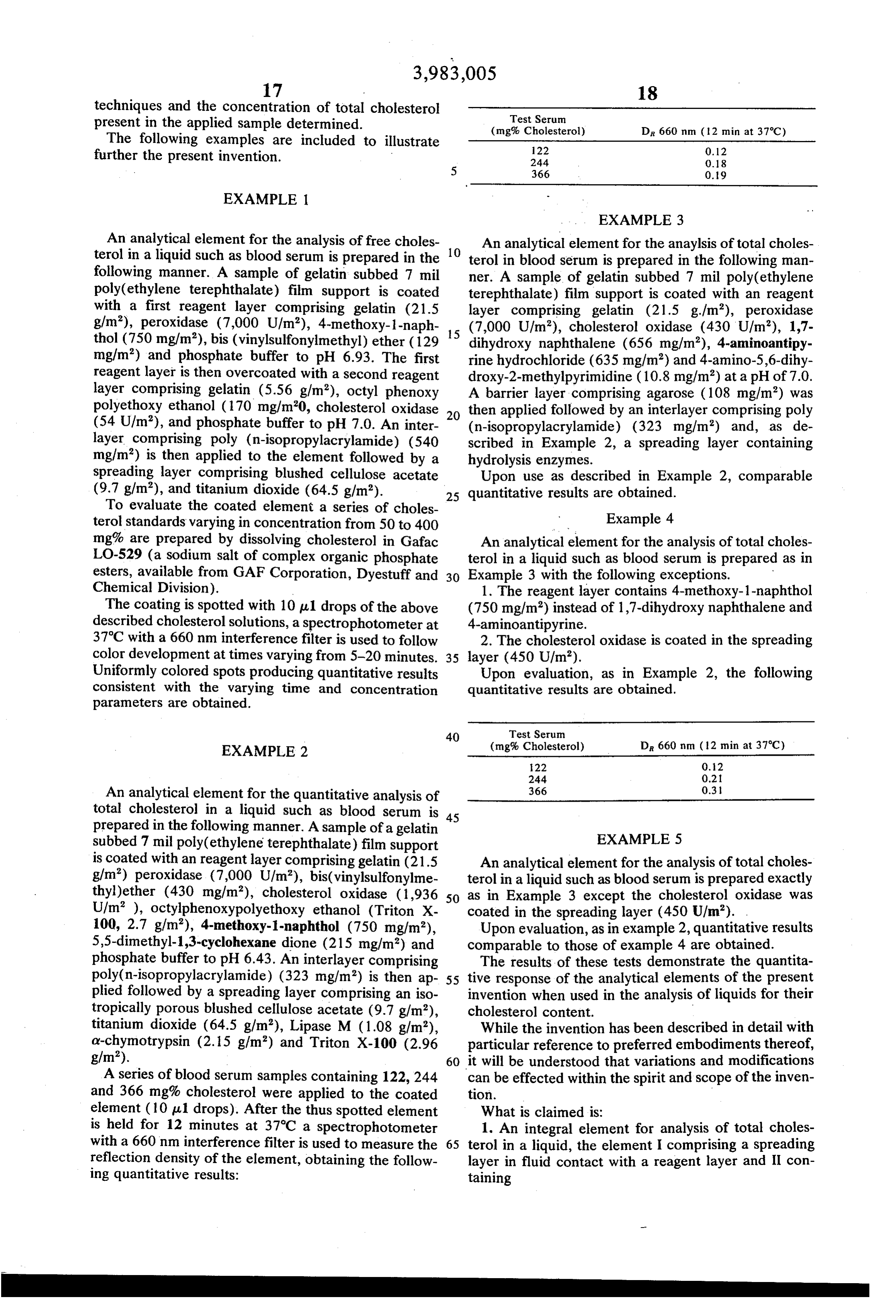
100, 2.7 g/m), 4-methoxy-1-naphthol (750 mg/m), Upon evaluation, as in example 2, quantitative results 5,5-dimethyl-1,3-cyclohexane dione (215 mg/m) and comparable to those of example 4 are obtained. phosphate buffer to pH 6.43. An interlayer comprising The results of these tests demonstrate the quantita poly(n-isopropylacrylamide) (323 mg/m') is then ap 55 tive response of the analytical elements of the present plied followed by a spreading layer comprising an iso invention when used in the analysis of liquids for their tropically porous blushed cellulose acetate (9.7 g/m), cholesterol content.
titanium dioxide (64.5 g/m), Lipase M (1.08 g/m), While the invention has been described in detail with o-chymotrypsin (2.15 g/m) and Triton X-100 (2.96 particular reference to preferred embodiments thereof, g/m). 60 it will be understood that variations and modifications A series of blood serum samples containing 122, 244 can be effected within the spirit and scope of the inven and 366 mg% cholesterol were applied to the coated tion.
element (10 u1 drops). After the thus spotted element What is claimed is:
is held for 12 minutes at 37°C a spectrophotometer 1. An integral element for analysis of total choles with a 660 nm interference filter is used to measure the 65 terol in a liquid, the element I comprising a spreading reflection density of the element, obtaining the follow layer in fluid contact with a reagent layer and II con ing quantitative results: taining
Page 12
a. a cholesterol ester hydrolyzing composition com 12. An integral element as described in claim 11 prising lipase having cholesterol esterase activity wherein the substance having peroxidative activity is a and protease; and peroxidase.
b. cholesterol oxidase; 13. An integral element as described in claim 5 the cholesterol ester hydrolyzing composition and cho wherein the lipase having cholesterol esterase activity lesterol oxidase being disposed within the element such releases at least 25 mg% cholesterol in 2 hours at 37°C that, in liquid applied to the element, cholesterol esters under nitrogen when 50 mg of a preparation of said are saponified and cholesterol is depomposed produc lipase in 5 ml 0.1 M phosphate buffer, pH 7.0, is used to treat a dispersion of cholesteryl linoleate prepared ing a detectable change related to the total cholesterol 10 by content of the liquid. dispersing 200 mg cholestery linoleate in 5 ml of 2. An integral element for analysis of total choles ethyl ether and 100 ml boiling water containing 430 mg terol in a liquid, the element I comprising a spreading of14. sodium cholate.
layer in fluid contact with a reagent layer and II con whereinAntheintegral element as described in claim 13 lipase is a microbial lipase.
a. a cholesterol ester hydrolyzing composition com wherein 15. An integral element as described in claim 14 the protease is selected from the group consist prising lipase having cholesterol esterase activity ing of Bacillus and protease; and subtilis protease, Streptomyces griseus protease, Aspergillus oryzae protease and mixtures b. cholesterol oxidase; thereof.
the cholesterol ester hydrolyzing composition and cho 20 16. An integral element for analysis of total choles lesterol oxidase being disposed within the element such terol in a liquid, the element comprising a support upon that, in liquid applied to the element, cholesterol esters which are superposed in fluid contact: are saponified and cholesterol is decomposed produc 1. a spreading layer containing a choiesterol ester ing a detectable change related to the total cholesterol hydrolyzing composition comprising lipase having content of the liquid, the spreading layer being capable 25 cholesterol esterase activity and protease; and of spreading within itself a substance selected from the 2. a reagent layer interposed between the spreading group consisting of cholesterol, cholesterol esters or layer and the support and containing cholesterol decomposition products of cholesterol to provide a oxidase and an indicator composition that can in uniform concentration of such substance at the surface teract with a decomposition product of cholesterol of the spreading layer facing the reagent layer, and the 30 to produce in the element a detectable change reagent layer being of substantially uniform permeabil related to the total cholesterol content of the liq ity to such substance or a reaction product of such uid.
substance. 17. The element of claim 16 wherein the layer con 3. The element of claim 2 wherein the layer contain 35 taining the cholesterol oxidase also contains a surfac ing the cholesterol oxidase also contains a surfactant. tant.
4. The element of claim 2 wherein the surfactant is 18. The element of claim 16 wherein the surfactant is present at a concentration of between about 0.5 and 5 present at a concentration of between about 0.5 and 5 g/m. g/m.
5. An integral element as described in claim 2 40 terol 19. An integral element for analysis of total choles wherein said reagent layer includes an indicator com whichinare a liquid, the element comprising a support upon superposed in fluid contact:
position that can interact with a decomposition product of cholesterol to produce a detectable change in the 1. a spreading layer containing a cholesterol ester element. hydrolyzing composition comprising lipase having 6. An integral element as described in claim 5 45 2. cholesterol a reagent esterase activity and protease; and layer interposed between the spreading wherein the reagent layer contains cholesterol oxidase. layer and the support and containing cholesterol 7. An integral element as described in claim 5 further oxidase and an indicator composition that can in including a support upon which the spreading layer and teract with a decomposition product of cholesterol the reagent layer in fluid contact are superposed, the to produce in the element a detectable change reagent layer being interposed between the support and 50 related to the total cholesterol content of the liquid the spreading layer. the spreading layer being capable of spreading within 8. An integral element as described in claim 7 wherein said support transmits energy of a wavelength itself a substance selected from the group consisting of cholesterol, cholesterol esters or decomposition prod in the region between about 200 and about 900 nm. ucts of cholesterol to provide a uniform concentration 9. An integral element as described in claim 5 55 of such substance at the surface of the spreading layer wherein the cholesterol oxidase is derived from a mi facing the reagent layer, and the reagent layer being of croorganism selected from the group consisting of substantially uniform permeability to such substance or NRRL 5635, NRRL 5636, NRRL 5767 and NRRL a reaction product of such substance. S768. 20. An integral element as described in claim 19 10. An integral element as described in claim 9 60 wherein the support transmits energy of a wavelength wherein the microorganism is selected from the group in the region between about 200 and about 900 nm. consisting of NRRL 5767 and NRRL 5768. 21. An integral element as described in claim 19 11. An integral element as described in claim 5 wherein the microorganism is selected from the group wherein said indicator composition comprises a sub consisting of NRRL 5767 and NRRL 5768.
stance having peroxidative activity and a composition 65 22. An integral element as described in claim 19 that produces a color change in the presence of hydro wherein the indicator composition comprises a sub gen peroxide and the substance having peroxidative stance having peroxidative activity and a composition activity. that produces a color change in the presence of hydro
Page 13
gen peroxide and the substance having peroxidative 2. a reagent layer interposed between the spreading activity. layer and the support and containing an indicator 23. An integral element as described in claim 22 composition that can interact with a decomposition wherein the substance having peroxidative activity is a product of cholesterol to produce in the element a peroxidase enzyme. detectable change related to the total cholesterol 24. An integral element as described in claim 23 content of the liquid.
wherein the color change producing composition com 35. The element of claim 34 wherein the layer con prises a leuco dye. taining the cholesterol oxidase also contains a surfac 25. An integral element as described in claim 23 tant.
wherein the color change producing composition com 10 36. The element of claim 35 wherein the surfactant is prises a substance that is oxidizable in the presence of present at a concentration of between about 0.5 and 5 hydrogen peroxide and oxygen and, in its oxidized g/m.
state, is capable of reacting to form a dye. 37. An integral element for analysis of total choles 26. An integral element as described in claim 25 terol in a liquid, the element comprising a support upon wherein the oxidizable substance comprises 4 5 which are superposed in fluid contact;
methoxy-1-naphthol. 1. a spreading layer containing (a) a cholesterol ester 27. An integral element as described in claim 25 hydrolyzing composition comprising a lipase hav wherein the oxidizable substance comprises 4 ing cholesterol esterase activity and protease and aminoantipyrine. (b) cholesterol oxidase; and 28. An integral element as described in claim 27 and 20 2. a reagent layer interposed between the spreading further comprising 1,7-dihydroxy naphthalene. layer and the support and containing an indicator 29. An integral element as described in claim 19 composition that can interact with a decomposition wherein said lipase having esterase activity releases at product of cholesterol to produce in the element a least 25 mg% cholesterol in 2 hours at 37°C under 25 detectable change related to the total cholesterol nitrogen when 50 mg of a preparation of said lipase in content of the liquid 5 ml 0.1 M phosphate buffer, pH 7.0, is used to treat a the spreading layer being capable of spreading within dispersion of cholesteryl linoleate prepared by dispers itself a substance selected from the group consisting of ing 200 mg cholesteryl linoleate in 5 ml of ethyl ether cholesterol, cholesterol esters or decomposition prod and 100 ml boiling water containing 430 mg of sodium ucts of cholesterol to provide a uniform concentration cholate. W 30 of such substance at the surface of the spreading layer 30. An integral element as described in claim 29 facing the reagent layer, and the reagent layer being of wherein the lipase is a microbial lipase. substantially uniform permeability to such substance or 31. An integral element as described in claim 29 a reaction product of such substance.
wherein the protease is selected from the group consist 38. An integral element as described in claim 37 ing of Bacillus subtilis protease, Streptomyces griseus 35 wherein the support transmits energy of a wavelength protease, Aspergillus oryzae protease and mixtures in the region between about 200 and about 900 nm. thereof. 39. An integral element as described in claim 38 32. An integral element as described in claim 19 wherein the microorganism is selected from the group wherein the spreading layer also contains cholesterol 40 consisting of NRRL 5767 and NRRL 5768. oxidase. 40. An integral element as described in claim 39 33. An integral element for analysis of total choles wherein the indicator composition comprises a sub terol in a liquid, the element comprising a support upon stance having peroxidative activity and a composition which are superposed in fluid contact; that produces a color change in the presence of hydro 1. a spreading layer buffered to a pH in the range of 45 gen peroxide and the substance having peroxidative between about 5.5 and 9.0 and containing (a) from activity.
about 90,000 to about 270,000 U/m of a microbial 41. An integral element as described in claim 40 lipase having cholesterol esterase activity and (b) wherein the substance having peroxidative activity is a from about 36,000 to about 105,000 U/m of pro peroxidase enzyme.
tease; and 42. An integral element as described in claim 41 2. a reagent layer containing (a) from about 100 to 50 wherein the color change producing composition com about 5000 U/m of cholesterol oxidase derived prises a leuco dye.
from a microorganism selected from the group 43. An integral element as described in claim 41 consisting of NRRL 5767 and NRRL 5768 and (b) wherein the color change producing composition com an indicator composition comprising a substance prises a substance that is oxidizable in the presence of having peroxidative activity and a composition that 55 hydrogen peroxide and oxygen and, in its oxidized reacts to produce a color change in the presence of state, is capable of reacting to form a dye. hydrogen peroxide and the substance having 44. An integral element as described in claim 43 peroxidative activity, the reagent layer being inter wherein the oxidizable substance comprises 4 posed between the spreading layer and the support methoxy-1-naphthol.
and buffered at a pH in the range between about 60 45. An integral element as described in claim 43 5.5 and 8.5. wherein the oxidizable substance comprises 4 34. An integral element for analysis of total choles aminoantipyrine.
terol in a liquid, the element comprising a support upon 46. An integral element as described in claim 45 and which are superposed in fluid contact; further comprising 1,7-dihydroxy naphthalene. 1. a spreading layer containing (a) a cholesterol ester 65 47. An integral element as described in claim 37 hydrolyzing composition comprising a lipase hav wherein said lipase having esterase activity releases at ing cholesterol esterase activity and protease and least 25 mg% cholesterol in 2 hours at 37°C under (b) cholesterol oxidase, and nitrogen when 50 mg of a preparation of said lipase in
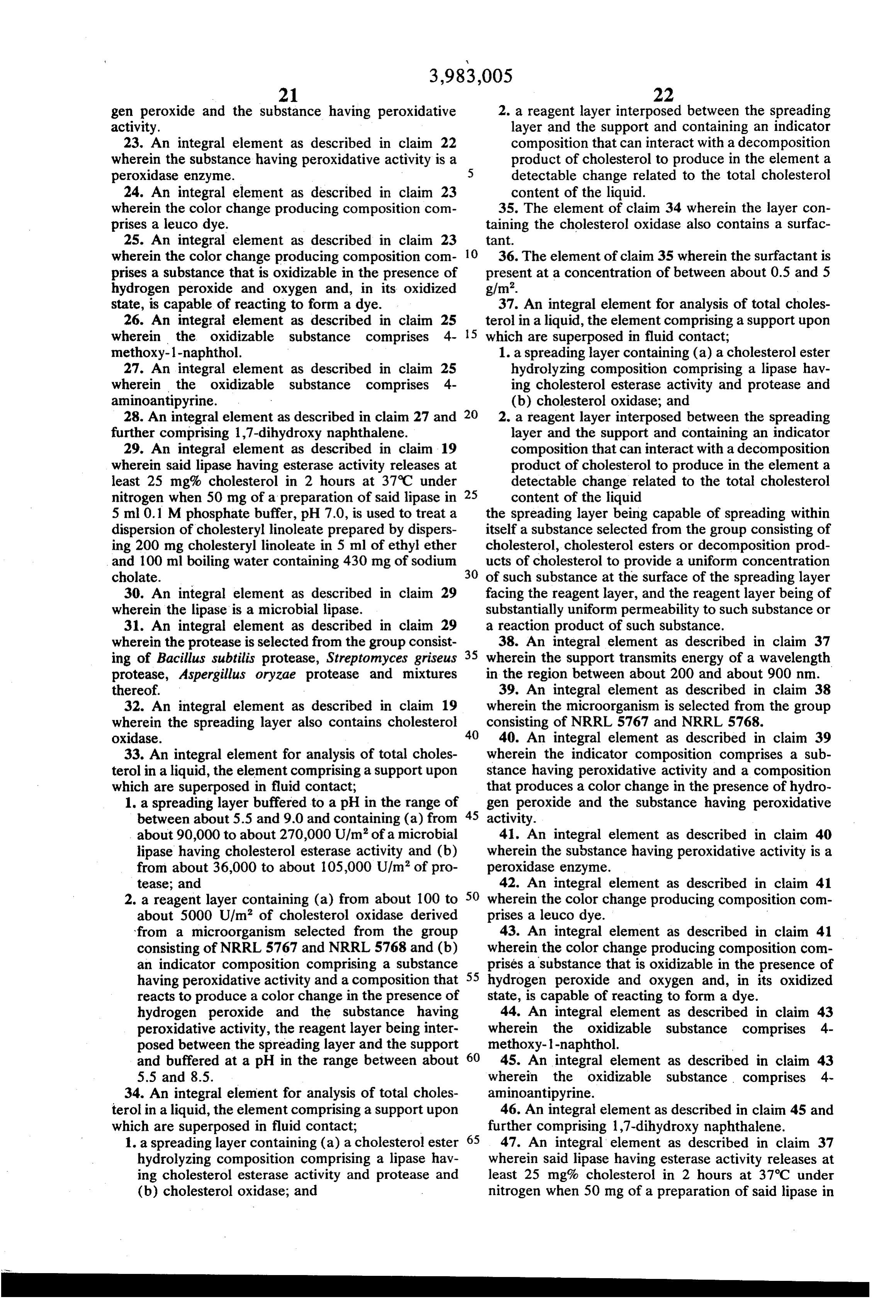
Page 14
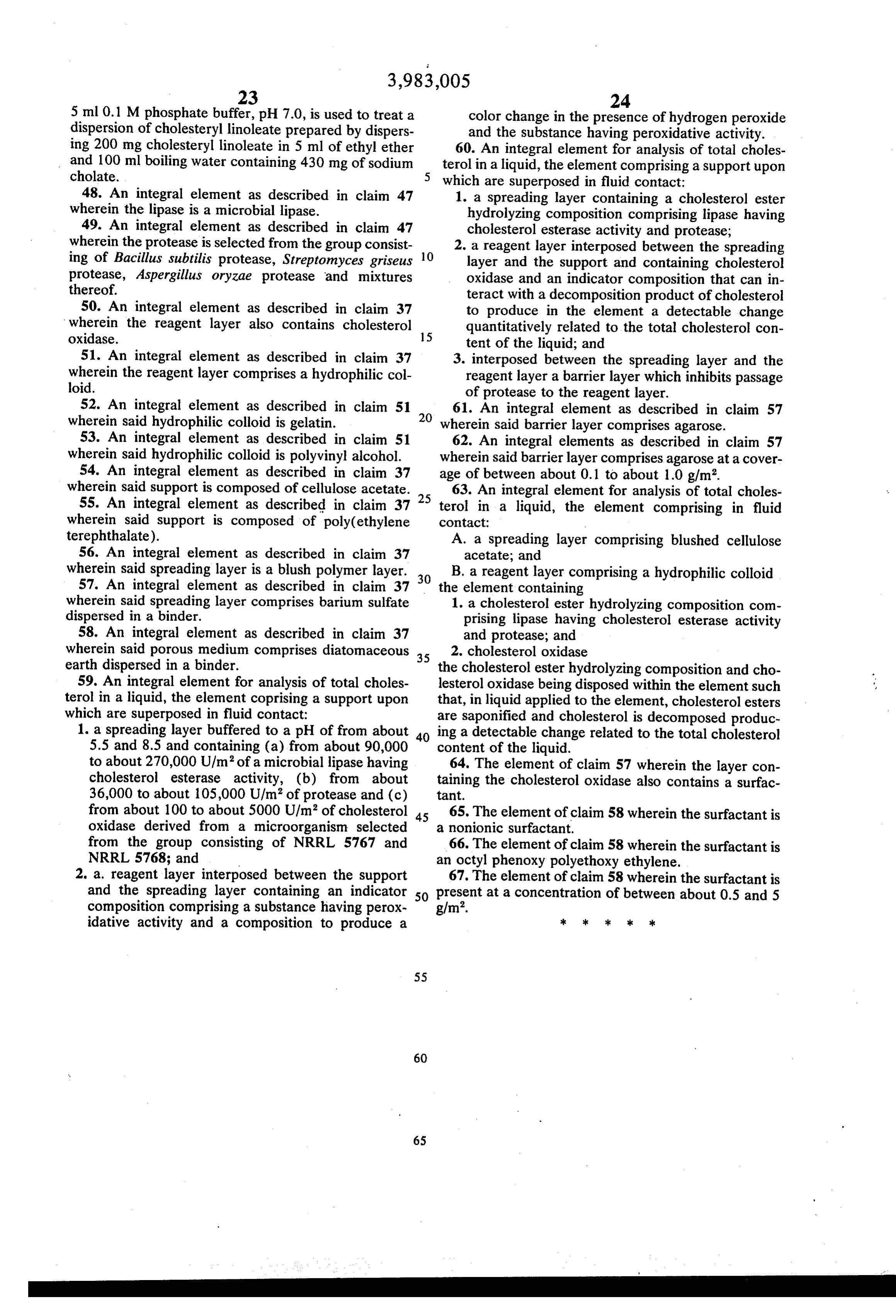
5 ml 0.1 M phosphate buffer, pH 7.0, is used to treat a color change in the presence of hydrogen peroxide dispersion of cholesteryl linoleate prepared by dispers and the substance having peroxidative activity. ing 200 mg cholesteryl linoleate in 5 ml of ethyl ether 60. An integral element for analysis of total choles and 100 ml boiling water containing 430 mg of sodium terol in a liquid, the element comprising a support upon
which are superposed in fluid contact:
48. An integral element as described in claim 47 1. a spreading layer containing a cholesterol ester wherein the lipase is a microbial lipase. hydrolyzing composition comprising lipase having 49. An integral element as described in claim 47 cholesterol esterase activity and protease; wherein the protease is selected from the group consist 2. a reagent layer interposed between the spreading ing of Bacillus subtilis protease, Streptomyces griseus 10 layer and the support and containing cholesterol protease, Aspergillus oryzae protease and mixtures oxidase and an indicator composition that can in thereof. teract with a decomposition product of cholesterol 50. An integral element as described in claim 37 to produce in the element a detectable change wherein the reagent layer also contains cholesterol 15 quantitatively related to the total cholesterol con oxidase. tent of the liquid; and 51. An integral element as described in claim 37 3. interposed between the spreading layer and the wherein the reagent layer comprises a hydrophilic col reagent layer a barrier layer which inhibits passage loid. of protease to the reagent layer. 52. An integral element as described in claim 51 20 61. An integral element as described in claim 57 wherein said hydrophilic colloid is gelatin. wherein said barrier layer comprises agarose. 53. An integral element as described in claim 51 62. An integral elements as described in claim 57 wherein said hydrophilic colloid is polyvinyl alcohol. wherein said barrier layer comprises agarose at a cover 54. An integral element as described in claim 37 age of between about 0.1 to about 1.0 g/m. wherein said support is composed of cellulose acetate. 25 63. An integral element for analysis of total choles 55. An integral element as described in claim 37 terol in a liquid, the element comprising in fluid wherein said support is composed of poly(ethylene contact:
terephthalate). A. a spreading layer comprising blushed cellulose 56. An integral element as described in claim 37 acetate; and wherein said spreading layer is a blush polymer layer. 30 B. a reagent layer comprising a hydrophilic colloid 57. An integral element as described in claim 37 the element containing wherein said spreading layer comprises barium sulfate 1. a cholesterol ester hydrolyzing composition com dispersed in a binder. prising lipase having cholesterol esterase activity 58. An integral element as described in claim 37 and protease; and wherein said porous medium comprises diatomaceous 35 2. cholesterol oxidase earth dispersed in a binder. the cholesterol ester hydrolyzing composition and cho 59. An integral element for analysis of total choles lesterol oxidase being disposed within the element such terol in a liquid, the element coprising a support upon that, in liquid applied to the element, cholesterol esters which are superposed in fluid contact: are saponified and cholesterol is decomposed produc 1. a spreading layer buffered to a pH of from about 40 ing a detectable change related to the total cholesterol 5.5 and 8.5 and containing (a) from about 90,000 content of the liquid.
to about 270,000 U/m of a microbial lipase having 64. The element of claim 57 wherein the layer con cholesterol esterase activity, (b) from about taining the cholesterol oxidase also contains a surfac 36,000 to about 105,000 U/m of protease and (c) tant.
from about 100 to about 5000 U/m of cholesterol 45 65. The element of claim 58 wherein the surfactant is oxidase derived from a microorganism selected a nonionic surfactant.
from the group consisting of NRRL 5767 and 66. The element of claim 58 wherein the surfactant is NRRL 5768; and an octyl phenoxy polyethoxyethylene. 2. a. reagent layer interposed between the support 67. The element of claim 58 wherein the surfactant is and the spreading layer containing an indicator 50 present at a concentration of between about 0.5 and 5 composition comprising a substance having perox g/m.
idative activity and a composition to produce a sk k -k k sk
Provenance
- Collection
- Cited prior art
- Original PDF
- patentimages.storage.googleapis.com →
- Filed
- 1975-04-07
- Pages
- 14
- Method
- pdftotext (the PDF's own text layer) + pdftoppm 300dpi page scans
- Source
- Google Patents bibliographic record
- Granted
- 1976-09-28
- Inventors
- Charles T. Goodhue; Hugh A. Risley; Roy E. Snoke; Gary M. Underwood; Eastman Kodak Co
- Transcribed from
- patentimages.storage.googleapis.com →