patent · US3968786
Solar heat absorbing tubing
13 July 1976
Page 1 — bibliographic record
United States Patent (19) (11 3,968,786 Spielberg (45) July 13, 1976 54 SOLAR HEAT ABSORBING TUBING 3,174.95 3/1965 Edlin............................... 126/27 | X 3,227,153 11966 Gudel et al......................... 126/27 | 75 inventor: David H. Spielberg, Schaumburg, Ill. 3.239,000 3/1966 Meagher........ ... 126/27 X (73) Assignee: Universal Oil Products Company, 3,265,124 8/1966 Reys ................................... 165/133 33 (), 102 3/1967 Trombe .............................. 1261271
Des Plaines, Ill.
(22 Filed: May 15, 1974 Primary Examiner-John J. Camby (21) Appl. No.: 470,254 Assistant Examiner-Henry C. Yuen Attorney, Agent, or Firm-James R. Hoatson, Jr.;
Philip T. Liggett; William H. Page II 52 U.S. Cl................................. 126/270; 165/33;
5 Int. Cl.............................................. F24, 3/02 An improved form of solar heat absorbing tubing com 58 Field of Search............ 26/270, 271; 165/133; prises a plastic material which contains small subdi 38/145 vided black body absorber particles being fully distrib
uted throughout the thickness of the tubing. A pre ferred form of tubing will utilize electrical conductive
UNITED STATES PATENTS carbon, or carbonized particles, in an amount to pro 88),938 10/1932 Emmet................................ 126/27 vide conductivity to the resulting tubing such that 2.9)7,38 10/1959 Awl .................................. 65/133 there may be electroplating or electrostatic spray 2.917,8 7 12/1959 Tabor ... ... 26/270 coating for the tubing to still further enhance its ab 3,022,78 2/1962 Andrassy ............................ 26/27 sorptive and reradiation properties. 3.072,42() 1963 Yelt....... ... 126/27 | X 3()79.273 2/1963 Johnson.............................. 65/33 7 Claims, 3 Drawing Figures
Page 2
Drawing sheet — no readable text.
Page 3
SOLAR HEAT ABSORBING TUBING
oxide type of particles can be used to provide a suit able, at lcast partially conductive, tubing.
The present invention relates to an improved form of In a related aspect, it may be considered an object of tubing for use in solar heat collectors. the invention to provide a conductive, black body con More particularly, the invention is directed to provid taining tubing which can be readily electroplated or ing a tubing which comprises a plastic material incor electrostatically spray coated with an ultrathin metal porating finely divided black body heat absorbing parti coating to effect a desirable selective absorption pror. cles that will be fully distributed throughout the thick erty to the surface of the plastic tubing. ness of the tubing. As will be more fully set forth here Briefly, the present invention provides an improved inafter, it is also preferable that the particulates are form of heat absorbing tubing to, in turn, provide en electrically conductive so as to provide a resulting tub hanced solar radiation collection efficiency which com ular member which will be electrically conductive to prises in combination, a tubular form member of plastic provide for plating or form electrostatic coating that material containing small black body absorber parti will enhance its heat retaining properties.
5 cles distributed throughout the thickness thereof,
BACKGROUND OF THE INVENTION whereby there is improved heat absorption and a re It is generally well known that solar energy heat col ductionThe in long wavelength emissions.
ultraviolet light between the atmospheric ab lecting tubing should be dark in color or have a black sorption cutoff of 0.29 microns and the lower edge of or dark colored coating in order to enhance the heat the visible spectrum, 0.4 absorption characteristics of the surface. A truly reflec 20 ultraviolet. A suitable plasticmicrons binder is called the solar will be transparent tive body will reflect essentially the same spectrum to this solar ultraviolet radiation, allowing the black which impinges upon it while a black body emits a body material in the binder to absorb the radiant en shifted, lower energy and longer wavelength spectrum.
Stated another way, the difference in energy between ergy. In addition the plastic binder will preferably transmit the remainder of the solar radiation spectrum, the incident and reemitted radiation for a black body 25 i.e., from about 0.3 to about 1.2 microns. Various types material is the absorbed energy which goes into heat of plastic materials may be used and it is not intended within such black body material. to limit the present invention to any one type of such In addition to the advantages of using black body material. For example, the optical properties of acrylic absorbing materials for the collection of solar heat, it is also generally known that there is improved efficiency 30 ester resins, as well as their ease of forming and stability in having a suitable covering over the absorbing surface to heat and light make them suitable candidates. Poly(- methyl methacrylate) transmits extensively in the solar in order to hold the heat in the collector system by the ultraviolet range and has almost perfect transmission in "greenhouse effect'. For example, window glass and certain plastics have selective transmitting properties the visible range. Other polymers, such as polystyrene, where the lower wavelength spectrum of the solar en 35 aliphatic polyesters, cellulose esters, and polyamides, ergy can pass through to the heat absorbing tubing, but contain groups that also show considerable transmit the higher wavelength radiation from the reradiation is tance in the solar ultraviolet.
not readily transmitted. Some commercial polymers are made up of struc It is also generally understood that plastic materials tures that have absorption maxima in the solar ultravio have had various types of fillers in admixture therewith 40 let region, and for this reason are unsuitable. Examples to provide improved strength, or to improve a particu of these include polysulfones, terephthalate polyesters, lar characteristic. For instance, carbon particles have and some polyurethanes. As briefly noted hereinbe been used to resist ultraviolet ray deterioration. How fore, it is an advantage in a preferred embodiment to ever, it is not known that conductive carbon particles make use of those plastics which will selectively trans have been used in tubing to provide black body heat mit the lower wavelength radiations from the solar absorption and resulting conductive or semiconductive energy such that the absorption may take place within tubing for solar heat collectors. the black body material of the tubing, but will minimize
SUMMARY OF THE INVENTION
reradiation by virtue of the lesser ability to pass the higher value wavelength radiations. For instance, poly
In the present instance, it is a principal object of the 50 vinyl chloride will transmit the lower wavelength solar invention to provide a solar energy collector tubing by radiations below about 5.5 microns but is inefficient in utilizing a suitable plastic binder material which con transmitting the higher wavelength radiations. Most tains finely divided black body particulates that will be polymers will not transmit infrared radiation efficiently distributed throughout the thickness of the material with the exception of halogenated polyethylenes. and will thus be primarily below the surface of the Most all of the thermoplastic and thermosetting plas plastic binder. As a result there can be heat absorption tic materials are sensitive to sunlight and tend to deteri in the particles themselves from their selective emissiv orate and crack unless there have been additive materi ity properties to preclude reflection and heat radiation als to provide stabilization and antioxidation properties therefrom. At the same time there can be selective into the binder material. In general, various types of transmittance on the part of the encompassing plastic 60 antioxidation additives may be used and should have no binding material of the tubing to preclude passage of effect with respect to interferring with the present im the higher wavelength spectrum, or reradiated heat. proved type of composition for a solar heat collecting It may also be considered an object of the present tubing. Actually, the darkening of plastic materials invention to use finely divided electrically conductive through the aging process will in no way be harmful to black body material in the plastic binder in an amount 65 the collector tubing inasmuch as the resulting improved which will provide a conductive or semiconductive tubing will be black from the black body material being tubing. For examplc, conductive carbon particles or combined with the plastic binder material in order to pyropolymeric semiconducting organic-refractory enhance the heat absorbing properties.
Page 4
With respect to the black body material to be mixed for an electroplating or electrostatic coating to permit or otherwise combined with the plastic binding mate the addition of a thin selectively absorbing type of rial to form the desired heat absorbing tubing, the parti coating over the tubing.
cles may comprise any one of a variety of well-known In a preferred embodiment of the finished tubing, it black heat absorbing matter. For example, the carbo may be of advantage to add a very thin electroplated or naceous materials may comprise carbon blacks, chan electrostatically coated layer of a metal such as copper, nel black, oil furnace black, lamp black and the like, or nickel, chromium, cobalt, silver, etc., which helps re even crushed natural materials such as coal, coke, duce the reradiation of the higher wavelength radia charcoal, etc. However, in accordance with a preferred O tions, while at the same time permitting the lower embodiment for the present heat collecting tubing, the wavelength solar energy to pass through into the black black body carbonaceous material will be of an electri body material. Where the tubing is sufficiently electri cally conductive type of carbon, such as graphite, so cally conductive then such tubing may serve as its own that the resulting tubing will have a conductive or semi electrode in an electroplating type of operation such conductive property. that there is the direct deposition of a desired metal It is also a particular feature of the present invention 15 component onto the surface of the tubing. Also, an to provide a solar heat collecting tubing which is electrically conductive tubing will permit an electro formed from the complex of a plastic binder material static type of coating operation, where there is a suit and pyropolymeric conductive organic-refractory able charging of the tubing such that there can be an oxide particles such that there is a resulting tubing adhering coating of particles from the spraying of pow which can possess a controlled electrical conductivity. dered metals onto the surface of the tubing and then This type of material is described in U.S. Pat. No. the subsequent binding therewith in a suitable elevated 3,651,386, issued Mar. 21, 1972. The material is temperature heating operation. Such types of selec formed by the deposition of the pyropolymer on the tively absorbing coatings may be unnecessary with the surface of a base material at a relatively high tempera use of certain of the selective types of plastic materials, ture in the range of from 400 to 750° C. Organic sub 25 such as the aforementioned poly(methyl methacrylate) stances such as aliphatic hydrocarbons, cycloaliphatic binder material which has selective transmission prop hydrocarbons, aromatic hydrocarbons, aliphatic halo erties but can be of particular advantage in connection gen derivatives, aliphatic oxygen derivatives, carbohy with all of the various binders that do not provide the drates, etc., may be pyrolyzed over the surface of a 30 integrated "greenhouse effect' described hereinbe subdivided refractory oxide material. The refractory fore.
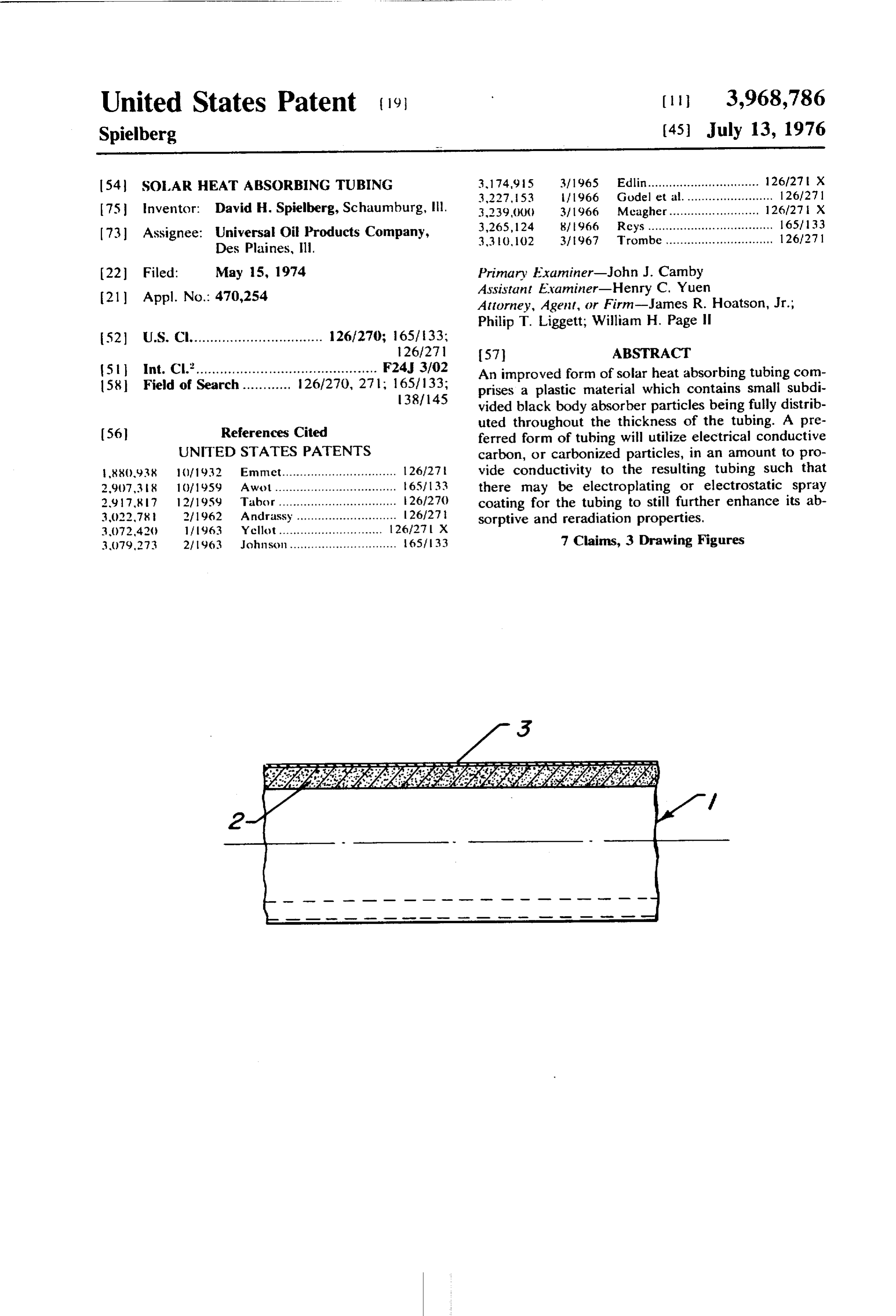
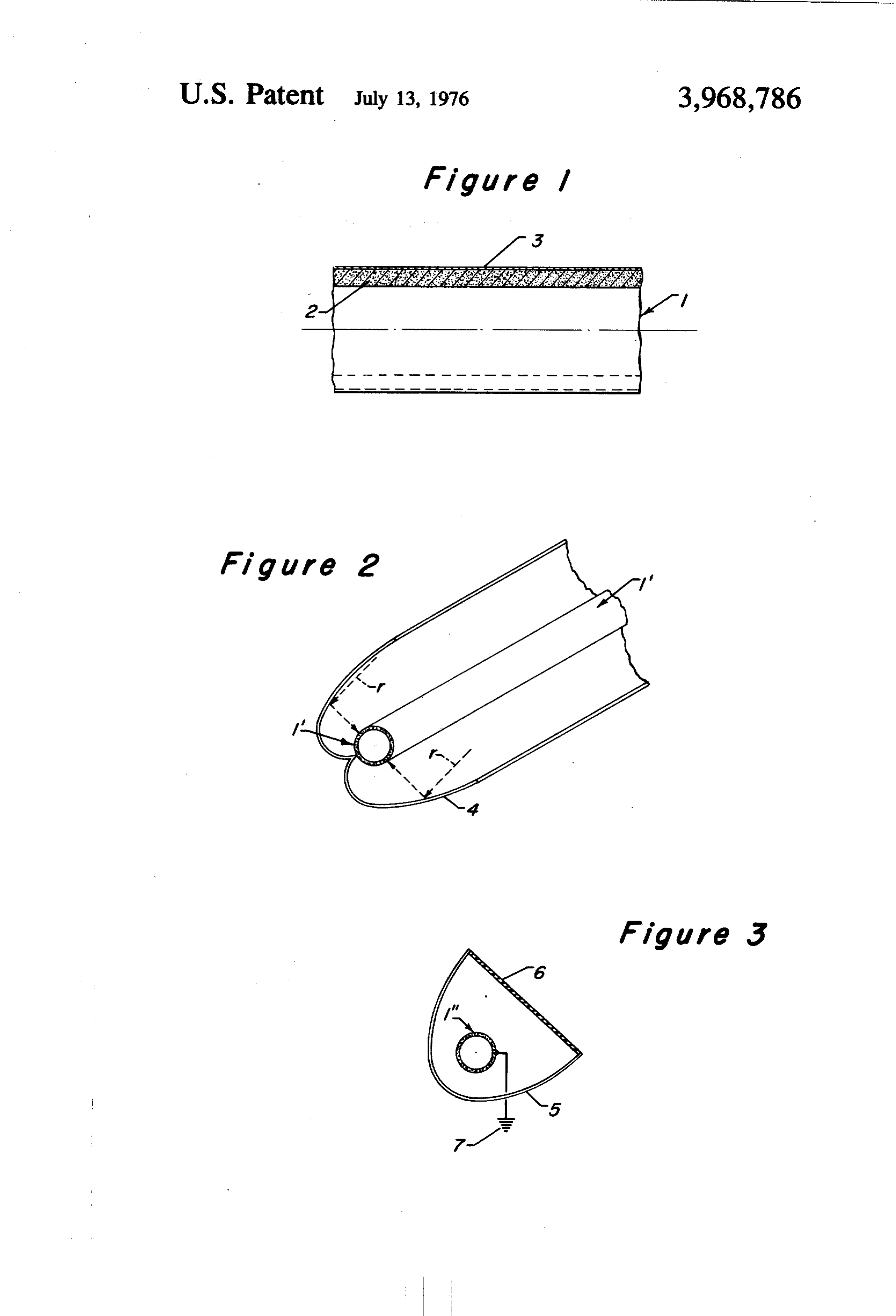
oxide may be alumina in various forms, such as gamma DESCRIPTION OF THE DRAWING alumina and silica-alumina; however, various other refractory oxides may be used. Preferably, the carbona The present invention may be further described and ceous pyropolymer, the graphite or other carbona explained by reference to the accompanying drawing ceous material which is to be combined with the plastic 35 and following description thereof. binder will be utilized as a finely divided powder where FIG. 1 of the drawing is a sectional view through a the particulates are generally of about 10 micron in size portion of tubing which is prepared in accordance with or less. These particle sizes can be obtained by milling the present invention.
the filler material in a volatile solvent medium by 40 FIG. 2 of the drawing illustrates, in an isometric type means of a roll mill, colloidal mill or ball mill and there of view, the placement of a solar collector tubing, such after flashing off or evaporating the solvent to obtain as provided by the present invention, within a focused the dried powder. It is also to be noted that the carbo ray reflector means having the shape of an involute of naceous filler material need not be in the finely divided the cylindrical tubing.
powder form, inasmuch as ultrafine diameter strands or 45 FIG. 3 of the drawing indicates diagrammatically fibers which have the carbonaceous coating may well another ray concentrating arrangement providing a be utilized. For example, small diameter fibers or fila parabolic reflector.
ments may be of a refractory inorganic oxide and may Referring now particularly to FIG. 1 of the drawing, be made in accordance with teachings of U.S. Pat. No. there is indicated a tubing 1 which is formed from a 3,614,809, issued Oct. 26, 1971. This type of refractory complex of a thermoplastic material, or thermal setting fiber may be chopped into short lengths and subjected 50 plastic material, as a binder having a high percentage of to the treatment of U.S. Pat. No. 3,651,386 to in turn carbonaceous black body material 2 which is distrib provide a desired carbonaceous pyropolymer with elec uted throughout the full thickness of the tubing. In trical conductivity properties. addition, there is indicated an ultrathin coating layer3 The heat absorbing tubing may have varying amounts 55 over the outer surface of the tubing. As heretofore of the carbonaceous material but will typically contain noted, the black body material may comprise carbon or from about 10 to about 95% by weight of the finished a carbonaceous pyropolymer formed on a refractory composition. Preferably, the higher the amount of oxide base material in order to provide a high degree of black body material the greater is the heat absorption black body effect and the preclusion of the reradiation capability of heat absorbing tubing. Also, a relatively 60 of a higher wavelength spectrum received from the large volume percent of carbonaceous material within solar energy. In general, the greater the quantity of the finished tubing will provide greater conductivity for black body material and the darker the coloration of the tubing. Conductivity is of advantage in two aspects the resulting tubing, the better is the efficiency pro with respect to solar heat absorbing tubing, as for ex vided from the use of the resulting ray absorbing tub ample (1) an electrical conductive property will permit 65 ing. Also, as heretofore noted, in order to obtain the the leakage of electrostatic charges on the tubing and desirable aspects of having an electrically conductive will help dissipate or prevent dust collection on the tubing which can bleed off electrostatic charges there tubing to in turn reduce maintenance aspects, and (2) will generally be required a high content of conductive a tubing which is electrically conductive can provide black body material in the resulting tubing.
Page 5
Although not heretofore set forth, it should be noted 2, the latter may comprise a typical mirror construction that the powdered filler material, or the carbonized or may be constructed of a suitable smooth metal hav refractory oxide filament pieces, will have a desirable ing a good interior reflective coating material which reinforcing effect on the resulting plastic tubing to will assist in reflecting the solar rays toward the surface provide a higher melting point for the tubing and in 5 of tubular member 1'.
crease structural rigidity. As still another aspect, the In connection with FIG. 3 of the drawing, there is utilization of the black body carbonaceous material will also indicated the placement of a covering glass u? assist in ultraviolet stabilization properties for the plas membrane 6 which will assist in minimizing heat losses tic binding material. Additional free radical inhibiting from the absorbing tubular member 1'. The glass or additives might also be included provided they did not 0 transparent membrane utilized at the location of mem alter the transmission properties of the plastic binder in ber 6 can assist in giving a greenhouse effect by virtue the solar ultraviolet region. of selective transmission of the solar energy and in The exterior coating 3 to provide a selectively ab particular being able to transmit the lower wavelength sorbing type of surface may, to some degree, be consid ered optional, depending upon the type of plastic 15 radiations more readily than the higher wavelength radiations. A covering member 6 may also be of value binder material being utilized to form the tubing. In in preventing dust or dirt collections within the body of other words, as heretofore noted, where the plastic the reflector 5 and over the surface of the tubing 1'. binder does not provide a desirable greenhouse effect Still further, there is indicated the grounding of the to preclude reradiation of the higher wavelength radia tubing 1' through ground means 7 such that there may tion, then it is desirable to add a very thin film of a 20 be the leakage, or bleed-off, of electrostatic electricity suitable metal component which will provide a selec from the heat collecting tubing and the elimination of tively absorbing effect and preclude or inhibit reradia any propensity toward dust collection on the part of an tion. Such coatings may be provided in accordance electrostatically charged tubing.
with generally conventional methods of electroplating Other ray concentrating or focusing arrangements or electrostatic coating procedures which are well may well be utilized in combination with the present known in the coating and plating arts and need not be 25 improved form of tubing and various sizing of tubings set forth herein. may be utilized depending upon the size of the reflector The present type of tubing may be utilized for posi means and the length of the tubing, or other factors tioning in front of flat plate reflecting means or within which determine the size of a system and the amount of focusing collectors. Flat plate collectors are preferable heated fluid to be accommodated within any one sys in many instances in that they can diffuse solar radia 30 ten.
tion and perform to some extent on cloudy and over I claim as my invention:
cast days. They may also be utilized in a fixed position 1. A heat absorbing tube providing enhanced solar and do not need to be moved to follow the sunlight. On radiation collection efficiency, which comprises in the other hand, the focusing type of collectors can combination, a tubular member formed of plastic mate generate much higher operating temperatures and are 35 rial containing a sufficient quantity of small electrical thus capable of higher efficiencies. conductive black body absorber particles distributed Referring now to FIG. 2 of the drawing there is indi throughout the thickness thereof to render said tubular cated a solar heat absorbing tube 1", which may be of member electrically conductive, and said black body the type shown and described in connection with FIG. particles being composed of conductive carbonaceous 1 of the drawing, comprising a plastic binding material pyropolymer formed on a refractory oxide base mate with a high volume of black body particulates that are 40 rial from a pyrolyzable organic material contacting said of carbon or of a carbonaceous pyropolymer so as to be base material at a high temperature in the range of 400 at least partially electrically conductive. Tube 1 is to 750' C.
indicated as being within a special reflector 4 which 2. The heat absorbing tube of claim 1 further charac will assist in focusing the solar radiation directly to the terized in that said refractory oxide base material is surface of the tubing and provide for heat transmission 45 alumina or silica-alumina.
into a fluid stream which would pass through the inter 3. The heat absorbing tube of claim 2 further charac ior of the tubing. Various types of fluid mediums and terized in that said refractory oxide base material is heat exchange arrangements may be utilized with re gamma-alumina.
spect to transmitting the energy from the heated fluid 4. The heat absorbing tube of claim 1 further charac to heat storing or heat consuming means. The type of 50 terized in that the black body particles are less than heat exchange system to be utilized does not comprise about 10 microns in size.
a part of the present invention. 5. The heat absorber tube of claim 1 further charac Specifically, the reflector 4 is in the shape of an invo terized in that the plastic material has selective trans lute of the cylindrical tubing 1 and shall be sized pro parency for the transmission of lower wavelength radia portional to the diameter of such tubing whereby the 55 tions, particularly from about 0.3 microns to 1.2 mi solar rays such as indicated at r will reflect from the crons and will minimize the transmittance for higher interior surface of means 4 and be reflected to the wavelength radiations.
exterior of tubing 1'. The reflector 4 may be a mirror or 6. The heat absorber tube of claim 1 further charac may comprise a smooth metal surface with a suitable terized in that the tubular member is provided with a reflective coating such as of titanium oxide, zinc oxide, thin coating of a metal component providing a selec calcium oxide, etc. Again, it is not intended to limit the 60 tively absorbing surface whereby to minimize reradia present invention to any one type of reflector means for tion of the solar radiation to the tubing. use in association with the improved type of black body 7. The heat absorber tube of claim 1 further charac containing tubular material. terized in that a ray concentrating member is spaced To illustrate variations in reflector or ray focusing from and coextensive with said tube to assist in focus members, reference may be made to FIG. 3 of the 65 ing rays on said tube and said tube with said electrically drawing where there is indicated diagrammatically the conductive particles therein is grounded to bleed off location of a tubular member 1' within a parabolic electrostatic charges.k k x k x focusing member 5. As noted in connection with FIG.
Provenance
- Collection
- Cited prior art
- Original PDF
- patentimages.storage.googleapis.com →
- Filed
- 1974-05-15
- Pages
- 5
- Method
- pdftotext (the PDF's own text layer) + pdftoppm 300dpi page scans
- Source
- Google Patents bibliographic record
- Granted
- 1976-07-13
- Inventors
- David H. Spielberg; Universal Oil Products Co
- Transcribed from
- patentimages.storage.googleapis.com →